Interplay between inhomogeneous chiral and crystalline color-superconducting phases in the two-flavor NJL model
Pith reviewed 2026-06-27 06:16 UTC · model grok-4.3
The pith
Inhomogeneous chiral and diquark condensates never coexist in two-flavor quark matter
A machine-rendered reading of the paper's core claim, the machinery that carries it, and where it could break.
Core claim
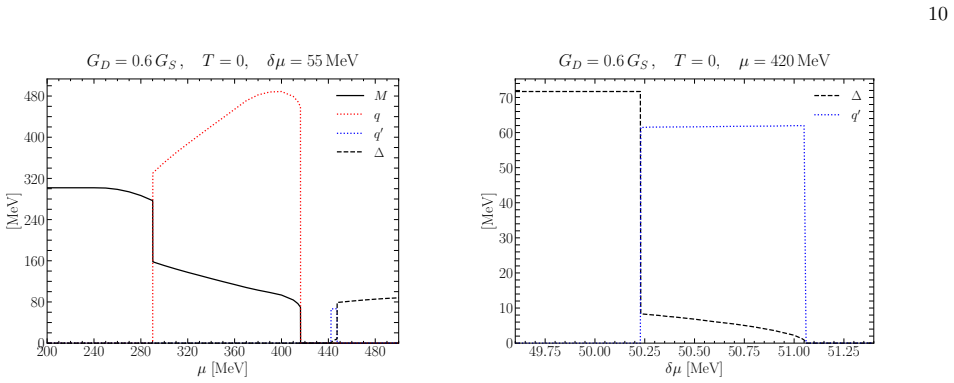
Treating the CDW wave vector vec q and the LOFF pair momentum vec q' as independent variational parameters, the mean-field effective potential is minimized with respect to both amplitudes and both wave vectors without constraining their relative orientation. The central result is that vec q and vec q' are never simultaneously nonzero: inhomogeneous chiral and diquark condensates do not coexist across the entire parameter range.
What carries the argument
Mean-field effective potential of the two-flavor NJL model with three-momentum cutoff, minimized over independent wave vectors for the chiral density wave and single-plane-wave LOFF diquark condensate.
If this is right
- The phase diagram contains regions of inhomogeneous chiral condensation or inhomogeneous diquark condensation but no mixed state in which both are modulated.
- The absence of coexistence holds for all temperatures, quark-number chemical potentials, and isospin chemical potentials examined.
- The result is unchanged when the relative orientation of the two wave vectors is left free.
- The separation persists across the range of diquark couplings considered.
Where Pith is reading between the lines
- The mutual exclusion may simplify the construction of equations of state for dense matter by removing the need to track simultaneous modulations.
- Extending the model to three flavors or adding explicit symmetry breaking could test whether the exclusion survives.
- If the result persists in more complete treatments, it would imply that chiral and diquark inhomogeneities compete rather than reinforce each other.
Load-bearing premise
The mean-field effective potential obtained from the two-flavor NJL model with a three-momentum cutoff scheme is sufficient to decide the relative stability of the modulated phases when the wave vectors are treated as independent variational parameters.
What would settle it
A calculation in a different regularization scheme or beyond mean field that finds a finite region of parameter space where both wave vectors remain nonzero at the minimum would falsify the central claim.
Figures



read the original abstract
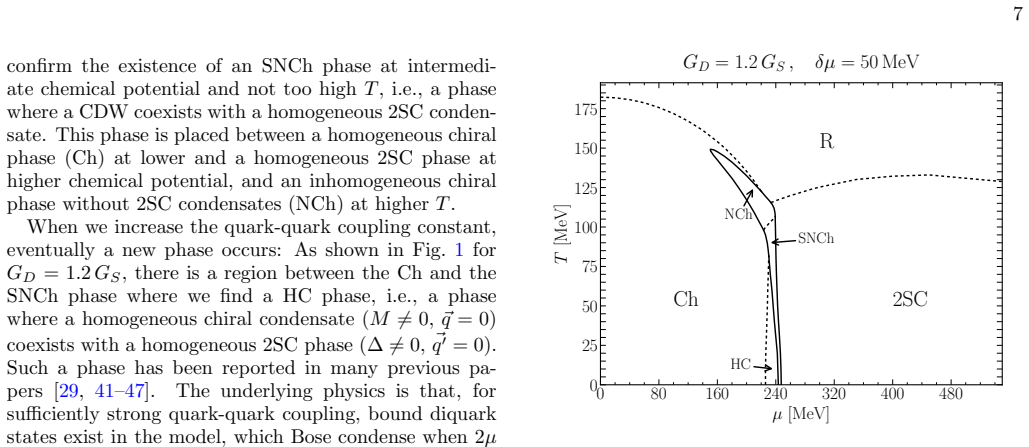
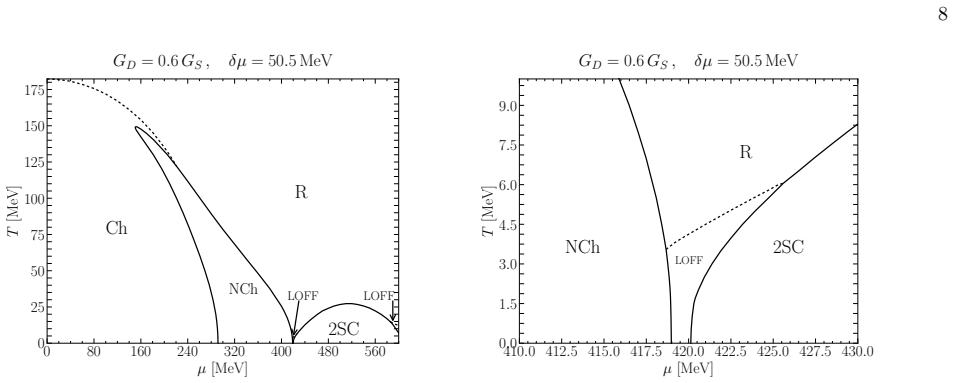
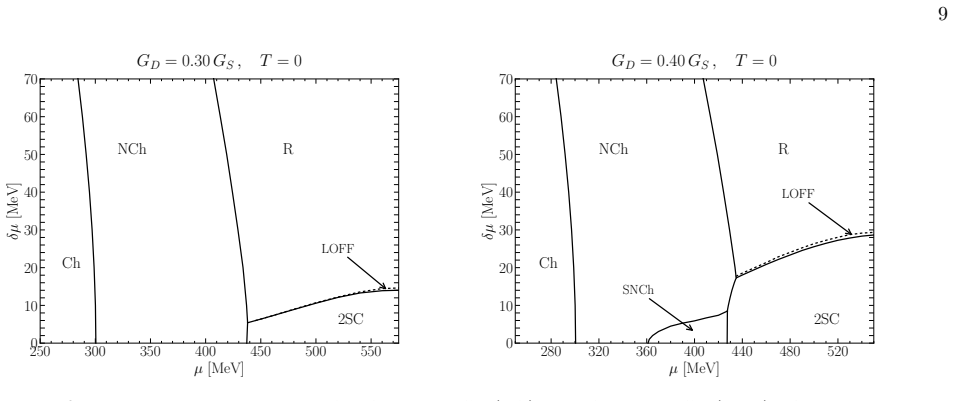
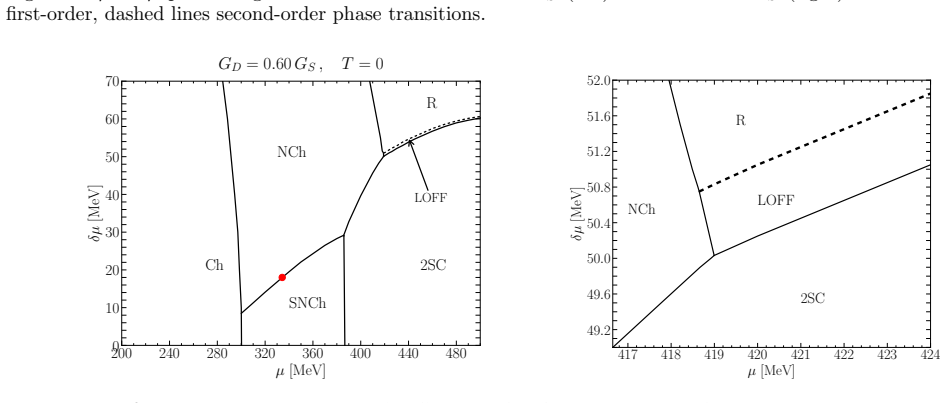
We study the interplay between the chiral density wave (CDW) and the single-plane-wave Larkin-Ovchinnikov-Fulde-Ferrell (LOFF) phase of color-superconducting matter in two-flavor quark matter at vanishing and non-vanishing temperature $T$, quark number chemical potential $\mu$ and isospin chemical potential $\delta\mu$. The analysis is performed within the two-flavor Nambu--Jona-Lasinio (NJL) model in the chiral limit, using a three-momentum cutoff scheme. Treating the CDW wave vector $\vec{q}$ and the LOFF pair momentum $\vec{q}\,'$ as independent variational parameters, we minimize the mean-field effective potential with respect to both amplitudes and both wave vectors, without constraining their relative orientation, and map out the $T$-$\mu$ and $\mu$-$\delta\mu$ phase diagrams for a range of diquark couplings $G_D$. Our central result is that $\vec{q}$ and $\vec{q}\,'$ are never simultaneously nonzero: inhomogeneous chiral and diquark condensates do not coexist across the entire parameter range.
Editorial analysis
A structured set of objections, weighed in public.
Referee Report
Summary. The paper studies the interplay of chiral density wave (CDW) and single-plane-wave LOFF phases in two-flavor NJL matter at finite T, μ, and δμ in the chiral limit. Treating both wave vectors \vec q and \vec q' (plus amplitudes and relative angle) as independent variational parameters, the authors numerically minimize the mean-field thermodynamic potential obtained with a three-momentum cutoff and map the resulting T-μ and μ-δμ phase diagrams for several values of the diquark coupling G_D. Their central claim is that \vec q and \vec q' are never simultaneously nonzero, so inhomogeneous chiral and diquark condensates do not coexist over the entire parameter range explored.
Significance. If the numerical result is robust against regularization artifacts, the finding that the two inhomogeneous phases remain mutually exclusive would simplify the phase structure of dense quark matter and reduce the number of candidate ground states relevant for neutron-star phenomenology. The methodological choice to vary both wave vectors independently without a priori constraints on their relative orientation is a clear strength, as it directly tests coexistence rather than assuming it.
major comments (1)
- [regularization and numerical minimization procedure] The three-momentum cutoff regularization (explicitly stated in the abstract and used to obtain the effective potential) is defined in a single rest frame and therefore breaks boost invariance. When two independent modulation vectors \vec q and \vec q' are simultaneously active, the integration domain |p| < Λ becomes frame-dependent and can receive spurious positive contributions that artificially raise the energy of any mixed phase. Because the central claim rests on the global minimum always having at least one wave vector exactly zero, this potential artifact directly affects the reliability of the no-coexistence conclusion and requires either an explicit justification or a cross-check with a Lorentz-invariant regulator.
minor comments (1)
- [abstract] The abstract states the numerical procedure and outcome but supplies no explicit form of the thermodynamic potential, convergence criteria, or error estimates on the location of the minima; adding a brief equation or table summarizing the variational parameters and minimization tolerances would improve reproducibility.
Simulated Author's Rebuttal
We thank the referee for the careful reading of the manuscript and for highlighting a potential limitation of our regularization scheme. We address the major comment point by point below.
read point-by-point responses
-
Referee: The three-momentum cutoff regularization (explicitly stated in the abstract and used to obtain the effective potential) is defined in a single rest frame and therefore breaks boost invariance. When two independent modulation vectors \vec q and \vec q' are simultaneously active, the integration domain |p| < \Lambda becomes frame-dependent and can receive spurious positive contributions that artificially raise the energy of any mixed phase. Because the central claim rests on the global minimum always having at least one wave vector exactly zero, this potential artifact directly affects the reliability of the no-coexistence conclusion and requires either an explicit justification or a cross-check with a Lorentz-invariant regulator.
Authors: We agree that the three-momentum cutoff breaks boost invariance and that the integration domain is defined in a single rest frame. This is the standard regularization employed in NJL-model studies of inhomogeneous phases, including those with a single modulation vector. When both wave vectors are allowed to be nonzero, the frame dependence could in principle introduce artifacts that preferentially raise the energy of mixed phases. Our numerical procedure minimizes the thermodynamic potential with respect to all variational parameters (amplitudes, |q|, |q'|, and relative angle) without a priori constraints, but we have not performed an explicit cross-check with a Lorentz-invariant regulator. We will revise the manuscript to include an explicit discussion of this limitation of the cutoff scheme and its possible impact on the no-coexistence result. revision: yes
Circularity Check
No circularity: central result obtained by direct numerical minimization over independent variational parameters
full rationale
The paper's derivation consists of constructing the mean-field thermodynamic potential in the two-flavor NJL model with a three-momentum cutoff and then numerically minimizing it with respect to the independent amplitudes and wave vectors q and q' (treated as free variational parameters without imposed relative orientation). The claim that these vectors are never simultaneously nonzero is the output of that minimization across the scanned parameter space; it is not obtained by re-expressing one quantity in terms of another by definition, by fitting a parameter to a subset of data and relabeling the fit as a prediction, or by load-bearing self-citation. The procedure is self-contained against the model's own effective potential and does not reduce to any of the enumerated circular patterns.
Axiom & Free-Parameter Ledger
free parameters (2)
- diquark coupling G_D
- three-momentum cutoff Lambda
axioms (2)
- domain assumption Mean-field approximation suffices to determine the phase structure.
- domain assumption Chiral limit (vanishing current quark mass).
Reference graph
Works this paper leans on
-
[1]
D. H. Rischke, The Quark gluon plasma in equilibrium, Prog. Part. Nucl. Phys.52, 197 (2004), arXiv:nucl-th/0305030
Pith/arXiv arXiv 2004
-
[2]
Achenbachet al., The present and future of QCD, Nucl
P. Achenbachet al., The present and future of QCD, Nucl. Phys. A1047, 122874 (2024), arXiv:2303.02579 [hep-ph]
arXiv 2024
-
[3]
Adamczyket al.(STAR), Direct virtual photon production in Au+Au collisions at √sN N = 200 GeV, Phys
L. Adamczyket al.(STAR), Direct virtual photon production in Au+Au collisions at √sN N = 200 GeV, Phys. Lett. B 770, 451 (2017), arXiv:1607.01447 [nucl-ex]. 12
Pith/arXiv arXiv 2017
-
[4]
A. Adareet al.(PHENIX), Beam Energy and Centrality Dependence of Direct-Photon Emission from Ultrarelativistic Heavy-Ion Collisions, Phys. Rev. Lett.123, 022301 (2019), arXiv:1805.04084 [hep-ex]
arXiv 2019
-
[5]
Sadhu, Recent developments in open heavy-flavour physics: Alice highlights, Journal of Subatomic Particles and Cos- mology4, 100140 (2025)
S. Sadhu, Recent developments in open heavy-flavour physics: Alice highlights, Journal of Subatomic Particles and Cos- mology4, 100140 (2025)
2025
-
[6]
M. G. Alford, A. Schmitt, K. Rajagopal, and T. Sch¨ afer, Color superconductivity in dense quark matter, Rev. Mod. Phys. 80, 1455 (2008), arXiv:0709.4635 [hep-ph]
Pith/arXiv arXiv 2008
-
[7]
G. Nardulli, Effective fields in dense quantum chromodynamics, inWorkshop on Quark Gluon Plasma and Relativistic Heavy Ions(2002) arXiv:hep-ph/0206065
Pith/arXiv arXiv 2002
-
[8]
Schmitt, Phases and properties of color superconductors, (2025), arXiv:2511.07319 [hep-ph]
A. Schmitt, Phases and properties of color superconductors, (2025), arXiv:2511.07319 [hep-ph]
arXiv 2025
-
[9]
A. W. Steiner, J. M. Lattimer, and E. F. Brown, The Equation of State from Observed Masses and Radii of Neutron Stars, Astrophys. J.722, 33 (2010), arXiv:1005.0811 [astro-ph.HE]
Pith/arXiv arXiv 2010
-
[10]
J. M. Lattimer, Neutron stars, Gen. Rel. Grav.46, 1713 (2014)
2014
-
[11]
J. M. Lattimer and M. Prakash, The Equation of State of Hot, Dense Matter and Neutron Stars, Phys. Rept.621, 127 (2016), arXiv:1512.07820 [astro-ph.SR]
Pith/arXiv arXiv 2016
-
[12]
M. G. Alford, K. Rajagopal, S. Reddy, and F. Wilczek, The Minimal CFL nuclear interface, Phys. Rev. D64, 074017 (2001), arXiv:hep-ph/0105009
Pith/arXiv arXiv 2001
-
[13]
A. M. Clogston, Upper Limit for the Critical Field in Hard Superconductors, Phys. Rev. Lett.9, 266 (1962)
1962
-
[14]
B. S. Chandrasekhar, A note on the maximum critical field of high-field superconductors, Appl. Phys. Lett.1, 7 (1962)
1962
-
[15]
Fulde and R
P. Fulde and R. A. Ferrell, Superconductivity in a Strong Spin-Exchange Field, Phys. Rev.135, A550 (1964)
1964
-
[16]
A. I. Larkin and Y. N. Ovchinnikov, Nonuniform state of superconductors, Zh. Eksp. Teor. Fiz.47, 1136 (1964), [Sov. Phys. JETP 20, 762 (1965)]
1964
-
[17]
R. Casalbuoni and G. Nardulli, Inhomogeneous superconductivity in condensed matter and QCD, Rev. Mod. Phys.76, 263 (2004), arXiv:hep-ph/0305069
Pith/arXiv arXiv 2004
-
[18]
R. Anglani, R. Casalbuoni, M. Ciminale, N. Ippolito, R. Gatto, M. Mannarelli, and M. Ruggieri, Crystalline color super- conductors, Rev. Mod. Phys.86, 509 (2014), arXiv:1302.4264 [hep-ph]
Pith/arXiv arXiv 2014
-
[19]
E. Nakano and T. Tatsumi, Chiral symmetry and density wave in quark matter, Phys. Rev. D71, 114006 (2005), arXiv:hep- ph/0411350
arXiv 2005
-
[20]
Nickel, Inhomogeneous phases in the Nambu-Jona-Lasinio and quark-meson model, Phys
D. Nickel, Inhomogeneous phases in the Nambu-Jona-Lasinio and quark-meson model, Phys. Rev. D80, 074025 (2009), arXiv:0906.5295 [hep-ph]
Pith/arXiv arXiv 2009
-
[21]
M. Buballa and S. Carignano, Inhomogeneous chiral condensates, Prog. Part. Nucl. Phys.81, 39 (2015), arXiv:1406.1367 [hep-ph]
Pith/arXiv arXiv 2015
-
[22]
S. P. Klevansky, The Nambu-Jona-Lasinio model of quantum chromodynamics, Rev. Mod. Phys.64, 649 (1992)
1992
-
[23]
Buballa, NJL-model analysis of dense quark matter, Physics Reports407, 205 (2005)
M. Buballa, NJL-model analysis of dense quark matter, Physics Reports407, 205 (2005)
2005
-
[24]
M. Sadzikowski, Comparison of the non-uniform chiral and 2SC phases at finite temperatures and densities, Phys. Lett. B 642, 238 (2006), arXiv:hep-ph/0609186
Pith/arXiv arXiv 2006
-
[25]
Lakaschus, M
P. Lakaschus, M. Buballa, and D. H. Rischke, Competition of inhomogeneous chiral phases and two-flavor color supercon- ductivity in the njl model, Phys. Rev. D103, 034030 (2021)
2021
-
[26]
L. He, M. Jin, and P. Zhuang, Neutral Color Superconductivity Including Inhomogeneous Phases at Finite Temperature, Phys. Rev. D75, 036003 (2007), arXiv:hep-ph/0610121
Pith/arXiv arXiv 2007
-
[27]
K. Fukushima and K. Iida, Larkin-Ovchinnikov-Fulde-Ferrell state in two-color quark matter, Phys. Rev. D76, 054004 (2007), arXiv:0705.0792 [hep-ph]
Pith/arXiv arXiv 2007
-
[28]
T. Fujihara, D. Kimura, T. Inagaki, and A. Kvinikhidze, High density quark matter in the Nambu-Jona-Lasinio model with dimensional versus cutoff regularization, Phys. Rev. D79, 096008 (2009), arXiv:0812.2821 [hep-ph]
Pith/arXiv arXiv 2009
-
[29]
M. Huang, P.-f. Zhuang, and W.-q. Chao, Massive quark propagator and competition between chiral and diquark conden- sate, Phys. Rev. D65, 076012 (2002), arXiv:hep-ph/0112124
Pith/arXiv arXiv 2002
-
[30]
M. Huang, P.-f. Zhuang, and W.-q. Chao, Charge neutrality effects on 2 flavor color superconductivity, Phys. Rev. D67, 065015 (2003), arXiv:hep-ph/0207008
Pith/arXiv arXiv 2003
-
[31]
Dautry and E
F. Dautry and E. M. Nyman, Pion condensation and theσ-model in liquid neutron matter, Nucl. Phys. A319, 323 (1979)
1979
-
[32]
Kutschera, W
M. Kutschera, W. Broniowski, and A. Kotlorz, Quark matter with pion condensate in an effective chiral model, Nuclear Physics A516, 566 (1990)
1990
-
[33]
J. A. Bowers, J. Kundu, K. Rajagopal, and E. Shuster, A Diagrammatic approach to crystalline color superconductivity, Phys. Rev. D64, 014024 (2001), arXiv:hep-ph/0101067
Pith/arXiv arXiv 2001
-
[34]
M. Sadzikowski, Coexistence of pion condensation and color superconductivity in two flavor quark matter, Phys. Lett. B 553, 45 (2003), arXiv:hep-ph/0210065
Pith/arXiv arXiv 2003
-
[35]
Broniowski and W
W. Broniowski and W. Kutschera, Ambiguities in effective chiral models with cut-off, Phys. Lett. B242, 133 (1990)
1990
-
[36]
T. L. Partyka and M. Sadzikowski, Phase diagram of the non-uniform chiral condensate in different regularization schemes at T=0, J. Phys. G36, 025004 (2009), arXiv:0811.4616 [hep-ph]
Pith/arXiv arXiv 2009
-
[37]
L. Pannullo, M. Wagner, and M. Winstel, Regularization effects in the Nambu–Jona-Lasinio model: Strong scheme depen- dence of inhomogeneous phases and persistence of the moat regime, Phys. Rev. D110, 076006 (2024), arXiv:2406.11312 [hep-ph]
arXiv 2024
-
[38]
Mu, L.-y
C.-f. Mu, L.-y. He, and Y.-x. Liu, Evaluating the phase diagram at finite isospin and baryon chemical potentials in the nambu–jona-lasinio model, Phys. Rev. D82, 056006 (2010)
2010
-
[39]
E. V. Gorbar, M. Hashimoto, and V. A. Miransky, Neutral Larkin-Ovchinnikov-Fulde-Ferrell state and chromomagnetic instability in two-flavor dense QCD, Phys. Rev. Lett.96, 022005 (2006), arXiv:hep-ph/0507307 [hep-ph]. 13
Pith/arXiv arXiv 2006
-
[40]
J.-E. Christian, I. A. Rather, H. Gholami, and M. Hofmann, Comprehensive Analysis of Constructing Hybrid Stars with an RG-consistent NJL Model, Astron. Astrophys.701, A145 (2025), arXiv:2503.13626 [astro-ph.HE]
arXiv 2025
-
[41]
Sadzikowski, Superconducting phase transition in the Nambu-Jona-Lasinio model, Mod
M. Sadzikowski, Superconducting phase transition in the Nambu-Jona-Lasinio model, Mod. Phys. Lett. A16, 1129 (2001), arXiv:hep-ph/0306114
Pith/arXiv arXiv 2001
-
[42]
D. Blaschke, M. K. Volkov, and V. L. Yudichev, Coexistence of color superconductivity and chiral symmetry breaking within the NJL model, Eur. Phys. J. A17, 103 (2003), arXiv:hep-ph/0207340 [hep-ph]
Pith/arXiv arXiv 2003
-
[43]
B.-Y. Park, M. Rho, A. Wirzba, and I. Zahed, Dense QCD: Overhauser or BCS pairing?, Phys. Rev. D62, 034015 (2000), arXiv:hep-ph/9910347 [hep-ph]
Pith/arXiv arXiv 2000
-
[44]
R. Rapp, E. V. Shuryak, and I. Zahed, Chiral crystal in cold QCD matter at intermediate densities?, Phys. Rev. D63, 034008 (2001), arXiv:hep-ph/0008207 [hep-ph]
Pith/arXiv arXiv 2001
-
[45]
T. M. Schwarz, S. P. Klevansky, and G. Papp, The Phase diagram and bulk thermodynamical quantities in the NJL model at finite temperature and density, Phys. Rev. C60, 055205 (1999), arXiv:nucl-th/9903048
Pith/arXiv arXiv 1999
-
[46]
J. Berges and K. Rajagopal, Color superconductivity and chiral symmetry restoration at nonzero baryon density and temperature, Nucl. Phys. B538, 215 (1999), arXiv:hep-ph/9804233 [hep-ph]
Pith/arXiv arXiv 1999
-
[47]
B. Vanderheyden and A. D. Jackson, Random matrix model for chiral symmetry breaking and color superconductivity in QCD at finite density, Phys. Rev. D62, 094010 (2000), arXiv:hep-ph/0003150 [hep-ph]
Pith/arXiv arXiv 2000
-
[48]
M. Thies, From relativistic quantum fields to condensed matter and back again: Updating the Gross-Neveu phase diagram, J. Phys. A39, 12707 (2006), arXiv:hep-th/0603099
Pith/arXiv arXiv 2006
-
[49]
J. Braun, M. Leonhardt, and J. M. Pawlowski, Renormalization group consistency and low-energy effective theories, SciPost Phys.6, 056 (2019), arXiv:1806.04432 [hep-ph]
Pith/arXiv arXiv 2019
-
[50]
H. Gholami, M. Hofmann, and M. Buballa, Renormalization-group consistent treatment of color superconductivity in the NJL model, Phys. Rev. D111, 014006 (2025), arXiv:2408.06704 [hep-ph]
arXiv 2025
-
[51]
H. Gholami, I. A. Rather, M. Hofmann, M. Buballa, and J. Schaffner-Bielich, Astrophysical constraints on color- superconducting phases in compact stars within the RG-consistent NJL model, Phys. Rev. D111, 103034 (2025), arXiv:2411.04064 [hep-ph]
arXiv 2025
-
[52]
R. L. S. Farias, G. Dallabona, G. Krein, and O. A. Battistel, Cutoff-independent regularization of four-fermion interactions for color superconductivity, Phys. Rev. C73, 018201 (2006), arXiv:hep-ph/0510145
Pith/arXiv arXiv 2006
-
[53]
D. C. Duarte, R. L. S. Farias, and R. O. Ramos, Regularization issues for a cold and dense quark matter model in β−equilibrium, Phys. Rev. D99, 016005 (2019), arXiv:1811.10598 [hep-ph]
Pith/arXiv arXiv 2019
-
[54]
A. Barducci, R. Casalbuoni, G. Pettini, and L. Ravagli, A Calculation of the QCD phase diagram at finite temperature, and baryon and isospin chemical potentials, Phys. Rev. D69, 096004 (2004), arXiv:hep-ph/0402104 [hep-ph]
Pith/arXiv arXiv 2004
-
[55]
H. J. Warringa, D. Boer, and J. O. Andersen, Color superconductivity vs. pseudoscalar condensation in a three-flavor NJL model, Phys. Rev. D72, 014015 (2005), arXiv:hep-ph/0504177 [hep-ph]
Pith/arXiv arXiv 2005
-
[56]
T. F. Motta, J. Bernhardt, M. Buballa, and C. S. Fischer, Toward a stability analysis of inhomogeneous phases in QCD, Phys. Rev. D108, 114019 (2023), arXiv:2306.09749 [hep-ph]
arXiv 2023
discussion (0)
Sign in with ORCID, Apple, or X to comment. Anyone can read and Pith papers without signing in.