Diffusive Dynamics of Nonstabilizerness
Pith reviewed 2026-06-27 06:23 UTC · model grok-4.3
The pith
Nonstabilizerness approaches its random-state value diffusively with a 1/t gap closure in symmetric systems.
A machine-rendered reading of the paper's core claim, the machinery that carries it, and where it could break.
Core claim
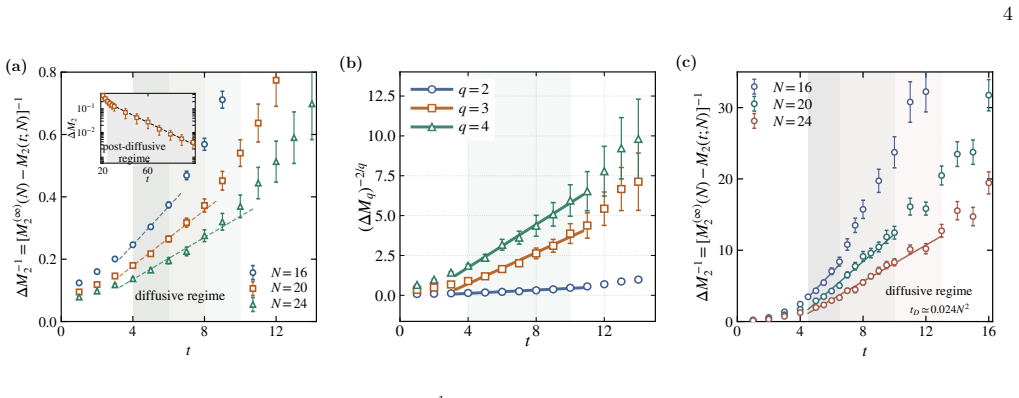
The disorder-averaged dynamics of the stabilizer Rényi entropy in U(1)-symmetric one-dimensional random circuits is captured by a four-replica tensor network evaluated via S4-adapted iTEBD, revealing that the entropy gap to the random-state value closes as 1/t at late times and thereby identifying a diffusive universality class for nonstabilizerness; the identical scaling is verified in an energy-conserving nonintegrable Ising chain.
What carries the argument
Four-replica tensor network for the averaged dynamics of the stabilizer Rényi entropy, evaluated in the thermodynamic limit with S4-adapted iTEBD, interpreted via a hydrodynamic argument for the diffusive scaling.
If this is right
- The generation of nonstabilizerness under U(1) symmetry is controlled by diffusion at long times.
- The universality class is independent of microscopic details as long as the symmetry is present.
- This scaling provides a concrete way to estimate how close Hamiltonian dynamics gets to maximal nonstabilizerness.
- The framework extends the hydrodynamic perspective to nonstabilizerness generation in addition to other quantities.
- Approximate Haar-random states can be reached via symmetry-preserving dynamics with this known relaxation rate.
Where Pith is reading between the lines
- Symmetry may generically slow the buildup of nonstabilizerness relative to symmetry-broken cases.
- Similar diffusive scaling could appear for other measures of quantum resources in conserved-charge systems.
- Extensions to higher dimensions or different symmetries would test the robustness of this universality class.
- The results suggest designing circuits or Hamiltonians to achieve target nonstabilizerness levels in finite time.
Load-bearing premise
The hydrodynamic argument used to link the observed 1/t scaling to diffusive behavior.
What would settle it
Finding that the stabilizer Rényi entropy gap decays with a power other than -1 or exponentially in the late-time regime of the U(1)-symmetric random circuits.
Figures

read the original abstract
Symmetries shape the quantum-information dynamics of many-body systems, but their effect on nonstabilizerness, the resource complementary to entanglement, is less understood. We compute the stabilizer R\'enyi entropy, a measure of nonstabilizerness, in $\mathrm{U}(1)$-symmetric one-dimensional random circuits. The disorder-averaged dynamics is captured by a four-replica tensor network, which we evaluate by $S_4$-adapted infinite time-evolving block decimation (iTEBD) directly in the thermodynamic limit. Together with a hydrodynamic argument, our results identify a diffusive universality class for the late-time approach of nonstabilizerness to its random-state value, with the stabilizer R\'enyi entropy gap closing as $1/t$. The same scaling is verified in an energy-conserving nonintegrable Ising chain. More broadly, our framework provides a hydrodynamic perspective on nonstabilizerness generation and offers insight into the design of approximate Haar-random states in Hamiltonian dynamics.
Editorial analysis
A structured set of objections, weighed in public.
Referee Report
Summary. The paper computes the stabilizer Rényi entropy (SRE) in U(1)-symmetric 1D random circuits using a four-replica tensor network evaluated by S4-adapted iTEBD in the thermodynamic limit. Combined with a hydrodynamic argument, it claims that nonstabilizerness approaches its random-state value in a diffusive universality class, with the SRE gap closing as 1/t; the same scaling is verified numerically in an energy-conserving nonintegrable Ising chain. The framework is presented as providing a hydrodynamic perspective on nonstabilizerness generation.
Significance. If the hydrodynamic mapping is valid, the work identifies a concrete diffusive universality class for late-time nonstabilizerness relaxation tied to U(1) charge diffusion, extending hydrodynamic ideas to a resource complementary to entanglement. Strengths include the direct thermodynamic-limit iTEBD treatment of the replica network and the independent verification in a Hamiltonian system; these establish the 1/t scaling itself as a robust numerical result.
major comments (2)
- [Hydrodynamic argument (following the iTEBD results)] The identification of a diffusive universality class rests on the hydrodynamic argument that maps the SRE gap closure to U(1) charge diffusion (invoked in the abstract and used to interpret the iTEBD data). Without an explicit derivation showing the coupling of the SRE operator to the diffusive mode—e.g., via the effective hydrodynamic equations or the four-replica tensor network structure—any mismatch in the assumed coupling would alter the predicted power law, undermining the universality-class claim.
- [Section describing the four-replica tensor network and iTEBD implementation] The abstract states that the four-replica tensor network encodes the disorder-averaged U(1)-symmetric circuit dynamics, yet the manuscript does not provide the explicit contraction rules or the S4 symmetry adaptation that would allow independent verification that the 1/t scaling is not an artifact of the replica construction.
minor comments (1)
- [Introduction / abstract] Notation for the stabilizer Rényi entropy gap and its relation to the random-state value should be defined with an equation number at first use to improve readability.
Simulated Author's Rebuttal
We thank the referee for the careful reading and constructive criticism. The two major comments identify areas where the manuscript can be strengthened by providing more explicit technical details. We address each point below and indicate the revisions we will make.
read point-by-point responses
-
Referee: [Hydrodynamic argument (following the iTEBD results)] The identification of a diffusive universality class rests on the hydrodynamic argument that maps the SRE gap closure to U(1) charge diffusion (invoked in the abstract and used to interpret the iTEBD data). Without an explicit derivation showing the coupling of the SRE operator to the diffusive mode—e.g., via the effective hydrodynamic equations or the four-replica tensor network structure—any mismatch in the assumed coupling would alter the predicted power law, undermining the universality-class claim.
Authors: We agree that the hydrodynamic argument is presented at a conceptual level in the current version and that an explicit derivation of the coupling would strengthen the universality-class claim. The argument relies on the fact that, in the four-replica space, the SRE operator is the lowest-dimension operator that is odd under the diagonal U(1) action while being invariant under the S4 permutation symmetry; this forces it to couple to the conserved charge density whose dynamics are diffusive. In the revision we will add a dedicated subsection deriving the effective hydrodynamic equations for the replica-averaged SRE gap, showing that the leading relaxation is controlled by the charge diffusion constant. This addition will make the power-law prediction fully traceable to the symmetry and conservation laws. revision: partial
-
Referee: [Section describing the four-replica tensor network and iTEBD implementation] The abstract states that the four-replica tensor network encodes the disorder-averaged U(1)-symmetric circuit dynamics, yet the manuscript does not provide the explicit contraction rules or the S4 symmetry adaptation that would allow independent verification that the 1/t scaling is not an artifact of the replica construction.
Authors: We accept that the current manuscript describes the construction at a high level without spelling out the gate-averaged contraction rules or the precise S4-adapted tensor representation. In the revised version we will add an appendix that (i) lists the explicit contraction rules for the four-replica U(1)-symmetric gates, (ii) shows the reduced tensor network after S4 projection, and (iii) specifies the iTEBD bond-dimension and truncation parameters used in the thermodynamic-limit calculations. These additions will enable independent reproduction of the 1/t scaling. revision: yes
Circularity Check
No significant circularity in derivation chain
full rationale
The paper computes the stabilizer Rényi entropy gap via iTEBD on a four-replica tensor network in the thermodynamic limit and verifies the 1/t scaling in an independent energy-conserving Ising chain. The hydrodynamic argument is invoked only to interpret the observed scaling as belonging to a diffusive class; no quoted equation or self-citation reduces the scaling itself to a fitted input, self-definition, or load-bearing prior result by the same authors. The numerical evidence is therefore independent of the interpretive step, satisfying the criteria for a self-contained derivation.
Axiom & Free-Parameter Ledger
axioms (2)
- domain assumption Disorder-averaged dynamics of the stabilizer Rényi entropy can be represented by a four-replica tensor network
- domain assumption A hydrodynamic argument yields the 1/t scaling of the stabilizer Rényi entropy gap
Forward citations
Cited by 1 Pith paper
-
Unitary Designs from Doped Matchgate Circuits
Doped matchgate circuits achieve approximate parity-preserving 2-designs in polylogarithmic depth using a sparse number of non-Gaussian gates, with the design formation mapped exactly to a birth-death Markov chain.
Reference graph
Works this paper leans on
-
[1]
P. W. Shor, Polynomial-Time Algorithms for Prime Fac- torization and Discrete Logarithms on a Quantum Com- puter, SIAM J. Comput.26, 1484 (1997)
1997
-
[2]
A. M. Childs and W. Van Dam, Quantum algorithms for algebraic problems, Rev. Mod. Phys.82, 1 (2010)
2010
-
[3]
Chitambar and G
E. Chitambar and G. Gour, Quantum resource theories, Rev. Mod. Phys.91, 025001 (2019)
2019
-
[4]
Amico, R
L. Amico, R. Fazio, A. Osterloh, and V. Vedral, Entan- glement in many-body systems, Rev. Mod. Phys.80, 517 (2008)
2008
-
[5]
Eisert, M
J. Eisert, M. Cramer, and M. B. Plenio, Colloquium: Area laws for the entanglement entropy, Rev. Mod. Phys.82, 277 (2010)
2010
-
[6]
M. A. Nielsen and I. L. Chuang,Quantum Computation and Quantum Information: 10th Anniversary Edition (Cambridge University Press, 2010)
2010
-
[7]
Gottesman, The Heisenberg Representation of Quan- tum Computers (1998), arXiv:quant-ph/9807006
D. Gottesman, The Heisenberg Representation of Quan- tum Computers (1998), arXiv:quant-ph/9807006
Pith/arXiv arXiv 1998
-
[8]
Aaronson and D
S. Aaronson and D. Gottesman, Improved simulation of stabilizer circuits, Phys. Rev. A70, 052328 (2004)
2004
-
[9]
Bravyi and A
S. Bravyi and A. Kitaev, Universal quantum computa- tion with ideal Clifford gates and noisy ancillas, Phys. Rev. A71, 022316 (2005)
2005
-
[10]
Howard, J
M. Howard, J. Wallman, V. Veitch, and J. Emerson, Contextuality supplies the ‘magic’ for quantum compu- tation, Nature510, 351 (2014)
2014
-
[11]
Veitch, S
V. Veitch, S. A. Hamed Mousavian, D. Gottesman, and J. Emerson, The resource theory of stabilizer quantum computation, New J. Phys.16, 013009 (2014)
2014
-
[12]
E. T. Campbell and D. E. Browne, Bound States for Magic State Distillation in Fault-Tolerant Quantum Computation, Phys. Rev. Lett.104, 030503 (2010)
2010
-
[13]
X. Wang, M. M. Wilde, and Y. Su, Efficiently Com- putable Bounds for Magic State Distillation, Phys. Rev. Lett.124, 090505 (2020)
2020
-
[14]
J. R. Seddon, B. Regula, H. Pashayan, Y. Ouyang, and E. T. Campbell, Quantifying Quantum Speedups: Im- proved Classical Simulation From Tighter Magic Mono- tones, PRX Quantum2, 010345 (2021)
2021
-
[15]
Rattacaso, L
D. Rattacaso, L. Leone, S. F. E. Oliviero, and A. Hamma, Stabilizer entropy dynamics after a quan- tum quench, Phys. Rev. A108, 042407 (2023)
2023
-
[16]
Y. Zhang and Y. Gu, Quantum magic dynamics in ran- dom circuits (2024), arXiv:2410.21128 [quant-ph]
Pith/arXiv arXiv 2024
-
[17]
J. A. Monta˜ n` a L´ opez and P. Kos, Exact solution of long- range stabilizer r´ enyi entropy in the dual-unitary XXZ model, Journal of Physics A: Mathematical and Theo- retical57, 475301 (2024), arXiv:2405.04448 [quant-ph]
arXiv 2024
-
[18]
Turkeshi, E
X. Turkeshi, E. Tirrito, and P. Sierant, Magic spread- ing in random quantum circuits, Nat Commun16, 2575 (2025)
2025
-
[19]
Tirrito, X
E. Tirrito, X. Turkeshi, and P. Sierant, Anticoncen- 6 tration and Nonstabilizerness Spreading under Ergodic Quantum Dynamics, Phys. Rev. Lett.135, 220401 (2025)
2025
-
[20]
Odavi´ c, M
J. Odavi´ c, M. Viscardi, and A. Hamma, Stabilizer en- tropy in nonintegrable quantum evolutions, Phys. Rev. B112, 104301 (2025)
2025
-
[21]
Bejan, C
M. Bejan, C. McLauchlan, and B. B´ eri, Dynamical Magic Transitions in Monitored Clifford+$T$Circuits, PRX Quantum5, 030332 (2024)
2024
- [22]
-
[23]
S. Maity and R. Hamazaki, Local spreading of stabilizer R´ enyi entropy in a brickwork random Clifford circuit, Phys. Rev. Research8, 013324 (2026), arXiv:2511.07769 [quant-ph]
arXiv 2026
-
[24]
Dowling, P
N. Dowling, P. Kos, and X. Turkeshi, Magic Resources of the Heisenberg Picture, Phys. Rev. Lett.135, 050401 (2025)
2025
- [25]
-
[26]
G. E. Fux, E. Tirrito, M. Dalmonte, and R. Fazio, Entanglement – nonstabilizerness separation in hybrid quantum circuits, Phys. Rev. Research6, L042030 (2024)
2024
-
[27]
P. S. Tarabunga and E. Tirrito, Magic transition in measurement-only circuits, npj Quantum Inf11, 166 (2025)
2025
-
[28]
A. Scocco, W.-K. Mok, L. Aolita, M. Collura, and T. Haug, Rise and fall of nonstabilizerness via random measurements (2025), arXiv:2507.11619 [quant-ph]
Pith/arXiv arXiv 2025
-
[29]
Niroula, C
P. Niroula, C. D. White, Q. Wang, S. Johri, D. Zhu, C. Monroe, C. Noel, and M. J. Gullans, Phase transition in magic with random quantum circuits, Nat. Phys.20, 1786 (2024)
2024
-
[30]
S. F. E. Oliviero, L. Leone, and A. Hamma, Magic-state resource theory for the ground state of the transverse- field Ising model, Phys. Rev. A106, 042426 (2022)
2022
-
[31]
P. S. Tarabunga, Critical behaviors of non-stabilizerness in quantum spin chains, Quantum8, 1413 (2024), arXiv:2309.00676 [quant-ph]
arXiv 2024
-
[32]
C. D. White, C. Cao, and B. Swingle, Conformal field theories are magical, Phys. Rev. B103, 075145 (2021)
2021
-
[33]
Qian and J
D. Qian and J. Wang, Quantum nonlocal nonstabilizer- ness, Phys. Rev. A111, 052443 (2025)
2025
-
[34]
M. Frau, P. S. Tarabunga, M. Collura, E. Tirrito, and M. Dalmonte, Stabilizer disentangling of conformal field theories, SciPost Phys.18, 165 (2025)
2025
-
[35]
M. Hoshino, M. Oshikawa, and Y. Ashida, Stabilizer R´ enyi Entropy and Conformal Field Theory, Phys. Rev. X16, 011037 (2026), arXiv:2503.13599 [quant-ph]
arXiv 2026
- [36]
-
[37]
Jasser, J
B. Jasser, J. Odavi´ c, and A. Hamma, Stabilizer entropy and entanglement complexity in the Sachdev-Ye-Kitaev model, Phys. Rev. B112, 174204 (2025)
2025
- [38]
-
[39]
S. Bera and M. Schir` o, Non-Stabilizerness of Sachdev- Ye-Kitaev Model, SciPost Phys.19, 159 (2025), arXiv:2502.01582 [quant-ph]
arXiv 2025
-
[40]
D. A. Korbany, M. J. Gullans, and L. Piroli, Long- Range Nonstabilizerness and Phases of Matter, Phys. Rev. Lett.135, 160404 (2025)
2025
-
[41]
G. C. Santra, A. Windey, S. Bandyopadhyay, A. Legra- mandi, and P. Hauke, Complexity transitions in chaotic quantum systems: Nonstabilizerness, entanglement, and fractal dimension in SYK and random matrix mod- els (2025), arXiv:2505.09707 [quant-ph]
arXiv 2025
-
[42]
T. Haug, L. Aolita, and M. S. Kim, Probing quan- tum complexity via universal saturation of stabilizer entropies, Quantum9, 1801 (2025), arXiv:2406.04190 [quant-ph]
arXiv 2025
-
[43]
Odavi´ c, T
J. Odavi´ c, T. Haug, G. Torre, A. Hamma, F. Franchini, and S. M. Giampaolo, Complexity of frustration: A new source of non-local non-stabilizerness, SciPost Phys.15, 131 (2023)
2023
-
[44]
G. Passarelli, A. Russomanno, and P. Lucignano, Non- stabilizerness of a Boundary Time Crystal, Phys. Rev. A111, 062417 (2025), arXiv:2503.05243 [quant-ph]
arXiv 2025
-
[45]
Z.-Y. Hou, C. Cao, and Z.-C. Yang, Stabilizer Entanglement Enhances Magic Injection (2025), arXiv:2503.20873 [quant-ph]
arXiv 2025
-
[46]
G. M. Sommers, S. Gopalakrishnan, M. J. Gullans, and D. A. Huse, Zero-temperature entanglement membranes in quantum circuits, Phys. Rev. B110, 064311 (2024)
2024
-
[47]
D’Alessio, Y
L. D’Alessio, Y. Kafri, A. Polkovnikov, and M. Rigol, From quantum chaos and eigenstate thermalization to statistical mechanics and thermodynamics, Adv. Phys. 65, 239 (2016)
2016
-
[48]
Nandkishore and D
R. Nandkishore and D. A. Huse, Many-Body Localiza- tion and Thermalization in Quantum Statistical Me- chanics, Annu. Rev. Condens. Matter Phys.6, 15 (2015)
2015
-
[49]
C. W. von Keyserlingk, T. Rakovszky, F. Pollmann, and S. L. Sondhi, Operator hydrodynamics, otocs, and entanglement growth in systems without conservation laws, Phys. Rev. X8, 021013 (2018)
2018
-
[50]
Khemani, A
V. Khemani, A. Vishwanath, and D. A. Huse, Opera- tor Spreading and the Emergence of Dissipative Hydro- dynamics under Unitary Evolution with Conservation Laws, Phys. Rev. X8, 031057 (2018)
2018
-
[51]
Gopalakrishnan, D
S. Gopalakrishnan, D. A. Huse, V. Khemani, and R. Vasseur, Hydrodynamics of operator spreading and quasiparticle diffusion in interacting integrable systems, Phys. Rev. B98, 220303 (2018)
2018
-
[52]
J. A. Jacoby, D. A. Huse, and S. Gopalakrishnan, Spectral gaps of local quantum channels in the weak- dissipation limit, Phys. Rev. B111, 104303 (2025)
2025
-
[53]
Rakovszky, F
T. Rakovszky, F. Pollmann, and C. W. Von Keyserlingk, Diffusive Hydrodynamics of Out-of-Time-Ordered Cor- relators with Charge Conservation, Phys. Rev. X8, 031058 (2018)
2018
-
[54]
Nahum, S
A. Nahum, S. Vijay, and J. Haah, Operator Spreading in Random Unitary Circuits, Phys. Rev. X8, 021014 (2018)
2018
-
[55]
T. Rakovszky, F. Pollmann, and C. W. von Keyserlingk, Sub-ballistic growth of R´ enyi entropies due to diffusion, Phys. Rev. Lett.122, 250602 (2019), arXiv:1901.10502 [cond-mat]
Pith/arXiv arXiv 2019
-
[56]
Zhou and A
T. Zhou and A. W. W. Ludwig, Diffusive scaling of R´ enyi entanglement entropy, Phys. Rev. Research2, 033020 (2020)
2020
-
[57]
McCulloch, J
E. McCulloch, J. De Nardis, S. Gopalakrishnan, and R. Vasseur, Full counting statistics of charge in chaotic 7 many-body quantum systems, Physical Review Letters 131, 210402 (2023)
2023
-
[58]
A. Chan, A. De Luca, and J. T. Chalker, Spectral statis- tics in spatially extended chaotic quantum many-body systems, Physical Review Letters121, 060601 (2018)
2018
-
[59]
Moudgalya, A
S. Moudgalya, A. Prem, D. A. Huse, and A. Chan, Spectral statistics in constrained many-body quantum chaotic systems, Physical Review Research3, 023176 (2021)
2021
-
[60]
Shivam, A
S. Shivam, A. De Luca, D. A. Huse, and A. Chan, Many- body quantum chaos and emergence of ginibre ensem- ble, Phys. Rev. Lett.130, 140403 (2023)
2023
- [61]
-
[62]
Xiao, H.-K
Z. Xiao, H.-K. Zhang, and S. Liu, Nonstabilizerness mpemba effects (2026), in preparation
2026
-
[63]
S. Aditya, E. Tirrito, P. Sierant, and X. Turkeshi, Co- herence dynamics in quantum many-body systems with conservation laws (2026), arXiv:2604.23192 [quant-ph]
Pith/arXiv arXiv 2026
-
[64]
Liu, H.-K
S. Liu, H.-K. Zhang, S. Yin, and S.-X. Zhang, Symmetry restoration and quantum mpemba effect in symmetric random circuits, Phys. Rev. Lett.133, 140405 (2024)
2024
-
[65]
Liu, H.-K
S. Liu, H.-K. Zhang, S. Yin, S.-X. Zhang, and H. Yao, Symmetry restoration and quantum mpemba effect in many-body localization systems, Science Bulletin70, 3991 (2025)
2025
-
[66]
Smith, Z
R. Smith, Z. Papi´ c, and A. Hallam, Nonstabilizerness in kinetically constrained Rydberg atom arrays, Phys. Rev. B111, 245148 (2025)
2025
-
[67]
Sticlet, B
D. Sticlet, B. D´ ora, D. Szombathy, G. Zar´ and, and C. P. Moca, Nonstabilizerness in open XXZ spin chains: Uni- versal scaling and dynamics, Phys. Rev. Research7, 043130 (2025)
2025
-
[68]
P. R. N. Falc˜ ao, P. Sierant, J. Zakrzewski, and E. Tir- rito, Nonstabilizerness Dynamics in Many-Body Local- ized Systems, Phys. Rev. Lett.135, 240404 (2025)
2025
-
[69]
C. Wang, Z.-C. Yang, T. Zhou, and X. Chen, Magic transition in monitored free fermion dynamics (2025), arXiv:2507.10688 [quant-ph]
arXiv 2025
-
[70]
D. Iannotti, A. Russotto, B. Jasser, J. Odavi´ c, and A. Hamma, Non-stabilizerness and U(1) symme- try in chaotic many-body quantum systems (2026), arXiv:2603.28870 [quant-ph]
Pith/arXiv arXiv 2026
-
[71]
Magni, A
B. Magni, A. Christopoulos, A. De Luca, and X. Turkeshi, Anticoncentration in Clifford Circuits and Beyond: From Random Tensor Networks to Pseudo- magic States, Phys. Rev. X15, 031071 (2025)
2025
-
[72]
D. Szombathy, A. Valli, C. P. Moca, L. Farkas, and G. Zar´ and, Asymptotically independent fluctuations of stabilizer r´ enyi entropy and entanglement in random unitary circuits, Phys. Rev. Research7, 043072 (2025), arXiv:2501.11489 [quant-ph]
arXiv 2025
-
[73]
D. Szombathy, A. Valli, C. P. Moca, J. Asb´ oth, L. Farkas, T. Rakovszky, and G. Zar´ and, Spectral prop- erties versus magic generation inT-doped random clif- ford circuits, Phys. Rev. Research7, 043080 (2025), arXiv:2412.15912 [quant-ph]
arXiv 2025
-
[74]
B. T. Gard, L. Zhu, G. S. Barron, N. J. Mayhall, S. E. Economou, and E. Barnes, Efficient symmetry- preserving state preparation circuits for the variational quantum eigensolver algorithm, npj Quantum Informa- tion6, 10 (2020)
2020
-
[75]
S. B. Bravyi and A. Y. Kitaev, Fermionic quantum com- putation, Annals of Physics298, 210 (2002)
2002
-
[76]
M. Collura, J. De Nardis, V. Alba, and G. Lami, The non-stabilizerness of fermionic Gaussian states, Quan- tum10, 2036 (2026), arXiv:2412.05367 [quant-ph]
arXiv 2036
-
[77]
E. A. Martinez, C. A. Muschik, P. Schindler, D. Nigg, A. Erhard, M. Heyl, P. Hauke, M. Dalmonte, T. Monz, P. Zoller, and R. Blatt, Real-time dynamics of lattice gauge theories with a few-qubit quantum computer, Na- ture534, 516 (2016)
2016
-
[78]
Rajput, A
A. Rajput, A. Roggero, and N. Wiebe, Quantum error correction with gauge symmetries, npj Quantum Infor- mation9, 41 (2023)
2023
-
[79]
P. S. Tarabunga, E. Tirrito, T. Chanda, and M. Dal- monte, Many-body magic via pauli-markov chains— from criticality to gauge theories, PRX Quantum4, 040317 (2023), arXiv:2305.18541 [quant-ph]
arXiv 2023
-
[80]
P. R. N. Falc˜ ao, P. S. Tarabunga, M. Frau, E. Tirrito, J. Zakrzewski, and M. Dalmonte, Nonstabilizerness in U(1) lattice gauge theory, Phys. Rev. B111, L081102 (2025)
2025
discussion (0)
Sign in with ORCID, Apple, or X to comment. Anyone can read and Pith papers without signing in.