Generalized two-qubit Hamiltonian for Projective Quantum Feature Maps
Pith reviewed 2026-06-27 06:18 UTC · model grok-4.3
The pith
A generalized two-qubit Hamiltonian encodes classical features more densely in projective quantum feature maps and delivers consistent gains over classical methods on biomedical datasets.
A machine-rendered reading of the paper's core claim, the machinery that carries it, and where it could break.
Core claim
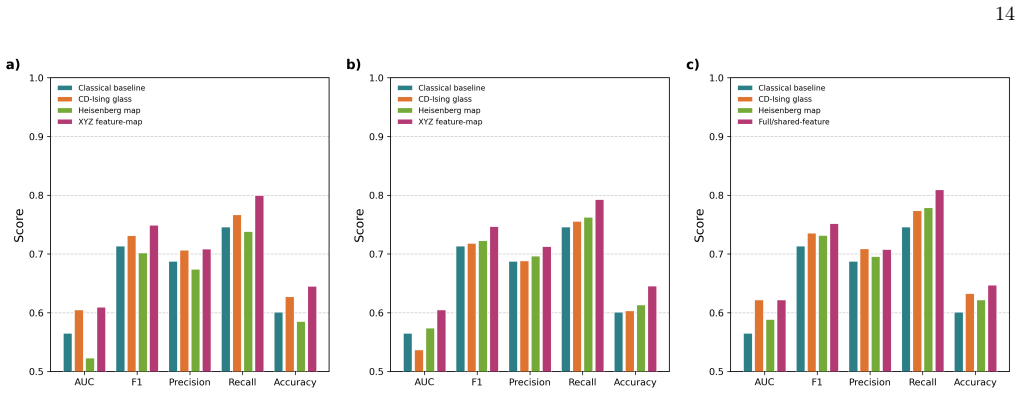
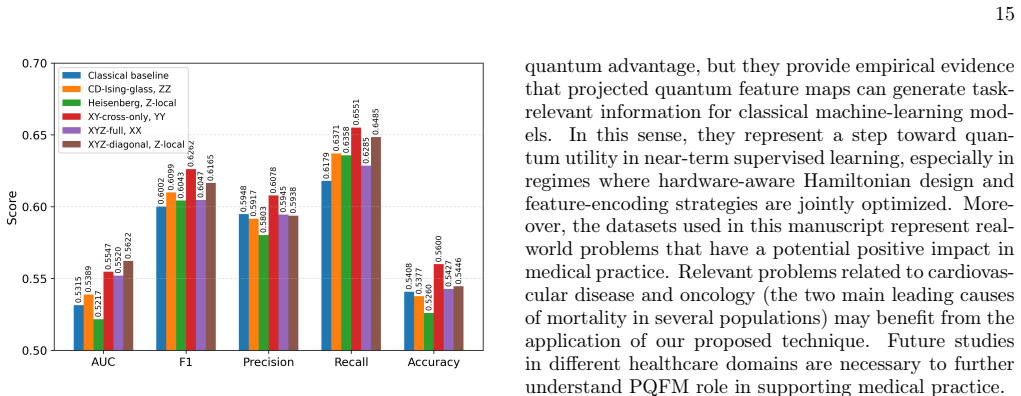
Building on earlier counterdiabatic Ising-glass and one-dimensional Heisenberg projective quantum feature maps, the generalized two-qubit Hamiltonian provides a unified encoding through local Pauli fields and pairwise two-qubit Pauli interactions, allowing distinct classical variables to embed along different Pauli axes of the same qubit; benchmarks under nested cross-validation with paired tests on biomedical datasets indicate this family yields the most consistent pattern of statistically supported gains over classical baselines.
What carries the argument
The generalized two-qubit Hamiltonian, which unifies encoding of classical features via local Pauli fields and pairwise two-qubit Pauli interactions on two qubits.
Load-bearing premise
The nested cross-validation protocol with paired statistical tests isolates the contribution of the generalized Hamiltonian encoding from confounding factors such as choice of measured observables and hardware noise.
What would settle it
Re-running the benchmarks on the same or new datasets with the generalized Hamiltonian showing no statistically significant gains over the reference methods in most cases would challenge the consistency claim.
Figures


read the original abstract
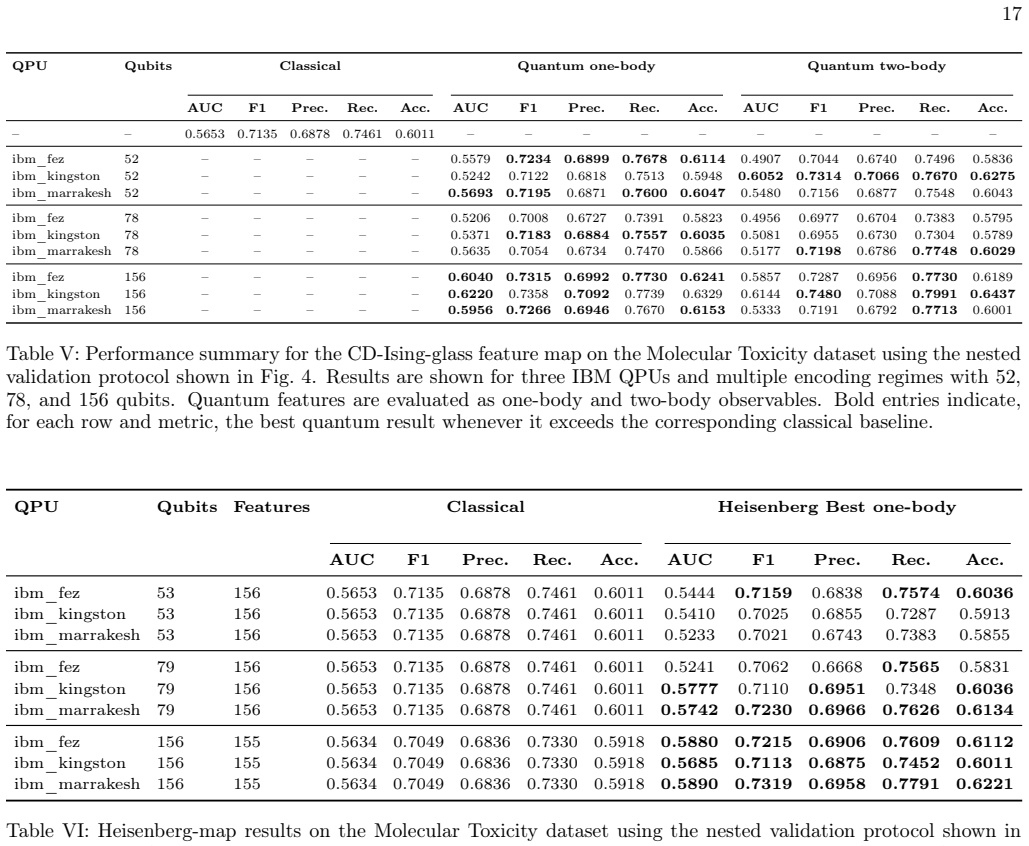
Projected quantum feature maps provide a strategy for using quantum processors as feature generators for classical machine-learning models. Building on counterdiabatic Ising-glass and one-dimensional Heisenberg PQFMs, we introduce a generalized two-qubit Hamiltonian-based PQFM that provides a unified way to encode classical features through local Pauli fields and pairwise two-qubit Pauli interactions. This construction allows distinct classical variables to be embedded along different Pauli axes of the same qubit, increasing the information density of shallow circuits while remaining compatible with hardware constraints. We develop and implement these methods in pqfmlib, a publicly available Python library for constructing, executing, and benchmarking Hamiltonian-based PQFMs.We then benchmark the generalized Hamiltonian PQFMs against reference PQFMs on four biomedical classification datasets under a nested cross-validation protocol with paired statistical tests. Quantum features are generated using both IBM quantum processors with up to 156 qubits and statevector simulations. Our results show that the generalized two-qubit Hamiltonian family provides the most consistent pattern of statistically supported gains over matched classical baselines, although the performance of all methods depends on the dataset, encoding strategy, measured observables, and hardware conditions. These findings support generalized Hamiltonian PQFMs as a promising route toward near-term quantum utility.
Editorial analysis
A structured set of objections, weighed in public.
Referee Report
Summary. The manuscript introduces a generalized two-qubit Hamiltonian for projective quantum feature maps (PQFMs) that unifies and extends prior counterdiabatic Ising-glass and one-dimensional Heisenberg constructions. Distinct classical variables can be embedded along different Pauli axes of the same qubit, increasing information density in shallow circuits while remaining hardware-compatible. The authors release the pqfmlib Python library and benchmark the generalized family against reference PQFMs on four biomedical classification datasets using nested cross-validation and paired statistical tests, executed on IBM quantum processors (up to 156 qubits) and statevector simulators. They conclude that the generalized family exhibits the most consistent pattern of statistically supported gains over matched classical baselines, although all methods depend on dataset, encoding, observables, and hardware conditions.
Significance. If the attribution of gains holds, the construction offers a systematic route to higher-capacity shallow PQFMs without increasing circuit depth, which could be relevant for near-term quantum machine-learning pipelines on biomedical data. The public library and real-hardware experiments with statistical testing are positive elements for reproducibility.
major comments (2)
- [Abstract] Abstract: the claim that the generalized two-qubit Hamiltonian family 'provides the most consistent pattern of statistically supported gains' is presented without any reported effect sizes, confidence intervals, or numerical p-values from the paired tests. This absence prevents verification of the magnitude or reliability of the reported improvements.
- [Benchmarking description (abstract)] Benchmarking description (abstract): the nested cross-validation protocol with paired statistical tests is asserted to isolate the contribution of the generalized Hamiltonian encoding. However, the construction explicitly couples feature embedding to the choice of measured observables (distinct classical variables placed on different Pauli axes of the same qubit), and the abstract itself lists dependence on 'measured observables.' It is therefore unclear how the statistical tests separate Hamiltonian effects from possible variations in observable selection across compared methods.
minor comments (2)
- [Abstract] The abstract states results on 'IBM quantum processors with up to 156 qubits' but supplies no information on circuit depth, qubit mapping, or error-mitigation strategy employed in those runs.
- The library name 'pqfmlib' is introduced without a URL or DOI in the abstract; the full manuscript should provide the repository link for immediate access.
Simulated Author's Rebuttal
We thank the referee for the careful reading and constructive comments. We address each major point below and indicate planned revisions.
read point-by-point responses
-
Referee: [Abstract] Abstract: the claim that the generalized two-qubit Hamiltonian family 'provides the most consistent pattern of statistically supported gains' is presented without any reported effect sizes, confidence intervals, or numerical p-values from the paired tests. This absence prevents verification of the magnitude or reliability of the reported improvements.
Authors: We agree that the abstract would benefit from explicit numerical support. The manuscript already contains the full paired-test results (p-values, effect sizes via Cohen's d, and confidence intervals) in Section 4, Tables 2–5, and the supplementary statistical appendix. In the revised manuscript we will insert representative values (e.g., median p < 0.05 with effect size > 0.3) directly into the abstract to make the claim immediately verifiable. revision: yes
-
Referee: [Benchmarking description (abstract)] Benchmarking description (abstract): the nested cross-validation protocol with paired statistical tests is asserted to isolate the contribution of the generalized Hamiltonian encoding. However, the construction explicitly couples feature embedding to the choice of measured observables (distinct classical variables placed on different Pauli axes of the same qubit), and the abstract itself lists dependence on 'measured observables.' It is therefore unclear how the statistical tests separate Hamiltonian effects from possible variations in observable selection across compared methods.
Authors: The tests compare complete, fixed pipelines rather than attempting to isolate the Hamiltonian from the observable choice. Each reference method is evaluated with its canonical observable set, while the generalized construction uses the additional freedom in Pauli-axis assignment as part of its definition. We will revise the abstract and methods section to state explicitly that the reported gains reflect end-to-end performance of each encoding strategy under its own observable protocol, not a pure Hamiltonian ablation. This matches the practical setting in which the methods would be deployed. revision: partial
Circularity Check
No circularity: new ansatz + external benchmarking on biomedical datasets
full rationale
The paper defines a new generalized two-qubit Hamiltonian PQFM construction and reports empirical performance on four external biomedical datasets via nested cross-validation and paired tests on IBM hardware and simulators. No equations, fitted parameters, or self-citations reduce the reported gains to inputs defined inside the paper. The construction is presented as an explicit ansatz extending prior PQFMs; the central claim is a statistical comparison against matched classical baselines, which remains externally falsifiable. This matches the default case of a self-contained empirical study.
Axiom & Free-Parameter Ledger
axioms (1)
- standard math Quantum feature maps are realized by time evolution under a Hamiltonian composed of local and two-qubit Pauli terms
Reference graph
Works this paper leans on
-
[1]
Sample-ordering control and hardware-drift effects It is important to emphasize that our results are more conservative when compared with the much larger improvements reported for the original CD-Ising- glass/DQFE pipeline on the same Molecular Toxicity dataset [13, 14]. However, there is an important sub- tlety in hardware-executed quantum feature extrac...
-
[2]
Boixo, S
S. Boixo, S. V. Isakov, V. N. Smelyanskiy, R. Babbush, N. Ding, Z. Jiang, M. J. Bremner, J. M. Martinis, and H. Neven, Nature Physics14, 595 (2018)
2018
-
[3]
Arute, K
F. Arute, K. Arya, R. Babbush, D. Bacon, J. C. Bardin, R. Barends, R. Biswas, S. Boixo, F. G. Brandao, D. A. Buell,et al., Nature574, 505 (2019)
2019
-
[4]
Rebentrost, M
P. Rebentrost, M. Mohseni, and S. Lloyd, Phys. Rev. Lett.113, 130503 (2014)
2014
-
[5]
Classification with Quantum Neural Networks on Near Term Processors
E. Farhi and H. Neven, arXiv preprint arXiv:1802.06002 (2018)
work page internal anchor Pith review Pith/arXiv arXiv 2018
-
[6]
Schuld and N
M. Schuld and N. Killoran, Phys. Rev. Lett.122, 040504 (2019)
2019
-
[7]
Havlíček, A
V. Havlíček, A. D. Córcoles, K. Temme, A. W. Harrow, A. Kandala, J. M. Chow, and J. M. Gambetta, Nature 567, 209 (2019)
2019
-
[8]
Huang, M
H.-Y. Huang, M. Broughton, M. Mohseni, R. Babbush, S. Boixo, H. Neven, and J. R. McClean, Nature Commu- nications12, 2631 (2021)
2021
-
[9]
Preskill, Quantum2, 79 (2018)
J. Preskill, Quantum2, 79 (2018)
2018
-
[10]
Schuld and N
M. Schuld and N. Killoran, PRX Quantum3, 030101 (2022)
2022
-
[11]
Bharti, A
K. Bharti, A. Cervera-Lierta, T. H. Kyaw, T. Haug, S. Alperin-Lea, A. Anand, M. Degroote, H. Heimonen, J. S. Kottmann, T. Menke, W.-K. Mok, S. Sim, L.- C. Kwek, and A. Aspuru-Guzik, Rev. Mod. Phys.94, 015004 (2022)
2022
-
[12]
A. Ferenczi, D. Wang, M. Bessonova, S. Samanta, T. Hodges, J. Hancock, G. M. Vilariño, A. Desh- mukh, M. LaDue, G. Pillai,et al., arXiv preprint arXiv:2510.01129 (2025)
- [13]
-
[14]
A.Simen, C.Flores-Garrigos, M.H.DeOliveira, G.D.A. Barrios, J. F. Hernández, Q. Zhang, A. G. Cadavid, Y. Vives-Gilabert, J. D. Martín-Guerrero, E. Solano, et al., arXiv preprint arXiv:2508.20975 (2025)
-
[15]
A.Simen, C.Flores-Garrigós, M.H.DeOliveira, G.D.A. Barrios, A. G. Cadavid, A. Dalal, E. Solano, N. N. Hegade, and Q. Zhang, arXiv preprint arXiv:2510.13807 (2025)
- [16]
-
[17]
R. S. Carmo, pqfmlib: Projective quantum feature maps library,https://github.com/rscarmo/pqfmlib(2026), gitHub repository, accessed June 7, 2026
2026
-
[18]
Wiersema, E
R. Wiersema, E. Kökcü, A. F. Kemper, and B. N. Bakalov, npj Quantum Information10, 110 (2024)
2024
-
[19]
M. Roesler, C. Wells, G. Schamberg, J. Gao, L. Boyle, E. Harrison, G. O’Grady, and C. Varghese, medRxiv 10.64898/2026.03.04.26347634 (2026)
-
[20]
Wilcoxon, Biometrics Bulletin1, 80 (1945)
F. Wilcoxon, Biometrics Bulletin1, 80 (1945)
1945
-
[21]
J. D. Gibbons and S. Chakraborti,Nonparametric Sta- tistical Inference, 5th ed. (Chapman & Hall/CRC, Boca Raton, 2010)
2010
-
[22]
A. D. King, A. Nocera, M. M. Rams, J. Dziarmaga, R. Wiersema, W. Bernoudy, J. Raymond, N. Kaushal, N. Heinsdorf, R. Harris,et al., Science388, 199 (2025)
2025
-
[23]
P. W. Claeys, M. Pandey, D. Sels, and A. Polkovnikov, Phys. Rev. Lett.123, 090602 (2019)
2019
-
[25]
J. R. Huerta-Ruiz, M. Araya-Gaete, D. Tancara, E. Solano, N. Barraza, and F. Albarrán-Arriagada, New Journal of Physics27, 084504 (2025)
2025
-
[26]
A. G. Cadavid, I. Montalban, A. Dalal, E. Solano, and N. N. Hegade, Phys. Rev. Appl.22, 054037 (2024)
2024
-
[27]
Y. Liu, S. Arunachalam, and K. Temme, Nature Physics 17, 1013 (2021)
2021
-
[28]
J. R. Glick, T. P. Gujarati, A. D. Córcoles, Y. Kim, A. Kandala, J. M. Gambetta, and K. Temme, Nature Physics20, 479 (2024)
2024
-
[29]
Klassen and B
J. Klassen and B. M. Terhal, Quantum3, 139 (2019)
2019
-
[30]
Langari, Physical Review B69, 100402 (2004)
A. Langari, Physical Review B69, 100402 (2004)
2004
-
[31]
P. W. Claeys, C. Dimo, S. De Baerdemacker, and A. Faribault, Journal of Physics A: Mathematical and Theoretical52, 08LT01 (2019)
2019
-
[32]
Burkard, SciPost Physics Core8, 030 (2025), arXiv:2209.07918
G. Burkard, SciPost Physics Core8, 030 (2025), arXiv:2209.07918
-
[33]
X.Li, H.Yu, F.Lou, J.Feng, M.-H.Whangbo,andH.Xi- ang, Molecules26, 803 (2021)
2021
-
[34]
S. Gul, F. Rahim, S. Isin, F. Yilmaz, N. Ozturk, M. Turkay,et al., Scientific Reports11, 18510 (2021)
2021
-
[35]
A.Demircioğlu,ComputersinBiologyandMedicine182, 109140 (2024)
2024
-
[36]
Newitt, N
D. Newitt, N. Hylton, I.-S. . Network, and A. . T. Team, Multi-center breast dce-mri data and segmentations from patients in the i-spy 1/acrin 6657 trials (2016)
2016
-
[37]
W. N. Street, W. H. Wolberg, and O. L. Mangasarian, in Biomedical Image Processing and Biomedical Visualiza- tion, Vol. 1905 (SPIE, 1993) pp. 861–870
1905
-
[38]
Detrano, A
R. Detrano, A. Janosi, W. Steinbrunn, M. Pfisterer, J.-J. Schmid, S. Sandhu, K. H. Guppy, S. Lee, and V. Froelicher, The American Journal of Cardiology64, 304 (1989)
1989
-
[39]
S. M. Lundberg and S.-I. Lee, inAdvances in Neural In- formation Processing Systems, Vol. 30 (2017)
2017
-
[40]
S. M. Lundberg, G. Erion, H. Chen, A. DeGrave, J. M. Prutkin, B. Nair, R. Katz, J. Himmelfarb, N. Bansal, and S.-I. Lee, Nature Machine Intelligence2, 56 (2020)
2020
-
[41]
I. T. Jolliffe,Principal Component Analysis, 2nd ed., Springer Series in Statistics (Springer, New York, 2002)
2002
-
[42]
I. T. Jolliffe and J. Cadima, Philosophical Transactions of the Royal Society A374, 20150202 (2016)
2016
-
[43]
Off-line quantum-advantage feature extraction for industrial production
C. Flores-Garrigós, G. D. Alvarado Barrios, Q. Zhang, A. Simen, and E. Solano, Off-line quantum-advantage feature extraction for industrial production (2026), arXiv:2605.19801 [quant-ph]
work page internal anchor Pith review Pith/arXiv arXiv 2026
discussion (0)
Sign in with ORCID, Apple, or X to comment. Anyone can read and Pith papers without signing in.