Driven dynamics of an attractive Bose polaron
Pith reviewed 2026-06-27 04:54 UTC · model grok-4.3
The pith
An attractive impurity driven by constant force through a 1D Bose gas shows drifted Bloch oscillations without any lattice.
A machine-rendered reading of the paper's core claim, the machinery that carries it, and where it could break.
Core claim
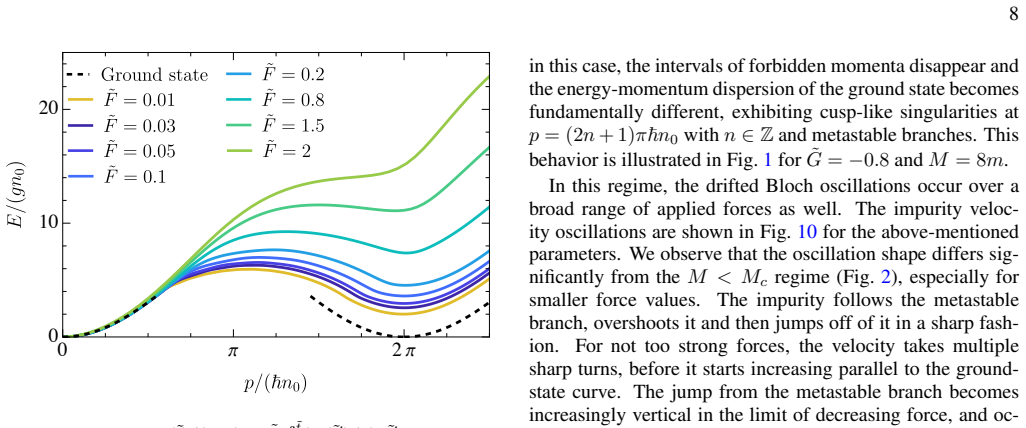
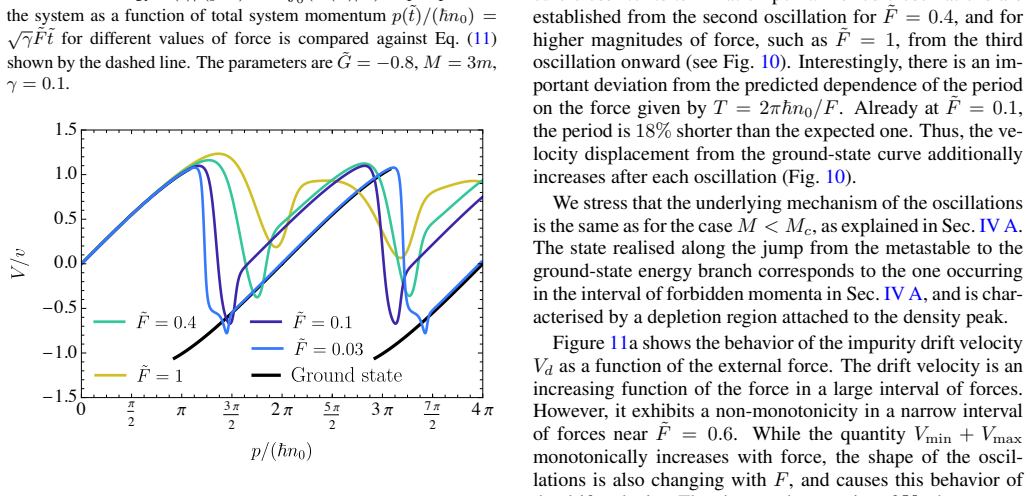
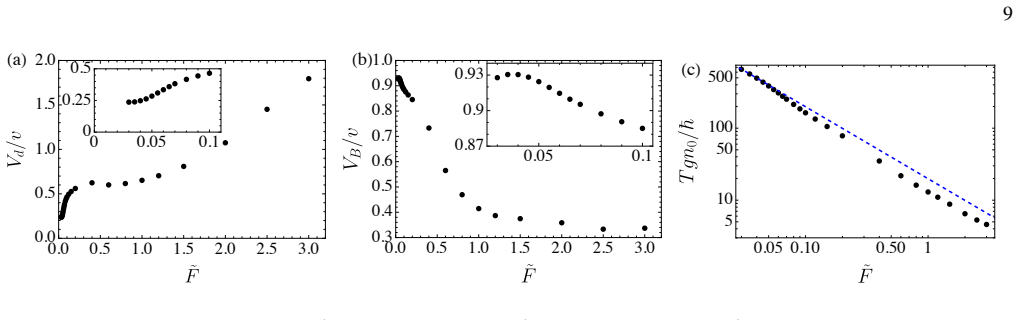
We show that the impurity exhibits drifted Bloch oscillations in a wide range of forces in the absence of a lattice. We characterize the dynamical response of the host bosons and explain the mechanism underlying the Bloch oscillations. In contrast to the case of repulsive impurity-boson interaction, the drift velocity exhibits a sub-linear dependence on a weak applied force, V_d ∼ F^α with a positive exponent α smaller than unity. The drift velocity monotonically increases with force, though the scaling behavior varies considerably across different regimes of F. Moreover, the amplitude of the velocity oscillations displays rich behavior: it first undergoes a decay with force, reaches a minim
What carries the argument
The density perturbation or wake that the moving impurity induces in the bosons, which generates an effective periodic back-force on the impurity.
If this is right
- The drift velocity scales sub-linearly with weak force and increases monotonically across force regimes.
- The amplitude of velocity oscillations decays to a minimum then revives as force is increased.
- The time period and Bloch amplitude depend on force strength and boson parameters.
- These features appear in the absence of any external lattice.
- The dynamical response of the bosons is central to sustaining the oscillations.
Where Pith is reading between the lines
- The sub-linear drift may indicate that attractive polarons respond more sluggishly to weak drives than repulsive ones because of the bound cloud.
- Similar oscillations could appear if the same density-back-action mechanism operates in two-dimensional geometries or with time-varying forces.
- Relaxing the weak-interaction assumption on the bosons would likely suppress the oscillations once strong correlations develop in the host gas.
Load-bearing premise
The bosons remain homogeneous and weakly interacting while the impurity is driven through them.
What would settle it
A direct measurement showing strictly linear drift velocity versus force at weak forces, or complete absence of velocity oscillations at moderate forces, would falsify the predicted mechanism.
Figures
read the original abstract
We study the out-of-equilibrium dynamics of an impurity driven by a constant external force through a system of homogeneous weakly-interacting bosons in one spatial dimension. The impurity-boson interaction is assumed to be attractive. We show that the impurity exhibits drifted Bloch oscillations in a wide range of forces in the absence of a lattice. We characterize the dynamical response of the host bosons and explain the mechanism underlying the Bloch oscillations. We analyse the behavior of the drift velocity, the Bloch amplitude and the time period of oscillations in a wide range of forces and other system parameters. In contrast to the case of repulsive impurity-boson interaction, the drift velocity exhibits a sub-linear dependence on a weak applied force, $V_d\sim {F}^{\alpha}$ with a positive exponent $\alpha$ smaller than unity. The drift velocity monotonically increases with force, though the scaling behavior varies considerably across different regimes of $F$. Moreover, the amplitude of the velocity oscillations displays rich behavior: it first undergoes a decay with force, reaches a minimum, and then presents a revival, increasing with force.
Editorial analysis
A structured set of objections, weighed in public.
Referee Report
Summary. The manuscript studies the driven dynamics of an attractive impurity in a 1D homogeneous weakly-interacting Bose gas. It claims that the impurity exhibits drifted Bloch oscillations over a wide range of forces even without an external lattice, characterizes the bosonic response, and reports a sub-linear drift velocity V_d ~ F^α (α<1) for weak forces together with non-monotonic behavior of the oscillation amplitude.
Significance. If the homogeneity and weak-interaction assumptions remain valid under attractive driving, the result would demonstrate a mechanism for lattice-free Bloch-like oscillations arising from the impurity-boson coupling itself, with distinctive sub-linear force dependence and amplitude revival. This would be of interest for out-of-equilibrium polaron physics in low-dimensional quantum gases.
major comments (1)
- [Abstract, first paragraph] Abstract, first paragraph: The central claim of drifted Bloch oscillations without a lattice rests on the bosons remaining homogeneous and weakly interacting while the attractive impurity traverses them. In 1D an attractive impurity-boson coupling generically produces local density pile-up or bound-state formation; once the local g_bb n / ħ² becomes order-1 the premise used to derive the effective dynamics is violated and the moving cloud cannot supply the static periodic potential required for Bloch motion. This assumption is load-bearing for the reported force scalings of V_d and the oscillation amplitude.
Simulated Author's Rebuttal
We thank the referee for their careful reading and for highlighting the importance of the weak-interaction and homogeneity assumptions. We address the concern below and propose targeted revisions.
read point-by-point responses
-
Referee: [Abstract, first paragraph] Abstract, first paragraph: The central claim of drifted Bloch oscillations without a lattice rests on the bosons remaining homogeneous and weakly interacting while the attractive impurity traverses them. In 1D an attractive impurity-boson coupling generically produces local density pile-up or bound-state formation; once the local g_bb n / ħ² becomes order-1 the premise used to derive the effective dynamics is violated and the moving cloud cannot supply the static periodic potential required for Bloch motion. This assumption is load-bearing for the reported force scalings of V_d and the oscillation amplitude.
Authors: We agree that the validity of the weak-interaction assumption is central and must be carefully justified for the attractive case. Our analysis employs the time-dependent Gross-Pitaevskii equation for the bosons under the explicit premise of weak interactions (g_bb n / ħ² ≪ 1). For the parameters studied, the impurity-boson coupling is chosen in the regime where no static bound state forms and the driven density modulation remains small; numerical monitoring of the local boson density confirms that g_bb n_local / ħ² stays well below unity throughout the evolution. The effective periodic potential is generated dynamically by the co-moving density response rather than by a static lattice. To strengthen the manuscript we will add a dedicated paragraph (and supporting figure) quantifying the maximum local density versus force and explicitly delineating the parameter window of validity; we will also revise the abstract to reference this regime. revision: partial
Circularity Check
No significant circularity; derivation self-contained
full rationale
The abstract and excerpts state the homogeneity and weak-interaction assumption for the bosons as an explicit premise rather than a derived result, and present the drifted Bloch oscillations, sub-linear V_d ~ F^alpha scaling, and amplitude behavior as outcomes of the driven dynamics analysis. No equations, self-citations, or fitted parameters are shown that would reduce any prediction to an input by construction (e.g., no self-definitional scaling or ansatz smuggled via prior work). The central claim therefore retains independent content relative to its stated inputs and does not match any enumerated circularity pattern.
Axiom & Free-Parameter Ledger
Reference graph
Works this paper leans on
-
[1]
L. D. Landau and I. M. Khalatnikov, Zh. Eksp. Teor. Fiz.19, 709 (1949)
1949
-
[2]
J. T. Devreese and A. S. Alexandrov, Rep. Prog. Phys.72, 066501 (2009)
2009
-
[3]
Schecter, D
M. Schecter, D. Gangardt, and A. Kamenev, Ann. Phys.327, 639 (2012)
2012
-
[4]
Giamarchi,Quantum Physics in One Dimension(Clarendon press, Oxford, 2003)
T. Giamarchi,Quantum Physics in One Dimension(Clarendon press, Oxford, 2003)
2003
-
[5]
A. M. Kosevich, Low Temp. Phys.27(2001)
2001
-
[6]
Schecter, A
M. Schecter, A. Kamenev, D. M. Gangardt, and A. Lamacraft, Phys. Rev. Lett.108, 207001 (2012)
2012
-
[7]
Mathy, M
C. Mathy, M. Zvonarev, and E. Demler, Nature Phys.8, 881 (2012)
2012
-
[8]
Gamayun, O
O. Gamayun, O. Lychkovskiy, and V . Cheianov, Phys. Rev. E 90, 032132 (2014)
2014
-
[9]
Meinert, M
F. Meinert, M. Knap, E. Kirilov, K. Jag-Lauber, M. B. Zvonarev, E. Demler, and H.-C. N ¨agerl, Science356, 945 (2017)
2017
-
[10]
Gamayun, O
O. Gamayun, O. Lychkovskiy, E. Burovski, M. Malcomson, V . V . Cheianov, and M. B. Zvonarev, Phys. Rev. Lett.120, 220605 (2018)
2018
-
[11]
S. I. Mistakidis, G. C. Katsimiga, G. M. Koutentakis, T. Busch, and P. Schmelcher, Phys. Rev. Lett.122, 183001 (2019)
2019
-
[12]
Petkovi ´c and Z
A. Petkovi ´c and Z. Ristivojevic, Phys. Rev. Lett.131, 186001 (2023)
2023
-
[13]
Bresolin, A
S. Bresolin, A. Roy, G. Ferrari, A. Recati, and N. Pavloff, Phys. Rev. Lett.130, 220403 (2023)
2023
-
[14]
Will and M
M. Will and M. Fleischhauer, New J. Phys.25, 083043 (2023)
2023
-
[15]
Majumdar and A
S. Majumdar and A. Petkovi ´c, Phys. Rev. A112, 053326 (2025)
2025
-
[16]
Majumdar and A
S. Majumdar and A. Petkovi ´c, Phys. Rev. A113, 043309 (2026)
2026
-
[17]
Rabec, G
F. Rabec, G. Chauveau, G. Brochier, S. Nascimbene, J. Dal- ibard, and J. Beugnon, Nature Physics21, 1541 (2025)
2025
-
[18]
S. Scopa, P. Zechmann, M. Knap, J. D. Nardis, and A. Bas- tianello, (2026), arXiv:2605.18957
Pith/arXiv arXiv 2026
-
[19]
Wysocki, M
P. Wysocki, M. Tylutki, and K. Jachymski, New J. Phys.28, 013201 (2026)
2026
- [20]
-
[21]
Lamacraft, Phys
A. Lamacraft, Phys. Rev. B79, 241105 (2009)
2009
-
[22]
[35, 36] for work on impurity Bloch oscillations in periodic potentials
See, for example, Refs. [35, 36] for work on impurity Bloch oscillations in periodic potentials
-
[23]
T. D. Lee, F. E. Low, and D. Pines, Phys. Rev.90, 297 (1953)
1953
-
[24]
L. P. Pitaevskii and S. Stringari,Bose-Einstein Condensation, International Series of Monographs on Physics (Oxford Uni- versity Press, Oxford, New York, 2003)
2003
-
[25]
A. G. Sykes, M. J. Davis, and D. C. Roberts, Phys. Rev. Lett. 103, 085302 (2009)
2009
-
[26]
Reichert, Z
B. Reichert, Z. Ristivojevic, and A. Petkovi ´c, New J. Phys.21, 053024 (2019)
2019
-
[27]
Pavloff, Phys
N. Pavloff, Phys. Rev. A66, 013610 (2002)
2002
-
[28]
V . A. Trofimov and N. V . Peskov, Mathematical Modelling and Analysis14, 109 (2009)
2009
-
[29]
Catani, G
J. Catani, G. Lamporesi, D. Naik, M. Gring, M. Inguscio, F. Mi- nardi, A. Kantian, and T. Giamarchi, Phys. Rev. A85, 023623 (2012)
2012
-
[30]
M.-G. Hu, M. J. Van de Graaff, D. Kedar, J. P. Corson, E. A. Cornell, and D. S. Jin, Phys. Rev. Lett.117, 055301 (2016)
2016
-
[31]
N. B. Jørgensen, L. Wacker, K. T. Skalmstang, M. M. Parish, J. Levinsen, R. S. Christensen, G. M. Bruun, and J. J. Arlt, Phys. Rev. Lett.117, 055302 (2016)
2016
-
[32]
Etrych, G
J. Etrych, G. Martirosyan, A. Cao, C. J. Ho, Z. Hadzibabic, and C. Eigen, Phys. Rev. X15, 021070 (2025)
2025
-
[33]
Grusdt, N
F. Grusdt, N. Mostaan, E. Demler, and L. A. P. Ardila, Reports on Progress in Physics88, 066401 (2025)
2025
- [34]
-
[35]
Bruderer, A
M. Bruderer, A. Klein, S. R. Clark, and D. Jaksch, New Journal of Physics10, 033015 (2008)
2008
-
[36]
Grusdt, A
F. Grusdt, A. Shashi, D. Abanin, and E. Demler, Phys. Rev. A 90, 063610 (2014)
2014
discussion (0)
Sign in with ORCID, Apple, or X to comment. Anyone can read and Pith papers without signing in.