Real-time pseudo entropy and modular-Hamiltonian correlations
Pith reviewed 2026-06-27 05:10 UTC · model grok-4.3
The pith
Real-time pseudo entropy's short-time change is set by the correlation of physical and modular Hamiltonians.
A machine-rendered reading of the paper's core claim, the machinery that carries it, and where it could break.
Core claim
The central claim is that the real-time pseudo entropy S_A(t,0) for subsystem A expands at short times as S_A(0) minus i t times the expectation value of K_A times (H minus its average), plus O(t squared), where K_A equals minus log of the initial reduced density matrix. For Hermitian evolution the imaginary response is controlled by the symmetrized covariance of H and K_A while the real response is governed by their commutator. The relation follows from the definition of the transition matrix, recovers the thermal case as a special instance, admits an all-order form in a Schmidt-diagonal model, and is illustrated by explicit two-qubit calculations and transverse-field Ising quenches includi
What carries the argument
The expectation value of the product of the modular Hamiltonian K_A equals minus log rho_A and the deviation of the physical Hamiltonian H, which fixes the linear term in the short-time expansion of the real-time pseudo entropy.
If this is right
- The imaginary part of real-time pseudo entropy encodes a physical time-oriented modular response rather than a branch artifact.
- For Hermitian dynamics the initial imaginary response equals minus the symmetrized covariance of H and K_A.
- The initial real response is governed by the commutator of H and K_A.
- The result recovers thermal pseudo entropy as a special case and supplies an all-order expression in Schmidt-diagonal models.
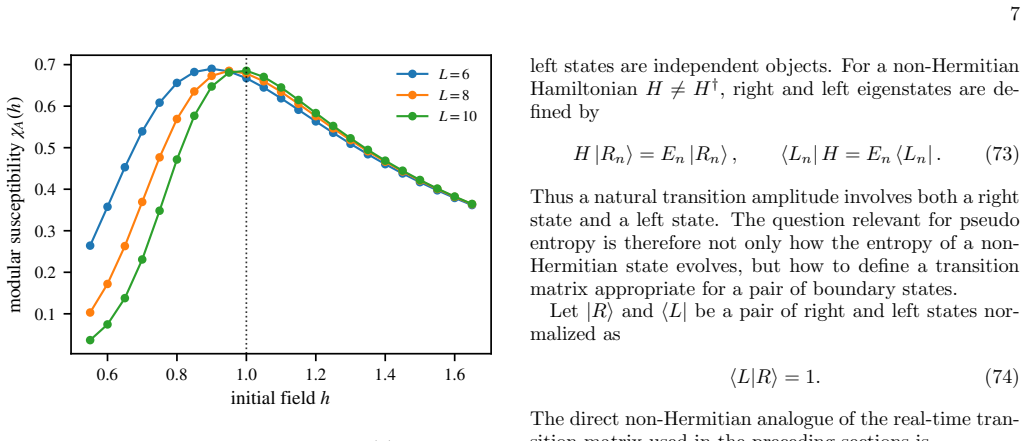
- The covariance response is confirmed numerically in transverse-field Ising-chain quenches including finite-size modular susceptibility near the critical point.
Where Pith is reading between the lines
- Short-time pseudo entropy dynamics could serve as an experimental probe for the structure of modular Hamiltonians in interacting quantum systems.
- The covariance-commutator decomposition might connect to existing measures of quantum information scrambling or chaos in time-dependent settings.
- Relating the amplitude-level response to ordinary entropy production could open a quantitative bridge between microscopic transition matrices and thermodynamic irreversibility.
Load-bearing premise
The real-time transition matrix is formed between an initial pure state and its unitary time-evolved state.
What would settle it
A direct short-time expansion of the pseudo entropy computed in the two-qubit model or the transverse-field Ising chain that fails to reproduce the predicted covariance term with the modular Hamiltonian would disprove the governing relation.
Figures

read the original abstract
Pseudo entropy is a complex-valued generalization of entanglement entropy defined from a reduced transition matrix. We study the pseudo entropy associated with a real-time transition matrix between an initial pure state and its unitary time evolution. For a subsystem $A$, we show that the short-time behavior of real-time pseudo entropy is governed by the correlation between the physical Hamiltonian $H$ and the modular Hamiltonian $K_A=-\log\rho_A$ of the initial reduced state, $ S_A(t,0)=S_A(0)-it \langle K_A(H-\langle H\rangle)\rangle + \mathcal{O}(t^2)$. For Hermitian dynamics, the initial imaginary response is controlled by the symmetrized covariance of $H$ and $K_A$ with an overall minus sign, while the initial real response is governed by their commutator. Thus the imaginary part of real-time pseudo entropy is not merely a branch artifact: it is a time-oriented modular response generated by the correlation between microscopic time evolution and subsystem coarse graining. We clarify the relation of this result to the known first law of pseudo entropy, derive an all-order expression in a Schmidt-diagonal model, recover thermal pseudo entropy as a special case, illustrate the covariance/commutator decomposition in a two-qubit model, and confirm the covariance response in transverse-field Ising-chain quenches, including a finite-size study of a modular susceptibility near the Ising critical region. We discuss how this amplitude-level oriented response can be related to ordinary entropy production, and also give a concrete $\mathcal{PT}$-symmetric toy-model illustration of the non-Hermitian extension.
Editorial analysis
A structured set of objections, weighed in public.
Referee Report
Summary. The manuscript studies real-time pseudo entropy defined from the reduced transition matrix between an initial pure state and its unitary time evolution. The central claim is the short-time expansion S_A(t,0)=S_A(0)−it⟨K_A(H−⟨H⟩)⟩+O(t²) for a subsystem A, with the linear coefficient given by the indicated correlation between the physical Hamiltonian H and the modular Hamiltonian K_A=−logρ_A. The work decomposes the response into symmetrized covariance (imaginary part) and commutator (real part) for Hermitian dynamics, recovers the thermal case as a special limit, supplies an all-order Schmidt-diagonal expression, illustrates the decomposition in a two-qubit model, and confirms the covariance coefficient via transverse-field Ising-chain quenches together with a finite-size modular-susceptibility study near criticality. A PT-symmetric non-Hermitian toy model is also discussed.
Significance. If the derivation holds, the result supplies a direct, first-principles link between real-time unitary evolution and the modular structure of a subsystem at the level of pseudo entropy. The explicit covariance/commutator decomposition, the demonstration that the imaginary part is a physical modular response rather than a branch artifact, the recovery of the thermal limit, and the numerical checks in solvable models are concrete strengths. The all-order Schmidt-diagonal formula and the finite-size critical-region study further strengthen the contribution to the literature on dynamical entanglement measures.
Simulated Author's Rebuttal
We thank the referee for their careful reading of the manuscript, their positive assessment of its contributions, and the recommendation to accept. There are no major comments requiring a point-by-point response.
Circularity Check
No significant circularity; derivation is direct from definitions
full rationale
The short-time expansion S_A(t,0)=S_A(0)-it ⟨K_A(H−⟨H⟩)⟩ + O(t²) is obtained by direct first-order Taylor expansion of the pseudo-entropy functional applied to the normalized real-time transition matrix T_A(t) = Tr_B |ψ⟩⟨ψ(t)| / ⟨ψ|ψ(t)⟩. The covariance term is the exact linear coefficient arising from the definition of K_A = −log ρ_A and the global-phase normalization; no parameter is fitted and then relabeled as a prediction. The relation to the first law of pseudo entropy is presented as a clarification of a known result rather than a load-bearing self-citation chain. Explicit all-order Schmidt-diagonal expressions, two-qubit checks, and Ising-chain numerics are independent verifications, not reductions to the input. The manuscript is therefore self-contained with no circular steps.
Axiom & Free-Parameter Ledger
axioms (2)
- standard math Quantum mechanics with unitary time evolution generated by a Hamiltonian H
- domain assumption Pseudo entropy is defined from the reduced transition matrix between two states
Reference graph
Works this paper leans on
-
[1]
Dis- sipation: The phase-space perspective,
R. Kawai, J. M. R. Parrondo, C. Van den Broeck, “Dis- sipation: The phase-space perspective,” Phys. Rev. Lett. 98, 080602 (2007), arXiv:cond-mat/0701397. 11
Pith/arXiv arXiv 2007
-
[2]
Entropy production and the arrow of time,
J. M. R. Parrondo, C. Van den Broeck, R. Kawai, “Entropy production and the arrow of time,” New J. Phys.11, 073008 (2009), arXiv:0904.1573 [cond- mat.stat-mech]
Pith/arXiv arXiv 2009
-
[3]
Irreversibility and the arrow of time in a quenched quantum system,
T. B. Batalh˜ ao, A. M. Souza, R. S. Sarthour, I. S. Oliveira, M. Paternostro, E. Lutz, R. M. Serra, “Irreversibility and the arrow of time in a quenched quantum system,” Phys. Rev. Lett.115, 190601 (2015), arXiv:1502.06704 [quant-ph]
Pith/arXiv arXiv 2015
-
[4]
G. Manzano, J. M. Horowitz, J. M. R. Parrondo, “Quan- tum fluctuation theorems for arbitrary environments: adiabatic and nonadiabatic entropy production,” Phys. Rev. X8, 031037 (2018), arXiv:1710.00054 [quant-ph]
Pith/arXiv arXiv 2018
-
[5]
Fluctuation Theorems for a Quantum Channel,
H. Kwon and M. S. Kim, “Fluctuation Theorems for a Quantum Channel,” Phys. Rev. X9, 031029 (2019), arXiv:1810.03150 [quant-ph]
arXiv 2019
-
[6]
Entanglement and ther- modynamics after a quantum quench in integrable sys- tems,
V. Alba and P. Calabrese, “Entanglement and ther- modynamics after a quantum quench in integrable sys- tems,” Proc. Natl. Acad. Sci. U.S.A.114, 7947 (2017), arXiv:1608.00614 [cond-mat.stat-mech]
Pith/arXiv arXiv 2017
-
[7]
New holographic generalization of entangle- ment entropy,
Y. Nakata, T. Takayanagi, Y. Taki, K. Tamaoka, Z. Wei, “New holographic generalization of entangle- ment entropy,” Phys. Rev. D103, 026005 (2021), arXiv:2005.13801 [hep-th]
arXiv 2021
-
[8]
Pseudo Entropy in Free Quantum Field Theories,
A. Mollabashi, N. Shiba, T. Takayanagi, K. Tamaoka, Z. Wei, “Pseudo Entropy in Free Quantum Field Theories,” Phys. Rev. Lett.126, 081601 (2021), arXiv:2011.09648 [hep-th]
arXiv 2021
-
[9]
Aspects of Pseudo Entropy in Field Theories,
A. Mollabashi, N. Shiba, T. Takayanagi, K. Tamaoka, Z. Wei, “Aspects of Pseudo Entropy in Field Theories,” Phys. Rev. Research3, 033254 (2021), arXiv:2106.03118 [hep-th]
arXiv 2021
-
[10]
Subregion spec- trum form factor via pseudoentropy,
K. Goto, M. Nozaki, K. Tamaoka, “Subregion spec- trum form factor via pseudoentropy,” Phys. Rev. D.104, L121902 (2021), arXiv:2109.00372 [hep-th]
arXiv 2021
-
[11]
T. Nishioka, T. Takayanagi, Y. Taki, “Topological pseudo entropy,” JHEP09, 015 (2021), arXiv:2107.01797 [hep- th]
arXiv 2021
-
[12]
Pseudo Entropy in U(1) gauge theory,
J. Mukherjee, “Pseudo Entropy in U(1) gauge theory,” JHEP10, 016 (2022), arXiv:2205.08179 [hep-th]
arXiv 2022
-
[13]
Notes on pseudo entropy amplification,
Y. Ishiyama, R. Kojima, S. Matsui, K. Tamaoka, “Notes on pseudo entropy amplification,” PTEP2022, 093B10 (2022), arXiv:2206.14551 [hep-th]
arXiv 2022
-
[14]
Constructible real- ity condition of pseudo entropy via pseudo-Hermiticity,
W.-z. Guo, S. He, Y.-X. Zhang, “Constructible real- ity condition of pseudo entropy via pseudo-Hermiticity,” JHEP05, 021 (2023), arXiv:2209.07308 [hep-th]
arXiv 2023
-
[15]
Thermodynamical Property of Entanglement Entropy for Excited States,
J. Bhattacharya, M. Nozaki, T. Takayanagi, T. Ugajin, “Thermodynamical Property of Entanglement Entropy for Excited States,” Phys. Rev. Lett.110, 091602 (2013), arXiv:1212.1164 [hep-th]
Pith/arXiv arXiv 2013
-
[16]
Rel- ative Entropy and Holography,
D. D. Blanco, H. Casini, L.-Y. Hung, R. C. Myers, “Rel- ative Entropy and Holography,” JHEP08, 060 (2013), arXiv:1305.3182 [hep-th]
Pith/arXiv arXiv 2013
-
[17]
Pseudoentropy in dS/CFT and Timelike Entangle- ment Entropy,
K. Doi, J. Harper, A. Mollabashi, T. Takayanagi, Y. Taki, “Pseudoentropy in dS/CFT and Timelike Entangle- ment Entropy,” Phys. Rev. Lett.130, 031601 (2023), arXiv:2210.09457 [hep-th]
arXiv 2023
-
[18]
Timelike entanglement entropy,
K. Doi, J. Harper, A. Mollabashi, T. Takayanagi, Y. Taki, “Timelike entanglement entropy,” JHEP05, 052 (2023), arXiv:2302.11695 [hep-th]
arXiv 2023
-
[19]
Extremal surfaces in de Sitter spacetime,
K. Narayan, “Extremal surfaces in de Sitter spacetime,” Phys. Rev. D91, 126011 (2015), arXiv:1501.03019 [hep- th]
Pith/arXiv arXiv 2015
-
[20]
OndS 4 extremal surfaces and entangle- ment entropy in some ghost CFTs,
K. Narayan, “OndS 4 extremal surfaces and entangle- ment entropy in some ghost CFTs,” Phys. Rev. D94, 046001 (2016), arXiv:1602.06505 [hep-th]
Pith/arXiv arXiv 2016
-
[21]
Ghost-spin chains, entan- glement andbc-ghost CFTs,
D. P. Jatkar and K. Narayan, “Ghost-spin chains, entan- glement andbc-ghost CFTs,” Phys. Rev. D96, 106015 (2017), arXiv:1706.06828 [hep-th]
Pith/arXiv arXiv 2017
-
[22]
On extremal surfaces and de Sitter en- tropy,
K. Narayan, “On extremal surfaces and de Sitter en- tropy,” Phys. Lett. B779, 214 (2018), arXiv:1711.01107 [hep-th]
Pith/arXiv arXiv 2018
-
[23]
de Sitter space, extremal surfaces and time-entanglement,
K. Narayan, “de Sitter space, extremal surfaces and time-entanglement,” Phys. Rev. D107, 126004 (2023), arXiv:2210.12963 [hep-th]
arXiv 2023
-
[24]
Notes on time entan- glement and pseudo-entropy,
K. Narayan and H. K. Saini, “Notes on time entan- glement and pseudo-entropy,” Eur. Phys. J. C84, 499 (2024), arXiv:2303.01307 [hep-th]
arXiv 2024
-
[25]
Further remarks on de Sitter space, ex- tremal surfaces and time entanglement,
K. Narayan, “Further remarks on de Sitter space, ex- tremal surfaces and time entanglement,” Phys. Rev. D 109, 086009 (2024), arXiv:2310.00320 [hep-th]
arXiv 2024
-
[26]
dS extremal surfaces, replicas, boundary Renyi entropies in dS/CF Tand time entanglement,
K. K. Nanda, K. Narayan, S. Porey, and G. Yadav, “dS extremal surfaces, replicas, boundary Renyi entropies in dS/CF Tand time entanglement,” JHEP11, 095 (2025), arXiv:2509.02775 [hep-th]
arXiv 2025
-
[27]
de Sitter extremal surfaces, time contours, complexifications and pseudo-entropies,
K. Narayan, “de Sitter extremal surfaces, time contours, complexifications and pseudo-entropies,” arXiv:2604.00108 [hep-th]
-
[28]
P. Caputa, B. Chen, T. Takayanagi, T. Tsuda, “Thermal Pseudo-Entropy,” JHEP01, 003 (2025), arXiv:2411.08948 [hep-th]
arXiv 2025
-
[29]
On the real-time evo- lution of pseudo-entropy in 2d CFTs,
W.-z. Guo, S. He, Y.-X. Zhang, “On the real-time evo- lution of pseudo-entropy in 2d CFTs,” JHEP09, 094 (2022), arXiv:2206.11818 [hep-th]
arXiv 2022
-
[30]
Imaginary part of time- like entanglement entropy,
J. Xu and W.-z. Guo, “Imaginary part of time- like entanglement entropy,” JHEP02, 094 (2025), arXiv:2410.22684 [hep-th]
arXiv 2025
-
[31]
Real spectra in non- Hermitian Hamiltonians having PT symmetry,
C. M. Bender and S. Boettcher, “Real spectra in non- Hermitian Hamiltonians having PT symmetry,” Phys. Rev. Lett.80, 5243 (1998), arXiv:physics/9712001
Pith/arXiv arXiv 1998
-
[32]
Making sense of non-Hermitian Hamil- tonians,
C. M. Bender, “Making sense of non-Hermitian Hamil- tonians,” Rep. Prog. Phys.70, 947 (2007), arXiv:hep- th/0703096
arXiv 2007
-
[33]
A. Mostafazadeh, “Pseudo-Hermiticity versus PT sym- metry: The necessary condition for the reality of the spectrum of a non-Hermitian Hamiltonian,” J. Math. Phys.43, 205 (2002), arXiv:math-ph/0107001
Pith/arXiv arXiv 2002
-
[34]
Non-Hermitian physics and PT symmetry,
R. El-Ganainy, K. G. Makris, M. Khajavikhan, Z. H. Musslimani, S. Rotter, D. N. Christodoulides, “Non-Hermitian physics and PT symmetry,” Nat. Phys. 14, 11 (2018), doi:10.1038/nphys4323
-
[35]
Y. Ashida, Z. Gong, M. Ueda, “Non-Hermitian physics,” Adv. Phys.69, 249 (2020), arXiv:2006.01837 [cond- mat.mes-hall]
arXiv 2020
-
[36]
Symme- try and topology in non-Hermitian physics,
K. Kawabata, K. Shiozaki, M. Ueda, M. Sato, “Symme- try and topology in non-Hermitian physics,” Phys. Rev. X9, 041015 (2019), arXiv:1812.09133 [cond-mat.mes- hall]
arXiv 2019
-
[37]
Exceptional topology of non-Hermitian systems,
E. J. Bergholtz, J. C. Budich, F. K. Kunst, “Exceptional topology of non-Hermitian systems,” Rev. Mod. Phys. 93, 015005 (2021), arXiv:1912.10048 [cond-mat.mes- hall]
arXiv 2021
-
[38]
P.-Y. Chang, J.-S. You, X. Wen, S. Ryu, “Entanglement spectrum and entropy in topological non-Hermitian sys- tems and non-unitary conformal field theories,” Phys. Rev. Research2, 033069 (2020), arXiv:1909.01346 [cond- mat.str-el]. 12
arXiv 2020
-
[39]
Complex entanglement entropy for complex conformal field theory,
H. Shimizu and K. Kawabata, “Complex entanglement entropy for complex conformal field theory,” Phys. Rev. B112, 085112 (2025), arXiv:2502.02001 [cond-mat.stat- mech]
arXiv 2025
-
[40]
Quantum Phase Transitions,
S. Sachdev, “Quantum Phase Transitions,” Cambridge University Press (2011)
2011
-
[41]
Ground state overlap and quantum phase transitions,
P. Zanardi and N. Paunkovi´ c, “Ground state overlap and quantum phase transitions,” Phys. Rev. E74, 031123 (2006), arXiv:quant-ph/0512249
Pith/arXiv arXiv 2006
-
[42]
Fidelity approach to quantum phase tran- sitions,
S.-J. Gu, “Fidelity approach to quantum phase tran- sitions,” Int. J. Mod. Phys. B24, 4371 (2010), arXiv:0811.3127 [quant-ph]
Pith/arXiv arXiv 2010
-
[43]
Generalised entangle- ment entropies from Unit-Invariant Singular Value De- composition,
P. Caputa, A. Saha, P. Su lkowski, “Generalised entangle- ment entropies from Unit-Invariant Singular Value De- composition,” JHEP05, 181 (2026), arXiv:2512.22997 [hep-th]
Pith/arXiv arXiv 2026
-
[44]
Dynami- cal quantum phase transitions in the transverse-field Ising model,
M. Heyl, A. Polkovnikov, S. Kehrein, “Dynami- cal quantum phase transitions in the transverse-field Ising model,” Phys. Rev. Lett.110, 135704 (2013), arXiv:1206.2505 [cond-mat.stat-mech]
Pith/arXiv arXiv 2013
-
[45]
Exact WKB analysis for PT-symmetric quantum mechanics: Study of the Ai-Bender-Sarkar conjecture,
S. Kamata, “Exact WKB analysis for PT-symmetric quantum mechanics: Study of the Ai-Bender-Sarkar conjecture,” Phys. Rev. D109, 085023 (2024), arXiv:2401.00574 [hep-th]
arXiv 2024
-
[46]
Exact WKB analysis of inverted triple-well: Resonance, PT- symmetry breaking, and resurgence,
S. Kamata, T. Misumi, C. Pazarba¸ sı, H. Taya, “Exact WKB analysis of inverted triple-well: Resonance, PT- symmetry breaking, and resurgence,” arXiv:2604.05878 [hep-th]
-
[47]
Holographic derivation of entanglement entropy from AdS/CFT,
S. Ryu and T. Takayanagi, “Holographic derivation of entanglement entropy from AdS/CFT,” Phys. Rev. Lett. 96, 181602 (2006), arXiv:hep-th/0603001
Pith/arXiv arXiv 2006
-
[48]
Aspects of holographic en- tanglement entropy,
S. Ryu and T. Takayanagi, “Aspects of holographic en- tanglement entropy,” JHEP08, 045 (2006), arXiv:hep- th/0605073
arXiv 2006
-
[49]
A covari- ant holographic entanglement entropy proposal,
V. E. Hubeny, M. Rangamani, T. Takayanagi, “A covari- ant holographic entanglement entropy proposal,” JHEP 07, 062 (2007), arXiv:0705.0016 [hep-th]
Pith/arXiv arXiv 2007
-
[50]
Holographic entan- glement entropy: An overview,
T. Nishioka, S. Ryu, T. Takayanagi, “Holographic entan- glement entropy: An overview,” J. Phys. A42, 504008 (2009), arXiv:0905.0932 [hep-th]
Pith/arXiv arXiv 2009
-
[51]
Holographic en- tanglement entropy,
M. Rangamani and T. Takayanagi, “Holographic en- tanglement entropy,” Lect. Notes Phys.931, 1 (2017), arXiv:1609.01287 [hep-th]
Pith/arXiv arXiv 2017
-
[52]
Generalized gravita- tional entropy,
A. Lewkowycz and J. Maldacena, “Generalized gravita- tional entropy,” JHEP08, 090 (2013), arXiv:1304.4926 [hep-th]
Pith/arXiv arXiv 2013
-
[53]
Quantum corrections to holographic entanglement entropy,
T. Faulkner, A. Lewkowycz, J. Maldacena, “Quantum corrections to holographic entanglement entropy,” JHEP 11, 074 (2013), arXiv:1307.2892 [hep-th]
Pith/arXiv arXiv 2013
-
[54]
Maximin surfaces, and the strong sub- additivity of the covariant holographic entanglement entropy,
A. C. Wall, “Maximin surfaces, and the strong sub- additivity of the covariant holographic entanglement entropy,” Class. Quant. Grav.31, 225007 (2014), arXiv:1211.3494 [hep-th]
Pith/arXiv arXiv 2014
-
[55]
Quantum extremal sur- faces: Holographic entanglement entropy beyond the classical regime,
N. Engelhardt and A. C. Wall, “Quantum extremal sur- faces: Holographic entanglement entropy beyond the classical regime,” JHEP01, 073 (2015), arXiv:1408.3203 [hep-th]
Pith/arXiv arXiv 2015
-
[56]
Holographic entanglement entropy for gen- eral higher derivative gravity,
X. Dong, “Holographic entanglement entropy for gen- eral higher derivative gravity,” JHEP01, 044 (2014), arXiv:1310.5713 [hep-th]
Pith/arXiv arXiv 2014
-
[57]
Gravitational dynamics from entanglement thermody- namics,
N. Lashkari, M. B. McDermott, M. Van Raamsdonk, “Gravitational dynamics from entanglement thermody- namics,” JHEP04, 195 (2014), arXiv:1308.3716 [hep-th]
Pith/arXiv arXiv 2014
-
[58]
Gravitation from entanglement in holo- graphic CFTs,
T. Faulkner, M. Guica, T. Hartman, R. C. Myers, M. Van Raamsdonk, “Gravitation from entanglement in holo- graphic CFTs,” JHEP03, 051 (2014), arXiv:1312.7856 [hep-th]
Pith/arXiv arXiv 2014
-
[59]
Relative entropy equals bulk relative entropy,
D. L. Jafferis, A. Lewkowycz, J. Maldacena, S. J. Suh, “Relative entropy equals bulk relative entropy,” JHEP 06, 004 (2016), arXiv:1512.06431 [hep-th]
Pith/arXiv arXiv 2016
-
[60]
Bulk locality and quantum error correction in AdS/CFT,
A. Almheiri, X. Dong, D. Harlow, “Bulk locality and quantum error correction in AdS/CFT,” JHEP04, 163 (2015), arXiv:1411.7041 [hep-th]
Pith/arXiv arXiv 2015
-
[61]
Reconstruction of bulk operators within the entanglement wedge in gauge- gravity duality,
X. Dong, D. Harlow, A. C. Wall, “Reconstruction of bulk operators within the entanglement wedge in gauge- gravity duality,” Phys. Rev. Lett.117, 021601 (2016), arXiv:1601.05416 [hep-th]
Pith/arXiv arXiv 2016
-
[62]
Entropic interpretation of Ein- stein equation in dS/CFT,
K. Fujiki, M. Kohara, K. Shinmyo, Y. Suzuki, T. Takayanagi, “Entropic interpretation of Ein- stein equation in dS/CFT,” JHEP04, 072 (2026), arXiv:2511.07915 [hep-th]
arXiv 2026
discussion (0)
Sign in with ORCID, Apple, or X to comment. Anyone can read and Pith papers without signing in.