REVIEW 2 major objections 2 cited by
Dynamical tidal response of neutron stars via scattering amplitudes
T0 review · 2 major / 0 minor · reviewed 2026-07-12 · grok-4.5
Pith's one-line read Dynamical tidal response of neutron stars is fixed by matching gravitational-wave scattering amplitudes between worldline EFT and stellar perturbation theory.
desk verdict Clean methods paper that defines dynamical NS tidal response by matching worldline-EFT scattering amplitudes to stellar-perturbation + MST amplitudes; abstract checks out, full calc unaudited. read the letter →
The pith
A machine-rendered reading of the paper's core claim, the machinery that carries it, and where it could break.
The reading
What carries the argument
Gauge-invariant gravitational-wave scattering amplitude of an isolated neutron star, used as the matching observable between the worldline EFT (infrared) and stellar perturbation theory (ultraviolet).
What would settle it
Recompute the scattering amplitude for a known polytropic or tabulated equation of state, extract the matched response, and check whether it reproduces the independently known static Love numbers, the frequencies and widths of the f- and p-modes, and the imaginary part induced by gravitational-wave damping to the precision claimed.
Extended reading notes
Core claim
The dynamical tidal response of a neutron star is systematically defined within the worldline EFT by matching the gauge-invariant gravitational-wave scattering amplitude obtained in the EFT to the same amplitude computed from stellar perturbation theory (numerical interior solutions matched to MST exterior solutions). The matched response is consistent with the static limit, the poles of resonant modes, and the dissipative imaginary part of the dominant oscillation mode.
Load-bearing premise
That the truncated worldline EFT together with the numerical interior-plus-MST-exterior scattering amplitude fully capture the dynamical tidal response relevant to binary waveforms, without missing higher multipoles, nonlinearities or non-perturbative effects that would change the matching.
Editorial extensions
If this is right
- Dynamical Love numbers and resonant-mode contributions can be inserted into waveform models as EFT coefficients fixed by the matched amplitude rather than by ad-hoc prescriptions.
- Equation-of-state constraints from binary neutron-star mergers become cleaner because the mapping from interior physics to waveform phase is free of coordinate gauge ambiguities.
- The same matching procedure can be repeated for higher multipoles or for stars with different spin and composition, systematically enlarging the set of tidal coefficients available for data analysis.
- Dissipative (imaginary) parts of the tidal response are now under control, allowing waveform models to include mode damping consistently.
Reading between the lines
- Once the matched response is available for a dense grid of equations of state, it could serve as a universal interpolating function that data-analysis pipelines sample without re-running full stellar-perturbation calculations for every template.
- The same amplitude-matching logic should apply to other compact objects (boson stars, gravastars, quark stars), offering a uniform language for distinguishing them from black holes via dynamical tides.
- Including higher-order nonlinear tidal operators in the EFT and repeating the matching would test how soon the linear-response approximation fails near merger.
Editorial analysis
A structured set of objections, weighed in public.
Referee Report
Summary. The manuscript proposes a systematic definition of the dynamical tidal response of a neutron star within the worldline effective field theory (EFT). The response is fixed by matching a gauge-invariant gravitational-wave scattering amplitude computed in the EFT to the same amplitude obtained from stellar perturbation theory: numerical solutions of the coupled metric–matter equations in the stellar interior matched to Mano–Suzuki–Takasugi (MST) vacuum exterior solutions. The abstract states that the resulting response is consistent with the static limit, exhibits the expected poles near resonant modes, and recovers the imaginary part of the dominant oscillation mode induced by gravitational-wave dissipation. Potential improvements on both the EFT and perturbation-theory sides are discussed.
Significance. If the matching procedure and numerical results hold as claimed, the work supplies a gauge-invariant, EFT-compatible definition of dynamical tidal response that can be inserted into binary waveform models. That would strengthen the link between gravitational-wave observations of neutron-star binaries and the high-density equation of state, and would clarify how resonant and dissipative effects enter the waveform. The use of a gauge-invariant scattering amplitude and the recovery of known limits (static Love numbers, resonant poles, dissipative imaginary part) are strengths of the proposed framework. Because only the abstract is available for this review, the concrete numerical accuracy, error budgets, and completeness of the multipole truncation cannot be assessed.
major comments (2)
- Only the abstract is available for this review. The central claim—that matching the EFT and stellar-perturbation scattering amplitudes uniquely fixes the dynamical tidal response—cannot be audited without the explicit matching formulae, the definition of the worldline operators retained in the EFT, the numerical interior solutions, the MST exterior matching, and the reported error budgets. A full technical assessment of soundness therefore remains impossible on the present material.
- The abstract asserts consistency with the static limit, resonant-mode poles, and the dissipative imaginary part, but does not state the precision of these checks or the multipole content retained. Without those quantitative results (tables or figures of the matched response functions, residual plots versus frequency, etc.), it is not possible to judge whether residual gauge or truncation artefacts remain at a level that would affect waveform applications.
Circularity Check
No significant circularity: standard EFT matching of dynamical tidal response to independent UV scattering amplitude
full rationale
The abstract describes a standard, non-circular EFT procedure: the dynamical tidal response is introduced as a worldline Wilson coefficient (or set of coefficients) in the infrared EFT, while an independent ultraviolet computation of the same gauge-invariant gravitational-wave scattering amplitude is performed via numerical stellar-interior solutions matched to analytical MST vacuum exterior solutions. Matching the two amplitudes then fixes the response. The UV side is not defined in terms of the EFT coefficients; the coefficients are outputs of the match. Consistency checks (static limit, resonant poles, dissipative imaginary part) are reported as recovered results rather than inputs. With only the abstract available there are no equations, fitted parameters renamed as predictions, load-bearing self-citations, uniqueness theorems imported from the authors, or ansatzes smuggled via prior work that would reduce the central claim to a tautology. The derivation chain is therefore self-contained against external benchmarks and exhibits no circularity of the enumerated kinds.
Assumptions & free parameters
assumptions (3)
- domain assumption General relativity governs the exterior vacuum and the coupled metric-matter perturbations inside the star.
- domain assumption Worldline effective field theory with tidal operators adequately describes the long-wavelength response of an isolated neutron star for the purpose of GW scattering.
- domain assumption Linear stellar perturbation theory with a chosen equation of state and the Mano-Suzuki-Takasugi exterior solutions correctly represent the ultraviolet scattering amplitude.
Cite this review
Pith. "Pith review of Dynamical tidal response of neutron stars via scattering amplitudes." pith.science (2026). https://pith.science/paper/D3BQTEK5
@misc{pith2026260614405,
  author       = {Pith},
  title        = {Pith review of: Dynamical tidal response of neutron stars via scattering amplitudes},
  year         = {2026},
  howpublished = {\url{https://pith.science/paper/D3BQTEK5}},
  note         = {Machine review of arXiv:2606.14405}
}
read the original abstract
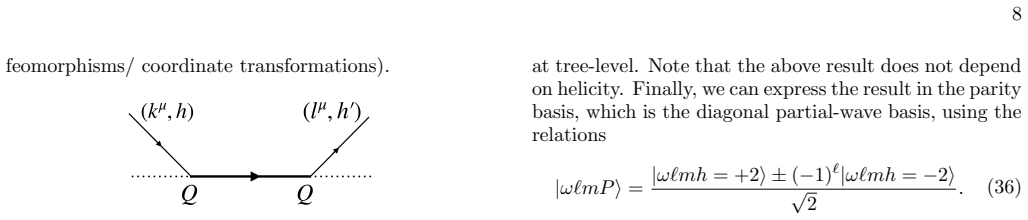
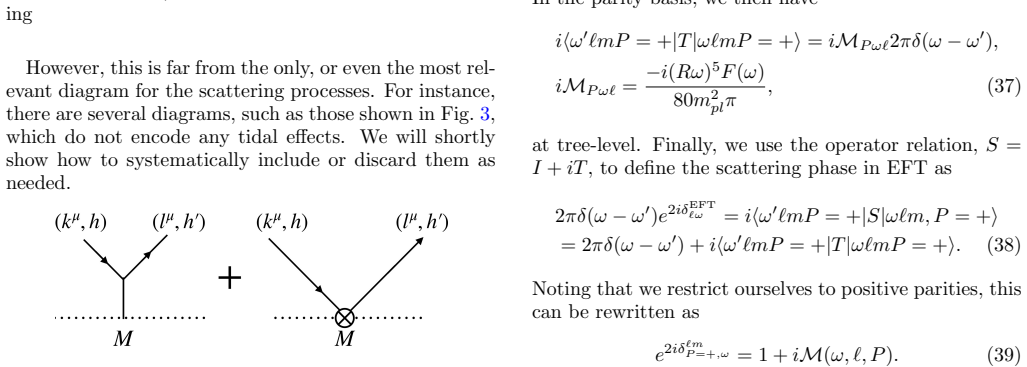
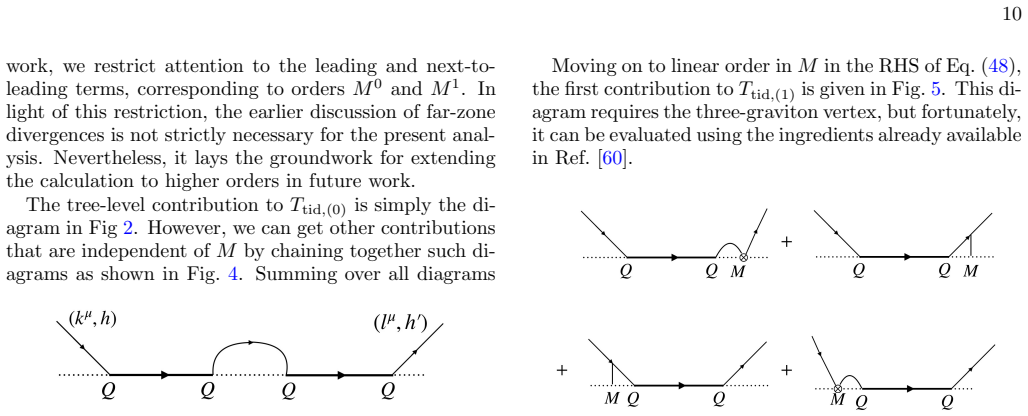
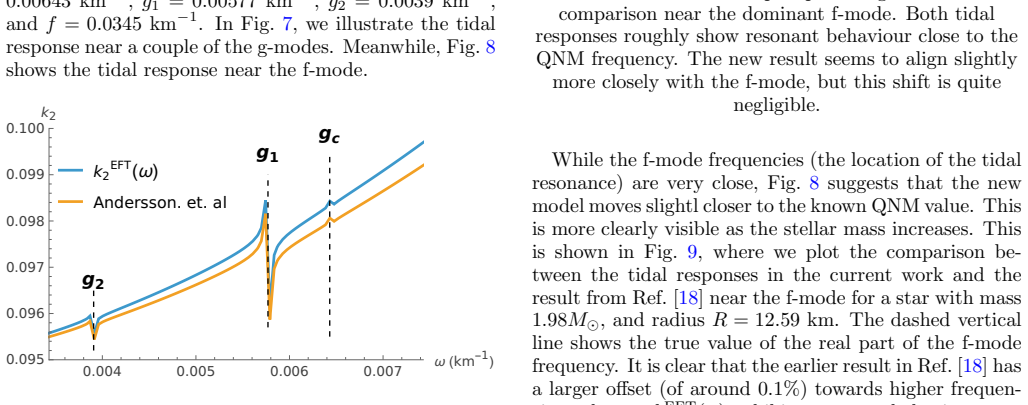
A key challenge of gravitational-wave physics is distinguishing the nature of compact objects in binary coalescences, in particular whether they are black holes or neutron stars. Neutron stars are set apart by a stronger tidal response, whose static and dynamical aspects are directly linked to their rich internal physics. Measurements of this response through gravitational-wave observations constrain the neutron-star equation of state and provide insight into the physics of high-density matter. However, defining the tidal response in general relativity is difficult due to coordinate ambiguities and the complexity of connecting the star's response to the binary dynamics and the associated waveforms. In this paper, we show how the dynamical tidal response of a neutron star can be systematically defined within the worldline effective field theory (EFT) framework, and relate it to the gauge-invariant amplitude for gravitational-wave scattering off an isolated star. We compute this amplitude both within the EFT, using standard quantum field-theory techniques, and within stellar perturbation theory (the corresponding ultraviolet theory), solving the coupled metric and matter perturbation equations numerically in the stellar interior and matching to the analytical Mano-Suzuki-Takasugi (MST) solutions in the vacuum exterior. Matching the amplitude between the two theories fixes the dynamical tidal response. The result is consistent with known expectations, including the static limit and the behaviour near the star's resonant modes, and it recovers the imaginary part of the dominant oscillation mode induced by gravitational-wave dissipation. We conclude with a discussion of potential improvements within both the EFT and perturbation theory.
Figures

Figures from the paper (7 more)





Forward citations
Cited by 2 Pith papers
-
Dynamical Tidal Response of Neutron Stars: from Effective Field Theory to Gravitational Waveforms
Complete leading-order dynamical tidal corrections to neutron-star binaries are derived in EFT, showing dynamical Love numbers enhanced relative to static ones and yielding measurable contributions to the GW phase at ...
-
Oscillations of Dissipative Neutron Stars: The Impact of Hyperonic Reaction Rates
Finite hyperonic reaction rates, encoded as a complex sound speed, damp neutron-star f-modes and remove hyperonic g-modes before their restoring force vanishes, producing a tidal lag.
Reviewed July 12, 2026 · model on record in the stance chip above.
Discussion (0). Continue with ORCID to comment.