Optimizing Wigner Negativity in Scattering Processes Using Energetic Cost Functions
Pith reviewed 2026-06-27 04:47 UTC · model grok-4.3
The pith
Energetic cost functions optimize Wigner negativity in coherent pulse scattering by a two-level atom, with peak efficiency below one input photon on average.
A machine-rendered reading of the paper's core claim, the machinery that carries it, and where it could break.
Core claim
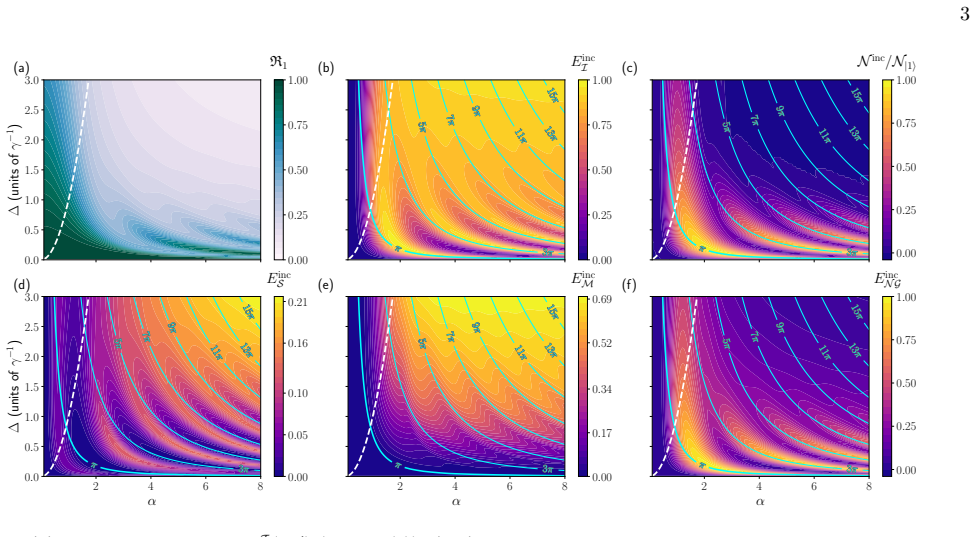
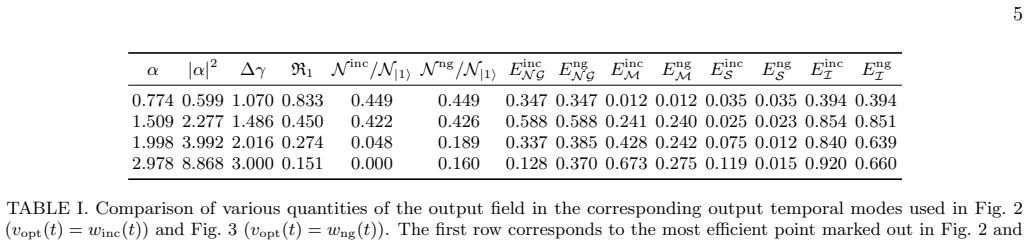
In the unitary scattering platform, energetic cost functions based on incoherent energy and a non-Gaussian contribution correlate with Wigner negativity across the multimode output, enabling identification of high-negativity modes; this correlation persists for finite-energy pulses, and efficiency is maximized when the average input photon number is less than one in a spectrally mode-matched pulse.
What carries the argument
Energetic cost functions (incoherent energy followed by isolation of the non-Gaussian contribution) applied to the multimode output field to proxy and optimize Wigner negativity.
If this is right
- Wigner negativity can be optimized by maximizing the identified energetic cost functions rather than computing full Wigner functions.
- The most energy-efficient negativity generation occurs at sub-unity average input photon number in a spectrally matched mode.
- The same cost-function approach applies equally to short intense pulses and to pulses that drive the atom during scattering.
- Output modes selected by the cost functions are the ones most likely to contain large negativities.
Where Pith is reading between the lines
- Weak coherent states may therefore serve as more efficient resources for non-Gaussian state preparation than stronger pulses in similar scattering setups.
- The cost-function method could be adapted to other bosonic scattering systems where full negativity calculations remain expensive.
- Real-time experimental feedback using only energy measurements might become feasible if the correlation survives additional decoherence channels.
Load-bearing premise
The energetic cost functions maintain a strong correlation with Wigner negativity across the multimode output for both short intense pulses and finite-energy driving pulses in the unitary scattering platform.
What would settle it
A direct computation or measurement demonstrating that the energetic cost functions lose their correlation with Wigner negativity for a chosen multimode output configuration under finite-energy driving would falsify the optimization claim.
Figures



read the original abstract
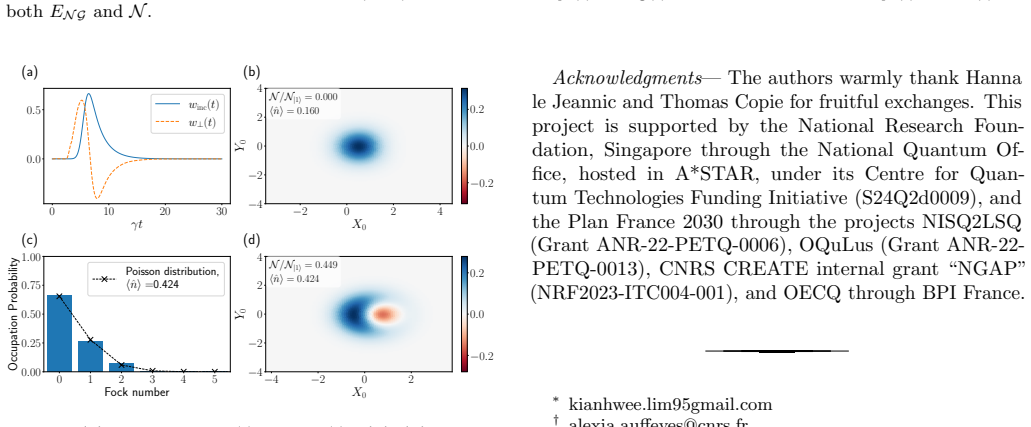
Wigner negativities (WNs) are key signatures of non-Gaussian bosonic states and essential resources for quantum technologies. We study their generation in the scattering of coherent pulses by a two-level atom coupled to a one-dimensional reservoir, a unitary and energy-preserving platform. Optimization in this multimode setting is hindered by the complexity of evaluating Wigner functions. We overcome this challenge by introducing energetic cost functions that identify output modes most likely to host large negativities. First using incoherent energy and then isolating a genuinely non-Gaussian contribution, we demonstrate a strong correlation between these quantities and WNs. This correlation extends beyond short, intense pulses to encompass pulses of finite energy, where photons are scattered while the two-level atom is driven. Focusing on the energy-efficiency of the process, we show that maximally efficient generation takes place for less than one input photon, on average, spectrally mode-matched with the atom.
Editorial analysis
A structured set of objections, weighed in public.
Referee Report
Summary. The paper studies Wigner negativity generation via scattering of coherent pulses from a two-level atom in a 1D reservoir. It introduces energetic cost functions (first incoherent energy, then a non-Gaussian contribution) as proxies to identify output modes likely to exhibit large negativity without computing full multimode Wigner functions. The central claims are that these proxies exhibit a strong correlation with actual Wigner negativity for both short intense pulses and finite-energy driving pulses, and that the energy-efficiency optimum occurs for mean input photon number below one when the pulse is spectrally mode-matched to the atom.
Significance. If the correlation is shown to be sufficiently tight and monotonic that the proxy maxima coincide with true negativity maxima (including in the sub-unity photon regime), the work supplies a practical route to optimize non-Gaussian resources in multimode continuous-variable systems where direct Wigner-function evaluation is prohibitive. The emphasis on energy efficiency at low photon numbers is relevant for near-term experiments.
major comments (2)
- [Abstract] Abstract: The assertion of a 'strong correlation' between the energetic cost functions and Wigner negativity, together with the claim that this correlation locates the global efficiency optimum, is presented without numerical values, error bars, or explicit verification that the argmax of either cost function coincides with the argmax of negativity when the mean input photon number is varied through the sub-unity regime. This verification is load-bearing for the efficiency claim.
- [Cost-function definitions] The construction of the cost functions from energy quantities selected precisely because they are anticipated to track negativity creates a moderate circularity risk: any reported correlation may partly reflect the proxy definition rather than an independent test. The manuscript must demonstrate that the functional relationship remains monotonic and offset-free below one photon so that the reported optimum is not an artifact.
minor comments (1)
- The distinction between 'incoherent energy' and the 'genuinely non-Gaussian contribution' should be given explicit mathematical definitions at first use, together with the precise multimode integration measure employed.
Simulated Author's Rebuttal
We thank the referee for the constructive feedback and for highlighting the potential utility of energetic cost functions in optimizing Wigner negativity. We address the two major comments point by point below, agreeing that the abstract would benefit from added quantitative detail and that further explicit checks on monotonicity are warranted.
read point-by-point responses
-
Referee: [Abstract] Abstract: The assertion of a 'strong correlation' between the energetic cost functions and Wigner negativity, together with the claim that this correlation locates the global efficiency optimum, is presented without numerical values, error bars, or explicit verification that the argmax of either cost function coincides with the argmax of negativity when the mean input photon number is varied through the sub-unity regime. This verification is load-bearing for the efficiency claim.
Authors: The main text already contains figures (e.g., Figs. 3 and 5) that report Pearson correlation coefficients above 0.85 across regimes and explicitly show that the argmax of both cost functions coincides with the negativity maximum for mean photon numbers below one when the pulse spectrum is matched to the atom. However, we acknowledge that these quantitative details are absent from the abstract. We will revise the abstract to include a concise statement of the correlation strength and the location of the efficiency optimum, thereby making the load-bearing verification visible at the summary level. revision: yes
-
Referee: [Cost-function definitions] The construction of the cost functions from energy quantities selected precisely because they are anticipated to track negativity creates a moderate circularity risk: any reported correlation may partly reflect the proxy definition rather than an independent test. The manuscript must demonstrate that the functional relationship remains monotonic and offset-free below one photon so that the reported optimum is not an artifact.
Authors: The cost functions are constructed from energy-partitioning quantities whose definitions follow directly from the unitary scattering dynamics and the decomposition of the output field into coherent and incoherent components; they are not fitted to negativity data. The correlation is then verified independently by computing the full multimode Wigner function in the same parameter space. We will add a dedicated subsection with additional panels that plot the cost functions against negativity for mean photon numbers ranging from 0.1 to 1.0, confirming monotonicity without offset and showing that the reported optimum remains unchanged under this explicit check. revision: yes
Circularity Check
No significant circularity detected
full rationale
The paper defines energetic cost functions from incoherent energy and non-Gaussian contributions, quantities independent of Wigner negativity. It then reports an empirical correlation between these functions and Wigner negativities as a demonstrated result rather than an input assumption. The location of the efficiency maximum is obtained by optimizing the cost functions, but this does not reduce by construction to the negativity measure itself; the correlation is checked separately and the cost functions are not defined in terms of negativity. No self-citations, uniqueness theorems, or ansatzes imported from prior author work appear in the derivation chain. The central claim therefore rests on independent energetic definitions and explicit correlation checks rather than tautological reduction.
Axiom & Free-Parameter Ledger
axioms (1)
- domain assumption Scattering of coherent pulses by the two-level atom in a one-dimensional reservoir is unitary and energy-preserving.
Reference graph
Works this paper leans on
-
[1]
Kenfack and K
A. Kenfack and K. ˙Zyczkowski, Negativity of the wigner function as an indicator of non-classicality, J. Opt. B: Quantum and Semiclass. Opt.6, 396 (2004)
2004
-
[2]
Albarelli, M
F. Albarelli, M. G. Genoni, M. G. A. Paris, and A. Ferraro, Resource theory of quantum non-Gaussianity and Wigner negativity, Phys. Rev. A , 052350 (2018)
2018
-
[3]
Adesso, F
G. Adesso, F. Dell’Anno, S. De Siena, F. Illuminati, and L. A. M. Souza, Optimal estimation of losses at the ulti- mate quantum limit with non-Gaussian states, Phys. Rev. A79, 040305 (2009)
2009
-
[4]
M. G. Genoni, C. Invernizzi, and M. G. A. Paris, En- hancement of parameter estimation by Kerr interaction, Phys. Rev. A80, 033842 (2009)
2009
-
[5]
K. C. Tan and H. Jeong, Nonclassical light and metrolog- ical power: An introductory review, AVS Quantum Sci. 1, 10.1116/1.5126696 (2019)
-
[6]
Q. R. Rahman, I. Kladari´ c, M.-E. Kern, L. Lachman, Y. Chu, R. Filip, and M. Fadel, Genuine quantum non- Gaussianity and metrological sensitivity of Fock states prepared in a mechanical resonator, Phys. Rev. Lett.134, 180801 (2025)
2025
-
[7]
Kenfack and K
A. Kenfack and K. Yczkowski, Negativity of the Wigner function as an indicator of non-classicality, J. Opt. B: Quantum Semiclass. Opt.6, 396 (2004)
2004
-
[8]
Mari and J
A. Mari and J. Eisert, Positive Wigner functions render classical simulation of quantum computation efficient, Phys. Rev. Lett.109, 230503 (2012)
2012
-
[9]
Veitch, N
V. Veitch, N. Wiebe, C. Ferrie, and J. Emerson, Efficient simulation scheme for a class of quantum optics experi- ments with non-negative Wigner representation, New J. Phys.15, 013037 (2013)
2013
-
[10]
A. I. Lvovsky, P. Grangier, A. Ourjoumtsev, V. Parigi, M. Sasaki, and R. Tualle-Brouri, Production and appli- 6 cations of non-Gaussian quantum states of light (2020), arXiv:2006.16985 [quant-ph]
arXiv 2020
-
[11]
M. G. Genoni, F. A. Beduini, A. Allevi, M. Bondani, S. Olivares, and M. G. A. Paris, Non-Gaussian states by conditional measurements, Phys. Scr.2010, 014007 (2010)
2010
-
[12]
Wang and S
Y. Wang and S. Zhou, Limitations of Gaussian measure- ments in quantum imaging, Phys. Rev. Lett.135, 120201 (2025)
2025
-
[13]
Y.-M. He, Y. He, Y.-J. Wei, D. Wu, M. Atat¨ ure, C. Schnei- der, S. H¨ ofling, M. Kamp, C.-Y. Lu, and J.-W. Pan, On-demand semiconductor single-photon source with near-unity indistinguishability, Nat. Nanotechnol.8, 213 (2013)
2013
-
[14]
Maffei, P
M. Maffei, P. A. Camati, and A. Auff` eves, Closed-system solution of the 1d atom from collision model, Entropy24, 151 (2022)
2022
-
[15]
S. P. Prasad, M. Maffei, P. A. Camati, C. Elouard, and A. Auff` eves, Thermodynamics of autonomous optical Bloch equations, SciPost Phys.20, 112 (2026)
2026
-
[16]
Scarpelli, B
L. Scarpelli, B. Lang, F. Masia, D. M. Beggs, E. A. Mul- jarov, A. B. Young, R. Oulton, M. Kamp, S. Hofling, C. Schneider, and W. Langbein, 99 % beta factor and directional coupling of quantum dots to fast light in pho- tonic crystal waveguides determined by spectral imaging, Phys. Rev. B100, 035311 (2019)
2019
-
[17]
Siampour, S
H. Siampour, S. Kumar, and S. I. Bozhevolnyi, Nanofab- rication of plasmonic circuits containing single photon sources, ACS Photonics4, 1879 (2017)
2017
-
[18]
Blais, A
A. Blais, A. L. Grimsmo, S. M. Girvin, and A. Wallraff, Circuit quantum electrodynamics, Rev. Mod. Phys.93, 025005 (2021)
2021
-
[19]
Javadi, D
A. Javadi, D. Ding, M. H. Appel, S. Mahmoodian, M. C. L¨ obl, I. S¨ ollner, R. Schott, C. Papon, T. Pregnolato, S. Stobbe, L. Midolo, T. Schr¨ oder, A. D. Wieck, A. Lud- wig, R. J. Warburton, and P. Lodahl, Spin–photon inter- face and spin-controlled photon switching in a nanobeam waveguide, Nat. Nanotechnol.13, 398 (2018)
2018
-
[20]
Sipahigil, R
A. Sipahigil, R. E. Evans, D. D. Sukachev, M. J. Bu- rek, J. Borregaard, M. K. Bhaskar, C. T. Nguyen, J. L. Pacheco, H. A. Atikian, C. Meuwly, R. M. Camacho, F. Jelezko, E. Bielejec, H. Park, M. Lonˇ car, and M. D. Lukin, An integrated diamond nanophotonics platform for quantum-optical networks, Science354, 847 (2016)
2016
-
[21]
C. Y. Hu, W. J. Munro, and J. G. Rarity, Deterministic photon entangler using a charged quantum dot inside a microcavity, Phys. Rev. B78, 125318 (2008)
2008
-
[22]
I.-C. Hoi, T. Palomaki, J. Lindkvist, G. Johansson, P. Delsing, and C. M. Wilson, Generation of nonclas- sical microwave states using an artificial atom in 1d open space, Phys. Rev. Lett.108, 263601 (2012)
2012
-
[23]
Javadi, I
A. Javadi, I. S¨ ollner, M. Arcari, S. L. Hansen, L. Midolo, S. Mahmoodian, G. Kirˇ sansk˙ e, T. Pregnolato, E. H. Lee, J. D. Song, S. Stobbe, and P. Lodahl, Single-photon non- linear optics with a quantum dot in a waveguide, Nat. Commun.6, 8655 (2015)
2015
-
[24]
Joshi, K
A. Joshi, K. Noh, and Y. Y. Gao, Quantum information processing with bosonic qubits in circuit QED, Quantum Sci. Technol.6, 033001 (2021)
2021
-
[25]
Krastanov, K
S. Krastanov, K. Jacobs, G. Gilbert, D. R. Englund, and M. Heuck, Controlled-phase gate by dynamic coupling of photons to a two-level emitter, npj Quantum Inf.8, 103 (2022)
2022
-
[26]
L. A. Pettersson, V. R. Christiansen, K. Mølmer, and A. S. Sørensen, High fidelity photon-photon gates by scattering off a two-level quantum emitter (2026), arXiv:2603.10805 [quant-ph]
arXiv 2026
-
[27]
Quijandr´ ıa, I
F. Quijandr´ ıa, I. Strandberg, and G. Johansson, Steady- state generation of Wigner-negative states in one- dimensional resonance fluorescence, Phys. Rev. Lett.121, 263603 (2018)
2018
-
[28]
Strandberg, Y
I. Strandberg, Y. Lu, F. Quijandr´ ıa, and G. Johansson, Numerical study of Wigner negativity in one-dimensional steady-state resonance fluorescence, Phys. Rev. A100, 063808 (2019)
2019
-
[29]
Kleinbeck, H
K. Kleinbeck, H. Busche, N. Stiesdal, S. Hofferberth, K. Mølmer, and H. P. B¨ uchler, Creation of nonclassical states of light in a chiral waveguide, Phys. Rev. A107, 013717 (2023)
2023
-
[30]
Brecht, D
B. Brecht, D. V. Reddy, C. Silberhorn, and M. G. Raymer, Photon temporal modes: A complete framework for quan- tum information science, Phys. Rev. X5, 041017 (2015)
2015
-
[31]
Loudon,The Quantum Theory of Light(Oxford Uni- versity Press, 2000)
R. Loudon,The Quantum Theory of Light(Oxford Uni- versity Press, 2000)
2000
-
[32]
K. T. Laverick, S. P. Prasad, P. Senellart, M. Maffei, and A. Auff` eves, An energetic constraint for qubit-qubit entanglement (2026), arXiv:2603.16225 [quant-ph]
Pith/arXiv arXiv 2026
-
[33]
S. S. Jafar, K. H. Lim, K. T. Laverick, S. P. Prasad, M. Maffei, and A. Auff` eves, (In Preparation)
-
[34]
R. W. Heeres, B. Vlastakis, E. Holland, S. Krastanov, V. V. Albert, L. Frunzio, L. Jiang, and R. J. Schoelkopf, Cavity state manipulation using photon-number selective phase gates, Phys. Rev. Lett.115, 137002 (2015)
2015
-
[35]
A. H. Kiilerich and K. Mølmer, Quantum interactions with pulses of radiation, Phys. Rev. A102, 023717 (2020)
2020
-
[36]
C. W. Gardiner and M. J. Collett, Input and output in damped quantum systems: Quantum stochastic differen- tial equations and the master equation, Phys. Rev. A31, 3761 (1985)
1985
-
[37]
Gardiner and P
C. Gardiner and P. Zoller,Quantum Noise: A Handbook of Markovian and Non-Markovian Quantum Stochastic Methods with Applications to Quantum Optics, Springer Series in Synergetics (Springer Berlin, Heidelberg, 2004)
2004
-
[38]
J. B. Conway,A Course in Functional Analysis(Springer New York, New York, NY, 2007)
2007
-
[39]
H. J. Carmichael,Statistical Methods in Quantum Op- tics 1: Master Equations and Fokker-Planck Equations, Theoretical and Mathematical Physics (Springer Berlin Heidelberg, 2013)
2013
-
[40]
See the Supplementary Material for details
-
[41]
Auff` eves-Garnier, C
A. Auff` eves-Garnier, C. Simon, J.-M. G´ erard, and J.-P. Poizat, Giant optical nonlinearity induced by a single two-level system interacting with a cavity in the Purcell regime, Phys. Rev. A75, 053823 (2007)
2007
-
[42]
Y. Wang, J. Min´ aˇ r, L. Sheridan, and V. Scarani, Efficient excitation of a two-level atom by a single photon in a propagating mode, Phys. Rev. A83, 063842 (2011)
2011
-
[43]
Stobi´ nska, G
M. Stobi´ nska, G. Alber, and G. Leuchs, Perfect excita- tion of a matter qubit by a single photon in free space, Europhys. Lett.86, 14007 (2009)
2009
-
[44]
Kojima, H
K. Kojima, H. F. Hofmann, S. Takeuchi, and K. Sasaki, Efficiencies for the single-mode operation of a quantum optical nonlinear shift gate, Phys. Rev. A70, 013810 (2004)
2004
-
[45]
virtual cavity
R. Storn and K. Price, Differential evolution – a sim- ple and efficient heuristic for global optimization over continuous spaces, J. Glob. Optim.11, 341 (1997). 7 End Matter Computing the Wigner Function of the detected mode The Wigner Function of a temporal mode ˆbv of the output field can be computed following the method proposed in Ref. [ 35]. For com...
1997
discussion (0)
Sign in with ORCID, Apple, or X to comment. Anyone can read and Pith papers without signing in.