Certified Finite-Shot Operating Windows for Virtual Distillation and Symmetry Verification
Pith reviewed 2026-06-27 03:47 UTC · model grok-4.3
The pith
Finite-shot mean-squared-error laws with explicit remainders create certified operating windows that classify comparisons of virtual distillation and symmetry verification as ties, dominance, or tradeoffs.
A machine-rendered reading of the paper's core claim, the machinery that carries it, and where it could break.
Core claim
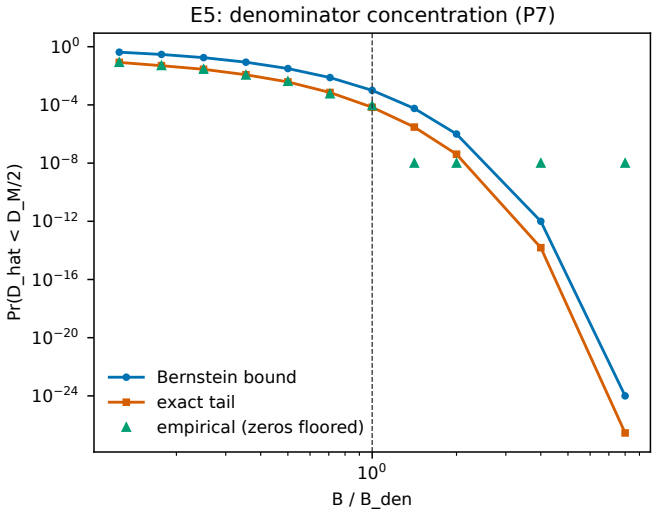
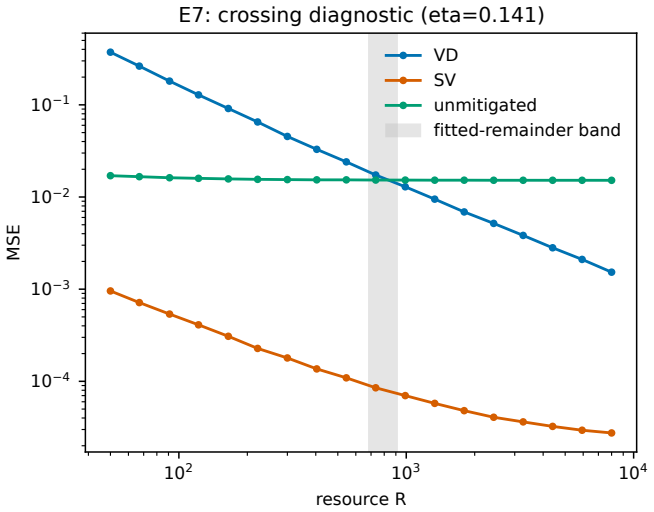
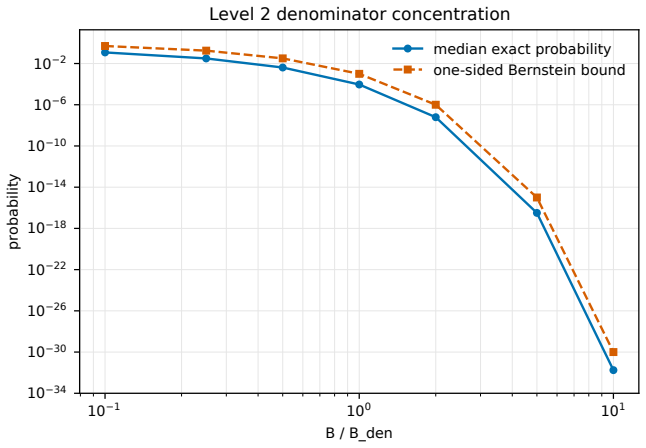
For each method we prove a mean-squared-error law with explicit non-asymptotic remainders. For VD, the law exposes quotient-estimator bias, denominator-driven variance, and a concentration certificate for when the denominator is statistically resolved. For SV, it separates the residual bias from undetectable errors from the sampling penalty set by the acceptance probability. These laws induce a selection trichotomy: a two-method comparison is a tie, a uniform dominance relation, or a genuine tradeoff with a certified crossing window and a self-consistency test.
What carries the argument
The mean-squared-error laws with explicit non-asymptotic remainders that induce the selection trichotomy for finite-shot method comparisons.
If this is right
- A two-method comparison is classified as a tie, a uniform dominance relation, or a genuine tradeoff with a certified crossing window and self-consistency test.
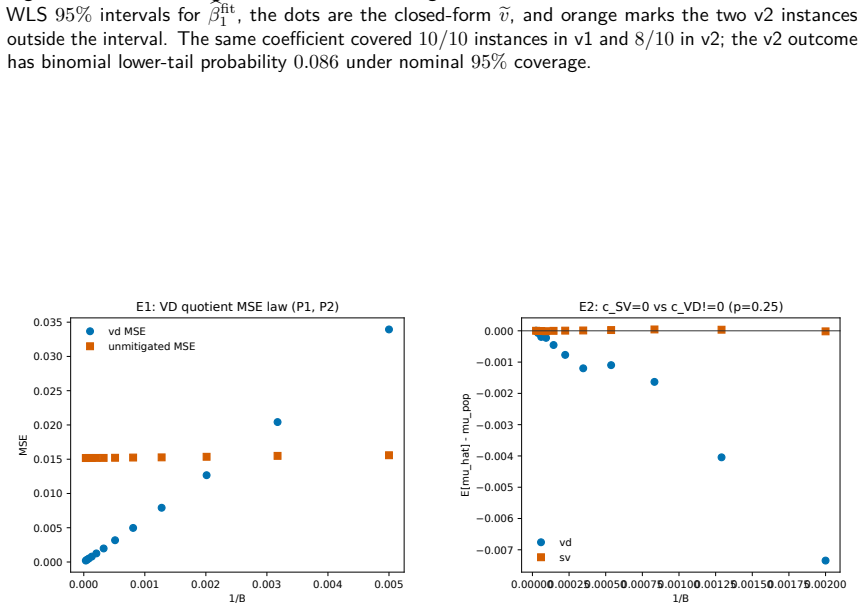
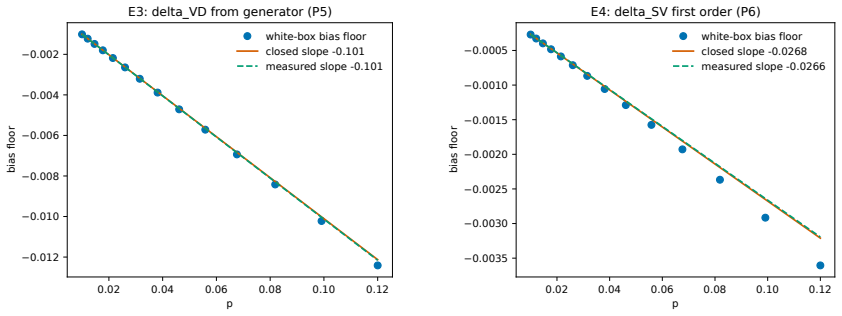
- Exact white-box experiments confirm the predicted p to the minus two operating-window scale with fitted exponent minus 1.97 and 300 out of 300 sign agreement.
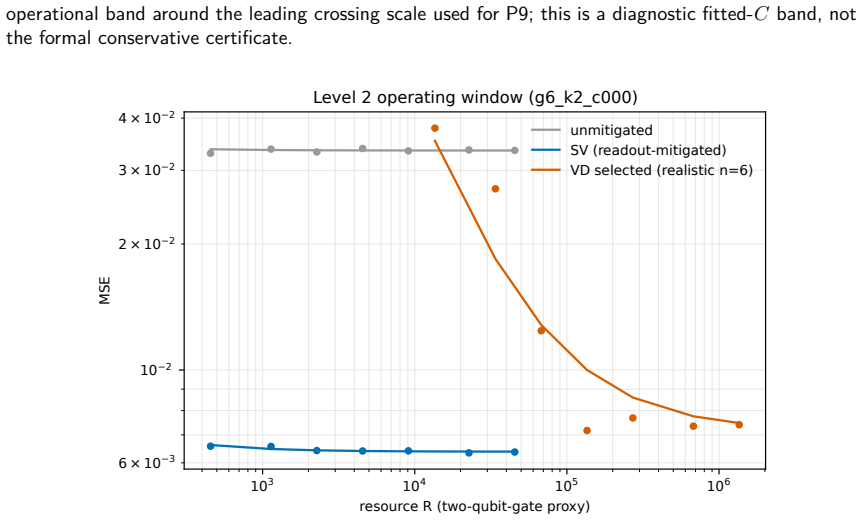
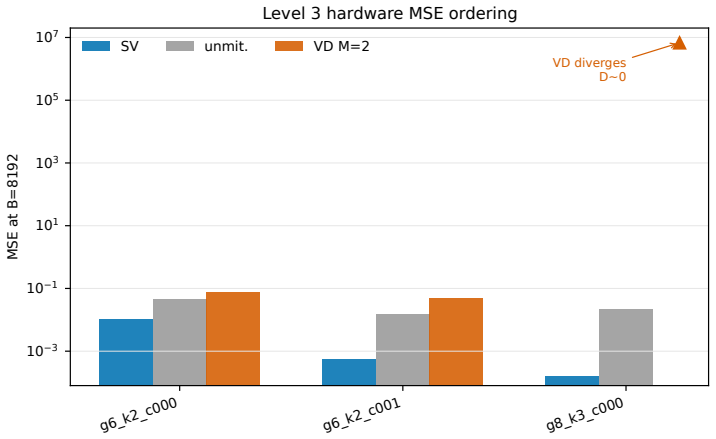
- Gate-level simulation and archived IBM hardware runs show that idealized VD windows exist but realistic interferometry overhead and denominator instability move them outside the tested resource range.
- Calibrated SV exhibits lower mean-squared error than VD in the tested QAOA instances under device conditions.
Where Pith is reading between the lines
- The same finite-shot MSE framework could be applied to compare additional error-mitigation techniques beyond VD and SV.
- Device-specific recalibration of the crossing windows may be needed when hardware noise profiles differ from the tested QAOA instances.
- The self-consistency test embedded in the trichotomy offers a practical way to flag when finite-shot assumptions break before committing resources.
Load-bearing premise
The mean-squared-error laws with explicit non-asymptotic remainders are provable and induce the trichotomy in finite-shot regimes.
What would settle it
White-box experiments that fail to recover the predicted p to the minus two operating-window scale or that show fewer than 300 out of 300 sign agreements in a pre-specified analysis would falsify the claimed laws.
Figures
read the original abstract
Quantum error mitigation methods are often compared through infinite-shot bias, but real experiments are decided by finite sampling budgets, estimator instabilities, and per-shot resource costs. We develop a certified finite-shot operating-window theory for comparing virtual distillation (VD) and symmetry verification (SV). For each method we prove a mean-squared-error law with explicit non-asymptotic remainders. For VD, the law exposes quotient-estimator bias, denominator-driven variance, and a concentration certificate for when the denominator is statistically resolved. For SV, it separates the residual bias from undetectable errors from the sampling penalty set by the acceptance probability. These laws induce a selection trichotomy: a two-method comparison is a tie, a uniform dominance relation, or a genuine tradeoff with a certified crossing window and a self-consistency test. Exact white-box experiments confirm the predicted $p^{-2}$ operating-window scale with fitted exponent $-1.97$ and show $300/300$ sign agreement in a pre-specified analysis; the single strict all-instance criterion not met is reported with its calibration analysis. Gate-level simulation and archived IBM hardware runs then test the windows under device conditions: idealized VD windows exist, but realistic interferometry overhead and denominator instability move them outside the tested resource range, while calibrated SV has lower MSE in the tested QAOA instances. The result is a regime statement, not a universal ranking: certified operating windows explain when mitigation advantages should appear or disappear, and keep coefficient-level validation separate from noisy-device evidence.
Editorial analysis
A structured set of objections, weighed in public.
Referee Report
Summary. The paper develops a certified finite-shot operating-window theory for comparing virtual distillation (VD) and symmetry verification (SV). For each method it proves a mean-squared-error law with explicit non-asymptotic remainders; these laws induce a selection trichotomy (tie, uniform dominance, or genuine tradeoff with certified crossing window and self-consistency test). White-box experiments confirm the predicted p^{-2} scaling (fitted exponent -1.97) with 300/300 sign agreement in a pre-specified analysis; gate-level simulations and archived IBM hardware runs then test the windows under device conditions, yielding context-dependent regime statements rather than a universal ranking.
Significance. If the derivations hold, the work supplies a rigorous, non-asymptotic framework that moves error-mitigation comparisons from infinite-shot bias to finite-shot certified operating windows, directly addressing practical sampling budgets and per-shot costs. The explicit remainders, concentration certificates, self-consistency tests, and reproducible white-box plus device experiments constitute clear strengths that enable falsifiable regime predictions.
minor comments (3)
- §3 (VD MSE law): the concentration certificate for the denominator is stated to resolve statistical instability, but the transition from the non-asymptotic remainder to the operating-window boundary is not accompanied by an explicit numerical threshold or pseudocode; adding this would improve reproducibility.
- Table 1 / Figure 3: the hardware-run panels report that idealized VD windows move outside the tested resource range due to interferometry overhead, yet the precise overhead factor and its propagation into the MSE law are not tabulated; a short supplementary table would clarify the shift.
- The single strict all-instance criterion not met is noted with its calibration analysis, but the main text does not state the numerical value of that criterion or the calibration tolerance used; explicit inclusion would strengthen the transparency claim.
Simulated Author's Rebuttal
We thank the referee for the positive and accurate summary of our work on certified finite-shot operating windows for virtual distillation and symmetry verification. The significance assessment correctly highlights the non-asymptotic framework, explicit remainders, and reproducible experiments. We note the recommendation for minor revision; with no specific major comments provided in the report, we will incorporate any editorial or minor clarifications in the revised manuscript.
Circularity Check
No significant circularity
full rationale
The paper's central derivation proves explicit non-asymptotic MSE laws for VD and SV from the definitions of their estimators (quotient bias and denominator variance for VD; residual bias versus acceptance probability for SV). These laws analytically induce the trichotomy of tie, dominance, or certified crossing window without reference to fitted parameters or experimental outcomes. White-box experiments are used only for post-hoc confirmation of the predicted p^{-2} scaling (with separate fitted exponent reported as validation metric) and sign agreement counts; the laws are not obtained by fitting or self-definition. No load-bearing self-citations, imported uniqueness theorems, or ansatzes appear in the argument structure. The result is self-contained.
Axiom & Free-Parameter Ledger
Reference graph
Works this paper leans on
-
[1]
Z. Cai, R. Babbush, S. C. Benjamin, S. Endo, W. J. Huggins, Y. Li, J. R. McClean, and T. E. O’Brien. Quantum error mitigation.Reviews of Modern Physics, 95:045005,
-
[2]
doi:10.1103/RevModPhys.95.045005
-
[3]
Error mitigation for short-depth quantum circuits
K. Temme, S. Bravyi, and J. M. Gambetta. Error mitigation for short-depth quantum circuits.Physical Review Letters, 119:180509, 2017. doi:10.1103/PhysRevLett.119.180509
work page internal anchor Pith review doi:10.1103/physrevlett.119.180509 2017
-
[4]
Y. Li and S. C. Benjamin. Efficient variational quantum simulator in- corporating active error minimization.Physical Review X, 7:021050, 2017. doi:10.1103/PhysRevX.7.021050
-
[5]
S.Endo, S.C.Benjamin, andY.Li. Practicalquantumerrormitigationfornear-future applications.Physical Review X, 8:031027, 2018. doi:10.1103/PhysRevX.8.031027
-
[6]
X. Bonet-Monroig, R. Sagastizabal, M. Singh, and T. E. O’Brien. Low-cost er- ror mitigation by symmetry verification.Physical Review A, 98:062339, 2018. doi:10.1103/PhysRevA.98.062339
-
[7]
S. McArdle, X. Yuan, and S. Benjamin. Error-mitigated digital quantum simulation. Physical Review Letters, 122:180501, 2019. doi:10.1103/PhysRevLett.122.180501
-
[8]
P. Czarnik, A. Arrasmith, P. J. Coles, and L. Cincio. Error mitigation with Clifford quantum-circuit data.Quantum, 5:592, 2021. doi:10.22331/q-2021-11-26-592
-
[9]
A. Lowe, M. H. Gordon, P. Czarnik, A. Arrasmith, P. J. Coles, and L. Cincio. Uni- fied approach to data-driven quantum error mitigation.Physical Review Research, 3:033098, 2021. doi:10.1103/PhysRevResearch.3.033098
-
[10]
W.J.Huggins, S.McArdle, T.E.O’Brien, J.Lee, N.C.Rubin, S.Boixo, K.B.Whaley, R. Babbush, and J. R. McClean. Virtual distillation for quantum error mitigation. Physical Review X, 11:041036, 2021. doi:10.1103/PhysRevX.11.041036
-
[11]
B. Koczor. Exponential error suppression for near-term quantum devices.Physical Review X, 11:031057, 2021. doi:10.1103/PhysRevX.11.031057
-
[12]
M. Huo and Y. Li. Dual-state purification for practical quantum error mitigation. Physical Review A, 105:022427, 2022. doi:10.1103/PhysRevA.105.022427
-
[13]
H. Hakoshima, S. Endo, K. Yamamoto, Y. Matsuzaki, and N. Yoshioka. Localized virtual purification.Physical Review Letters, 133:080601, 2024. doi:10.1103/PhysRevLett.133.080601
-
[14]
X. Yuan, B. Regula, R. Takagi, and M. Gu. Virtual quantum resource distillation. Physical Review Letters, 132:050203, 2024. doi:10.1103/PhysRevLett.132.050203
-
[15]
D. Bultrini, M. H. Gordon, P. Czarnik, A. Arrasmith, M. Cerezo, P. J. Coles, and L. Cincio. Unifying and benchmarking state-of-the-art quantum error mitigation tech- niques.Quantum, 7:1034, 2023. doi:10.22331/q-2023-06-06-1034. 33
-
[16]
A. Ijaz, C. Huerta Alderete, F. Sauvage, L. Cincio, M. Cerezo, and M. L. Goh. More buck-per-shot: Why learning trumps mitigation in noisy quantum sensing.Materials Today Quantum, 6:100042, 2025. doi:10.1016/j.mtquan.2025.100042
-
[17]
B. Koczor. The dominant eigenvector of a noisy quantum state.New Journal of Physics, 23:123047, 2021. doi:10.1088/1367-2630/ac37ae
-
[18]
R. Sagastizabal, X. Bonet-Monroig, M. Singh, M. A. Rol, C. C. Bultink, X. Fu, C. H. Price, V. P. Ostroukh, N. Muthusubramanian, A. Bruno, M. Beekman, N. Haider, T. E. O’Brien, and L. DiCarlo. Experimental error mitigation via symmetry verifica- tion in a variational quantum eigensolver.Physical Review A, 100:010302(R), 2019. doi:10.1103/PhysRevA.100.010302
-
[19]
A. Kakkar, J. Larson, A. Galda, and R. Shaydulin. Characterizing error mit- igation by symmetry verification in QAOA. In2022 IEEE International Con- ference on Quantum Computing and Engineering (QCE), pages 306–316, 2022. doi:10.1109/QCE53715.2022.00086
-
[20]
Z. Cai. Quantum error mitigation using symmetry expansion.Quantum, 5:548, 2021. doi:10.22331/q-2021-09-21-548
-
[21]
Y. S. Teo, S. Shin, H. Kwon, S.-H. Lee, and H. Jeong. Virtual distillation with noise dilution.Physical Review A, 107:022608, 2023. doi:10.1103/PhysRevA.107.022608
-
[22]
P. Vikstal, G. Ferrini, and S. Puri. Study of noise in virtual distillation circuits for quantum error mitigation.Quantum, 8:1441, 2024. doi:10.22331/q-2024-08-14-1441
-
[23]
T. E. O’Brien et al. Purification-based quantum error mitigation of pair-correlated electron simulations.Nature Physics, 19:1787–1792, 2023. doi:10.1038/s41567-023- 02240-y
-
[24]
M. Demarty, B. Yang, K. Hammam, and P. Besserve. Error-mitigation aware benchmarking strategy for quantum optimization problems. arXiv:2601.18680, 2026. doi:10.48550/arXiv.2601.18680
-
[25]
M. Seksaria and A. Prabhakar. Estimating shots and variance on noisy quantum circuits. arXiv:2501.03194, 2025. doi:10.48550/arXiv.2501.03194
-
[26]
P. Niroula, S. Gopalakrishnan, and M. J. Gullans. Error mitigation thresholds in noisy random quantum circuits.Physical Review B, 112:024206, 2025. doi:10.1103/qsmz- 9kkh
-
[27]
A. Javadi-Abhari et al. Quantum computing with Qiskit. arXiv:2405.08810, 2024. doi:10.48550/arXiv.2405.08810
work page internal anchor Pith review Pith/arXiv arXiv doi:10.48550/arxiv.2405.08810 2024
-
[28]
F. B. Maciejewski, Z. Zimboras, and M. Oszmaniec. Mitigation of readout noise in near-term quantum devices by classical post-processing based on detector tomography. Quantum, 4:257, 2020. doi:10.22331/q-2020-04-24-257
-
[29]
S. Bravyi, S. Sheldon, A. Kandala, D. C. McKay, and J. M. Gambetta. Mitigating measurement errors in multiqubit experiments.Physical Review A, 103:042605, 2021. doi:10.1103/PhysRevA.103.042605
-
[30]
W. G. Cochran.Sampling Techniques. Wiley, 3rd edition, 1977. ISBN 978-0-471- 16240-7
1977
-
[31]
T. Kato.Perturbation Theory for Linear Operators. Springer, 1995. doi:10.1007/978- 3-642-66282-9
-
[32]
R. A. Horn and C. R. Johnson.Matrix Analysis. Cambridge University Press, 2nd edition, 2013. ISBN 978-0-521-83940-2
2013
-
[33]
S. Boucheron, G. Lugosi, and P. Massart.Concentration Inequalities: A Nonasymp- totic Theory of Independence. Oxford University Press, 2013.doi:10.1093/acprof: oso/9780199535255.001.0001. 34
-
[34]
A. K. Ekert, C. M. Alves, D. K. L. Oi, M. Horodecki, P. Horodecki, and L. C. Kwek. Direct estimations of linear and nonlinear functionals of a quantum state.Physical Review Letters, 88:217901, 2002. doi:10.1103/PhysRevLett.88.217901
-
[35]
E. van den Berg, Z. K. Minev, A. Kandala, and K. Temme. Probabilistic error can- cellation with sparse Pauli–Lindblad models on noisy quantum processors.Nature Physics, 19:1116–1121, 2023. doi:10.1038/s41567-023-02042-2
-
[36]
R. Takagi, S. Endo, S. Minagawa, and M. Gu. Fundamental limits of quantum error mitigation.npj Quantum Information, 8:114, 2022. doi:10.1038/s41534-022-00618-z
-
[37]
R. Takagi, H. Tajima, and M. Gu. Universal sampling lower bounds for quantum error mitigation.Physical Review Letters, 131:210602, 2023. doi:10.1103/PhysRevLett.131.210602
-
[38]
Tsubouchi, T
K. Tsubouchi, T. Sagawa, and N. Yoshioka. Universal cost bound of quantum error mitigation based on quantum estimation theory.Physical Review Letters, 131:210601,
-
[39]
doi:10.1103/PhysRevLett.131.210601
-
[40]
Y. Quek, D. Stilck França, S. Khatri, J. J. Meyer, and J. Eisert. Exponentially tighter bounds on limitations of quantum error mitigation.Nature Physics, 20:1648–1658,
-
[41]
doi:10.1038/s41567-024-02536-7
-
[42]
L. Le Cam. Convergence of estimates under dimensionality restrictions.The Annals of Statistics, 1:38–53, 1973. doi:10.1214/aos/1193342380
-
[43]
A. B. Tsybakov.Introduction to Nonparametric Estimation. Springer, 2009. doi:10.1007/b13794
-
[44]
A. W. van der Vaart.Asymptotic Statistics. Cambridge University Press, 1998. doi:10.1017/CBO9780511802256
-
[45]
A Quantum Approximate Optimization Algorithm
E. Farhi, J. Goldstone, and S. Gutmann. A quantum approximate optimization algo- rithm. arXiv:1411.4028, 2014. doi:10.48550/arXiv.1411.4028
work page internal anchor Pith review Pith/arXiv arXiv doi:10.48550/arxiv.1411.4028 2014
-
[46]
S. Hadfield, Z. Wang, B. O’Gorman, E. G. Rieffel, D. Venturelli, and R. Biswas. From the quantum approximate optimization algorithm to a quantum alternating operator ansatz.Algorithms, 12:34, 2019. doi:10.3390/a12020034
-
[47]
B. A. Nosek, C. R. Ebersole, A. C. DeHaven, and D. T. Mellor. The preregistration revolution.Proceedings of the National Academy of Sciences, 115:2600–2606, 2018. doi:10.1073/pnas.1708274114. doi:10.1002/pst.291
-
[48]
H. Akaike. A new look at the statistical model identification.IEEE Transactions on Automatic Control, 19:716–723, 1974. doi:10.1109/TAC.1974.1100705
-
[49]
K. P. Burnham and D. R. Anderson.Model Selection and Multimodel Infer- ence: A Practical Information-Theoretic Approach. Springer, 2nd edition, 2002. doi:10.1007/b97636
-
[50]
D. J. Schuirmann. A comparison of the two one-sided tests procedure and the power approach for assessing the equivalence of average bioavailability.Journal of Pharma- cokinetics and Biopharmaceutics, 15:657–680, 1987. doi:10.1007/BF01068419
-
[51]
T. Giurgica-Tiron, Y. Hindy, R. LaRose, A. Mari, and W. J. Zeng. Digital zero noise extrapolation for quantum error mitigation. In2020 IEEE International Conference on Quantum Computing and Engineering (QCE), pages 306–316, 2020. doi:10.1109/QCE49297.2020.00045
-
[52]
B. Efron and R. J. Tibshirani.An Introduction to the Bootstrap. Chapman and Hall/CRC, 1993. doi:10.1201/9780429246593. 35 A Quotient delta-method template Let(U s,Vs)B s=1 be i.i.d. with means(u,v),v >0, and covariance matrix Σ = ( σ2 U σUV σUV σ2 V ) .(A.1) Let ˆu=B −1∑ sUs, ˆv=B −1∑ sVs, and ˆθ=ˆu/ˆv. Withθ=u/v, Eˆθ=θ+θσ2 V−σUV Bv2 +RE(B),(A.2) Var(ˆθ) ...
-
[53]
selected
Hence |cVD,2| B =|µVD,2|σ2 D D2 2B ≤1−D2 2 D2 2B < 0.09 B < 4 R.(C.27) The remaining expectation remainder is controlled by Equation (E.4): Asector E,VD,2 B2 < 3.1×10³ (106)2 <3.1×10⁻⁹.(C.28) For the denominator event, Equation (E.10) givesBden,2≤31 log(2×10⁶)< 4.5×10² at failure probability10−6, while hereB = 106; hence the exponentially small denominato...
discussion (0)
Sign in with ORCID, Apple, or X to comment. Anyone can read and Pith papers without signing in.