Production of high-orbital kaon excited states in the K⁻p reaction
Pith reviewed 2026-06-27 04:05 UTC · model grok-4.3
The pith
Effective Lagrangian model with one fitted parameter reproduces cross sections for four high-orbital kaons and predicts sizable forward-peaked production for others in K-p reactions.
A machine-rendered reading of the paper's core claim, the machinery that carries it, and where it could break.
Core claim
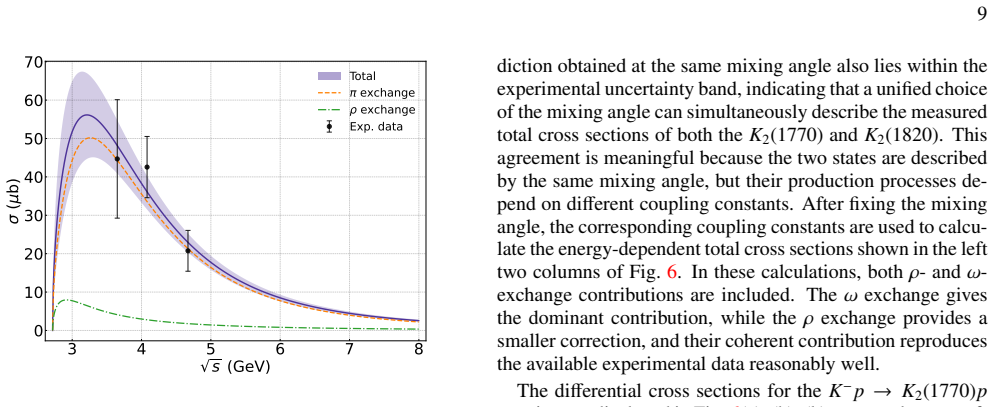
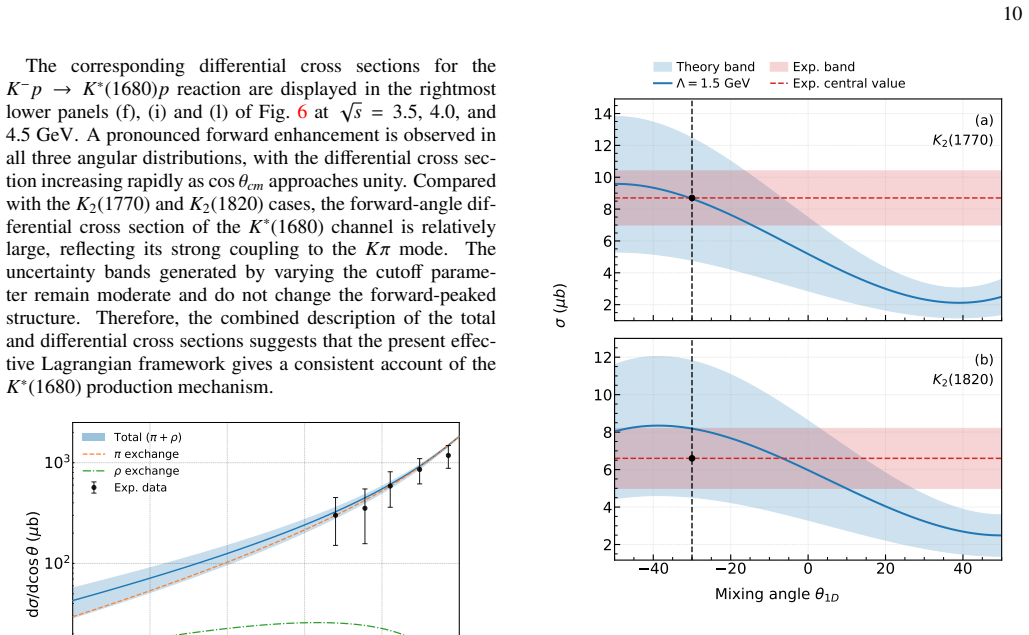
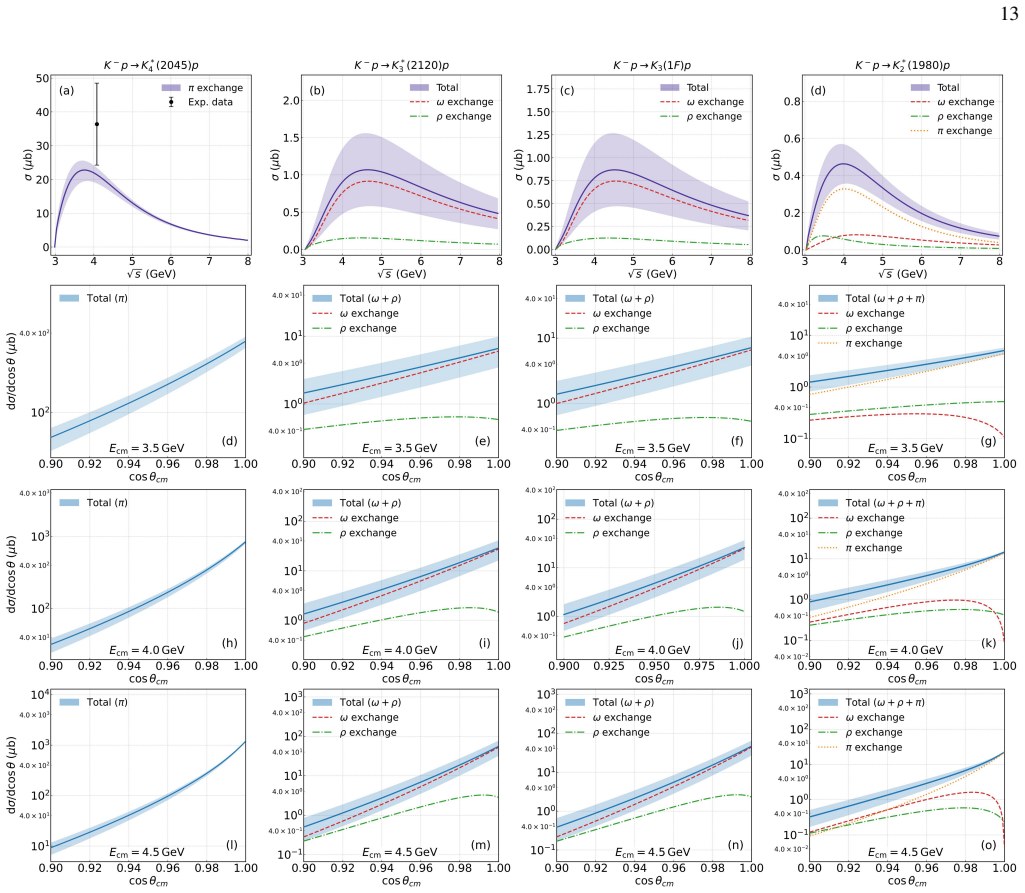
Within the effective Lagrangian approach the relevant t-channel processes are constructed and the model is calibrated using a single adjustable parameter determined from existing experimental data. With this parameter the measured production cross sections for the K3*(1780), K2(1820), K2(1770) and K4*(2045) states are successfully reproduced. Employing the same framework the production cross sections for other high-orbital kaons are predicted, indicating that these states possess sizable cross sections and exhibit characteristically forward-peaked angular distributions.
What carries the argument
The t-channel effective Lagrangian framework calibrated by a single adjustable parameter that sets the overall coupling strength for the exchange processes.
If this is right
- The production cross sections for other high-orbital kaons are sizable.
- The angular distributions of these states are forward-peaked, a typical feature of t-channel exchange.
- The states possess great potential for observation in future experiments.
Where Pith is reading between the lines
- If the predictions hold, beam experiments that can produce intense K- fluxes at appropriate energies would be well positioned to search for the additional states.
- The forward-peaked character implies that detectors covering small scattering angles would capture most of the signal events.
- The success of a one-parameter description may motivate similar economical models for production of high-orbital states in other light-meson families.
Load-bearing premise
The single adjustable parameter fitted to the four measured states remains valid and sufficient when the same t-channel effective Lagrangian framework is applied to predict cross sections and angular distributions for additional high-orbital kaon states.
What would settle it
An experimental measurement of the production cross section or angular distribution for any one of the predicted high-orbital kaon states that deviates substantially from the calculated value would falsify the claim that the single-parameter framework applies generally.
Figures



read the original abstract
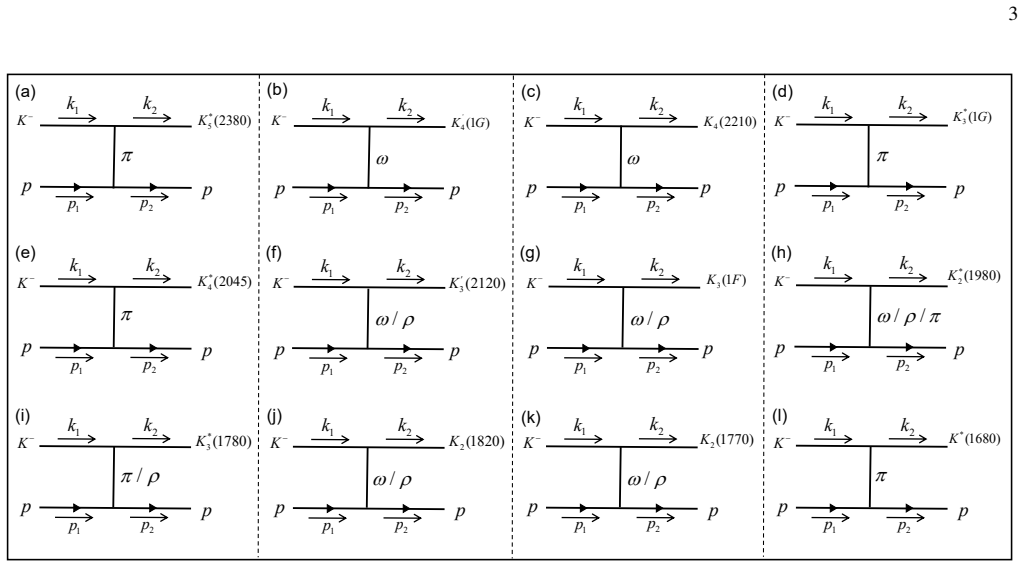
In this work, a systematic investigation of the production of high-orbital-excitation kaons in $K^{-}p$ reactions is carried out within an effective Lagrangian approach. The relevant $t$-channel processes are constructed, and the model is calibrated using a single adjustable parameter determined from existing experimental data. With this parameter, the measured production cross sections for the $K_3^*(1780)$, $K_2(1820)$, $K_2(1770)$ and $K_4^*(2045)$ states are successfully reproduced. Employing the same framework, the production cross sections for other high-orbital kaons are predicted. The results indicate that these states possess sizable cross sections and exhibit characteristically forward-peaked angular distributions, which is a typical feature of $t$-channel exchange, highlighting their great potential for observation in future experiments.
Editorial analysis
A structured set of objections, weighed in public.
Referee Report
Summary. The manuscript presents a systematic study of high-orbital kaon production in K^{-}p reactions within an effective Lagrangian framework restricted to t-channel exchange. A single adjustable parameter is determined by fitting existing data and is then used both to reproduce the measured cross sections for K_{3}*(1780), K_{2}(1820), K_{2}(1770) and K_{4}*(2045) and to generate predictions for additional high-orbital states, which are reported to be sizable and forward-peaked.
Significance. If the construction of the t-channel vertices and propagators for different J^P states can be shown to introduce no further independent constants, the work would supply concrete, falsifiable predictions that could guide experimental searches at facilities capable of high-statistics K^{-}p measurements.
major comments (2)
- [Abstract] Abstract: the statement that the four measured cross sections 'are successfully reproduced' with one adjustable parameter presupposes that the effective Lagrangian for high-spin fields (J=2,3,4) contains only a single overall scale; the manuscript must explicitly display the vertex structures and demonstrate that no additional independent couplings or cutoff parameters are required for each J^P.
- [Abstract] Abstract / Results section: because all predictions for unmeasured states are generated by the identical parameter fixed on the four measured cross sections, the claim that these constitute independent predictions of the underlying dynamics requires a demonstration that the t-channel construction remains parameter-free beyond that single constant when the masses and spins are varied.
minor comments (1)
- The abstract refers to 'the relevant t-channel processes' without quoting the explicit Lagrangians, propagators or form-factor choices; these should be written out in the formalism section to allow independent verification of the single-parameter claim.
Simulated Author's Rebuttal
We thank the referee for the careful reading of our manuscript and for the constructive comments. We address each major point below and will incorporate revisions to strengthen the presentation of the effective Lagrangian construction.
read point-by-point responses
-
Referee: [Abstract] Abstract: the statement that the four measured cross sections 'are successfully reproduced' with one adjustable parameter presupposes that the effective Lagrangian for high-spin fields (J=2,3,4) contains only a single overall scale; the manuscript must explicitly display the vertex structures and demonstrate that no additional independent couplings or cutoff parameters are required for each J^P.
Authors: We agree that the abstract claim would benefit from explicit support. In the revised manuscript we will add a new subsection (or appendix) that displays the full t-channel vertex Lagrangians for the J^P = 2^+, 2^-, 3^-, and 4^+ states. These vertices are constructed from the standard Rarita-Schwinger formalism with a single overall coupling constant g that is fixed once by the data; the same g is used for all states, and the propagators follow the standard high-spin forms without additional cutoff parameters or J^P-dependent couplings. This will make clear that the reproduction of the four measured cross sections relies on only that single scale. revision: yes
-
Referee: [Abstract] Abstract / Results section: because all predictions for unmeasured states are generated by the identical parameter fixed on the four measured cross sections, the claim that these constitute independent predictions of the underlying dynamics requires a demonstration that the t-channel construction remains parameter-free beyond that single constant when the masses and spins are varied.
Authors: We will revise the Results section to include explicit amplitude expressions (or a compact table) showing that, once the single coupling is fixed, the differential cross sections for any additional high-orbital state are completely determined by the known masses (taken from the PDG), the standard propagator structures, and the same vertex form factors. No new constants are introduced when the spin or mass is changed; the only variation comes from the kinematic factors and the Clebsch-Gordan coefficients inherent to the given J^P. This will substantiate that the predictions are independent of further adjustable parameters. revision: yes
Circularity Check
No circularity: single-parameter fit to four states enables independent extrapolation to unmeasured states
full rationale
The paper constructs a t-channel effective Lagrangian framework, introduces one adjustable parameter calibrated on existing data for four measured states (K3*(1780), K2(1820), K2(1770), K4*(2045)), reproduces those cross sections, and then applies the identical framework to predict cross sections and angular distributions for additional unmeasured high-orbital kaon states. No quoted equation or step reduces any prediction to the fitted inputs by definition; the predictions concern distinct final states whose cross sections were not used in the fit. No self-citations, uniqueness theorems, or ansatze are invoked in the provided text to justify the framework. This is ordinary model calibration followed by extrapolation, which remains falsifiable by future measurements on the predicted states.
Axiom & Free-Parameter Ledger
free parameters (1)
- single adjustable parameter
axioms (1)
- domain assumption Effective Lagrangian approach with t-channel exchanges is adequate to describe production of high-orbital kaon states
Reference graph
Works this paper leans on
-
[1]
H.-X. Chen, W. Chen, X. Liu, Y .-R. Liu, and S.-L. Zhu, Rept. Prog. Phys.86, 026201 (2023), arXiv:2204.02649 [hep-ph]
arXiv 2023
- [2]
-
[3]
X. Wang, X. Liu, and Y . Gao, Rev. Mod. Phys.98, 021001 (2026), arXiv:2502.15117 [hep-ex]
Pith/arXiv arXiv 2026
- [4]
-
[5]
B. Aubert et al. (BaBar), Phys. Rev. D77, 092002 (2008), arXiv:0710.4451 [hep-ex]
Pith/arXiv arXiv 2008
-
[6]
A. V . Anisovich, C. A. Baker, C. J. Batty, D. V . Bugg, C. Hodd, H. C. Lu, V . A. Nikonov, A. V . Sarantsev, V . V . Sarantsev, and B. S. Zou, Phys. Lett. B491, 47 (2000), arXiv:1109.0883 [hep- ex] . 15 FIG. 8: Calculated total and differential production cross sections for the 1G-wave strange meson statesK ∗ 5(2380),K ′ 4(1G),K 4(2210), and K∗ 3(1G) in ...
Pith/arXiv arXiv 2000
-
[7]
Navas et al
S. Navas et al. (Particle Data Group), Phys. Rev. D110, 030001 (2024)
2024
- [8]
-
[9]
X.-Y . Wang and J. He, Eur. Phys. J. A55, 152 (2019), arXiv:1909.07631 [nucl-th]
arXiv 2019
-
[10]
X.-Y . Wang and J. He, Phys. Rev. D96, 034017 (2017), arXiv:1706.05202 [hep-ph]
Pith/arXiv arXiv 2017
-
[11]
X.-Y . Wang, H.-F. Zhou, and X. Liu, Phys. Rev. D108, 034015 (2023), arXiv:2306.12815 [hep-ph]
arXiv 2023
-
[12]
W ANG and X
X. W ANG and X. LIU, Nucl. Phys. Rev.42, 10 (2025)
2025
-
[13]
G. D. Alexeev et al. (COMPASS), (2025), arXiv:2504.09470 [hep-ex]
arXiv 2025
-
[14]
CHERENKOV RING IMAGING AND SPEC- TROSCOPY OF CHARGED KSTAR CHARGED KSTAR IN- TERACTIONS AT 11-GeV/c,
F. P. Bird, “CHERENKOV RING IMAGING AND SPEC- TROSCOPY OF CHARGED KSTAR CHARGED KSTAR IN- TERACTIONS AT 11-GeV/c,” (1988)
1988
-
[15]
Baubillier et al
M. Baubillier et al. (Birmingham-CERN-Glasgow-Michigan State-Paris), Z. Phys. C26, 37 (1984)
1984
-
[16]
Toaffet al., Phys
S. Toaffet al., Phys. Rev. D23, 1500 (1981)
1981
-
[17]
Aston et al., Phys
D. Aston et al., Phys. Lett. B308, 186 (1993)
1993
-
[18]
Baubillier et al
M. Baubillier et al. (Birmingham-CERN-Glasgow-Michigan State-Paris), Phys. Lett. B118, 447 (1982)
1982
- [19]
-
[20]
C.-Q. Pang, J.-Z. Wang, X. Liu, and T. Matsuki, Eur. Phys. J. C77, 861 (2017), arXiv:1705.03144 [hep-ph]
Pith/arXiv arXiv 2017
-
[21]
S. Jafarzade, A. Vereijken, M. Piotrowska, and F. Giacosa, Phys. Rev. D106, 036008 (2022), arXiv:2203.16585 [hep-ph]
arXiv 2022
-
[22]
S. Jafarzade, A. Koenigstein, and F. Giacosa, Phys. Rev. D103, 096027 (2021), arXiv:2101.03195 [hep-ph]
arXiv 2021
-
[23]
Y .-R. Wang, H. Chen, X.-H. Liu, and C.-Q. Pang, Phys. Rev. D 112, 094039 (2025), arXiv:2507.12072 [hep-ph]
arXiv 2025
-
[24]
Baldi, T
R. Baldi, T. Bohringer, P. A. Dorsaz, V . Hungerbuhler, M. N. Kienzle-Focacci, M. Martin, A. Mermoud, C. Nef, and P. Siegrist, Phys. Lett. B63, 344 (1976)
1976
-
[25]
Konigs et al., Phys
E. Konigs et al., Phys. Lett. B74, 282 (1978)
1978
-
[26]
S. U. Chung et al., Phys. Rev. Lett.40, 355 (1978)
1978
-
[27]
Aston et al., Nucl
D. Aston et al., Nucl. Phys. B296, 493 (1988)
1988
-
[28]
Aston et al., Nucl
D. Aston et al., Nucl. Phys. B292, 693 (1987)
1987
-
[29]
Daum et al
C. Daum et al. (ACCMOR), Nucl. Phys. B187, 1 (1981)
1981
-
[30]
R. Aaij et al. (LHCb), Phys. Rev. Lett.118, 022003 (2017), arXiv:1606.07895 [hep-ex]
Pith/arXiv arXiv 2017
-
[31]
T. A. Rijken, M. M. Nagels, and Y . Yamamoto, Prog. Theor. Phys. Suppl.185, 14 (2010)
2010
-
[32]
M. M. Nagels, T. A. Rijken, and Y . Yamamoto, Phys. Rev. C 99, 044003 (2019), arXiv:1501.06636 [nucl-th]
Pith/arXiv arXiv 2019
-
[33]
M. Ablikim et al. (BESIII), Phys. Rev. D100, 032004 (2019), arXiv:1904.10630 [hep-ex]
arXiv 2019
-
[34]
Aston et al., Phys
D. Aston et al., Phys. Lett. B106, 235 (1981)
1981
-
[35]
Aston et al., Phys
D. Aston et al., Phys. Lett. B180, 308 (1986), [Erratum: Phys.Lett.B 183, 434 (1987)]
1986
-
[36]
M. Ablikim et al. (BESIII), Phys. Rev. D101, 032008 (2020), arXiv:1912.08566 [hep-ex]
arXiv 2020
-
[37]
Estabrooks, R
P. Estabrooks, R. K. Carnegie, A. D. Martin, W. M. Dunwoodie, T. A. Lasinski, and D. W. G. S. Leith, Nucl. Phys. B133, 490 (1978)
1978
-
[38]
S. Ozaki, H. Nagahiro, and A. Hosaka, Phys. Rev. C81, 035206 (2010), arXiv:0910.0384 [hep-ph]
Pith/arXiv arXiv 2010
-
[39]
J. K. Storrow, Phys. Rept.103, 317 (1984)
1984
-
[40]
Guidal, J
M. Guidal, J. M. Laget, and M. Vanderhaeghen, Nucl. Phys. A 627, 645 (1997)
1997
discussion (0)
Sign in with ORCID, Apple, or X to comment. Anyone can read and Pith papers without signing in.