Light-front diagnostics in the 't Hooft model: I. Wave functions, EMT decomposition, and the diagonal GPD overlap
Pith reviewed 2026-06-30 10:37 UTC · model grok-4.3
The pith
For equal-mass mesons the diagonal overlap of light-front wave functions produces forward EMT moments with no linear skewness term yet a resonant nonanalyticity at the equal-mass point.
A machine-rendered reading of the paper's core claim, the machinery that carries it, and where it could break.
Core claim
The exact diagonal overlap of the light-front wave function yields a second moment of the forward EMT with no term linear in the asymmetric skewness variable b. Its regular b squared and b cubed coefficients are equal and determined by a universal kinematic contribution and a weighted wave-function gradient norm. At the equal-mass reference point the boundary expansion becomes resonant and generates a b to the fourth ln squared of one over b nonanalyticity, identifying the precise limitation of the diagonal two-body overlap.
What carries the argument
The diagonal two-body overlap extracted from the light-front wave function, which carries the forward EMT moment and the diagonal GPD contribution.
If this is right
- The second moment obtained from the exact diagonal overlap has no term linear in the asymmetric skewness variable b when constituent masses are equal.
- The regular b squared and b cubed coefficients are equal and set by a universal kinematic contribution together with a weighted wave-function gradient norm.
- At the equal-mass reference point the boundary expansion generates a b to the fourth ln squared of one over b nonanalyticity.
- This nonanalyticity identifies the precise limitation of the diagonal two-body overlap for describing the local EMT moment.
Where Pith is reading between the lines
- The resonant nonanalyticity at equal masses indicates that wave-function support properties become singular when the two constituents carry identical momentum fractions.
- Comparisons of light-light, heavy-light, and heavy-heavy systems suggest that the size of the gradient-norm contribution to the coefficients scales with the mass asymmetry.
- The sine-basis confirmation of the light-light spectrum provides an independent cross-check that the overlap results are not artifacts of the numerical representation.
Load-bearing premise
The diagonal two-body overlap extracted from the light-front wave function supplies the dominant or sufficient contribution to the forward EMT moment without additional corrections from the ERBL region.
What would settle it
A direct evaluation of the complete forward EMT moment that includes all kinematic regions to check whether the b to the fourth ln squared nonanalyticity is canceled or persists.
Figures

read the original abstract
I examine how the longitudinal light-front wave function of a meson encodes forward energy-momentum tensor (EMT) structure and the diagonal part of an off-forward generalized parton distribution in the large-$N_c$ 't~Hooft model. Light-light, equal-mass reference, heavy-light, and heavy-heavy systems are compared through their momentum distributions, differential entropy, bilocal Coulomb kernel, and forward mass-squared decomposition. An independent sine-basis calculation confirms the light-light spectrum despite the slow convergence of the sine representation. For equal constituent masses, the second moment obtained from the exact diagonal overlap has no term linear in the asymmetric skewness variable $b$, while its regular $b^2$ and $b^3$ coefficients are equal and determined by a universal kinematic contribution and a weighted wave-function gradient norm. At the equal-mass reference point, corresponding to $\beta=1/2$, the boundary expansion becomes resonant and generates a $b^4\ln^2(1/b)$ nonanalyticity, identifying the precise limitation of the diagonal two-body overlap. The companion Part II analysis constructs the ERBL completion required to cancel this support-dependent nonanalyticity and restore the analyticity of the local EMT moment.
Editorial analysis
A structured set of objections, weighed in public.
Referee Report
Summary. The paper analyzes how longitudinal light-front wave functions in the large-N_c 't Hooft model encode forward EMT structure and the diagonal component of off-forward GPDs. It compares light-light, equal-mass, heavy-light, and heavy-heavy systems via momentum distributions, differential entropy, bilocal Coulomb kernel, and mass-squared decomposition. An independent sine-basis calculation is used to confirm the light-light spectrum. For equal masses the second moment of the exact diagonal overlap is shown to lack a linear term in the skewness variable b, with its regular b² and b³ coefficients fixed by a universal kinematic piece plus a weighted wave-function gradient norm; at the equal-mass point β=1/2 the boundary expansion produces a resonant b⁴ ln²(1/b) nonanalyticity that marks the limitation of the diagonal overlap alone, with ERBL completion deferred to the companion paper.
Significance. If the derivations hold, the work supplies concrete, model-specific diagnostics for the relation between light-front wave functions and local EMT operators in a solvable QCD-like theory. Explicit credit is due for the independent sine-basis spectral confirmation and for the precise identification of the resonant nonanalyticity that limits the diagonal two-body overlap; these elements make the results useful benchmarks for future light-front studies of GPDs and EMT decompositions.
minor comments (2)
- The note on slow convergence of the sine-basis representation is stated but not accompanied by any quantitative error estimate or convergence metric for the confirmed eigenvalues; adding a short table or paragraph with residual norms would strengthen the supporting check without altering the central claims.
- Notation for the asymmetric skewness variable b and the mass-ratio parameter β is introduced in the abstract and used throughout; a single consolidated definition paragraph early in the text would improve readability for readers unfamiliar with the 't Hooft-model conventions.
Simulated Author's Rebuttal
We thank the referee for the positive summary, significance assessment, and recommendation of minor revision. No specific major comments appear in the provided report.
Circularity Check
No significant circularity
full rationale
The paper computes explicit properties of the second moment of the diagonal GPD overlap directly from the light-front wave functions of the 't Hooft model (solved via the standard integral equation for the meson spectrum). The reported absence of a linear b term, equality of b² and b³ coefficients, and resonant b⁴ ln²(1/b) nonanalyticity at β=1/2 are algebraic consequences of that overlap integral evaluated at equal masses; they are not obtained by fitting parameters to the target quantities themselves. An independent sine-basis diagonalization is used only to cross-check the spectrum, not the EMT moments. No self-citation chain, ansatz smuggling, or renaming of known results is invoked to justify the central claims; the ERBL completion is explicitly deferred to Part II rather than asserted as already complete. The derivation is therefore self-contained within the model's wave-function input.
Axiom & Free-Parameter Ledger
Reference graph
Works this paper leans on
-
[1]
The value0.04gives a small boundary exponent and a broad relativistic state
= (0.04,0.04),(1,1),(0.04,4),(16,16).(11) These are controlled benchmarks chosen here, not assignments to physical mesons. The value0.04gives a small boundary exponent and a broad relativistic state. The equal-mass pointem2 = 1givesβ= 1/2and is special because the subleading boundary expansion becomes logarithmic. The pair(0.04,4)probes strongly asymmetri...
-
[2]
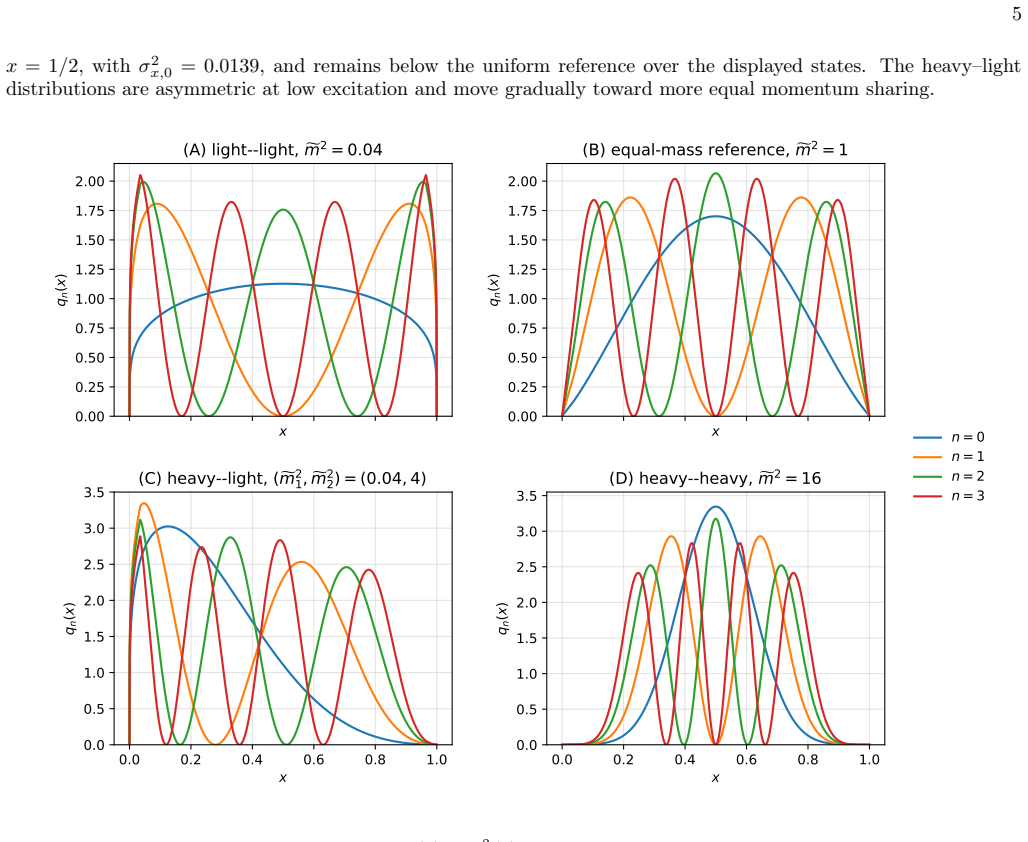
= (0.04, 4) 0.0 0.2 0.4 0.6 0.8 1.0 x 1.5 1.0 0.5 0.0 0.5 1.0 1.5 2.0 n(x) (D) heavy--heavy, m2 = 16 n = 0 n = 1 n = 2 n = 3 FIG. 1. Light-front wave functionsϕ n(x)for the four mass families andn= 0,1,2,3. The exact endpoint valuesϕ n(0) = ϕn(1) = 0are included. The corresponding momentum distributionsqn(x) =ϕ 2 n(x)are shown in Fig. 2. Squaring removes ...
-
[3]
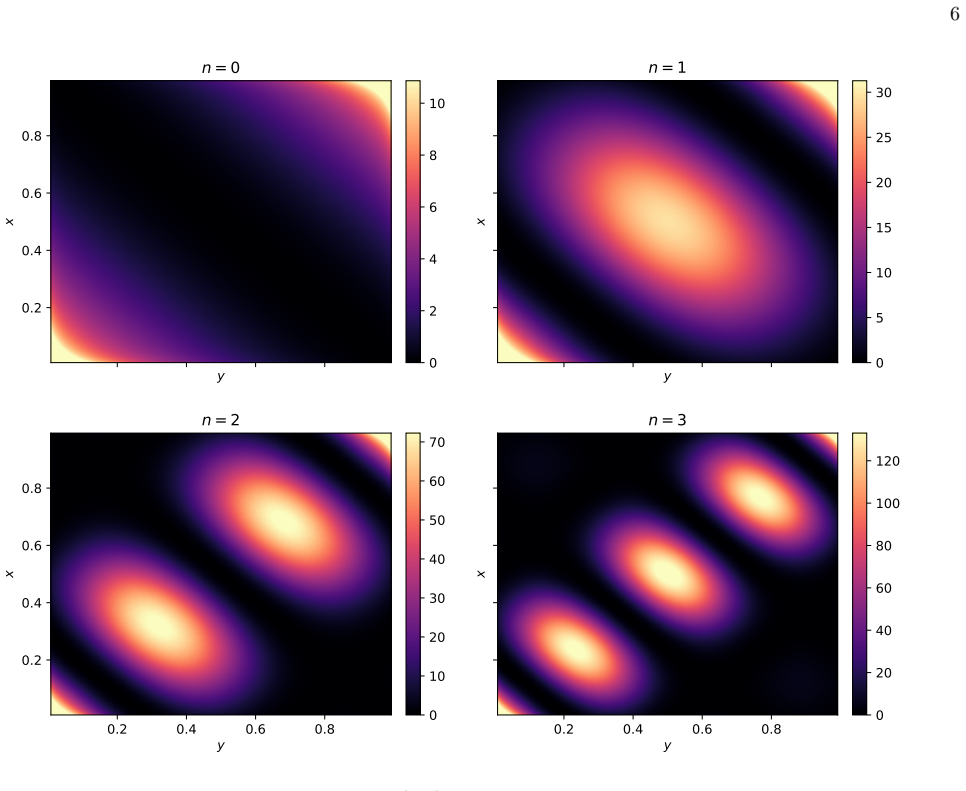
= (0.04, 4) 0.0 0.2 0.4 0.6 0.8 1.0 x 0.0 0.5 1.0 1.5 2.0 2.5 3.0 3.5qn(x) (D) heavy--heavy, m2 = 16 n = 0 n = 1 n = 2 n = 3 FIG. 2. Longitudinal momentum distributionsq n(x) =ϕ 2 n(x)for the same states as in Fig. 1. The exact endpoint values qn(0) =q n(1) = 0are included. The integrated interaction energy does not show how pairs of momentum fractions co...
-
[4]
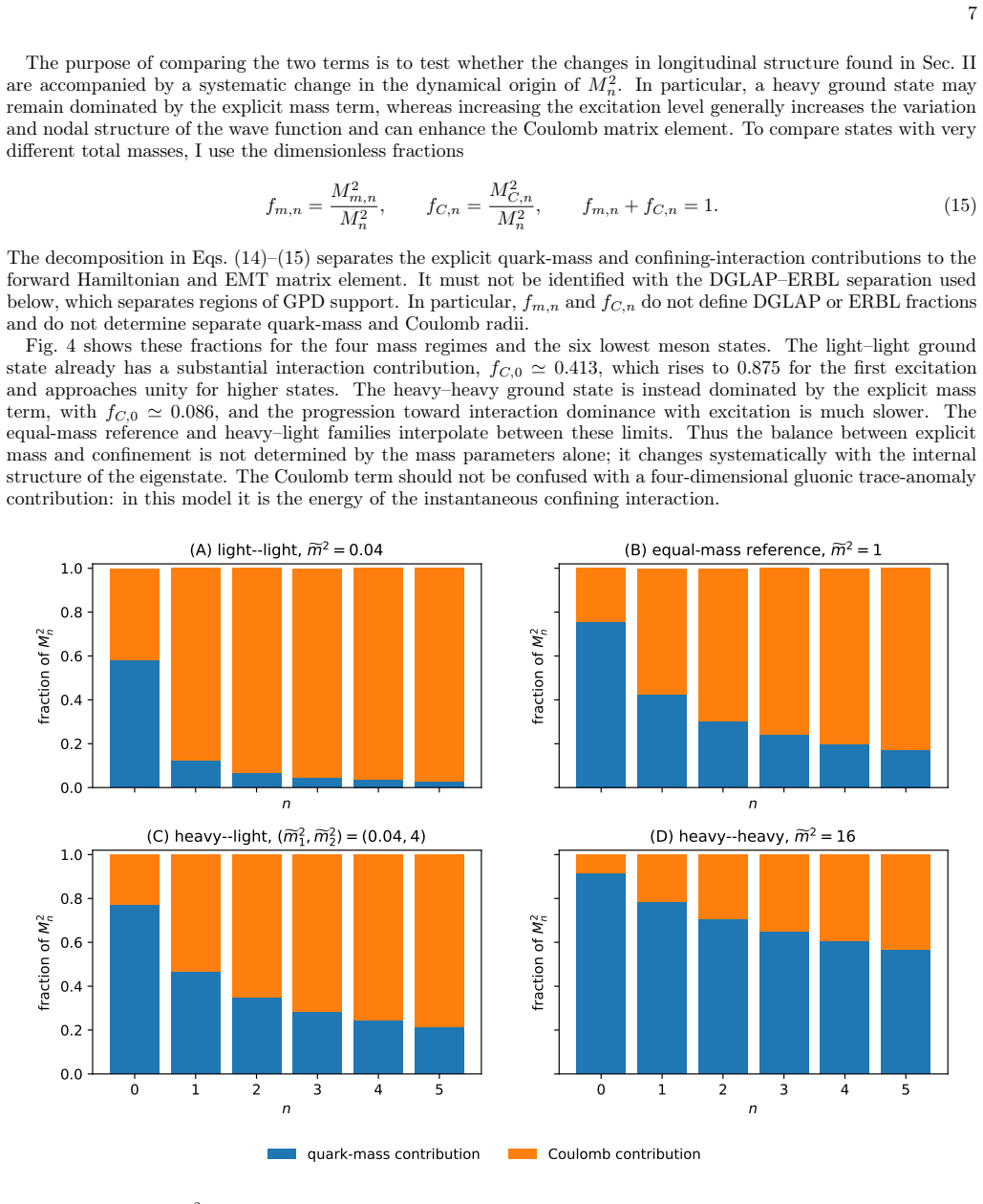
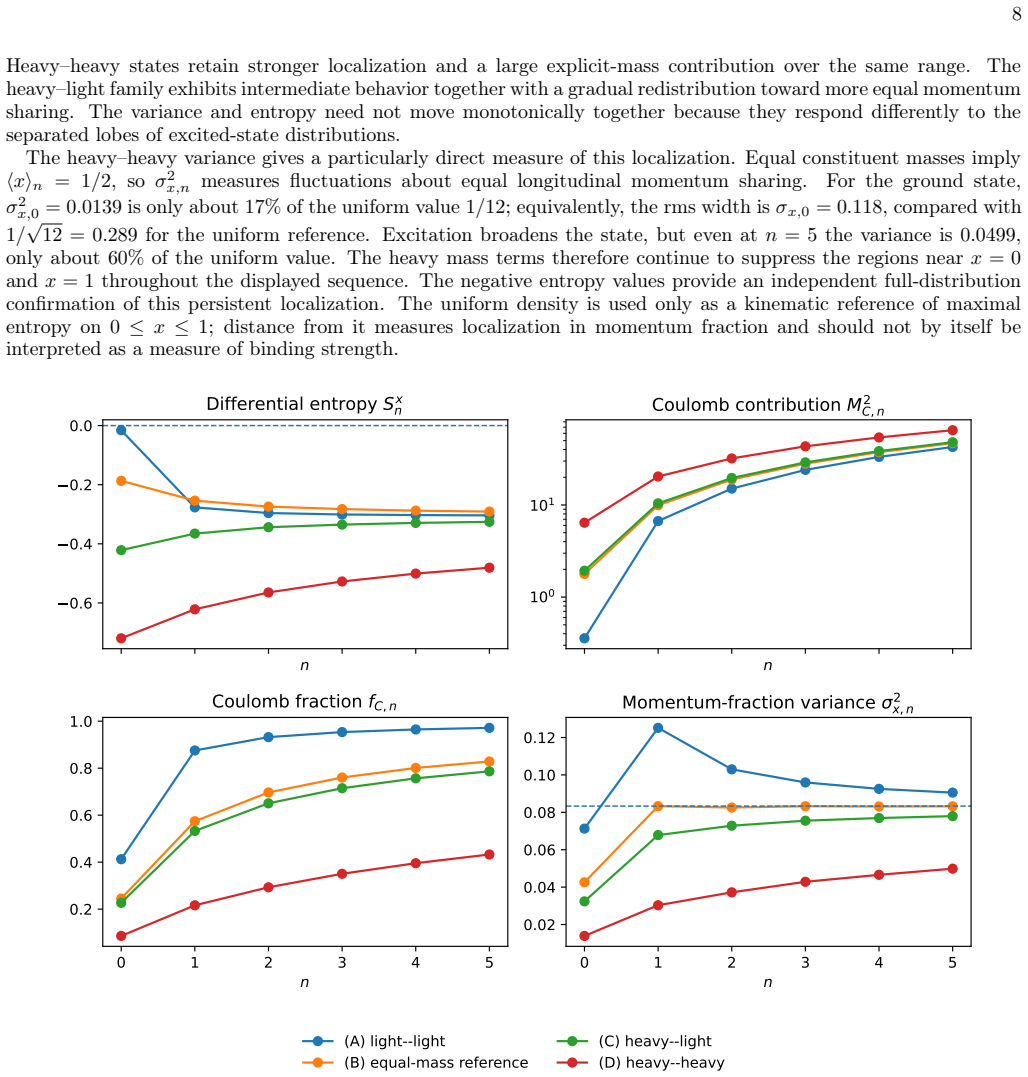
= (0.04, 4) 0 1 2 3 4 5 n fraction of M2 n (D) heavy--heavy, m2 = 16 quark-mass contribution Coulomb contribution FIG. 4. Fractions ofM 2 n carried by the explicit quark-mass and Coulomb-interaction terms. At each displayed point, both fractions are evaluated from the same eigenstate obtained withNB = 28andN q = 2400, so thatf m,n +f C,n = 1. Fig. 5 compa...
2000
-
[5]
’t Hooft, A two-dimensional model for mesons, Nucl
G. ’t Hooft, A two-dimensional model for mesons, Nucl. Phys. B75, 461 (1974)
1974
-
[6]
S. J. Brodsky, H.-C. Pauli, and S. S. Pinsky, Quantum chromodynamics and other field theories on the light cone, Phys. Rep.301, 299 (1998), arXiv:hep-ph/9705477
work page internal anchor Pith review Pith/arXiv arXiv 1998
- [7]
-
[8]
A. Freese and G. A. Miller, Mass decomposition of the pion in the ’t Hooft model, Phys. Rev. D107, 034004 (2023), arXiv:2210.00119
-
[9]
Burkardt, Off-forward parton distributions in (1+1)-dimensional QCD, Phys
M. Burkardt, Off-forward parton distributions in (1+1)-dimensional QCD, Phys. Rev. D62, 094003 (2000), arXiv:hep- ph/0005209
- [10]
- [11]
- [12]
-
[13]
Generalized Parton Distributions
M. Diehl, Generalized parton distributions, Phys. Rep.388, 41 (2003), arXiv:hep-ph/0307382
work page internal anchor Pith review Pith/arXiv arXiv 2003
-
[14]
M. V. Polyakov and P. Schweitzer, Forces inside hadrons: Pressure, surface tension, mechanical radius, and all that, Int. J. Mod. Phys. A33, 1830025 (2018), arXiv:1805.06596
work page internal anchor Pith review Pith/arXiv arXiv 2018
-
[15]
Abe, New basis function approach to the ’t Hooft–Bergknoff–Eller equations, Phys
O. Abe, New basis function approach to the ’t Hooft–Bergknoff–Eller equations, Phys. Rev. D60, 105040 (1999)
1999
-
[16]
Convergence of Discretized Light Cone Quantization in the small mass limit
B. van de Sande, Convergence of discretized light-cone quantization in the small-mass limit, Phys. Rev. D54, 6347 (1996), arXiv:hep-ph/9605409
work page internal anchor Pith review Pith/arXiv arXiv 1996
-
[17]
A. Litvinov and P. Meshcheriakov, Meson mass spectrum in QCD2 ’t Hooft’s model, Nucl. Phys. B1010, 116766 (2025), arXiv:2409.11324 [hep-th]
-
[18]
A. Artemev, A. Litvinov, and P. Meshcheriakov, QCD2 ’t Hooft model: Two-flavor mesons spectrum, Phys. Rev. D111, 125001 (2025), arXiv:2504.12081 [hep-th]
-
[19]
Deeply Virtual Compton Scattering
X. Ji, Deeply virtual compton scattering, Phys. Rev. D55, 7114 (1997), arXiv:hep-ph/9609381
work page internal anchor Pith review Pith/arXiv arXiv 1997
discussion (0)
Sign in with ORCID, Apple, or X to comment. Anyone can read and Pith papers without signing in.