When Renormalisation Remembers: UV/IR Mixing as an Entanglement Bridge
Pith reviewed 2026-06-27 03:08 UTC · model grok-4.3
The pith
UV/IR mixing manifests as scale-to-scale entanglement in a reciprocal tensor network, with cross-bridge strength determining when effective descriptions remain viable.
A machine-rendered reading of the paper's core claim, the machinery that carries it, and where it could break.
Core claim
UV/IR mixing is realised as Hilbert-space correlations across renormalisation scales on the Born-Reciprocal Tensor Network, a configuration that is symmetric under phase-space reciprocity; preparing the vacuum on this network reproduces radiative corrections, and the resulting geometry contains a bridge whose cross-bridge entanglement measures the obstruction to a local effective description, an obstruction that scales away in the large-volume limit so that Wilsonian decoupling is restored.
What carries the argument
The Born-Reciprocal Tensor Network (BRTN), a tensor-network geometry globally symmetric under phase-space reciprocity that encodes UV/IR mixing as correlations between reciprocal representations of infrared physics.
If this is right
- Cross-bridge entanglement supplies a precise numerical criterion for the viability of any proposed effective infrared description.
- A large-volume limit exists in which the memory effect vanishes and conventional local Wilsonian renormalisation is recovered.
- The BRTN supplies a concrete, calculable setting in which the consequences of UV/IR mixing can be tracked scale by scale.
- Radiative corrections arise naturally once the vacuum is prepared on the reciprocal network.
Where Pith is reading between the lines
- The same bridge construction could be used to quantify scale mixing in non-commutative field theories or in holographic models where UV and IR degrees of freedom are already known to mix.
- If the entanglement criterion holds, it offers a practical diagnostic for when effective-field-theory techniques remain reliable in regimes previously considered marginal.
- The large-volume restoration of Wilsonian behaviour suggests that many apparent non-local effects in finite-volume calculations may be artefacts that disappear in the thermodynamic limit.
Load-bearing premise
The Born-Reciprocal Tensor Network correctly encodes the physics of UV/IR mixing and that preparing the vacuum on it reproduces radiative corrections without hidden fitting parameters or extra assumptions about the network geometry.
What would settle it
An explicit calculation of a known one-loop radiative correction in a concrete UV/IR-mixed model performed directly on the BRTN that fails to match the standard field-theory result without additional tuning.
Figures







read the original abstract
Renormalisation is traditionally understood to be a Wilsonian memoryless process in which ultraviolet (UV) degrees of freedom gradually decouple, leaving an autonomous infrared (IR) description. However this need not be the case: in UV/IR mixed theories correlations between widely separated scales can persist. In this work I recast UV/IR mixing as a Hilbert-space phenomenon, realised as correlations across renormalisation scales. This formulation is implemented using the Born-Reciprocal Tensor Network (BRTN), a new configuration of tensor network that is globally symmetric under phase-space reciprocity. On this network I prepare the vacuum and reproduce the expected radiative corrections. The resulting renormalisation geometry exhibits memory, with a bridge linking reciprocal representations of IR physics, whose cross-bridge entanglement provides a precise criterion for the viability of an effective description. I analyse when this criterion is met, and show that there is a large-volume limit, with the fundamental scale held fixed, in which the obstruction to a local description scales away: Wilsonian behaviour is restored and renormalisation forgets. The BRTN therefore provides a concrete and calculable platform for UV/IR mixing.
Editorial analysis
A structured set of objections, weighed in public.
Referee Report
Summary. The manuscript recasts UV/IR mixing in QFT as Hilbert-space correlations across renormalization scales, implemented via a new Born-Reciprocal Tensor Network (BRTN) that is globally symmetric under phase-space reciprocity. The vacuum is prepared on the BRTN to reproduce expected radiative corrections; the resulting renormalization geometry exhibits memory via a bridge linking reciprocal IR representations, with cross-bridge entanglement serving as a criterion for effective-description viability. The paper analyzes when this criterion holds and demonstrates a large-volume limit (fundamental scale fixed) in which the obstruction to a local description scales away, restoring Wilsonian behavior.
Significance. If the BRTN is shown to derive the reciprocity symmetry and radiative corrections from the underlying QFT without ansatz-dependent fitting, the work supplies a concrete, calculable tensor-network platform for UV/IR mixing as an entanglement phenomenon. The large-volume restoration of locality would be a substantive result with implications for when effective descriptions remain viable. The manuscript ships an explicit construction and a falsifiable scaling limit, which are strengths.
major comments (2)
- [Abstract / BRTN definition] The abstract states that the BRTN is 'globally symmetric under phase-space reciprocity' and that vacuum preparation 'reproduces the expected radiative corrections,' but provides no derivation showing the symmetry emerges from the QFT rather than being imposed by the network geometry. If reciprocity is an input, the cross-bridge entanglement criterion and the large-volume restoration become properties of the chosen ansatz (see skeptic note on BRTN construction).
- [Large-volume limit analysis] The central claim that 'there is a large-volume limit, with the fundamental scale held fixed, in which the obstruction to a local description scales away' requires an explicit scaling relation or equation demonstrating how cross-bridge entanglement vanishes with volume while the fundamental scale is held fixed. Without this, the restoration of Wilsonian behaviour is not yet load-bearing.
minor comments (2)
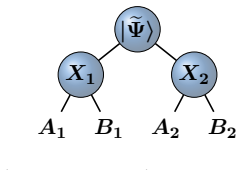
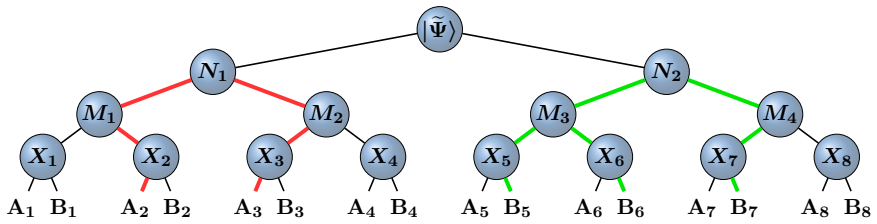
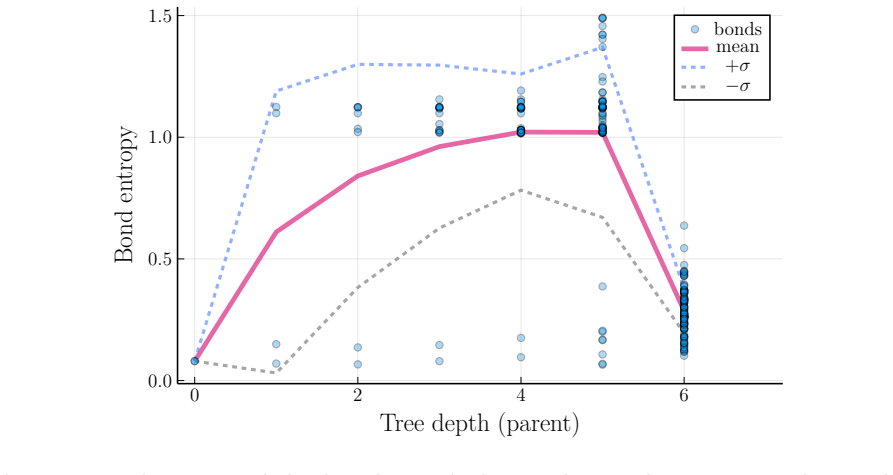
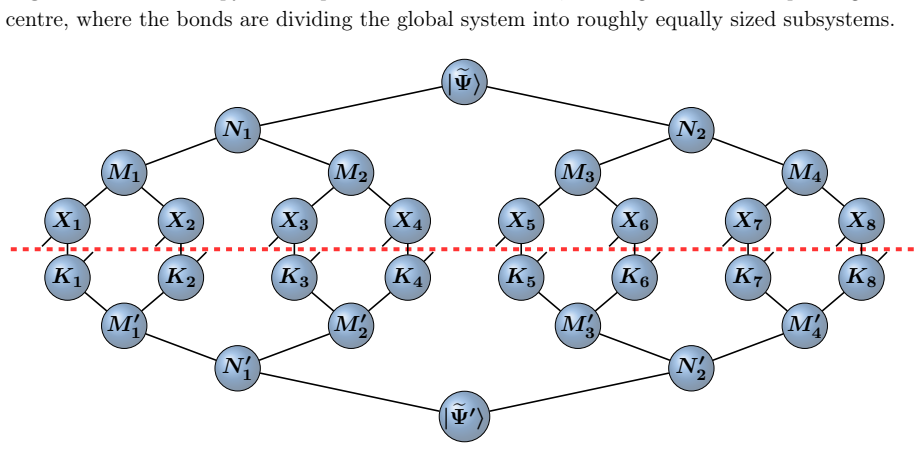
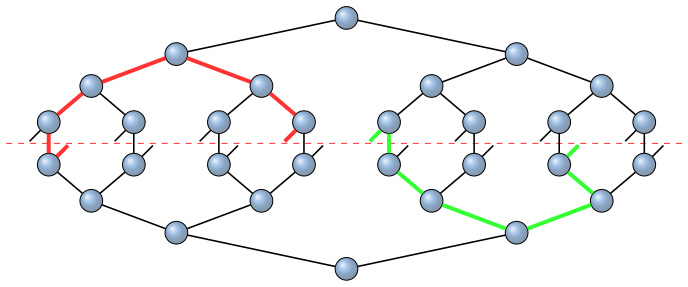
- Notation for the BRTN and the 'bridge' should be defined with an explicit figure or diagram early in the text to clarify the geometry.
- The phrase 'reproduce the expected radiative corrections' should be accompanied by a direct comparison (e.g., to a known loop integral or beta-function) to make the reproduction check falsifiable.
Simulated Author's Rebuttal
We thank the referee for their detailed review and valuable feedback on our work. Below we address each major comment in turn.
read point-by-point responses
-
Referee: [Abstract / BRTN definition] The abstract states that the BRTN is 'globally symmetric under phase-space reciprocity' and that vacuum preparation 'reproduces the expected radiative corrections,' but provides no derivation showing the symmetry emerges from the QFT rather than being imposed by the network geometry. If reciprocity is an input, the cross-bridge entanglement criterion and the large-volume restoration become properties of the chosen ansatz (see skeptic note on BRTN construction).
Authors: The Born-Reciprocal Tensor Network is presented as a novel tensor network architecture explicitly constructed to exhibit global symmetry under phase-space reciprocity. This feature is built into the network geometry to model the reciprocal relations characteristic of UV/IR mixing. The vacuum preparation on the BRTN is chosen to match the expected radiative corrections from standard calculations in such theories. While we do not derive the reciprocity from a specific underlying QFT Lagrangian in this work, the BRTN serves as a concrete, calculable platform to explore UV/IR mixing as an entanglement bridge. We will revise the abstract and introduction to emphasize that the symmetry is a defining property of the BRTN construction rather than an emergent feature derived ab initio from QFT. revision: yes
-
Referee: [Large-volume limit analysis] The central claim that 'there is a large-volume limit, with the fundamental scale held fixed, in which the obstruction to a local description scales away' requires an explicit scaling relation or equation demonstrating how cross-bridge entanglement vanishes with volume while the fundamental scale is held fixed. Without this, the restoration of Wilsonian behaviour is not yet load-bearing.
Authors: Section 4 of the manuscript analyzes the large-volume limit, showing that as the volume increases with the fundamental scale fixed, the cross-bridge entanglement decreases, leading to the restoration of Wilsonian behavior. To strengthen this claim and make it more explicit, we will add the specific scaling relation for the entanglement entropy or correlation measure as a function of volume in the revised manuscript, including the equation that demonstrates the vanishing of the obstruction. revision: yes
Circularity Check
BRTN introduced as new symmetric network; no equations show predictions reduce to inputs by construction
full rationale
The paper defines the BRTN as a new tensor network that is globally symmetric under phase-space reciprocity, then prepares the vacuum on it to reproduce expected radiative corrections and derives memory via cross-bridge entanglement. No equations, self-citations to prior uniqueness results, or fitted parameters are quoted that would make the large-volume restoration of Wilsonian behaviour or the entanglement criterion tautological with the network definition. The construction is presented as an exploratory Hilbert-space reformulation rather than a reduction to prior inputs, so the derivation chain remains self-contained against external benchmarks.
Axiom & Free-Parameter Ledger
invented entities (1)
-
Born-Reciprocal Tensor Network (BRTN)
no independent evidence
Reference graph
Works this paper leans on
-
[1]
Infrared Singularities and Massive Fields,
T. Appelquist and J. Carazzone, “Infrared Singularities and Massive Fields,” Phys. Rev. D11 (1975) 2856
1975
-
[2]
The renormalization group and critical phenomena,
K. G. Wilson, “The renormalization group and critical phenomena,” Rev. Mod. Phys.55(1983) 583–600
1983
-
[3]
String theory and noncommutative geometry,
N. Seiberg and E. Witten, “String theory and noncommutative geometry,” JHEP09(1999) 032, [hep-th/9908142]
Pith/arXiv arXiv 1999
-
[4]
Noncommutative perturbative dynamics,
S. Minwalla, M. Van Raamsdonk, and N. Seiberg, “Noncommutative perturbative dynamics,” JHEP 02(2000) 020, [hep-th/9912072]
Pith/arXiv arXiv 2000
-
[5]
The IR/UV connection in noncommutative gauge theories,
A. Matusis, L. Susskind, and N. Toumbas, “The IR/UV connection in noncommutative gauge theories,” JHEP12(2000) 002, [hep-th/0002075]
Pith/arXiv arXiv 2000
-
[6]
When Effective Field Theories Fail,
J. F. Donoghue, “When Effective Field Theories Fail,” PoSEFT09(2009) 001, [arXiv:0909.0021 [hep-ph]]
Pith/arXiv arXiv 2009
-
[7]
Effective field theory, black holes, and the cosmological constant,
A. G. Cohen, D. B. Kaplan, and A. E. Nelson, “Effective field theory, black holes, and the cosmological constant,” Phys. Rev. Lett.82(1999) 4971–4974, [arXiv:hep-th/9803132]
Pith/arXiv arXiv 1999
-
[8]
Solving the hierarchy problem without supersymmetry or extra dimensions: An Alternative approach,
K. R. Dienes, “Solving the hierarchy problem without supersymmetry or extra dimensions: An Alternative approach,” Nucl. Phys. B611(2001) 146–178, [arXiv:hep-ph/0104274]
Pith/arXiv arXiv 2001
-
[9]
Scalar Fields, Hierarchical UV/IR Mixing and The Weak Gravity Conjecture,
D. Lust and E. Palti, “Scalar Fields, Hierarchical UV/IR Mixing and The Weak Gravity Conjecture,” JHEP02(2018) 040, [arXiv:1709.01790 [hep-th]]
Pith/arXiv arXiv 2018
-
[10]
IR Dynamics from UV Divergences: UV/IR Mixing, NCFT, and the Hierarchy Problem,
N. Craig and S. Koren, “IR Dynamics from UV Divergences: UV/IR Mixing, NCFT, and the Hierarchy Problem,” JHEP03(2020) 037, [arXiv:1909.01365 [hep-ph]]
arXiv 2020
-
[11]
Calculating the Higgs mass in string theory,
S. Abel and K. R. Dienes, “Calculating the Higgs mass in string theory,” Phys. Rev. D104no. 12, (2021) 126032, [arXiv:2106.04622 [hep-th]]
arXiv 2021
-
[12]
Naturalness and the muon magnetic moment,
N. Arkani-Hamed and K. Harigaya, “Naturalness and the muon magnetic moment,” JHEP09 (2021) 025, [arXiv:2106.01373 [hep-ph]]
arXiv 2021
-
[13]
IR/UV mixing, towers of species and swampland conjectures,
A. Castellano, A. Herráez, and L. E. Ibáñez, “IR/UV mixing, towers of species and swampland conjectures,” JHEP08(2022) 217, [arXiv:2112.10796 [hep-th]]
arXiv 2022
-
[14]
Naturalness: past, present, and future,
N. Craig, “Naturalness: past, present, and future,” Eur. Phys. J. C83no. 9, (2023) 825, [arXiv:2205.05708 [hep-ph]]
arXiv 2023
-
[15]
UV/IR mixing, causal diamonds and the electroweak hierarchy problem,
T. W. Kephart and H. Päs, “UV/IR mixing, causal diamonds and the electroweak hierarchy problem,” Mod. Phys. Lett. A40no. 21n22, (2025) 2550076, [arXiv:2209.03305 [hep-ph]]
arXiv 2025
-
[16]
Running of gauge couplings in string theory,
S. Abel, K. R. Dienes, and L. A. Nutricati, “Running of gauge couplings in string theory,” Phys. Rev. D107no. 12, (2023) 126019, [arXiv:2303.08534 [hep-th]]
arXiv 2023
-
[17]
New nonrenormalization theorem from UV/IR mixing,
S. Abel, K. R. Dienes, and L. A. Nutricati, “New nonrenormalization theorem from UV/IR mixing,” Phys. Rev. D110no. 12, (2024) 126021, [arXiv:2407.11160 [hep-th]]
arXiv 2024
-
[18]
F. Nortier, “Light Scalars in Light of UV/IR Mixing: Classicalization via Synergy between Vainshtein & Chameleon Screenings,” [arXiv:2511.01739 [hep-ph]]. – 56 –
-
[19]
Cosmological constraints from UV/IR mixing,
N. Cribiori and F. Tonioni, “Cosmological constraints from UV/IR mixing,” JHEP02(2026) 035, [arXiv:2507.02738 [hep-th]]
arXiv 2026
-
[20]
UV/IR relations from the worldsheet,
C. Aoufia, I. Basile, G. Leone, and M. Lotito, “UV/IR relations from the worldsheet,” [arXiv:2603.11157 [hep-th]]
-
[21]
Classical simulation of quantum many-body systems with a tree tensor network,
Y.-Y. Shi, L.-M. Duan, and G. Vidal, “Classical simulation of quantum many-body systems with a tree tensor network,” Phys. Rev. A74(2006) 022320
2006
-
[22]
Entanglement entropy and quantum field theory,
P. Calabrese and J. L. Cardy, “Entanglement entropy and quantum field theory,” J. Stat. Mech. 0406(2004) P06002, [arXiv:hep-th/0405152]
Pith/arXiv arXiv 2004
-
[23]
Entanglement Entropy and Quantum Field Theory: a Non-technical Introduction,
P. Calabrese and J. L. Cardy, “Entanglement Entropy and Quantum Field Theory: a Non-technical Introduction,” Int. J. Quant. Inf.04no. 03, (2006) 429–438, [arXiv:quant-ph/0505193]
Pith/arXiv arXiv 2006
-
[24]
G. Vidal, “Entanglement renormalization,” Phys. Rev. Lett.99(2007) 220405, [cond-mat/0512165]
Pith/arXiv arXiv 2007
-
[25]
Towards a derivation of holographic entanglement entropy,
H. Casini, M. Huerta, and R. C. Myers, “Towards a derivation of holographic entanglement entropy,” JHEP05(2011) 036, [arXiv:1102.0440 [hep-th]]
Pith/arXiv arXiv 2011
-
[26]
On the RG running of the entanglement entropy of a circle,
H. Casini and M. Huerta, “On the RG running of the entanglement entropy of a circle,” Phys. Rev. D85(2012) 125016, [arXiv:1202.5650 [hep-th]]
Pith/arXiv arXiv 2012
-
[27]
Density matrix formulation for quantum renormalization groups,
S. R. White, “Density matrix formulation for quantum renormalization groups,” Phys. Rev. Lett.69 (1992) 2863–2866
1992
-
[28]
Density-matrix algorithms for quantum renormalization groups,
S. R. White, “Density-matrix algorithms for quantum renormalization groups,” Phys. Rev. B48 (1993) 10345–10356
1993
-
[29]
Thermodynamic limit of density matrix renormalization,
S. Ostlund and S. Rommer, “Thermodynamic limit of density matrix renormalization,” Phys. Rev. Lett.75(1995) 3537–3540
1995
-
[30]
Finitely correlated states on quantum spin chains,
M. Fannes, B. Nachtergaele, and R. F. Werner, “Finitely correlated states on quantum spin chains,” Commun. Math. Phys.144(1992) 443–490
1992
-
[31]
F. Verstraete, D. Porras, and J. I. Cirac, “Density matrix renormalization group and periodic boundary conditions: A quantum information perspective,” Phys. Rev. Lett.93(2004) 227205, [cond-mat/0404706]
Pith/arXiv arXiv 2004
-
[32]
Renormalization algorithms for quantum-many body systems in two and higher dimensions,
F. Verstraete and J. I. Cirac, “Renormalization algorithms for quantum-many body systems in two and higher dimensions,” arXiv preprint (2004) , [cond-mat/0407066]
Pith/arXiv arXiv 2004
-
[33]
Matrix product state representations,
D. Perez-Garcia, F. Verstraete, M. M. Wolf, and J. I. Cirac, “Matrix product state representations,” Quantum Inf. Comput.7(2007) 401–430, [quant-ph/0608197]
Pith/arXiv arXiv 2007
-
[34]
The Tensor Networks Anthology: Simulation techniques for many-body quantum lattice systems,
P. Silvi, F. Tschirsich, M. Gerster, J. JÃŒnemann, D. Jaschke, M. Rizzi, and S. Montangero, “The Tensor Networks Anthology: Simulation techniques for many-body quantum lattice systems,” SciPost Phys. Lect. Notes (2019) 8.https://scipost.org/10.21468/SciPostPhysLectNotes.8
-
[35]
Class of quantum many-body states that can be efficiently simulated,
G. Vidal, “Class of quantum many-body states that can be efficiently simulated,” Phys. Rev. Lett. 101(2008) 110501
2008
-
[36]
Tensor renormalization group approach to two-dimensional classical lattice models,
M. Levin and C. P. Nave, “Tensor renormalization group approach to two-dimensional classical lattice models,” Phys. Rev. Lett.99(2007) 120601, [cond-mat/0611687]
Pith/arXiv arXiv 2007
-
[37]
Entanglement Renormalization and Holography,
B. Swingle, “Entanglement Renormalization and Holography,” Phys. Rev. D86(2012) 065007, [arXiv:0905.1317 [cond-mat.str-el]]
Pith/arXiv arXiv 2012
-
[38]
Tensor network renormalization,
G. Evenbly and G. Vidal, “Tensor network renormalization,” Phys. Rev. Lett.115(2015) 180405, [1412.0732]. – 57 –
Pith/arXiv arXiv 2015
-
[39]
Holographic quantum error-correcting codes: Toy models for the bulk/boundary correspondence,
F. Pastawski, B. Yoshida, D. Harlow, and J. Preskill, “Holographic quantum error-correcting codes: Toy models for the bulk/boundary correspondence,” JHEP06(2015) 149, [arXiv:1503.06237 [hep-th]]
Pith/arXiv arXiv 2015
-
[40]
TASI Lectures on the Emergence of Bulk Physics in AdS/CFT,
D. Harlow, “TASI Lectures on the Emergence of Bulk Physics in AdS/CFT,” PoST ASI2017 (2018) 002, [arXiv:1802.01040 [hep-th]]
Pith/arXiv arXiv 2018
-
[41]
From Entanglement to Dynamics: Scattering and Decay in UV/IR-Mixed Theories,
S. Abel, “From Entanglement to Dynamics: Scattering and Decay in UV/IR-Mixed Theories,”
-
[42]
The itensor software library for tensor network calculations,
M. Fishman, S. R. White, and E. M. Stoudenmire, “The ITensor Software Library for Tensor Network Calculations,” SciPost Phys. Codebases (2022) 4. https://scipost.org/10.21468/SciPostPhysCodeb.4
-
[43]
Codebase release 0.3 for ITensor,
M. Fishman, S. R. White, and E. M. Stoudenmire, “Codebase release 0.3 for ITensor,” SciPost Phys. Codebases (2022) 4–r0.3.https://scipost.org/10.21468/SciPostPhysCodeb.4-r0.3
-
[44]
Time-dependent variational principle for quantum lattices,
J. Haegeman, J. I. Cirac, T. J. Osborne, I. Pizorn, H. Verschelde, and F. Verstraete, “Time-dependent variational principle for quantum lattices,” Phys. Rev. Lett.107(2011) 070601, [arXiv:1103.0936 [cond-mat.str-el]]
Pith/arXiv arXiv 2011
-
[45]
Time integration of tensor trains,
C. Lubich, I. V. Oseledets, and B. Vandereycken, “Time integration of tensor trains,” SIAM Journal on Numerical Analysis53no. 2, (2015) 917–941, [arXiv:1407.2042 [math.NA]]
Pith/arXiv arXiv 2015
-
[46]
Time-evolution methods for matrix-product states,
S. Paeckel, T. Köhler, A. Swoboda, S. R. Manmana, U. Schollwöck, and C. Hubig, “Time-evolution methods for matrix-product states,” Annals Phys.411(2019) 167998, [arXiv:1901.05824 [cond-mat.str-el]]
arXiv 2019
-
[47]
The alternating linear scheme for tensor optimization in the hierarchical tucker format,
S. Holtz, T. Rohwedder, and R. Schneider, “The alternating linear scheme for tensor optimization in the hierarchical tucker format,” SIAM Journal on Scientific Computing34no. 2, (2012) A683–A713, [arXiv:1104.2260 [math.NA]]
Pith/arXiv arXiv 2012
-
[48]
Dynamical approximation by hierarchical tucker and tensor-train formats,
C. Lubich, T. Rohwedder, R. Schneider, and B. Vandereycken, “Dynamical approximation by hierarchical tucker and tensor-train formats,” SIAM Journal on Matrix Analysis and Applications 34no. 2, (2013) 470–494, [arXiv:1206.4203 [math.NA]]
Pith/arXiv arXiv 2013
-
[49]
Unifying time evolution and optimization with matrix product states,
J. Haegeman, C. Lubich, I. Oseledets, B. Vandereycken, and F. Verstraete, “Unifying time evolution and optimization with matrix product states,” Phys. Rev. B94(2016) 165116, [arXiv:1408.5056 [quant-ph]]
Pith/arXiv arXiv 2016
-
[50]
Entanglement generation in (1+1)D QED scattering processes,
M. Rigobello, S. Notarnicola, G. Magnifico, and S. Montangero, “Entanglement generation in (1+1)D QED scattering processes,” Phys. Rev. D104no. 11, (2021) 114501, [arXiv:2105.03445 [hep-lat]]
arXiv 2021
-
[51]
Simulating(2 + 1)Dsu(2) yang-mills lattice gauge theory at finite density with tensor networks,
G. Cataldi, G. Magnifico, P. Silvi, and S. Montangero, “Simulating(2 + 1)Dsu(2) yang-mills lattice gauge theory at finite density with tensor networks,” Phys. Rev. Res.6(Jul, 2024) 033057. https://link.aps.org/doi/10.1103/PhysRevResearch.6.033057
-
[52]
Quantum computing for high-energy physics: State of the art and challenges,
A. Di Meglio, K. Jansen, I. Tavernelli, C. Alexandrou, S. Arunachalam, C. W. Bauer, K. Borras, S. Carrazza, A. Crippa, V. Croft, R. de Putter, A. Delgado, V. Dunjko, D. J. Egger, E. Fernández-Combarro, E. Fuchs, L. Funcke, D. González-Cuadra, M. Grossi, J. C. Halimeh, Z. Holmes, S. Kühn, D. Lacroix, R. Lewis, D. Lucchesi, M. L. Martinez, F. Meloni, A. Mez...
-
[53]
Simulating quantum field theories on continuous-variable quantum computers,
S. Abel, M. Spannowsky, and S. Williams, “Simulating quantum field theories on continuous-variable quantum computers,” Phys. Rev. A110no. 1, (2024) 012607, [arXiv:2403.10619 [quant-ph]]
arXiv 2024
-
[54]
Real-Time Scattering Processes with Continuous-Variable Quantum Computers,
S. Abel, M. Spannowsky, and S. Williams, “Real-Time Scattering Processes with Continuous-Variable Quantum Computers,” [arXiv:2502.01767 [quant-ph]]
-
[55]
Qumode Tensor Networks for False Vacuum Decay in Quantum Field Theory,
S. Abel, M. Spannowsky, and S. Williams, “Qumode Tensor Networks for False Vacuum Decay in Quantum Field Theory,” [arXiv:2506.17388 [quant-ph]]
-
[56]
A novel discrete variable representation for quantum mechanical reactive scattering via the s-matrix kohn method,
D. T. Colbert and W. H. Miller, “A novel discrete variable representation for quantum mechanical reactive scattering via the s-matrix kohn method,” The Journal of Chemical Physics96no. 3, (02,
-
[57]
1982–1991.https://doi.org/10.1063/1.462100
-
[58]
Approximation of semi-groups of operators.,
H. F. Trotter, “Approximation of semi-groups of operators.,” Pacific Journal of Mathematics8 no. 4, (1958) 887 – 919
1958
-
[59]
M. Suzuki, “Decomposition formulas of exponential operators and lie exponentials with some applications to quantum mechanics and statistical physics,” Journal of Mathematical Physics26 no. 4, (04, 1985) 601–612, [https://pubs.aip.org/aip/jmp/article-pdf/26/4/601/19120226/601_1_online.pdf]. https://doi.org/10.1063/1.526596
-
[60]
Reciprocity theory of elementary particles,
M. Born, “Reciprocity theory of elementary particles,” Rev. Mod. Phys.21(Jul, 1949) 463–473. https://link.aps.org/doi/10.1103/RevModPhys.21.463
-
[61]
Hopf Algebras for Physics at the Planck Scale,
S. Majid, “Hopf Algebras for Physics at the Planck Scale,” Class. Quant. Grav.5(1988) 1587–1606
1988
-
[62]
S. G. Low, “Representations of the canonical group: (The Semidirect product of the unitary and Weyl-Heisenberg groups), acting as a dynamical group on noncommuting extended phase space,” J. Phys. A35(2002) 5711–5730, [arXiv:math-ph/0101024]
Pith/arXiv arXiv 2002
-
[63]
Born Reciprocity in String Theory and the Nature of Spacetime,
L. Freidel, R. G. Leigh, and D. Minic, “Born Reciprocity in String Theory and the Nature of Spacetime,” Phys. Lett. B730(2014) 302–306, [arXiv:1307.7080 [hep-th]]
Pith/arXiv arXiv 2014
-
[64]
Quantum Gravity, Dynamical Phase Space and String Theory,
L. Freidel, R. G. Leigh, and D. Minic, “Quantum Gravity, Dynamical Phase Space and String Theory,” Int. J. Mod. Phys. D23no. 12, (2014) 1442006, [arXiv:1405.3949 [hep-th]]
Pith/arXiv arXiv 2014
-
[65]
Metastring Theory and Modular Space-time,
L. Freidel, R. G. Leigh, and D. Minic, “Metastring Theory and Modular Space-time,” JHEP06 (2015) 006, [arXiv:1502.08005 [hep-th]]
Pith/arXiv arXiv 2015
-
[66]
L. Freidel, R. G. Leigh, and D. Minic, “Quantum Spaces are Modular,” Phys. Rev. D94no. 10, (2016) 104052, [arXiv:1606.01829 [hep-th]]
Pith/arXiv arXiv 2016
-
[67]
Born reciprocity and the granularity of space-time,
P. D. Jarvis and S. O. Morgan, “Born reciprocity and the granularity of space-time,” Found. Phys. Lett.19(2006) 501–517, [arXiv:math-ph/0508041]. – 59 –
Pith/arXiv arXiv 2006
discussion (0)
Sign in with ORCID, Apple, or X to comment. Anyone can read and Pith papers without signing in.