Quantum Resources and Wigner Symmetry in Nucleon-Nucleon Scattering from Effective Field Theory
Pith reviewed 2026-06-27 02:22 UTC · model grok-4.3
The pith
Wigner's SU(4) symmetry reduces the neutron-proton scattering amplitude to the spin identity operator, generating no new quantum resources.
A machine-rendered reading of the paper's core claim, the machinery that carries it, and where it could break.
Core claim
When the microscopic physics respects Wigner's SU(4) symmetry the neutron-proton scattering amplitude becomes proportional to the spin-space identity operator and therefore generates no new resources after scattering; the same-nucleon channel remains resource-generating because identical-particle constraints remove part of the Hilbert space. This holds at generic center-of-mass momentum and scattering angle when only the two-derivative contact interactions of the NLO pionless EFT are retained.
What carries the argument
The NLO pionless EFT scattering operator in the two-qubit spin space, made proportional to the identity by exact SU(4) symmetry.
If this is right
- Neutron-proton scattering under exact SU(4) leaves the resource content of any incoming spin state unchanged.
- Scattering of identical nucleons still produces resources because antisymmetrization removes half the two-qubit space.
- The resource-neutral result for neutron-proton scattering persists at all angles and momenta once only two-derivative contacts are kept.
- All three resource measures (entanglement, stabilizer magic, non-local magic) simultaneously vanish for the neutron-proton channel under the symmetry.
Where Pith is reading between the lines
- Approximate SU(4) symmetry in real nuclear forces may suppress but not completely eliminate resource generation in neutron-proton scattering.
- The same symmetry argument could be applied to three-nucleon systems to identify channels where quantum resources remain protected.
- Quantum simulators of nuclear physics could exploit the symmetry-protected channels to reduce the overhead of simulating spin entanglement.
Load-bearing premise
Each nucleon spin can be treated as an independent qubit whose resource measures are completely determined by the S- and P-wave contact amplitudes of the NLO pionless EFT.
What would settle it
Explicit computation of the entanglement or magic measures for a realistic nucleon-nucleon potential that exactly enforces SU(4) symmetry and observation of nonzero resource generation in the neutron-proton channel at low momentum.
Figures

read the original abstract
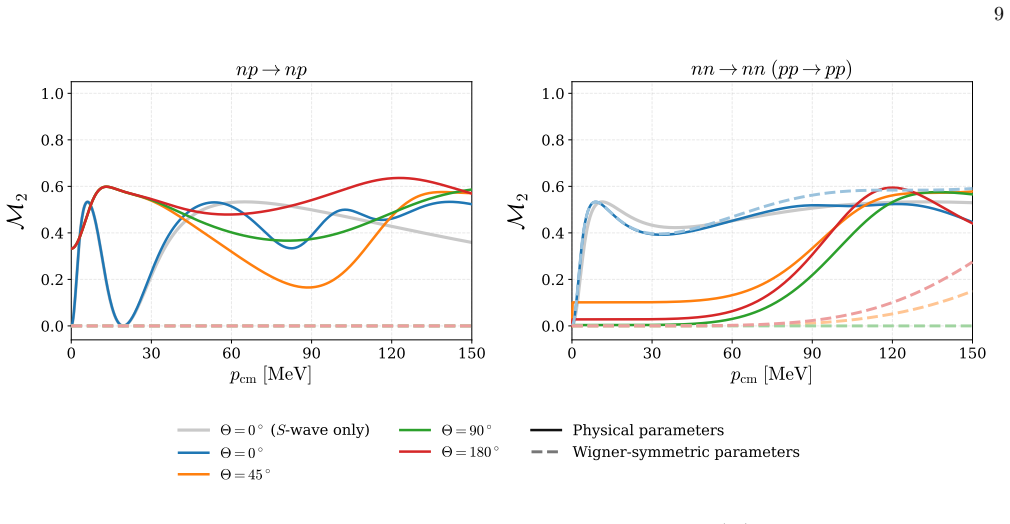
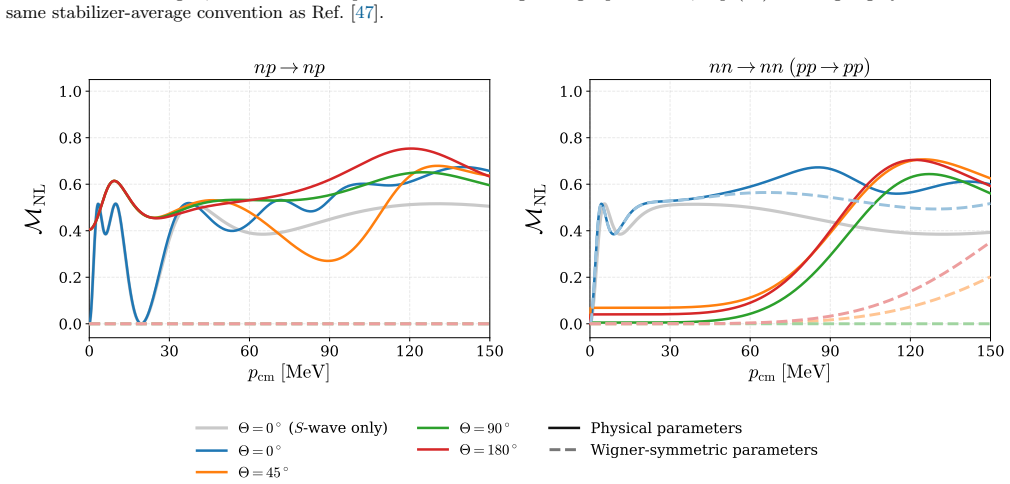
We study quantum resources in the spin degrees of freedom, such as entanglement, stabilizer magic, and non-local magic, in low-energy nucleon-nucleon scattering through next-to-leading order in pionless effective field theory. Treating each nucleon spin as a qubit, we calculate the corresponding resource-generating powers of the scattering operator at generic center-of-mass momentum and scattering angle $\Theta$. The analysis retains $S$- and $P$-wave channels generated by two-derivative contact interactions. When the microscopic physics exhibits Wigner's $SU(4)$ spin-flavor symmetry, the neutron-proton amplitude becomes proportional to the spin-space identity operator and therefore generates no new resources after scattering, extending an observation previously made for leading-order $S$-wave scattering. The same-nucleon channel remains resource-generating because constraints from identical particles project out part of the Hilbert space. These results show how enhanced symmetries, partial-wave structure, and resource generation are intertwined in low-energy two-body scattering.
Editorial analysis
A structured set of objections, weighed in public.
Referee Report
Summary. The paper examines quantum resources (entanglement, stabilizer magic, non-local magic) in low-energy nucleon-nucleon scattering at next-to-leading order in pionless EFT. Treating nucleon spins as qubits, it computes the resource-generating power of the scattering operator at generic center-of-mass momentum and angle, retaining S- and P-wave channels from two-derivative contact interactions. Under exact Wigner's SU(4) symmetry the neutron-proton amplitude is proportional to the spin-space identity operator and therefore generates no new resources, extending a prior leading-order S-wave observation; the same-nucleon (pp/nn) channels remain resource-generating because identical-particle projections break the proportionality.
Significance. If the central algebraic result holds, the work demonstrates how an enhanced symmetry in the NLO contact Lagrangian directly suppresses quantum resource generation in two-body scattering, independent of the values of the low-energy constants. This provides a clean, parameter-free illustration of the interplay between EFT operator structure, partial-wave content, and quantum-information measures, extending earlier LO results in a controlled way.
minor comments (3)
- [Abstract] The abstract states that the np amplitude 'becomes proportional to the spin-space identity operator' but does not indicate the explicit operator basis or the projection used for the identical-particle channels; adding one sentence referencing the relevant contact Lagrangian terms would improve clarity.
- The qubit encoding of the two-nucleon spin space is introduced without a brief reminder of the standard 4-dimensional basis (e.g., |↑↑⟩, |↑↓⟩, …); a short parenthetical definition in the first paragraph of the methods section would aid readers outside quantum information.
- Figure captions should explicitly state whether the plotted resource measures are evaluated at fixed momentum or integrated over angle, and whether the SU(4) limit is shown as a separate curve or as a limiting case.
Simulated Author's Rebuttal
We thank the referee for the positive assessment of our work and the recommendation for minor revision. The report contains no specific major comments to address point by point.
Circularity Check
No significant circularity; derivation is self-contained
full rationale
The central claim follows algebraically from imposing exact SU(4) symmetry on the two-derivative contact operators in the NLO pionless EFT Lagrangian, which forces the np T-matrix to be proportional to the spin-space identity by representation theory; this holds for any values of the LECs and is independent of data fitting or prior results. The note that the result extends an LO observation is incidental and not load-bearing for the NLO derivation or resource calculation. No step equates a prediction to a fitted input by construction, renames a known result, or relies on a self-citation chain whose content is unverified outside the paper. The qubit encoding and resource measures are applied to the resulting operator in a standard way.
Axiom & Free-Parameter Ledger
axioms (2)
- domain assumption Pionless effective field theory truncated at next-to-leading order accurately describes low-energy nucleon-nucleon scattering in S- and P-waves
- domain assumption Nucleon spins may be treated as qubits for the purpose of calculating entanglement, stabilizer magic, and non-local magic
Reference graph
Works this paper leans on
-
[1]
Wigner, Phys
E. Wigner, Phys. Rev.51, 106 (1937)
1937
-
[2]
D. B. Kaplan and A. V. Manohar, Phys. Rev. C56, 76 (1997), arXiv:nucl-th/9612021
Pith/arXiv arXiv 1997
-
[3]
D. B. Kaplan and M. J. Savage, Phys. Lett. B365, 244 (1996), arXiv:hep-ph/9509371
arXiv 1996
-
[4]
T. R. Richardson, M. R. Schindler, and R. P. Springer, Ann. Rev. Nucl. Part. Sci.73, 123 (2023), arXiv:2212.13049 [nucl-th]
arXiv 2023
-
[5]
T. Mehen, I. W. Stewart, and M. B. Wise, Phys. Rev. Lett.83, 931 (1999), arXiv:hep-ph/9902370
Pith/arXiv arXiv 1999
-
[6]
S. R. Beane, D. B. Kaplan, N. Klco, and M. J. Savage, Phys. Rev. Lett.122, 102001 (2019), arXiv:1812.03138 [nucl-th]
Pith/arXiv arXiv 2019
-
[7]
D. B. Kaplan, M. J. Savage, and M. B. Wise, Nucl. Phys. B478, 629 (1996), arXiv:nucl-th/9605002
Pith/arXiv arXiv 1996
-
[8]
D. B. Kaplan, M. J. Savage, and M. B. Wise, Phys. Lett. B424, 390 (1998), arXiv:nucl-th/9801034
Pith/arXiv arXiv 1998
-
[9]
D. B. Kaplan, M. J. Savage, and M. B. Wise, Nucl. Phys. B534, 329 (1998), arXiv:nucl-th/9802075
Pith/arXiv arXiv 1998
- [10]
-
[11]
J.-W. Chen, G. Rupak, and M. J. Savage, Nucl. Phys. A 653, 386 (1999), arXiv:nucl-th/9902056
Pith/arXiv arXiv 1999
-
[12]
T. Mehen, I. W. Stewart, and M. B. Wise, Phys. Lett. B 474, 145 (2000), arXiv:hep-th/9910025
Pith/arXiv arXiv 2000
- [13]
-
[14]
Q. Liu, I. Low, and T. Mehen, Phys. Rev. C107, 025204 (2023), arXiv:2210.12085 [quant-ph]
arXiv 2023
-
[15]
S. R. Beane, R. C. Farrell, and M. Varma, Int. J. Mod. Phys. A36, 2150205 (2021), arXiv:2108.00646 [hep-ph]
arXiv 2021
-
[16]
T.-R. Hu, S. Chen, and F.-K. Guo, Phys. Rev. D110, 014001 (2024), arXiv:2404.05958 [hep-ph]
arXiv 2024
-
[17]
T.-R. Hu, K. Sone, F.-K. Guo, T. Hyodo, and I. Low, Phys. Rev. Res.7, 043306 (2025), arXiv:2506.08960 [hep- ph]
arXiv 2025
-
[18]
T.-R. Hu, S. Chen, K. Sone, F.-K. Guo, T. Hy- odo, and I. Low, PoSHADRON2025, 104 (2026), arXiv:2507.22694 [hep-ph]
arXiv 2026
-
[19]
K. Sone, T.-R. Hu, F.-K. Guo, T. Hyodo, and I. Low (2026) arXiv:2602.09630 [hep-ph]
arXiv 2026
- [20]
- [21]
-
[22]
McGinnis, Symmetry, entanglement, and theS- matrix (2025), arXiv:2504.21079 [hep-th]
N. McGinnis, Symmetry, entanglement, and theS- matrix (2025), arXiv:2504.21079 [hep-th]
arXiv 2025
-
[23]
A. Cervera-Lierta, J. I. Latorre, J. Rojo, and L. Rottoli, SciPost Phys.3, 036 (2017), arXiv:1703.02989 [hep-th]
Pith/arXiv arXiv 2017
- [24]
-
[25]
S. Chang and G. Jacobo, Phys. Rev. D110, 096020 (2024), arXiv:2409.13030 [hep-ph]
arXiv 2024
- [26]
- [27]
-
[28]
J. Liu, M. Tanaka, X.-P. Wang, J.-J. Zhang, and Z. Zheng, Parameter Inference from Final-State Entan- glement in Higgs Decays (2025), arXiv:2511.17321 [hep- ph]
arXiv 2025
-
[29]
J. Thaler and S. Trifinopoulos, Phys. Rev. D111, 056021 (2025), arXiv:2410.23343 [hep-ph]
arXiv 2025
-
[30]
Q. Liu, I. Low, and Z. Yin, A Quantum Computational Determination of the Weak Mixing Angle in the Standard Model (2025), arXiv:2509.18251 [hep-ph]
arXiv 2025
-
[31]
C. Li, T. Ma, J. Shu, and M. Zhu, Entanglement Max- imization and Symmetry Selection in Composite Higgs Models (2026), arXiv:2605.17434 [hep-ph]
Pith/arXiv arXiv 2026
-
[32]
Q.-H. Cao, Y. Liu, H. Qi, H. Zhang, and H. Zhao, Sym- 12 metry Breaking as Quantum Gate: Entropy and Weak Mixing Angle (2026), arXiv:2605.22070 [hep-ph]
Pith/arXiv arXiv 2026
-
[33]
I. Low and P. Goswami, Entangling Power: A Probe of Symmetry and Integrability in Quantum Many-Body Systems (2026), arXiv:2605.20661 [quant-ph]
Pith/arXiv arXiv 2026
-
[34]
S. Bravyi and A. Kitaev, Phys. Rev. A71, 022316 (2005), arXiv:quant-ph/0403025
arXiv 2005
-
[35]
J. Emerson, D. Gottesman, S. A. H. Mousavian, and V. Veitch, New J. Phys.16, 013009 (2014), arXiv:1307.7171 [quant-ph]
Pith/arXiv arXiv 2014
-
[36]
D. Qian and J. Wang, Phys. Rev. A111, 052443 (2025), arXiv:2502.06393 [quant-ph]
arXiv 2025
-
[37]
J. Gargalionis, N. Moynihan, M. L. Reichenberg Ashby, E. N. V. Wallace, C. D. White, and M. J. White, Non- local nonstabiliserness in Gluon and Graviton Scattering (2026), arXiv:2603.04148 [hep-th]
arXiv 2026
- [38]
-
[39]
I. Chernyshev, C. E. P. Robin, and M. J. Savage, Phys. Rev. Res.7, 023228 (2025), arXiv:2411.04203 [quant-ph]
arXiv 2025
-
[40]
C. D. White and M. J. White, Phys. Rev. D110, 116016 (2024), arXiv:2406.07321 [hep-ph]
arXiv 2024
- [41]
-
[42]
Q. Liu, I. Low, and Z. Yin, Phys. Rev. D113, 056001 (2026), arXiv:2503.03098 [quant-ph]
arXiv 2026
-
[43]
Chang, T
S. Chang, T. Driscoll, and S. Trifinopoulos, Next-to- Leading-Order Electroweak Corrections to Quantum Re- sources in Lepton-Lepton Colliders (2026), in prepara- tion
2026
- [44]
-
[45]
J. Gargalionis, N. Moynihan, S. Trifinopoulos, E. N. V. Wallace, C. D. White, and M. J. White, Phys. Rev. D 113, 016007 (2026), arXiv:2508.14967 [hep-th]
arXiv 2026
-
[46]
C. N´ u˜ nez, M. Pardina, M. Asorey, J. I. Latorre, and A. Cervera-Lierta, Phys. Rev. D113, 096019 (2026), arXiv:2511.04358 [hep-th]
Pith/arXiv arXiv 2026
-
[47]
C. E. P. Robin and M. J. Savage, Phys. Rev. C112, 044004 (2025), arXiv:2405.10268 [nucl-th]
arXiv 2025
-
[48]
C. E. P. Robin and M. J. Savage, Anti-Flatness and Non- Local Magic in Two-Particle Scattering Processes (2025), arXiv:2510.23426 [quant-ph]
arXiv 2025
- [49]
-
[50]
G. A. Miller, Phys. Rev. C108, L031002 (2023), arXiv:2306.03239 [nucl-th]
arXiv 2023
-
[51]
A. L. Cavallin, O. Thim, and C. Forss´ en, Phys. Rev. C 113, 014005 (2026), arXiv:2510.09466 [nucl-th]
arXiv 2026
-
[52]
H. Wita la, J. Golak, and R. Skibi´ nski, Phys. Rev. C112, 044002 (2025), arXiv:2505.14401 [nucl-th]
arXiv 2025
- [53]
-
[54]
T. Kirchner, W. Elkamhawy, and H.-W. Hammer, Few Body Syst.65, 29 (2024), arXiv:2312.14484 [nucl-th]
arXiv 2024
-
[55]
P. Zanardi, C. Zalka, and L. Faoro, Phys. Rev. A62, 030301 (2000), arXiv:quant-ph/0005031
Pith/arXiv arXiv 2000
-
[56]
M. A. Nielsen and I. L. Chuang,Quantum Computation and Quantum Information(Cambridge University Press, 2012)
2012
-
[57]
Gottesman, in22nd International Colloquium on Group Theoretical Methods in Physics(1998) pp
D. Gottesman, in22nd International Colloquium on Group Theoretical Methods in Physics(1998) pp. 32–43, arXiv:quant-ph/9807006
Pith/arXiv arXiv 1998
-
[58]
S. Aaronson and D. Gottesman, Phys. Rev. A70, 052328 (2004), arXiv:quant-ph/0406196
Pith/arXiv arXiv 2004
- [59]
-
[60]
Wang and Y
Y. Wang and Y. Li, Quant. Inf. Proc.22, 444 (2023)
2023
-
[61]
M. Ohta and K. Sakurai, Extremal Magic States from Symmetric Lattices (2025), arXiv:2506.11725 [quant-ph]
arXiv 2025
-
[62]
Q. Liu, I. Low, and Z. Yin, Quantum Sci. Technol.11, 015035 (2026), arXiv:2502.17550 [quant-ph]
arXiv 2026
-
[63]
H. A. Bethe, Phys. Rev.76, 38 (1949)
1949
-
[64]
M. R. Schindler, H. Singh, and R. P. Springer, Phys. Rev. C98, 044001 (2018), arXiv:1805.06056 [nucl-th]
Pith/arXiv arXiv 2018
-
[65]
C. Ordonez, L. Ray, and U. van Kolck, Phys. Rev. C53, 2086 (1996), arXiv:hep-ph/9511380
Pith/arXiv arXiv 2086
-
[66]
E. Epelbaum, W. Gloeckle, and U.-G. Meissner, Nucl. Phys. A637, 107 (1998), arXiv:nucl-th/9801064
Pith/arXiv arXiv 1998
-
[67]
L. Girlanda, S. Pastore, R. Schiavilla, and M. Viviani, Phys. Rev. C81, 034005 (2010), arXiv:1001.3676 [nucl- th]
Pith/arXiv arXiv 2010
-
[68]
E. P. Wigner, Phys. Rev.56, 519 (1939)
1939
-
[69]
K. T. Hecht and S. C. Pang, J. Math. Phys.10, 1571 (1969)
1969
-
[70]
S. S. Li Muli, T. R. Dj¨ arv, C. Forss´ en, and D. R. Phillips, The role of spin-isospin symmetries in nuclearβ-decays (2025), arXiv:2503.16372 [nucl-th]
arXiv 2025
-
[71]
D. R. Phillips and C. Schat, Phys. Rev. C88, 034002 (2013), arXiv:1307.6274 [nucl-th]
Pith/arXiv arXiv 2013
-
[72]
Pavon Valderrama and E
M. Pavon Valderrama and E. Ruiz Arriola, Phys. Rev. C 72, 044007 (2005)
2005
-
[73]
V. G. J. Stoks, R. A. M. Klomp, M. C. M. Rentmeester, and J. J. de Swart, Phys. Rev. C48, 792 (1993)
1993
-
[74]
Weinberg, Phys
S. Weinberg, Phys. Lett. B251, 288 (1990)
1990
-
[75]
Weinberg, Nucl
S. Weinberg, Nucl. Phys. B363, 3 (1991)
1991
discussion (0)
Sign in with ORCID, Apple, or X to comment. Anyone can read and Pith papers without signing in.