Two-Stage IQ Imbalance Estimation and Compensation for AFDM Systems
Reviewed by Pith2026-06-26 23:42 UTCgrok-4.3pith:T6IGXCJZopen to challenge →
The pith
A two-stage method estimates time-invariant IQ imbalance parameters via preamble iteration and suppresses residual interference through joint BEM channel estimation plus improved LMMSE detection in AFDM systems.
A machine-rendered reading of the paper's core claim, the machinery that carries it, and where it could break.
Core claim
The paper claims that the two-stage IQ imbalance estimation and compensation method for AFDM systems achieves rapid convergence and near-ideal BER performance by first using a preamble-assisted iterative algorithm to estimate time-invariant IQ imbalance parameters that exploit their slowly time-varying nature, and then applying a joint BEM-based channel estimation with an improved LMMSE detector to suppress image interference.
What carries the argument
The two-stage IQ imbalance estimation and compensation method that combines preamble-assisted iterative estimation of time-invariant parameters with joint BEM channel estimation and improved LMMSE detection.
If this is right
- The estimator converges rapidly under the stated simulation conditions.
- The overall scheme produces bit-error rates close to the ideal reference without IQ imbalance.
- Image interference is suppressed by the combination of parameter estimation and the joint BEM-LMMSE processing.
- The method exploits the slowly time-varying property of the imbalance parameters to simplify estimation.
Where Pith is reading between the lines
- The same separation of time-invariant imbalance estimation from channel estimation could be tested on other chirp-based or multicarrier waveforms that encounter similar hardware non-idealities.
- If the slow-variation assumption holds in hardware, the approach may reduce the calibration precision required from analog components in practical AFDM deployments.
- Extending the second stage to include more advanced detectors or adaptive BEM orders would be a direct next step once the basic two-stage flow is verified.
Load-bearing premise
The IQ imbalance parameters are slowly time-varying, allowing the preamble-assisted iterative algorithm to produce accurate estimates.
What would settle it
A set of simulations or over-the-air measurements in which the iterative estimator fails to converge within a small number of preambles or the final bit-error rate stays well above the ideal no-imbalance reference curve.
Figures
read the original abstract
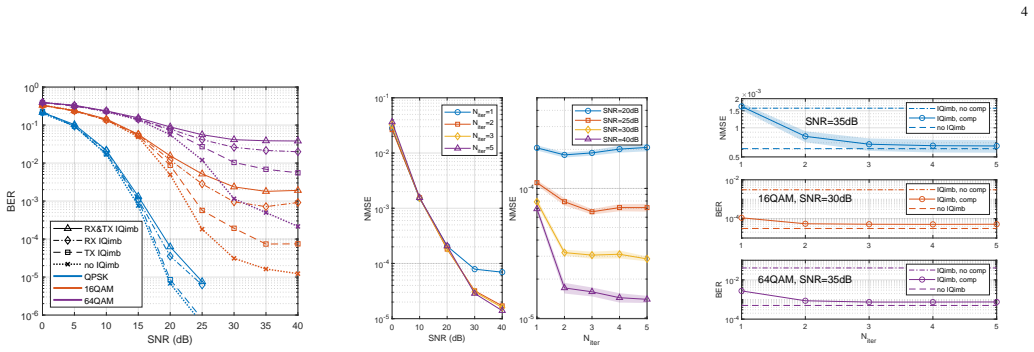
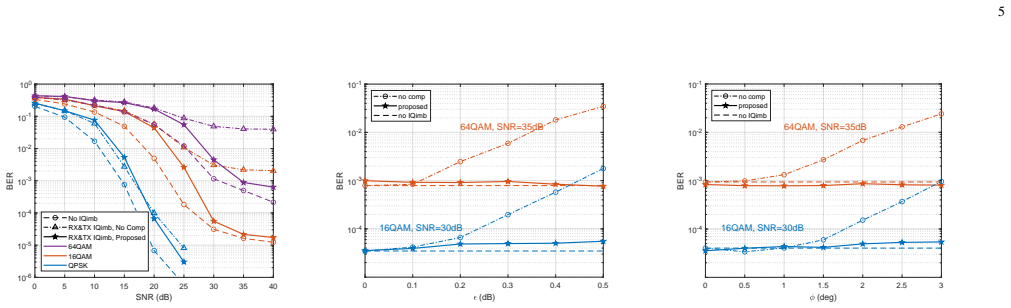
Affine frequency division multiplexing (AFDM) is an emerging chirp-based multicarrier waveform with strong diversity in doubly selective channels, but practical systems suffer from transmitter and receiver IQ imbalance, causing image interference and performance degradation. This paper proposes a two-stage IQ imbalance estimation and compensation method for AFDM systems. First, a preamble-assisted iterative algorithm estimates the time-invariant IQ imbalance parameters by exploiting their slowly time-varying nature. Then, a joint channel estimation and data detection scheme combines basis expansion model (BEM)-based channel estimation with an improved LMMSE detector for interference suppression. Simulations show rapid convergence and near-ideal BER performance.
Editorial analysis
A structured set of objections, weighed in public.
Referee Report
Summary. The paper proposes a two-stage IQ imbalance estimation and compensation scheme for AFDM systems in doubly selective channels. Stage 1 uses a preamble-assisted iterative algorithm to estimate time-invariant transmitter/receiver IQ imbalance parameters by exploiting their slowly time-varying nature. Stage 2 performs joint BEM-based channel estimation combined with an improved LMMSE detector to suppress image interference. Simulations are reported to show rapid convergence of the estimator and near-ideal BER performance.
Significance. If the performance claims hold under realistic variation rates, the work would be significant for practical AFDM deployment by providing a low-overhead method to mitigate a common RF impairment while preserving the waveform's diversity benefits in high-mobility scenarios. The two-stage separation of slowly varying impairment parameters from fast channel variations is a conceptually clean approach.
major comments (1)
- [Abstract and §II] Abstract and §II (system model): The central performance claim rests on the premise that IQ imbalance parameters remain sufficiently stationary across preamble intervals for the iterative estimator to converge to accurate values, while the underlying channel is doubly selective. No analysis, bound, or simulation is provided quantifying the maximum allowable variation rate of the imbalance parameters relative to the preamble spacing or iteration window; if this rate is exceeded, the estimated parameters become stale and the subsequent BEM/LMMSE stage cannot achieve the claimed near-ideal BER.
minor comments (2)
- [§II] Notation for the IQ imbalance parameters (e.g., g_T, ϕ_T) should be introduced with explicit definitions and ranges in the system model section rather than only in the algorithm description.
- [§IV] The simulation section should report the exact values of the imbalance parameters, Doppler spreads, and preamble lengths used, together with error bars or multiple Monte-Carlo runs, to allow reproduction of the convergence and BER curves.
Simulated Author's Rebuttal
We thank the referee for the constructive feedback. We address the single major comment below and will revise the manuscript accordingly.
read point-by-point responses
-
Referee: [Abstract and §II] Abstract and §II (system model): The central performance claim rests on the premise that IQ imbalance parameters remain sufficiently stationary across preamble intervals for the iterative estimator to converge to accurate values, while the underlying channel is doubly selective. No analysis, bound, or simulation is provided quantifying the maximum allowable variation rate of the imbalance parameters relative to the preamble spacing or iteration window; if this rate is exceeded, the estimated parameters become stale and the subsequent BEM/LMMSE stage cannot achieve the claimed near-ideal BER.
Authors: We agree that the manuscript lacks quantitative analysis or bounds on the allowable variation rate of the IQ imbalance parameters. While the work assumes these parameters vary much more slowly than the doubly selective channel (a standard modeling choice for RF impairments), providing explicit guidance on this point would strengthen the claims. In the revised manuscript we will add simulation results that sweep the variation rate of the transmitter and receiver IQ parameters relative to preamble spacing, reporting the resulting estimation MSE and BER degradation. This will establish practical limits under which the two-stage scheme maintains near-ideal performance. revision: yes
Circularity Check
No circularity detected; method description is self-contained
full rationale
The provided abstract and context describe a two-stage estimation/compensation algorithm for AFDM without any equations, derivations, or load-bearing steps that reduce a claimed prediction to a fitted input or self-citation by construction. No self-definitional loops, fitted parameters renamed as predictions, or uniqueness theorems imported from prior author work appear. The approach relies on standard BEM/LMMSE techniques and iterative estimation justified by the slowly time-varying assumption, with performance validated via simulation rather than internal redefinition. This is the common case of an honest non-finding.
Axiom & Free-Parameter Ledger
Reference graph
Works this paper leans on
-
[1]
Space-Air-Ground Integrated Wireless Networks for 6G: Basics, Key Technologies, and Future Trends,
Y . Xiao, Z. Ye, M. Wu, H. Li, M. Xiao, M.-S. Alouini, A. Al-Hourani, and S. Cioni, “Space-Air-Ground Integrated Wireless Networks for 6G: Basics, Key Technologies, and Future Trends,”IEEE Journal on Selected Areas in Communications, vol. 42, no. 12, pp. 3327–3354, Dec. 2024
2024
-
[2]
Space-Air-Ground Integrated Networks: Their Channel Model and Performance Analysis,
C. Zhang, Q. Li, C. Xu, L.-L. Yang, and L. Hanzo, “Space-Air-Ground Integrated Networks: Their Channel Model and Performance Analysis,” IEEE Open Journal of Vehicular Technology, vol. 6, pp. 1501–1523, 2025
2025
-
[3]
Space-air-ground integrated network (SAGIN) for 6G: Requirements, architecture and challenges,
H. Cui, J. Zhang, Y . Geng, Z. Xiao, T. Sun, N. Zhang, J. Liu, Q. Wu, and X. Cao, “Space-air-ground integrated network (SAGIN) for 6G: Requirements, architecture and challenges,”China Communications, vol. 19, no. 2, pp. 90–108, Feb. 2022
2022
-
[4]
Affine Frequency Division Multiplexing: Extending OFDM for Scenario-Flexibility and Resilience,
H. Yin, Y . Tang, A. Bemani, M. Kountouris, Y . Zhou, X. Zhang, Y . Liu, G. Chen, K. Yang, F. Liu, C. Masouros, S. Li, G. Caire, and P. Xiao, “Affine Frequency Division Multiplexing: Extending OFDM for Scenario-Flexibility and Resilience,”IEEE Wireless Communications, pp. 1–9, 2025
2025
-
[5]
Affine Frequency Division Multiplexing For Communications on Sparse Time-Varying Channels,
W. Benzine, A. Bemani, N. Ksairi, and D. Slock, “Affine Frequency Division Multiplexing For Communications on Sparse Time-Varying Channels,” inGLOBECOM 2023 - 2023 IEEE Global Communications Conference, Dec. 2023, pp. 4921–4926
2023
-
[6]
Affine Frequency Division Multiplexing for Next Generation Wireless Communications,
A. Bemani, N. Ksairi, and M. Kountouris, “Affine Frequency Division Multiplexing for Next Generation Wireless Communications,”IEEE Transactions on Wireless Communications, vol. 22, no. 11, pp. 8214– 8229, Nov. 2023
2023
-
[7]
AFDM Based Preamble Se- quence Transmission for 6G Mobile Satellite Communication Systems,
Y . Wang, Y . He, L. Zhao, and Y . Jiang, “AFDM Based Preamble Se- quence Transmission for 6G Mobile Satellite Communication Systems,” IEEE Transactions on Wireless Communications, pp. 1–1, 2025
2025
-
[8]
AFDM: A Full Diversity Next Generation Waveform for High Mobility Communications,
A. Bemani, N. Ksairi, and M. Kountouris, “AFDM: A Full Diversity Next Generation Waveform for High Mobility Communications,” in 2021 IEEE International Conference on Communications Workshops (ICC Workshops), Jun. 2021, pp. 1–6
2021
-
[9]
Channel Estimation and Data detection of OTFS system in the presence of Receiver IQ Imbalance,
S. G. Neelam and P. R. Sahu, “Channel Estimation and Data detection of OTFS system in the presence of Receiver IQ Imbalance,” in2021 National Conference on Communications (NCC), Jul. 2021, pp. 1–6
2021
-
[10]
Estimation of Wideband IQ Imbalance in MIMO OFDM Systems With CFO,
M. Sandell, E. Tsimbalo, S. Jardak, D. Uchida, K. Akita, D. Yoda, T. Kawaguchi, and M. Sano, “Estimation of Wideband IQ Imbalance in MIMO OFDM Systems With CFO,”IEEE Transactions on Wireless Communications, vol. 20, no. 9, pp. 5821–5830, Sep. 2021
2021
-
[11]
MIMO-AFDM Outperforms MIMO-OFDM in the Face of Hardware Impairments
Z. Sui, Z. Liu, L. Musavian, Y . L. Guan, L.-L. Yang, and L. Hanzo, “MIMO-AFDM Outperforms MIMO-OFDM in the Face of Hardware Impairments,” Jan. 2026, arXiv:2601.00502 [eess]
work page internal anchor Pith review Pith/arXiv arXiv 2026
-
[12]
Analysis and Compensation of Re- ceiver IQ Imbalance and Residual CFO Error for AFDM,
N. Gunasekara and E. Bedeer, “Analysis and Compensation of Re- ceiver IQ Imbalance and Residual CFO Error for AFDM,” Dec. 2025, arXiv:2512.10036 [eess]
-
[13]
Analysis and Compensation of Tx and Rx IQ Imbalances in AFDM System
H. Liu, L. Zeng, J. Tian, Q. Li, F. Xu, C. Liu, and G. Liu, “Analysis and Compensation of Tx and Rx IQ Imbalances in AFDM System,” May 2026, arXiv:2605.01328 [eess]
work page internal anchor Pith review Pith/arXiv arXiv 2026
-
[14]
Models, Methods, and Waveforms for Estimation and Prediction of Sparse Time-Varying Channels,
W. Benzine, A. Bemani, N. Ksairi, and D. Slock, “Models, Methods, and Waveforms for Estimation and Prediction of Sparse Time-Varying Channels,”IEEE Transactions on Wireless Communications, vol. 25, pp. 9623–9638, 2026
2026
-
[15]
Razavi,RF Microelectronics, 2nd ed
B. Razavi,RF Microelectronics, 2nd ed. Pearson Education, Inc., 2012
2012
-
[16]
Diagonally Reconstructed Channel Estimation for MIMO-AFDM With Inter-Doppler Interference in Doubly Selective Channels,
H. Yin, X. Wei, Y . Tang, and K. Yang, “Diagonally Reconstructed Channel Estimation for MIMO-AFDM With Inter-Doppler Interference in Doubly Selective Channels,”IEEE Transactions on Wireless Commu- nications, vol. 23, no. 10, pp. 14 066–14 079, Oct. 2024. [17]ADL5375: 400 MHz to 6 GHz Broadband Quadrature Modulator Data Sheet (Rev.D), Analog Devices, Norwo...
2024
discussion (0)
Sign in with ORCID, Apple, or X to comment. Anyone can read and Pith papers without signing in.