Multi-Adapter PPO: A Cross-Attention Enhanced Wavelength Selection Framework for LIBS Quantitative Analysis
Pith reviewed 2026-06-27 01:54 UTC · model grok-4.3
The pith
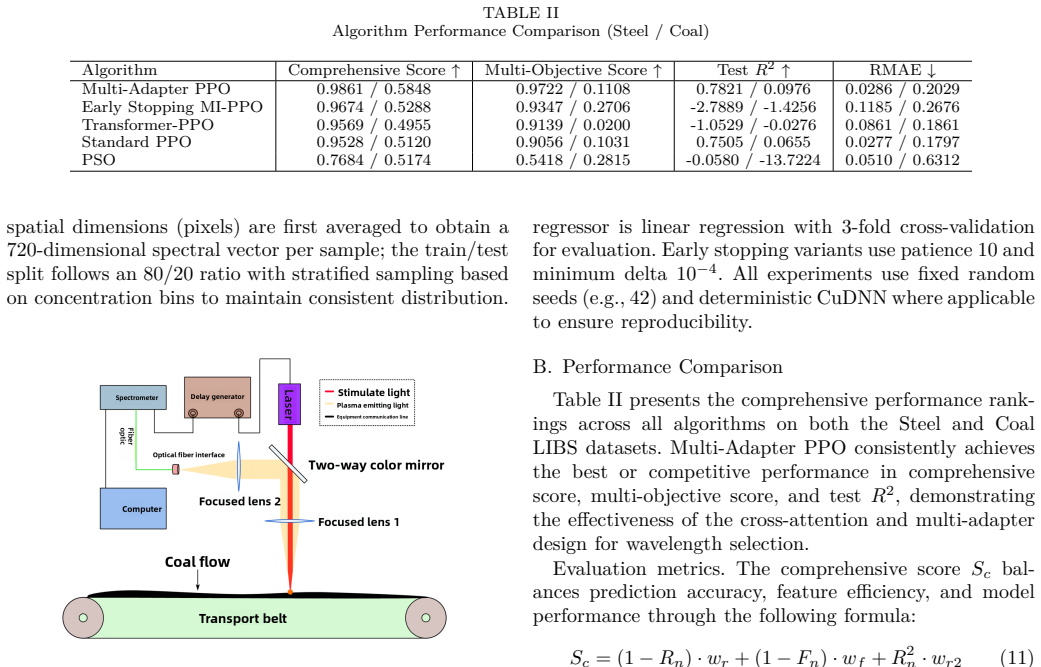
A multi-adapter reinforcement learning method selects wavelengths for LIBS analysis and beats particle swarm optimization by 28 percent in overall score.
A machine-rendered reading of the paper's core claim, the machinery that carries it, and where it could break.
Core claim
The Multi-Adapter PPO framework converts wavelength selection into a sequential decision process in which an agent receives state information from the spectrum, chooses lines via cross-attention adapters, and receives a reward based on downstream regression accuracy and feature count. When trained this way, the policy yields higher accuracy with fewer wavelengths than particle swarm optimization across the tested steel and coal datasets.
What carries the argument
Multi-Adapter PPO: proximal policy optimization augmented with multiple cross-attention adapters that each specialize in different spectral relationship patterns.
If this is right
- The selected wavelengths can be used directly in simpler regression models while retaining most predictive power.
- The same adapter structure can be reused across related spectroscopic tasks by swapping only the reward function.
- Fewer wavelengths reduce both acquisition time and data storage needs in field-deployed LIBS systems.
Where Pith is reading between the lines
- The same framing could be tested on Raman or FTIR spectra where feature selection is equally high-dimensional.
- If the adapters learn reusable spectral motifs, pre-training on public LIBS libraries might reduce the need for new labeled data.
- A direct comparison against attention-based supervised feature selectors would clarify whether the reinforcement learning component adds value beyond the cross-attention itself.
Load-bearing premise
The assumption that casting wavelength selection as a reinforcement learning problem with cross-attention adapters will reliably discover useful spectral relationships without overfitting to the training spectra.
What would settle it
Apply the trained model to a new set of LIBS spectra from a different material or instrument and measure whether the reported accuracy and efficiency gains disappear.
Figures

read the original abstract
Laser-induced breakdown spectroscopy (LIBS) quantitative analysis faces critical challenges in wavelength selection due to high-dimensional spectral data and the fundamental trade-off between prediction accuracy and feature efficiency. This paper presents a novel Multi-Adapter PPO framework that transforms wavelength selection into a reinforcement learning problem, leveraging cross-attention mechanisms and multiple specialized adapters to capture complex spectral relationships. Our approach outperforms traditional Particle Swarm Optimization (PSO) by an average of 28.4\% in comprehensive score and 45.2\% in prediction accuracy across steel and coal datasets. The proposed method demonstrates superior performance in balancing prediction accuracy with feature efficiency, achieving state-of-the-art results in LIBS quantitative analysis while maintaining interpretability and computational efficiency. We released our code and dataset here: https://github.com/Hflying/MAPPO
Editorial analysis
A structured set of objections, weighed in public.
Referee Report
Summary. The manuscript proposes a Multi-Adapter PPO (MAPPO) framework that casts wavelength selection for LIBS quantitative analysis as a reinforcement learning task. Cross-attention mechanisms and multiple specialized adapters are used to model complex spectral relationships; the method is reported to outperform Particle Swarm Optimization by 28.4% in comprehensive score and 45.2% in prediction accuracy on steel and coal datasets while balancing accuracy against feature count. Code and data are released at the cited GitHub repository.
Significance. If the performance margins hold under proper validation, the work would demonstrate a viable RL formulation for high-dimensional spectral feature selection that explicitly addresses the accuracy-efficiency trade-off. The public release of code and dataset is a clear strength that enables direct verification of the reported gains.
major comments (3)
- [§3] §3 (Method): no equation or pseudocode defines the state representation of the high-dimensional LIBS spectrum fed to the PPO policy; without this, the central claim that cross-attention adapters capture useful wavelength policies cannot be evaluated or reproduced from the text.
- [§3.2] §3.2 (Reward design): the reward function that trades prediction accuracy against feature cardinality is never specified; this definition is load-bearing for the asserted 28.4% comprehensive-score improvement over PSO.
- [§4] §4 (Experiments): dataset sizes, cross-validation procedure, and error bars are omitted, so the 45.2% accuracy gain cannot be assessed for statistical reliability or overfitting on the small LIBS collections.
minor comments (2)
- [Table 1] Table 1 caption should explicitly state the number of wavelengths selected by each method to allow direct comparison of feature efficiency.
- [Abstract] The GitHub link in the abstract is useful but should also appear in the main text with a brief description of what is released (code, trained models, raw spectra).
Simulated Author's Rebuttal
We thank the referee for the constructive comments that highlight areas for improved clarity. We address each major comment point by point below. All requested details will be added to the revised manuscript.
read point-by-point responses
-
Referee: [§3] §3 (Method): no equation or pseudocode defines the state representation of the high-dimensional LIBS spectrum fed to the PPO policy; without this, the central claim that cross-attention adapters capture useful wavelength policies cannot be evaluated or reproduced from the text.
Authors: We agree the state representation requires an explicit equation and pseudocode for full reproducibility. The state is the raw spectral intensity vector, but this was described only narratively. We will insert a formal definition s_t ∈ ℝ^D (D = number of wavelengths) together with pseudocode showing how the vector is tokenized and passed through the cross-attention adapters. This addition will appear in the revised Section 3. revision: yes
-
Referee: [§3.2] §3.2 (Reward design): the reward function that trades prediction accuracy against feature cardinality is never specified; this definition is load-bearing for the asserted 28.4% comprehensive-score improvement over PSO.
Authors: The reward function is indeed central and should have been stated mathematically. We will add the exact formulation R = accuracy_term − λ · (selected_features / total_features) with the concrete value of λ and the definition of the accuracy_term used to obtain the reported 28.4 % comprehensive score. The revised Section 3.2 will contain this equation and the hyper-parameter settings. revision: yes
-
Referee: [§4] §4 (Experiments): dataset sizes, cross-validation procedure, and error bars are omitted, so the 45.2% accuracy gain cannot be assessed for statistical reliability or overfitting on the small LIBS collections.
Authors: We accept that these experimental details must be stated explicitly in the text. We will expand Section 4 to report the exact sample counts for each dataset, the cross-validation scheme employed, and how error bars (standard deviation across repeated runs) were computed. These additions will allow readers to evaluate statistical reliability directly from the manuscript. revision: yes
Circularity Check
No circularity: empirical RL method with external benchmarks
full rationale
The paper presents an applied reinforcement-learning formulation for wavelength selection in LIBS spectra, using PPO with cross-attention adapters. Performance is measured by direct comparison against PSO on held-out steel and coal datasets; no derivation, uniqueness theorem, or fitted-parameter-as-prediction step is claimed. The reward, state, and adapter definitions are presented as design choices whose value is validated by the reported accuracy and feature-efficiency metrics rather than by algebraic identity with the inputs. No self-citation load-bearing steps or ansatz smuggling appear. The work is therefore self-contained against external empirical benchmarks.
Axiom & Free-Parameter Ledger
Forward citations
Cited by 1 Pith paper
-
A Standard Processing Pipeline for High-accuracy Measurement of Few-shot Regression on Laser Induced Breakdown Spectroscopy
The Diffusion-DA-AE pipeline achieves a mean RMAE of 0.2847 on few-shot LIBS elemental concentration regression, with reported 37.7% and 37.6% improvements over baseline autoencoder and PCA-PLS methods.
Reference graph
Works this paper leans on
-
[1]
A review on spectral data preprocessing techniques for machine learning and quantitative analysis,
Chunsheng Yan, “A review on spectral data preprocessing techniques for machine learning and quantitative analysis,” iScience, 2025
2025
-
[2]
Baseline correction method based on improved adaptive iteratively reweighted penalized least squares for the x-ray fluorescence spectrum,
Xiaoyu Jiang, Fusheng Li, Qingya Wang, Jie Luo, Jun Hao, and Muqiang Xu, “Baseline correction method based on improved adaptive iteratively reweighted penalized least squares for the x-ray fluorescence spectrum,” Applied Optics, vol. 60, no. 19, pp. 5707–5715, 2021
2021
-
[3]
Single convolutional neural network model for multiple preprocessing of raman spectra,
Jiahao Shen, Miao Li, Zhongfeng Li, Zhuoyong Zhang, and Xin Zhang, “Single convolutional neural network model for multiple preprocessing of raman spectra,” Vibrational Spectroscopy, vol. 121, pp. 103391, 2022
2022
-
[4]
Automatic kalman- filter-based wavelet shrinkage denoising of 1d stellar spectra,
Sankalp Gilda and Zachary Slepian, “Automatic kalman- filter-based wavelet shrinkage denoising of 1d stellar spectra,” Monthly Notices of the Royal Astronomical Society, vol. 490, no. 4, pp. 5249–5269, 2019
2019
-
[5]
Cascaded deep convolutional neural networks as improved methods of preprocessing raman spectroscopy data,
Mohammadrahim Kazemzadeh, Miguel Martinez-Calderon, Weiliang Xu, Lawrence W Chamley, Colin L Hisey, and Neil GR Broderick, “Cascaded deep convolutional neural networks as improved methods of preprocessing raman spectroscopy data,” Analytical Chemistry, vol. 94, no. 37, pp. 12907–12918, 2022
2022
-
[6]
A three-stage deep learning- based training frame for spectra baseline correction,
Qingliang Jiao, Boyong Cai, Ming Liu, Liquan Dong, Mei Hei, Lingqin Kong, and Yuejin Zhao, “A three-stage deep learning- based training frame for spectra baseline correction,” Analytical Methods, vol. 16, no. 10, pp. 1496–1507, 2024
2024
-
[7]
A new technique for baseline calibration of soil x-ray fluorescence spectra based on enhanced generative adversarial networks combined with transfer learning,
Xinghua He, Yanchun Zhao, and Fusheng Li, “A new technique for baseline calibration of soil x-ray fluorescence spectra based on enhanced generative adversarial networks combined with transfer learning,” Journal of Analytical Atomic Spectrometry, vol. 38, no. 11, pp. 2486–2498, 2023
2023
-
[8]
Study on breast cancerization and isolated diagnosis in situ by hof-atr-mir spectroscopy with deep learning,
Hui Shang, Qingxia Wu, Jinjin Wu, Suwei Zhou, Zihan Wang, Huijie Wang, and Jianhua Yin, “Study on breast cancerization and isolated diagnosis in situ by hof-atr-mir spectroscopy with deep learning,” Spectrochimica Acta Part A: Molecular and Biomolecular Spectroscopy, vol. 319, pp. 124546, 2024
2024
-
[9]
Protein-protein interface hot spots prediction based on a hybrid feature selection strategy,
Yanhua Qiao, Yi Xiong, Hongyun Gao, Xiaolei Zhu, and Peng Chen, “Protein-protein interface hot spots prediction based on a hybrid feature selection strategy,” BMC bioinformatics, vol. 19, no. 1, pp. 14, 2018
2018
-
[10]
Performing sequential forward selection and variational autoencoder techniques in soil classification based on laser-induced breakdown spectroscopy,
Edward Harefa and Weidong Zhou, “Performing sequential forward selection and variational autoencoder techniques in soil classification based on laser-induced breakdown spectroscopy,” Analytical Methods, vol. 13, no. 41, pp. 4926–4933, 2021
2021
-
[11]
Variations in variational autoencoders-a comparative evaluation,
Ruoqi Wei, Cesar Garcia, Ahmed El-Sayed, Viyaleta Peterson, and Ausif Mahmood, “Variations in variational autoencoders-a comparative evaluation,” Ieee Access, vol. 8, pp. 153651–153670, 2020
2020
-
[12]
Restricted boltzmann ma- chine method for dimensionality reduction of large spectroscopic data,
J Vrábel, P Pořízka, and J Kaiser, “Restricted boltzmann ma- chine method for dimensionality reduction of large spectroscopic data,” Spectrochimica Acta Part B: Atomic Spectroscopy, vol. 167, pp. 105849, 2020
2020
-
[13]
Rapid classification of steel via a modified support vector machine algorithm based on portable fiber-optic laser-induced breakdown spectroscopy,
Mengtian Yuan, Qingdong Zeng, Jie Wang, Wenxin Li, Guanghui Chen, Zitao Li, Yang Liu, Lianbo Guo, Xiangyou Li, and Huaqing Yu, “Rapid classification of steel via a modified support vector machine algorithm based on portable fiber-optic laser-induced breakdown spectroscopy,” Optical Engineering, vol. 60, no. 12, pp. 124114–124114, 2021
2021
-
[14]
A step-by-step classification method of coal and miscella- neous materials by laser-induced breakdown spectroscopy,
Weizhe Ma, Ziyu Yu, Zhimin Lu, Qingxiang Ma, and Shunchun Yao, “A step-by-step classification method of coal and miscella- neous materials by laser-induced breakdown spectroscopy,” At. Spectrosc, vol. 44, no. 3, pp. 160–168, 2023
2023
-
[15]
Learning to decide with just enough: Information-theoretic context summarization for cmdps,
Peidong Liu, Junjiang Lin, Shaowen Wang, Yao Xu, Haiqing Li, Xuhao Xie, Siyi Wu, and Hao Li, “Learning to decide with just enough: Information-theoretic context summarization for cmdps,” arXiv preprint arXiv:2510.01620, 2025
arXiv 2025
-
[16]
A hybrid feature selection algorithm based on information gain and sequential forward floating search,
Jianli Ding and Liyang Fu, “A hybrid feature selection algorithm based on information gain and sequential forward floating search,” J Intell Comput, vol. 9, no. 3, pp. 93, 2018
2018
-
[17]
Application and research progress of laser-induced breakdown spectroscopy in agricultural product inspection,
Li Wang, Galina Tolok, Yuanxia Fu, Li Xu, Li Li, Hui Gao, and Yu Zhou, “Application and research progress of laser-induced breakdown spectroscopy in agricultural product inspection,” ACS omega, vol. 9, no. 23, pp. 24203–24218, 2024
2024
-
[18]
A review of feature selection methods based on mutual information,
Jorge R Vergara and Pablo A Estévez, “A review of feature selection methods based on mutual information,” Neural computing and applications, vol. 24, no. 1, pp. 175–186, 2014
2014
-
[19]
A novel hybrid feature selection strategy in quantitative analysis of laser-induced breakdown spectroscopy,
Chunhua Yan, Jing Liang, Mingjing Zhao, Xin Zhang, Tianlong Zhang, and Hua Li, “A novel hybrid feature selection strategy in quantitative analysis of laser-induced breakdown spectroscopy,” Analytica chimica acta, vol. 1080, pp. 35–42, 2019
2019
-
[20]
A wavelength selection method based on randomization test for near-infrared spectral analysis,
Heng Xu, Zhichao Liu, Wensheng Cai, and Xueguang Shao, “A wavelength selection method based on randomization test for near-infrared spectral analysis,” Chemometrics and Intelligent Laboratory Systems, vol. 97, no. 2, pp. 189–193, 2009
2009
-
[21]
Classification of brazilian soils by using libs and variable selection in the wavelet domain,
Márcio José Coelho Pontes, Juliana Cortez, Roberto Kawakami Harrop Galvão, Celio Pasquini, Mário César Ugulino Araújo, Ricardo Marques Coelho, Márcio Koiti Chiba, Mônica Ferreira de Abreu, and Beáta Emöke Madari, “Classification of brazilian soils by using libs and variable selection in the wavelet domain,” Analytica Chimica Acta, vol. 642, no. 1-2, pp. 1...
2009
-
[22]
Ting He, Jing Liang, Hongsheng Tang, Tianlong Zhang, Chun- hua Yan, and Hua Li, “Quantitative analysis of coal quality by mutual information-particle swarm optimization (mi-pso) hybrid variable selection method coupled with spectral fusion strategy of laser-induced breakdown spectroscopy (libs) and fourier transform infrared spectroscopy (ftir),” Spectroc...
2021
-
[23]
An overview of variable selection methods in multivariate analysis of near-infrared spectra,
Yong-Huan Yun, Hong-Dong Li, Bai-Chuan Deng, and Dong- Sheng Cao, “An overview of variable selection methods in multivariate analysis of near-infrared spectra,” TrAC Trends in Analytical Chemistry, vol. 113, pp. 102–115, 2019
2019
-
[24]
A modified kennard-stone algorithm for optimal division of data for devel- oping artificial neural network models,
Agus Saptoro, Moses O Tadé, and Hari Vuthaluru, “A modified kennard-stone algorithm for optimal division of data for devel- oping artificial neural network models,” Chemical Product and Process Modeling, vol. 7, no. 1, 2012
2012
-
[25]
Golden rpg: Confidence-adaptive region-aware noise for compositional text-to-image generation,
Hao Li, “Golden rpg: Confidence-adaptive region-aware noise for compositional text-to-image generation,” arXiv preprint arXiv:2604.25314, 2026
Pith/arXiv arXiv 2026
-
[26]
Latency-aware batch task offloading for vehicular cloud: Maximizing submod- ular bandit,
Hao Li, Haitao Huang, and Zhuzhong Qian, “Latency-aware batch task offloading for vehicular cloud: Maximizing submod- ular bandit,” in 2021 IEEE 14th International Conference on Cloud Computing (CLOUD). IEEE, 2021, pp. 584–593
2021
-
[27]
Hao Li and Man Fung Zhuo, “Revisiting the scale loss func- tion and gaussian-shape convolution for infrared small target detection,” arXiv preprint arXiv:2604.09991, 2026
Pith/arXiv arXiv 2026
-
[28]
R3d: Regional-guided residual radar diffusion,
Hao Li, Xinqi Liu, and Yaoqing Jin, “R3d: Regional-guided residual radar diffusion,” arXiv preprint arXiv:2601.06465, 2026
arXiv 2026
-
[29]
A reliable resource scheduling for network function virtualization,
Daoqiang Xu, Yefei Li, Ming Yin, Xin Li, Hao Li, and Zhuzhong Qian, “A reliable resource scheduling for network function virtualization,” in International Conference on Security, Privacy and Anonymity in Computation, Communication and Storage. Springer, 2017, pp. 251–260
2017
-
[30]
Deep reinforcement learning for semisupervised hyperspectral band selection,
Jie Feng, Di Li, Jing Gu, Xianghai Cao, Ronghua Shang, Xiangrong Zhang, and Licheng Jiao, “Deep reinforcement learning for semisupervised hyperspectral band selection,” IEEE Transactions on Geoscience and Remote Sensing, vol. 60, pp. 1–19, 2021
2021
discussion (0)
Sign in with ORCID, Apple, or X to comment. Anyone can read and Pith papers without signing in.