On the entanglement induced by the deformation of phase-space
Pith reviewed 2026-06-27 00:59 UTC · model grok-4.3
The pith
Deformation parameters θ and η in noncommutative phase space induce entanglement between bipartite Gaussian states.
A machine-rendered reading of the paper's core claim, the machinery that carries it, and where it could break.
Core claim
θ and η induce the entanglement. The bipartite Gaussian state is almost always entangled in deformed space. The Peres-Horodecki separability condition leads to a constraint equation for the parameter values of the oscillator in NC space.
What carries the argument
Extension of the PPT separability criterion to the general Bopp shift that incorporates both θ (position-position) and η (momentum-momentum) noncommutativity.
If this is right
- States that are separable under ordinary commutative dynamics become entangled once the phase-space deformation parameters are turned on.
- The Peres-Horodecki condition supplies an explicit algebraic constraint relating the oscillator frequencies and the deformation parameters θ and η.
- Any experimental detection of unexpected entanglement in supposedly separable Gaussian states would be interpreted as evidence for an intermediate noncommutative phase-space structure.
Where Pith is reading between the lines
- The same deformation-induced entanglement mechanism could be searched for in other quadratic systems whose covariance matrices are experimentally accessible.
- If the gedankenexperiment succeeds, it supplies an operational route to distinguish noncommutative effects from other sources of entanglement without requiring direct access to Planck-scale physics.
Load-bearing premise
The positive partial transpose criterion remains a valid separability test when extended from ordinary phase space to the general Bopp shift that includes both position-position and momentum-momentum noncommutativity.
What would settle it
Perform the proposed photocurrent measurement on input states that are separable in commutative space; if the reconstructed covariance matrix violates the PPT condition, the states are entangled and the entanglement must be attributed to the noncommutative background.
Figures

read the original abstract
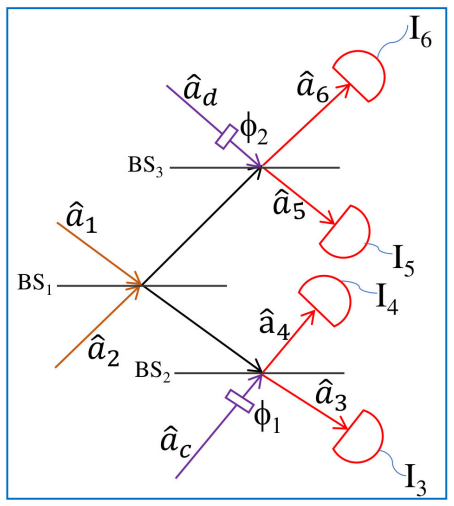
Most quantum gravity theories propose that the fundamental concept of space-time is mostly compatible with quantum theory in noncommutative (NC) space. In the present paper, we revisit the notion of entanglement induced by NC deformations of phase space. The positive partial transpose (PPT) criterion for separability of bipartite Gaussian states is extended to a general class of Bopp's shift. In particular, we have considered both the position-position and momentum-momentum noncommutativity, with deformation parameters $\theta$ and $\eta$, respectively. It turns out that $\theta$ and $\eta$ induce the entanglement. We have directly applied the formalism for an anisotropic two-dimensional harmonic oscillator. Peres-Horodecki separability condition leads to a constraint equation for the parameter values of the oscillator in NC space. It turns out that the bipartite Gaussian state is almost always entangled in deformed space. To implement the theoretical idea, we provide an outline for a gedankenexperiment to identify the signature of phase-space noncommutativity, i.e., quantum gravity. In particular, the gedankenexperiment is devised to test the separability of supposedly separable Gaussian states in the usual commutative space, through the covariance matrix, which is constructed via measured output photocurrents after interaction of input Gaussian states and reference states. If the experiment shows that the supposedly separable states are actually entangled, then the entanglement is created through the intermediate background noncommutative space, which is a signature of the quantum nature of gravity.
Editorial analysis
A structured set of objections, weighed in public.
Referee Report
Summary. The manuscript claims that noncommutative deformations of phase space with parameters θ (position-position noncommutativity) and η (momentum-momentum noncommutativity) induce entanglement in bipartite Gaussian states. It extends the positive partial transpose (PPT) separability criterion to a general class of Bopp shifts, applies the formalism to an anisotropic two-dimensional harmonic oscillator to obtain a constraint equation on the oscillator parameters, and concludes that the resulting states are almost always entangled. An outline of a gedankenexperiment is provided to detect this effect as a signature of quantum gravity via measured photocurrents and covariance matrices.
Significance. If the PPT extension were rigorously justified, the result would link noncommutativity directly to entanglement generation and offer a potential experimental probe of quantum-gravity-induced phase-space deformation. The work does not supply machine-checked proofs, reproducible code, or parameter-free derivations, and the central claim rests on an unverified extension of a separability criterion whose validity in the deformed algebra is not established.
major comments (2)
- [Abstract and main text] Abstract and main text: the claim that the PPT criterion 'is extended' to Bopp shifts with both θ and η is load-bearing for the conclusion that these parameters induce entanglement and that states are 'almost always entangled.' No derivation is supplied showing that the shifted covariance matrix preserves the correct symplectic structure under the deformed commutation relations or that the extended PPT condition remains necessary and sufficient for separability once the underlying operator algebra is noncommutative.
- [Main text (constraint equation)] The separability constraint derived for the anisotropic oscillator is presented as evidence that θ and η induce entanglement, yet the manuscript supplies no verification that the numerical constraint is not satisfied by construction once the deformation parameters are inserted into the covariance matrix.
minor comments (1)
- [Abstract] The abstract states conclusions ('almost always entangled') without referencing the explicit form of the constraint equation or any error analysis on the numerical results.
Simulated Author's Rebuttal
We thank the referee for the careful reading of the manuscript and the constructive comments. We address each major point below and will revise the manuscript to incorporate additional derivations and verifications as needed.
read point-by-point responses
-
Referee: [Abstract and main text] Abstract and main text: the claim that the PPT criterion 'is extended' to Bopp shifts with both θ and η is load-bearing for the conclusion that these parameters induce entanglement and that states are 'almost always entangled.' No derivation is supplied showing that the shifted covariance matrix preserves the correct symplectic structure under the deformed commutation relations or that the extended PPT condition remains necessary and sufficient for separability once the underlying operator algebra is noncommutative.
Authors: We agree that an explicit derivation of the PPT extension would strengthen the presentation. The Bopp shifts are introduced precisely to encode the deformed commutation relations [θ,η] while the covariance matrix is formed from the expectation values of the shifted operators; the symplectic form is preserved by the definition of the shifts. We will add a dedicated subsection (or appendix) that derives the extended PPT condition step by step, confirming that necessity and sufficiency carry over because the partial-transpose operation commutes with the shift in the manner required by the noncommutative algebra. revision: yes
-
Referee: [Main text (constraint equation)] The separability constraint derived for the anisotropic oscillator is presented as evidence that θ and η induce entanglement, yet the manuscript supplies no verification that the numerical constraint is not satisfied by construction once the deformation parameters are inserted into the covariance matrix.
Authors: The constraint is not satisfied by construction. When θ = η = 0 the deformed covariance matrix reduces exactly to the standard commutative case, and the PPT inequality holds for the chosen oscillator parameters, recovering separability. Nonzero θ and η generate additional cross terms that violate the inequality for generic frequency and mass values. We will insert an explicit check of the commutative limit together with numerical examples that isolate the contribution of the deformation parameters. revision: yes
Circularity Check
No significant circularity; derivation applies extended criterion to deformed covariance matrix
full rationale
The paper extends the PPT separability criterion to Bopp-shifted NC phase space incorporating both θ (position-position) and η (momentum-momentum) noncommutativity, constructs the corresponding covariance matrix for the anisotropic 2D harmonic oscillator, and derives a parameter constraint from the Peres-Horodecki condition. The claim that θ and η induce entanglement is the direct output of this calculation rather than a definitional tautology or a fitted input renamed as prediction. No load-bearing self-citation, uniqueness theorem imported from prior work, or ansatz smuggled via citation is present in the abstract or described chain. The derivation remains self-contained against the stated assumptions even if the validity of the PPT extension itself is debatable on other grounds.
Axiom & Free-Parameter Ledger
free parameters (2)
- θ
- η
axioms (2)
- domain assumption Bipartite Gaussian states remain well-defined and the PPT criterion applies after Bopp shift deformation
- ad hoc to paper The anisotropic 2D harmonic oscillator in NC space yields a covariance matrix whose separability is governed by the stated constraint
Reference graph
Works this paper leans on
-
[1]
Horodecki, P
R. Horodecki, P. Horodecki, M. Horodecki, and K. Horodecki, Quantum entanglement , Rev. Mod. Phys. 81 , 865 (2009)
2009
-
[2]
Dorner, and V
R. Dorner, and V. Vedral, Correlations in Quantum Physics , International Journal of Modern Physics B 27 , 1345017 (2013)
2013
-
[3]
Schlosshauer, Quantum decoherence , Physics Reports 831 , 1-57 (2019)
M. Schlosshauer, Quantum decoherence , Physics Reports 831 , 1-57 (2019)
2019
-
[4]
D. F. Walls, and G. J. Milburn, Quantum Optics , Publisher: Springer Cham, eBook ISBN: 978-3-031-84177-4 (2025)
2025
-
[5]
Raz, and R
T. Raz, and R. D. Levine, The essence of phase transitions in condensed matter by an information theoretic approach , PNAS 120 , e2310281120 (2023)
2023
-
[6]
Agullo, A
I. Agullo, A. J. Brady, A. Delhom, and D. Kranas, Entanglement from rotating black holes in thermal baths , Phys. Rev. D 110 , 025021 (2024)
2024
-
[7]
Neukart, Geometry-information duality: Quantum entanglement contributions to gravitational dynamics , Annals of Physics 479 , 170044 (2025)
F. Neukart, Geometry-information duality: Quantum entanglement contributions to gravitational dynamics , Annals of Physics 479 , 170044 (2025)
2025
- [8]
-
[9]
C. Marletto, J. Oppenheim, V. Vedral, and E. Wilson, Classical gravity cannot mediate entanglement , arXiv:2511.07348v1 [quant-ph]
-
[10]
Rovelli, Quantum Gravity , Cambridge University Press, ISBN: 0-521-83733-2 (2004)
C. Rovelli, Quantum Gravity , Cambridge University Press, ISBN: 0-521-83733-2 (2004)
2004
-
[11]
Stachel, and K
J. Stachel, and K. Bradonji\' c , Quantum gravity: Meaning and measurement , Studies in History and Philosophy of Science Part B: Studies in History and Philosophy of Modern Physics 46 , 209-216 (2014)
2014
-
[12]
Ashtekar, and R
A. Ashtekar, and R. Geroch, Quantum theory of gravitation , Rep. Prog. Phys. 37 , 1211 (1974)
1974
-
[13]
Stelle, The unification of quantum gravity , Nuclear Physics B - Proceedings Supplements 88 , 3-9 (2000)
K.S. Stelle, The unification of quantum gravity , Nuclear Physics B - Proceedings Supplements 88 , 3-9 (2000)
2000
-
[14]
Doplicher, K
S. Doplicher, K. Fredenhagen, and J. E. Roberts, The quantum structure of spacetime at the Planck scale and quantum fields , Commun.Math.Phys. 172 187-220 (1995)
1995
-
[15]
Hanif, D
F. Hanif, D. Das, J. Halliwell, D. Home, A. Mazumdar, H. Ulbricht, and S. Bose, Testing Whether Gravity Acts as a Quantum Entity When Measured , Phys. Rev. Lett. 133 , 180201 (2024)
2024
-
[16]
Last visited
https://home.cern/science/engineering/restarting-lhc-why-13-tev. Last visited
-
[17]
Kiefer, Quantum gravity - an unfinished revolution , arXiv:2302.13047 [gr-qc] (25 Feb 2023)
C. Kiefer, Quantum gravity - an unfinished revolution , arXiv:2302.13047 [gr-qc] (25 Feb 2023)
arXiv 2023
-
[18]
S. Dey, A. Bhat, D. Momeni, M. Faizal, A. F. Ali, T. K. Dey, A. Rehman, Probing noncommutative theories with quantum optical experiments , Nuclear Physics B 924 , 578-587 (2017)
2017
-
[19]
Pikovski, M
I. Pikovski, M. R. Vanner, M. Aspelmeyer, M. S. Kim, \^ C . Brukner, Probing Planck-scale physics with quantum optics , Nature Phys 8 , 393-397 (2012)
2012
-
[20]
Bosso, S
P. Bosso, S. Das, I. Pikovski, M. R. Vanner, Amplified transduction of Planck-scale effects using quantum optics , Phys. Rev. A 96 , 023849 (2017)
2017
-
[21]
Liberati, Tests of Lorentz invariance: a 2013 update, Class
S. Liberati, Tests of Lorentz invariance: a 2013 update, Class. Quantum Gravity 30 , 133001 (2013)
2013
-
[22]
Seiberg and E
N. Seiberg and E. Witten, String theory and noncommutative geometry, Journal of High Energy Physics 09 (1999)
1999
-
[23]
J. M. Romero, J. D. Vergara, and J. A. Santiago, Noncommutative spaces, the quantum of time, and Lorentz symmetry, Phys. Rev. D 75 , 065008 (2007)
2007
-
[24]
R. J. Szabo, Quantum field theory on noncommutative spaces, Physics Reports 378 , 207-299 (2003)
2003
-
[25]
M. R. Douglas, and N. A. Nekrasov, Noncommutative field theory, Rev. Mod. Phys. 73 977 (2001)
2001
-
[26]
M. B. Fr\" o b, A. Much, and K. Papadopoulos, Noncommutative geometry from perturbative quantum gravity, Phys. Rev. D 107 , 064041 (2023)
2023
-
[27]
Quantum mechanics as a statistical theory
J. E. Moyal, "Quantum mechanics as a statistical theory", Mathematical Proceedings of the Cambridge Philosophical Society 45 , 99-124 (1949)
1949
-
[28]
Nandi, N
P. Nandi, N. Debnath, S. Kala, and A. S. Majumdar, Magnetically induced Schr\" o dinger cat states: The shadow of a quantum space, Phys. Rev. A 110 , 032204 (2024)
2024
-
[29]
On the entanglement of co-ordinate and momentum degrees of freedom in noncommutative space
S. Nandi, M. Rahaman, and P. Patra, "On the entanglement of co-ordinate and momentum degrees of freedom in noncommutative space", Modern Physics Letters A 39 , 2450091 (2024)
2024
-
[30]
Deformation quantization of noncommutative quantum mechanics and dissipation
C Bastos, O Bertolami, N C Dias, and J N Prata, "Deformation quantization of noncommutative quantum mechanics and dissipation", J. Phys.: Conf. Ser. 67 , 012058 (2007)
2007
-
[31]
Tuning the separability in noncommutative space
P. Patra, "Tuning the separability in noncommutative space", J. Math. Phys. 65 , 052103 (2024)
2024
-
[32]
Unitary maps on Hamiltonians of an electron moving in a plane and coherent state construction
I. Aremua, and L. Gouba, "Unitary maps on Hamiltonians of an electron moving in a plane and coherent state construction", J. Math. Phys. 64 , 063508 (2023)
2023
-
[33]
Entanglement due to noncommutativity in phase space
C. Bastos, A. E. Bernardini, O. Bertolami, N. C. Dias, and J. N. Prata, "Entanglement due to noncommutativity in phase space", Phys. Rev. D 88 , 085013 (2013)
2013
-
[34]
Entanglement in phase-space distribution for an anisotropic harmonic oscillator in noncommutative space
P. Patra, "Entanglement in phase-space distribution for an anisotropic harmonic oscillator in noncommutative space", Quantum Inf Process 22 , 20 (2023)
2023
-
[35]
Entanglement induced by noncommutativity: anisotropic harmonic oscillator in noncommutative space
A. Muhuri, D. Sinha, and S. Ghosh, "Entanglement induced by noncommutativity: anisotropic harmonic oscillator in noncommutative space", Eur. Phys. J. Plus 136 , 35 (2021)
2021
-
[36]
Emergent time crystals from phase-space noncommutative quantum mechanics
A.E. Bernardini, and O. Bertolami, "Emergent time crystals from phase-space noncommutative quantum mechanics", Phys. Lett. B 835 , 137549 (2022)
2022
-
[37]
Marletto, and V
C. Marletto, and V. Vedral, Gravitationally Induced Entanglement between Two Massive Particles is Sufficient Evidence of Quantum Effects in Gravity , Phys. Rev. Lett. 119 , 240402 (2017)
2017
-
[38]
A. Dutta, S. Ghosh, J. Kim, and R. Sengupta, Robust entanglement detection in arbitrary two-mode Gaussian state: a Stokes-like operator-based approach , arXiv:2103.12987v2 [quant-ph] (2026). https://doi.org/10.48550/arXiv.2103.12987
-
[39]
A. Ferraro, S. Olivares, and Matteo G. A. Paris, Gaussian States in Quantum Information , Napoli Series on physics and Astrophysics, Bibliopolis, ISBN: 88-7088-483-X, 978-8870884838 (2005). arXiv:quant-ph/0503237v1 (31 Mar 2005 )
Pith/arXiv arXiv 2005
-
[40]
Peres-Horodecki Separability Criterion for Continuous Variable Systems
R. Simon, "Peres-Horodecki Separability Criterion for Continuous Variable Systems", Phys. Rev. Lett. 84 , 2726 (2000)
2000
-
[41]
Nokkala, R
J. Nokkala, R. Mart\' i nez-Pe\ n a, G. L. Giorgi, V. Parigi, M. C. Soriano, and R. Zambrini, Gaussian states of continuous-variable quantum systems provide universal and versatile reservoir computing , Commun Phys 4 , 53 (2021)
2021
-
[42]
Gaussian states and operations - a quick reference
J. B. Brask, "Gaussian states and operations - a quick reference", arXiv:2102.05748v2 [quant-ph] (30 Mar 2022)
arXiv 2022
-
[43]
Gaussian-Wigner distributions in quantum mechanics and optics
R. Simon, E. Sudarshan, and N. Mukunda, "Gaussian-Wigner distributions in quantum mechanics and optics", Phys. Rev. A 36 , 3868 (1987)
1987
-
[44]
Williamson, On the Algebraic Problem Concerning the Normal Forms of Linear Dynamical Systems , Am
J. Williamson, On the Algebraic Problem Concerning the Normal Forms of Linear Dynamical Systems , Am. J. of Math. 58 , 141 (1936)
1936
-
[45]
Nicacio, Williamson theorem in classical, quantum, and statistical physics , American Journal of Physics 89 , 1139-1151 (2021)
F. Nicacio, Williamson theorem in classical, quantum, and statistical physics , American Journal of Physics 89 , 1139-1151 (2021)
2021
discussion (0)
Sign in with ORCID, Apple, or X to comment. Anyone can read and Pith papers without signing in.