PSZ: The meta-catalogue of Planck Sunyaev-Zeldovich sources
Pith reviewed 2026-06-27 00:08 UTC · model grok-4.3
The pith
The PSZ meta-catalogue compiles 1500 confirmed Planck Sunyaev-Zeldovich clusters with updated redshifts and selection-corrected masses.
A machine-rendered reading of the paper's core claim, the machinery that carries it, and where it could break.
Core claim
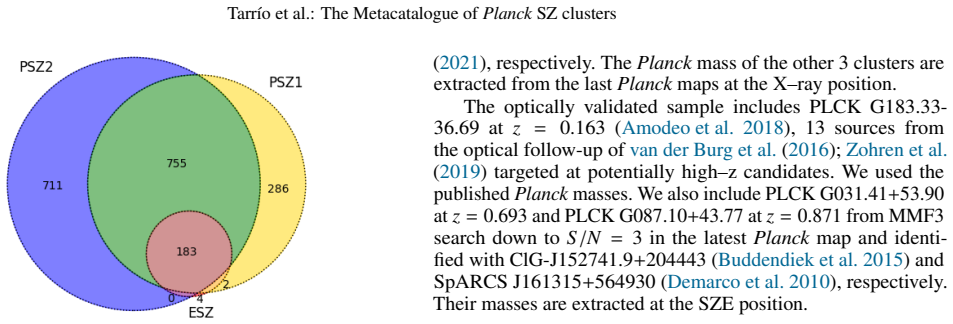
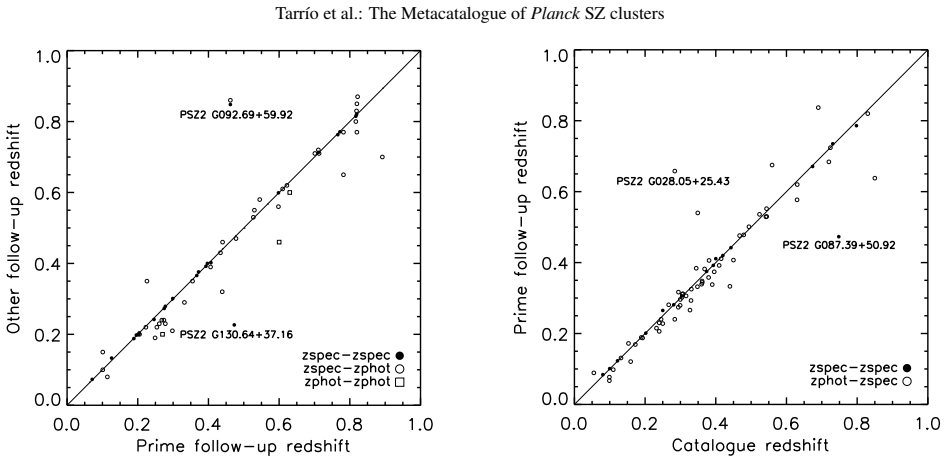
The PSZ meta-catalogue contains 1962 entries that consolidate validation status for every official Planck SZ source, resulting in 1500 confirmed clusters, 262 noise-dominated detections, and 200 unconfirmed candidates, together with 274 updated redshifts, 278 newly assigned redshifts, new posterior probability contours, and selection-corrected M500 values for the confirmed sample.
What carries the argument
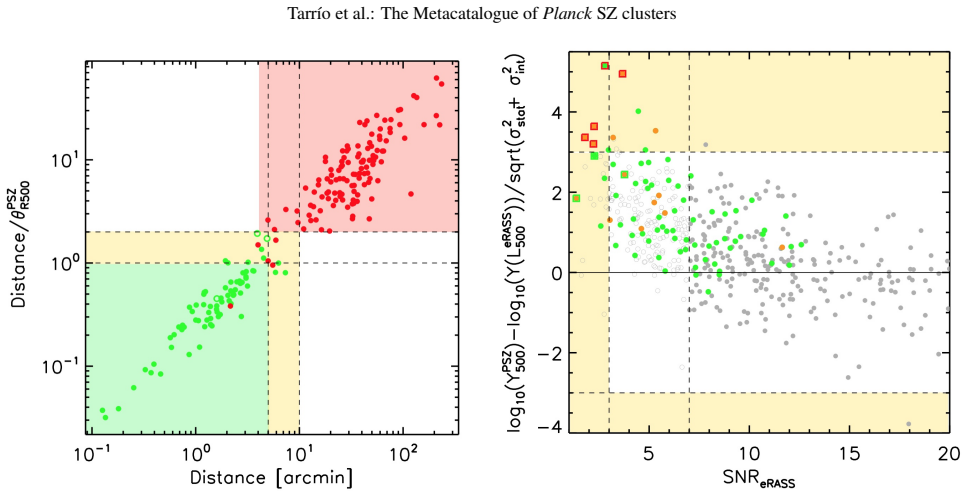
The validation and cross-identification procedure that combines follow-up campaigns with external catalogue matches and adds consistency checks on mass proxies, redshifts, and distance-versus-angular-size relations.
If this is right
- The catalogue supplies a cleaner input sample for cosmological constraints derived from cluster abundance.
- Uniform selection-corrected mass estimates enable direct comparison of cluster properties across the full confirmed set.
- The 200 remaining candidates can be targeted for efficient follow-up to increase the confirmed sample.
- The demonstrated need for mass and redshift consistency checks beyond fixed-distance matching improves reliability of future multi-catalogue work.
Where Pith is reading between the lines
- The approach of building meta-catalogues from multiple validation sources could reduce duplication in other large cluster surveys.
- Probability contours supplied for all sources allow statistical analyses that include candidates without forcing binary confirmed/unconfirmed labels.
- The cross-identification rules may generalize to other wavelength regimes where simple positional matches produce false duplicates.
Load-bearing premise
The optical and X-ray follow-up data together with external catalogue cross-matches correctly classify sources as confirmed clusters versus noise or unconfirmed candidates with negligible contamination or incompleteness.
What would settle it
An independent spectroscopic or X-ray survey of a random subset of the 1500 confirmed clusters that finds a contamination rate substantially above the level implied by the validation process would falsify the reported counts.
Figures




read the original abstract
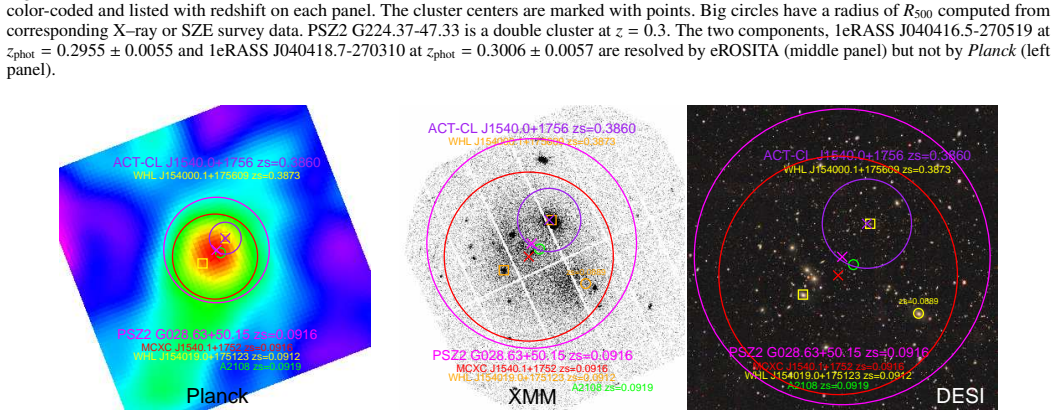
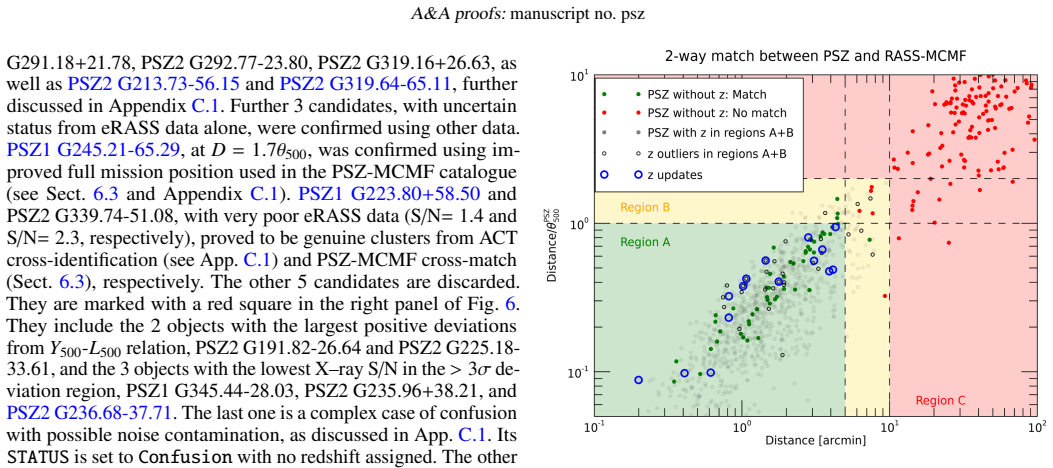
We present the PSZ, a meta-catalogue of 1962 clusters and cluster candidates produced by the Planck Collaboration. The PSZ contains fully-updated validation information for all official Planck catalogue detections, together with redshift estimates for confirmed clusters, with no duplicate entries. The validation is derived from optical and X-ray follow-up campaigns, supplemented by cross-matching with external catalogues with redshift information, and with XMM-Newton archive data. The external catalogues considered include the all-sky X-ray catalogue MCXC-II, the eROSITA X-ray cluster catalogue, the RASS-MCMF and PSZ-MCMF catalogues, and the extended Planck catalogues of Burenin. A total of 281 clusters are newly-confirmed owing to this process; conversely, 262 Planck candidates are invalidated. Of the 1500 confirmed clusters, 274 have updated redshifts, and 278 have newly-assigned redshifts. An MCXC-II counterpart is assigned to 631 clusters, updating the MCXC cross-match published in the Planck catalogues. Differences with the PSZ2 update of Bahk & Hwang are discussed. We further introduce a new, homogeneously-derived mass estimate, corrected for selection effects owing to intrinsic scatter and the properties of the underlying mass function. New posterior probability contours in the $Y_{5R500}-\theta_s$ plane are provided for all sources, in addition to the corresponding $M_{500}(z)$ degeneracy curves. PSZ includes both corrected and uncorrected $M_{500}$ values for confirmed clusters. A methodology for cross-identification between catalogues is presented. We show that simple fixed-distance matching is insufficient for this task, and demonstrate the need for additional consistency checks based on mass proxies, redshifts, and distance versus angular size comparisons. The final PSZ comprises 1500 confirmed clusters, 262 noise-dominated detections, and 200 candidates awaiting validation.
Editorial analysis
A structured set of objections, weighed in public.
Referee Report
Summary. The manuscript presents the PSZ meta-catalogue compiling 1962 Planck SZ detections into a duplicate-free resource. It updates validation for all sources via optical/X-ray follow-up and cross-matches to external catalogues (MCXC-II, eROSITA, RASS-MCMF, etc.), reporting 1500 confirmed clusters (281 newly confirmed), 262 invalidated, 200 candidates, 274 updated redshifts, 278 new redshifts, new selection-corrected M500 values, and posterior probability contours in the Y5R500-θs plane. A cross-identification methodology is described that requires consistency checks on mass proxies, redshifts, and angular size versus distance beyond fixed-distance matching.
Significance. If the validation and mass-correction procedures hold, the PSZ provides a consolidated, homogeneous reference catalogue with corrected masses that accounts for intrinsic scatter and mass-function effects. This strengthens the utility of Planck SZ data for cosmological analyses and cluster studies by reducing duplicates and supplying updated redshifts and selection-corrected masses for the full sample.
major comments (1)
- [Abstract] Abstract: The central claims of 1500 confirmed clusters, 281 new confirmations, and 262 invalidations rest on the cross-matching and validation procedures achieving negligible contamination and incompleteness. However, no quantitative metrics (purity, completeness, false-positive rates from mocks, or overlap statistics with independent surveys) are supplied to support this, despite the abstract noting that fixed-distance matching alone is insufficient and additional consistency checks are applied.
minor comments (1)
- The differences with the PSZ2 update of Bahk & Hwang are mentioned but would benefit from a dedicated comparison table listing key discrepancies in validation status or redshifts.
Simulated Author's Rebuttal
We thank the referee for their review. We address the single major comment below and agree that additional quantitative support for the validation claims will improve the manuscript.
read point-by-point responses
-
Referee: [Abstract] Abstract: The central claims of 1500 confirmed clusters, 281 new confirmations, and 262 invalidations rest on the cross-matching and validation procedures achieving negligible contamination and incompleteness. However, no quantitative metrics (purity, completeness, false-positive rates from mocks, or overlap statistics with independent surveys) are supplied to support this, despite the abstract noting that fixed-distance matching alone is insufficient and additional consistency checks are applied.
Authors: We agree that the manuscript would be strengthened by explicit quantitative metrics. The reported numbers of confirmed clusters, new confirmations, and invalidations are obtained from the combination of published optical/X-ray follow-up results and systematic cross-matches to MCXC-II, eROSITA, RASS-MCMF, and the Burenin catalogues, using the consistency checks on mass proxies, redshifts, and angular-size versus distance relations described in the text. Because PSZ is a meta-catalogue rather than a new survey, we did not generate fresh mock catalogues; however, we can and will add overlap statistics (e.g., confirmation fractions with eROSITA and MCXC-II, and the fraction of sources rejected on the basis of redshift or mass-proxy inconsistencies). These will be incorporated as a new table and brief subsection in the revised version. revision: yes
Circularity Check
No circularity; meta-catalogue is a data compilation with no self-referential derivations.
full rationale
The paper compiles Planck SZ detections into a meta-catalogue by cross-matching with external catalogues (MCXC-II, eROSITA, RASS-MCMF, etc.) and incorporating optical/X-ray follow-up. No equations, fitted parameters, or derivations are described that reduce the reported counts (1500 confirmed clusters, 281 new confirmations), redshifts, or mass estimates to quantities defined or fitted within the same work. The central outputs are direct products of external validation steps, making the result self-contained against independent benchmarks rather than circular by construction.
Axiom & Free-Parameter Ledger
Reference graph
Works this paper leans on
-
[1]
Planck intermediate results. V. Pressure profiles of galaxy clusters from the Sunyaev-Zeldovich effect. , keywords =. doi:10.1051/0004-6361/201220040 , archivePrefix =. 1207.4061 , primaryClass =
work page internal anchor Pith review Pith/arXiv arXiv doi:10.1051/0004-6361/201220040
-
[2]
Toward a halo mass function for precision cosmology: the limits of universality
Toward a Halo Mass Function for Precision Cosmology: The Limits of Universality. , keywords =. doi:10.1086/591439 , archivePrefix =. 0803.2706 , primaryClass =
work page internal anchor Pith review Pith/arXiv arXiv doi:10.1086/591439
-
[3]
A catalog of rich clusters of galaxies. , keywords =. doi:10.1086/191333 , adsurl =
-
[4]
The Motion of the Local Group with Respect to the 15,000 Kilometer per Second Abell Cluster Inertial Frame. , keywords =. doi:10.1086/173997 , adsurl =
-
[5]
Brightest Cluster Galaxies as Standard Candles. , keywords =. doi:10.1086/175245 , adsurl =
-
[6]
Linking a universal gas density profile to the core-excised X-ray luminosity in galaxy clusters up to z 1.1. , keywords =. doi:10.1051/0004-6361/202243074 , archivePrefix =. 2206.06656 , primaryClass =
-
[7]
A 2572 and HCG 94 - galaxy clusters but not as we know them: an X-ray case study of optical misclassifications. , keywords =. doi:10.1093/mnras/277.3.1006 , archivePrefix =. astro-ph/9507092 , primaryClass =
work page internal anchor Pith review Pith/arXiv arXiv doi:10.1093/mnras/277.3.1006
-
[8]
The Most Massive galaxy Clusters (M2C) across cosmic time: link between radial total mass distribution and dynamical state. , keywords =. doi:10.1051/0004-6361/201935984 , archivePrefix =. 1906.02339 , primaryClass =
-
[9]
Spectroscopic Confirmation of Three Red-sequence Selected Galaxy Clusters at z = 0.87, 1.16, and 1.21 from the SpARCS Survey. , keywords =. doi:10.1088/0004-637X/711/2/1185 , archivePrefix =. 1002.0160 , primaryClass =
work page internal anchor Pith review Pith/arXiv arXiv doi:10.1088/0004-637x/711/2/1185
-
[10]
Optical and Sunyaev-Zel'dovich observations of a new sample of distant rich galaxy clusters in the ROSAT All Sky. , keywords =. doi:10.1093/mnras/stv783 , archivePrefix =. 1412.3304 , primaryClass =
work page internal anchor Pith review Pith/arXiv arXiv doi:10.1093/mnras/stv783
-
[11]
Multi-object spectroscopy of CL1821+643: a dynamically relaxed cluster with a giant radio halo?
Multi-object spectroscopy of CL1821+643: a dynamically relaxed cluster with a giant radio halo?. , keywords =. doi:10.1093/mnras/sty1854 , archivePrefix =. 1808.04133 , primaryClass =
work page internal anchor Pith review Pith/arXiv arXiv doi:10.1093/mnras/sty1854
-
[12]
Planck intermediate results. VI. The dynamical structure of PLCKG214.6+37.0, a Planck discovered triple system of galaxy clusters. , keywords =. doi:10.1051/0004-6361/201220039 , archivePrefix =. 1207.4009 , primaryClass =
work page internal anchor Pith review Pith/arXiv arXiv doi:10.1051/0004-6361/201220039
-
[13]
X-ray analysis of the Planck-detected triplet-cluster system PLCK G334.8-38. , keywords =. doi:10.1051/0004-6361/202140657 , archivePrefix =. 2107.07801 , primaryClass =
-
[14]
Planck intermediate results. X. Physics of the hot gas in the Coma cluster. , keywords =. doi:10.1051/0004-6361/201220247 , archivePrefix =. 1208.3611 , primaryClass =
work page internal anchor Pith review Pith/arXiv arXiv doi:10.1051/0004-6361/201220247
-
[15]
Bolocam Observations of Two Unconfirmed Galaxy Cluster Candidates from the Planck Early SZ Sample
Bolocam Observations of Two Unconfirmed Galaxy Cluster Candidates from the Planck Early Sunyaev-Zel'dovich Sample. , keywords =. doi:10.1088/2041-8205/749/1/L15 , archivePrefix =. 1112.5151 , primaryClass =
work page internal anchor Pith review Pith/arXiv arXiv doi:10.1088/2041-8205/749/1/l15 2041
-
[16]
Chandra Observation of the Merging Cluster A168: A Late Stage in the Evolution of a Cold Front
Chandra Observation of the Merging Cluster A168: A Late Stage in the Evolution of a Cold Front. , keywords =. doi:10.1086/423449 , archivePrefix =. astro-ph/0406322 , primaryClass =
work page internal anchor Pith review Pith/arXiv arXiv doi:10.1086/423449
-
[17]
Large-Field Multicolor Study of Abell 168 : Subclusters, Dynamics and Luminosity Functions
Large-Field Multicolor Study of A168: Subclusters, Dynamics, and Luminosity Functions. , keywords =. doi:10.1086/379703 , archivePrefix =. astro-ph/0309659 , primaryClass =
work page internal anchor Pith review Pith/arXiv arXiv doi:10.1086/379703
-
[18]
Chandra X-ray Analysis of Galaxy Cluster A168
Chandra X-Ray Observations of Galaxy Cluster A168. , keywords =. doi:10.1086/423925 , archivePrefix =. astro-ph/0406638 , primaryClass =
work page internal anchor Pith review Pith/arXiv arXiv doi:10.1086/423925
-
[19]
CHANDRA X-Ray Observations of A119: Cold Fronts and a Shock in an Evolved Off-axis Merger. , keywords =. doi:10.3847/1538-4357/acee74 , archivePrefix =. 2308.04367 , primaryClass =
-
[20]
Optical validation and characterisation of Planck PSZ1 sources at the Canary Islands observatories. II. Second year of ITP13 observations. , keywords =. doi:10.1051/0004-6361/202037552 , archivePrefix =. 2004.07913 , primaryClass =
-
[21]
Planck intermediate results. XXXVI. Optical identification and redshifts of Planck SZ sources with telescopes at the Canary Islands observatories. , keywords =. doi:10.1051/0004-6361/201526345 , archivePrefix =. 1504.04583 , primaryClass =
work page internal anchor Pith review Pith/arXiv arXiv doi:10.1051/0004-6361/201526345
-
[22]
Optical validation and characterization of Planck PSZ2 sources at the Canary Islands observatories. II. Second year of LP15 observations. , keywords =. doi:10.1051/0004-6361/201936034 , archivePrefix =. 1909.06235 , primaryClass =
-
[23]
Optical follow-up study of 32 high-redshift galaxy cluster candidates from Planck with the William Herschel Telescope. , keywords =. doi:10.1093/mnras/stz1838 , archivePrefix =. 1906.08174 , primaryClass =
work page internal anchor Pith review Pith/arXiv arXiv doi:10.1093/mnras/stz1838 1906
-
[24]
Optical validation and characterization of Planck PSZ2 sources at the Canary Islands observatories. I. First year of LP15 observations. , keywords =. doi:10.1051/0004-6361/201935674 , archivePrefix =. 1905.13661 , primaryClass =
-
[25]
Astronomy Letters , keywords =
Optical Identifications of Galaxy Clusters Among Objects from the Second Planck Catalogue of Sunyaev-Zeldovich Sources. Astronomy Letters , keywords =. doi:10.1134/S1063773719020063 , adsurl =
-
[26]
Astronomy Letters , year = 2020, month = feb, volume =
Spectroscopic Redshift Measurements for Galaxy Clusters Detected in the Planck All-Sky Survey. Astronomy Letters , year = 2020, month = feb, volume =. doi:10.1134/S1063773720020048 , adsurl =
-
[27]
High Confidence Optical Confirmations among the High Signal-to-noise Planck Cluster Candidates. , keywords =. doi:10.3847/1538-4357/aaf3a0 , adsurl =
-
[28]
Prospects for high-z cluster detections with Planck, based on a follow-up of 28 candidates using MegaCam at CFHT. , keywords =. doi:10.1051/0004-6361/201527299 , archivePrefix =. 1512.00852 , primaryClass =
work page internal anchor Pith review Pith/arXiv arXiv doi:10.1051/0004-6361/201527299
-
[29]
The stellar mass function of galaxies in Planck-selected clusters at 0.5 < z < 0.7: new constraints on the timescale and location of satellite quenching. , keywords =. doi:10.1051/0004-6361/201833572 , archivePrefix =. 1807.00820 , primaryClass =
work page internal anchor Pith review Pith/arXiv arXiv doi:10.1051/0004-6361/201833572
-
[30]
Characterization of a subsample of the Planck SZ source cluster catalogues using optical SDSS DR12 data. , keywords =. doi:10.1051/0004-6361/201732306 , archivePrefix =. 1804.01356 , primaryClass =
work page internal anchor Pith review Pith/arXiv arXiv doi:10.1051/0004-6361/201732306
-
[31]
Optical validation and characterization of Planck PSZ1 sources at the Canary Islands observatories. I. First year of ITP13 observations. , keywords =. doi:10.1051/0004-6361/201732315 , archivePrefix =. 1803.05764 , primaryClass =
work page internal anchor Pith review Pith/arXiv arXiv doi:10.1051/0004-6361/201732315
-
[32]
Optical identifications of high-redshift galaxy clusters from Planck Sunyaev-Zeldovich survey
Optical Identifications of High-Redshift Galaxy Clusters from the Planck Sunyaev-Zeldovich Survey. Astronomy Letters , keywords =. doi:10.1134/S1063773718050018 , archivePrefix =. 1801.04464 , primaryClass =
work page internal anchor Pith review Pith/arXiv arXiv doi:10.1134/s1063773718050018
-
[33]
Spectroscopic confirmation and velocity dispersions for twenty Planck galaxy clusters at 0.16<z<0.78
Spectroscopic Confirmation and Velocity Dispersions for 20 Planck Galaxy Clusters at 0.16 < z < 0.78. , keywords =. doi:10.3847/1538-4357/aa98dd , archivePrefix =. 1711.00021 , primaryClass =
work page internal anchor Pith review Pith/arXiv arXiv doi:10.3847/1538-4357/aa98dd
-
[34]
An extension of the Planck galaxy cluster catalogue
An extension of the Planck galaxy cluster catalogue. Astronomy Letters , keywords =. doi:10.1134/S1063773717080035 , archivePrefix =. 1703.05597 , primaryClass =
work page internal anchor Pith review Pith/arXiv arXiv doi:10.1134/s1063773717080035
-
[35]
Planck early results. VIII. The all-sky early Sunyaev-Zeldovich cluster sample. , keywords =. doi:10.1051/0004-6361/201116459 , archivePrefix =. 1101.2024 , primaryClass =
work page internal anchor Pith review Pith/arXiv arXiv doi:10.1051/0004-6361/201116459 2024
-
[36]
Planck 2015 results. XXVII. The second Planck catalogue of Sunyaev-Zeldovich sources. , keywords =. doi:10.1051/0004-6361/201525823 , archivePrefix =. 1502.01598 , primaryClass =
work page internal anchor Pith review Pith/arXiv arXiv doi:10.1051/0004-6361/201525823 2015
-
[37]
Planck 2013 results. XXXII. The updated Planck catalogue of Sunyaev-Zeldovich sources. , keywords =. doi:10.1051/0004-6361/201525787 , archivePrefix =. 1502.00543 , primaryClass =
work page internal anchor Pith review Pith/arXiv arXiv doi:10.1051/0004-6361/201525787 2013
-
[38]
Planck 2013 results. XXIX. The Planck catalogue of Sunyaev-Zeldovich sources. , keywords =. doi:10.1051/0004-6361/201321523 , archivePrefix =. 1303.5089 , primaryClass =
work page internal anchor Pith review Pith/arXiv arXiv doi:10.1051/0004-6361/201321523 2013
-
[39]
Planck intermediate results. IV. The XMM-Newton validation programme for new Planck galaxy clusters. , keywords =. doi:10.1051/0004-6361/201219519 , archivePrefix =. 1205.3376 , primaryClass =
work page internal anchor Pith review Pith/arXiv arXiv doi:10.1051/0004-6361/201219519
-
[40]
Planck intermediate results. I. Further validation of new Planck clusters with XMM-Newton. , keywords =. doi:10.1051/0004-6361/201118731 , archivePrefix =. 1112.5595 , primaryClass =
work page internal anchor Pith review Pith/arXiv arXiv doi:10.1051/0004-6361/201118731
-
[41]
Planck early results. IX. XMM-Newton follow-up for validation of Planck cluster candidates. , keywords =. doi:10.1051/0004-6361/201116460 , archivePrefix =. 1101.2025 , primaryClass =
work page internal anchor Pith review Pith/arXiv arXiv doi:10.1051/0004-6361/201116460 2025
-
[42]
Planck intermediate results. XXVI. Optical identification and redshifts of Planck clusters with the RTT150 telescope. , keywords =. doi:10.1051/0004-6361/201424674 , archivePrefix =. 1407.6663 , primaryClass =
work page internal anchor Pith review Pith/arXiv arXiv doi:10.1051/0004-6361/201424674
-
[43]
Planck 2013 results. XX. Cosmology from Sunyaev-Zeldovich cluster counts. , keywords =. doi:10.1051/0004-6361/201321521 , archivePrefix =. 1303.5080 , primaryClass =
work page internal anchor Pith review Pith/arXiv arXiv doi:10.1051/0004-6361/201321521 2013
-
[44]
Planck early results. XI. Calibration of the local galaxy cluster Sunyaev-Zeldovich scaling relations. , keywords =. doi:10.1051/0004-6361/201116458 , archivePrefix =. 1101.2026 , primaryClass =
work page internal anchor Pith review Pith/arXiv arXiv doi:10.1051/0004-6361/201116458 2026
-
[45]
The SPTpol Extended Cluster Survey. , keywords =. doi:10.3847/1538-4365/ab6993 , archivePrefix =. 1910.04121 , primaryClass =
-
[46]
Galaxy Clusters Discovered via the Sunyaev-Zel'dovich Effect in the 2500-square-degree SPT-SZ survey
Galaxy Clusters Discovered via the Sunyaev-Zel'dovich Effect in the 2500-Square-Degree SPT-SZ Survey. , keywords =. doi:10.1088/0067-0049/216/2/27 , archivePrefix =. 1409.0850 , primaryClass =
work page internal anchor Pith review Pith/arXiv arXiv doi:10.1088/0067-0049/216/2/27
-
[47]
The Atacama Cosmology Telescope: Sunyaev-Zel'dovich selected galaxy clusters at 148 GHz from three seasons of data. , keywords =. doi:10.1088/1475-7516/2013/07/008 , archivePrefix =. 1301.0816 , primaryClass =
work page internal anchor Pith review Pith/arXiv arXiv doi:10.1088/1475-7516/2013/07/008 2013
-
[48]
The Atacama Cosmology Telescope: Sunyaev-Zel'dovich-Selected Galaxy Clusters at 148 GHz in the 2008 Survey. , keywords =. doi:10.1088/0004-637X/737/2/61 , archivePrefix =. 1010.1065 , primaryClass =
work page internal anchor Pith review Pith/arXiv arXiv doi:10.1088/0004-637x/737/2/61 2008
-
[49]
Cluster Cosmology Constraints from the 2500 deg ^ 2 SPT-SZ Survey: Inclusion of Weak Gravitational Lensing Data from Magellan and the Hubble Space Telescope. , keywords =. doi:10.3847/1538-4357/ab1f10 , archivePrefix =. 1812.01679 , primaryClass =
work page internal anchor Pith review Pith/arXiv arXiv doi:10.3847/1538-4357/ab1f10
-
[50]
The Atacama Cosmology Telescope: The Two-season ACTPol Sunyaev-Zel dovich Effect Selected Cluster Catalog. , keywords =. doi:10.3847/1538-4365/aaa6cb , archivePrefix =. 1709.05600 , primaryClass =
work page internal anchor Pith review Pith/arXiv arXiv doi:10.3847/1538-4365/aaa6cb
-
[51]
The Atacama Cosmology Telescope: A Catalog of >4000 Sunyaev-Zel dovich Galaxy Clusters. , keywords =. doi:10.3847/1538-4365/abd023 , archivePrefix =. 2009.11043 , primaryClass =
-
[52]
Galaxy Clusters Selected via the Sunyaev-Zel'dovich Effect in the SPTpol 100-square-degree Survey. , keywords =. doi:10.3847/1538-3881/ab6a96 , archivePrefix =. 1907.09621 , primaryClass =
-
[53]
The Open Journal of Astrophysics , keywords =
Galaxy Clusters Discovered via the Thermal Sunyaev-Zel'dovich Effect in the 500-square-degree SPTpol Survey. The Open Journal of Astrophysics , keywords =. doi:10.21105/astro.2311.07512 , archivePrefix =. 2311.07512 , primaryClass =
-
[54]
Weak-lensing mass calibration of the Atacama Cosmology Telescope equatorial Sunyaev-Zeldovich cluster sample with the Canada-France-Hawaii telescope stripe 82 survey. , keywords =. doi:10.1088/1475-7516/2016/08/013 , archivePrefix =. 1509.08930 , primaryClass =
work page internal anchor Pith review Pith/arXiv arXiv doi:10.1088/1475-7516/2016/08/013 2016
-
[55]
ComPRASS: a Combined Planck-RASS catalogue of X-ray-SZ clusters
ComPRASS: a Combined Planck-RASS catalogue of X-ray-SZ clusters. , keywords =. doi:10.1051/0004-6361/201834979 , archivePrefix =. 1901.00873 , primaryClass =
work page internal anchor Pith review Pith/arXiv arXiv doi:10.1051/0004-6361/201834979 1901
-
[56]
The dynamical state of brightest cluster galaxies and the formation of clusters
The Dynamical State of Brightest Cluster Galaxies and The Formation of Clusters. , keywords =. doi:10.1088/0004-6256/137/6/4795 , archivePrefix =. 0903.2360 , primaryClass =
work page internal anchor Pith review Pith/arXiv arXiv doi:10.1088/0004-6256/137/6/4795
-
[57]
Optical confirmation and redshift estimation of the Planck cluster candidates overlapping the Pan-STARRS Survey. , keywords =. doi:10.1093/mnras/stv458 , archivePrefix =. 1407.6001 , primaryClass =
work page internal anchor Pith review Pith/arXiv arXiv doi:10.1093/mnras/stv458
-
[58]
redMaPPer III: A Detailed Comparison of the Planck 2013 and SDSS DR8 RedMaPPer Cluster Catalogs
redMaPPer - III. A detailed comparison of the Planck 2013 and SDSS DR8 redMaPPer cluster catalogues. , keywords =. doi:10.1093/mnras/stv605 , archivePrefix =. 1401.7716 , primaryClass =
work page internal anchor Pith review Pith/arXiv arXiv doi:10.1093/mnras/stv605 2013
-
[59]
, archivePrefix = "arXiv", eprint =
The RedMaPPer Galaxy Cluster Catalog From DES Science Verification Data. , archivePrefix = "arXiv", eprint =. doi:10.3847/0067-0049/224/1/1 , adsurl =
-
[60]
A catalog of 132,684 clusters of galaxies identified from Sloan Digital Sky Survey III
A Catalog of 132,684 Clusters of Galaxies Identified from Sloan Digital Sky Survey III. , keywords =. doi:10.1088/0067-0049/199/2/34 , archivePrefix =. 1202.6424 , primaryClass =
work page internal anchor Pith review Pith/arXiv arXiv doi:10.1088/0067-0049/199/2/34
-
[61]
Calibration of the Optical Mass Proxy for Clusters of Galaxies and an Update of the WHL12 Cluster Catalog. , keywords =. doi:10.1088/0004-637X/807/2/178 , archivePrefix =. 1506.04503 , primaryClass =
work page internal anchor Pith review Pith/arXiv arXiv doi:10.1088/0004-637x/807/2/178
-
[62]
A catalogue of clusters of galaxies identified from all sky surveys of 2MASS, WISE, and SuperCOSMOS
A catalogue of clusters of galaxies identified from all sky surveys of 2MASS, WISE, and SuperCOSMOS. , keywords =. doi:10.1093/mnras/stx3189 , archivePrefix =. 1712.02491 , primaryClass =
work page internal anchor Pith review Pith/arXiv arXiv doi:10.1093/mnras/stx3189
-
[63]
, archivePrefix = "arXiv", eprint =
The MCXC: a meta-catalogue of x-ray detected clusters of galaxies. , archivePrefix = "arXiv", eprint =. doi:10.1051/0004-6361/201015377 , adsurl =
-
[64]
The ROSAT-ESO Flux Limited X-ray (REFLEX) Galaxy cluster survey. V. The cluster catalogue. , keywords =. doi:10.1051/0004-6361:20034484 , archivePrefix =. astro-ph/0405546 , primaryClass =
work page internal anchor Pith review Pith/arXiv arXiv doi:10.1051/0004-6361:20034484
-
[65]
The ROSAT-ESO flux limited X-ray galaxy cluster survey (REFLEX II). I. Newly identified X-ray luminous clusters at z 0.2. , keywords =. doi:10.1051/0004-6361/201117996 , archivePrefix =. 1112.5049 , primaryClass =
work page internal anchor Pith review Pith/arXiv arXiv doi:10.1051/0004-6361/201117996
-
[66]
Identification of low redshift groups and clusters of galaxies in the X-CLASS survey and the X-ray luminosity-temperature relation. arXiv e-prints , keywords =. doi:10.48550/arXiv.2603.23195 , archivePrefix =. 2603.23195 , primaryClass =
work page internal anchor Pith review Pith/arXiv arXiv doi:10.48550/arxiv.2603.23195
-
[67]
The first catalog of galaxy clusters and groups in the Western Galactic Hemisphere
The SRG/eROSITA All-Sky Survey. The first catalog of galaxy clusters and groups in the Western Galactic Hemisphere. , keywords =. doi:10.1051/0004-6361/202348264 , archivePrefix =. 2402.08452 , primaryClass =
-
[68]
MCXC-II: Second release of the Meta-Catalogue of X-ray detected Clusters of galaxies. , keywords =. doi:10.1051/0004-6361/202449427 , archivePrefix =. 2402.01538 , primaryClass =
-
[69]
RASS-MCMF: a full-sky X-ray selected galaxy cluster catalogue. , keywords =. doi:10.1093/mnras/stad2729 , archivePrefix =. 2305.20066 , primaryClass =
-
[70]
The PSZ-MCMF catalogue of Planck clusters over the DES region. , keywords =. doi:10.1093/mnras/stad2319 , archivePrefix =. 2210.04666 , primaryClass =
-
[71]
The ACT-DR5 MCMF galaxy cluster catalog. , keywords =. doi:10.1051/0004-6361/202451203 , archivePrefix =. 2406.14754 , primaryClass =
-
[72]
Second ROSAT all-sky survey (2RXS) source catalogue
Second ROSAT all-sky survey (2RXS) source catalogue. , keywords =. doi:10.1051/0004-6361/201525648 , archivePrefix =. 1609.09244 , primaryClass =
work page internal anchor Pith review Pith/arXiv arXiv doi:10.1051/0004-6361/201525648
-
[73]
Overview of the DESI Legacy Imaging Surveys
Overview of the DESI Legacy Imaging Surveys. , keywords =. doi:10.3847/1538-3881/ab089d , archivePrefix =. 1804.08657 , primaryClass =
work page internal anchor Pith review Pith/arXiv arXiv doi:10.3847/1538-3881/ab089d
-
[74]
The Dark Energy Survey Data Release 1
The Dark Energy Survey: Data Release 1. , keywords =. doi:10.3847/1538-4365/aae9f0 , archivePrefix =. 1801.03181 , primaryClass =
work page internal anchor Pith review Pith/arXiv arXiv doi:10.3847/1538-4365/aae9f0
-
[75]
UPCluster-SZ: The Updated Catalog of Galaxy Clusters from the List of Planck Sunyaev Zel'dovich Sources. , keywords =. doi:10.3847/1538-4365/ad323f , archivePrefix =. 2403.03818 , primaryClass =
-
[76]
NOAO Fundamental Plane Survey. I. Survey Design, Redshifts, and Velocity Dispersion Data. , keywords =. doi:10.1086/423915 , adsurl =
-
[77]
Cosmological constraints from the Planck cluster catalogue with DES shear profiles and Chandra observations. arXiv e-prints , keywords =. doi:10.48550/arXiv.2509.02068 , archivePrefix =. 2509.02068 , primaryClass =
-
[78]
MILCANN: A tSZ map for galaxy cluster detection assessed using a neural network. , keywords =. doi:10.1051/0004-6361/201730534 , archivePrefix =. 1702.00075 , primaryClass =
-
[79]
The Planck SZiFi catalogues: a new set of Planck catalogues of Sunyaev-Zeldovich-detected galaxy clusters. , keywords =. doi:10.1093/mnras/staf463 , archivePrefix =. 2408.06189 , primaryClass =
-
[80]
Cosmological Parameters from Observations of Galaxy Clusters
Cosmological Parameters from Observations of Galaxy Clusters. , keywords =. doi:10.1146/annurev-astro-081710-102514 , archivePrefix =. 1103.4829 , primaryClass =
work page internal anchor Pith review Pith/arXiv arXiv doi:10.1146/annurev-astro-081710-102514
discussion (0)
Sign in with ORCID, Apple, or X to comment. Anyone can read and Pith papers without signing in.