Stability of Kirigami parachutes in effectively infinite numerical domains
Pith reviewed 2026-06-26 23:00 UTC · model grok-4.3
The pith
Kirigami parachutes achieve stable flight at deployment heights as small as half their radius.
A machine-rendered reading of the paper's core claim, the machinery that carries it, and where it could break.
Core claim
The kirigami parachute achieves stable flight for deployment heights as small as half its radius, quickly damping out applied perturbations. For smaller deployments, the parachute tumbles due to side-slip and rotational coupling, as in falling disks. Deployments approximately equal to the radius offer high drag forces with strong dynamic stability, providing a simple design rule for deployable parachutes.
What carries the argument
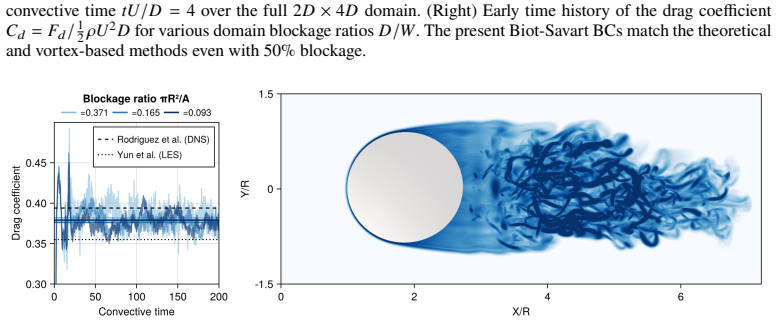
The Biot-Savart far-field boundary condition, which reconstructs far-field velocity from interior vorticity to enable simulations whose dynamics vary less than 0.1 percent when the domain size is doubled.
If this is right
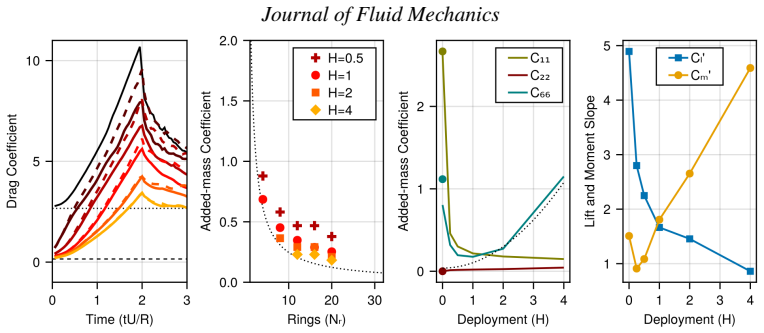
- Linear forces on the parachute drop by a factor of 2 to 5 upon deployment because permeability increases.
- Moments rise during deployment because the increased lever arm counterbalances the permeability change.
- Deployments smaller than half the radius produce tumbling via side-slip and rotational coupling.
- A deployment height approximately equal to the radius simultaneously maximizes drag and damping of perturbations.
Where Pith is reading between the lines
- The identified design rule could be tested by manufacturing physical kirigami prototypes at the radius-scale deployment height and dropping them in still air.
- The same boundary-condition approach might extend to other permeable falling bodies whose far-field flow must be treated without artificial walls.
- Varying the cut pattern or sheet stiffness while holding deployment height at one radius would reveal how geometry modulates the observed stability threshold.
Load-bearing premise
The Biot-Savart far-field boundary condition produces dynamics that remain unchanged when the computational domain size is doubled, thereby representing an effectively infinite physical domain.
What would settle it
If doubling the computational domain again produces more than 0.1 percent change in the predicted descent velocity or rotation rate, the claim that the boundary condition represents an effectively infinite domain would be falsified.
Figures




read the original abstract
Kirigami, the art of cutting flat sheets into deployable 3D structures, has recently inspired a new class of parachutes which can deploy into a naturally stable inverted canopy. However, the dynamic mechanism, fluid forces, and geometrical parameters that grant this stability have not yet been clearly identified. In this paper, we use a novel Biot-Savart far-field boundary condition to perform prescribed acceleration and free-falling simulations in effectively infinite domains, tracking the descent of a parameterized kirigami parachute. The far-field velocity is reconstructed from the interior vorticity, resulting in less than 0.1% variation in the predicted dynamics as the domain size is doubled. We first show the linear forces drop 2-5 times as the parachute is deployed due to increased permeability, whereas the moments increase due the counterbalancing effect of the increased lever-arm. Next, we find that the kirigami parachute achieves stable flight for deployment heights as small as half its radius, quickly damping out applied perturbations. For smaller deployments, the parachute tumbles due to side-slip and rotational coupling, as in falling disks. These effectively unbounded simulations identify that deployments approximately equal to the radius offer high drag forces with strong dynamic stability, providing a simple design rule for deployable parachutes.
Editorial analysis
A structured set of objections, weighed in public.
Referee Report
Summary. The manuscript uses direct numerical simulations of kirigami parachutes with a Biot-Savart far-field boundary condition to model effectively infinite domains. It reports that linear forces drop 2-5 times with deployment due to increased permeability while moments increase due to lever-arm effects, that stable descent with rapid damping of perturbations occurs for deployment heights as small as R/2, and that deployments near the radius optimize both drag and dynamic stability, yielding a simple design rule.
Significance. If the domain-independence and stability results hold, the work supplies a concrete, falsifiable design guideline for deployable parachutes and demonstrates a parameter-free numerical tool for unbounded flows. The direct time-marching approach without fitted parameters or self-referential equations is a methodological strength.
major comments (1)
- [Abstract] Abstract: the claim that the Biot-Savart reconstruction produces <0.1% variation when the domain is doubled does not identify the monitored observable (vertical velocity, lateral force, angular velocity, or perturbation damping rate). Because the central stability conclusion (stable flight for heights ≥ R/2) requires that small-amplitude dynamics are free of residual boundary effects, this omission is load-bearing for the result.
minor comments (2)
- The manuscript would benefit from explicit mesh-refinement and time-step studies reported alongside the stability metrics (damping time constants) rather than only mean descent speed.
- Notation for deployment height (relative to radius R) and the precise definition of the Biot-Savart far-field velocity reconstruction should be stated once in the methods before being used in the results.
Simulated Author's Rebuttal
We thank the referee for their constructive comment on the abstract and for recognizing the methodological strengths of the Biot-Savart approach. We address the single major comment below and will revise the manuscript accordingly.
read point-by-point responses
-
Referee: [Abstract] Abstract: the claim that the Biot-Savart reconstruction produces <0.1% variation when the domain is doubled does not identify the monitored observable (vertical velocity, lateral force, angular velocity, or perturbation damping rate). Because the central stability conclusion (stable flight for heights ≥ R/2) requires that small-amplitude dynamics are free of residual boundary effects, this omission is load-bearing for the result.
Authors: We agree that the abstract should explicitly name the observables used to quantify the <0.1% variation. In the full manuscript the domain-doubling test was performed on the vertical descent velocity, the lateral force components, the angular velocity, and the exponential damping rates of applied perturbations; these quantities were monitored because they directly govern the stability conclusions. We will revise the abstract to state that the monitored observables are the descent velocity, lateral forces, angular velocities, and perturbation damping rates, thereby making the domain-independence claim fully transparent for the small-amplitude dynamics. revision: yes
Circularity Check
No significant circularity; results from direct numerical simulation
full rationale
The paper reports outcomes from time-marching fluid simulations of kirigami parachute dynamics under a Biot-Savart far-field boundary condition. The <0.1% variation statement is an empirical domain-size check on the numerical method, not a derivation that reduces to its own inputs. No load-bearing claims involve fitted parameters renamed as predictions, self-definitional equations, or self-citation chains that substitute for independent evidence. The stability and force results are simulation outputs, not tautological restatements of the method.
Axiom & Free-Parameter Ledger
axioms (1)
- standard math Incompressible Navier-Stokes equations govern the flow around the parachute
Reference graph
Works this paper leans on
-
[1]
Lee, Injae and Choi, Haecheon , pages =. 2015 , journal =. doi:10.1016/j.jcp.2014.09.028 , issn =
-
[2]
Colonius, Tim and Taira, Kunihiko , number =. 2008 , journal =. doi:10.1016/j.cma.2007.08.014 , issn =
-
[3]
Maertens, Audrey P. and Weymouth, Gabriel D. , pages =. 2015 , journal =. doi:10.1016/j.cma.2014.09.007 , issn =
-
[4]
Mittal, Rajat and Iaccarino, Gianluca , number =. 2005 , journal =. doi:10.1146/annurev.fluid.37.061903.175743 , issn =
-
[5]
and Limbert, Georges , month =
Lauber, Marin and Weymouth, Gabriel D. and Limbert, Georges , month =. 2022 , journal =. doi:10.1016/J.JCP.2022.111076 , issn =
-
[6]
Gresho, Philip M. and Sani, Robert L. , number =. 1987 , journal =. doi:10.1002/fld.1650071008 , issn =
-
[7]
Fernando, J. N. and Weymouth, Gabriel D. and Rival, D. E. , pages =. 2020 , journal =. doi:10.1016/j.jfluidstructs.2019.102835 , issn =
-
[8]
Peskin, Charles S. , pages =. 2010 , journal =. doi:10.1017/cbo9780511550140.007 , issn =
-
[9]
Taira, Kunihiko and Colonius, Tim , number =. 2007 , journal =. doi:10.1016/j.jcp.2007.03.005 , issn =
-
[10]
Chorin, Alexandre Joel , number =. 1967 , journal =. doi:10.1016/0045-7930(73)90010-8 , issn =
-
[11]
Gillis, T. and Marichal, Y. and Winckelmans, G. and Chatelain, P. , month =. 2019 , journal =. doi:10.1016/J.JCP.2019.05.033 , issn =
-
[12]
1999 , booktitle =
Cheng, H and Greengard, L and Rokhlin, V , pages =. 1999 , booktitle =
1999
-
[13]
1987 , journal =
Greencard, L and Rokhlin, V , pages =. 1987 , journal =
1987
-
[14]
Liska, Sebastian and Colonius, Tim , month =. 2017 , journal =. doi:10.1016/j.jcp.2016.11.034 , issn =
-
[15]
Liska, Sebastian and Colonius, Tim , pages =. 2016 , journal =. doi:10.1016/j.jcp.2016.04.023 , keywords =
-
[16]
Dorschner, Benedikt and Yu, Ke and Mengaldo, Gianmarco and Colonius, Tim , month =. 2020 , journal =. doi:10.1016/j.jcp.2020.109270 , issn =
-
[17]
Gillman, A. and Martinsson, P. G. , month =. 2014 , journal =. doi:10.1016/J.CAM.2013.09.003 , issn =
-
[18]
doi:10.1016/j.jcp.2009.12.035 , keywords =
2010 , author =. doi:10.1016/j.jcp.2009.12.035 , keywords =
-
[19]
Ying, Lexing and Biros, George and Zorin, Denis , number =. 2004 , journal =. doi:10.1016/j.jcp.2003.11.021 , issn =
-
[20]
2006 , journal =
Mccorquodale, Peter and Colella, Phillip and Balls, Gregory T and Baden, Scott B , volume =. 2006 , journal =
2006
-
[21]
Liska, Sebastian and Colonius, Tim , month =. 2014 , journal =. doi:10.1016/j.jcp.2014.07.048 , issn =
-
[22]
Cummins, Cathal and Seale, Madeleine and Macente, Alice and Certini, Daniele and Mastropaolo, Enrico and Viola, Ignazio Maria and Nakayama, Naomi , number =. 2018 , journal =. doi:10.1038/s41586-018-0604-2 , issn =
-
[23]
Colonius, Tim and Ran, Hongyu , number =. 2002 , journal =. doi:10.1006/JCPH.2002.7161 , issn =
-
[24]
Billuart, P. and Duponcheel, M. and Winckelmans, G. and Chatelain, P. , month =. 2023 , journal =. doi:10.1016/j.jcp.2022.111726 , issn =
-
[25]
Combustion and Flame , keywords =
Hou, Wei and Colonius, Tim , month =. 2024 , journal =. doi:10.1016/J.JCP.2024.113370 , issn =
-
[26]
Miller, G H , pages =. 2008 , journal =. doi:10.1016/j.jcp.2008.05.005 , keywords =
-
[27]
Andersen, A. and Pesavento, U. and Wang, Z. Jane , month =. 2005 , journal =. doi:10.1017/S0022112005005847 , issn =
-
[28]
2002 , journal =
Martinsson, Per-Gunnar and Rodin, Gregory J , number =. 2002 , journal =
2002
-
[29]
Weymouth, G. D. , pages =. 2014 , journal =. doi:10.1017/JFM.2014.42 , issn =
-
[30]
Cocle, Roger and Winckelmans, Grégoire and Daeninck, Goéric , number =. 2008 , journal =. doi:10.1016/j.jcp.2007.10.010 , issn =
-
[31]
1976 , journal =
Lackner, K , pages =. 1976 , journal =
1976
-
[32]
Kavouklis, Chris and Colella, Phillip , number =. 2019 , journal =. doi:10.2140/CAMCOS.2019.14.1 , issn =
-
[33]
Weymouth, Gabriel D. , month =. 2022 , journal =. doi:10.1016/J.COMPFLUID.2022.105620 , issn =
-
[34]
Chen, Yen Ming and ou, Yuh Roung and ou, Yuh Roung , number =. 1993 , journal =. doi:10.1017/S0022112093001867 , issn =
-
[35]
Rodriguez, Ivette and Borell, Ricard and Lehmkuhl, Oriol and Perez Segarra, Carlos D. and Oliva, Assensi , month =. 2011 , journal =. doi:10.1017/jfm.2011.136 , issn =
-
[36]
Reijtenbagh, J. and Tummers, M. J. and Westerweel, J. , number =. 2023 , journal =. doi:10.1103/PhysRevLett.130.174001 , issn =
-
[37]
Wang, Z. Jane , number =. 1999 , journal =. doi:10.1006/JCPH.1999.6289 , issn =
-
[38]
2000 , journal =
Shusser, Michael and Gharib, Morteza , pages =. 2000 , journal =
2000
-
[39]
Auguste, Franck and Magnaudet, Jacques and Fabre, David , pages =. 2013 , journal =. doi:10.1017/JFM.2012.602 , issn =
-
[40]
Marzin, Tom and Le Hay, Kerian and De Langre, Emmanuel and Ramananarivo, Sophie , number =. 2022 , journal =. doi:10.1103/PhysRevFluids.7.023906 , issn =
-
[41]
Callens, Sebastien J.P. and Zadpoor, Amir A. , number =. 2018 , journal =. doi:10.1016/J.MATTOD.2017.10.004 , issn =
-
[42]
Morton, B R , pages =. 1984 , journal =. doi:10.1080/03091928408230368 , issn =
-
[43]
Yang, Yi and Vella, Katherine and Holmes, Douglas P. , number =. 2021 , journal =. doi:10.1126/SCIROBOTICS.ABD6426 , issn =
-
[44]
1995 , journal =
Koumoutsakos, P and Leonard, A , pages =. 1995 , journal =
1995
-
[45]
Scott and Kanso, Eva , month =
Vincent, Lionel and Shambaugh, W. Scott and Kanso, Eva , month =. 2016 , journal =. doi:10.1017/JFM.2016.432 , issn =
-
[46]
Carleton, A. G. and Modarres-Sadeghi, Y. , month =. 2024 , journal =. doi:10.1016/J.EML.2024.102198 , issn =
-
[47]
and Melancon, David , number =
Lamoureux, Danick and Fillion, Jérémi and Ramananarivo, Sophie and Gosselin, Frédérick P. and Melancon, David , number =. 2025 , journal =. doi:10.1038/s41586-025-09515-9 , issn =
-
[48]
Wang, Chengjie and Eldredge, Jeff D. , number =. 2013 , journal =. doi:10.1007/s00162-012-0279-5 , issn =
-
[49]
Colonius, Tim , pages =. 2004 , journal =. doi:10.1146/annurev.fluid.36.050802.121930 , issn =
-
[50]
Yu, Ke and Dorschner, Benedikt and Colonius, Tim , month =. 2022 , journal =. doi:10.1016/j.jcp.2021.110845 , issn =
-
[51]
1997 , journal =
Rennich, Steven C and Lele, Sanjiva K , pages =. 1997 , journal =
1997
-
[52]
Grosch, C. E. and Orzag, S. A. , pages =. 1977 , journal =
1977
-
[53]
1998 , journal =
Tsynkov, Semyon V , pages =. 1998 , journal =
1998
-
[54]
Calderon, D. E. and Cleaver, D. J. and Gursul, I. and Wang, Z. , number =. 2014 , journal =. doi:10.1063/1.4891256/258599 , issn =
-
[55]
JEong, Jinhee and Hussain, Fazle , pages =. 1995 , journal =. doi:10.1017/S0022112095000462 , issn =
-
[56]
Beckers, Diederik and Eldredge, Jeff D. , month =. 2022 , journal =. doi:10.1017/jfm.2022.238 , issn =
-
[57]
Bose, Chandan and Bruce, Callum and Viola, Ignazio Maria , number =. 2025 , journal =. doi:10.1007/S00162-025-00740-6 , issn =
-
[58]
and Limbert, Georges , number =
Lauber, Marin and Weymouth, Gabriel D. and Limbert, Georges , number =. 2023 , journal =. doi:10.1098/RSIF.2023.0466 , issn =
-
[59]
Sani, R. L. and Gresho, P. M. , number =. 1994 , journal =. doi:10.1002/FLD.1650181006 , issn =
-
[60]
Carleton, Adrian and Modarres-Sadeghi, Yahya , month =. 2026 , journal =. doi:10.1016/J.JFLUIDSTRUCTS.2026.104590 , issn =
-
[61]
Lamoureux, Danick and Ramananarivo, Sophie and Melancon, David and Gosselin, Frédérick P. , month =. 2025 , journal =. doi:10.1016/J.EML.2024.102271 , issn =
-
[62]
L. 2022 , journal =. doi:10.1103/PhysRevD.106.124021 , issn =
-
[63]
Fong, William and Darve, Eric , number =. 2009 , journal =. doi:10.1016/j.jcp.2009.08.031 , issn =
-
[64]
1976 , booktitle =
Chadwick, Edmund , pages =. 1976 , booktitle =
1976
-
[65]
Collins, W. M. and Dennis, S. C.R. , number =. 1973 , journal =. doi:10.1093/QJMAM/26.1.53 , issn =
-
[66]
1977 , journal =
Jamb, R A , pages =. 1977 , journal =
1977
-
[67]
Higuchi, H. and Anderson, R. W. and Zhang, J. , number =. 1996 , journal =. doi:10.2514/3.13204 , issn =
-
[68]
Godoy-Diana, R and Aider, J. L. and Wesfreid, J. E. , pages =. 2008 , journal =
2008
-
[69]
Marichal, Y and Chatelain, P and Winckelmans, G , pages =. 2015 , journal =. doi:10.1016/j.piutam.2015.11.010 , issn =
-
[70]
Andersen, A. and Pesavento, U. and Wang, Z. Jane , month =. 2005 , journal =. doi:10.1017/S002211200500594X , issn =
-
[71]
Yun, Giwoong and Kim, Dongjoo and Choi, Haecheon , number =. 2006 , journal =. doi:10.1063/1.2166454 , issn =
-
[72]
Weymouth, Gabriel D. and Font, Bernat , month =. 2025 , journal =. doi:10.1016/J.CPC.2025.109748 , issn =
discussion (0)
Sign in with ORCID, Apple, or X to comment. Anyone can read and Pith papers without signing in.