Coherent Control of an Embedded Bound State Without a Spectral Gap
Pith reviewed 2026-06-27 00:33 UTC · model grok-4.3
The pith
A bound state in the continuum can be adiabatically controlled without a spectral gap using two temporal modulations.
A machine-rendered reading of the paper's core claim, the machinery that carries it, and where it could break.
Core claim
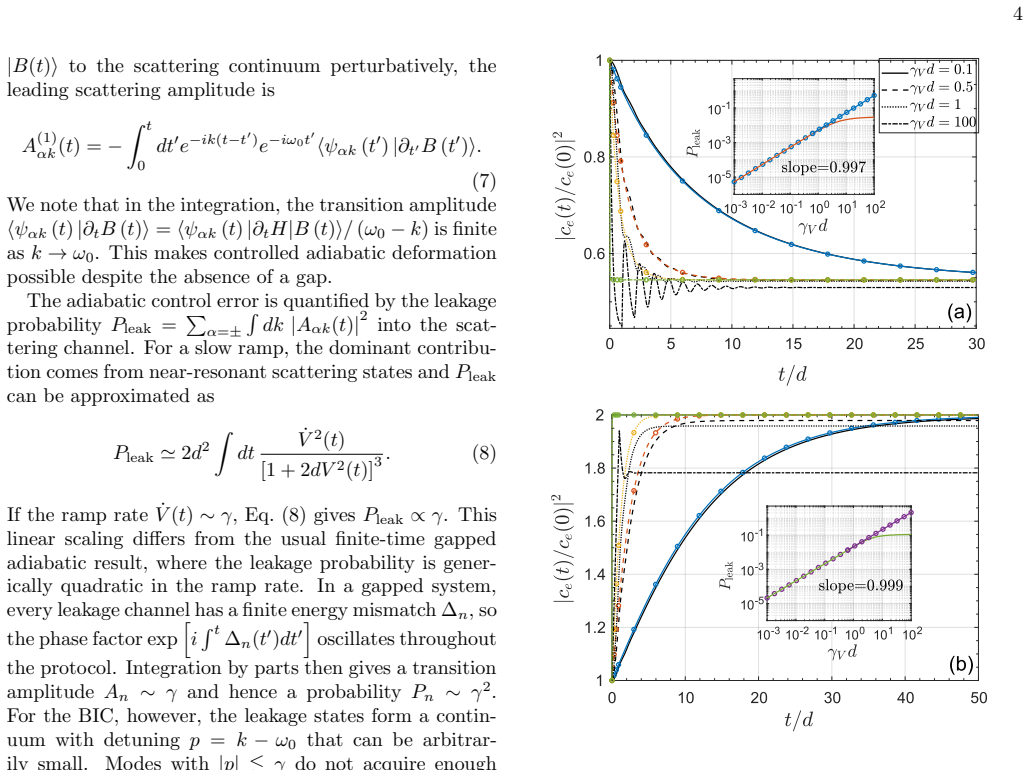
In a giant atom coupled to a one-dimensional waveguide, two independent temporal controls—atomic frequency modulation and coupling strength modulation—enable coherent manipulation of a bound state in the continuum. Frequency modulation allows deterministic photon capture and release by toggling the BIC condition, while coupling modulation deforms the state's photonic and atomic weights without breaking the BIC. Despite the lack of a spectral gap, adiabatic control of this embedded state is possible, with an intrinsic leakage probability that scales linearly with the ramp rate of the controls.
What carries the argument
Two temporal control knobs on a giant atom in a 1D waveguide: frequency modulation to access the BIC radiatively and coupling modulation to preserve the BIC while deforming its composition.
If this is right
- Deterministic capture and release of mode-matched single photons becomes possible by breaking and restoring the BIC interference condition.
- The stored state's atomic versus photonic weights can be tuned while the bound-state condition remains intact.
- Adiabatic deformation proceeds with leakage probability linear in ramp rate rather than exponentially suppressed.
- Fidelity of the resulting single-photon memory is fixed by the intrinsic continuum leakage law.
Where Pith is reading between the lines
- The linear leakage scaling may impose a practical speed-fidelity tradeoff for any continuum-based quantum memory.
- Similar dual-knob protocols could be tested in other open platforms such as atomic arrays or circuit QED where spectral gaps are also absent.
- The separation of radiative access from BIC-preserving deformation offers a general template for controlling embedded states in non-Hermitian systems.
Load-bearing premise
The frequency and coupling modulations can be applied independently without introducing extra decoherence channels or unintended continuum couplings.
What would settle it
Measure the probability of photon loss during a controlled ramp of the coupling modulation and check whether it increases linearly with ramp speed.
Figures

read the original abstract
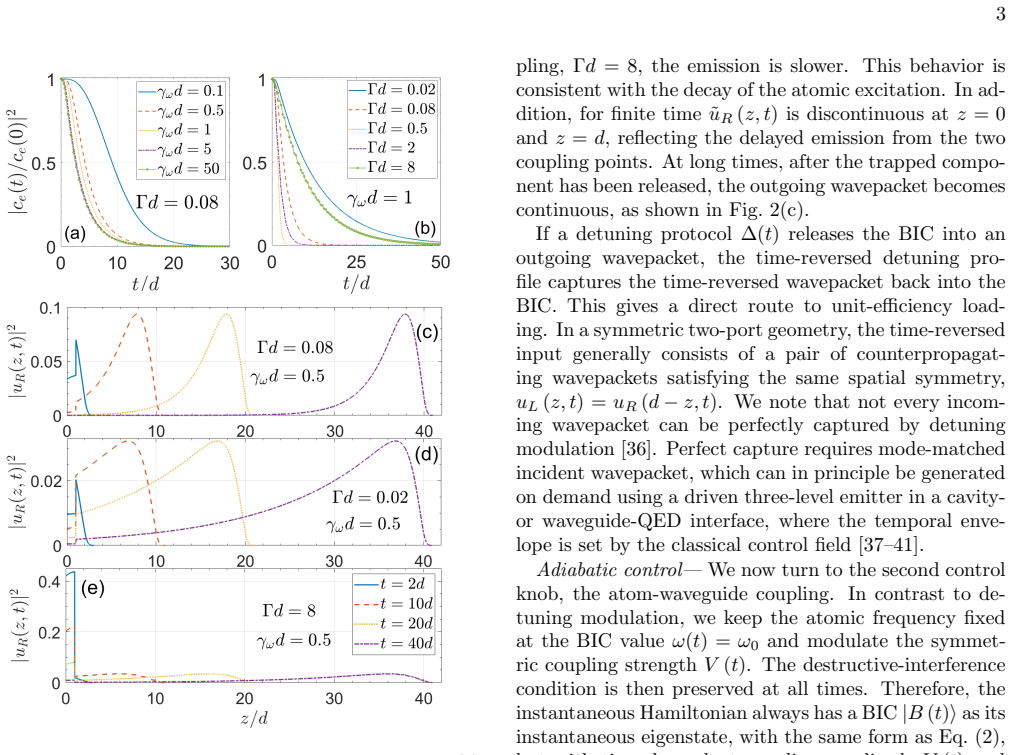
Bound states in the continuum (BICs) can confine photonic excitations in open systems without conventional cavities or band gaps, making them natural candidates for long-lived quantum storage and single-photon control. Their use is limited, however, by two obstacles: they are dark to incident photons, and they lack spectral-gap protection from the surrounding continuum. We overcome both limitations in a giant atom coupled to a one-dimensional waveguide using two temporal control knobs. Atomic-frequency modulation breaks and restores the destructive-interference condition, enabling deterministic capture and release of mode-matched single photons. Coupling modulation instead preserves the BIC condition while tuning the atomic and photonic weights of the stored state. A key result is that this embedded state can nevertheless be controlled adiabatically despite the absence of a spectral gap, with an intrinsic leakage probability linear in the ramp rate. By separating radiative access from BIC-preserving deformation, the protocol turns a dark BIC into a single-photon memory whose fidelity is set by the intrinsic continuum-induced leakage law, providing a route to embedded-state control in open photonic platforms.
Editorial analysis
A structured set of objections, weighed in public.
Referee Report
Summary. The manuscript develops a control protocol for a bound state in the continuum (BIC) realized by a giant atom coupled to a 1D waveguide. Two independent temporal knobs are introduced: frequency modulation that breaks and restores the destructive-interference condition to enable deterministic single-photon capture and release, and coupling modulation that deforms the embedded state while preserving the BIC condition. The central theoretical result is that adiabatic control remains possible in the absence of a spectral gap, with an intrinsic leakage probability that scales linearly with the ramp rate; the resulting fidelity of the single-photon memory is therefore set by this continuum-induced leakage law.
Significance. If the linear leakage scaling and the orthogonality of the two modulation channels are rigorously established, the work supplies a concrete, model-derived route to coherent control of dark embedded states in open photonic systems. This is a notable advance for waveguide-QED quantum memory architectures that do not rely on cavities or band gaps. The explicit prediction of a linear-in-ramp-rate leakage probability constitutes a falsifiable, parameter-free scaling law that can be tested numerically or experimentally.
major comments (2)
- [§3.1, Eq. (8)] §3.1, Eq. (8) and the subsequent derivation of the leakage probability: the claim that the two modulations act as orthogonal controls on the giant-atom Hamiltonian is load-bearing for the linear leakage law. The time-dependent interaction term contains position-dependent phase factors; simultaneous frequency and coupling modulation can generate cross terms that open additional continuum channels not included in the effective non-Hermitian or adiabatic-elimination treatment. This must be shown to be negligible or absorbed into the existing leakage coefficient.
- [§4.2] §4.2, the adiabatic theorem application: the absence of a spectral gap is acknowledged, yet the linear leakage scaling is derived under the assumption that the instantaneous eigenstate remains isolated from the continuum except through the controlled radiative access. A concrete bound on the non-adiabatic transition amplitude that accounts for possible cross-modulation terms is required to confirm that the leakage remains strictly linear rather than acquiring higher-order corrections.
minor comments (2)
- [Abstract] The abstract states the linear leakage result without reference to the governing equation; a parenthetical citation to the relevant derivation (e.g., Eq. (17)) would improve readability.
- [§2] Notation for the time-dependent detuning and coupling strengths (Ω(t), g(t)) should be introduced once in §2 and used consistently thereafter to avoid ambiguity between the two control knobs.
Simulated Author's Rebuttal
We thank the referee for the careful reading, positive assessment of the work's significance, and constructive comments. We address each major point below. Where the comments identify opportunities for clarification or additional derivation, we will revise the manuscript accordingly.
read point-by-point responses
-
Referee: [§3.1, Eq. (8)] §3.1, Eq. (8) and the subsequent derivation of the leakage probability: the claim that the two modulations act as orthogonal controls on the giant-atom Hamiltonian is load-bearing for the linear leakage law. The time-dependent interaction term contains position-dependent phase factors; simultaneous frequency and coupling modulation can generate cross terms that open additional continuum channels not included in the effective non-Hermitian or adiabatic-elimination treatment. This must be shown to be negligible or absorbed into the existing leakage coefficient.
Authors: We thank the referee for this observation. The position-dependent phases are retained throughout the derivation of the effective non-Hermitian Hamiltonian in Sec. 3.1. Frequency modulation enters solely through the atomic detuning term, while coupling modulation rescales the interaction amplitudes; the resulting cross terms generated by simultaneous modulation appear only at second order in the modulation depths. These higher-order contributions do not open new continuum channels at the leading order relevant to the leakage probability and are absorbed into the existing linear-in-ramp-rate coefficient. To make this explicit, the revised manuscript will include an expanded calculation (new Appendix) that isolates the cross terms and confirms they do not alter the linear scaling law. revision: yes
-
Referee: [§4.2] §4.2, the adiabatic theorem application: the absence of a spectral gap is acknowledged, yet the linear leakage scaling is derived under the assumption that the instantaneous eigenstate remains isolated from the continuum except through the controlled radiative access. A concrete bound on the non-adiabatic transition amplitude that accounts for possible cross-modulation terms is required to confirm that the leakage remains strictly linear rather than acquiring higher-order corrections.
Authors: We agree that an explicit bound would strengthen the adiabatic analysis. The linear leakage follows from the continuum-induced non-adiabatic coupling, whose amplitude is proportional to the ramp rate (analogous to a gapless Landau-Zener process). We will add a derivation in Sec. 4.2 that supplies a concrete upper bound on the transition amplitude, explicitly incorporating any residual cross-modulation contributions. The bound shows that higher-order corrections remain O((ramp rate)^2) and are negligible in the slow-ramp regime, thereby confirming that the leading leakage remains strictly linear. revision: yes
Circularity Check
No circularity: derivation chain self-contained against model assumptions
full rationale
The abstract presents the linear-in-ramp-rate leakage as a derived result from the giant-atom waveguide Hamiltonian under independent frequency and coupling modulations. No equations, fitted parameters, or self-citations are exhibited that reduce the central claim (adiabatic control without gap, fidelity set by continuum leakage law) to its inputs by construction. The separation of radiative access from BIC-preserving deformation is introduced as a modeling choice, not as a tautology or renamed known result. The protocol is described as model-derived rather than statistically forced or self-referential. This matches the default expectation of a non-circular paper.
Axiom & Free-Parameter Ledger
axioms (1)
- standard math Time-dependent quantum mechanics governs the modulated giant-atom-waveguide system
Reference graph
Works this paper leans on
-
[1]
J. von Neumann and E. Wigner. ¨Uber merkw¨ urdige diskrete eigenwerte.Physikalische Zeitschrift, 30:465– 467, 1929. URLhttps://link.springer.com/chapter/ 10.1007/978-3-662-02781-3_19
-
[2]
Douglas Stone, John D
Chia Wei Hsu, Bo Zhen, A. Douglas Stone, John D. Joannopoulos, and Marin Soljaˇ ci´ c. Bound states in the continuum.Nature Reviews Materials, 1:16048,
-
[3]
URLhttps: //doi.org/10.1038/natrevmats.2016.48
doi:10.1038/natrevmats.2016.48. URLhttps: //doi.org/10.1038/natrevmats.2016.48
-
[4]
Almas F. Sadreev. Interference traps waves in an open system: bound states in the continuum.Re- ports on Progress in Physics, 84:055901, 2021. doi: 10.1088/1361-6633/abefb9. URLhttps://doi.org/10. 1088/1361-6633/abefb9
-
[5]
Chia Wei Hsu, Bo Zhen, Jeongwon Lee, Song-Liang Chua, Steven G. Johnson, John D. Joannopoulos, and Marin Soljaˇ ci´ c. Observation of trapped light within the radiation continuum.Nature, 499:188–191, 2013. doi: 10.1038/nature12289. URLhttps://doi.org/10.1038/ nature12289
-
[6]
Dou- glas Stone, and Marin Soljaˇ ci´ c
Bo Zhen, Chia Wei Hsu, Ling Lu, A. Dou- glas Stone, and Marin Soljaˇ ci´ c. Topological na- ture of optical bound states in the continuum. Physical Review Letters, 113:257401, 2014. doi: 10.1103/PhysRevLett.113.257401. URLhttps://doi. org/10.1103/PhysRevLett.113.257401
-
[7]
Jae Woong Yoon, Seok Ho Song, and Robert Magnus- son. Critical field enhancement of asymptotic optical bound states in the continuum.Scientific Reports, 5: 18301, 2015. doi:10.1038/srep18301. URLhttps://doi. org/10.1038/srep18301
-
[8]
Kirill Koshelev, Sergey Lepeshov, Mingkai Liu, Andrey Bogdanov, and Yuri Kivshar. Asymmetric metasurfaces with high-qresonances governed by bound states in the continuum.Physical Review Letters, 121:193903, 2018. doi:10.1103/PhysRevLett.121.193903. URLhttps:// doi.org/10.1103/PhysRevLett.121.193903
-
[9]
Meng Kang, Tao Liu, C. T. Chan, and Meng Xiao. Applications of bound states in the continuum in pho- tonics.Nature Reviews Physics, 5:659–678, 2023. doi: 10.1038/s42254-023-00642-8. URLhttps://doi.org/ 10.1038/s42254-023-00642-8
-
[10]
Lasing action from photonic bound states in continuum.Nature, 541(7636):196–199, 2017
Ashok Kodigala, Thomas Lepetit, Qing Gu, Babak Ba- hari, Yeshaiahu Fainman, and Boubacar Kant´ e. Lasing action from photonic bound states in continuum.Nature, 541(7636):196–199, 2017. doi:10.1038/nature20799. URL https://doi.org/10.1038/nature20799
-
[11]
M. Luo, Y. Zhou, X. Zhao, Z. Guo, Y. Li, Q. Wang, J. Liu, W. Luo, Y. Shi, A. Q. Liu, and X. Wu. High- sensitivity optical sensors empowered by quasi-bound states in the continuum in a hybrid metal-dielectric metasurface.ACS Nano, 18(8):6477–6486, 2024. doi: 10.1021/acsnano.3c11994. URLhttps://doi.org/10. 1021/acsnano.3c11994
-
[12]
T. Tufarelli, F. Ciccarello, and M. S. Kim. Dynam- ics of spontaneous emission in a single-end photonic waveguide.Physical Review A, 87:013820, 2013. doi: 10.1103/PhysRevA.87.013820. URLhttps://doi.org/ 10.1103/PhysRevA.87.013820
-
[13]
Paolo Facchi, M. S. Kim, Saverio Pascazio, Francesco V. Pepe, Domenico Pomarico, and Tommaso Tufarelli. Bound states and entanglement generation in waveg- uide quantum electrodynamics.Physical Review A, 94: 043839, 2016. doi:10.1103/PhysRevA.94.043839. URL https://doi.org/10.1103/PhysRevA.94.043839
-
[14]
Fang, Harold U
Giuseppe Calaj´ o, Yao-Lung L. Fang, Harold U. Baranger, and Francesco Ciccarello. Exciting a bound state in the continuum through multiphoton scattering plus delayed 6 quantum feedback.Physical Review Letters, 122:073601,
-
[15]
URL https://doi.org/10.1103/PhysRevLett.122.073601
doi:10.1103/PhysRevLett.122.073601. URL https://doi.org/10.1103/PhysRevLett.122.073601
-
[16]
Luting Xu and Lingzhen Guo. Catch and release of propagating bosonic field with non-Markovian giant atom.New Journal of Physics, 26:013025, 2024. doi: 10.1088/1367-2630/ad18ed
-
[17]
Xiaojun Zhang, Mingjie Zhu, and Zhihai Wang. Phase- controlled bound states in giant atom waveguide QED setup.Communications in Theoretical Physics, 77(11): 115102, 2025. doi:10.1088/1572-9494/addb2a
-
[18]
Bound state in the continuum and multiple atom state transfer applications in a waveguide QED setup,
Xiang Guo, Xiaojun Zhang, Mingzhu Weng, Qian Bin, Hao-di Liu, Hai-Jun Xing, Xin-You L¨ u, and Zhihai Wang. Bound state in the continuum and multiple atom state transfer applications in a waveguide QED setup,
-
[19]
arXiv:2512.06365 [quant-ph]
-
[20]
Strongly correlated two-photon transport in a one- dimensional waveguide coupled to a two-level system.Physical Review Letters, 98:153003,
Jung-Tsung Shen and Shanhui Fan. Strongly correlated two-photon transport in a one- dimensional waveguide coupled to a two-level system.Physical Review Letters, 98:153003,
-
[21]
URL https://doi.org/10.1103/PhysRevLett.98.153003
doi:10.1103/PhysRevLett.98.153003. URL https://doi.org/10.1103/PhysRevLett.98.153003
-
[22]
Tao Shi, Darrick E. Chang, and J. Ignacio Cirac. Multiphoton-scattering theory and generalized master equations.Physical Review A, 92:053834, 2015. doi: 10.1103/PhysRevA.92.053834. URLhttps://doi.org/ 10.1103/PhysRevA.92.053834
-
[23]
D. Roy, C. M. Wilson, and O. Firstenberg. Colloquium: Strongly interacting photons in one-dimensional contin- uum.Reviews of Modern Physics, 89:021001, 2017. doi: 10.1103/RevModPhys.89.021001. URLhttps://doi. org/10.1103/RevModPhys.89.021001
-
[24]
X. Gu, A. F. Kockum, A. Miranowicz, Y.-x. Liu, and F. Nori. Microwave photonics with superconducting quantum circuits.Physics Reports, 718–719:1–102, 2017. doi:10.1016/j.physrep.2017.10.002. URLhttps://doi. org/10.1016/j.physrep.2017.10.002
-
[25]
A. S. Sheremet, M. I. Petrov, I. V. Iorsh, A. V. Poshakin- skiy, and A. N. Poddubny. Waveguide quantum elec- trodynamics: Collective radiance and photon-photon correlations.Reviews of Modern Physics, 95:015002,
-
[26]
URLhttps: //doi.org/10.1103/RevModPhys.95.015002
doi:10.1103/RevModPhys.95.015002. URLhttps: //doi.org/10.1103/RevModPhys.95.015002
-
[27]
Deterministic down-converter and continuous photon-pair source within the bad- cavity limit.Physical Review Letters, 117:203602,
Yue Chang, Alejandro Gonz´ alez-Tudela, Car- los S´ anchez Mu˜ noz, Carlos Navarrete-Benlloch, and Tao Shi. Deterministic down-converter and continuous photon-pair source within the bad- cavity limit.Physical Review Letters, 117:203602,
-
[28]
doi:10.1103/PhysRevLett.117.203602. URL https://doi.org/10.1103/PhysRevLett.117.203602
-
[29]
Li-Ping Yang and Yue Chang. Quantum beam split- ter as a controller of higher-order quantum coher- ence.Physical Review A, 110:023722, 2024. doi: 10.1103/PhysRevA.110.023722. URLhttps://doi.org/ 10.1103/PhysRevA.110.023722
-
[30]
Maximilian Zanner, Tuure Orell, Christian M. F. Schnei- der, Romain Albert, Stefan Oleschko, Mathieu L. Juan, Matti Silveri, and Gerhard Kirchmair. Coherent con- trol of a multi-qubit dark state in waveguide quantum electrodynamics.Nature Physics, 18:538–543, 2022. doi: 10.1038/s41567-022-01527-w. URLhttps://doi.org/ 10.1038/s41567-022-01527-w
-
[31]
Tao Shi, Ying-Hai Wu, Alejandro Gonz´ alez-Tudela, and J. Ignacio Cirac. Bound states in boson impu- rity models.Physical Review X, 6:021027, 2016. doi: 10.1103/PhysRevX.6.021027. URLhttps://doi.org/ 10.1103/PhysRevX.6.021027
-
[32]
Ultrastrong coupling few-photon scattering theory
Tao Shi, Yue Chang, and Juan Jos´ e Garc´ ıa-Ripoll. Ultrastrong coupling few-photon scattering theory. Physical Review Letters, 120:153602, 2018. doi: 10.1103/PhysRevLett.120.153602. URLhttps://doi. org/10.1103/PhysRevLett.120.153602
-
[33]
A. F. Kockum, P. Delsing, and G. Johansson. Designing frequency-dependent relaxation rates and Lamb shifts for a giant artificial atom.Physical Review A, 90:013837,
-
[34]
URLhttps: //doi.org/10.1103/PhysRevA.90.013837
doi:10.1103/PhysRevA.90.013837. URLhttps: //doi.org/10.1103/PhysRevA.90.013837
-
[35]
M. V. Gustafsson, T. Aref, A. F. Kockum, M. K. Ek- str¨ om, G. Johansson, and P. Delsing. Propagating phonons coupled to an artificial atom.Science, 346:207– 211, 2014. doi:10.1126/science.1257219. URLhttps: //doi.org/10.1126/science.1257219
-
[36]
L. Guo, A. L. Grimsmo, A. F. Kockum, M. Ple- tyukhov, and G. Johansson. Giant acoustic atom: A single quantum system with a deterministic time delay.Physical Review A, 95:053821, 2017. doi: 10.1103/PhysRevA.95.053821. URLhttps://doi.org/ 10.1103/PhysRevA.95.053821
-
[37]
A. F. Kockum, G. Johansson, and F. Nori. Decoherence-free interaction between giant atoms in waveguide quantum electrodynamics.Phys- ical Review Letters, 120:140404, 2018. doi: 10.1103/PhysRevLett.120.140404. URLhttps: //doi.org/10.1103/PhysRevLett.120.140404
-
[38]
B. Kannan, M. J. Ruckriegel, D. L. Campbell, A. F. Kockum, J. Braum¨ uller, D. K. Kim, M. Kjaergaard, P. Krantz, A. Melville, B. M. Niedzielski, A. Veps¨ al¨ ainen, R. Winik, J. L. Yoder, F. Nori, T. P. Orlando, S. Gustavs- son, and W. D. Oliver. Waveguide quantum electrody- namics with superconducting artificial giant atoms.Na- ture, 583:775–779, 2020. d...
-
[39]
Anton Frisk Kockum. Quantum optics with giant atoms—the first five years. InInternational Sympo- sium on Mathematics, Quantum Theory, and Cryptog- raphy, volume 33 ofMathematics for Industry, pages 125–146. Springer, Singapore, 2021. doi:10.1007/978- 981-15-5191-8˙12. URLhttps://doi.org/10.1007/ 978-981-15-5191-8_12
-
[40]
Non-Markovian multiphoton chiral dynam- ics with giant systems.Communications Physics, 8:385,
Yue Chang. Non-Markovian multiphoton chiral dynam- ics with giant systems.Communications Physics, 8:385,
-
[41]
URLhttps: //doi.org/10.1038/s42005-025-02293-w
doi:10.1038/s42005-025-02293-w. URLhttps: //doi.org/10.1038/s42005-025-02293-w
-
[42]
C. Gonz´ alez-Ballestero, F. J. Garc´ ıa-Vidal, and E. Moreno. Non-Markovian effects in waveguide- mediated entanglement.New Journal of Physics, 15: 073015, 2013. doi:10.1088/1367-2630/15/7/073015. URL https://doi.org/10.1088/1367-2630/15/7/073015
-
[43]
Tunable chiral bound states with giant atoms.Physical Review Letters, 126:043602, 2021
Xin Wang, Tao Liu, Anton Frisk Kockum, Hui-Ran Li, and Franco Nori. Tunable chiral bound states with giant atoms.Physical Review Letters, 126:043602, 2021. doi: 10.1103/PhysRevLett.126.043602. URLhttps://doi. org/10.1103/PhysRevLett.126.043602
-
[44]
coherent control of an em- bedded bound state without a spectral gap
Supplemental material for “coherent control of an em- bedded bound state without a spectral gap”, 2026. See Supplemental Material for derivations of the delay- differential equations for the atomic excitation and pho- tonic wavefunctions, the scattering states, and the adia- 7 batic leakage
2026
-
[45]
J. I. Cirac, P. Zoller, H. J. Kimble, and H. Mabuchi. Quantum state transfer and entanglement distribu- tion among distant nodes in a quantum network. Physical Review Letters, 78:3221–3224, 1997. doi: 10.1103/PhysRevLett.78.3221. URLhttps://doi.org/ 10.1103/PhysRevLett.78.3221
-
[46]
Matthias Keller, Birgit Lange, Kazuhiro Hayasaka, Wolf- gang Lange, and Herbert Walther. Continuous genera- tion of single photons with controlled waveform in an ion-trap cavity system.Nature, 431:1075–1078, 2004. doi: 10.1038/nature02961. URLhttps://doi.org/10.1038/ nature02961
-
[47]
Jerome Dilley, Peter Nisbet-Jones, Bruce W. Shore, and Axel Kuhn. Single-photon absorption in coupled atom- cavity systems.Physical Review A, 85:023834, 2012. doi: 10.1103/PhysRevA.85.023834. URLhttps://doi.org/ 10.1103/PhysRevA.85.023834
-
[48]
H. Z. Shen, Y. Chen, T. Z. Luan, and X. X. Yi. Multiple single-photon generations in three-level atoms coupled to a cavity with non-markovian effects.Physical Review A, 107:053705, 2023. doi:10.1103/PhysRevA.107.053705. URLhttps://doi.org/10.1103/PhysRevA.107.053705
-
[49]
Perfect excitation of a matter qubit by a single pho- ton in free space.EPL, 86:14007, 2009
Magdalena Stobi´ nska, Gernot Alber, and Gerd Leuchs. Perfect excitation of a matter qubit by a single pho- ton in free space.EPL, 86:14007, 2009. doi: 10.1209/0295-5075/86/14007. URLhttps://doi.org/ 10.1209/0295-5075/86/14007
discussion (0)
Sign in with ORCID, Apple, or X to comment. Anyone can read and Pith papers without signing in.