Using fast-reactive crosslinkers to modulate the internal structure of thermoresponsive microgels
Pith reviewed 2026-06-26 22:47 UTC · model grok-4.3
The pith
Surfactant presence and EGDMA concentration control whether PNIPAM microgels form star-like or core-dominated internal structures.
A machine-rendered reading of the paper's core claim, the machinery that carries it, and where it could break.
Core claim
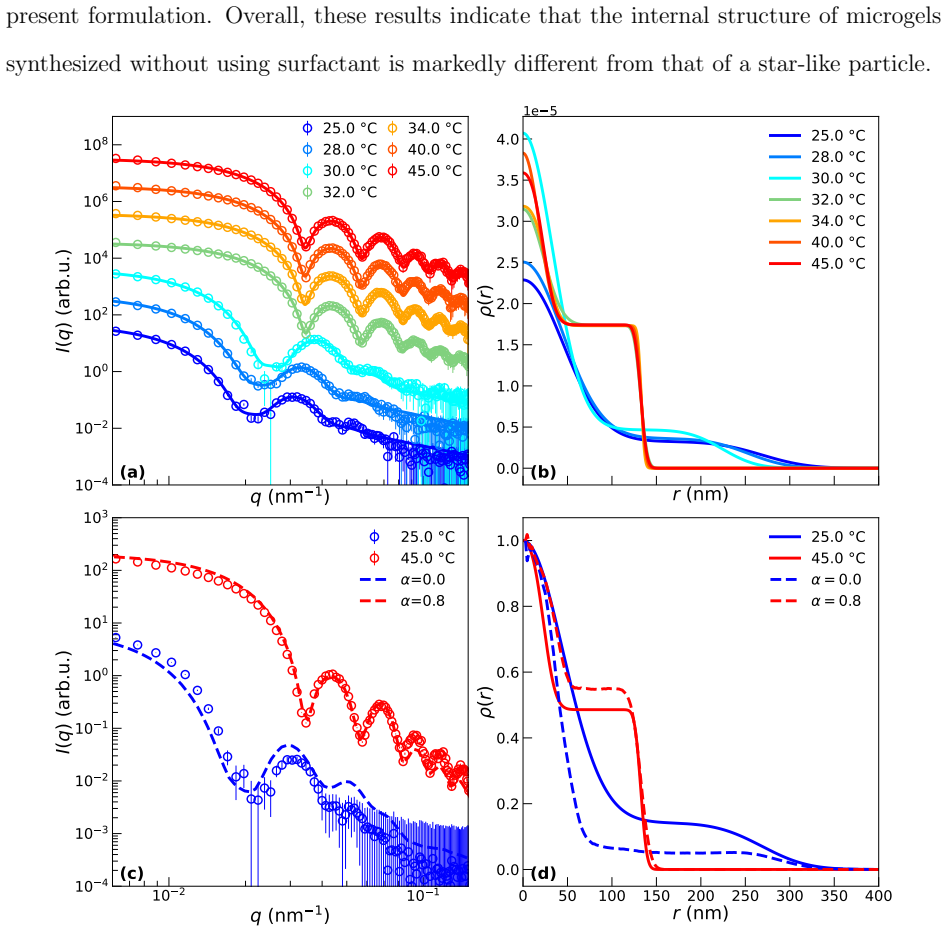
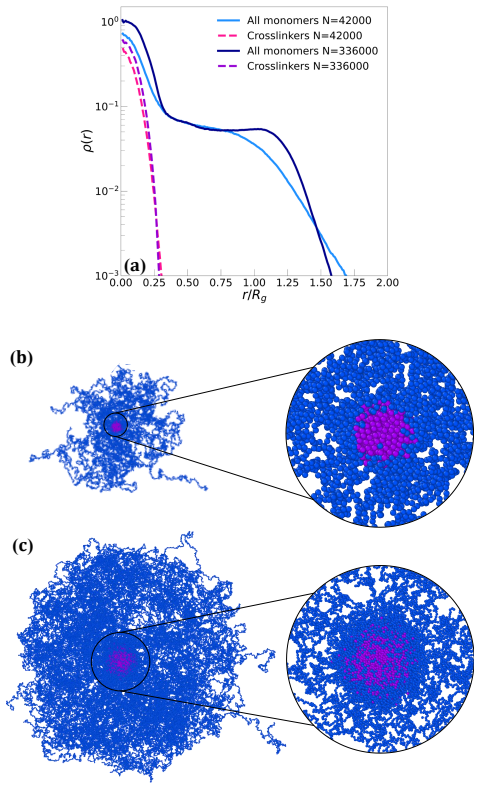
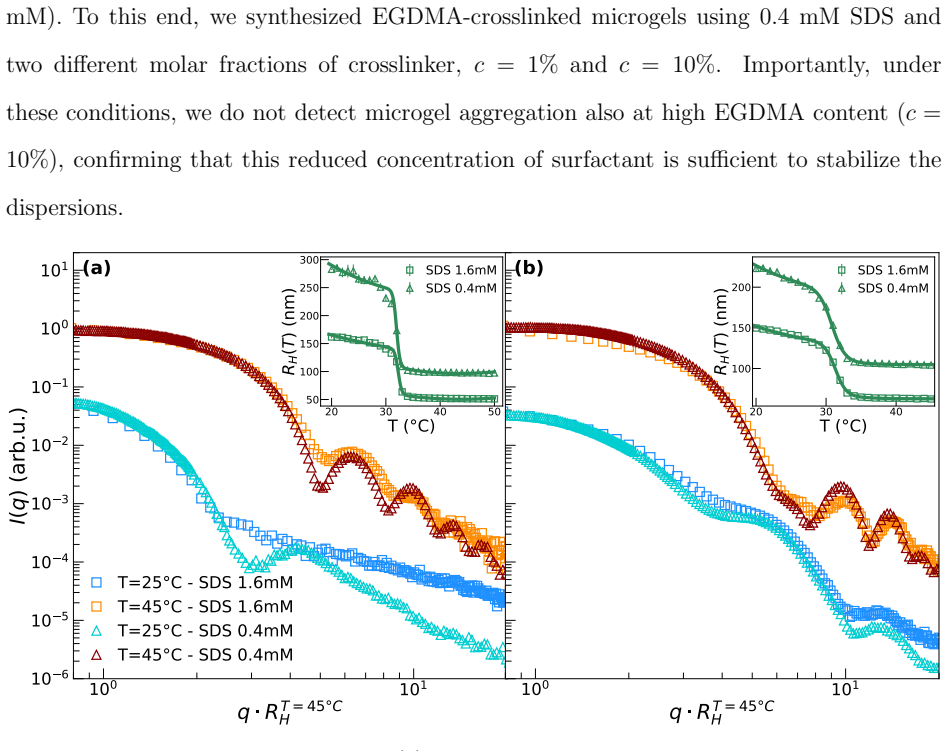
The presence of the surfactant is required to obtain the star-like architecture when EGDMA replaces BIS, and a transition to core-dominated structure occurs above a threshold EGDMA concentration; monomer-resolved simulations show that surfactant plays a different role in EGDMA-crosslinked versus BIS-crosslinked microgels.
What carries the argument
EGDMA concentration combined with surfactant presence, which switches the microgel from star-like to core-dominated internal architecture during synthesis.
If this is right
- Microgels synthesized with EGDMA below the threshold and with surfactant will exhibit ultra-soft interactions similar to model star polymers.
- Above the EGDMA threshold the internal structure becomes core-dominated regardless of surfactant, altering swelling behavior.
- The synthesis-structure relationship allows rational tuning of microgel interactions by choice of crosslinker and surfactant level.
- Monomer-resolved simulations can predict how surfactant affects architecture differently for fast-reactive versus standard crosslinkers.
Where Pith is reading between the lines
- Similar crosslinker reactivity thresholds may exist for other thermoresponsive polymers, allowing generalization of the star-like design rule.
- Controlling internal architecture this way could enable microgels to serve as tunable model systems for testing star-polymer theories in soft-matter experiments.
- The surfactant dependence suggests that surface-active agents during polymerization influence monomer distribution more strongly when the crosslinker reacts quickly.
Load-bearing premise
The scattering measurements and simulations correctly distinguish star-like from core-dominated architectures under the specific synthesis conditions tested.
What would settle it
A synthesis run at the reported EGDMA threshold concentration but without surfactant, followed by SAXS or DLS that still shows star-like scattering, would falsify the claim that surfactant is crucial.
Figures




read the original abstract
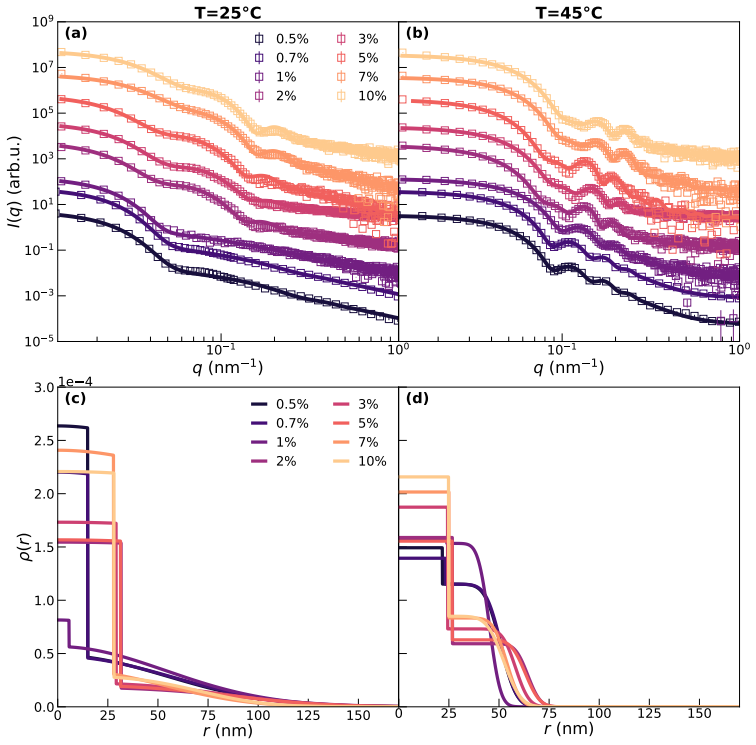
The internal architecture of poly(N-isopropylacrylamide) (PNIPAM) microgels, which switches from fuzzy-sphere to star-like when the standard N,N'-methylenebis(acrylamide) (BIS) crosslinker is replaced with ethylene glycol dimethacrylate (EGDMA), critically determines their interactions and swelling behavior. Here, we systematically investigate the role of the surfactant and crosslinker content in modulating the internal structure of the microgels using Dynamic Light Scattering, Small-angle X-ray Scattering and monomer-resolved numerical simulations. We reveal that the presence of the surfactant is crucial for obtaining the star-like architecture, and that the transition from the star-like regime to a more core-dominated structure occurs above a threshold EGDMA concentration. Monomer-resolved simulations capture how the role of surfactant differs between EGDMA-crosslinked and BIS-crosslinked microgels. Our findings establish a direct synthesis-structure relationship, providing a clear guidance for the rational design of soft, star-like microgels with ultra-soft interactions, strenghtening the connection between microgels and model star polymers.
Editorial analysis
A structured set of objections, weighed in public.
Referee Report
Summary. The manuscript claims that PNIPAM microgels synthesized with the fast-reactive crosslinker EGDMA adopt a star-like internal architecture (instead of the conventional fuzzy-sphere morphology obtained with BIS) only when surfactant is present during synthesis; above a threshold EGDMA concentration the structure reverts to a more core-dominated form. This synthesis–structure relationship is established through systematic variation of surfactant and crosslinker content, characterized by dynamic light scattering, small-angle X-ray scattering, and monomer-resolved simulations that also capture the differential role of surfactant in EGDMA versus BIS systems. The work positions these star-like microgels as closer analogues to model star polymers with ultra-soft interactions.
Significance. If the central experimental and simulation results hold, the paper supplies a practical, tunable route to star-like thermoresponsive microgels whose internal architecture can be dialed by surfactant presence and EGDMA loading. This directly strengthens the connection between microgel colloids and star-polymer physics, offering rational design rules for particles with controlled softness and interaction potentials that are currently difficult to achieve with standard BIS crosslinking.
major comments (2)
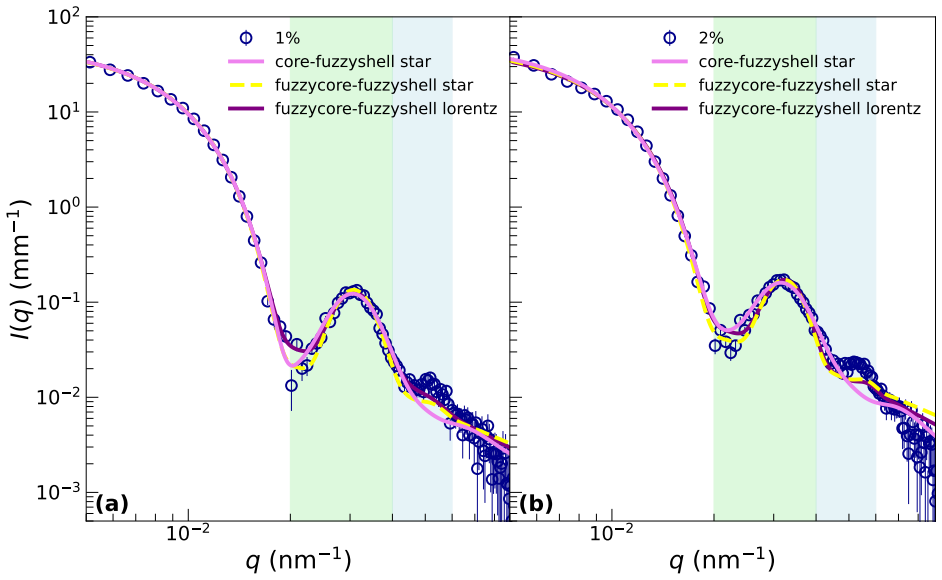
- [Results and Discussion (architecture classification)] The central claim that surfactant is required for the star-like regime and that a sharp transition occurs above a threshold EGDMA concentration rests on the ability of DLS, SAXS, and the monomer-resolved simulations to reliably distinguish the two architectures. The manuscript should therefore include explicit quantitative criteria (e.g., the specific SAXS form-factor parameters, the radius-of-gyration to hydrodynamic-radius ratios, or the simulation-derived density profiles) that define the boundary between regimes, together with the raw data or fit residuals that support the stated threshold value.
- [Simulation methods and comparison with experiment] The simulations are presented as capturing how the surfactant role differs between EGDMA- and BIS-crosslinked microgels. It is not clear from the text whether the simulated surfactant–monomer interaction parameters were taken from independent literature values or adjusted to reproduce the experimental trends; if the latter, the risk of circularity in the architecture assignment should be addressed.
minor comments (3)
- [Abstract] The abstract states that the transition occurs 'above a threshold EGDMA concentration' but does not quote the numerical value; this value (and its uncertainty) should appear in the abstract and be clearly marked on the relevant figure.
- [Figures] Figure captions should explicitly state the surfactant concentration used for each data series and whether the samples were prepared with or without surfactant, to allow immediate visual assessment of the surfactant-dependence claim.
- [Methods] A short methods paragraph or table summarizing the exact EGDMA mole fractions, surfactant concentrations, and polymerization temperatures used for the star-like versus core-dominated samples would improve reproducibility.
Simulated Author's Rebuttal
We thank the referee for their positive evaluation and constructive feedback, which has helped us improve the clarity of our manuscript. We address each major comment below.
read point-by-point responses
-
Referee: [Results and Discussion (architecture classification)] The central claim that surfactant is required for the star-like regime and that a sharp transition occurs above a threshold EGDMA concentration rests on the ability of DLS, SAXS, and the monomer-resolved simulations to reliably distinguish the two architectures. The manuscript should therefore include explicit quantitative criteria (e.g., the specific SAXS form-factor parameters, the radius-of-gyration to hydrodynamic-radius ratios, or the simulation-derived density profiles) that define the boundary between regimes, together with the raw data or fit residuals that support the stated threshold value.
Authors: We agree that explicit quantitative criteria for distinguishing the architectures would enhance the rigor of the classification. In the revised manuscript, we will include a dedicated paragraph in the Results section specifying the criteria: for example, star-like structures are identified when the ratio R_g/R_h is below 0.75 and the SAXS form factor shows a power-law decay with exponent close to -2 in the intermediate q-range, while core-dominated show higher ratios and different exponents. We will also provide the simulation density profiles for representative samples and include fit residuals for the SAXS data at the threshold EGDMA concentration to support the transition point. revision: yes
-
Referee: [Simulation methods and comparison with experiment] The simulations are presented as capturing how the surfactant role differs between EGDMA- and BIS-crosslinked microgels. It is not clear from the text whether the simulated surfactant–monomer interaction parameters were taken from independent literature values or adjusted to reproduce the experimental trends; if the latter, the risk of circularity in the architecture assignment should be addressed.
Authors: The surfactant-monomer interaction parameters in the simulations were taken from independent literature values for similar PNIPAM-surfactant systems and not adjusted to match the experimental architecture trends. The differential role of surfactant emerges from the distinct reactivity of EGDMA versus BIS in the model. To eliminate any ambiguity, we will add a clarifying statement in the Methods section detailing the source of these parameters and confirming that no fitting to the architecture data was performed, thereby avoiding any circularity. revision: yes
Circularity Check
No circularity: experimental and simulation study with independent data support
full rationale
The paper presents an experimental investigation using DLS, SAXS, and monomer-resolved simulations to map synthesis conditions (surfactant presence, EGDMA concentration) to microgel internal architecture (star-like vs. core-dominated). No mathematical derivation, fitted-parameter prediction, or self-citation chain is invoked to establish the reported threshold or architecture classification; the claims rest directly on the measurements and simulations, which are standard, mutually reinforcing techniques for this system and do not reduce to each other by construction.
Axiom & Free-Parameter Ledger
Reference graph
Works this paper leans on
-
[1]
Temperature-sensitive aqueous microgels.Advances in colloid and interface science2000,85, 1–33
Pelton, R. Temperature-sensitive aqueous microgels.Advances in colloid and interface science2000,85, 1–33
-
[2]
A.Microgel suspensions: fun- damentals and applications; John Wiley & Sons, 2011
Fernandez-Nieves, A.; Wyss, H.; Mattsson, J.; Weitz, D. A.Microgel suspensions: fun- damentals and applications; John Wiley & Sons, 2011
2011
-
[3]
A.; Fernandez-Nieves, A
Lyon, L. A.; Fernandez-Nieves, A. The Polymer/Colloid Duality of Microgel Suspensions. Annual Review of Physical Chemistry2012,63, 25–43
-
[4]
J.; Chen, K.; Gratale, M
Yunker, P. J.; Chen, K.; Gratale, M. D.; Lohr, M. A.; Still, T.; Yodh, A. Physics in ordered and disordered colloidal matter composed of poly (N-isopropylacrylamide) microgel particles.Reports on Progress in Physics2014,77, 056601
-
[5]
Responsive hydrogel colloids: Structure, interactions, phase behavior, and equilibrium and nonequilibrium transitions of microgel dispersions
Brijitta, J.; Schurtenberger, P. Responsive hydrogel colloids: Structure, interactions, phase behavior, and equilibrium and nonequilibrium transitions of microgel dispersions. Current opinion in colloid & interface science2019,40, 87–103
-
[6]
F.; Lopez, C
Scotti, A.; Schulte, M. F.; Lopez, C. G.; Crassous, J. J.; Bochenek, S.; Richtering, W. How softness matters in soft nanogels and nanogel assemblies.Chemical reviews2022, 122, 11675–11700
-
[7]
A.; Richtering, W
Plamper, F. A.; Richtering, W. Functional Microgels and Microgel Systems.Accounts of Chemical Research2017,50, 131–140. 33
-
[8]
A.; Crassous, J
Karg, M.; Pich, A.; Hellweg, T.; Hoare, T.; Lyon, L. A.; Crassous, J. J.; Suzuki, D.; Gumerov, R. A.; Schneider, S.; Potemkin, Igor. I.; Richtering, W. Nanogels and Micro- gels: From Model Colloids to Applications, Recent Developments, and Future Trends. Langmuir2019,35, 6231–6255
-
[9]
J.; Scotti, A.; Bleuel, M.; Rheinst¨ adter, M
Mueller, E.; Alsop, R. J.; Scotti, A.; Bleuel, M.; Rheinst¨ adter, M. C.; Richtering, W.; Hoare, T. Dynamically cross-linked self-assembled thermoresponsive microgels with ho- mogeneous internal structures.Langmuir2018,34, 1601–1612
-
[10]
Gao, J.; Frisken, B. J. Cross-linker-free N-isopropylacrylamide gel nanospheres.Lang- muir2003,19, 5212–5216
-
[11]
C.; Clarke, K
Bachman, H.; Brown, A. C.; Clarke, K. C.; Dhada, K. S.; Douglas, A.; Hansen, C. E.; Herman, E.; Hyatt, J. S.; Kodlekere, P.; Meng, Z.; others Ultrasoft, highly deformable microgels.Soft matter2015,11, 2018–2028
2018
-
[12]
E.; Mota-Santiago, P.; Zaccarelli, E.; Crassous, J
Hazra, N.; Ninarello, A.; Scotti, A.; Houston, J. E.; Mota-Santiago, P.; Zaccarelli, E.; Crassous, J. J. Structure of Responsive Microgels down to Ultralow Cross-Linkings. Macromolecules2024,57, 339–355
-
[13]
J.; Lyon, L
Nayak, S.; Gan, D.; Serpe, M. J.; Lyon, L. A. Hollow Thermoresponsive Microgels.Small 2005,1, 416–421
2005
-
[14]
Thermosensitive Core–Shell Microgels: From Colloidal Model Sys- tems to Nanoreactors.Progress in Polymer Science2011,36, 767–792
Lu, Y.; Ballauff, M. Thermosensitive Core–Shell Microgels: From Colloidal Model Sys- tems to Nanoreactors.Progress in Polymer Science2011,36, 767–792
-
[15]
A.; Cardellini, J.; Licea-Claverie, A.; Camerin, F.; Zaccarelli, E.; Laurati, M
Rivas-Barbosa, R.; Ruiz-Franco, J.; Lara-Pe˜ na, M. A.; Cardellini, J.; Licea-Claverie, A.; Camerin, F.; Zaccarelli, E.; Laurati, M. Link between morphology, structure, and inter- actions of composite microgels.Macromolecules2022,55, 1834–1843
-
[16]
A.; Villanueva-Valencia, J
Ruiz-Franco, J.; Rivas-Barbosa, R.; Lara-Pe˜ na, M. A.; Villanueva-Valencia, J. R.; Licea- Claverie, A.; Zaccarelli, E.; Laurati, M. Concentration and Temperature Dependent 34 Interactions and State Diagram of Dispersions of Copolymer Microgels.Soft Matter 2023,19, 3614–3628
2023
-
[17]
Controlling the structure of star-like copolymer microgels through the monomer chain length to modulate softness and deswelling.Journal of Colloid and Interface Science2025, 139162
Vialetto, J.; Emerse, M.; Bassu, G.; Allgaier, J.; Laurati, M. Controlling the structure of star-like copolymer microgels through the monomer chain length to modulate softness and deswelling.Journal of Colloid and Interface Science2025, 139162
-
[18]
Star-Like Thermoresponsive Microgels as an Emerging Class of Soft Nanocol- loids.ACS Nano2025,19, 35447–35458
Ballin, E.; Brasili, F.; Papetti, T.; Vialetto, J.; Sztucki, M.; Sennato, S.; Laurati, M.; Za- ccarelli, E. Star-Like Thermoresponsive Microgels as an Emerging Class of Soft Nanocol- loids.ACS Nano2025,19, 35447–35458
-
[19]
N.; L¨ owen, H.; Watzlawek, M.; Abbas, B.; Jucknischke, O.; Allgaier, J.; Richter, D
Likos, C. N.; L¨ owen, H.; Watzlawek, M.; Abbas, B.; Jucknischke, O.; Allgaier, J.; Richter, D. Star polymers viewed as ultrasoft colloidal particles.Phys. Rev. Lett.1998, 80, 4450
1998
-
[20]
Papetti, T.; Ballin, E.; Brasili, F.; Zaccarelli, E. Star-like microgels vs star polymers: similarities and differences.Macromolecules; arXiv preprint arXiv:2601.207412026,
-
[21]
Likos, C. N. Soft matter with soft particles.Soft Matter2006,2, 478–498
-
[22]
D.; Huang, J
Dozier, W. D.; Huang, J. S.; Fetters, L. J. Colloidal Nature of Star Polymer Dilute and Semidilute Solutions.Macromolecules1991,24, 2810–2814
-
[23]
Kratz, K.; Lapp, A.; Eimer, W.; Hellweg, T. Volume Transition and Structure of Tri- ethyleneglycol Dimethacrylate, Ethylenglykol Dimethacrylate, and N,N′-Methylene Bis- Acrylamide Cross-Linked Poly(N-isopropyl Acrylamide) Microgels: A Small Angle Neu- tron and Dynamic Light Scattering Study.Colloids and Surfaces A: Physicochemical and Engineering Aspects2...
-
[24]
Andersson, M.; Maunu, S. L. Structural Studies of Poly(N-isopropylacrylamide) Mi- crogels: Effect of SDS Surfactant Concentration in the Microgel Synthesis.Journal of Polymer Science Part B: Polymer Physics2006,44, 3305–3314. 35
-
[25]
Fine-tuning the architecture of microgels by vary- ing the initiator addition time.Soft Matter2025,21, 1571–1582
Buratti, E.; Camerin, F.; Nigro, V.; Franco, S.; Ruiz-Franco, J.; Porcar, L.; Angelini, R.; Ruzicka, B.; Gerelli, Y.; Zaccarelli, E. Fine-tuning the architecture of microgels by vary- ing the initiator addition time.Soft Matter2025,21, 1571–1582
-
[26]
Koppel, D. E. Analysis of macromolecular polydispersity in intensity correlation spec- troscopy: the method of cumulants.The Journal of Chemical Physics1972,57, 4814– 4820
-
[27]
Two-Step Deswelling in the Volume Phase Transition of Thermoresponsive Microgels.Proceedings of the National Academy of Sciences2021,118, e2109560118
Del Monte, G.; Truzzolillo, D.; Camerin, F.; Ninarello, A.; Chauveau, E.; Tavagnacco, L.; Gnan, N.; Rovigatti, L.; Sennato, S.; Zaccarelli, E. Two-Step Deswelling in the Volume Phase Transition of Thermoresponsive Microgels.Proceedings of the National Academy of Sciences2021,118, e2109560118
-
[28]
Performance of the time-resolved ultra-small-angle X-ray scattering beamline with the Extremely Brilliant Source.Applied Crystallography 2022,55, 98–111
Narayanan, T.; Sztucki, M.; Zinn, T.; Kieffer, J.; Homs-Puron, A.; Gorini, J.; Van Vaerenbergh, P.; Boesecke, P. Performance of the time-resolved ultra-small-angle X-ray scattering beamline with the Extremely Brilliant Source.Applied Crystallography 2022,55, 98–111
2022
-
[29]
Ballin, E.; Brasili, F.; Zaccarelli, E. Designing polymeric microgels with star-like archi- tecture [Dataset], European Synchrotron Radiation Facility, doi.org/10.15151/ESRF- ES-1901510656 (2027)
-
[30]
Sztucki, M. SAXSutilities2: a graphical user interface for processing and analysis of Small-Angle X-ray Scattering data, Zenodo, https://doi.org/10.5281/zenodo.5825707 (2021)
-
[31]
SasViewhttp://www.sasview.org/
-
[32]
In silico synthesis of microgel particles.Macromolecules2017,50, 8777–8786
Gnan, N.; Rovigatti, L.; Bergman, M.; Zaccarelli, E. In silico synthesis of microgel particles.Macromolecules2017,50, 8777–8786. 36
-
[33]
J.; Paloli, D.; Camerin, F.; Gnan, N.; Rovigatti, L.; Schurten- berger, P.; Zaccarelli, E
Ninarello, A.; Crassous, J. J.; Paloli, D.; Camerin, F.; Gnan, N.; Rovigatti, L.; Schurten- berger, P.; Zaccarelli, E. Modeling microgels with a controlled structure across the vol- ume phase transition.Macromolecules2019,52, 7584–7592
-
[34]
Poppleton, E.; Romero, R.; Mallya, A.; Rovigatti, L.; ˇSulc, P. OxDNA. org: a public webserver for coarse-grained simulations of DNA and RNA nanostructures.Nucleic acids research2021,49, W491–W498
-
[35]
S.; Kremer, K
Grest, G. S.; Kremer, K. Molecular Dynamics Simulation for Polymers in the Presence of a Heat Bath.Physical Review A1986,33, 3628
-
[36]
A generic computer model for amphiphilic systems.The European Physical Journal E2001,6, 409–419
Soddemann, T.; D¨ unweg, B.; Kremer, K. A generic computer model for amphiphilic systems.The European Physical Journal E2001,6, 409–419
-
[37]
S.; Lindner, P
Stieger, M.; Richtering, W.; Pedersen, J. S.; Lindner, P. Small-Angle Neutron Scattering Study of Structural Changes in Temperature Sensitive Microgel Colloids.The Journal of Chemical Physics2004,120, 6197–6206
-
[38]
S.; Gerstenberg, M
Pedersen, J. S.; Gerstenberg, M. C. Scattering Form Factor of Block Copolymer Micelles. Macromolecules1996,29, 1363–1365
-
[39]
N.; Zaccarelli, E
Ruiz-Franco, J.; Jaramillo-Cano, D.; Camargo, M.; Likos, C. N.; Zaccarelli, E. Multi- Particle Collision Dynamics for a Coarse-Grained Model of Soft Colloids.The Journal of Chemical Physics2019,151, 074902. 37 Supporting Information Available Figure S1 reports the measured intensity curves for the two microgels synthesized without added surfactant and wit...
discussion (0)
Sign in with ORCID, Apple, or X to comment. Anyone can read and Pith papers without signing in.