Optimizing bias-tailored quantum error correction beyond code-capacity noise
Pith reviewed 2026-06-27 00:30 UTC · model grok-4.3
The pith
Under circuit-level noise the predicted high-bias advantages of rectangular surface codes disappear, leaving XZZX codes as the simpler and better choice.
A machine-rendered reading of the paper's core claim, the machinery that carries it, and where it could break.
Core claim
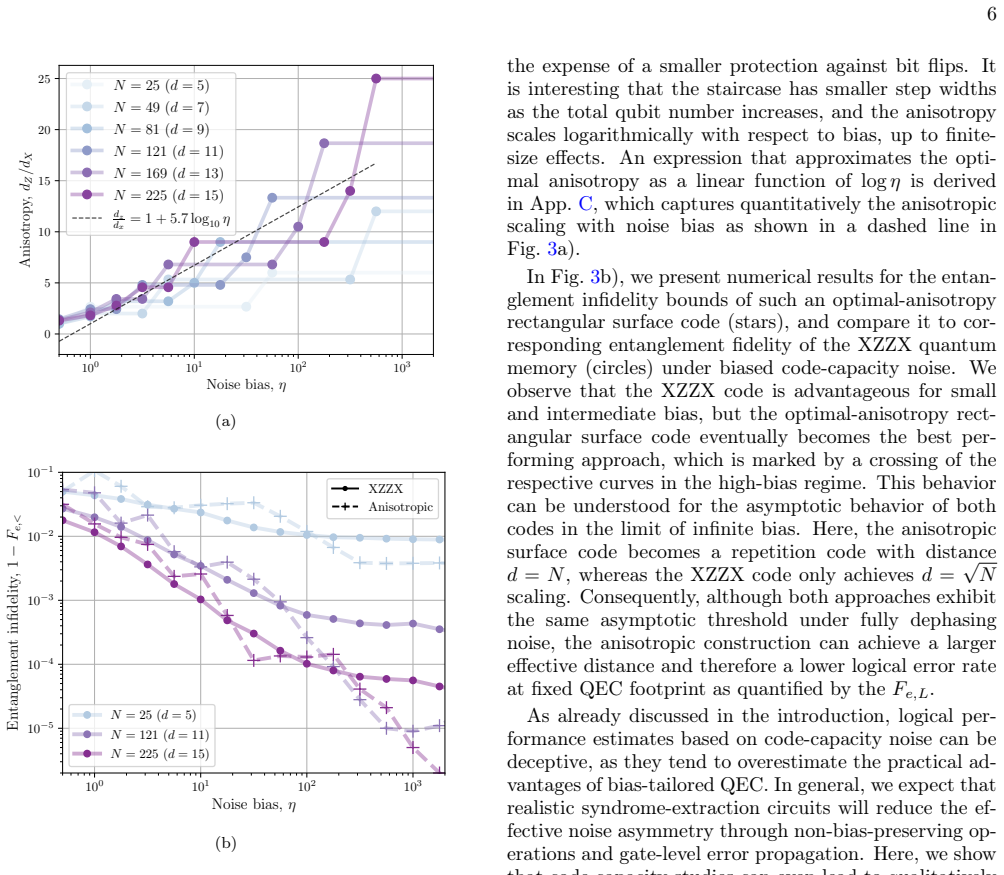
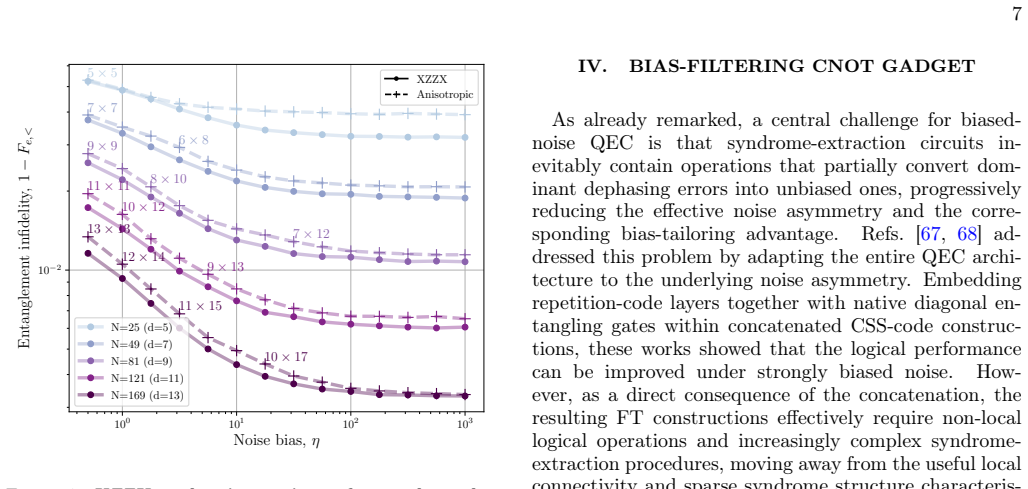
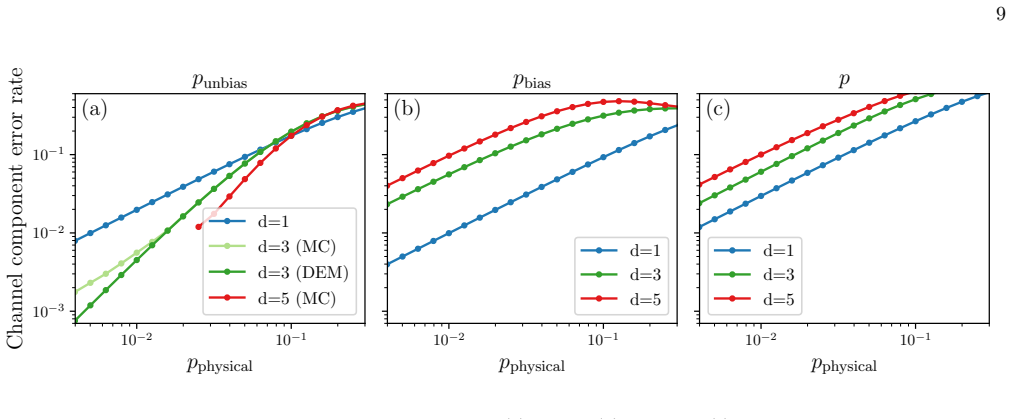
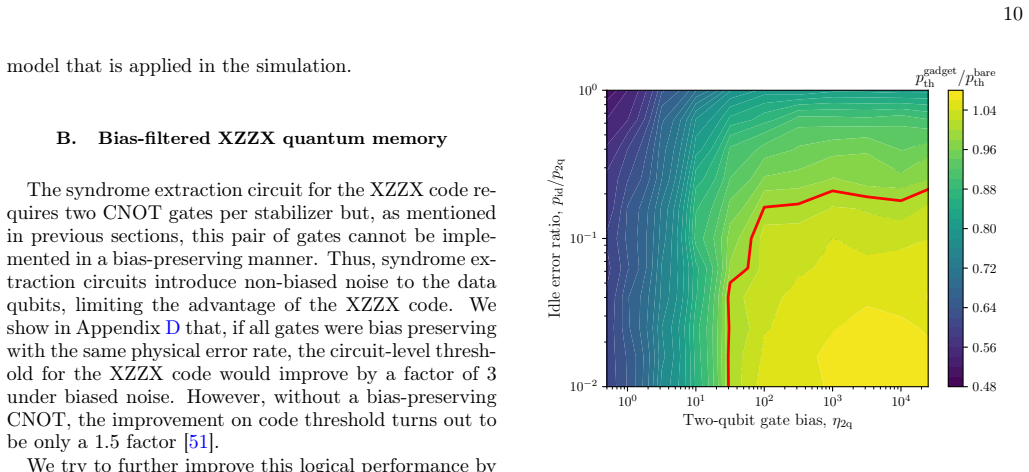
Although code-capacity simulations predict an advantage of rectangular surface codes in the limit of high noise bias, this actually disappears under circuit-level noise, making the XZZX codes the preferred and simplest choice even for platforms that allow flexible code layout. Bias degradation during syndrome extraction under circuit-level noise is the central limitation of bias-tailored QEC. A bias-filtering CNOT gadget that temporarily encodes the ancillary target qubit in a repetition code and uses measurement plus feed-forward reduces this degradation and produces a few-percent relative improvement of the XZZX code error threshold in the high-bias low-idle regime.
What carries the argument
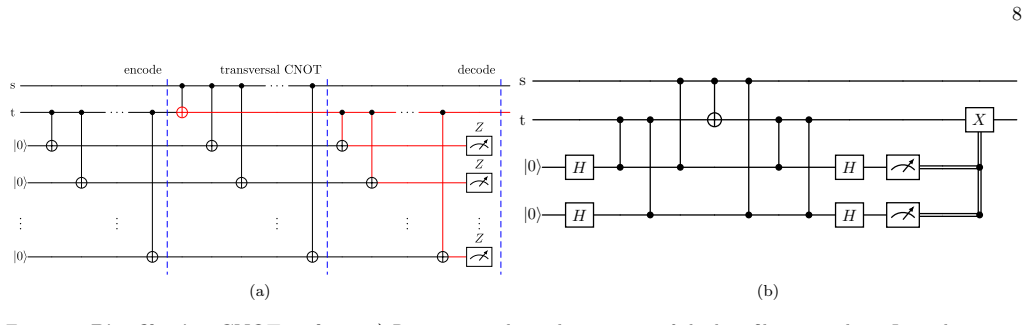
The bias-filtering CNOT gadget, which encodes the ancillary target qubit in a repetition code during syndrome extraction to reduce bias degradation via measurement and feed-forward.
If this is right
- XZZX codes become the preferred choice over rectangular surface codes once circuit-level noise is modeled, even when code layout can be adapted to noise calibration.
- Bias degradation during syndrome extraction is the dominant obstacle to realizing bias-tailored QEC advantages.
- Lightweight bias-filtering strategies recover a few percent of the lost threshold advantage for XZZX codes in high-bias low-idle regimes.
- Flexible-layout platforms may still favor fixed XZZX layouts for simplicity rather than optimizing anisotropy.
Where Pith is reading between the lines
- Hardware platforms aiming for biased-noise qubits may need to reduce idle errors or redesign syndrome extraction to preserve bias tailoring benefits.
- The bias-filtering repetition-code approach on ancillas could be tested on other surface-code variants or larger distances for comparable small gains.
- Future code-capacity optimizations should be validated first under circuit-level models before hardware investment, as the ranking of layouts can reverse.
Load-bearing premise
The simulations are performed in a regime of high bias and low idle errors where the bias-filtering gadget shows improvement; the claim that bias degradation is the dominant limitation would be invalidated if other noise sources or higher idle errors dominate in actual hardware.
What would settle it
An experiment that measures the effective noise bias after a full syndrome-extraction circuit on a high-bias qubit platform, or a threshold comparison showing rectangular surface codes outperforming XZZX codes under complete circuit-level noise, would test the central claim.
Figures




read the original abstract
We find that the substantial advantages predicted for bias-tailored quantum error correction (QEC) under code-capacity noise are strongly reduced once realistic syndrome extraction and circuit-level noise models are considered. We start by comparing XZZX codes to rectangular surface codes with a bias-dependent optimised anisotropy. Although code-capacity simulations predict an advantage of rectangular surface codes in the limit of high noise bias, this actually disappears under circuit-level noise, making the XZZX codes the preferred and simplest choice even for platforms that allow for a flexible variation of the code layout adapted to changes in noise calibration. Our results identify bias degradation during syndrome extraction under circuit-level noise as the central limitation of biased-tailored QEC. To partially mitigate this effect, we introduce a bias-filtering CNOT gadget that temporarily encodes the ancillary target qubit during syndrome extraction in a repetition code and, upon measurement and feed forward, manages to reduce the bias degradation. In a regime of high-bias and low-idle errors, this bias-filtering gadget yields a few-percent relative improvement of the XZZX code error threshold, demonstrating that lightweight bias-filtering strategies can recover part of the lost bias-tailoring advantage for realistic circuit-level noise.
Editorial analysis
A structured set of objections, weighed in public.
Referee Report
Summary. The paper claims that substantial advantages of bias-tailored rectangular surface codes over XZZX codes, as predicted by code-capacity noise models, disappear under circuit-level noise due to bias degradation during syndrome extraction. It concludes that XZZX codes are the preferred choice even for platforms allowing layout adaptation, identifies bias degradation as the central limitation of bias-tailored QEC, and introduces a bias-filtering CNOT gadget (encoding the target in a repetition code) that yields a few-percent relative threshold improvement for XZZX codes in the high-bias, low-idle-error regime.
Significance. If the simulation results are substantiated with full details, the work would indicate that realistic circuit noise erodes the benefits of bias tailoring, favoring simpler XZZX codes and motivating lightweight mitigation strategies like the proposed gadget. This provides concrete guidance for code selection in biased-noise hardware platforms and highlights syndrome-extraction effects as a key design constraint.
major comments (3)
- [Abstract/methods] Abstract and methods (unspecified section): the central claims that rectangular-code advantages disappear under circuit-level noise and that bias degradation is the dominant limitation rest entirely on numerical simulations, yet no parameters (noise bias levels, idle error rates, circuit models, number of shots, or error bars) are provided, rendering the evidence unverifiable and load-bearing for the performance-ordering conclusion.
- [Abstract] Abstract: the identification of bias degradation as the 'central limitation' and the gadget's reported improvement are explicitly restricted to the high-bias/low-idle-error regime; the manuscript provides no simulations or analysis outside this regime (e.g., higher idle errors or additional coherent channels), so the generality of the ordering and limitation claim cannot be assessed.
- [Gadget section] The bias-filtering gadget description (likely Section IV): the few-percent threshold improvement is stated without accompanying threshold values, comparison data, or statistical significance, which is required to substantiate even the modest recovery of bias-tailoring advantage.
minor comments (1)
- Notation for the bias-filtering gadget and repetition-code encoding should be defined explicitly on first use to aid readability.
Simulated Author's Rebuttal
We thank the referee for their careful reading and constructive comments. Below we respond point-by-point to the major comments. We indicate where revisions will be made to improve clarity and verifiability.
read point-by-point responses
-
Referee: [Abstract/methods] Abstract and methods (unspecified section): the central claims that rectangular-code advantages disappear under circuit-level noise and that bias degradation is the dominant limitation rest entirely on numerical simulations, yet no parameters (noise bias levels, idle error rates, circuit models, number of shots, or error bars) are provided, rendering the evidence unverifiable and load-bearing for the performance-ordering conclusion.
Authors: We agree that explicit listing of simulation parameters is needed for verifiability. In the revised manuscript we will add the noise bias levels, idle error rates, circuit models, number of shots, and error bars to both the abstract and methods sections. revision: yes
-
Referee: [Abstract] Abstract: the identification of bias degradation as the 'central limitation' and the gadget's reported improvement are explicitly restricted to the high-bias/low-idle-error regime; the manuscript provides no simulations or analysis outside this regime (e.g., higher idle errors or additional coherent channels), so the generality of the ordering and limitation claim cannot be assessed.
Authors: The abstract already restricts the gadget improvement to the high-bias/low-idle-error regime. We will revise the abstract and discussion to explicitly scope the 'central limitation' claim to this regime and note the absence of analysis for other regimes (e.g., higher idle errors or coherent channels) as a limitation. revision: partial
-
Referee: [Gadget section] The bias-filtering gadget description (likely Section IV): the few-percent threshold improvement is stated without accompanying threshold values, comparison data, or statistical significance, which is required to substantiate even the modest recovery of bias-tailoring advantage.
Authors: We agree that the reported improvement requires supporting quantitative details. In the revised manuscript we will include the specific threshold values, comparison data, and any available statistical information for the gadget. revision: yes
Circularity Check
Simulation-based comparison of noise models shows no derivation chain
full rationale
The paper's central claims rest on direct numerical simulations comparing XZZX and rectangular surface codes under code-capacity versus circuit-level noise, with the bias-filtering gadget evaluated in a stated high-bias/low-idle regime. No load-bearing mathematical derivation, parameter fitting, or self-referential equation is presented that reduces a prediction to its own inputs by construction. The identification of bias degradation as the dominant limitation follows from the observed simulation thresholds rather than from any ansatz, uniqueness theorem, or self-citation that would force the result. External benchmarks (standard circuit noise models) are used without circular reduction, so the work is self-contained against those benchmarks.
Axiom & Free-Parameter Ledger
free parameters (2)
- noise bias level
- idle error rate
axioms (2)
- domain assumption Pauli noise channels during gates and measurements
- domain assumption Independent error processes on data and ancilla qubits
invented entities (1)
-
bias-filtering CNOT gadget
no independent evidence
Reference graph
Works this paper leans on
-
[1]
acknowledges support from Spanish Min- istry of Science, Innovation and Universities under grant FPU24/01105
C.B. acknowledges support from Spanish Min- istry of Science, Innovation and Universities under grant FPU24/01105
-
[2]
P. W. Shor, Scheme for reducing decoherence in quantum computer memory, Phys. Rev. A52, R2493 (1995)
1995
-
[3]
A.Steane,Multiple-particleinterferenceandquantumer- ror correction, Proceedings of the Royal Society A: Math- ematical, Physical and Engineering Sciences452, 2551 (1996), https://royalsocietypublishing.org/rspa/article- pdf/452/1954/2551/998878/rspa.1996.0136.pdf
arXiv 1996
-
[4]
Shor, Fault-tolerant quantum computation, inPro- ceedings of 37th Conference on Foundations of Computer Science(1996) pp
P. Shor, Fault-tolerant quantum computation, inPro- ceedings of 37th Conference on Foundations of Computer Science(1996) pp. 56–65
1996
-
[5]
Gottesman, Theory of fault-tolerant quantum compu- tation, Phys
D. Gottesman, Theory of fault-tolerant quantum compu- tation, Phys. Rev. A57, 127 (1998)
1998
-
[6]
D. Aharonov and M. Ben-Or, Fault-tolerant quan- tum computation with constant error rate (1999), arXiv:quant-ph/9906129 [quant-ph]
Pith/arXiv arXiv 1999
-
[7]
J.EisertandJ.Preskill,Mindthegaps: Thefraughtroad to quantum advantage (2025), arXiv:2510.19928 [quant- ph]
Pith/arXiv arXiv 2025
-
[8]
A. M. Dalzell, S. McArdle, M. Berta, P. Bienias, C.-F. Chen, A. Gilyén, C. T. Hann, M. J. Kastoryano, E. T. Khabiboulline, A. Kubica, and et al.,Quantum Algo- rithms: A Survey of Applications and End-to-end Com- plexities(Cambridge University Press, 2025)
2025
-
[9]
G. Q. AI and Collaborators, Quantum error correction belowthesurfacecodethreshold,Nature638,920(2025)
2025
-
[10]
Lacroix, A
N. Lacroix, A. Bourassa, F. J. H. Heras, L. M. Zhang, J. Bausch, A. W. Senior, T. Edlich, N. Shutty, V. Sivak, A. Bengtsson, M. McEwen, O. Higgott, D. Kafri, J. Claes, A. Morvan, Z. Chen, A. Zalcman, S. Madhuk, et al., Scaling and logic in the colour code on a supercon- ducting quantum processor, Nature645, 614 (2025)
2025
-
[11]
Postler, S
L. Postler, S. Heußen, I. Pogorelov, M. Rispler, T. Feld- ker, M. Meth, C. D. Marciniak, R. Stricker, M. Ring- bauer, R. Blatt, P. Schindler, M. Müller, and T. Monz, Demonstration of fault-tolerant universal quantum gate operations, Nature605, 675–680 (2022)
2022
-
[12]
Sales Rodriguez, J
P. Sales Rodriguez, J. M. Robinson, P. N. Jepsen, Z. He, C. Duckering, C. Zhao, K.-H. Wu, J. Campo, K. Bagnall, M. Kwon, T. Karolyshyn, P. Weinberg, M. Cain, S. J. Evered, A. A. Geim,et al., Experimental demonstration oflogicalmagicstatedistillation,Nature645,620(2025)
2025
-
[13]
Ryan-Anderson, N
C. Ryan-Anderson, N. C. Brown, C. H. Baldwin, J. M. Dreiling, C. Foltz, J. P. Gaebler, T. M. Gatterman, N. Hewitt, C. Holliman, C. V. Horst, J. Johansen, D. Lucchetti, T. Mengle, M. Matheny, Y. Matsuoka, K. Mayer, M. Mills, S. A. Moses, B. Neyenhuis, J. Pino, P. Siegfried, R. P. Stutz, J. Walker, and D. Hayes, High- fidelity teleportation of a logical qub...
2024
-
[14]
K. Mayer, C. Ryan-Anderson, N. Brown, E. Durso- Sabina, C. H. Baldwin, D. Hayes, J. M. Dreiling, 12 C. Foltz, J. P. Gaebler, T. M. Gatterman, J. A. Gerber, K. Gilmore, D. Gresh, N. Hewitt, C. V. Horst, J. Jo- hansen, T. Mengle, M. Mills, S. A. Moses, P. E. Siegfried, B. Neyenhuis, J. Pino, and R. Stutz, Benchmarking logi- cal three-qubit quantum fourier t...
arXiv 2024
-
[15]
Bluvstein, A
D. Bluvstein, A. A. Geim, S. H. Li, S. J. Evered, J. P. Bonilla Ataides, G. Baranes, A. Gu, T. Manovitz, M. Xu, M. Kalinowski, S. Majidy, C. Kokail, N. Maskara, E. C. Trapp, L. M. Stewart, S. Hollerith, H. Zhou, M. J. Gullans, S. F. Yelin, M. Greiner, V. Vuletić, M. Cain, and M. D. Lukin, A fault-tolerant neutral-atom architec- ture for universal quantum ...
2026
-
[16]
M. A. Perlin, Z. He, A. A. Armenakas, P. Andres- Martinez, T. Hao, D. Herman, Y. Jin, K. Mayer, C. Self, D. Amaro, C. Ryan-Anderson, and R. Shaydulin, Fault- tolerant execution of error-corrected quantum algorithms (2026), arXiv:2603.04584 [quant-ph]
arXiv 2026
-
[17]
Kitaev, Fault-tolerant quantum computation by anyons, Annals of Physics303, 2 (2003)
A. Kitaev, Fault-tolerant quantum computation by anyons, Annals of Physics303, 2 (2003)
2003
-
[18]
B. M. Terhal, Quantum error correction for quantum memories, Rev. Mod. Phys.87, 307 (2015)
2015
-
[19]
S. B. Bravyi and A. Y. Kitaev, Quantum codes on a lattice with boundary (1998), arXiv:quant-ph/9811052 [quant-ph]
Pith/arXiv arXiv 1998
-
[20]
Dennis, A
E. Dennis, A. Kitaev, A. Landahl, and J. Preskill, Topological quantum memory, Journal of Mathematical Physics43, 4452 (2002)
2002
-
[21]
Bombin and M
H. Bombin and M. A. Martin-Delgado, Topological quan- tum distillation, Phys. Rev. Lett.97, 180501 (2006)
2006
-
[22]
A. J. Landahl, J. T. Anderson, and P. R. Rice, Fault- tolerant quantum computing with color codes (2011), arXiv:1108.5738 [quant-ph]
Pith/arXiv arXiv 2011
-
[23]
A. G. Fowler, M. Mariantoni, J. M. Martinis, and A. N. Cleland, Surface codes: Towards practical large-scale quantum computation, Phys. Rev. A86, 032324 (2012)
2012
-
[24]
Benito, E
C. Benito, E. López, B. Peropadre, and A. Bermudez, Comparative study of quantum error correction strate- gies for the heavy-hexagonal lattice, Quantum9, 1623 (2025)
2025
-
[25]
E. Knill, R. Laflamme, and W. H. Zurek, Resilient quantum computation: error models and thresh- olds, Proceedings of the Royal Society A: Mathe- matical, Physical and Engineering Sciences454, 365 (1998), https://royalsocietypublishing.org/rspa/article- pdf/454/1969/365/633972/rspa.1998.0166.pdf
arXiv 1998
-
[26]
D. S. Wang, A. G. Fowler, A. M. Stephens, and L. C. L. Hollenberg, Threshold error rates for the toric and planar codes, Quant. Inf. Comput.10, 0456 (2010), arXiv:0905.0531 [quant-ph]
Pith/arXiv arXiv 2010
-
[27]
M. A. Sepiol, A. C. Hughes, J. E. Tarlton, D. P. Nadlinger, T. G. Ballance, C. J. Ballance, T. P. Harty, A. M. Steane, J. F. Goodwin, and D. M. Lucas, Probing qubit memory errors at the part-per-million level, Phys. Rev. Lett.123, 110503 (2019)
2019
-
[28]
Y. Seis, B. J. Brown, A. S. Sørensen, and J. F. Good- win, Improving trapped-ion-qubit memories via code- mediated error-channel balancing, Physical Review A 107, 052417 (2023)
2023
-
[29]
A. M. Kolhatkar and K. K. Mehta, Efficient optical con- figurations for trapped-ion entangling gates, Phys. Rev. A113, 042424 (2026)
2026
-
[30]
Takeda, A
K. Takeda, A. Noiri, T. Nakajima, T. Kobayashi, and S. Tarucha, Quantum error correction with silicon spin qubits, Nature608, 682 (2022)
2022
-
[31]
Hetényi and J
B. Hetényi and J. R. Wootton, Tailoring quantum error correction to spin qubits, Physical Review A109, 032433 (2024)
2024
-
[32]
Scappucci, and S
A.Noiri, K.Takeda, T.Nakajima, T.Kobayashi, A.Sam- mak, G. Scappucci, and S. Tarucha, Fast universal quan- tum gate above the fault-tolerance threshold in silicon, Nature601, 338 (2022)
2022
-
[33]
Steinacker, N
P. Steinacker, N. Dumoulin Stuyck, W. H. Lim, T. Tanttu, M. Feng, S. Serrano, A. Nickl, M. Can- dido, J. D. Cifuentes, E. Vahapoglu,et al., Industry- compatible silicon spin-qubit unit cells exceeding 99% fidelity, Nature646, 81 (2025)
2025
-
[34]
Lescanne, M
R. Lescanne, M. Villiers, T. Peronnin, A. Sarlette, M. Delbecq, B. Huard, T. Kontos, M. Mirrahimi, and Z. Leghtas, Exponential suppression of bit-flips in a qubit encoded in an oscillator, Nature Physics16, 509 (2020)
2020
-
[35]
Berdou, A
C. Berdou, A. Murani, U. Reglade, W. C. Smith, M. Vil- liers, J. Palomo, M. Rosticher, A. Denis, P. Morfin, M. Delbecq,et al., One hundred second bit-flip time in a two-photon dissipative oscillator, PRX Quantum4, 020350 (2023)
2023
-
[36]
A.Z.Ding, B.L.Brock, A.Eickbusch, A.Koottandavida, N. E. Frattini, R. G. Cortiñas, V. R. Joshi, S. J. de Graaf, B. J. Chapman, S. Ganjam,et al., Quantum control of an oscillator with a kerr-cat qubit, Nature Communications 16, 5279 (2025)
2025
-
[37]
Knill, R
E. Knill, R. Laflamme, and L. Viola, Theory of quantum error correction for general noise, Phys. Rev. Lett.84, 2525 (2000)
2000
-
[38]
D. K. Tuckett, A. S. Darmawan, C. T. Chubb, S. Bravyi, S.D.Bartlett,andS.T.Flammia,Tailoringsurfacecodes for highly biased noise, Phys. Rev. X9, 041031 (2019)
2019
-
[39]
H.BombinandM.A.Martin-Delgado,Optimalresources for topological two-dimensional stabilizer codes: Com- parative study, Phys. Rev. A76, 012305 (2007)
2007
-
[40]
Tomita and K
Y. Tomita and K. M. Svore, Low-distance surface codes under realistic quantum noise, Phys. Rev. A90, 062320 (2014)
2014
-
[41]
Bombin, R
H. Bombin, R. S. Andrist, M. Ohzeki, H. G. Katzgraber, and M. A. Martin-Delgado, Strong resilience of topo- logical codes to depolarization, Phys. Rev. X2, 021004 (2012)
2012
-
[42]
J. R. Wootton and D. Loss, High threshold error correc- tion for the surface code, Phys. Rev. Lett.109, 160503 (2012)
2012
-
[43]
J. P. Bonilla Ataides, D. K. Tuckett, S. D. Bartlett, S. T. Flammia, and B. J. Brown, The xzzx surface code, Na- ture Communications12, 2172 (2021)
2021
-
[44]
Q. Xu, N. Mannucci, A. Seif, A. Kubica, S. T. Flammia, and L. Jiang, Tailored xzzx codes for biased noise, Phys. Rev. Res.5, 013035 (2023)
2023
-
[45]
Roffe, L
J. Roffe, L. Z. Cohen, A. O. Quintavalle, D. Chandra, and E. T. Campbell, Bias-tailored quantum LDPC codes, Quantum7, 1005 (2023)
2023
-
[46]
Liang, F
Z. Liang, F. Yang, Z. Yi, and X. Wang, Quantumxyz cyclic codes for biased noise, Phys. Rev. A112, 012402 (2025)
2025
-
[47]
Liang, Z
Z. Liang, Z. Yi, F. Yang, J. Chen, Z. Wang, and X.Wang, High-dimensional quantumxyzproduct codes for biased noise, Phys. Rev. A112, 052439 (2025). 13
2025
-
[48]
S. Wu, T. A. Brun, and D. A. Lidar, Bias-tailored single-shot quantum ldpc codes (2025), arXiv:2507.02239 [quant-ph]
arXiv 2025
-
[49]
Setiawan and C
F. Setiawan and C. McLauchlan, Tailoring dynamical codes for biased noise: the x3z3 floquet code, npj Quan- tum Information11, 149 (2025)
2025
-
[50]
Aliferis and J
P. Aliferis and J. Preskill, Fault-tolerant quantum computation against biased noise, Physical Review A—Atomic, Molecular, and Optical Physics78, 052331 (2008)
2008
-
[51]
Guillaud and M
J. Guillaud and M. Mirrahimi, Repetition cat qubits for fault-tolerant quantum computation, Phys. Rev. X9, 041053 (2019)
2019
-
[52]
J. E. Martinez, P. Schnabl, J. O. del Moral, R. Dast- basteh, P. M. Crespo, and R. M. Otxoa, Leveraging biased noise for more efficient quantum error correc- tion at the circuit-level with two-level qubits (2025), arXiv:2505.17718 [quant-ph]
arXiv 2025
-
[53]
Kielpinski, C
D. Kielpinski, C. Monroe, and D. J. Wineland, Architec- ture for a large-scale ion-trap quantum computer, Nature 417, 709 (2002)
2002
-
[54]
J. M. Pino, J. M. Dreiling, C. Figgatt, J. P. Gaebler, S. A. Moses, M. S. Allman, C. H. Baldwin, M. Foss-Feig, D. Hayes, K. Mayer, C. Ryan-Anderson, and B. Neyen- huis, Demonstration of the trapped-ion quantum ccd computer architecture, Nature592, 209 (2021)
2021
-
[55]
Bermudez, X
A. Bermudez, X. Xu, R. Nigmatullin, J. O’Gorman, V. Negnevitsky, P. Schindler, T. Monz, U. G. Poschinger, C. Hempel, J. Home, F. Schmidt-Kaler, M. Biercuk, R. Blatt, S. Benjamin, and M. Müller, Assessing the progress of trapped-ion processors towards fault-tolerant quantum computation, Phys. Rev. X7, 041061 (2017)
2017
-
[56]
Gutiérrez, M
M. Gutiérrez, M. Müller, and A. Bermúdez, Transversal- ity and lattice surgery: Exploring realistic routes toward coupled logical qubits with trapped-ion quantum proces- sors, Phys. Rev. A99, 022330 (2019)
2019
-
[57]
Bermudez, X
A. Bermudez, X. Xu, M. Gutiérrez, S. C. Benjamin, and M. Müller, Fault-tolerant protection of near-term trapped-ion topological qubits under realistic noise sources, Phys. Rev. A100, 062307 (2019)
2019
- [58]
-
[59]
M. A. Nielsen and I. L. Chuang,Quantum Computation and Quantum Information: 10th Anniversary Edition (Cambridge University Press, 2010)
2010
-
[60]
Aaronson and D
S. Aaronson and D. Gottesman, Improved simulation of stabilizer circuits, Phys. Rev. A70, 052328 (2004)
2004
-
[61]
C.Gidney,Stim: afaststabilizercircuitsimulator,Quan- tum5, 497 (2021)
2021
-
[62]
Tillich and G
J.-P. Tillich and G. Zémor, Quantum ldpc codes with positive rate and minimum distance proportional to the square root of the blocklength, IEEE Transactions on Information Theory60, 1193 (2014)
2014
-
[63]
J. Lee, J. Park, and J. Heo, Rectangular surface code under biased noise, Quantum Information Processing20, 231 (2021)
2021
-
[64]
Higgott and C
O. Higgott and C. Gidney, Sparse Blossom: correcting a million errors per core second with minimum-weight matching, Quantum9, 1600 (2025)
2025
-
[65]
Schumacher, Sending entanglement through noisy quantum channels, Phys
B. Schumacher, Sending entanglement through noisy quantum channels, Phys. Rev. A54, 2614 (1996)
1996
-
[66]
M. A. Nielsen, A simple formula for the average gate fi- delity of a quantum dynamical operation, Physics Letters A303, 249 (2002)
2002
-
[67]
A. Vezvaee, C. Benito, M. Morford-Oberst, A. Bermudez, andD.A.Lidar,Surfacecodescalingonheavy-hexsuper- conductingquantumprocessors (2025), arXiv:2510.18847 [quant-ph]
arXiv 2025
-
[68]
Aliferis and J
P. Aliferis and J. Preskill, Fault-tolerant quantum com- putation against biased noise, Phys. Rev. A78, 052331 (2008)
2008
-
[69]
Webster, S
P. Webster, S. D. Bartlett, and D. Poulin, Reducing the overhead for quantum computation when noise is biased, Phys. Rev. A92, 062309 (2015)
2015
-
[70]
Chao and B
R. Chao and B. W. Reichardt, Quantum error correction with only two extra qubits, Phys. Rev. Lett.121, 050502 (2018)
2018
-
[71]
Chao and B
R. Chao and B. W. Reichardt, Fault-tolerant quantum computation with few qubits, npj Quantum Information 4, 42 (2018)
2018
-
[72]
C.ChamberlandandM.E.Beverland,Flagfault-tolerant error correction with arbitrary distance codes, Quantum 2, 53 (2018)
2018
-
[73]
Wang, C.-Y
P. Wang, C.-Y. Luan, M. Qiao, M. Um, J. Zhang, Y. Wang, X. Yuan, M. Gu, J. Zhang, and K. Kim, Single ion qubit with estimated coherence time exceeding one hour, Nature communications12, 233 (2021)
2021
-
[74]
Nünnerich, D
M. Nünnerich, D. Cohen, P. Barthel, P. H. Huber, D. Ni- roomand, A. Retzker, and C. Wunderlich, Fast, robust, and laser-free universal entangling gates for trapped- ion quantum computing, Physical Review X15, 021079 (2025)
2025
-
[75]
I. L. Chuang and M. A. Nielsen, Prescription for ex- perimental determination of the dynamics of a quantum black box, Journal of Modern Optics44, 2455 (1997)
1997
-
[76]
J. F. Poyatos, J. I. Cirac, and P. Zoller, Complete char- acterization of a quantum process: The two-bit quantum gate, Phys. Rev. Lett.78, 390 (1997)
1997
-
[77]
Fiurášek and Z
J. Fiurášek and Z. c. v. Hradil, Maximum-likelihood estimation of quantum processes, Phys. Rev. A63, 020101(R) (2001)
2001
-
[78]
M.F.Sacchi,Maximum-likelihoodreconstructionofcom- pletely positive maps, Phys. Rev. A63, 054104 (2001)
2001
-
[79]
Ježek, J
M. Ježek, J. Fiurášek, and Z. c. v. Hradil, Quantum in- ference of states and processes, Phys. Rev. A68, 012305 (2003). Appendix A: Gadget quantum process tomography (QPT) For a two-qubit system, QPT aims at reconstructing the CPTP channel describing a physically-allowed oper- ation E(ρ) = X m,n χmnEmρE† n : χ∈Pos(H),X m,n χmnE† nEm =I 4 (A1) whereχ...
2003
discussion (0)
Sign in with ORCID, Apple, or X to comment. Anyone can read and Pith papers without signing in.