Latent Residual-Closure Fourier Neural Operator for Robust Multi-Field Solving in Particle-in-Cell Simulations
Pith reviewed 2026-06-26 22:06 UTC · model grok-4.3
The pith
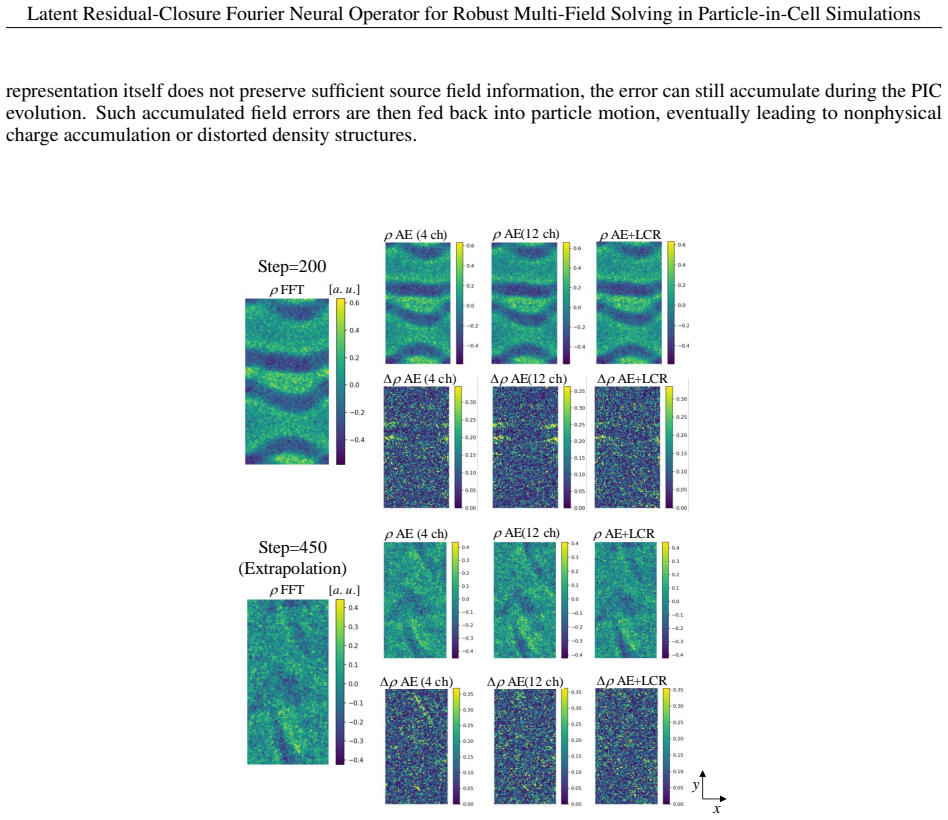
LRC-FNO maintains physical consistency in PIC field solving when used as an initial guess with 20 iterative corrections over times nearly twice the training horizon.
A machine-rendered reading of the paper's core claim, the machinery that carries it, and where it could break.
Core claim
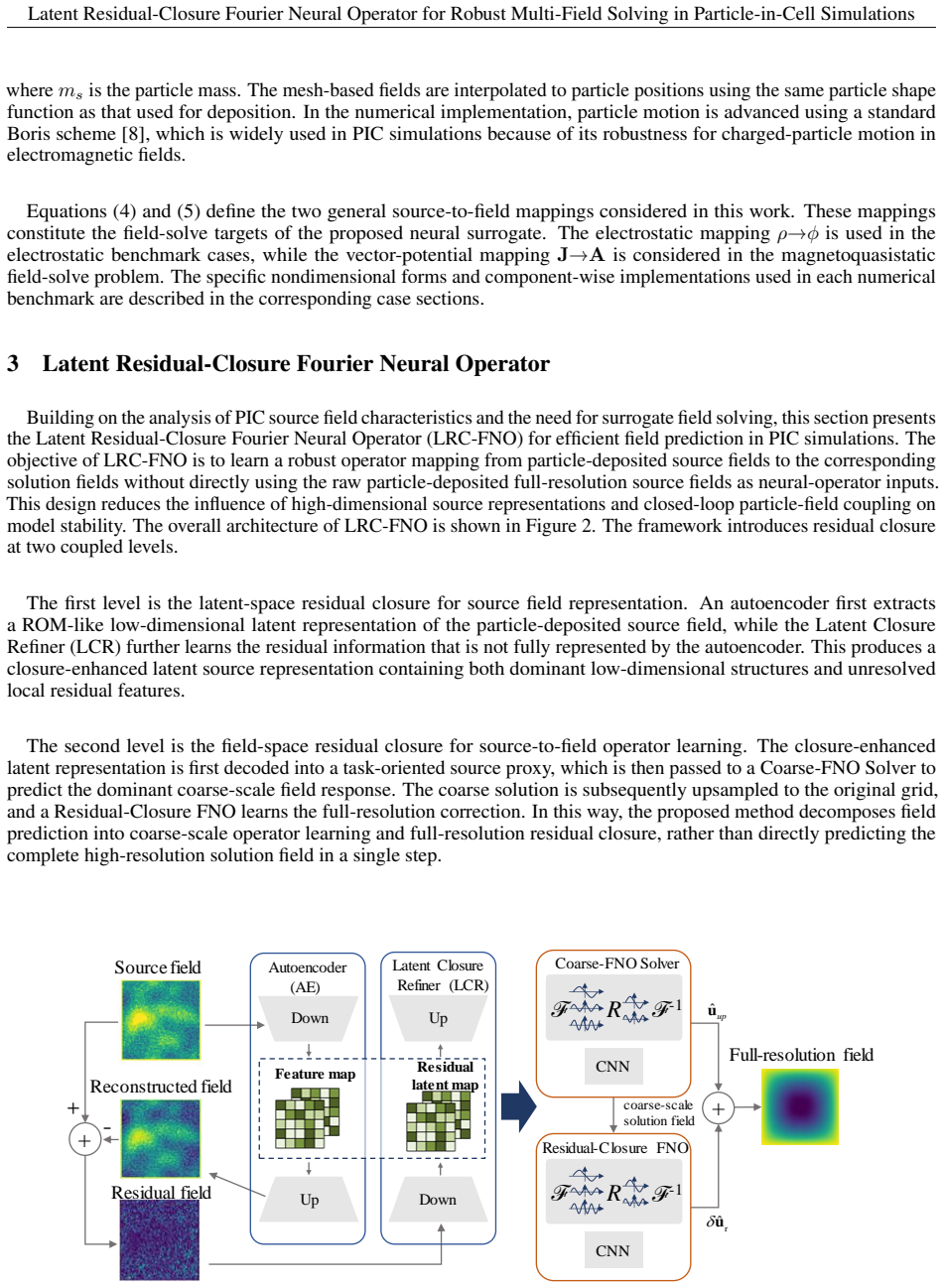
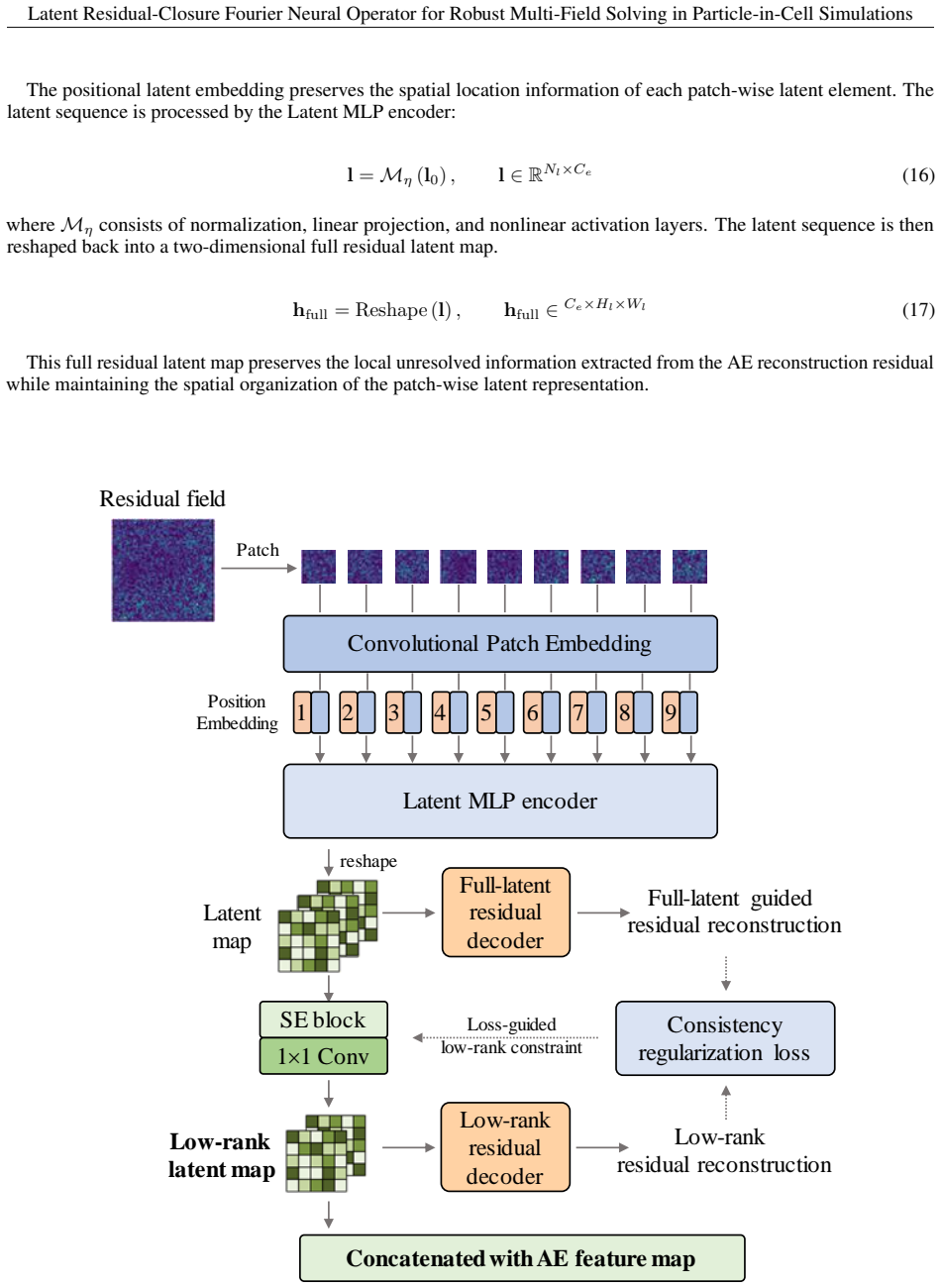
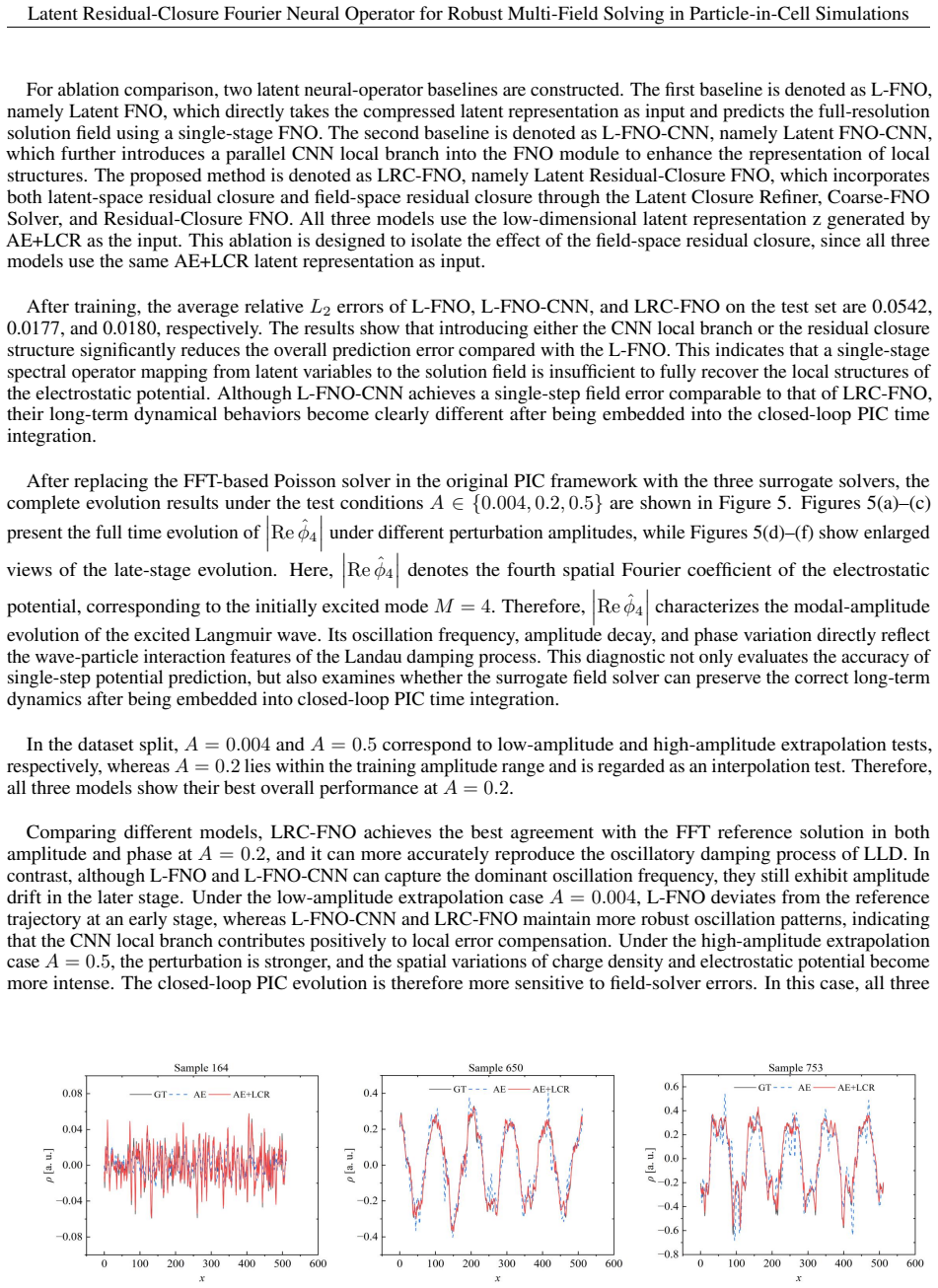
By extracting compact latent source representations with an autoencoder, recovering lost residuals via a Latent Closure Refiner, and applying a Coarse-FNO Solver together with a Residual-Closure FNO, LRC-FNO produces field predictions that, when supplied as an initial guess with 20 iterative corrections, sustain charge and current density structures in extrapolated closed-loop PIC runs over a time range close to twice the training horizon.
What carries the argument
Two-level residual-closure formulation that separates source compression by autoencoder from source-to-field mapping by Coarse-FNO and Residual-Closure FNO.
If this is right
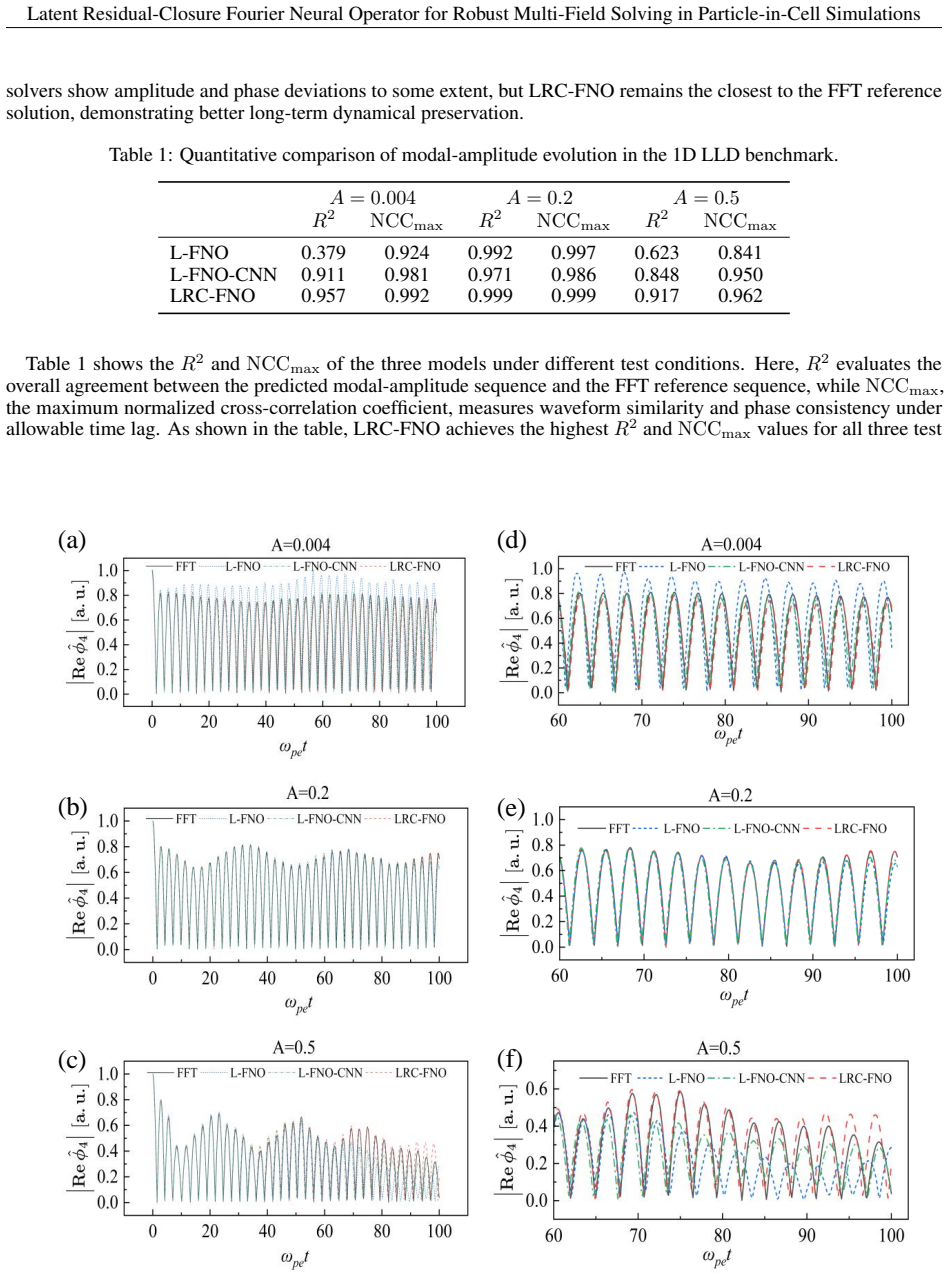
- In 1D linear Landau damping and 2D two-stream instability, charge-to-potential mapping, potential-mode evolution, and particle-field energy exchange remain intact during closed-loop runs.
- In the 2D scrape-off layer case, single-step relative L2 errors reach 0.0447 for self-consistent potential and 0.0251 for magnetic vector potential.
- When paired with 20 iterative corrections, the surrogate supports stable multi-step integration over a time span approaching twice the training horizon while preserving source structures.
Where Pith is reading between the lines
- The same decomposition could be tested on other particle-mesh problems where source-to-field consistency is the bottleneck.
- Reducing the required correction count below 20 would further lower per-step cost in long runs.
- The hybrid neural-plus-iterative pattern may generalize to other kinetic models that alternate particle pushing with field solves.
Load-bearing premise
The latent representations plus residual corrections retain enough unresolved source detail to keep charge-to-potential mapping and energy exchange consistent across multiple closed-loop steps.
What would settle it
A closed-loop PIC integration that uses the LRC-FNO initial guess with 20 corrections and shows clear loss of charge or current density structure before reaching roughly twice the training time horizon would falsify the consistency claim.
Figures




read the original abstract
Particle-in-cell (PIC) simulations are widely used for kinetic plasma modeling in energy applications, but their efficiency is often limited by repeated field solves on dense meshes. This work proposes a Latent Residual-Closure Fourier Neural Operator (LRC-FNO) for robust surrogate multi-field solving in PIC simulations. Rather than treating field prediction as a purely data-driven regression task, LRC-FNO formulates PIC field solving as a two-level residual-closure problem involving source compression and source-to-field operator mapping. An autoencoder extracts compact representations of particle-deposited source fields, while a Latent Closure Refiner recovers unresolved residual structures lost during compression. A Coarse-FNO Solver captures the dominant field response, and a Residual-Closure FNO restores full-resolution corrections. The method is tested on three benchmarks with increasing complexity: 1D linear Landau damping (LLD), 2D two-stream instability (TSI), and a 2D scrape-off layer (SOL) fusion plasma model. In LLD and TSI, LRC-FNO better preserves charge-to-potential mapping, potential-mode evolution, residual charge structures, and particle-field energy exchange during closed-loop PIC integration. In the SOL case, LRC-FNO achieves relative L2 errors of 0.0447 for the self-consistent potential and 0.0251 for the magnetic vector potential in single-step prediction. More importantly, when used as a neural initial guess with 20 iterative corrections, LRC-FNO maintains strong physical consistency in extrapolated closed-loop simulations, preserving charge and current density structures over a time range close to twice the training horizon. These results demonstrate that LRC-FNO can serve as both a fast surrogate field solver and a high-quality initialization strategy for iterative PIC field solvers.
Editorial analysis
A structured set of objections, weighed in public.
Referee Report
Summary. The manuscript proposes the Latent Residual-Closure Fourier Neural Operator (LRC-FNO) architecture for surrogate multi-field solving in particle-in-cell (PIC) simulations. It frames the problem as a two-level residual-closure task: an autoencoder compresses particle-deposited source fields, a Latent Closure Refiner recovers unresolved residuals, a Coarse-FNO Solver captures dominant responses, and a Residual-Closure FNO supplies full-resolution corrections. Evaluated on 1D linear Landau damping (LLD), 2D two-stream instability (TSI), and 2D scrape-off layer (SOL) benchmarks, the work reports improved preservation of charge-to-potential mapping, potential-mode evolution, residual charge structures, and particle-field energy exchange in closed-loop integration. For the SOL case it gives relative L2 errors of 0.0447 (self-consistent potential) and 0.0251 (magnetic vector potential) in single-step prediction; when used as an initial guess followed by 20 iterative corrections, it maintains physical consistency over a time horizon approximately twice the training length.
Significance. If the central claims on closed-loop consistency hold after rigorous verification, the work would provide a practical route to accelerating PIC field solves while retaining physical fidelity, with the initialization strategy offering immediate utility for existing iterative solvers in fusion-plasma modeling. The two-level residual-closure formulation and the progression across benchmarks of increasing dimensionality are constructive elements. However, the absence of quantitative diagnostics on compression loss and error growth currently limits the assessed impact.
major comments (3)
- [Abstract] Abstract (SOL benchmark paragraph): the reported single-step L2 errors (0.0447/0.0251) are presented without accompanying error bars, data-exclusion criteria, or cross-validation statistics; because these numbers underpin the claim of accurate multi-field prediction, their statistical support must be supplied.
- [Abstract] Abstract (closed-loop integration paragraph) and method description: the claim that LRC-FNO “maintains strong physical consistency” when supplying an initial guess for 20 iterative corrections rests on the assumption that the autoencoder latent space plus Latent Closure Refiner retain sufficient unresolved source structures; no quantitative diagnostics are given on (a) fraction of source energy or Fourier content lost to compression or (b) error-growth rates of charge/current density when the neural guess is inserted inside the closed loop. These diagnostics are load-bearing for distinguishing architecture-driven consistency from correction-driven consistency.
- [Results (LLD/TSI)] Results sections on LLD/TSI closed-loop tests: the statements that LRC-FNO “better preserves charge-to-potential mapping, potential-mode evolution, residual charge structures, and particle-field energy exchange” are not accompanied by tabulated metrics or growth-rate comparisons against the training horizon; without such numbers the extrapolation claim to ~2× training horizon cannot be evaluated.
minor comments (2)
- [Method] Notation for the two-level residual-closure formulation should be introduced with explicit equations rather than descriptive paragraphs only.
- [Results (SOL)] The manuscript should clarify whether the 20 iterative corrections are performed with the same traditional solver used in the baseline or with a modified procedure.
Simulated Author's Rebuttal
We thank the referee for the constructive and detailed comments. We address each major point below and will revise the manuscript accordingly to strengthen the statistical and diagnostic support for our claims.
read point-by-point responses
-
Referee: [Abstract] Abstract (SOL benchmark paragraph): the reported single-step L2 errors (0.0447/0.0251) are presented without accompanying error bars, data-exclusion criteria, or cross-validation statistics; because these numbers underpin the claim of accurate multi-field prediction, their statistical support must be supplied.
Authors: We agree that the reported L2 errors require statistical context. In the revised manuscript we will add error bars computed from an ensemble of independent training runs with varied random seeds, explicitly state the data-exclusion criteria, and report the cross-validation procedure used to obtain the quoted values. revision: yes
-
Referee: [Abstract] Abstract (closed-loop integration paragraph) and method description: the claim that LRC-FNO “maintains strong physical consistency” when supplying an initial guess for 20 iterative corrections rests on the assumption that the autoencoder latent space plus Latent Closure Refiner retain sufficient unresolved source structures; no quantitative diagnostics are given on (a) fraction of source energy or Fourier content lost to compression or (b) error-growth rates of charge/current density when the neural guess is inserted inside the closed loop. These diagnostics are load-bearing for distinguishing architecture-driven consistency from correction-driven consistency.
Authors: We accept that additional quantitative diagnostics are needed to separate architecture-driven from correction-driven consistency. The revised manuscript will include (a) the retained fraction of source energy and Fourier content after latent compression and (b) explicit error-growth curves for charge and current density when the neural initial guess is used inside the closed-loop solver. These will be presented for the SOL benchmark and, where feasible, for LLD/TSI as well. revision: yes
-
Referee: [Results (LLD/TSI)] Results sections on LLD/TSI closed-loop tests: the statements that LRC-FNO “better preserves charge-to-potential mapping, potential-mode evolution, residual charge structures, and particle-field energy exchange” are not accompanied by tabulated metrics or growth-rate comparisons against the training horizon; without such numbers the extrapolation claim to ~2× training horizon cannot be evaluated.
Authors: We agree that tabulated quantitative metrics are required for rigorous evaluation. The revised results sections will contain tables reporting the relevant metrics (charge-to-potential correlation, dominant-mode amplitudes, residual charge norms, and particle-field energy exchange) together with growth-rate comparisons referenced to the training horizon, thereby supporting the stated extrapolation to approximately twice the training length. revision: yes
Circularity Check
No significant circularity; empirical architecture evaluation is self-contained
full rationale
The paper introduces LRC-FNO as a composite neural architecture (autoencoder + Latent Closure Refiner + Coarse-FNO + Residual-Closure FNO) for surrogate PIC field solving and reports its performance via L2 errors and closed-loop consistency metrics on LLD, TSI, and SOL benchmarks. No derivation chain, uniqueness theorem, or first-principles reduction is claimed; the method is defined by its components and evaluated directly against simulation data without any step that renames a fit as a prediction or reduces outputs to inputs by construction. Self-citations are absent from the provided text, and the central claims rest on independent numerical tests rather than tautological mappings.
Axiom & Free-Parameter Ledger
Reference graph
Works this paper leans on
-
[1]
Y . Xu, Y . Gao, L. Dou, D. Xi, C. Qi, B. Lu, and T. Shao. Low-temperature plasma-enabled CO2 dissociation: a critical analysis of plasma setups and conversion mechanisms toward scale-up valorization.Green Chemistry, 27: 9332, 2025
2025
-
[2]
C. Li, T. Zhang, Z. Qiu, B. Ye, X. Liang, X. Liu, M. Chen, X. Xia, C. Wang, and W. Wan. Plasma-assisted fabrication of multiscale materials for electrochemical energy conversion and storage.Carbon Energy, 7: e641, 2025
2025
-
[3]
Ren and L
H. Ren and L. Zhong. A deep operator network-based method for fast predicting arc quenching performance of eco-friendly gases.Journal of Physics D: Applied Physics, 59: 015201, 2026
2026
-
[4]
Z. Wang, B. Baheti, and L. Zhong. Two-temperature (2T) non-LTE plasmas of C4F7N and C5F10O mixed with CO2, N2 and O2 as eco-friendly SF6 replacements: thermodynamic, transport, and radiation properties.Plasma Chemistry and Plasma Processing, 46: 3, 2026
2026
-
[5]
Ren and L
H. Ren and L. Zhong. Plasma properties and arc decaying characteristics of perfluoromethyl vinyl ether (C3F6O) as new eco-friendly arc quenching medium.Journal of Physics D: Applied Physics, 58: 265202, 2025
2025
-
[6]
Lyu and L
J. Lyu and L. Zhong. Cross-field confinement and power balance in an Orbitron fusion device.Plasma Physics and Controlled Fusion, 2026
2026
-
[7]
B. Cui, T. Sun, W. Zhong, Z. Gao, X. Ji, N. Wu, G. Hao, S. Liang, A. Wang, and M. He. 2D PIC modeling of the helical scrape-off layer current driven by hybrid divertor biased targets in tokamak plasmas.Nuclear Fusion, 64: 126027, 2024
2024
-
[8]
Langdon.Plasma Physics via Computer Simulation
A. Langdon.Plasma Physics via Computer Simulation. CRC Press, 2018
2018
-
[9]
Lesur, J
M. Lesur, J. Moritz, E. Gravier, and T. Drouot. Benchmark between N-body, PIC, and semi-Lagrangian simulations of Landau-damped Langmuir wave.Physics of Plasmas, 32, 2025
2025
-
[10]
Fitzpatrick.Introduction to Computational Physics
R. Fitzpatrick.Introduction to Computational Physics. 2022
2022
-
[11]
Procassini, C
R. Procassini, C. Birdsall, and E. Morse. A fully kinetic, self-consistent particle simulation model of the collisionless plasma-sheath region.Physics of Fluids B: Plasma Physics, 2: 3191, 1990
1990
-
[12]
Revel, S
A. Revel, S. Mochalskyy, I. M. Montellano, D. Wünderlich, U. Fantz, and T. Minea. Massive parallel 3D PIC simulation of negative ion extraction.Journal of Applied Physics, 122, 2017
2017
-
[13]
A. G. Özbay, A. Hamzehloo, S. Laizet, P. Tzirakis, G. Rizos, and B. Schuller. Poisson CNN: Convolutional neural networks for the solution of the Poisson equation on a Cartesian mesh.Data-Centric Engineering, 2: e6, 2021
2021
- [14]
-
[15]
Wang and L
Y . Wang and L. Zhong. NAS-PINN: Neural architecture search-guided physics-informed neural network for solving PDEs.Journal of Computational Physics, 496: 112603, 2024
2024
-
[16]
Zhong, B
L. Zhong, B. Wu, and Y . Wang. Accelerating physics-informed neural network based 1D arc simulation by meta learning.Journal of Physics D: Applied Physics, 56: 074006, 2023
2023
-
[17]
L. Lu, P. Jin, G. Pang, Z. Zhang, and G. E. Karniadakis. Learning nonlinear operators via DeepONet based on the universal approximation theorem of operators.Nature Machine Intelligence, 3: 218, 2021
2021
-
[18]
Z. Li, N. Kovachki, K. Azizzadenesheli, B. Liu, K. Bhattacharya, A. Stuart, and A. Anandkumar. Fourier neural operator for parametric partial differential equations.arXiv:2010.08895, 2020
work page internal anchor Pith review Pith/arXiv arXiv 2010
-
[19]
Z. Li, N. Kovachki, K. Azizzadenesheli, B. Liu, K. Bhattacharya, A. Stuart, and A. Anandkumar. Neural operator: Graph kernel network for partial differential equations.arXiv:2003.03485, 2020. 22 Latent Residual-Closure Fourier Neural Operator for Robust Multi-Field Solving in Particle-in-Cell Simulations
work page internal anchor Pith review Pith/arXiv arXiv 2003
-
[20]
Z. Li, N. Kovachki, C. Choy, B. Li, J. Kossaifi, S. Otta, M. A. Nabian, M. Stadler, C. Hundt, and K. Azizzadenesheli. Geometry-informed neural operator for large-scale 3D PDEs.Advances in Neural Information Processing Systems, 36: 35836, 2023
2023
-
[21]
Zong and Z
Z. Zong and Z. Wei. Solving Poisson’s equation in electromagnetics with limited data and arbitrary domain deformation using physics-enhanced neural operator. IEEE, 2024
2024
-
[22]
W. Xiao, S. Wang, and L. Yang. An optimized Fourier neural operator for the 2D fractional Poisson equation. IEEE, 2025
2025
-
[23]
M. D. Acciarri, C. Moore, and S. D. Baalrud. Artificial correlation heating in PIC simulations.Physics of Plasmas, 31, 2024
2024
-
[24]
F. M. Bayo-Muñoz, A. Malagón-Romero, and A. Luque. Efficient Monte Carlo simulation of streamer discharges with deep-learning denoising models.Machine Learning: Science and Technology, 6: 015036, 2025
2025
-
[25]
Deluzet, G
F. Deluzet, G. Fubiani, L. Garrigues, C. Guillet, and J. Narski. Efficient parallelization for 3D-3V sparse grid particle-in-cell: shared memory architectures.Journal of Computational Physics, 480: 112022, 2023
2023
-
[26]
C. Fu, Y . Dong, Y . Li, W. Wang, Z. Wang, and W. Liu. Kinetic simulations of low-pressure inductively coupled plasma: an implicit electromagnetic PIC/MCC model with the ADI-FDTD method.Journal of Physics D: Applied Physics, 57: 135201, 2024
2024
-
[27]
Mattei, K
S. Mattei, K. Nishida, M. Onai, J. Lettry, M. Tran, and A. Hatayama. A fully-implicit particle-in-cell Monte Carlo collision code for the simulation of inductively coupled plasmas.Journal of Computational Physics, 350: 891, 2017
2017
-
[28]
S. E. Ahmed, S. Pawar, O. San, A. Rasheed, T. Iliescu, and B. R. Noack. On closures for reduced order models: a spectrum of first-principle to machine-learned avenues.Physics of Fluids, 33, 2021
2021
-
[29]
Issan, O
O. Issan, O. Koshkarov, F. D. Halpern, G. L. Delzanno, and B. Kramer. Conservative projection-based data-driven model order reduction of a fluid-kinetic spectral solver.Physics of Plasmas, 32, 2025
2025
-
[30]
P.-H. Tsai, S. W. Chung, D. Ghosh, J. Loffeld, Y . Choi, and J. L. Belof. Local reduced-order modeling for electrostatic plasmas by physics-informed solution manifold decomposition.Computer Physics Communications, 110039, 2026
2026
-
[31]
Hesthaven, C
J. Hesthaven, C. Pagliantini, and N. Ripamonti. Adaptive symplectic model order reduction of parametric particle-based Vlasov–Poisson equation.Mathematics of Computation, 93: 1153, 2024
2024
- [32]
-
[33]
Nayak, M
I. Nayak, M. Kumar, and F. L. Teixeira. Detection and prediction of equilibrium states in kinetic plasma simulations via mode tracking using reduced-order dynamic mode decomposition.Journal of Computational Physics, 447: 110671, 2021
2021
- [34]
-
[35]
Ivagnes, G
A. Ivagnes, G. Stabile, A. Mola, T. Iliescu, and G. Rozza. Pressure data-driven variational multiscale reduced order models.Journal of Computational Physics, 476: 111904, 2023
2023
-
[36]
C. Mou, N. Chen, and T. Iliescu. An efficient data-driven multiscale stochastic reduced order modeling framework for complex systems.Journal of Computational Physics, 493: 112450, 2023
2023
-
[37]
Manti, P.-H
S. Manti, P.-H. Tsai, A. Lucantonio, and T. Iliescu. Symbolic regression of data-driven reduced order model closures for under-resolved, convection-dominated flows.Journal of Computational Physics, 114298, 2025
2025
-
[38]
An Image is Worth 16x16 Words: Transformers for Image Recognition at Scale
A. Dosovitskiy, L. Beyer, A. Kolesnikov, D. Weissenborn, X. Zhai, T. Unterthiner, M. Dehghani, M. Minderer, G. Heigold, and S. Gelly. An image is worth 16x16 words: Transformers for image recognition at scale. arXiv:2010.11929, 2020
work page internal anchor Pith review Pith/arXiv arXiv 2010
-
[39]
I. O. Tolstikhin, N. Houlsby, A. Kolesnikov, L. Beyer, X. Zhai, T. Unterthiner, J. Yung, A. Steiner, D. Keysers, and J. Uszkoreit. MLP-Mixer: An all-MLP architecture for vision.Advances in Neural Information Processing Systems, 34: 24261, 2021
2021
-
[40]
J. Hu, L. Shen, and G. Sun. Squeeze-and-excitation networks. 2018
2018
-
[41]
Paszke, S
A. Paszke, S. Gross, F. Massa, A. Lerer, J. Bradbury, G. Chanan, T. Killeen, Z. Lin, N. Gimelshein, and L. Antiga. PyTorch: An imperative style, high-performance deep learning library.Advances in Neural Information Processing Systems, 32, 2019
2019
-
[42]
D. P. Kingma and J. Ba. Adam: A method for stochastic optimization.arXiv:1412.6980, 2014. 23
work page internal anchor Pith review Pith/arXiv arXiv 2014
discussion (0)
Sign in with ORCID, Apple, or X to comment. Anyone can read and Pith papers without signing in.