Blind Recovery of Latent Domains via Unsupervised Symmetry Discovery
Pith reviewed 2026-06-27 02:01 UTC · model grok-4.3
The pith
A shallow group-convolutional network recovers latent domains and signals from linear measurements by discovering the underlying symmetries of the data distribution.
A machine-rendered reading of the paper's core claim, the machinery that carries it, and where it could break.
Core claim
The central claim is that optimizing a shallow group-convolutional network by imposing stationarity and locality regularization at the model output allows the model to learn a latent symmetry action and an appropriate filter, thereby mapping unstructured observations to a symmetry-based representation that reveals latent signals.
What carries the argument
A shallow group-convolutional network optimized under stationarity and locality regularization at the output to learn the latent symmetry action and filter.
If this is right
- The learned symmetry action maps the observations back onto the latent domain structure.
- Latent signals become recoverable from stochastic processes and Ising models without knowledge of the measurement process.
- The same procedure succeeds on shuffled images, bit-scrambled images, and neural recordings.
- Symmetry discovery supplies a general route to unsupervised structure learning in blind inverse problems.
Where Pith is reading between the lines
- The approach could be tested on data whose linear measurement operator is known in advance to verify that the learned filter matches the true corruption.
- If the latent symmetry group is discrete, the method might extend to recovering categorical latent variables in other high-dimensional datasets.
- Approximate or noisy symmetries could be handled by relaxing the exact stationarity constraint, broadening applicability to real recordings.
Load-bearing premise
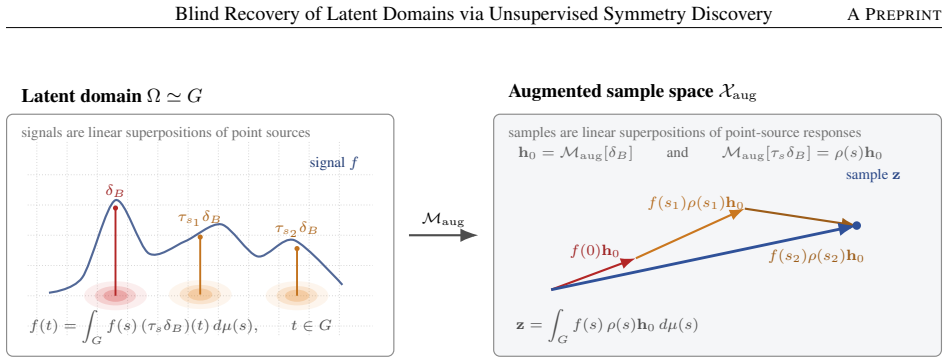
Observations are linear measurements of signals sampled from a latent random field whose symmetries can be recovered by the network optimization.
What would settle it
Generate observations from a latent field that has no recoverable symmetry group, such as completely unstructured random noise, apply the method, and check whether it still produces a symmetry action that maps the data to a coherent recovered signal.
Figures





read the original abstract
Primary motivation in blind inverse problems is to recover signals of interest from corrupted observations without knowing the obfuscating mechanism. Blind deconvolution is a prominent approach when the corruption is convolutional, but it is not applicable when general linear transformations obfuscate the domain structure. In this work, we propose an unsupervised framework for recovering latent domains and signals by discovering symmetries of the data distribution. Our framework models observations as linear measurements of signals sampled from a latent random field, and optimizes a shallow group-convolutional network by imposing stationarity and locality regularization at the model output. The model learns a latent symmetry action and an appropriate filter, thereby mapping unstructured observations to a symmetry-based representation that reveals latent signals. Experiments on stochastic processes, Ising models, shuffled and bit-scrambled images, and neural recordings show that the method recovers latent domains and signals from unstructured observations, suggesting symmetry discovery as a new direction for unsupervised structure learning and blind inverse problems.
Editorial analysis
A structured set of objections, weighed in public.
Referee Report
Summary. The paper proposes an unsupervised framework for recovering latent domains and signals from linear measurements of observations by discovering symmetries of the data distribution. It models observations as linear measurements of signals from a latent random field and optimizes a shallow group-convolutional network under stationarity and locality regularization at the output to learn a latent symmetry action and filter, with experiments on stochastic processes, Ising models, shuffled images, and neural recordings demonstrating recovery of latent structures.
Significance. If the central claim holds, the work could establish symmetry discovery as a viable direction for unsupervised structure learning and blind inverse problems, extending beyond convolutional assumptions in traditional blind deconvolution. The multi-domain experiments provide initial empirical support for practical utility in recovering signals from unstructured data.
major comments (2)
- [Abstract] Abstract (modeling premise): the claim that optimizing the shallow group-convolutional network under output stationarity and locality regularization recovers the unknown latent symmetry group and linear measurement operator lacks any identifiability analysis, uniqueness proof, or conditions on the loss landscape guaranteeing that the true group action is recovered rather than a trivial or alternative solution satisfying the same constraints.
- [Abstract] Abstract (experiments): the reported recoveries on stochastic processes, Ising models, shuffled/bit-scrambled images, and neural recordings are presented as evidence, but without accompanying analysis of how the regularization isolates the latent symmetry (e.g., ablation on the stationarity/locality terms or checks against degenerate group parameterizations), the results do not confirm that recovery occurs for the stated theoretical reason.
minor comments (1)
- [Abstract] The abstract refers to 'shallow group-convolutional network' and 'symmetry-based representation' without defining the group parameterization or network architecture details that would allow reproduction.
Simulated Author's Rebuttal
We thank the referee for the constructive comments on our manuscript. We address the two major comments point by point below, acknowledging the absence of formal identifiability analysis and ablation studies in the current version. We plan revisions to strengthen the presentation of the framework's claims and empirical support.
read point-by-point responses
-
Referee: [Abstract] Abstract (modeling premise): the claim that optimizing the shallow group-convolutional network under output stationarity and locality regularization recovers the unknown latent symmetry group and linear measurement operator lacks any identifiability analysis, uniqueness proof, or conditions on the loss landscape guaranteeing that the true group action is recovered rather than a trivial or alternative solution satisfying the same constraints.
Authors: The abstract summarizes the optimization objective and its intended outcome based on the stationarity and locality constraints derived from the latent random field model. The manuscript does not contain a formal identifiability analysis, uniqueness proof, or detailed characterization of the loss landscape. We agree this is a substantive gap: without such analysis it remains possible that alternative or degenerate solutions satisfy the constraints. In the revised manuscript we will add a dedicated discussion paragraph addressing the loss landscape under the group-convolutional parameterization and stating the modeling assumptions (locality of the filter and stationarity of the field) under which recovery of the true action is expected. We will also revise the abstract wording to indicate that recovery is observed empirically rather than theoretically guaranteed. revision: yes
-
Referee: [Abstract] Abstract (experiments): the reported recoveries on stochastic processes, Ising models, shuffled/bit-scrambled images, and neural recordings are presented as evidence, but without accompanying analysis of how the regularization isolates the latent symmetry (e.g., ablation on the stationarity/locality terms or checks against degenerate group parameterizations), the results do not confirm that recovery occurs for the stated theoretical reason.
Authors: The experiments are designed to demonstrate that the framework recovers plausible latent domains and signals across synthetic and real data. We acknowledge that the current presentation does not include ablations on the stationarity or locality terms nor explicit verification against degenerate group actions, making it harder to attribute success specifically to the regularization isolating the latent symmetry. We will add these analyses in the revision: (i) ablation experiments that disable each regularization term individually and report degradation in recovery metrics, and (ii) checks that the learned group actions are non-trivial (e.g., by comparing against fixed-identity or random group parameterizations). These additions will directly address how the constraints drive the observed recoveries. revision: yes
Circularity Check
Proposed framework with empirical validation; no reduction to self-definition or fitted inputs
full rationale
The paper defines a modeling premise (observations as linear measurements of a latent random field) and a method (optimize shallow group-convolutional network under output stationarity and locality regularization to recover symmetry action and filter). This is presented as a proposed unsupervised approach, not a derivation claiming first-principles uniqueness. No equations or steps reduce by construction to their inputs; the central claim rests on experimental recoveries across multiple datasets rather than tautological identities or self-citation chains. Per rules, this qualifies as self-contained against external benchmarks with score 0.
Axiom & Free-Parameter Ledger
axioms (1)
- domain assumption Observations are linear measurements of signals sampled from a latent random field
invented entities (1)
-
latent symmetry action
no independent evidence
Reference graph
Works this paper leans on
-
[1]
Blind deconvolution in autocorrelation inversion for multiview light-sheet microscopy.Microscopy Research and Technique, 85(6):2349–2358, 2022
S Corbetta, D Ancora, and A Bassi. Blind deconvolution in autocorrelation inversion for multiview light-sheet microscopy.Microscopy Research and Technique, 85(6):2349–2358, 2022
2022
-
[2]
Blind calibration of sensor networks
Laura Balzano and Robert Nowak. Blind calibration of sensor networks. InProceedings of the 6th International Conference on Information Processing in Sensor Networks, pages 79–90. ACM, 2007
2007
-
[3]
Image scrambling encryption algorithm of pixel bit based on chaos map.Pattern Recognition Letters, 31(5):347–354, 2010
Guodong Ye. Image scrambling encryption algorithm of pixel bit based on chaos map.Pattern Recognition Letters, 31(5):347–354, 2010
2010
-
[4]
Non-invasive imaging through opaque scattering layers.Nature, 491(7423):232–234, 2012
Jacopo Bertolotti, Elbert G Van Putten, Christian Blum, Ad Lagendijk, Willem L V os, and Allard P Mosk. Non-invasive imaging through opaque scattering layers.Nature, 491(7423):232–234, 2012
2012
-
[5]
Learning the 2-d topology of images.Advances in Neural Information Processing Systems, 20, 2007
Nicolas Roux, Yoshua Bengio, Pascal Lamblin, Marc Joliveau, and Balázs Kégl. Learning the 2-d topology of images.Advances in Neural Information Processing Systems, 20, 2007
2007
-
[6]
Symmetry discovery with deep learning.Physical Review D, 105(9):096031, 2022
Krish Desai, Benjamin Nachman, and Jesse Thaler. Symmetry discovery with deep learning.Physical Review D, 105(9):096031, 2022
2022
-
[7]
Latent space symmetry discovery.arXiv preprint arXiv:2310.00105, 2023
Jianke Yang, Nima Dehmamy, Robin Walters, and Rose Yu. Latent space symmetry discovery.arXiv preprint arXiv:2310.00105, 2023
-
[8]
Metzler, Richard G
Gregory Ongie, Ajil Jalal, Christopher A. Metzler, Richard G. Baraniuk, Alexandros G. Dimakis, and Rebecca Willett. Deep learning techniques for inverse problems in imaging, 2020. URL https://arxiv.org/abs/2005. 06001
2020
-
[9]
Understanding and evaluating blind deconvolution algorithms
Anat Levin, Yair Weiss, Fredo Freeman, and Fredo Durand. Understanding and evaluating blind deconvolution algorithms. InIEEE Conference on Computer Vision and Pattern Recognition (CVPR), pages 1964–1971. IEEE, 2009
1964
-
[10]
Non-invasive single-shot imaging through scattering layers and around corners via speckle correlations.Nature Photonics, 8(10):784–790, 2014
Ori Katz, Pierre Heidmann, Mathias Fink, and Sylvain Gigan. Non-invasive single-shot imaging through scattering layers and around corners via speckle correlations.Nature Photonics, 8(10):784–790, 2014
2014
-
[11]
Multichannel blind deconvolution of seismic signals.Geophysics, 63(6): 2093–2107, 1998
Kjetil F Kaaresen and Torfinn Taxt. Multichannel blind deconvolution of seismic signals.Geophysics, 63(6): 2093–2107, 1998
2093
-
[12]
Independent component analysis of electroencephalographic data
Scott Makeig, Anthony J Bell, Tzyy-Ping Jung, and Terrence J Sejnowski. Independent component analysis of electroencephalographic data. InAdvances in Neural Information Processing Systems (NIPS), volume 8, pages 145–151, 1996
1996
-
[13]
Learning partial equivariances from data.arXiv preprint arXiv:2110.10211, 2021
David W Romero and Suhas Lohit. Learning partial equivariances from data.arXiv preprint arXiv:2110.10211, 2021
-
[14]
Learning equivariant models by discovering symmetries with learnable augmentations, 2025
Eduardo Santos-Escriche and Stefanie Jegelka. Learning equivariant models by discovering symmetries with learnable augmentations, 2025. URLhttps://arxiv.org/abs/2506.03914
-
[15]
Deep learning symmetries and their lie groups, algebras, and subalgebras from first principles.Machine Learning: Science and Technology, 4(2):025027, 2023
Roy T Forestano, Konstantin T Matchev, Katia Matcheva, Alexander Roman, Eyup B Unlu, and Sarunas Verner. Deep learning symmetries and their lie groups, algebras, and subalgebras from first principles.Machine Learning: Science and Technology, 4(2):025027, 2023
2023
-
[16]
Liegg: Studying learned lie group generators
Artem Moskalev, Anna Sepliarskaia, Ivan Sosnovik, and Arnold Smeulders. Liegg: Studying learned lie group generators. In S. Koyejo, S. Mohamed, A. Agarwal, D. Belgrave, K. Cho, and A. Oh, editors,Advances in Neural Information Processing Systems, volume 35, pages 25212–25223. Curran Associates, Inc., 2022. URL https://proceedings.neurips.cc/paper_files/pa...
2022
-
[17]
Atlasd: Automatic local symmetry discovery.arXiv preprint arXiv:2504.10777, 2025
Manu Bhat, Jonghyun Park, Jianke Yang, Nima Dehmamy, Robin Walters, and Rose Yu. Atlasd: Automatic local symmetry discovery.arXiv preprint arXiv:2504.10777, 2025
-
[18]
Meta-learning symmetries by reparameterization.arXiv preprint arXiv:2007.02933, 2020
Allan Zhou, Tom Knowles, and Chelsea Finn. Meta-learning symmetries by reparameterization.arXiv preprint arXiv:2007.02933, 2020
-
[19]
Hamiltonian neural networks.Advances in neural information processing systems, 32, 2019
Samuel Greydanus, Misko Dzamba, and Jason Yosinski. Hamiltonian neural networks.Advances in neural information processing systems, 32, 2019
2019
-
[20]
Noether networks: meta-learning useful conserved quantities.Advances in Neural Information Processing Systems, 34:16384–16397, 2021
Ferran Alet, Dylan Doblar, Allan Zhou, Josh Tenenbaum, Kenji Kawaguchi, and Chelsea Finn. Noether networks: meta-learning useful conserved quantities.Advances in Neural Information Processing Systems, 34:16384–16397, 2021
2021
-
[21]
Flow map learning for unknown dynamical systems: Overview, implementation, and benchmarks.Journal of Machine Learning for Modeling and Computing, 4(2):173–201, 2023
Victor Churchill and Dongbin Xiu. Flow map learning for unknown dynamical systems: Overview, implementation, and benchmarks.Journal of Machine Learning for Modeling and Computing, 4(2):173–201, 2023. ISSN 2689- 3967. 11 Blind Recovery of Latent Domains via Unsupervised Symmetry DiscoveryA PREPRINT
2023
-
[22]
An Unsupervised Algorithm For Learning Lie Group Transformations
Jascha Sohl-Dickstein, Ching Ming Wang, and Bruno A Olshausen. An unsupervised algorithm for learning lie group transformations.arXiv preprint arXiv:1001.1027, 2010
work page internal anchor Pith review Pith/arXiv arXiv 2010
-
[23]
Kathleen Champion, Bethany Lusch, J. Nathan Kutz, and Steven L. Brunton. Data-driven discovery of coordinates and governing equations.Proceedings of the National Academy of Sciences, 116(45):22445–22451, October 2019. ISSN 1091-6490. doi: 10.1073/pnas.1906995116. URLhttp://dx.doi.org/10.1073/pnas.1906995116
-
[24]
Automatic symmetry discovery with lie algebra convolutional network.Advances in Neural Information Processing Systems, 34:2503–2515, 2021
Nima Dehmamy, Robin Walters, Yanchen Liu, Dashun Wang, and Rose Yu. Automatic symmetry discovery with lie algebra convolutional network.Advances in Neural Information Processing Systems, 34:2503–2515, 2021
2021
-
[25]
Masanori Koyama, Kenji Fukumizu, Kohei Hayashi, and Takeru Miyato. Neural fourier transform: A general approach to equivariant representation learning.arXiv preprint arXiv:2305.18484, 2023
-
[26]
Unsupervised learning of equivariant structure from sequences.Advances in Neural Information Processing Systems, 35:768–781, 2022
Takeru Miyato, Masanori Koyama, and Kenji Fukumizu. Unsupervised learning of equivariant structure from sequences.Advances in Neural Information Processing Systems, 35:768–781, 2022
2022
-
[27]
Learning symmetric embeddings for equivariant world models.arXiv preprint arXiv:2204.11371, 2022
Jung Yeon Park, Ondrej Biza, Linfeng Zhao, Jan Willem van de Meent, and Robin Walters. Learning symmetric embeddings for equivariant world models.arXiv preprint arXiv:2204.11371, 2022
-
[28]
Neural isometries: Taming transformations for equivariant ml.Advances in Neural Information Processing Systems, 37:7311–7338, 2024
Thomas Mitchel, Michael J Taylor, and Vincent Sitzmann. Neural isometries: Taming transformations for equivariant ml.Advances in Neural Information Processing Systems, 37:7311–7338, 2024
2024
-
[29]
Learning invariances in neural networks from training data.Advances in neural information processing systems, 33:17605–17616, 2020
Gregory Benton, Marc Finzi, Pavel Izmailov, and Andrew G Wilson. Learning invariances in neural networks from training data.Advances in neural information processing systems, 33:17605–17616, 2020
2020
-
[30]
A method to challenge symmetries in data with self-supervised learning
Rupert Tombs and Christopher G Lester. A method to challenge symmetries in data with self-supervised learning. Journal of Instrumentation, 17(08):P08024, 2022
2022
-
[31]
Generative adversarial symmetry discovery
Jianke Yang, Robin Walters, Nima Dehmamy, and Rose Yu. Generative adversarial symmetry discovery. In International Conference on Machine Learning, pages 39488–39508. PMLR, 2023
2023
-
[32]
Onur Efe and Arkadas Ozakin. Symmetrylens: Unsupervised symmetry learning via locality and density preservation.Symmetry, 17(3), 2025. doi: 10.3390/sym17030425
- [33]
-
[34]
Learning discrete structures for graph neural networks
Luca Franceschi, Mathias Niepert, Massimiliano Pontil, and Xiao He. Learning discrete structures for graph neural networks. InInternational conference on machine learning, pages 1972–1982. PMLR, 2019
1972
-
[35]
Yanqiao Zhu, Weizhi Xu, Jinghao Zhang, Yuanqi Du, Jieyu Zhang, Qiang Liu, Carl Yang, and Shu Wu. A survey on graph structure learning: Progress and opportunities.arXiv preprint arXiv:2103.03036, 2021
-
[36]
A global geometric framework for nonlinear dimen- sionality reduction.science, 290(5500):2319–2323, 2000
Joshua B Tenenbaum, Vin de Silva, and John C Langford. A global geometric framework for nonlinear dimen- sionality reduction.science, 290(5500):2319–2323, 2000
2000
-
[37]
UMAP: Uniform Manifold Approximation and Projection for Dimension Reduction
Leland McInnes, John Healy, and James Melville. Umap: Uniform manifold approximation and projection for dimension reduction, 2020. URLhttps://arxiv.org/abs/1802.03426
work page internal anchor Pith review Pith/arXiv arXiv 2020
-
[38]
Erik J Bekkers, Sharvaree Vadgama, Rob D Hesselink, Putri A van der Linden, and David W Romero. Fast, expressive se(n) equivariant networks through weight-sharing in position-orientation space, 2024. URL https: //arxiv.org/abs/2310.02970
-
[39]
Mathematical analysis of random noise.The Bell System Technical Journal, 23(3):282–332, 1944
Stephen O Rice. Mathematical analysis of random noise.The Bell System Technical Journal, 23(3):282–332, 1944
1944
-
[40]
The ising model: highlights and perspectives: C
Christof Külske. The ising model: highlights and perspectives: C. külske.Mathematical Physics, Analysis and Geometry, 28(3):20, 2025
2025
-
[41]
Survey of spiking in the mouse visual system reveals functional hierarchy.Nature, 592(7852):86–92, 2021
Joshua H Siegle, Xiaoxuan Jia, Séverine Durand, Sam Gale, Corbett Bennett, Nile Graddis, Greggory Heller, Tamina K Ramirez, Hannah Choi, Jennifer A Luviano, et al. Survey of spiking in the mouse visual system reveals functional hierarchy.Nature, 592(7852):86–92, 2021
2021
-
[42]
A correlation coefficient for circular data.Biometrika, 70(2):327–332, 1983
Nick I Fisher and Alan J Lee. A correlation coefficient for circular data.Biometrika, 70(2):327–332, 1983
1983
-
[43]
world scientific, 2001
S Rao Jammalamadaka and Ambar Sengupta.Topics in circular statistics, volume 5. world scientific, 2001
2001
-
[44]
Neural estimation of statistical divergences, 2022
Sreejith Sreekumar and Ziv Goldfeld. Neural estimation of statistical divergences, 2022. URL https://arxiv. org/abs/2110.03652
-
[45]
Asymptotic evaluation of certain markov process expectations for large time, i.Communications on pure and applied mathematics, 28(1):1–47, 1975
Monroe D Donsker and SR Srinivasa Varadhan. Asymptotic evaluation of certain markov process expectations for large time, i.Communications on pure and applied mathematics, 28(1):1–47, 1975. 12 Blind Recovery of Latent Domains via Unsupervised Symmetry DiscoveryA PREPRINT
1975
-
[46]
A differential entropy estimator for training neural networks
Georg Pichler, Pierre Jean A Colombo, Malik Boudiaf, Günther Koliander, and Pablo Piantanida. A differential entropy estimator for training neural networks. InInternational Conference on Machine Learning, pages 17691– 17715. PMLR, 2022
2022
-
[47]
Stochastic Pooling for Regularization of Deep Convolutional Neural Networks
Matthew D Zeiler and Rob Fergus. Stochastic pooling for regularization of deep convolutional neural networks. arXiv preprint arXiv:1301.3557, 2013
work page internal anchor Pith review Pith/arXiv arXiv 2013
-
[48]
mixup: Beyond Empirical Risk Minimization
Hongyi Zhang, Moustapha Cissé, Yann N. Dauphin, and David Lopez-Paz. mixup: Beyond empirical risk minimization.CoRR, abs/1710.09412, 2017. URLhttp://arxiv.org/abs/1710.09412. 13 Blind Recovery of Latent Domains via Unsupervised Symmetry DiscoveryA PREPRINT A Additional theoretical analysis A.1 Resolution term and Markov structure In this section, we analy...
work page internal anchor Pith review Pith/arXiv arXiv 2017
-
[49]
Partition they-representation into patches along each axis
-
[50]
amount of gradient flow
Randomly select one component within each patch. This operation is formalized in Equation 19, where the coarse-grained representation ycoarse is indexed by positive integers (n1, n2, . . . , nk). For each sample, we independently generate random integer offsets{ri} uniformly distributed in {0,1, . . . , qi −1} , where qi denotes the dilation factor along ...
2000
-
[51]
Bounds: [0.75,1.25]
Resolution:The regularization coefficient for the total correlation minimization objective. Bounds: [0.75,1.25]
-
[52]
most influential
InfoMax:The regularization coefficient for the joint entropy maximization objective. Bounds: [0.5625,0.9375]. Using 6 trajectories and an 8-level grid structure, we generated 36 distinct experimental configurations. Each experiment was trained for 1500 epochs with a batch size of 500. We evaluate the framework’s sensitivity using two primary metrics: • In...
discussion (0)
Sign in with ORCID, Apple, or X to comment. Anyone can read and Pith papers without signing in.