Ice Giants Revisited: Uranus and Neptune as Magma Ocean Worlds
Pith reviewed 2026-06-26 22:32 UTC · model grok-4.3
The pith
Uranus and Neptune's properties match supercritical hydrogen-rich magma ocean interiors under H2 envelopes using three parameters per planet.
A machine-rendered reading of the paper's core claim, the machinery that carries it, and where it could break.
Core claim
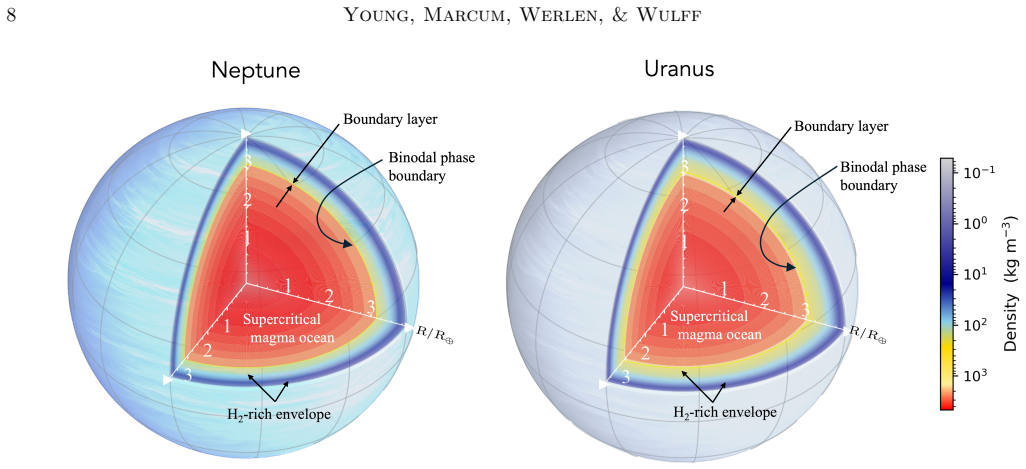
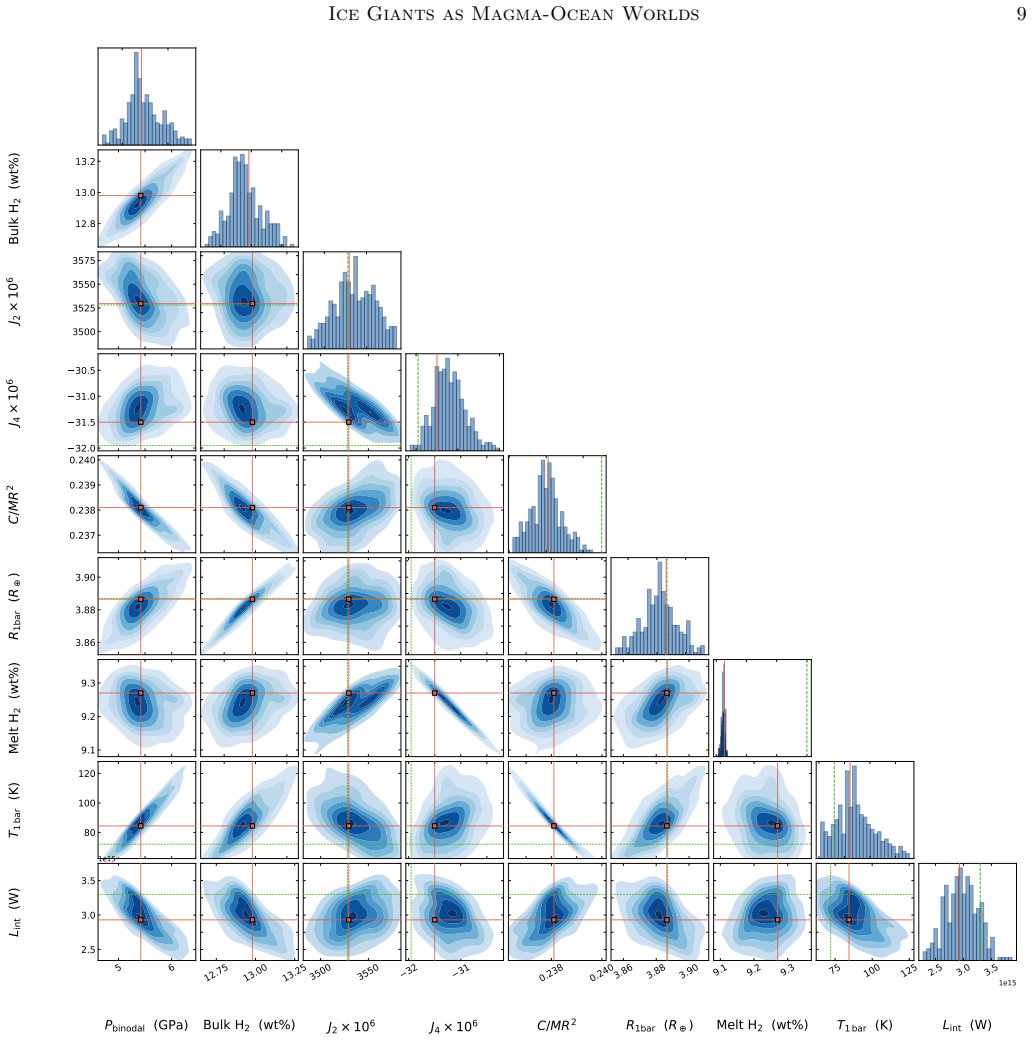
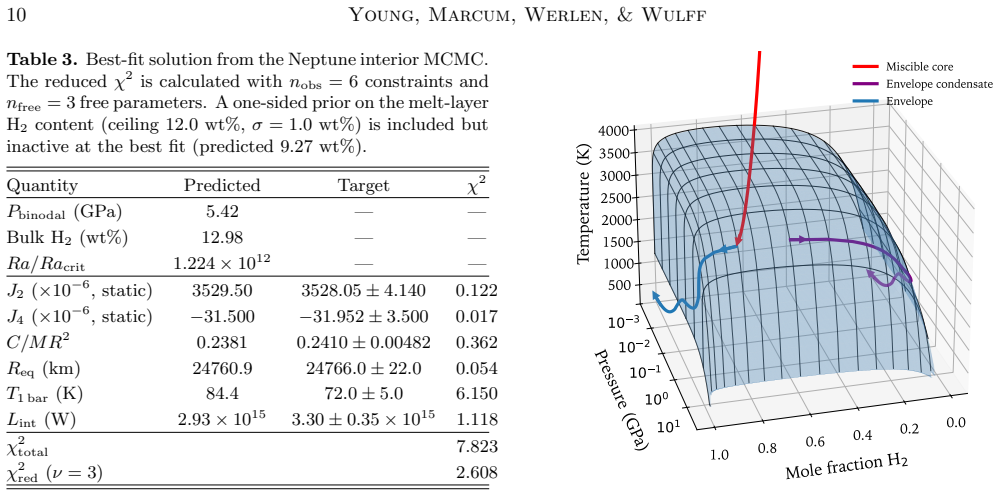
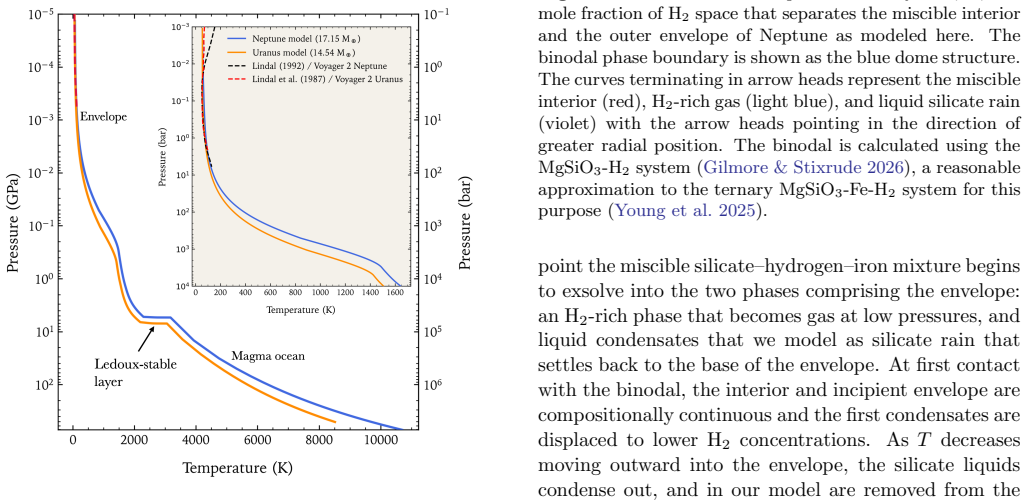
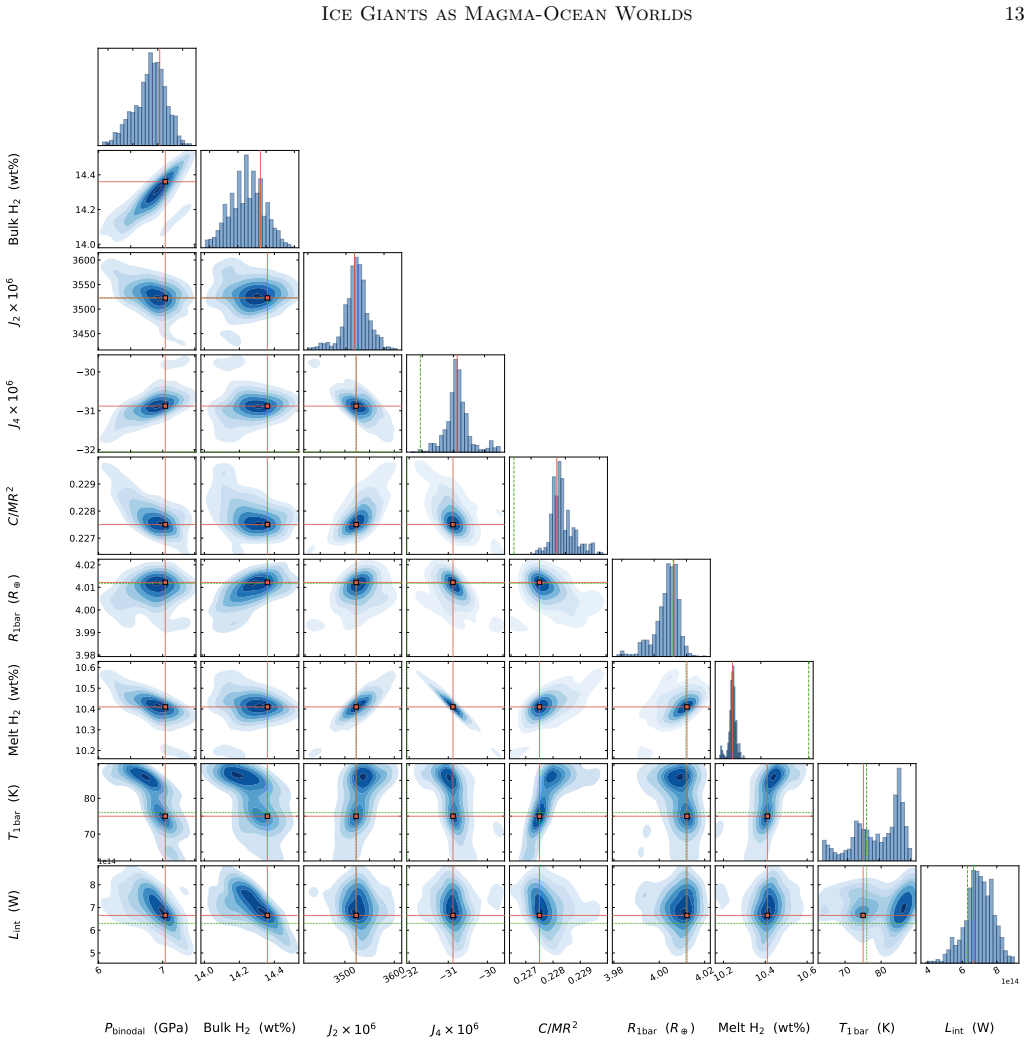
Uranus and Neptune's observed radii, bulk densities, gravitational harmonics, normalized moments of inertia, intrinsic luminosities, and key features of their atmospheric compositions are consistent with interiors comprising supercritical, hydrogen-rich magma oceans overlain by H2-rich envelopes, based on three fit parameters for each planet.
What carries the argument
Three-parameter-per-planet models that construct supercritical hydrogen-rich magma ocean interiors overlain by H2-rich envelopes.
If this is right
- The Solar System ice giants are better understood as magma-ocean giants whose origins parallel those of sub-Neptune gas-dwarf planets.
- A continuum among gas-dwarf planets lets Neptune and Uranus serve as accessible test cases for interior structure models and material properties applied to sub-Neptunes.
- Atmospheric chemistries of both planets arise naturally from the magma-ocean plus envelope configuration.
Where Pith is reading between the lines
- The same three-parameter construction could be tested on observed sub-Neptunes to predict which ones host extended magma oceans.
- High-precision measurements of additional atmospheric species or deeper gravitational harmonics could distinguish the magma-ocean model from traditional ice-rich interiors.
- Thermal evolution calculations that assume magma oceans would predict different cooling rates and present-day heat flows than ice-dominated models.
Load-bearing premise
A model employing only three free parameters per planet can capture the relevant physics of supercritical magma oceans, envelopes, and atmospheric chemistry without major omissions.
What would settle it
A precise measurement or calculation showing that no choice of the three parameters simultaneously reproduces the radius, bulk density, J2 and J4 harmonics, moment of inertia, luminosity, and observed atmospheric abundances within their uncertainties.
Figures



read the original abstract
Uranus and Neptune are commonly interpreted as volatile-rich "ice giants", an assumption that underpins most interior models. Here we show that their observed radii, bulk densities, gravitational harmonics, normalized moments of inertia, intrinsic luminosities, and key features of their atmospheric compositions are consistent with interiors comprising supercritical, hydrogen-rich magma oceans overlain by H2-rich envelopes. Our results, based on three fit parameters for each planet, provide a parsimonious explanation for the structures, thermal states, and atmospheric chemistries of Uranus and Neptune. We find that the Solar System's ice giants are better understood as magma-ocean giants, with origins parallel to those of sub-Neptune gas-dwarf planets. A continuum among gas dwarf planets permits Neptune and Uranus to serve as accessible, data-driven test cases for structure models and material properties used to understand sub-Neptunes.
Editorial analysis
A structured set of objections, weighed in public.
Referee Report
Summary. The manuscript claims that Uranus and Neptune's observed radii, bulk densities, gravitational harmonics (J2/J4), normalized moments of inertia, intrinsic luminosities, and atmospheric compositions are consistent with interiors consisting of supercritical hydrogen-rich magma oceans overlain by H2-rich envelopes. This is achieved with a model employing only three fit parameters per planet, providing a parsimonious alternative to traditional ice-giant interpretations and suggesting a structural continuum with sub-Neptune exoplanets.
Significance. If the central claim holds, the work supplies a data-driven, low-parameter framework that unifies Solar-System ice giants with the exoplanet population of gas dwarfs and offers testable predictions for material properties in supercritical regimes. Explicit use of only three parameters per planet is a strength when the underlying EOS, solubility laws, and chemistry network are shown to introduce no additional effective freedoms.
major comments (2)
- [Abstract] Abstract: the claim that radii, J2/J4, NMOI, luminosity, and atmospheric mole fractions are simultaneously reproduced by three fit parameters requires that the supercritical-fluid EOS, H2 solubility law, radiative/convective boundaries, and atmospheric chemistry network contain no significant fixed assumptions that absorb extra degrees of freedom; the manuscript provides no details on the functional form, error treatment, or validation against independent constraints.
- [Abstract] Abstract: if the EOS for the supercritical fluid or the H2 dissolution coefficient is taken from a single reference without propagation of its uncertainty range, the reported consistency with three parameters per planet could be an artifact of those fixed choices rather than an outcome of the fit parameters alone.
minor comments (1)
- Clarify whether the three fit parameters are the same quantities for both planets or allowed to differ, and list them explicitly.
Simulated Author's Rebuttal
We thank the referee for their detailed review and constructive feedback on our manuscript. Below we respond point by point to the major comments, clarifying the distinction between the three fit parameters and the fixed model components drawn from the literature. We are prepared to revise the abstract and add clarifying text as needed.
read point-by-point responses
-
Referee: [Abstract] Abstract: the claim that radii, J2/J4, NMOI, luminosity, and atmospheric mole fractions are simultaneously reproduced by three fit parameters requires that the supercritical-fluid EOS, H2 solubility law, radiative/convective boundaries, and atmospheric chemistry network contain no significant fixed assumptions that absorb extra degrees of freedom; the manuscript provides no details on the functional form, error treatment, or validation against independent constraints.
Authors: The three fit parameters per planet are the sole adjustable quantities used to match the suite of observations. The supercritical-fluid EOS, H2 solubility law, radiative/convective boundaries, and atmospheric chemistry network are held fixed at values taken from established literature sources; they introduce no additional free parameters. Functional forms, sources, and validation against independent data are described in the Methods section. We will revise the abstract to state explicitly that only three quantities are varied while the remaining components are fixed from prior work, and we will ensure the Methods section cross-references are clear. revision: yes
-
Referee: [Abstract] Abstract: if the EOS for the supercritical fluid or the H2 dissolution coefficient is taken from a single reference without propagation of its uncertainty range, the reported consistency with three parameters per planet could be an artifact of those fixed choices rather than an outcome of the fit parameters alone.
Authors: The EOS and solubility coefficients are adopted from specific, widely used references in the same manner as other interior models in the field; they are not tuned during the fit. While a full Monte-Carlo propagation of their uncertainties is beyond the scope of the present study, the simultaneous reproduction of multiple independent observables (radius, J2/J4, NMOI, luminosity, and atmospheric abundances) with only three free parameters per planet provides evidence that the agreement is not an artifact of the fixed choices. We will add a short paragraph in the revised manuscript discussing the provenance of the adopted material properties and noting the absence of uncertainty propagation as a limitation for future work. revision: partial
Circularity Check
No significant circularity; model explicitly uses parameter fitting to demonstrate consistency.
full rationale
The abstract states that observed properties 'are consistent with interiors comprising supercritical, hydrogen-rich magma oceans overlain by H2-rich envelopes' and that 'our results, based on three fit parameters for each planet, provide a parsimonious explanation'. This is a standard interior modeling exercise in which parameters are tuned to match external data (radii, densities, J2/J4, NMOI, luminosities, atmospheric compositions). No quoted step reduces a claimed prediction to the fit by construction, invokes a self-citation as the sole justification for a uniqueness theorem, or renames a known result. The central claim is presented as a fit result rather than an independent first-principles derivation, so the match is not misrepresented. The paper is therefore self-contained against external benchmarks with no load-bearing circular steps.
Axiom & Free-Parameter Ledger
free parameters (1)
- three fit parameters per planet
axioms (1)
- domain assumption Observed planetary properties can be reproduced by a supercritical hydrogen-rich magma ocean plus H2 envelope model
invented entities (1)
-
supercritical hydrogen-rich magma ocean
no independent evidence
Reference graph
Works this paper leans on
-
[1]
Ahlers, G., Grossmann, S., & Lohse, D. 2009, Rev. Mod. Phys., 81, 503, doi: 10.1103/RevModPhys.81.503
-
[2]
2014, Ecology, 95, 631, doi: https://doi.org/10.1890/13-1452.1
Aho, K., Derryberry, D., & Peterson, T. 2014, Ecology, 95, 631, doi: https://doi.org/10.1890/13-1452.1
-
[3]
Bailey, E., & Stevenson, D. J. 2021, The Planetary Science Journal, 2, 64, doi: 10.3847/PSJ/abd1e0
-
[4]
Bean, J. L., Raymond, S. N., Owen, J. E., et al. 2021, Journal of Geophysical Research: Planets, 126, e2020JE006639, doi: 10.1029/2020JE006639
-
[5]
Benneke, B., Roy, P.-A., Coulombe, L.-P., et al. 2024, JWST Reveals CH 4, CO2, and H 2O in a Metal-rich Miscible Atmosphere on a Two-Earth-Radius Exoplanet. https://arxiv.org/abs/2403.03325
arXiv 2024
-
[6]
2019, Icarus, 326, 10, doi: https://doi.org/10.1016/j.icarus.2019.01.027
Bierson, C., & Nimmo, F. 2019, Icarus, 326, 10, doi: https://doi.org/10.1016/j.icarus.2019.01.027
-
[7]
2018, Applied Sciences, 8, doi: 10.3390/app8060893 Brozovi´ c, M., Showalter, M
Braun, J., Sousa, J., & Paniagua, G. 2018, Applied Sciences, 8, doi: 10.3390/app8060893 Brozovi´ c, M., Showalter, M. R., Jacobson, R. A., et al. 2020, Icarus, 338, 113462, doi: 10.1016/j.icarus.2019.113462 Cano Amoros, M., Nettelmann, N., Tosi, N., Baumeister, P., & Rauer, H. 2024, Astronomy & Astrophysics, 692, A152, doi: 10.1051/0004-6361/202452148
-
[8]
Cao, H., & Stevenson, D. J. 2017, Journal of Geophysical Research: Planets, 122, 686, doi: https://doi.org/10.1002/2017JE005272
-
[9]
2020, Space Science Reviews, 216, doi: 10.1007/s11214-020-00677-8
Cavalie, T., Venot, O., Miguel, Y., et al. 2020, Space Science Reviews, 216, doi: 10.1007/s11214-020-00677-8
-
[10]
2019, The Astrophysical Journal, 872, 51, doi: 10.3847/1538-4357/aaf99f
Chabrier, G., Mazevet, S., & Soubiran, F. 2019, The Astrophysical Journal, 872, 51, doi: 10.3847/1538-4357/aaf99f
-
[11]
Chandrasekhar, S. 1961, Hydrodynamic and Hydromagnetic Stability, International Series of Monographs on Physics (Oxford: Clarendon Press), 652 de Koker, N., & Stixrude, L. 2009, Geophysical Journal International, 178, 162, doi: 10.1111/j.1365-246X.2009.04142.x de Pater, I., Romani, P. N., & Atreya, S. K. 1991, Icarus, 91, 220, doi: 10.1016/0019-1035(91)90020-T
-
[12]
Desch, M. D., Connerney, J. E. P., & Kaiser, M. L. 1986, Nature, 322, 42, doi: 10.1038/322042a0
-
[13]
Dietrich, W., Wulff, P., Wicht, J., & Christensen, U. R. 2021, MNRAS, 505, 3177, doi: 10.1093/mnras/stab1566
-
[14]
Dragulet, F., & Stixrude, L. 2025, Proceedings of the National Academy of Sciences, 122, e2509771122, doi: 10.1073/pnas.2509771122
-
[15]
N., Gustafsson, M., & Orton, G
Fletcher, L. N., Gustafsson, M., & Orton, G. S. 2018, The Astrophysical Journal Supplement Series, 235, 24, doi: 10.3847/1538-4365/aaa07a
-
[16]
Fortney, J. J., & Nettelmann, N. 2010, Space Science Reviews, 152, 423, doi: 10.1007/s11214-009-9582-x
-
[17]
2009, Planetary and Space Science, 57, 2053, doi: https://doi.org/10.1016/j.pss.2009.09.011
Fray, N., & Schmitt, B. 2009, Planetary and Space Science, 57, 2053, doi: https://doi.org/10.1016/j.pss.2009.09.011
-
[18]
Longaretti, P.-Y., & McGhee-French, C. A. 2024, Icarus, 411, 115957, doi: 10.1016/j.icarus.2024.115957
-
[19]
Fulle, M., Blum, J., Green, S. F., et al. 2019, Monthly Notices of the Royal Astronomical Society, 482, 3326, doi: 10.1093/mnras/sty2926
-
[20]
2017, Journal of Fluid Mechanics, 810, 175, doi: 10.1017/jfm.2016.687
Galanti, E., Kaspi, Y., & Tziperman, E. 2017, Journal of Fluid Mechanics, 810, 175, doi: 10.1017/jfm.2016.687
-
[21]
Gastine, T., Duarte, L., & Wicht, J. 2012, Astron. Astrophys., 546, A19, doi: 10.1051/0004-6361/201219799
-
[22]
2026, Nature, 650, 60, doi: 10.1038/s41586-025-09970-4
Gilmore, T., & Stixrude, L. 2026, Nature, 650, 60, doi: 10.1038/s41586-025-09970-4
-
[23]
Ginzburg, S., Schlichting, H. E., & Sari, R. 2016, The Astrophysical Journal, 825, 29, doi: 10.3847/0004-637X/825/1/29
-
[24]
Pierrehumbert, R. T. 2021, The Planetary Science Journal, 2, 207, doi: 10.3847/PSJ/ac214c
-
[25]
Grimm, S. L., Steinmeyer, M.-L., Werlen, A., et al. 2026, A New Global Chemical Equilibrium Code: Refractory Element Signatures in Super-Earths and Sub-Neptunes, arXiv, doi: 10.48550/arXiv.2605.07833
work page internal anchor Pith review Pith/arXiv arXiv doi:10.48550/arxiv.2605.07833 2026
-
[26]
2000, Journal of Fluid Mechanics, 407, 27–56, doi: 10.1017/S0022112099007545
Grossmann, S., & Lohse, D. 2000, Journal of Fluid Mechanics, 407, 27–56, doi: 10.1017/S0022112099007545
-
[27]
2010, A&A, 520, A27, doi: 10.1051/0004-6361/200913396
Guillot, T. 2010, A&A, 520, A27, doi: 10.1051/0004-6361/200913396
work page internal anchor Pith review doi:10.1051/0004-6361/200913396 2010
-
[28]
Hammel, H. B., Rages, K., Lockwood, G. W., Karkoschka, E., & de Pater, I. 2001, Icarus, 153, 229, doi: 10.1006/icar.2001.6689 Ice Giants as Magma-Ocean Worlds27
-
[29]
D., Podolak, M., & Schubert, G
Helled, R., Anderson, J. D., Podolak, M., & Schubert, G. 2011, The Astrophysical Journal, 726, 15, doi: 10.1088/0004-637X/726/1/15
-
[30]
Helled, R., Anderson, J. D., & Schubert, G. 2010, Icarus, 210, 446, doi: 10.1016/j.icarus.2010.06.037
-
[31]
Helled, R., & Fortney, J. J. 2020, Philosophical Transactions of the Royal Society A, 378, 20190474, doi: 10.1098/rsta.2019.0474
-
[32]
2020, Space Science Reviews, 216, 38
Helled, R., Nettelmann, N., & Guillot, T. 2020, Space Science Reviews, 216, 38
2020
-
[33]
Hofstadter, M. D., & Butler, B. J. 2003, Icarus, 165, 168, doi: 10.1016/S0019-1035(03)00174-X
-
[34]
2024, Astronomy & Astrophysics, 683, L2, doi: 10.1051/0004-6361/202348238
Holmberg, M., & Madhusudhan, N. 2024, Astronomy & Astrophysics, 683, L2, doi: 10.1051/0004-6361/202348238
-
[35]
Hubbard, W. B. 2013, The Astrophysical Journal, 768, 43, doi: 10.1088/0004-637X/768/1/43
-
[36]
Hubbard, W. B., & MacFarlane, J. J. 1980, Journal of Geophysical Research: Solid Earth, 85, 225, doi: 10.1029/JB085iB01p00225
-
[37]
Hubbard, W. B., & Marley, M. S. 1989, Icarus, 78, 102, doi: 10.1016/0019-1035(89)90072-9
-
[38]
Insixiengmay, L., & Stixrude, L. 2025, Earth and Planetary Science Letters, 654, 119242, doi: https://doi.org/10.1016/j.epsl.2025.119242
-
[39]
Irwin, P. G. J., Toledo, D., Garland, R., et al. 2018, Nature Astronomy, 2, 420, doi: 10.1038/s41550-018-0432-1
-
[40]
Hammel, H. B. 2025, Monthly Notices of the Royal Astronomical Society, 540, 1719, doi: 10.1093/mnras/staf540
-
[41]
Irwin, P. G. J., et al. 2019a, Icarus, 331, 69, doi: 10.1016/j.icarus.2019.05.011 —. 2019b, Icarus, 321, 550, doi: 10.1016/j.icarus.2018.12.014 —. 2021, Icarus, 357, 114277, doi: 10.1016/j.icarus.2020.114277
-
[42]
Irwin, P. G. J., Dobinson, J., James, A., et al. 2023, Journal of Geophysical Research: Planets, 128, e2023J. https://agupubs.onlinelibrary.wiley.com/doi/abs/10. 1029/2023JE007980
2023
-
[43]
Jacobson, R. A. 2009, The Astronomical Journal, 137, 4322, doi: 10.1088/0004-6256/137/5/4322
-
[44]
Jacobson, R. A., & Park, R. S. 2025, The Astronomical Journal, 169, 65, doi: 10.3847/1538-3881/ad99d1
-
[45]
Karkoschka, E., & Tomasko, M. G. 2011, Icarus, 211, 780, doi: 10.1016/j.icarus.2010.08.013
-
[46]
Kaspi, Y., Showman, A. P., Hubbard, W. B., Aharonson, O., & Helled, R. 2013, Nature, 497, 344, doi: 10.1038/nature12131
-
[47]
2021, The Astrophysical Journal Letters, 909:L22, 6 pp
Kite, E., & Schaefer, L. 2021, The Astrophysical Journal Letters, 909:L22, 6 pp
2021
-
[48]
2022, Scientific Reports, 12, 13055, doi: 10.1038/s41598-022-16816-w
Militzer, B. 2022, Scientific Reports, 12, 13055, doi: 10.1038/s41598-022-16816-w
-
[49]
2017, AJ, 153, 260, doi: 10.3847/1538-3881/aa6faf
Kurosaki, K., & Ikoma, M. 2017, AJ, 153, 260, doi: 10.3847/1538-3881/aa6faf
-
[50]
Kuwayama, Y., Morard, G., Nakajima, Y., et al. 2020, Phys. Rev. Lett., 124, 165701, doi: 10.1103/PhysRevLett.124.165701
-
[51]
Lindal, G. F. 1992, The Astronomical Journal, 103, 967, doi: 10.1086/116119
-
[52]
Lindal, G. F., Lyons, J. R., Sweetnam, D. N., et al. 1987, Journal of Geophysical Research: Space Physics, 92, 14987, doi: 10.1029/JA092iA13p14987
-
[53]
Liu, C., Cohen, R. E., & Sun, J. 2026, Nature Communications, 17, 3980, doi: 10.1038/s41467-026-70603-z
-
[54]
Long, R. S., Mound, J. E., Davies, C. J., & Tobias, S. M. 2020, Phys. Rev. Fluids, 5, 113502, doi: 10.1103/PhysRevFluids.5.113502
-
[55]
2023, The Astrophysical Journal Letters, 956, L13, doi: 10.3847/2041-8213/acf577
Madhusudhan, N., Sarkar, S., Constantinou, S., et al. 2023, The Astrophysical Journal Letters, 956, L13, doi: 10.3847/2041-8213/acf577
-
[56]
Malamud, U., Podolak, M., Podolak, J. I., & Bodenheimer, P. H. 2024, Icarus, 421, 116217, doi: https://doi.org/10.1016/j.icarus.2024.116217
-
[57]
P., Stixrude, L., & Young, E
Marcum, S. P., Stixrude, L., & Young, E. D. 2026, PhD dissertation, in prep. The Astrophysical Journal
2026
-
[58]
2022, A&A, 665, A12, doi: 10.1051/0004-6361/202243359
Markham, S., Guillot, T., & Stevenson, D. 2022, A&A, 665, A12, doi: 10.1051/0004-6361/202243359
-
[59]
Marley, M. S., Gomez, P., & Podolak, M. 1995, J. Geophys. Res., 100, 23349, doi: 10.1029/95JE02362
-
[60]
B., Nimmo, F., Wong, T.-S., et al
McKinnon, W. B., Nimmo, F., Wong, T.-S., et al. 2017, Icarus, 287, 2, doi: 10.1016/j.icarus.2016.11.019
-
[61]
Militzer, B. 2024, Proceedings of the National Academy of Sciences, 121, e2403981121, doi: 10.1073/pnas.2403981121
-
[62]
Miozzi, F., Shahar, A., Young, E. D., et al. 2025, Nature, 648, 551, doi: 10.1038/s41586-025-09816-z
-
[63]
Misener, W., Schlichting, H. E., & Young, E. D. 2023, Monthly Notices of the Royal Astronomical Society, 524, 981, doi: 10.1093/mnras/stad1910
-
[64]
Moses, J. I., Fletcher, L. N., Greathouse, T. K., Orton, G. S., & Hue, V. 2020, Philosophical Transactions of the Royal Society A, 378, 20190477, doi: 10.1098/rsta.2019.0477
-
[65]
Movshovitz, N., & Fortney, J. J. 2022, The Planetary Science Journal, 3, 88, doi: 10.3847/PSJ/ac60ff 28Young, Marcum, Werlen, & Wulff
-
[66]
J., Mankovich, C., Thorngren, D., & Helled, R
Movshovitz, N., Fortney, J. J., Mankovich, C., Thorngren, D., & Helled, R. 2019, The Astrophysical Journal, 891, 109, doi: 10.3847/1538-4357/ab7fa2
-
[67]
Ness, N. F., Acuna, M. H., Behannon, K. W., et al. 1986, Science, 233, 85, doi: 10.1126/science.233.4759.85
-
[68]
Ness, N. F., Acuna, M. H., Burlaga, L. F., et al. 1989, Science, 246, 1473, doi: 10.1126/science.246.4936.1473
-
[69]
Nettelmann, N., Helled, R., Fortney, J. J., & Redmer, R. 2013, Planetary and Space Science, 77, 143, doi: 10.1016/j.pss.2012.06.019
-
[70]
Nettelmann, N., Wang, K., Fortney, J. J., et al. 2016, Icarus, 275, 107, doi: 10.1016/j.icarus.2016.04.008
-
[71]
Neuenschwander, B. A., & Helled, R. 2022, Monthly Notices of the Royal Astronomical Society, 512, 3124, doi: 10.1093/mnras/stac628
-
[72]
Neuenschwander, B. A., M¨ uller, S., & Helled, R. 2024, Astronomy & Astrophysics, 684, A191, doi: 10.1051/0004-6361/202347846 P¨ atzold, M., Andert, T., Hahn, M., et al. 2016, Nature, 530, 63, doi: 10.1038/nature16535
-
[73]
Pearl, J. C., & Conrath, B. J. 1991, Journal of Geophysical Research: Space Physics, 96, 18921, doi: 10.1029/91JA01087
-
[74]
Pearl, J. C., Conrath, B. J., Hanel, R. A., Pirraglia, J. A., & Coustenis, A. 1990, Icarus, 84, 12, doi: 10.1016/0019-1035(90)90155-3
-
[75]
Podolak, M., & Cameron, A. G. W. 1974, Icarus, 22, 123, doi: 10.1016/0019-1035(74)90112-4
-
[76]
2012, The Astrophysical Journal Letters, 759, L32, doi: 10.1088/2041-8205/759/1/L32
Podolak, M., & Helled, R. 2012, The Astrophysical Journal Letters, 759, L32, doi: 10.1088/2041-8205/759/1/L32
-
[77]
Podolak, M., & Reynolds, R. T. 1984, Icarus, 57, 102, doi: 10.1016/0019-1035(84)90011-9
-
[78]
Podolak, M., Weizman, A., & Marley, M. 1995, Planet. Space Sci., 43, 1517, doi: 10.1016/0032-0633(95)00061-5
-
[79]
Qi, C., ¨Oberg, K. I., Wilner, D. J., et al. 2013, Science, 341, 630, doi: 10.1126/science.1239560
-
[80]
Qi, C., ¨Oberg, K. I., Espaillat, C. C., et al. 2019, The Astrophysical Journal, 882, 160, doi: 10.3847/1538-4357/ab35d3
discussion (0)
Sign in with ORCID, Apple, or X to comment. Anyone can read and Pith papers without signing in.