Impulse Decoding of Quantum LDPC Codes: Equivalence of Degeneracy and Code-Shortening
Pith reviewed 2026-06-27 00:43 UTC · model grok-4.3
The pith
Degeneracy in quantum stabilizer codes corresponds to shortening the classical code at the decoder rather than the encoder.
A machine-rendered reading of the paper's core claim, the machinery that carries it, and where it could break.
Core claim
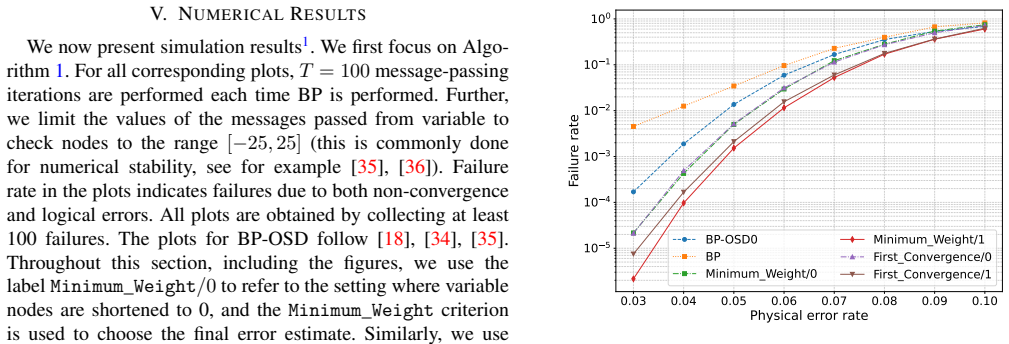
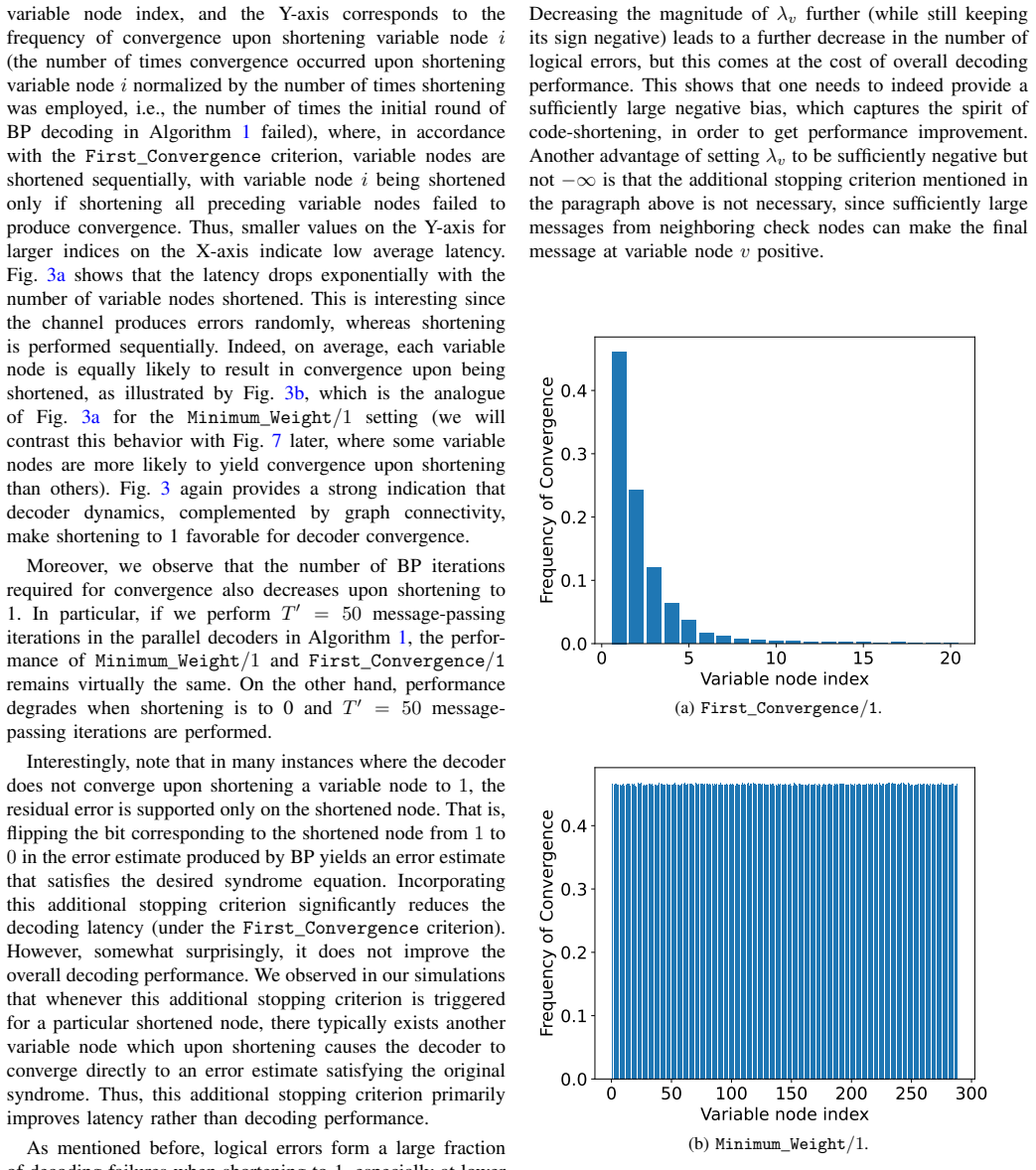
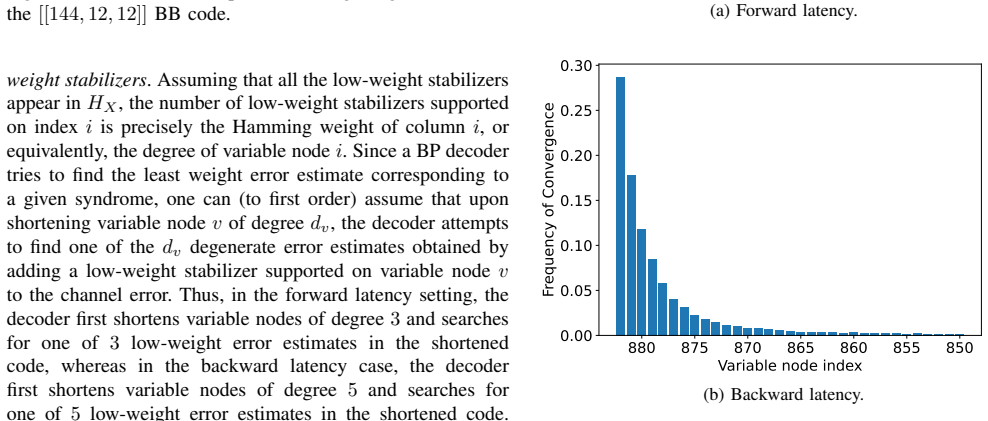
We demonstrate that degeneracy is closely related to the classical operation of shortening of a linear block code, where the shortening takes place at the decoder. This equivalence enables impulse decoding, a parallel scheme for quantum LDPC codes that significantly outperforms belief propagation with ordered statistics decoding under both code-capacity and circuit-level noise with significantly lesser complexity. An additional algorithm based on decoding of residual errors, when combined with impulse decoding, achieves further performance improvement under circuit-level noise.
What carries the argument
The equivalence mapping degeneracy to decoder-side shortening of the underlying classical code, which directly motivates the impulse decoding algorithm.
If this is right
- Impulse decoding provides a lower-complexity alternative to BP+OSD for quantum LDPC codes.
- Performance gains hold for both code-capacity and circuit-level noise models.
- Combining impulse decoding with residual error decoding further reduces error rates under circuit-level noise.
- The approach bridges quantum degeneracy to a standard classical coding operation.
Where Pith is reading between the lines
- The decoder-side shortening view may extend to other families of quantum codes beyond LDPC.
- Explicit code constructions that anticipate decoder shortening could be designed to minimize degeneracy effects.
- Impulse decoding's parallel nature suggests scalability advantages for larger quantum systems.
Load-bearing premise
The mapping from degeneracy to decoder-side shortening produces a practical algorithm whose performance advantage persists for the quantum LDPC codes and noise models considered.
What would settle it
Implement impulse decoding on a standard quantum LDPC code under circuit-level depolarizing noise and measure whether the logical error rate is lower than that of BP+OSD at the same computational budget; absence of improvement would falsify the practical utility claim.
Figures





read the original abstract
Quantum error correction is essential for building scalable quantum computers. Within the stabilizer formalism, the Calderbank-Shor-Steane framework constructs quantum codes from pairs of classical linear codes. A distinctive feature in this setting is degeneracy, where multiple equivalent error estimates exist-a phenomenon that has no classical counterpart, and the lack of a meaningful classical coding-theoretic interpretation of which has remained a gap in the literature. In this paper, we demonstrate that degeneracy is closely related to the classical operation of shortening of a linear block code. Interestingly, the shortening here takes place at the decoder rather than at the encoder. Leveraging this insight, we present a parallel decoding scheme for quantum low-density parity-check codes, which we term impulse decoding, that significantly outperforms belief propagation with ordered statistics decoding, as well as several other existing techniques, under both code-capacity and circuit-level noise, with significantly lesser complexity. We then present another algorithm based on decoding of residual errors, which when combined with impulse decoding achieves further performance improvement under circuit-level noise.
Editorial analysis
A structured set of objections, weighed in public.
Referee Report
Summary. The paper claims that degeneracy in quantum stabilizer codes (multiple equivalent error estimates with no classical counterpart) is equivalent to the classical operation of shortening a linear block code, but performed at the decoder rather than the encoder. Leveraging this, it introduces 'impulse decoding'—a parallel scheme for quantum LDPC codes that significantly outperforms belief propagation with ordered statistics decoding (BP+OSD) and other methods under both code-capacity and circuit-level noise, at lower complexity. A second algorithm for decoding residual errors is proposed; when combined with impulse decoding it yields further gains under circuit-level noise.
Significance. If the equivalence is shown to be faithful (i.e., the decoder-side shortening preserves all correctable cosets without new undetectable logical errors) and the reported performance advantage holds for the tested quantum LDPC constructions, the work would supply a missing coding-theoretic interpretation of degeneracy and a practical, lower-complexity decoder for codes relevant to scalable fault tolerance. The explicit link to classical shortening and the parallel nature of the decoder are potentially useful strengths.
major comments (1)
- [Section presenting the equivalence and impulse decoding construction] The central claim requires that the mapping from degenerate cosets to shortened syndromes is faithful: every degenerate coset leader must correspond to a shortened-code syndrome without introducing undetectable logical errors or altering the effective distance. This mapping is load-bearing for the assertion that impulse decoding recovers the same logical outcomes as an optimal decoder on the original code and for the claimed performance gains over BP+OSD under circuit-level noise. The manuscript must supply an explicit construction or proof that the parity-check matrix admits a uniform shortening rule across stabilizers (without case-by-case handling of weight-2 or higher stabilizers) that does not create new failure modes when residual errors interact with the shortening.
minor comments (2)
- [Abstract] The abstract states that impulse decoding 'significantly outperforms' BP+OSD 'with significantly lesser complexity' but supplies no quantitative metrics, code parameters, or noise-model details; adding these would allow readers to assess the scope of the gains.
- [Performance evaluation section] Performance claims under circuit-level noise should be accompanied by explicit statements of the noise model parameters, number of Monte Carlo trials, and any post-selection or fitting procedures used to generate the reported curves.
Simulated Author's Rebuttal
We thank the referee for their careful reading and constructive comments. We address the major comment below and will revise the manuscript to incorporate an explicit construction and proof as requested.
read point-by-point responses
-
Referee: [Section presenting the equivalence and impulse decoding construction] The central claim requires that the mapping from degenerate cosets to shortened syndromes is faithful: every degenerate coset leader must correspond to a shortened-code syndrome without introducing undetectable logical errors or altering the effective distance. This mapping is load-bearing for the assertion that impulse decoding recovers the same logical outcomes as an optimal decoder on the original code and for the claimed performance gains over BP+OSD under circuit-level noise. The manuscript must supply an explicit construction or proof that the parity-check matrix admits a uniform shortening rule across stabilizers (without case-by-case handling of weight-2 or higher stabilizers) that does not create new failure modes when residual errors interact with the shortening.
Authors: We agree that a rigorous demonstration of the faithfulness of the mapping is essential. The manuscript establishes the equivalence by interpreting degeneracy as shortening performed at the decoder rather than the encoder. In the revised version, we will add an explicit uniform shortening rule derived from the parity-check matrix structure that applies consistently to all stabilizers without case-by-case handling based on weight. We will also include a proof that this rule maps every degenerate coset leader to a valid shortened syndrome, preserves all correctable cosets, introduces no new undetectable logical errors, and does not alter the effective distance. The proof will further address interactions between residual errors and the shortening operation under circuit-level noise, confirming that impulse decoding achieves the same logical outcomes as an optimal decoder on the original code. revision: yes
Circularity Check
No circularity: equivalence framed as external classical relation without self-referential reduction
full rationale
The provided abstract and context contain no equations, fitted parameters, or self-citations that reduce the claimed equivalence (degeneracy to decoder-side shortening) to a definition or input by construction. The central demonstration is presented as relating a quantum phenomenon to an independent classical operation performed at the decoder, with no load-bearing step that renames or fits the target result. The derivation chain is therefore self-contained against external benchmarks, consistent with the reader's assessment of score 2.0.
Axiom & Free-Parameter Ledger
Reference graph
Works this paper leans on
-
[1]
Gottesman,Stabilizer codes and quantum error correction
D. Gottesman,Stabilizer codes and quantum error correction. California Institute of Technology, 1997
1997
-
[2]
Good quantum error-correcting codes exist,
A. R. Calderbank and P. W. Shor, “Good quantum error-correcting codes exist,”Physical Review A, vol. 54, no. 2, p. 1098, 1996
1996
-
[3]
Error correcting codes in quantum theory,
A. M. Steane, “Error correcting codes in quantum theory,”Physical Review Letters, vol. 77, no. 5, p. 793, 1996
1996
-
[4]
Sparse-graph codes for quantum error correction,
D. J. MacKay, G. Mitchison, and P. L. McFadden, “Sparse-graph codes for quantum error correction,”IEEE Transactions on Information Theory, vol. 50, no. 10, pp. 2315–2330, 2004
2004
-
[5]
Low-density parity-check codes,
R. Gallager, “Low-density parity-check codes,”IRE Transactions on Information Theory, vol. 8, no. 1, pp. 21–28, 1962
1962
-
[6]
Fiber bundle codes: breaking the n 1/2 polylog (n) barrier for quantum LDPC codes,
M. B. Hastings, J. Haah, and R. O’Donnell, “Fiber bundle codes: breaking the n 1/2 polylog (n) barrier for quantum LDPC codes,” in Proceedings of the 53rd Annual ACM SIGACT Symposium on Theory of Computing, pp. 1276–1288, 2021
2021
-
[7]
Balanced product quantum codes,
N. P. Breuckmann and J. N. Eberhardt, “Balanced product quantum codes,”IEEE Transactions on Information Theory, vol. 67, no. 10, pp. 6653–6674, 2021
2021
-
[8]
Quantum LDPC codes with almost linear minimum distance,
P. Panteleev and G. Kalachev, “Quantum LDPC codes with almost linear minimum distance,”IEEE Transactions on Information Theory, vol. 68, no. 1, pp. 213–229, 2021
2021
-
[9]
Quantum LDPC codes with positive rate and minimum distance proportional to the square root of the blocklength,
J.-P. Tillich and G. Zémor, “Quantum LDPC codes with positive rate and minimum distance proportional to the square root of the blocklength,” IEEE Transactions on Information Theory, vol. 60, no. 2, pp. 1193– 1202, 2013
2013
-
[10]
Asymptotically good quantum and locally testable classical LDPC codes,
P. Panteleev and G. Kalachev, “Asymptotically good quantum and locally testable classical LDPC codes,” inProceedings of the 54th Annual ACM SIGACT Symposium on Theory of Computing, pp. 375–388, 2022
2022
-
[11]
Good quantum LDPC codes with linear time decoders,
I. Dinur, M.-H. Hsieh, T.-C. Lin, and T. Vidick, “Good quantum LDPC codes with linear time decoders,” inProceedings of the 55th annual ACM symposium on theory of computing, pp. 905–918, 2023
2023
-
[12]
Quantum tanner codes,
A. Leverrier and G. Zémor, “Quantum tanner codes,” in2022 IEEE 63rd Annual Symposium on F oundations of Computer Science (FOCS), pp. 872–883, IEEE, 2022
2022
-
[13]
The generalized distributive law,
S. M. Aji and R. J. McEliece, “The generalized distributive law,”IEEE transactions on Information Theory, vol. 46, no. 2, pp. 325–343, 2002
2002
-
[14]
Reduced-complexity decoding of LDPC codes,
J. Chen, A. Dholakia, E. Eleftheriou, M. P. Fossorier, and X.-Y . Hu, “Reduced-complexity decoding of LDPC codes,”IEEE transactions on communications, vol. 53, no. 8, pp. 1288–1299, 2005
2005
-
[15]
On the iterative decoding of sparse quantum codes,
D. Poulin and Y . Chung, “On the iterative decoding of sparse quantum codes,”arXiv preprint arXiv:0801.1241, 2008
Pith/arXiv arXiv 2008
-
[16]
High-threshold and low-overhead fault-tolerant quantum memory,
S. Bravyi, A. W. Cross, J. M. Gambetta, D. Maslov, P. Rall, and T. J. Yoder, “High-threshold and low-overhead fault-tolerant quantum memory,”Nature, vol. 627, no. 8005, pp. 778–782, 2024
2024
-
[17]
Degenerate quantum LDPC codes with good finite length performance,
P. Panteleev and G. Kalachev, “Degenerate quantum LDPC codes with good finite length performance,”Quantum, vol. 5, p. 585, 2021
2021
-
[18]
Decoding across the quantum low-density parity-check code landscape,
J. Roffe, D. R. White, S. Burton, and E. Campbell, “Decoding across the quantum low-density parity-check code landscape,”Physical Review Research, vol. 2, no. 4, p. 043423, 2020
2020
-
[19]
Check- agnosia based post-processor for message-passing decoding of quantum LDPC codes,
J. du Crest, F. Garcia-Herrero, M. Mhalla, V . Savin, and J. Valls, “Check- agnosia based post-processor for message-passing decoding of quantum LDPC codes,”Quantum, vol. 8, p. 1334, 2024
2024
-
[20]
Stabilizer inactivation for message-passing decoding of quantum LDPC codes,
J. Du Crest, M. Mhalla, and V . Savin, “Stabilizer inactivation for message-passing decoding of quantum LDPC codes,” in2022 IEEE Information Theory Workshop (ITW), pp. 488–493, IEEE, 2022
2022
-
[21]
T. Hillmann, L. Berent, A. O. Quintavalle, J. Eisert, R. Wille, and J. Roffe, “Localized statistics decoding: A parallel decoding algo- rithm for quantum low-density parity-check codes,”arXiv preprint arXiv:2406.18655, 2024
arXiv 2024
-
[22]
An almost-linear time decoding algorithm for quan- tum LDPC codes under circuit-level noise,
A. deMarti iOlius, I. Etxezarreta Martinez, J. Roffe, and J. Etx- ezarreta Martinez, “An almost-linear time decoding algorithm for quan- tum LDPC codes under circuit-level noise,”arXiv e-prints, pp. arXiv– 2409, 2024
2024
-
[23]
The closed-branch decoder for quantum LDPC codes,
A. deMarti iOlius and J. Etxezarreta Martinez, “The closed-branch decoder for quantum LDPC codes,”arXiv e-prints, pp. arXiv–2402, 2024
2024
-
[24]
Ambiguity clustering: an accurate and efficient decoder for qLDPC codes,
S. Wolanski and B. Barber, “Ambiguity clustering: an accurate and efficient decoder for qLDPC codes,”arXiv preprint arXiv:2406.14527, 2024
arXiv 2024
-
[25]
Almost-linear time decoding algo- rithm for topological codes,
N. Delfosse and N. H. Nickerson, “Almost-linear time decoding algo- rithm for topological codes,”Quantum, vol. 5, p. 595, 2021
2021
-
[26]
Decoding quantum LDPC codes using collaborative check node removal,
M. Bhattacharyya and A. Raina, “Decoding quantum LDPC codes using collaborative check node removal,”arXiv preprint arXiv:2501.08036, 2025
Pith/arXiv arXiv 2025
-
[27]
Symbreak: Mitigating quantum degeneracy issues in QLDPC code decoders by breaking symmetry,
K. Yin, X. Fang, J. Ruan, H. Zhang, D. Tullsen, A. Sornborger, C. Liu, A. Li, T. Humble, and Y . Ding, “Symbreak: Mitigating quantum degeneracy issues in QLDPC code decoders by breaking symmetry,” arXiv preprint arXiv:2412.02885, 2024
arXiv 2024
-
[28]
Belief propagation for general graphical models with loops,
P. Hack, C. B. Mendl, and A. Paler, “Belief propagation for general graphical models with loops,”arXiv preprint arXiv:2411.04957, 2024
arXiv 2024
-
[29]
Decoding quantum LDPC codes using graph neural networks,
V . Ninkovic, O. Kundacina, D. Vukobratovic, C. Häger,et al., “Decoding quantum LDPC codes using graph neural networks,”arXiv preprint arXiv:2408.05170, 2024
arXiv 2024
-
[30]
Trapping sets of quantum LDPC codes,
N. Raveendran and B. Vasi ´c, “Trapping sets of quantum LDPC codes,” Quantum, vol. 5, p. 562, 2021
2021
-
[31]
Restart Belief: A General Quantum LDPC Decoder,
L. Valentini, D. Forlivesi, A. Talarico, and M. Chiani, “Restart Belief: A General Quantum LDPC Decoder,” 2025
2025
-
[32]
Beam search decoder for quantum LDPC codes,
M. Ye, D. Wecker, and N. Delfosse, “Beam search decoder for quantum LDPC codes,” 2025
2025
-
[33]
Improved belief propagation is sufficient for real-time decoding of quantum memory,
T. Müller, T. Alexander, M. E. Beverland, M. Bühler, B. R. John- son, T. Maurer, and D. Vandeth, “Improved belief propagation is sufficient for real-time decoding of quantum memory,”arXiv preprint arXiv:2506.01779, 2025
arXiv 2025
-
[34]
Toward low-latency iterative decoding of QLDPC codes under circuit-level noise,
A. Gong, S. Cammerer, and J. M. Renes, “Toward low-latency iterative decoding of QLDPC codes under circuit-level noise,”arXiv preprint arXiv:2403.18901, 2024
arXiv 2024
-
[35]
Belief propagation decoding of quantum LDPC codes with guided decimation,
H. Yao, W. A. Laban, C. Häger, A. G. i Amat, and H. D. Pfister, “Belief propagation decoding of quantum LDPC codes with guided decimation,” in2024 IEEE International Symposium on Information Theory (ISIT), pp. 2478–2483, IEEE, 2024
2024
-
[36]
Decimation Strategies for Belief Propagation Decoding of Quantum LDPC Codes,
M. Alinia, D. G. Mitchell, H. Yao, and H. D. Pfister, “Decimation Strategies for Belief Propagation Decoding of Quantum LDPC Codes,” in2025 13th International Symposium on Topics in Coding (ISTC), pp. 1–5, IEEE, 2025
2025
-
[37]
K. Tsubouchi, H. Yamasaki, and S. Tamiya, “Degeneracy cutting: A lo- cal and efficient post-processing for belief propagation decoding of quan- tum low-density parity-check codes,”arXiv preprint arXiv:2510.08695, 2025
arXiv 2025
-
[38]
W. C. Huffman and V . Pless,Fundamentals of error-correcting codes. Cambridge university press, 2010
2010
-
[39]
Richardson and R
T. Richardson and R. Urbanke,Modern coding theory. Cambridge university press, 2008
2008
-
[40]
Designing fault-tolerant circuits using detector error models,
P.-J. H. Derks, A. Townsend-Teague, A. G. Burchards, and J. Eisert, “Designing fault-tolerant circuits using detector error models,”Quantum, vol. 9, p. 1905, 2025
1905
-
[41]
Fault tolerant decoding of QLDPC-GKP codes with circuit level soft information,
S. K. Borah, A. K. Pradhan, N. Raveendran, M. Pacenti, and B. Vasi ´c, “Fault tolerant decoding of QLDPC-GKP codes with circuit level soft information,” in2025 IEEE International Conference on Quantum Computing and Engineering (QCE), vol. 1, pp. 2505–2514, IEEE, 2025
2025
-
[42]
Single-shot and measurement-based quantum error correction via fault complexes,
T. Hillmann, G. Dauphinais, I. Tzitrin, and M. Vasmer, “Single-shot and measurement-based quantum error correction via fault complexes,” Phys. Rev. A, vol. 112, p. L040401, Oct 2025
2025
-
[43]
Auto- morphism ensemble decoding of quantum LDPC codes,
S. Koutsioumpas, H. Sayginel, M. Webster, and D. E. Browne, “Auto- morphism ensemble decoding of quantum LDPC codes,”arXiv preprint arXiv:2503.01738, 2025
arXiv 2025
-
[44]
Ising models on locally tree-like graphs,
A. Dembo and A. Montanari, “Ising models on locally tree-like graphs,” 2010
2010
-
[45]
Decoding correlated errors in quantum LDPC codes,
A. S. Maan, F. M. Garcia Herrero, A. Paler, and V . Savin, “Decoding correlated errors in quantum LDPC codes,”Nature Communications, 2026
2026
discussion (0)
Sign in with ORCID, Apple, or X to comment. Anyone can read and Pith papers without signing in.