Weak corrections to Minimal Dark Matter annihilations
Pith reviewed 2026-06-26 23:44 UTC · model grok-4.3
The pith
One-loop weak corrections to fermionic minimal dark matter annihilation reach the 5% level for the most motivated multiplets.
A machine-rendered reading of the paper's core claim, the machinery that carries it, and where it could break.
Core claim
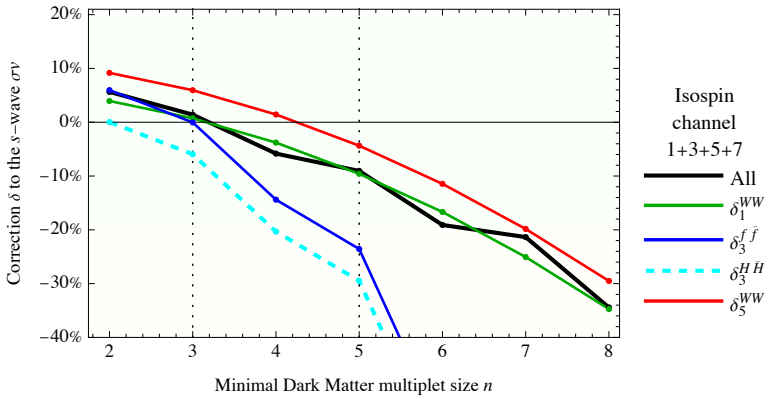
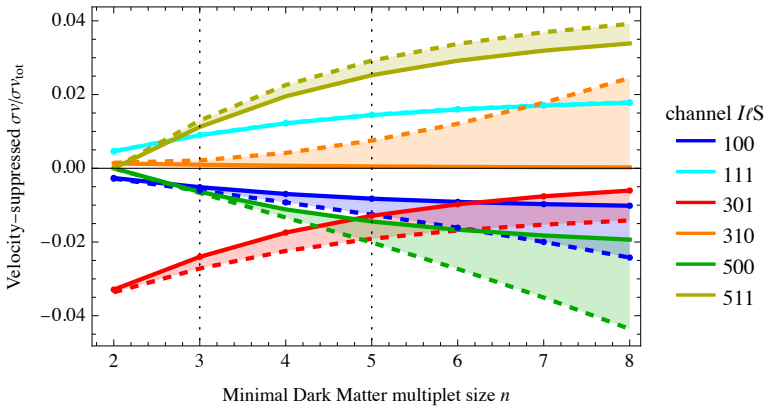
We compute the one-loop weak corrections to the annihilation cross sections of fermionic Minimal Dark Matter multiplets. Infrared divergences cancel in the dominant s-wave combination relevant for the thermal relic abundance. Instead, infrared-enhanced corrections affect velocity-suppressed rates, through a Sudakov/Sommerfeld interplay. The corrections grow with the multiplet size and are at the 5% level in the most motivated cases: the Higgsino-like doublet, the wino-like triplet, the stable quintuplet.
What carries the argument
One-loop electroweak corrections to the annihilation cross sections of fermionic Minimal Dark Matter multiplets, with infrared divergences canceling in the s-wave combination.
If this is right
- The thermal relic abundance for these multiplets must incorporate the one-loop corrections to achieve percent-level accuracy.
- Velocity-suppressed annihilation channels receive additional infrared-enhanced corrections from the Sudakov/Sommerfeld interplay.
- The size of the effect scales upward with larger multiplet dimension.
- The doublet, triplet, and quintuplet cases each receive shifts at the five percent level.
Where Pith is reading between the lines
- Relic density constraints derived from cosmic microwave background data would shift when these corrections are included in parameter scans.
- Comparable one-loop electroweak corrections may be required for scalar minimal dark matter candidates or for co-annihilation processes.
- Full resummation of Sudakov logarithms could extend the precision beyond the one-loop result for even larger multiplets.
- The separation into infrared-safe and enhanced channels suggests similar techniques could apply to other early-universe processes involving electroweak multiplets.
Load-bearing premise
The one-loop weak corrections extracted after isolating the infrared-safe s-wave combination remain accurate without higher-order or non-perturbative effects altering the result at the quoted five percent level.
What would settle it
A two-loop or non-perturbative calculation of the annihilation cross section for the wino-like triplet or stable quintuplet that differs from the one-loop result by substantially more than five percent.
Figures
read the original abstract
We compute the one-loop weak corrections to the annihilation cross sections of fermionic Minimal Dark Matter multiplets. Infrared divergences cancel in the dominant $s$-wave combination relevant for the thermal relic abundance. Instead, infrared-enhanced corrections affect velocity-suppressed rates, through a Sudakov/Sommerfeld interplay. The corrections grow with the multiplet size and are at the $5\%$ level in the most motivated cases: the Higgsino-like doublet, the wino-like triplet, the stable quintuplet.
Editorial analysis
A structured set of objections, weighed in public.
Referee Report
Summary. The paper computes the one-loop weak corrections to the annihilation cross sections of fermionic Minimal Dark Matter multiplets. Infrared divergences cancel in the dominant s-wave combination relevant for the thermal relic abundance. Infrared-enhanced corrections affect velocity-suppressed rates through a Sudakov/Sommerfeld interplay. The corrections grow with the multiplet size and reach the 5% level for the Higgsino-like doublet, wino-like triplet, and stable quintuplet.
Significance. If the central result holds, the work supplies a concrete, parameter-free improvement to the annihilation rates entering thermal relic calculations for Minimal Dark Matter. The explicit isolation of the IR-safe s-wave projector and the reported size of the corrections for the three most motivated multiplets constitute a useful update to existing MDM phenomenology. The direct perturbative nature of the expansion, with no fitted parameters or ad-hoc entities, strengthens the result.
minor comments (3)
- The abstract states that corrections 'grow with the multiplet size' but does not quantify the growth or list the representations beyond the three examples; a brief table or sentence in §2 or §3 would clarify the pattern.
- The interplay between Sudakov logarithms and Sommerfeld enhancement is mentioned for velocity-suppressed rates; a short paragraph or equation showing the leading logarithmic structure would help readers reproduce the separation of scales.
- No numerical values or plots are referenced in the provided abstract; if the manuscript contains them, they should be cited explicitly in the text when the 5% figure is stated.
Simulated Author's Rebuttal
We thank the referee for the positive assessment of our manuscript and the recommendation of minor revision. The report accurately summarizes our computation of one-loop weak corrections to fermionic Minimal Dark Matter annihilation cross sections, including the cancellation of infrared divergences in the s-wave channel and the size of the corrections for the doublet, triplet, and quintuplet cases.
Circularity Check
No significant circularity identified
full rationale
The paper performs an explicit one-loop perturbative computation of weak corrections to fermionic Minimal Dark Matter annihilation cross sections. The key technical step is the demonstration that infrared divergences cancel exactly in the s-wave projector relevant to thermal freeze-out, after which the remaining finite corrections are evaluated directly for the doublet, triplet and quintuplet cases. No equation or result is obtained by fitting a parameter to a subset of the same data, by renaming a known empirical pattern, or by invoking a load-bearing self-citation whose content is itself unverified; the derivation chain consists of standard QFT Feynman rules and cancellation identities that are independent of the final numerical percentages quoted.
Axiom & Free-Parameter Ledger
Reference graph
Works this paper leans on
-
[1]
M. Cirelli, N. Fornengo, A. Strumia,‘Mini- mal dark matter’, Nucl.Phys.B 753 (2006) 178 [arXiv:hep-ph/0512090]
Pith/arXiv arXiv 2006
- [2]
-
[3]
S. Bottaro, D. Buttazzo, M. Costa, R. Frances- chini, P. Panci, D. Redigolo, L. Vittorio,‘The last complex WIMPs standing’, Eur. Phys. J. C 82 (2022) 992 [arXiv:2205.04486]
arXiv 2022
-
[4]
N. Arkani-Hamed, S. Dimopoulos,‘Supersym- metric unification without low energy su- persymmetry and signatures for fine-tuning at the LHC’, JHEP 06 (2005) 073 [arXiv:hep- th/0405159]
arXiv 2005
-
[5]
M. Cirelli, A. Strumia, M. Tamburini,‘Cos- mology and Astrophysics of Minimal Dark Matter’, Nucl.Phys.B 787 (2007) 152 [arXiv:0706.4071]
Pith/arXiv arXiv 2007
-
[6]
A. Mitridate, M. Redi, J. Smirnov, A. Stru- mia,‘Cosmological Implications of Dark Matter Bound States’, JCAP 05 (2017) 006 [arXiv:1702.01141]
Pith/arXiv arXiv 2017
- [7]
-
[8]
S. Bottaro, A. Strumia, N. Vignaroli,‘Minimal Dark Matter bound states at future colliders’, JHEP 06 (2021) 143 [arXiv:2103.12766]
arXiv 2021
-
[9]
A. Strumia,‘QCD corrections to Minimal Dark Matter annihilations’, JHEP 12 (2025) 093 [arXiv:2508.02778]
arXiv 2025
-
[10]
J. Hisano, S. Matsumoto, M. Nagai, O. Saito, M. Senami,‘Non-perturbative effect on thermal relic abundance of dark matter’, Phys.Lett.B 646 (2007) 34 [arXiv:hep-ph/0610249]
Pith/arXiv arXiv 2007
-
[11]
S. Bottaro, D. Redigolo,‘Sommerfeld en- hancement at NLO and the dark matter uni- tarity bound’, Phys.Rev.D 110 (2024) 076027 [arXiv:2305.01680]
arXiv 2024
-
[12]
S. Bottaro, D. Buttazzo, M. Costa, R. Frances- chini, P. Panci, D. Redigolo, L. Vittorio,‘Clos- ing the window on WIMP Dark Matter’, Eur. Phys. J. C 82 (2022) 31 [arXiv:2107.09688]
arXiv 2022
-
[13]
P. Ciafaloni, D. Comelli, A. Riotto, F. Sala, A. Strumia, A. Urbano,‘Weak Corrections are Relevant for Dark Matter Indirect Detec- tion’, JCAP 03 (2011) 019 [arXiv:1009.0224]
Pith/arXiv arXiv 2011
-
[14]
P. Ciafaloni, M. Cirelli, D. Comelli, A. De Si- mone, A. Riotto, A. Urbano,‘On the Impor- tance of Electroweak Corrections for Majo- rana Dark Matter Indirect Detection’, JCAP 06 (2011) 018 [arXiv:1104.2996]
Pith/arXiv arXiv 2011
-
[15]
P. Ciafaloni, M. Cirelli, D. Comelli, A. De Si- mone, A. Riotto, A. Urbano,‘Initial State Ra- diation in Majorana Dark Matter Annihila- tions’, JCAP 10 (2011) 034 [arXiv:1107.4453]
Pith/arXiv arXiv 2011
-
[16]
A. Hryczuk, R. Iengo,‘The one-loop and Som- merfeld electroweak corrections to the Wino dark matter annihilation’, JHEP 01 (2012) 163 [arXiv:1111.2916]
Pith/arXiv arXiv 2012
-
[17]
P. Ciafaloni, D. Comelli, A. De Simone, A. Ri- otto, A. Urbano,‘Electroweak Bremsstrahlung for Wino-Like Dark Matter Annihilations’, JCAP 06 (2012) 016 [arXiv:1202.0692]
Pith/arXiv arXiv 2012
-
[18]
P. Ciafaloni, D. Comelli, A. De Simone, E. Mor- gante, A. Riotto, A. Urbano,‘The Role of Electroweak Corrections for the Dark Mat- ter Relic Abundance’, JCAP 10 (2013) 031 [arXiv:1305.6391]
Pith/arXiv arXiv 2013
-
[19]
M. Bauer, T. Cohen, R.J. Hill, M.P. Solon, ‘Soft Collinear Effective Theory for Heavy WIMP Annihilation’, JHEP 01 (2015) 099 [arXiv:1409.7392]
Pith/arXiv arXiv 2015
-
[20]
G. Ovanesyan, T.R. Slatyer, I.W. Stewart, ‘Heavy Dark Matter Annihilation from Ef- fective Field Theory’, Phys.Rev.Lett. 114 (2015) 211302 [arXiv:1409.8294]
Pith/arXiv arXiv 2015
-
[21]
M. Baumgart, V. Vaidya,‘Semi-inclusive wino and higgsino annihilation toLL ′’, JHEP 03 (2016) 213 [arXiv:1510.02470]
Pith/arXiv arXiv 2016
-
[22]
M. Baumgart, T. Cohen, I. Moult, N.L. Rodd, T.R. Slatyer, M.P. Solon, I.W. Stew- art, V. Vaidya,‘Resummed Photon Spectra for WIMP Annihilation’, JHEP 03 (2018) 117 [arXiv:1712.07656]
Pith/arXiv arXiv 2018
- [23]
- [24]
- [25]
-
[26]
M. Baumgart, N.L. Rodd, T.R. Slatyer, V. Vaidya,‘The quintuplet annihilation spec- trum’, JHEP 01 (2024) 158 [arXiv:2309.11562]
arXiv 2024
- [27]
-
[29]
Kinoshita,‘Mass singularities of Feynman amplitudes’, J.Math.Phys
T. Kinoshita,‘Mass singularities of Feynman amplitudes’, J.Math.Phys. 3 (1962) 650
1962
-
[30]
T.D. Lee, M. Nauenberg,‘Degenerate Systems and Mass Singularities’, Phys.Rev. 133 (1964) B1549
1964
-
[31]
M. Ciafaloni, P. Ciafaloni, D. Comelli,‘Bloch- Nordsieck violating electroweak corrections to inclusive TeV scale hard processes’, Phys.Rev.Lett. 84 (2000) 4810 [arXiv:hep- ph/0001142]
arXiv 2000
-
[32]
M. Ciafaloni, P. Ciafaloni, D. Comelli,‘Elec- troweak Bloch-Nordsieck violation at the TeV scale: ’Strong’ weak interactions?’, Nucl.Phys.B 589 (2000) 359 [arXiv:hep- ph/0004071]
arXiv 2000
-
[33]
P. Ciafaloni, D. Comelli, A. Urbano,‘Power suppressed corrections show new features of infrared cancellations’, JHEP 07 (2022) 063 [arXiv:2202.00934]
arXiv 2022
-
[34]
Bloch, A
F. Bloch, A. Nordsieck,‘Note on the Radiation Field of the electron’, Phys.Rev. 52 (1937) 54
1937
-
[35]
C. Hellmann, P. Ruiz-Femen´ ıa,‘Non- relativistic pair annihilation of nearly mass degenerate neutralinos and charginos II. P-wave and next-to-next-to-leading order S-wave coefficients’, JHEP 08 (2013) 084 [arXiv:1303.0200]
Pith/arXiv arXiv 2013
-
[36]
M. Beneke, C. Hellmann, P. Ruiz-Femenia, ‘Non-relativistic pair annihilation of nearly mass degenerate neutralinos and charginos III. Computation of the Som- merfeld enhancements’, JHEP 05 (2015) 115 [arXiv:1411.6924]
Pith/arXiv arXiv 2015
- [37]
-
[38]
A. R. Edmonds,‘Angular momentum in quan- tum mechanics’, Eur.Phys.J.C 82 (2022) 31 [In- Spire:Edmonds:1955fi]
2022
-
[39]
N. Baro, F. Boudjema, A. Semenov,‘Full one- loop corrections to the relic density in the MSSM: A Few examples’, Phys.Lett.B 660 (2008) 550 [arXiv:0710.1821]
Pith/arXiv arXiv 2008
-
[40]
N. Baro, F. Boudjema, G. Chalons, S. Hao, ‘Relic density at one-loop with gauge boson pair production’, Phys.Rev.D 81 (2010) 015005 [arXiv:0910.3293]
Pith/arXiv arXiv 2010
-
[41]
M. Beneke, C. Hellmann, P. Ruiz-Femenia, ‘Non-relativistic pair annihilation of nearly mass degenerate neutralinos and charginos I. General framework and S-wave annihila- tion’, JHEP 03 (2013) 148 [arXiv:1210.7928]
Pith/arXiv arXiv 2013
-
[42]
M. Beneke, C. Hellmann, P. Ruiz-Femenia, ‘Heavy neutralino relic abundance with Sommerfeld enhancements - a study of pMSSM scenarios’, JHEP 03 (2015) 162 [arXiv:1411.6930]
Pith/arXiv arXiv 2015
- [43]
-
[44]
Hahn,‘Generating Feynman diagrams and amplitudes with FeynArts 3’, Com- put.Phys.Commun
T. Hahn,‘Generating Feynman diagrams and amplitudes with FeynArts 3’, Com- put.Phys.Commun. 140 (2001) 418 [arXiv:hep- ph/0012260]
arXiv 2001
-
[45]
V. Shtabovenko, R. Mertig, F. Orellana,‘Feyn- Calc 9.3: New features and improve- ments’, Comput.Phys.Commun. 256 (2020) 107478 [arXiv:2001.04407]
Pith/arXiv arXiv 2020
-
[46]
A. Alloul, N. D. Christensen, C. Degrande, C. Duhr, B. Fuks,‘FeynRules 2.0 - A com- plete toolbox for tree-level phenomenology’, Comput.Phys.Commun. 185 (2014) 2250-2300 [arXiv:1310.1921]. 21
Pith/arXiv arXiv 2014
discussion (0)
Sign in with ORCID, Apple, or X to comment. Anyone can read and Pith papers without signing in.