Standard Candles for Supernova Neutrino Detection at DUNE
Pith reviewed 2026-06-26 23:41 UTC · model grok-4.3
The pith
Solar neutrinos and muon-decay neutrinos calibrate the argon cross section to reduce bias in DUNE supernova detection by up to 300%.
A machine-rendered reading of the paper's core claim, the machinery that carries it, and where it could break.
Core claim
The authors argue that ^8B solar neutrinos and muon-decay-at-rest neutrinos provide calibration samples that constrain both the low- and high-energy components of the ν_e-Ar cross section. This reduces the reliance on nuclear models, which can bias the extraction of the spectral parameters by as much as 300%.
What carries the argument
Standard candles consisting of ^8B solar neutrinos for low energies and muon-decay-at-rest neutrinos for higher energies to constrain the ν_e-Ar cross section.
If this is right
- The supernova neutrino spectrum parameters can be extracted with reduced systematic bias from nuclear theory.
- DUNE gains improved sensitivity to the electron neutrino component of Galactic core-collapse supernovae.
- Both low- and high-energy parts of the cross section are constrained without model dependence.
- The method applies specifically to the O(10) MeV range relevant for supernova detection.
Where Pith is reading between the lines
- Similar calibration techniques might apply to other neutrino-nucleus interactions in different detectors.
- This could lead to more reliable predictions for supernova neutrino signals in future experiments.
- The approach highlights the value of multi-source calibration for reducing theoretical uncertainties in neutrino physics.
Load-bearing premise
The assumption that the ^8B solar neutrino and muon-decay-at-rest samples can constrain the low- and high-energy components of the ν_e-Ar cross section with small enough systematics to reduce the 300% bias from nuclear models.
What would settle it
An experiment or simulation demonstrating that the calibration samples leave a residual bias larger than 100% in the extracted supernova spectral parameters would falsify the effectiveness of the method.
Figures

read the original abstract
The Deep Underground Neutrino Experiment (DUNE) far detector is sensitive to $\mathcal{O}(10)$ MeV electron neutrinos through $\nu_e$ charged-current reaction with argon. This capability is a unique window into the $\nu_e$ component of a Galactic core-collapse supernova flux. Extracting the properties of the supernova spectrum is, however, limited by the poorly-known $\nu_e$-Ar cross section. We propose a data-driven strategy that leverages $^8$B solar neutrinos and muon-decay-at-rest neutrinos as standard candles for this process. These calibration samples constrain both the low-energy and high-energy components of the cross section relevant for supernova detection. Our method reduces the reliance on nuclear models, which can bias the extraction of the spectral parameters by as much as 300$\%$.
Editorial analysis
A structured set of objections, weighed in public.
Referee Report
Summary. The paper proposes a data-driven calibration strategy for the ν_e-Ar charged-current cross section at DUNE using ^8B solar neutrinos (low-energy) and muon-decay-at-rest neutrinos (high-energy) as standard candles. This is intended to constrain the cross section in the energy range relevant for Galactic core-collapse supernova neutrinos, thereby reducing the bias in extracted supernova spectral parameters that arises from nuclear-model uncertainties (claimed to reach 300%).
Significance. If the calibration uncertainties can be shown to be substantially smaller than the nuclear-model bias, the approach would meaningfully improve the robustness of supernova neutrino spectrum extraction at DUNE by shifting from model-dependent to data-driven constraints on the interaction cross section.
major comments (1)
- [Abstract and calibration strategy sections] The central claim requires that the total systematics on the ^8B and DAR calibration samples (flux normalization, detector response, background subtraction, energy scale) are small enough to reduce the 300% nuclear-model bias. The manuscript identifies the relevant energy windows but does not present an end-to-end uncertainty budget propagated through to the supernova spectral-parameter bias; without this propagation it is not demonstrated that calibration uncertainties are sub-dominant.
Simulated Author's Rebuttal
We thank the referee for their careful reading of the manuscript and for highlighting this important point regarding the uncertainty budget.
read point-by-point responses
-
Referee: [Abstract and calibration strategy sections] The central claim requires that the total systematics on the ^8B and DAR calibration samples (flux normalization, detector response, background subtraction, energy scale) are small enough to reduce the 300% nuclear-model bias. The manuscript identifies the relevant energy windows but does not present an end-to-end uncertainty budget propagated through to the supernova spectral-parameter bias; without this propagation it is not demonstrated that calibration uncertainties are sub-dominant.
Authors: We agree with the referee that a quantitative demonstration of the calibration uncertainties being sub-dominant is necessary to fully support the central claim. The current work focuses on the strategy and energy matching but lacks the propagated uncertainty analysis. In the revised manuscript, we will add a new section providing an initial end-to-end uncertainty estimate based on published values for the ^8B flux, DAR neutrino spectra, and DUNE detector performance. This will allow a direct comparison to the nuclear model bias and show the potential improvement. revision: yes
Circularity Check
No circularity detected in data-driven calibration proposal
full rationale
The paper proposes a data-driven method using external ^8B solar and muon-decay-at-rest neutrino samples to constrain ν_e-Ar cross-section components relevant to supernova detection. No equations, derivations, or claims in the abstract reduce by construction to self-definition, fitted inputs renamed as predictions, or load-bearing self-citations. The approach is presented as an alternative to nuclear models without internal consistency loops or ansatz smuggling. The central claim remains a methodological suggestion whose validity depends on external data constraints rather than tautological reduction to its own inputs.
Axiom & Free-Parameter Ledger
Reference graph
Works this paper leans on
-
[1]
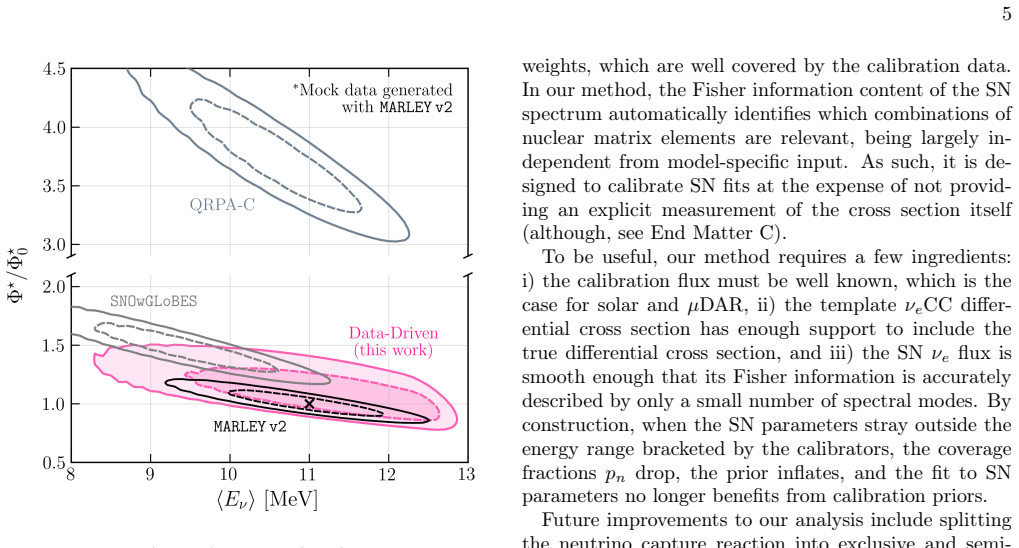
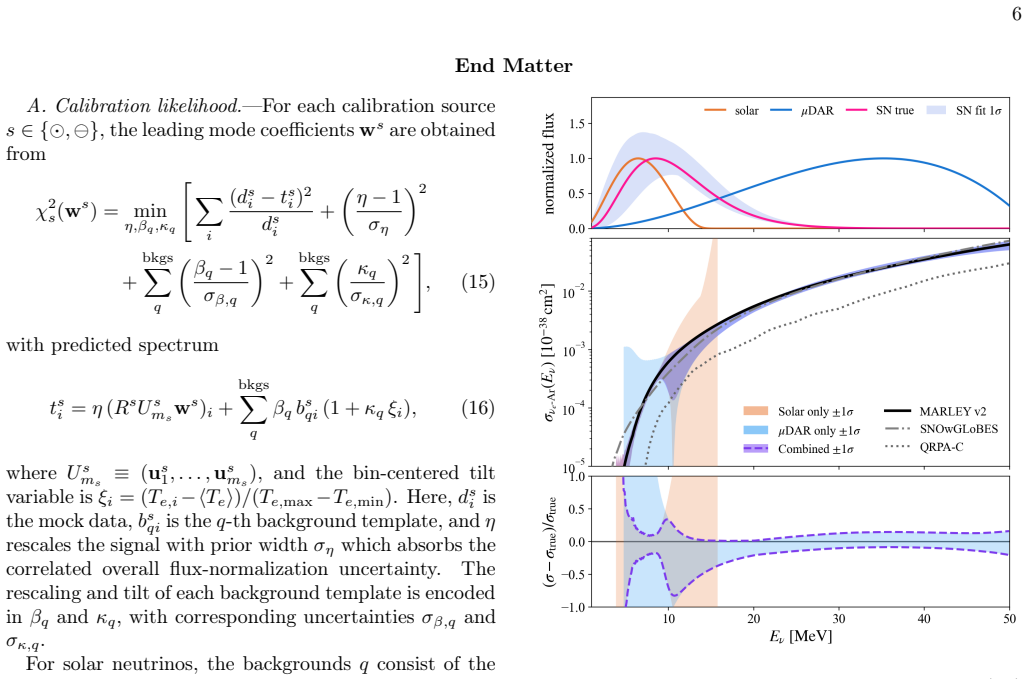
ForS(T e, Eν), we useMARLEY v2[45, 56] to generate mock data and the phenomenological parameterization in Eq
is modeled as a Gaussian smearing with fractional resolution11%/ p Te/MeV[21](5%/ p Te/MeV[69]). ForS(T e, Eν), we useMARLEY v2[45, 56] to generate mock data and the phenomenological parameterization in Eq. (3) to carry out our analysis. Our calibration pro- cedure is independent of the details of the cross section model used to generate mock data. Substi...
-
[2]
Spectral decomposition for the calibration sources.— While each calibration spectrum depends on the 200 weights through Eq
For simplicity, we work with the flux integrated in time over the neutronization, accretion, and cooling phases, and we do not account for flavor oscillations3. Spectral decomposition for the calibration sources.— While each calibration spectrum depends on the 200 weights through Eq. (5), only certain linear combinations of weights that change the predict...
-
[3]
= (11MeV,3.4,1), withΦ ⋆/Φ⋆ 0 rescaling the nominal time-integrated fluenceΦ⋆ 0 = 1.1× 10¹¹ neutrinos per cm2 [79]. At the benchmark point, solar data alone cover the two leading SN modes atp1,2 = (0.82,0.17)andµDAR alone atp 1,2 = (0.96,0.40), while their combination reachesp1,2 = (0.998,0.989); the third mode is covered atp3 = 0.47. Re-expressed in the ...
-
[4]
High Impact Hiring Initiative (HIHI): A Program to Strategically Re- cruit and Retain Talented Faculty
In the region of interest considered here, the first two SN modes inherit the calibration precision and the third, due to its small Fisher information fraction, is left essentially unconstrained. The final SN fit over binned datad⋆ is then χ2 = (d⋆ −R ⋆U ⋆ m⋆ w⋆)T (C ⋆ Te)−1(d⋆ −R ⋆U ⋆ m⋆ w⋆) + (w⋆ −w ⋆ cal)T (C ⋆ cal)−1(w⋆ −w ⋆ cal),(14) whereU ⋆ m⋆ ≡(u ...
-
[5]
Scholberg,Supernova Neutrino Detection,Ann
K. Scholberg,Supernova Neutrino Detection,Ann. Rev. Nucl. Part. Sci.62(2012) 81 [1205.6003]
Pith/arXiv arXiv 2012
-
[6]
R. M. Bionta et al.,Observation of a Neutrino Burst in Coincidence with Supernova SN 1987a in the Large Magellanic Cloud,Phys. Rev. Lett.58(1987) 1494. [3]IMBCollaboration, C. B. Bratton et al.,Angular Distribution of Events From Sn1987a,Phys. Rev. D37 (1988) 3361. [4]Kamiokande-IICollaboration, K. Hirata et al., Observation of a Neutrino Burst from the S...
1987
-
[7]
K. S. Hirata et al.,Observation in the Kamiokande-II Detector of the Neutrino Burst from Supernova SN 1987a,Phys. Rev. D38(1988) 448
1988
-
[8]
E. N. Alekseev, L. N. Alekseeva, I. V. Krivosheina and V. I. Volchenko,Detection of the Neutrino Signal From SN1987A in the LMC Using the Inr Baksan Underground Scintillation Telescope,Phys. Lett. B205 (1988) 209
1988
-
[9]
S. W. Li, J. F. Beacom, L. F. Roberts and F. Capozzi, Old data, new forensics: The first second of SN 1987A neutrino emission,Phys. Rev. D109(2024) 083025 [2306.08024]
arXiv 2024
-
[10]
Diehl et al.,Radioactive Al-26 and massive stars in the galaxy,Nature439(2006) 45 [astro-ph/0601015]
R. Diehl et al.,Radioactive Al-26 and massive stars in the galaxy,Nature439(2006) 45 [astro-ph/0601015]
Pith/arXiv arXiv 2006
-
[11]
K. Rozwadowska, F. Vissani and E. Cappellaro,On the rate of core collapse supernovae in the milky way,New Astron.83(2021) 101498 [2009.03438]
arXiv 2021
-
[12]
G. A. Tammann, W. Loeffler and A. Schroder,The Galactic supernova rate,Astrophys. J. Suppl.92(1994) 487
1994
-
[13]
S. M. Adams, C. S. Kochanek, J. F. Beacom, M. R. Vagins and K. Z. Stanek,Observing the Next Galactic Supernova,Astrophys. J.778(2013) 164 [1306.0559]. [12]Super-KamiokandeCollaboration, L. N. Machado et al.,Pre-supernova Alert System for Super-Kamiokande,Astrophys. J.935(2022) 40 [2205.09881]
Pith/arXiv arXiv 2013
- [14]
-
[15]
Wang,Supernova neutrinos and measurement of liquid scintillator backgrounds in SNO+, Ph.D
J.-S. Wang,Supernova neutrinos and measurement of liquid scintillator backgrounds in SNO+, Ph.D. thesis, Oxford U., 2022. [15]KamLANDCollaboration, K. Asakura et al., KamLAND Sensitivity to Neutrinos from Pre-Supernova Stars,Astrophys. J.818(2016) 91 [1506.01175]. [16]IceCubeCollaboration, R. Abbasi et al.,IceCube Sensitivity for Low-Energy Neutrinos from...
Pith/arXiv arXiv 2022
-
[16]
R. F. Lang, C. McCabe, S. Reichard, M. Selvi and I. Tamborra,Supernova neutrino physics with xenon dark matter detectors: A timely perspective,Phys. Rev. D94(2016) 103009 [1606.09243]. [19]XLZDCollaboration, J. Aalbers et al.,The XLZD Design Book: towards the next-generation liquid xenon observatory for dark matter and neutrino physics,Eur. Phys. J. C85(2...
Pith/arXiv arXiv 2016
-
[17]
A. Mirizzi, I. Tamborra, H.-T. Janka, N. Saviano, K. Scholberg, R. Bollig, L. Hudepohl and S. Chakraborty,Supernova Neutrinos: Production, Oscillations and Detection,Riv. Nuovo Cim.39(2016) 1 [1508.00785]
Pith/arXiv arXiv 2016
-
[18]
H.-T. Janka, K. Langanke, A. Marek, G. Martinez-Pinedo and B. Mueller,Theory of Core-Collapse Supernovae,Phys. Rept.442(2007) 38 [astro-ph/0612072]
Pith/arXiv arXiv 2007
-
[19]
Janka,Explosion Mechanisms of Core-Collapse Supernovae,Ann
H.-T. Janka,Explosion Mechanisms of Core-Collapse Supernovae,Ann. Rev. Nucl. Part. Sci.62(2012) 407 [1206.2503]
Pith/arXiv arXiv 2012
-
[20]
I. Tamborra, F. Hanke, B. Müller, H.-T. Janka and G. Raffelt,Neutrino signature of supernova hydrodynamical instabilities in three dimensions,Phys. Rev. Lett.111(2013) 121104 [1307.7936]
Pith/arXiv arXiv 2013
-
[21]
A. Burrows and D. Vartanyan,Core-Collapse Supernova Explosion Theory,Nature589(2021) 29 [2009.14157]
arXiv 2021
-
[22]
G. Martinez-Pinedo, T. Fischer, A. Lohs and L. Huther, Charged-current weak interaction processes in hot and dense matter and its impact on the spectra of neutrinos emitted from proto-neutron star cooling,Phys. Rev. Lett.109(2012) 251104 [1205.2793]
Pith/arXiv arXiv 2012
-
[23]
L. F. Roberts and S. Reddy,Neutrino Signatures From Young Neutron Stars,1612.03860
-
[24]
H. Duan, G. M. Fuller and Y.-Z. Qian,Collective Neutrino Oscillations,Ann. Rev. Nucl. Part. Sci.60 (2010) 569 [1001.2799]
Pith/arXiv arXiv 2010
-
[25]
I. Tamborra and S. Shalgar,New Developments in Flavor Evolution of a Dense Neutrino Gas,Ann. Rev. Nucl. Part. Sci.71(2021) 165 [2011.01948]
arXiv 2021
-
[26]
M. C. Volpe,Neutrinos from dense environments: Flavor mechanisms, theoretical approaches, observations, and new directions,Rev. Mod. Phys.96 (2024) 025004 [2301.11814]
arXiv 2024
-
[27]
G. G. Raffelt,Stars as laboratories for fundamental physics: The astrophysics of neutrinos, axions, and other weakly interacting particles. 5, 1996
1996
-
[28]
G. G. Raffelt, H.-T. Janka and D. F. G. Fiorillo, Neutrinos from core-collapse supernovae, 9, 2025, 2509.16306. [37]DEAPCollaboration, P. Adhikari et al.,First evidence of neutrino absorption on argon using8B solar neutrinos in DEAP-3600,2605.12769
arXiv 2025
-
[29]
Bhattacharya, C
M. Bhattacharya, C. D. Goodman and A. Garcia, Weak-interaction strength from charge-exchange reactions versus beta decay in the A=40 isoquintet, Phys. Rev. C80(2009) 055501
2009
-
[30]
Bhattacharya et al.,Neutrino absorption efficiency of an Ar-40 detector from the beta decay of Ti-40,Phys
M. Bhattacharya et al.,Neutrino absorption efficiency of an Ar-40 detector from the beta decay of Ti-40,Phys. Rev. C58(1998) 3677. [40]ICARUSCollaboration, W. Liu et al.,Beta decay of Ti-40 and Ti-41 and implication for solar neutrino detection,Phys. Rev. C58(1998) 2677
1998
-
[31]
T. C. Li et al.,First evidence for spin-flip M1 strength in Ar-40,Phys. Rev. C73(2006) 054306
2006
-
[32]
Gayer, T
U. Gayer, T. Beck, M. Bhike, J. Isaak, N. Pietralla, P. C. Ries, D. Savran, M. Schilling, W. Tornow and V. Werner,Experimental M1 response of Ar40 as a benchmark for neutrino-nucleus scattering calculations, Phys. Rev. C100(2019) 034305
2019
-
[33]
W. Tornow, A. P. Tonchev, S. W. Finch, Krishichayan, X. B. Wang, A. C. Hayes, H. G. D. Yeomans and D. A. Newmark,Neutral-current neutrino cross section and expected supernova signals for 40Ar from a three-fold increase in the magnetic dipole strength,Phys. Lett. B 835(2022) 137576 [2210.14316]
arXiv 2022
-
[34]
Chen,Nuclear Data Sheets for A=40,Nucl
J. Chen,Nuclear Data Sheets for A=40,Nucl. Data Sheets140(2017) 1
2017
-
[35]
S. Gardiner, P. Barham Alzás, A. Nikolakopoulos, L. H. A. El-Haj, N. Jachowicz and V. Pandey, Continuum contribution to charged-current absorption of low-energyν e on 40Ar,2604.26801
-
[36]
R. S. Raghavan,Inverse Beta Decay of40Ar: A New Approach for Observing MeV Neutrinos From Laboratory and Astrophysical Sources,Phys. Rev. D34 (1986) 2088
1986
-
[37]
W. E. Ormand, P. M. Pizzochero, P. F. Bortignon and R. A. Broglia,Neutrino capture cross-sections for Ar-40 and Beta decay of Ti-40,Phys. Lett. B345(1995) 343 [nucl-th/9405007]
Pith/arXiv arXiv 1995
-
[38]
I. Gil Botella and A. Rubbia,Oscillation effects on supernova neutrino rates and spectra and detection of the shock breakout in a liquid argon TPC,JCAP10 (2003) 009 [hep-ph/0307244]
Pith/arXiv arXiv 2003
-
[39]
E. Kolbe, K. Langanke, G. Martinez-Pinedo and P. Vogel,Neutrino nucleus reactions and nuclear structure,J. Phys. G29(2003) 2569 [nucl-th/0311022]
Pith/arXiv arXiv 2003
-
[40]
A. R. Samana, C. A. Barbero, S. B. Duarte, A. J. Dimarco and F. Krmpotic,Gross Theory Model for Neutrino-Nucleus Cross Section,New J. Phys.10 (2008) 033007 [0802.2093]
Pith/arXiv arXiv 2008
-
[41]
F. Krmpotic, A. R. Samana and C. A. Bertulani, QRAP: A Numerical code for projected (Q)uasi-particle 9 (RA)ndom (P)hase approximation,Comput. Phys. Commun.181(2010) 1123 [0906.4301]
Pith/arXiv arXiv 2010
-
[42]
Cheoun, E
M.-K. Cheoun, E. Ha and T. Kajino,Reactions on Ar-40 involving solar neutrinos and neutrinos from core-collapsing supernovae,Phys. Rev. C83(2011) 028801
2011
-
[43]
T. Suzuki and M. Honma,Neutrino Capture Reactions on 40Ar,Phys. Rev. C87(2013) 014607 [1211.4078]
Pith/arXiv arXiv 2013
-
[44]
N. Paar, H. Tutman, T. Marketin and T. Fischer, Large-scale calculations of supernova neutrino-induced reactions in Z=8–82 target nuclei,Phys. Rev. C87 (2013) 025801 [1210.2655]
Pith/arXiv arXiv 2013
-
[45]
C. A. Barbero, M. Cassiano dos Santos and A. R. Samana,Systematic Calculation of Neutrino–Nucleus Cross Section Available for Astrophysical Applications, Braz. J. Phys.50(2020) 331
2020
-
[46]
Gardiner,Simulating low-energy neutrino interactions with MARLEY,Comput
S. Gardiner,Simulating low-energy neutrino interactions with MARLEY,Comput. Phys. Commun. 269(2021) 108123 [2101.11867]
arXiv 2021
-
[47]
F. Capozzi, S. W. Li, G. Zhu and J. F. Beacom,DUNE as the Next-Generation Solar Neutrino Experiment, Phys. Rev. Lett.123(2019) 131803 [1808.08232]
arXiv 2019
-
[48]
S. A. Meighen-Berger, J. L. Newstead, J. F. Beacom, N. F. Bell and M. J. Dolan,Enhancing DUNE’s Solar Neutrino Capabilities with Neutral-Current Detection, Phys. Rev. Lett.135(2025) 011803 [2410.00330]. [59]SNOCollaboration, Q. R. Ahmad et al.,Direct evidence for neutrino flavor transformation from neutral current interactions in the Sudbury Neutrino Obse...
arXiv 2025
-
[49]
Longfellow et al.,Determination of the B8 neutrino energy spectrum using trapped ions,Phys
B. Longfellow et al.,Determination of the B8 neutrino energy spectrum using trapped ions,Phys. Rev. C107 (2023) L032801
2023
-
[50]
Bhattacharya, E
M. Bhattacharya, E. G. Adelberger and H. E. Swanson, Precise study of the final-state continua in Li8 and B8 decays,Phys. Rev. C73(2006) 055802
2006
-
[51]
O. S. Kirsebom et al.,Precise and accurate determination of the B-8 decay spectrum,Phys. Rev. C 83(2011) 065802. [Erratum: Phys.Rev.C 84, 049902 (2011)]
2011
-
[52]
Roger et al.,Precise Determination of the Unperturbed B-8 Neutrino Spectrum,Phys
T. Roger et al.,Precise Determination of the Unperturbed B-8 Neutrino Spectrum,Phys. Rev. Lett. 108(2012) 162502
2012
-
[53]
S. J. Parke,Nonadiabatic Level Crossing in Resonant Neutrino Oscillations,Phys. Rev. Lett.57(1986) 1275 [2212.06978]
arXiv 1986
-
[54]
J. N. Bahcall, A. M. Serenelli and S. Basu,New solar opacities, abundances, helioseismology, and neutrino fluxes,Astrophys. J. Lett.621(2005) L85 [astro-ph/0412440]. [68]COHERENTCollaboration, D. Akimov et al.,The COHERENT Experimental Program, inSnowmass 2021, 4, 2022,2204.04575. [69]COHERENTCollaboration, M. Adhikari et al.,The COHERENT Experiment: 2026...
Pith/arXiv arXiv 2005
-
[55]
Indico contribution ID 6505368
-
[56]
Benevides Rodrigues,Search for NuMIµDAR Electron Neutrinos in MicroBooNE, Ph.D
O. Benevides Rodrigues,Search for NuMIµDAR Electron Neutrinos in MicroBooNE, Ph.D. thesis, Syracuse U., 9, 2022
2022
-
[57]
T. Fischer, S. C. Whitehouse, A. Mezzacappa, F. K. Thielemann and M. Liebendorfer,Protoneutron star evolution and the neutrino driven wind in general relativistic neutrino radiation hydrodynamics simulations,Astron. Astrophys.517(2010) A80 [0908.1871]
Pith/arXiv arXiv 2010
-
[58]
P. D. Serpico, S. Chakraborty, T. Fischer, L. Hudepohl, H.-T. Janka and A. Mirizzi,Probing the neutrino mass hierarchy with the rise time of a supernova burst,Phys. Rev. D85(2012) 085031 [1111.4483]
Pith/arXiv arXiv 2012
-
[59]
D. F. G. Fiorillo, M. Heinlein, H.-T. Janka, G. Raffelt, E. Vitagliano and R. Bollig,Supernova simulations confront SN 1987A neutrinos,Phys. Rev. D108(2023) 083040 [2308.01403]. [76]DUNECollaboration, C. Cuesta,Sensitivity of DUNE to low energy physics searches,PoSICHEP2022 (2022) 621 [2301.04526]. [77]DUNECollaboration, S. Manthey Corchado,Dune’s low Ene...
arXiv 2023
-
[60]
M. T. Keil, G. G. Raffelt and H.-T. Janka,Monte Carlo study of supernova neutrino spectra formation, Astrophys. J.590(2003) 971 [astro-ph/0208035]
Pith/arXiv arXiv 2003
-
[61]
F. Capozzi, B. Dasgupta and A. Mirizzi, Model-independent diagnostic of self-induced spectral equalization versus ordinary matter effects in supernova neutrinos,Phys. Rev. D98(2018) 063013 [1807.00840]
Pith/arXiv arXiv 2018
-
[62]
Scholberg, J
K. Scholberg, J. B. Albert and J. Vasel,SNOwGLoBES: SuperNova Observatories with GLoBES, Astrophysics Source Code Library, record ascl:2109.019, Sept., 2021
2021
-
[63]
W. Shi, X. Ning, D. Pershey, F. Marinho, A. Fleuri, C. Riccio, J. H. Jo, C. Zhang and F. Cavanna,Physics prospects with MeV neutrino-argon charged current interactions using enhanced photon detection in future LArTPCs,Phys. Rev. D112(2025) 012019 [2502.18498]
arXiv 2025
-
[64]
Hajjar, O
R. Hajjar, O. Nairat and J. F. Beacom,to appear, 2026
2026
discussion (0)
Sign in with ORCID, Apple, or X to comment. Anyone can read and Pith papers without signing in.