CMBComp: A Simple and Accurate Compressed CMB Likelihood for Dark Energy, Curvature, and Massive Neutrinos
Pith reviewed 2026-06-26 22:49 UTC · model grok-4.3
The pith
A set of compressed CMB likelihoods reproduces full-dataset posteriors for dark-energy, curvature and neutrino extensions when combined with BAO data.
A machine-rendered reading of the paper's core claim, the machinery that carries it, and where it could break.
Core claim
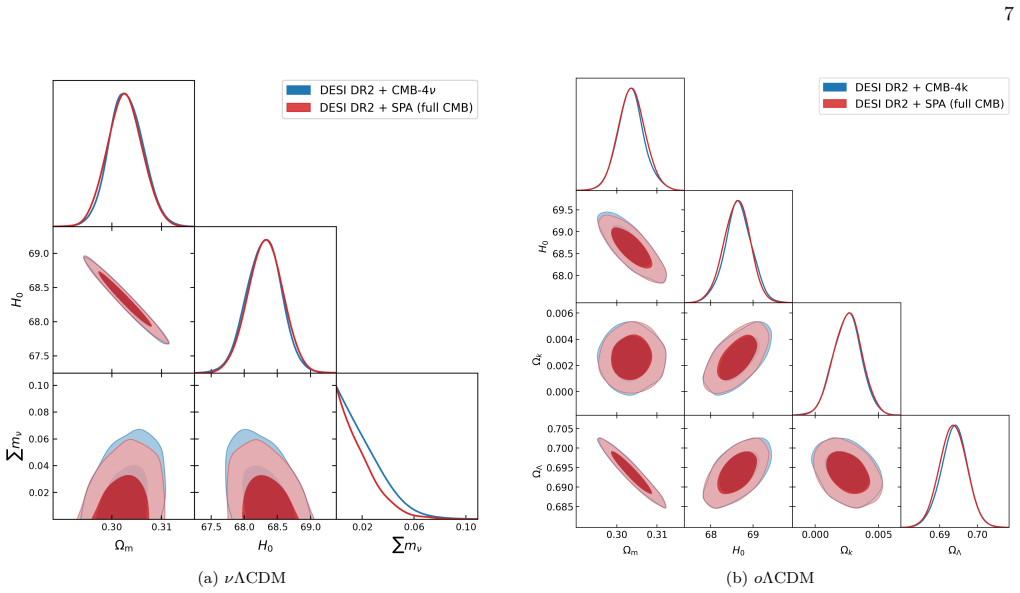
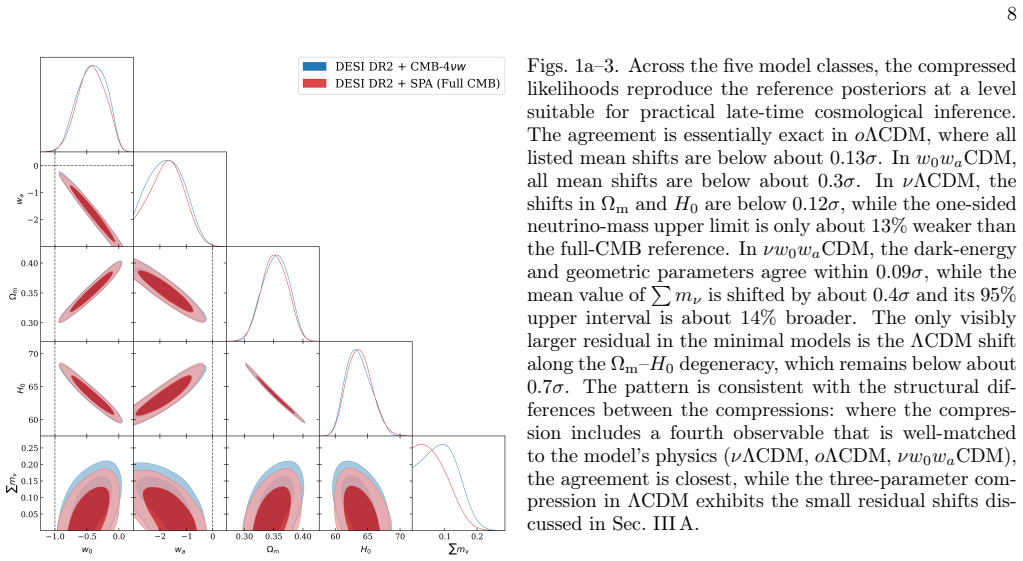
Five compressed likelihoods (CMB-3, CMB-3w, CMB-4 u, CMB-4 u w, CMB-4k) are built from the SPA CMB dataset; each retains the geometric constraining power of the full likelihood in its respective model space (ΛCDM, w0waCDM, uΛCDM, u w0waCDM, oΛCDM). When each is combined with DESI DR2 BAO data the recovered posteriors agree to high precision with the corresponding full-CMB chains.
What carries the argument
Model-specific compressed likelihoods that reduce the full CMB posterior to three or four parameters encoding geometric information.
If this is right
- Researchers can obtain accurate CMB constraints on w0, wa, sum of neutrino masses, and curvature without running a full Boltzmann solver for each new model variant.
- Inference pipelines for late-time extensions become computationally lighter while retaining the same BAO+CMB joint constraints.
- The released files allow immediate incorporation of the compressed CMB information into existing DESI or similar BAO analyses.
- The method is limited to the tested extensions but provides a template for constructing analogous compressions in other model spaces.
Where Pith is reading between the lines
- The same compression approach could be tested on future CMB experiments such as CMB-S4 to check whether the required number of parameters remains small.
- One could examine whether the compressed forms remain accurate when additional late-time probes such as supernovae or weak lensing are added to the BAO data.
- If the geometric focus proves sufficient, similar low-dimensional summaries might be constructed for other high-dimensional datasets that are expensive to evaluate repeatedly.
Load-bearing premise
The geometric information extracted by the compression fully captures the CMB's constraining power for the tested extensions without meaningful loss from other data aspects.
What would settle it
A statistically significant mismatch between the compressed-plus-BAO and full-CMB-plus-BAO posterior contours for any of the five model spaces would falsify the claim.
Figures

read the original abstract
We present CMBComp, a compact and accurate compressed cosmic microwave background (CMB) likelihood that captures the dominant geometric information of the full CMB likelihood derived from the combined SPT-3G D1 + ACT DR6 + Planck PR3 primary CMB anisotropy + Planck PR4/NPIPE CMB-lensing dataset, which we collectively refer to as SPA. The compression is fast to evaluate and trivial to implement in standard inference pipelines. We construct and validate it in five model spaces: the spatially flat cosmological-constant model ($\Lambda$CDM), and its dynamical-dark-energy ($w_0w_a$CDM), massive-neutrino ($\nu\Lambda$CDM), non-flat ($o\Lambda$CDM), and joint massive-neutrino--dynamical-dark-energy ($\nu w_0 w_a$CDM) extensions. Five compressed likelihoods are introduced, corresponding to two three-parameter compressions for the dark-energy sector (CMB-3 for $\Lambda$CDM and CMB-3w for $w_0w_a$CDM), two four-parameter compressions for the neutrino sector (CMB-4$\nu$ for $\nu\Lambda$CDM and CMB-4$\nu$w for $\nu w_0 w_a$CDM), and a four-parameter curvature compression (CMB-4k for $o\Lambda$CDM). Combining each compressed likelihood with the DESI DR2 baryon acoustic oscillation (BAO) data, we demonstrate that the resulting posteriors agree to high precision with those obtained from the corresponding full-CMB chains. CMBComp is therefore particularly well suited to cosmological inference for models that modify the late-time expansion history, enabling accurate CMB constraints to be incorporated into new analyses with minimal computational overhead and without reliance on a full Boltzmann-solver-based inference pipeline. The compressed likelihood files and example notebooks accompanying CMBComp are made publicly available at https://github.com/Amoghsriv/CMBComp.
Editorial analysis
A structured set of objections, weighed in public.
Referee Report
Summary. The manuscript introduces CMBComp, a set of five compressed CMB likelihoods (CMB-3, CMB-3w, CMB-4ν, CMB-4νw, CMB-4k) derived from the combined SPT-3G D1 + ACT DR6 + Planck PR3 primary + PR4/NPIPE lensing (SPA) dataset. These capture dominant geometric information for ΛCDM and its extensions to dynamical dark energy (w0waCDM), massive neutrinos (νΛCDM), curvature (oΛCDM), and joint neutrino+dark-energy (νw0waCDM). The central claim is that each compressed likelihood, when combined with DESI DR2 BAO, yields posteriors in high-precision agreement with the corresponding full SPA + BAO chains; the compressed files and example notebooks are released publicly.
Significance. If the reported agreement holds, CMBComp offers a low-overhead route to include accurate CMB geometric constraints in analyses of late-time extensions without requiring a full Boltzmann solver at each step. The public release of likelihood files and notebooks is a clear strength that supports immediate reproducibility and adoption by the community.
minor comments (2)
- [Introduction] The abstract defines SPA but the main text should restate the full dataset composition (SPT-3G D1 + ACT DR6 + Planck PR3 + PR4 lensing) at first use for readers who skip the abstract.
- [§2 or §3] Notation for the five compressed likelihoods (CMB-3, CMB-3w, etc.) is introduced in the abstract; a short table in §2 or §3 summarizing the parameter count and target model space for each would improve readability.
Simulated Author's Rebuttal
We thank the referee for their positive assessment of the manuscript and for recommending acceptance. The report accurately captures the scope and purpose of CMBComp as a compressed likelihood for geometric CMB constraints in late-time extensions when combined with DESI BAO data.
Circularity Check
No significant circularity; compression is an explicit approximation with external validation.
full rationale
The paper derives CMBComp by extracting dominant geometric parameters from the full SPA likelihood (SPT-3G + ACT + Planck) and validates the resulting posteriors only after combining with independent DESI DR2 BAO data, showing agreement with full-CMB+BAO chains across five model spaces. This is a standard data-compression technique whose construction is not self-definitional, does not rename a fitted input as a prediction, and does not rely on load-bearing self-citations or uniqueness theorems. The validation step uses separate late-time data, so the agreement is not forced by construction. No quoted equations or steps reduce the central claim to the input dataset by definition.
Axiom & Free-Parameter Ledger
free parameters (3)
- CMB-3 / CMB-3w parameters
- CMB-4ν / CMB-4νw parameters
- CMB-4k parameters
axioms (1)
- domain assumption The combined SPT-3G D1 + ACT DR6 + Planck PR3/PR4 SPA dataset provides a reliable full CMB likelihood reference.
Reference graph
Works this paper leans on
-
[1]
Physically,R measures the angular position of the acoustic peaks for fixed matter physics, whileℓa measures the angular size of the sound horizon
General framework The two core geometric observables in the compressed vector are the CMB shift parameterRand the acoustic angular scaleℓ a, defined as R≡ p Ωm H0 DM(z∗) c , ℓ a ≡π DM(z∗) rs(z∗) ,(6) whereD M(z∗)is the comoving transverse distance to the last-scattering surface,rs(z∗)is the comoving sound hori- zon at the same epoch, andz∗ is the redshift...
2002
-
[2]
Each horizontal block corresponds to one compressed likelihood:CMB-3(used inΛCDM),CMB-3w(used inw 0waCDM),CMB-4ν(used inνΛCDM),CMB-4k(used inoΛCDM), andCMB-4νw (used inνw 0waCDM)
Data vectors and covariances The mean vectors and covariance matrices of the com- pressions, all obtained from SPA chains in the relevant model, are collected in Table II. Each horizontal block corresponds to one compressed likelihood:CMB-3(used inΛCDM),CMB-3w(used inw 0waCDM),CMB-4ν(used inνΛCDM),CMB-4k(used inoΛCDM), andCMB-4νw (used inνw 0waCDM). For e...
2087
-
[3]
fitting formula for the sound horizon at the drag epoch. Parameter inference is performed using a custom adap- tive Metropolis–Hastings sampler with reflecting prior boundaries, an evolving proposal covariance matrix, and online Gelman–Rubin convergence monitoring. As a re- sult, the complete analysis pipeline can be run in a stan- dard Python environment...
-
[4]
J. R. Bond, G. Efstathiou, and M. Tegmark, Mon. Not. Roy. Astron. Soc.291, L33 (1997), arXiv:astro- ph/9702100
arXiv 1997
-
[5]
Y. Wang and P. Mukherjee, Phys. Rev. D76, 103533 (2007), arXiv:astro-ph/0703780
Pith/arXiv arXiv 2007
-
[6]
P. Mukherjee, M. Kunz, D. Parkinson, and Y. Wang, Phys. Rev. D78, 083529 (2008), arXiv:0803.1616 [astro- ph]
Pith/arXiv arXiv 2008
-
[7]
O. Elgaroy and T. Multamaki, Astron. Astrophys.471, 65 (2007), arXiv:astro-ph/0702343
Pith/arXiv arXiv 2007
-
[8]
M. Vonlanthen, S. Rasanen, and R. Durrer, JCAP2010 (08), 023, arXiv:1003.0810 [astro-ph.CO]
-
[9]
Q.-G. Huang, K. Wang, and S. Wang, JCAP2015(12), 022, arXiv:1509.00969 [astro-ph.CO]
-
[10]
Z. Zhai, C.-G. Park, Y. Wang, and B. Ratra, JCAP2020 (07), 009, arXiv:1912.04921 [astro-ph.CO]
arXiv 1912
-
[11]
P. Bansal and D. Huterer, Phys. Rev. D112, 023528 (2025), arXiv:2502.07185 [astro-ph.CO]
arXiv 2025
-
[12]
L. Balkenholet al.(SPT-3G), Phys. Rev. D108, 023510 (2023), arXiv:2212.05642 [astro-ph.CO]
arXiv 2023
-
[13]
M. S. Madhavacherilet al.(ACT), Astrophys. J.962, 113 (2024), arXiv:2304.05203 [astro-ph.CO]
Pith/arXiv arXiv 2024
-
[14]
N. Aghanimet al.(Planck), Astron. Astrophys.641, A5 (2020), arXiv:1907.12875 [astro-ph.CO]
Pith/arXiv arXiv 2020
-
[15]
M. Chevallier and D. Polarski, Int. J. Mod. Phys. D10, 213 (2001), arXiv:gr-qc/0009008
Pith/arXiv arXiv 2001
-
[16]
E. V. Linder, Phys. Rev. Lett.90, 091301 (2003), arXiv:astro-ph/0208512
Pith/arXiv arXiv 2003
-
[17]
J. Torrado and A. Lewis, JCAP2021(05), 057, arXiv:2005.05290 [astro-ph.IM]
Pith/arXiv arXiv 2005
-
[18]
A. Lewis, A. Challinor, and A. Lasenby, Astrophys. J. 538, 473 (2000), arXiv:astro-ph/9911177 [astro-ph]
Pith/arXiv arXiv 2000
-
[19]
M.Abdul-Karimet al.(DESI),Phys.Rev.D112,083515 (2025), arXiv:2503.14738 [astro-ph.CO]
Pith/arXiv arXiv 2025
-
[20]
Lewis, JCAP2025(08), 025, arXiv:1910.13970 [astro- ph.IM]
A. Lewis, JCAP2025(08), 025, arXiv:1910.13970 [astro- ph.IM]
Pith/arXiv arXiv 1910
-
[21]
E. Camphuiset al.(SPT-3G), Phys. Rev. D113, 083504 (2026), arXiv:2506.20707 [astro-ph.CO]
Pith/arXiv arXiv 2026
-
[22]
E. Aubourget al., Phys. Rev. D92, 123516 (2015), arXiv:1411.1074 [astro-ph.CO]
Pith/arXiv arXiv 2015
discussion (0)
Sign in with ORCID, Apple, or X to comment. Anyone can read and Pith papers without signing in.