π⁰-γ mixing in the presence of a strong magnetic field
Pith reviewed 2026-06-26 23:28 UTC · model grok-4.3
The pith
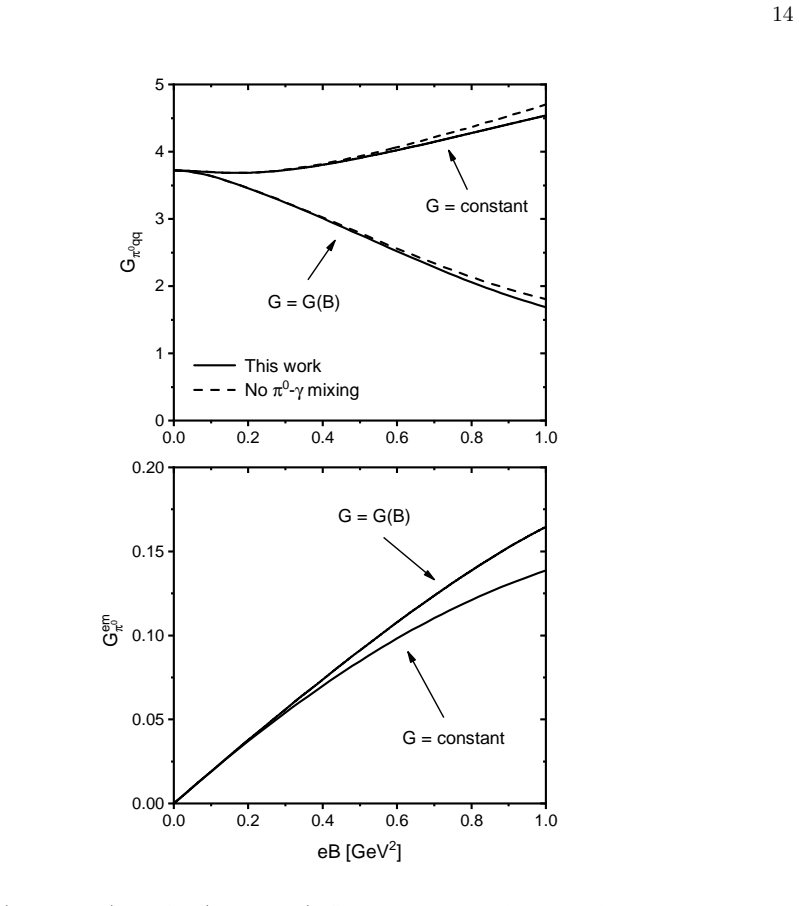
In the two-flavor NJL model, π⁰-photon mixing in uniform magnetic fields up to 1 GeV²/e changes the pion mass and quark couplings by less than 15%.
A machine-rendered reading of the paper's core claim, the machinery that carries it, and where it could break.
Core claim
Within the two-flavor Nambu-Jona-Lasinio model, a uniform magnetic field mixes the π⁰ only with one specific photon polarization; the induced corrections to the pion mass and to the pion-quark couplings stay below 15% for |eB| ≤ 1 GeV², in disagreement with previous literature results.
What carries the argument
The polarization-selective π⁰-γ mixing amplitude generated by the magnetic field inside the NJL gap equation and polarization tensor.
If this is right
- The pion mass receives only small additional corrections from the mixing channel.
- Pion-quark coupling strengths are modified by amounts below 15%.
- Only one photon polarization state participates in the mixing.
- Earlier literature results claiming substantially larger effects are not reproduced inside this framework.
Where Pith is reading between the lines
- Pion properties in magnetized quark matter can be computed to good accuracy without including the photon-mixing channel.
- Decay rates or production cross sections involving the neutral pion in strong fields may remain close to their zero-field values once the small mixing correction is neglected.
- Lattice QCD simulations performed at comparable field strengths could test whether the smallness of the mixing effect persists beyond the NJL approximation.
Load-bearing premise
The two-flavor Nambu-Jona-Lasinio model together with its chosen regularization and parameter set supplies an adequate description of the mixing dynamics.
What would settle it
A direct computation of the pion mass shift arising solely from the photon mixing channel that exceeds 15% at |eB| = 0.5 GeV² would contradict the reported result.
Figures

read the original abstract
We analyze the mixing between the $\pi^0$ meson and the photon in the presence of a strong uniform magnetic field, in the context of a two-flavor Nambu-Jona-Lasinio model. It is shown that only one specific photon polarization state can get mixed with the $\pi^0$ state, a fact that can be understood on general grounds. For magnetic fields with values up to 1 GeV$^2$/e, it is found that the effect of the mixing on the pion mass and pion-quark couplings is relatively small (below a level of 15%), which is at variance with previous results reported in the literature.
Editorial analysis
A structured set of objections, weighed in public.
Referee Report
Summary. The manuscript analyzes π⁰-γ mixing in a strong uniform magnetic field within the two-flavor Nambu-Jona-Lasinio model. It establishes that only one photon polarization state mixes with the π⁰ and reports that, for B up to 1 GeV²/e, the mixing induces shifts in the pion mass and pion-quark couplings below the 15% level, in contrast to earlier literature results.
Significance. If the numerical bound holds under controlled regularization, the result would indicate that π⁰-γ mixing remains a modest correction in the NJL framework for magnetic fields relevant to heavy-ion collisions or magnetars, thereby constraining the size of electromagnetic corrections to meson properties in strong B. The explicit polarization selection rule provides a model-independent clarification that strengthens the analysis.
major comments (1)
- [Abstract] Abstract: The headline claim that mixing corrections remain below 15% up to B = 1 GeV²/e rests on the NJL gap equation and one-loop polarization tensor, yet supplies no explicit regularization scheme, cutoff implementation, or parameter values (G, Λ, m). Because the Landau-level summation in magnetic NJL models is known to be sensitive to the choice of regulator (sharp cutoff versus proper-time), the reported discrepancy with prior work cannot be assessed for robustness without this information.
minor comments (1)
- The abstract would be strengthened by a single sentence identifying the regularization procedure and the numerical method used to extract the mixing angle.
Simulated Author's Rebuttal
We thank the referee for the careful reading of our manuscript and the constructive comment. We address the point raised below and will revise the manuscript to improve transparency.
read point-by-point responses
-
Referee: [Abstract] Abstract: The headline claim that mixing corrections remain below 15% up to B = 1 GeV²/e rests on the NJL gap equation and one-loop polarization tensor, yet supplies no explicit regularization scheme, cutoff implementation, or parameter values (G, Λ, m). Because the Landau-level summation in magnetic NJL models is known to be sensitive to the choice of regulator (sharp cutoff versus proper-time), the reported discrepancy with prior work cannot be assessed for robustness without this information.
Authors: We agree that explicit specification of the regularization scheme, cutoff procedure, and model parameters is necessary to allow independent assessment of robustness and comparison with earlier literature. The calculations in the manuscript were performed using the standard two-flavor NJL Lagrangian with proper-time regularization to regulate the Landau-level sums, employing parameter values (G, Λ, m) fixed to reproduce vacuum pion properties as in our prior works. To address the referee's concern directly, the revised manuscript will include a new subsection detailing the regularization method, the precise cutoff implementation, the numerical parameter set, and a brief discussion of regulator sensitivity. This addition will enable readers to reproduce the <15% bound and evaluate the variance with previous results. We maintain that the polarization selection rule and the modest size of the mixing corrections hold within the controlled scheme employed. revision: yes
Circularity Check
No significant circularity detected in derivation chain
full rationale
The paper computes π⁰-γ mixing within the two-flavor NJL model by solving the gap equation and evaluating the one-loop polarization tensor in a uniform magnetic field. The central numerical claim (mixing shifts below 15% for B ≤ 1 GeV²/e) is obtained as an output of this explicit calculation rather than by fitting a parameter to the target quantity or by reducing to a self-citation. No self-definitional steps, fitted-input-as-prediction, or load-bearing self-citation chains are present in the provided abstract or description; the result is therefore self-contained against external benchmarks.
Axiom & Free-Parameter Ledger
axioms (1)
- domain assumption The two-flavor Nambu-Jona-Lasinio model is applicable to π⁰-γ mixing in uniform strong magnetic fields
Reference graph
Works this paper leans on
-
[1]
D. E. Kharzeev, K. Landsteiner, A. Schmitt and H. U. Yee, Lect. Notes Phys.871, 1-11 (2013) [arXiv:1211.6245 [hep-ph]]
Pith/arXiv arXiv 2013
-
[2]
J. O. Andersen, W. R. Naylor and A. Tranberg, Rev. Mod. Phys.88, 025001 (2016) [arXiv:1411.7176 [hep-ph]]
Pith/arXiv arXiv 2016
-
[3]
V. A. Miransky and I. A. Shovkovy, Phys. Rept.576, 1-209 (2015) [arXiv:1503.00732 [hep-ph]]
Pith/arXiv arXiv 2015
-
[4]
P. Adhikari, M. Ammon, S. S. Avancini, A. Ayala, A. Bandyopadhyay, D. Blaschke, F. L. Braghin, P. Buividovich, R. P. Cardoso and C. Cartwright,et al., Prog. Part. Nucl. Phys.146, 104199 (2026) [arXiv:2412.18632 [nucl-th]]
Pith/arXiv arXiv 2026
-
[5]
Vachaspati, Phys
T. Vachaspati, Phys. Lett. B265, 258-261 (1991)
1991
-
[6]
D. Grasso and H. R. Rubinstein, Phys. Rept.348, 163-266 (2001) [arXiv:astro-ph/0009061 [astro-ph]]
Pith/arXiv arXiv 2001
-
[7]
V. Skokov, A. Y. Illarionov and V. Toneev, Int. J. Mod. Phys. A24, 5925-5932 (2009) [arXiv:0907.1396 [nucl-th]]
Pith/arXiv arXiv 2009
-
[8]
V. Voronyuk, V. D. Toneev, W. Cassing, E. L. Bratkovskaya, V. P. Konchakovski and S. A. Voloshin, Phys. Rev. C83, 054911 (2011) [arXiv:1103.4239 [nucl-th]]
Pith/arXiv arXiv 2011
-
[9]
R. C. Duncan and C. Thompson, Astrophys. J. Lett.392, L9 (1992)
1992
-
[10]
Kouveliotouet al., Nature393, 235-237 (1998)
C. Kouveliotouet al., Nature393, 235-237 (1998)
1998
-
[11]
D. E. Kharzeev, L. D. McLerran and H. J. Warringa, Nucl. Phys. A803, 227-253 (2008) [arXiv:0711.0950 [hep-ph]]
Pith/arXiv arXiv 2008
-
[12]
K. Fukushima, D. E. Kharzeev and H. J. Warringa, Phys. Rev. D78, 074033 (2008) [arXiv:0808.3382 [hep-ph]]
Pith/arXiv arXiv 2008
-
[13]
D. E. Kharzeev, J. Liao, S. A. Voloshin and G. Wang, Prog. Part. Nucl. Phys.88, 1-28 (2016) [arXiv:1511.04050 [hep-ph]]
Pith/arXiv arXiv 2016
-
[14]
V. P. Gusynin, V. A. Miransky and I. A. Shovkovy, Nucl. Phys. B462, 249-290 (1996) [arXiv:hep- ph/9509320 [hep-ph]]. 19
arXiv 1996
-
[15]
G. S. Bali, F. Bruckmann, G. Endrodi, Z. Fodor, S. D. Katz, S. Krieg, A. Schafer and K. K. Szabo, JHEP02, 044 (2012) [arXiv:1111.4956 [hep-lat]]
Pith/arXiv arXiv 2012
-
[16]
M. Coppola, D. Gomez Dumm, S. Noguera and N. N. Scoccola, Phys. Rev. D109, no.5, 054014 (2024) [arXiv:2312.16675 [hep-ph]]
arXiv 2024
-
[17]
J. P. Carlomagno, D. Gomez Dumm, S. Noguera and N. N. Scoccola, Phys. Rev. D106, no.7, 074002 (2022) [arXiv:2205.15928 [hep-ph]]
arXiv 2022
-
[18]
J. P. Carlomagno, D. Gomez Dumm, M. F. I. Villafa˜ ne, S. Noguera and N. N. Scoccola, Phys. Rev. D 106, no.9, 094035 (2022) [arXiv:2209.10679 [hep-ph]]
arXiv 2022
-
[19]
Raffelt and L
G. Raffelt and L. Stodolsky, Phys. Rev. D37, 1237 (1988)
1988
-
[20]
T. Brauner and S. V. Kadam, JHEP11, 103 (2017) [arXiv:1706.04514 [hep-ph]]
Pith/arXiv arXiv 2017
-
[21]
Vogl and W
U. Vogl and W. Weise, Prog. Part. Nucl. Phys.27, 195 (1991)
1991
-
[22]
S. P. Klevansky, Rev. Mod. Phys.64, 649 (1992)
1992
-
[23]
T. Hatsuda and T. Kunihiro, Phys. Rep.247, 221 (1994) [arXiv:hep-ph/9401310 [hep-ph]]
Pith/arXiv arXiv 1994
-
[24]
D. Ebert, K. G. Klimenko, M. A. Vdovichenko and A. S. Vshivtsev, Phys. Rev. D61, 025005 (2000) [arXiv:hep-ph/9905253 [hep-ph]]
Pith/arXiv arXiv 2000
-
[25]
D. P. Menezes, M. Benghi Pinto, S. S. Avancini, A. Perez Martinez and C. Providencia, Phys. Rev. C 79, 035807 (2009) [arXiv:0811.3361 [nucl-th]]
Pith/arXiv arXiv 2009
-
[26]
P. G. Allen, A. G. Grunfeld and N. N. Scoccola, Phys. Rev. D92, no.7, 074041 (2015) [arXiv:1508.04724 [hep-ph]]
Pith/arXiv arXiv 2015
-
[27]
S. S. Avancini, R. L. S. Farias, N. N. Scoccola and W. R. Tavares, Phys. Rev. D99, no.11, 116002 (2019) [arXiv:1904.02730 [hep-ph]]
Pith/arXiv arXiv 2019
-
[28]
W. y. Tsai, Phys. Rev. D10, 2699 (1974)
1974
-
[29]
L. F. Urrutia, Phys. Rev. D17, 1977 (1978)
1977
-
[30]
K. Hattori and K. Itakura, Annals Phys.330, 23-54 (2013) [arXiv:1209.2663 [hep-ph]]
Pith/arXiv arXiv 2013
-
[31]
V. P. Pagura, D. Gomez Dumm, S. Noguera and N. N. Scoccola, Phys. Rev. D95, 034013 (2017) [arXiv:1609.02025 [hep-ph]]
Pith/arXiv arXiv 2017
-
[32]
D. Gomez Dumm, M. F. Izzo Villafa˜ ne, S. Noguera, V. P. Pagura and N. N. Scoccola, Phys. Rev. D 96, 114012 (2017) [arXiv:1709.04742 [hep-ph]]
Pith/arXiv arXiv 2017
-
[33]
S. S. Avancini, R. L. S. Farias, M. Benghi Pinto, W. R. Tavares and V. S. Tim´ oteo, Phys. Lett. B767, 247-252 (2017) [arXiv:1606.05754 [hep-ph]]
Pith/arXiv arXiv 2017
discussion (0)
Sign in with ORCID, Apple, or X to comment. Anyone can read and Pith papers without signing in.