Semi-invisible Hyperon Decays in the Effective Lagrangian Approach
Pith reviewed 2026-06-26 20:43 UTC · model grok-4.3
The pith
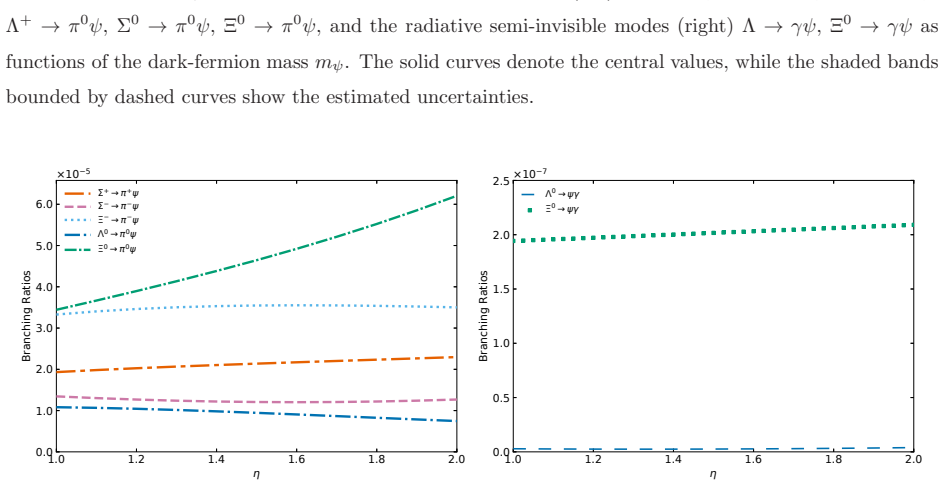
Effective Lagrangian calculations predict branching ratios of order 10^{-5} for several hyperon decays to a pion plus an invisible particle.
A machine-rendered reading of the paper's core claim, the machinery that carries it, and where it could break.
Core claim
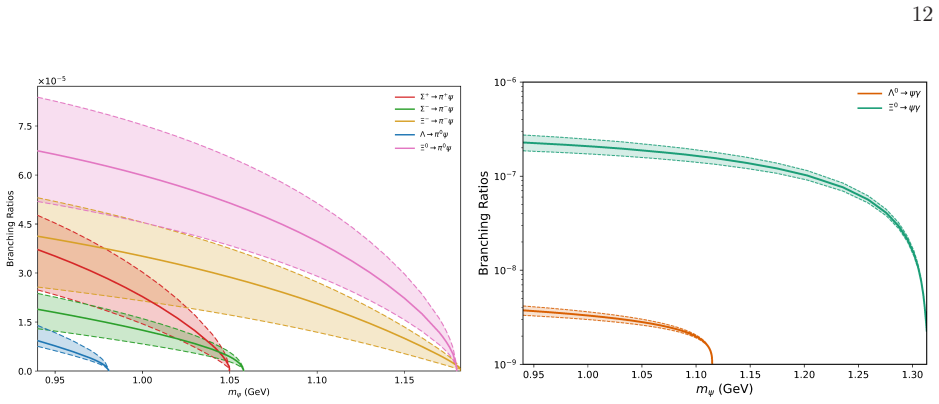
In the Mesogenesis mechanism, the branching ratios of hyperon hadronic semi-invisible decays are found to be of order 10^{-5}, particularly for Σ⁺→π⁺ψ, Ξ⁰→π⁰ψ, and Ξ⁻→π⁻ψ, whereas those of radiative semi-invisible decays are less than 10^{-7}. The one-loop hadronic contribution of triangle diagrams with final-state interactions yields sizable corrections that are as significant as those from tree diagrams, especially for Σ⁻→π⁻ψ and Ξ⁰→π⁰ψ.
What carries the argument
Effective Lagrangian approach with one-loop triangle diagrams that include final-state interactions.
If this is right
- The channels Σ⁺→π⁺ψ, Ξ⁰→π⁰ψ, and Ξ⁻→π⁻ψ are expected to have the largest observable rates among the hadronic modes.
- Radiative semi-invisible decays remain suppressed by at least two orders of magnitude relative to the hadronic ones.
- Loop contributions must be retained to obtain reliable predictions for Σ⁻→π⁻ψ and Ξ⁰→π⁰ψ.
- These rates arise directly from the combination of tree and one-loop amplitudes in the chosen effective Lagrangian.
Where Pith is reading between the lines
- Confirmation of these rates would offer a concrete experimental handle on the invisible particle ψ in the Mesogenesis picture.
- Similar loop-corrected calculations could be extended to other baryon species or to related invisible-particle scenarios.
- Current hyperon production experiments could set meaningful limits on the predicted channels with modest improvements in sensitivity.
- Discrepancies between measured and predicted rates would point to the need for additional interaction terms beyond the triangle diagrams.
Load-bearing premise
The effective Lagrangian and the specific triangle-diagram contributions with final-state interactions accurately represent the hadronic physics without large higher-order or non-perturbative effects that would change the numerical results.
What would settle it
An experimental upper limit or measured value for the branching ratio of Σ⁺→π⁺ψ that lies well below or above 10^{-5} would contradict the central prediction.
Figures
read the original abstract
We systematically investigate the semi-invisible decays of hyperons (hyperon $\to \pi(/\gamma)\ +$ invisible($\psi$)) in the Mesogenesis mechanism by the effective Lagrangian approach. The one-loop hadronic contribution of triangle diagrams with final-state interactions is fully examined in the present work. Our analysis indicates that the triangle diagram yield sizable corrections to the branching ratio that are as significant as those from tree diagrams. Especially for the $\Sigma^-\to \pi^-\psi$ and $\Xi^0 \to \pi^0 \psi$, their loop contributions cannot be ignored. Consequently, the branching ratios of hyperon hadronic semi-invisible decays are found to be of order $10^{-5}$, particularly for $\Sigma^+\to\pi^+\psi$, $\Xi^0\to\pi^0\psi$, and $\Xi^-\to\pi^-\psi$, whereas those of radiative semi-invisible decays are less than $10^{-7}$.
Editorial analysis
A structured set of objections, weighed in public.
Referee Report
Summary. The manuscript systematically investigates semi-invisible hyperon decays (hyperon → π(γ) + invisible ψ) in the Mesogenesis mechanism within the effective Lagrangian approach. It computes tree-level amplitudes together with one-loop contributions from triangle diagrams that incorporate final-state interactions, concluding that the loop terms are sizable and comparable in magnitude to the tree-level contributions (especially for Σ⁻ → π⁻ψ and Ξ⁰ → π⁰ψ). This leads to predicted branching ratios of order 10^{-5} for several hadronic modes (notably Σ⁺ → π⁺ψ, Ξ⁰ → π⁰ψ, Ξ⁻ → π⁻ψ) while radiative modes remain below 10^{-7}.
Significance. If the numerical results prove robust, the work supplies concrete, testable predictions for rare hyperon decays that could probe the Mesogenesis scenario. The explicit inclusion and size assessment of loop diagrams with final-state interactions is a positive feature that draws attention to an often-neglected class of contributions in effective-theory calculations of hyperon processes.
major comments (2)
- [Loop calculation (Sec. 3) and numerical results] The headline result that loop contributions are 'as significant as those from tree diagrams' and drive BR ~ 10^{-5} rests on the triangle-diagram integrals. No variation of the ultraviolet cutoff, regularization scheme, or form-factor suppression is reported for these integrals at the ~1 GeV momentum transfers characteristic of hyperon decays; without such a sensitivity study the order-of-magnitude claim remains vulnerable to uncontrolled hadronic-scale uncertainties.
- [Effective Lagrangian setup and results section] The effective-Lagrangian couplings are standardly determined from other processes; the manuscript does not demonstrate that the quoted branching ratios constitute independent predictions rather than being largely fixed by those external inputs (cf. the circularity concern for the numerical outputs).
minor comments (1)
- [Abstract] The abstract states results to order-of-magnitude precision but supplies neither explicit parameter values nor error estimates; adding a short table of central values with estimated theoretical ranges would improve clarity.
Simulated Author's Rebuttal
We thank the referee for the thorough review and constructive feedback on our manuscript. We address each major comment below, providing clarifications and indicating planned revisions where appropriate.
read point-by-point responses
-
Referee: [Loop calculation (Sec. 3) and numerical results] The headline result that loop contributions are 'as significant as those from tree diagrams' and drive BR ~ 10^{-5} rests on the triangle-diagram integrals. No variation of the ultraviolet cutoff, regularization scheme, or form-factor suppression is reported for these integrals at the ~1 GeV momentum transfers characteristic of hyperon decays; without such a sensitivity study the order-of-magnitude claim remains vulnerable to uncontrolled hadronic-scale uncertainties.
Authors: We acknowledge the importance of assessing sensitivity to the regularization procedure. The triangle integrals are computed in dimensional regularization supplemented by a hard cutoff at the hadronic scale (~1 GeV) to tame the ultraviolet divergence, with dipole form factors taken from standard parametrizations fitted to hyperon data. In the revised version we will add an explicit sensitivity study varying the cutoff between 0.8 and 1.5 GeV and comparing results obtained with a Pauli-Villars regulator; this will quantify the hadronic uncertainty and strengthen the robustness claim for the order-of-magnitude branching ratios. revision: yes
-
Referee: [Effective Lagrangian setup and results section] The effective-Lagrangian couplings are standardly determined from other processes; the manuscript does not demonstrate that the quoted branching ratios constitute independent predictions rather than being largely fixed by those external inputs (cf. the circularity concern for the numerical outputs).
Authors: The hadronic couplings (e.g., those entering the tree-level and loop vertices) are fixed from measured non-leptonic hyperon decays, as is standard in effective-theory analyses. The new-physics couplings involving the invisible ψ, however, are independent parameters of the Mesogenesis scenario and are not constrained by existing data. The computed branching ratios therefore constitute genuine predictions for the semi-invisible channels. We will insert a clarifying paragraph in Sec. 2 and the results section to explicitly separate the externally fixed hadronic parameters from the new-physics couplings, thereby addressing the circularity concern. revision: partial
Circularity Check
No significant circularity; branching ratios are model predictions from external inputs
full rationale
The derivation applies an effective Lagrangian to compute tree and one-loop contributions to hyperon semi-invisible decay branching ratios. Inputs are standard couplings and form factors drawn from other processes; the outputs are new numerical results for the target modes. No equations or self-citations reduce the claimed BR values to tautological redefinitions or refits of the same quantities. The calculation is therefore a standard model application rather than a closed loop on its own inputs.
Axiom & Free-Parameter Ledger
Reference graph
Works this paper leans on
-
[1]
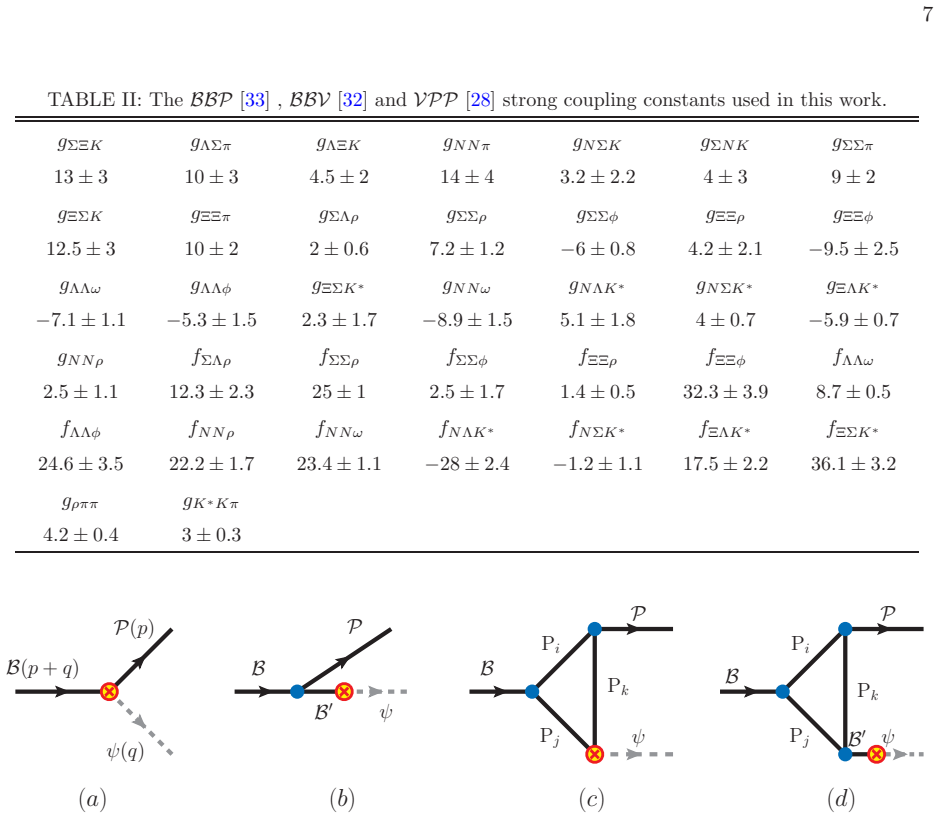
5 ± 3 10 ± 2 2 ± 0. 6 7 . 2 ± 1. 2 − 6 ± 0. 8 4 . 2 ± 2. 1 − 9. 5 ± 2. 5 gΛΛ ω gΛΛ φ gΞΣ K ∗ gNNω gN ΛK ∗ gN ΣK ∗ gΞΛ K ∗ − 7. 1 ± 1. 1 − 5. 3 ± 1. 5 2 . 3 ± 1. 7 − 8. 9 ± 1. 5 5 . 1 ± 1. 8 4 ± 0. 7 − 5. 9 ± 0. 7 gNNρ fΣΛ ρ fΣΣ ρ fΣΣ φ fΞΞ ρ fΞΞ φ fΛΛ ω
-
[2]
5 ± 1. 1 12 . 3 ± 2. 3 25 ± 1 2 . 5 ± 1. 7 1 . 4 ± 0. 5 32 . 3 ± 3. 9 8 . 7 ± 0. 5 fΛΛ φ fNNρ fNNω fN ΛK ∗ fN ΣK ∗ fΞΛ K ∗ fΞΣ K ∗
-
[3]
6 ± 3. 5 22 . 2 ± 1. 7 23 . 4 ± 1. 1 − 28 ± 2. 4 − 1. 2 ± 1. 1 17 . 5 ± 2. 2 36 . 1 ± 3. 2 gρππ gK ∗Kπ
-
[4]
2 ± 0. 4 3 ± 0. 3 (a) ψ (q) B(p +q) P(p) (b) B P B′ ψ (c) P B Pi Pj Pk ψ (d) Pi Pj Pk P ψ B B′ FIG. 2: The tree and triangle diagrams of semi-invisible hyperon deca ys in the effective Lagrangian frame- work. Diagrams (a) and (b) provide the leading-order contribution s, while (c) and (d) are next-to-leading- order ones. B. Hyperon decays into ψ and γ We p...
-
[5]
18 GeV, (22) In this region, all hyperons may decay into a dark baryon ψ and π or γ
94 GeV < mψ < 1. 18 GeV, (22) In this region, all hyperons may decay into a dark baryon ψ and π or γ. If kinematically allowed, the semi-invisible decay of the neutron is also possible, an d we will then briefly discuss it. Triangle loop diagrams involve final-state strong interact ions among hadrons. To account for the internal structure of hadrons as well...
-
[6]
G. Elor, M. Escudero and A. Nelson, Phys. Rev. D 99 (2019) no.3, 035031 doi:10.1103/PhysRevD.99.035031 [arXiv:1810.00880 [hep-ph]]
work page internal anchor Pith review Pith/arXiv arXiv doi:10.1103/physrevd.99.035031 2019
-
[7]
G. Alonso- ´Alvarez, G. Elor and M. Escudero, Phys. Rev. D 104 (2021) no.3, 035028 doi:10.1103/PhysRevD.104.035028 [arXiv:2101.02706 [hep-ph]]
-
[8]
J. P. Lees et al. [BaBar], Phys. Rev. D 107 (2023) no.9, 092001 doi:10.1103/PhysRevD.107.092001 [arXiv:2302.00208 [hep-ex]]
-
[9]
J. P. Lees et al. [BaBar], Phys. Rev. Lett. 131 (2023) no.20, 201801 doi:10.1103/PhysRevLett.131.201801 [arXiv:2306.08490 [hep-ex]]
-
[10]
C. Hadjivasiliou et al. [Belle], Phys. Rev. D 105 (2022) no.5, L051101 doi:10.1103/PhysRevD.105.L051101 [arXiv:2110.14086 [hep-ex]]
-
[11]
M. Abumusabh et al. [Belle and Belle-II], Phys. Rev. Lett. 136 (2026) no.23, 231802 doi:10.1103/1rl4- j3np [arXiv:2601.07104 [hep-ex]]
-
[12]
M. Ablikim et al. [BESIII], Phys. Rev. D 105 (2022) no.7, L071101 doi:10.1103/PhysRevD.105.L071101 [arXiv:2110.06759 [hep-ex]]
- [13]
-
[14]
G. Alonso- ´Alvarez, G. Elor, M. Escudero, B. Fornal, B. Grinstein and J. Martin Camalich, Phys. Rev. D 105 (2022) no.11, 115005 doi:10.1103/PhysRevD.105.115005 [arXiv:2111 .12712 [hep-ph]]
-
[15]
Hylogenesis: A Unified Origin for Baryonic Visible Matter and Antibaryonic Dark Matter
H. Davoudiasl, D. E. Morrissey, K. Sigurdson and S. Tulin, Phys. Rev. Lett. 105 (2010), 211304 doi:10.1103/PhysRevLett.105.211304 [arXiv:1008.2399 [hep-ph]]
work page internal anchor Pith review Pith/arXiv arXiv doi:10.1103/physrevlett.105.211304 2010
-
[16]
A. Khodjamirian and M. Wald, Phys. Lett. B 834 (2022), 137434 doi:10.1016/j.physletb.2022.137434 [arXiv:2206.11601 [hep-ph]]
-
[17]
A. Boushmelev and M. Wald, Phys. Rev. D 109 (2024) no.5, 055049 doi:10.1103/PhysRevD.109.055049 [arXiv:2311.13482 [hep-ph]]
-
[18]
G. Elor and A. W. M. Guerrera, JHEP 02 (2023), 100 doi:10.1007/JHEP02(2023)100 [arXiv:2211.10553 [hep-ph]]
-
[19]
Y. J. Shi, Y. Xing and Z. P. Xing, Eur. Phys. J. C 84 (2024) no.3, 306 doi:10.1140/epjc/s10052-024- 12663-3 [arXiv:2401.14120 [hep-ph]]
-
[20]
Y. J. Shi, Y. Xing and Z. P. Xing, Eur. Phys. J. C 83 (2023) no.8, 744 doi:10.1140/epjc/s10052-023- 11930-z [arXiv:2305.17622 [hep-ph]]. 15
-
[21]
X. G. He, X. D. Ma, M. A. Schmidt, G. Valencia and R. R. Volkas, JH EP 07 (2024), 168 doi:10.1007/JHEP07(2024)168 [arXiv:2403.12485 [hep-ph]]
-
[22]
Y. Zheng, J. N. Ding, D. H. Li, L. Y. Li, C. D. L¨ u and F. S. Yu, Chin . Phys. C 48 (2024) no.8, 083109 doi:10.1088/1674-1137/ad4afa [arXiv:2404.04337 [hep-ph]]
-
[23]
Y. Xing, Y. J. Shi and X. H. Hu, Phys. Rev. D 112 (2025) no.11, 116018 doi:10.1103/xr47-p5n2 [arXiv:2508.05181 [hep-ph]]
-
[24]
H. Y. Cheng, C. K. Chua and A. Soni, Phys. Rev. D 71 (2005), 014030 doi:10.1103/PhysRevD.71.014030 [arXiv:hep-ph/0409317 [hep-ph]]
work page internal anchor Pith review Pith/arXiv arXiv doi:10.1103/physrevd.71.014030 2005
-
[25]
H. Y. Cheng and C. K. Chua, Phys. Rev. D 92 (2015) no.7, 074014 doi:10.1103/PhysRevD.92.074014 [arXiv:1508.05653 [hep-ph]]
work page internal anchor Pith review Pith/arXiv arXiv doi:10.1103/physrevd.92.074014 2015
-
[26]
N. Li, Y. Xing and J. R. Shi, Chin. Phys. C 50 (2026) no.7, 073105 doi:10.1088/1674-1137/ae5f08 [arXiv:2503.03555 [hep-ph]]
work page internal anchor Pith review Pith/arXiv arXiv doi:10.1088/1674-1137/ae5f08 2026
-
[27]
M. J. Savage and M. B. Wise, Phys. Rev. D 39 (1989), 3346 [erratum: Phys. Rev. D 40 (1989), 3127] doi:10.1103/PhysRevD.39.3346
-
[28]
X. G. He, Eur. Phys. J. C 9 (1999), 443-448 doi:10.1007/s100529900064 [arXiv:hep-ph/9810 397 [hep- ph]]
-
[29]
Y. J. Shi, W. Wang, Y. Xing and J. Xu, Eur. Phys. J. C 78 (2018) no.1, 56 doi:10.1140/epjc/s10052- 018-5532-7 [arXiv:1712.03830 [hep-ph]]
work page internal anchor Pith review Pith/arXiv arXiv doi:10.1140/epjc/s10052- 2018
-
[30]
Weak Decays of Stable Doubly Heavy Tetraquark States
Y. Xing and R. Zhu, Phys. Rev. D 98 (2018) no.5, 053005 doi:10.1103/PhysRevD.98.053005 [arXiv:1806.01659 [hep-ph]]
work page internal anchor Pith review Pith/arXiv arXiv doi:10.1103/physrevd.98.053005 2018
-
[31]
M. Y. Khlopov, Sov. J. Nucl. Phys. 28 (1978), 583
1978
-
[32]
J. J. de Swart, Rev. Mod. Phys. 35 (1963), 916-939 [erratum: Rev. Mod. Phys. 37 (1965) no.2, 326-326] doi:10.1103/RevModPhys.35.916
-
[33]
Coupled-channel dynamics in the reactions piN --> piN, etaN, KLambda, KSigma
D. Ronchen, M. Doring, F. Huang, H. Haberzettl, J. Haidenbau er, C. Hanhart, S. Krewald, U. G. Meiss- ner and K. Nakayama, Eur. Phys. J. A 49 (2013), 44 doi:10.1140/epja/i2013-13044-5 [arXiv:1211.6998 [nucl-th]]
work page internal anchor Pith review Pith/arXiv arXiv doi:10.1140/epja/i2013-13044-5 2013
-
[34]
Y. Oh, K. Nakayama and T. S. H. Lee, Phys. Rept. 423 (2006), 49-89 doi:10.1016/j.physrep.2005.10.002 [arXiv:hep-ph/0412363 [hep-ph]]
work page internal anchor Pith review Pith/arXiv arXiv doi:10.1016/j.physrep.2005.10.002 2006
-
[35]
Y. Xing and J. Xu, Chin. Phys. C 49 (2025) no.9, 093109 doi:10.1088/1674-1137/add5d1 [arXiv:2311.12346 [hep-ph]]
-
[36]
X. H. Hu, C. P. Jia, Y. Xing and F. S. Yu, Phys. Rev. D 111 (2025) no.7, 076002 doi:10.1103/PhysRevD.111.076002 [arXiv:2403.09511 [hep-ph]]
-
[37]
T. M. Aliev, A. Ozpineci, M. Savci and V. S. Zamiralov, Phys. Rev. D 80 (2009), 016010 doi:10.1103/PhysRevD.80.016010 [arXiv:0905.4664 [hep-ph]]
work page internal anchor Pith review Pith/arXiv arXiv doi:10.1103/physrevd.80.016010 2009
-
[38]
T. M. Aliev, A. Ozpineci, S. B. Yakovlev and V. Zamiralov, Phys. Re v. D 74 (2006), 116001 doi:10.1103/PhysRevD.74.116001
-
[39]
J. C. Suo, D. Ben and B. S. Zou, Phys. Rev. C 112 (2025) no.6, 065208 doi:10.1103/ckt7-58sd 16 [arXiv:2504.05811 [nucl-th]]
-
[40]
X. L. Ren, I. Danilkin and M. Vanderhaeghen, Phys. Rev. D 107 (2023) no.5, 054037 doi:10.1103/PhysRevD.107.054037 [arXiv:2212.03086 [hep-ph]]
-
[41]
P. Gao, J. J. Wu and B. S. Zou, Phys. Rev. C 81 (2010), 055203 doi:10.1103/PhysRevC.81.055203 [arXiv:1001.0805 [nucl-th]]
work page internal anchor Pith review Pith/arXiv arXiv doi:10.1103/physrevc.81.055203 2010
-
[42]
Y. Huang, F. Yang and H. Zhu, Chin. Phys. C 45 (2021) no.7, 073112 doi:10.1088/1674-1137/abfd28 [arXiv:2101.02872 [hep-ph]]
-
[43]
X. Q. Li, D. V. Bugg and B. S. Zou, Phys. Rev. D 55 (1997), 1421-1424 doi:10.1103/PhysRevD.55.1421
-
[44]
D. Buzatu and F. M. Lev, Phys. Lett. B 329 (1994), 143-148 doi:10.1016/0370-2693(94)90530-4
-
[45]
J. J. Han, H. Y. Jiang, W. Liu, Z. J. Xiao and F. S. Yu, Chin. Phys. C 45 (2021) no.5, 053105 doi:10.1088/1674-1137/abec68 [arXiv:2101.12019 [hep-ph]]
-
[46]
R. Bollig, W. DeRocco, P. W. Graham and H. T. Janka, Phys. Rev. Lett. 125 (2020) no.5, 051104 [erratum: Phys. Rev. Lett. 126 (2021) no.18, 189901] doi:10.1103/PhysRevLett.125.051104 [arXiv:2005.07141 [hep-ph]]
-
[47]
A. T. Yue, M. S. Dewey, D. M. Gilliam, G. L. Greene, A. B. Laptev, J. S. Nico, W. M. Snow and F. E. Wietfeldt, Phys. Rev. Lett. 111 (2013) no.22, 222501 doi:10.1103/PhysRevLett.111.222501 [arXiv:1309.2623 [nucl-ex]]
work page internal anchor Pith review Pith/arXiv arXiv doi:10.1103/physrevlett.111.222501 2013
-
[48]
Measurement of the neutron lifetime using a gravitational trap and a low-temperature Fomblin coating
A. Serebrov, V. Varlamov, A. Kharitonov, A. Fomin, Y. Pokotilo vski, P. Geltenbort, J. Butter- worth, I. Krasnoschekova, M. Lasakov and R. Tal’daev, et al. Phys. Lett. B 605 (2005), 72-78 doi:10.1016/j.physletb.2004.11.013 [arXiv:nucl-ex/0408009 [nucl-ex]]
work page internal anchor Pith review Pith/arXiv arXiv doi:10.1016/j.physletb.2004.11.013 2005
discussion (0)
Sign in with ORCID, Apple, or X to comment. Anyone can read and Pith papers without signing in.