Extension of a multi-region free-surface MHD solver beyond the inductionless approximation
Pith reviewed 2026-06-26 19:10 UTC · model grok-4.3
The pith
A vector-potential formulation extends a free-surface MHD solver to resolve the induced magnetic field self-consistently.
A machine-rendered reading of the paper's core claim, the machinery that carries it, and where it could break.
Core claim
The solver is extended beyond the inductionless approximation to resolve the evolution of the induced magnetic field using a vector-potential formulation that enforces the divergence-free condition by construction while preserving the multi-region two-phase framework.
What carries the argument
The vector-potential formulation for the magnetic field, which enforces the divergence-free condition by construction.
If this is right
- The solver can treat finite magnetic Reynolds number regimes without approximation.
- It supplies the foundation for modeling transient events in large-scale liquid-metal systems.
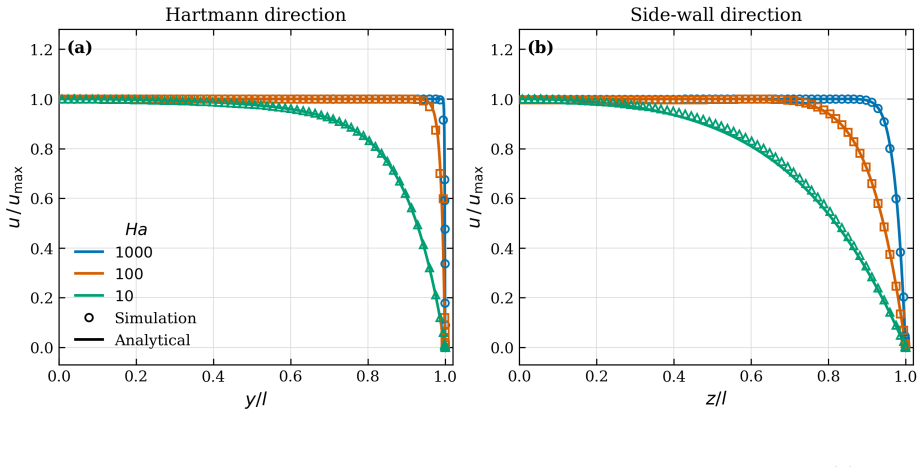
- Verification against analytical duct solutions holds across a range of Hartmann numbers.
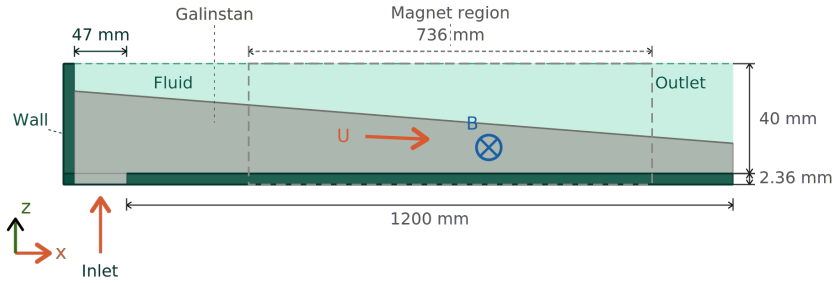
- Validation reproduces experimental free-surface height data.
Where Pith is reading between the lines
- The same formulation could be applied to other multi-region two-phase MHD problems that currently use the inductionless limit.
- It enables direct numerical studies of how induced fields alter flow stability at higher magnetic Reynolds numbers.
- Coupling this magnetic treatment with time-dependent external fields would test its behavior under realistic transient conditions.
Load-bearing premise
The vector-potential formulation correctly enforces the divergence-free condition on the magnetic field while preserving the original multi-region two-phase framework.
What would settle it
A mismatch between the solver's predicted free-surface heights and measured values in an experiment conducted at magnetic Reynolds number greater than one, where the inductionless approximation would produce a detectable deviation.
Figures






read the original abstract
Free-surface liquid metal flows are a leading candidate for the plasma-facing components of future fusion reactors. Existing transient, three-dimensional, free-surface MHD solvers rely on the inductionless approximation in which the induced magnetic field is neglected. This paper extends the open-source solver FreeMHD [B. Wynne et al., Phys. Plasmas 32, 013907 (2025)] beyond the inductionless approximation to resolve the induced magnetic field self-consistently using a vector-potential formulation that enforces $\nabla\cdot\boldsymbol{B}=0$ by construction while preserving the original multi-region, two-phase framework. The solver is verified against analytical Shercliff and Hunt duct-flow solutions across a range of Hartmann numbers and validated against free-surface height measurements from the LMX-U experiment. To the best of our knowledge, FreeMHD2 is the first open-source, experimentally validated free-surface liquid metal solver to resolve the evolution of the induced magnetic field without invoking the inductionless approximation. By removing this approximation rather than relaxing it, the formulation provides the basis for future modeling of the finite magnetic Reynolds number conditions expected in large-scale, transient fusion events.
Editorial analysis
A structured set of objections, weighed in public.
Referee Report
Summary. The manuscript extends the open-source FreeMHD solver (Wynne et al., Phys. Plasmas 2025) to FreeMHD2 by replacing the inductionless approximation with a vector-potential formulation (B = curl A) that enforces ∇·B = 0 by construction. The multi-region two-phase framework is preserved. The new solver is verified against the Shercliff and Hunt analytical duct-flow solutions over a range of Hartmann numbers and validated against free-surface height measurements from the LMX-U experiment. The authors claim that FreeMHD2 is the first open-source, experimentally validated free-surface liquid-metal solver that resolves the induced magnetic field without the inductionless approximation and that the formulation supplies a basis for finite-Rm transient fusion modeling.
Significance. If the implementation details and reported agreements hold, the work is significant because it removes rather than relaxes the inductionless approximation while retaining an existing multi-region free-surface infrastructure. The combination of analytical verification across Hartmann numbers and experimental validation on height data, together with the open-source release, supplies a concrete, reusable tool for modeling liquid-metal plasma-facing components under conditions where induced-field effects become non-negligible.
minor comments (3)
- [Verification section] The abstract states that the solver is 'verified against analytical Shercliff and Hunt duct-flow solutions across a range of Hartmann numbers,' but the main text should supply the specific Hartmann-number values, mesh resolutions, and quantitative error measures (e.g., L2 or L∞ norms of velocity or B) so that readers can judge the accuracy of the induced-field resolution.
- [Validation section] The validation is performed on free-surface height; the manuscript should clarify whether any induced-field quantities (e.g., surface current or local B perturbation) were compared with experiment or whether the height agreement is taken as indirect evidence that the induced field is correctly captured.
- [Introduction or Discussion] A brief statement of the magnetic Reynolds number range accessed by the LMX-U data and by the intended fusion applications would help readers assess how far the new capability extends beyond the inductionless regime.
Simulated Author's Rebuttal
We thank the referee for the positive assessment of the work, the recognition of its significance in removing the inductionless approximation while retaining the multi-region free-surface framework, and the recommendation for minor revision. No specific major comments appear in the report.
Circularity Check
No significant circularity identified
full rationale
The derivation extends the prior FreeMHD solver by adopting the standard vector-potential formulation B = curl(A) to resolve the induced field while preserving the multi-region framework; this is a direct, non-circular removal of the inductionless approximation using an established technique that enforces div(B)=0 by construction. Verification relies on independent analytical duct-flow solutions (Shercliff/Hunt) and external LMX-U experimental height data rather than any fitted parameters, self-definitions, or load-bearing self-citations that reduce the central result to its inputs. The novelty claim is external and does not affect the mathematical chain.
Axiom & Free-Parameter Ledger
Reference graph
Works this paper leans on
-
[1]
M. K. Jung. Input files for ``Extension of a multi-region free-surface MHD solver beyond the inductionless approximation''. Zenodo. 2026. doi:10.5281/zenodo.20727182
-
[2]
D. Alegre and E. Oyarzabal and D. Tafalla and M. Liniers and A. Soleto and F. Tabar \'e s. Design and testing of advanced liquid metal targets for DEMO divertor: The OLMAT Project. Journal of Fusion Energy. 2020. doi:10.1007/s10894-020-00254-5
-
[3]
Al-Salami
J. Al-Salami. Numerical simulation of MHD free surface liquid metal flows for nuclear fusion applications. 2022
2022
-
[4]
J. Brackbill and D. Kothe and C. Zemach. A continuum method for modeling surface tension. Journal of Computational Physics. 1992. doi:10.1016/0021-9991(92)90240-Y
-
[5]
L. Caretto and A. Gosman and S. Patankar and D. Spalding. Two calculation procedures for steady, three-dimensional flows with recirculation. Proceedings of the Third International Conference on Numerical Methods in Fluid Mechanics. 1973. doi:10.1007/BFb0112677
-
[6]
J. Cortazar and N. Lazarus. Creating a softer RoboSquid: Liquid-metal-based compliant pumps for pulsed jet propulsion. Advanced Materials Technologies. 2025. doi:10.1002/admt.202401372
-
[7]
S. Deshpande and L. Anumolu and M. Trujillo. Evaluating the performance of the two-phase flow solver interFoam. Computational Science & Discovery. 2012. doi:10.1088/1749-4699/5/1/014016
-
[8]
E. Endeve and D. Stefanski and M.-O. G. Delchini and S. Slattery and C. D. Hauck and B. Turcksin and S. Smolentsev. A full-induction magnetohydrodynamics solver for liquid metal fusion blankets in Vertex-CFD. Fusion Engineering and Design. 2026. doi:10.1016/j.fusengdes.2026.115792
-
[9]
A. E. Fisher and Z. Sun and E. Kolemen. Liquid metal ``divertorlets'' concept for fusion reactors. Nuclear Materials and Energy. 2020. doi:10.1016/j.nme.2020.100855
-
[10]
Y. Haiqi and W. Baofeng and L. Huiqin and L. Jianchao. Influence of electromagnetic brake on flow field of liquid steel in the slab continuous casting mold. Journal of Materials Processing Technology. 2008. doi:10.1016/j.jmatprotec.2007.08.054
-
[11]
R. Issa. Solution of the implicitly discretised fluid flow equations by operator-splitting. Journal of Computational Physics. 1986. doi:10.1016/0021-9991(86)90099-9
-
[12]
C. Kawczynski and S. Smolentsev and M. Abdou. An induction-based magnetohydrodynamic 3D code for finite magnetic Reynolds number liquid-metal flows in fusion blankets. Fusion Engineering and Design. 2016. doi:10.1016/j.fusengdes.2016.02.088
-
[13]
C. Kawczynski and S. Smolentsev and M. Abdou. Characterization of the lid-driven cavity magnetohydrodynamic flow at finite magnetic Reynolds numbers using far-field magnetic boundary conditions. Physics of Fluids. 2018. doi:10.1063/1.5036775
-
[14]
B. Levitt and E. T. Meier and R. Umstattd and J. R. Barhydt and I. A. M. Datta and C. Liekhus-Schmaltz and D. A. Sutherland and B. A. Nelson. The Zap Energy approach to commerical fusion. Physics of Plasmas. 2023. doi:10.1063/5.0163361
-
[15]
J. Miyazawa and T. Goto and T. Murase and T. Ohgo and N. Yanagi and H. Tanaka and H. Tamura and T. Tanaka and S. Masuzaki and R. Sakamoto and J. Yagi and A. Sagara and the FFHR Design Group. Conceptual design of a liquid metal limiter/divertor system for the FFHR-d1. Fusion Engineering and Design. 2017. doi:10.1016/j.fusengdes.2017.07.003
-
[16]
N. B. Morley and S. Smolentsev and R. Munipalli and M.-J. Ni and D. Gao and M. Abdou. Progress on the modeling of liquid metal, free surface, MHD flows for fusion liquid walls. Fusion Engineering and Design. 2004. doi:10.1016/j.fusengdes.2004.07.013
-
[17]
N. Morley and J. Burris and L. Cadwallader and M. Nornberg. GaInSn usage in the research laboratory. Review of Scientific Instruments. 2008. doi:10.1063/1.2930813
-
[18]
U. M \"u ller and L. B \"u hler. Magnetofluiddynamics in Channels and Containers. 2001. doi:10.1007/978-3-662-04405-6
-
[19]
G. Pintsuk and G. Aiello and S. Dudarev and M. Gorley and J. Henry and M. Richou and M. Rieth and D. Terentyev and R. Vila. Materials for in-vessel components. Fusion Engineering and Design. 2022. doi:10.1016/j.fusengdes.2021.112994
-
[20]
P. Rindt and J. van den Eijnden and T. Morgan and N. Lopes Cardozo. Conceptual design of a liquid-metal divertor for the European DEMO. Fusion Engineering and Design. 2021. doi:10.1016/j.fusengdes.2021.112812
-
[21]
F. Saenz and Z. Sun and A. E. Fisher and B. Wynne and E. Kolemen. Divertorlets concept for low-recycling fusion reactor divertor: experimental, analytical and numerical verification. Nuclear Fusion. 2022. doi:10.1088/1741-4326/ac6682
-
[22]
R. Samulyak and J. Du and J. Glimm and Z. Xu. A numerical algorithm for MHD of free surface flows at low magnetic Reynolds numbers. Journal of Computational Physics. 2007. doi:10.1016/j.jcp.2007.06.005
-
[23]
V. Sergeev and B. Kuteev and A. Bykov and A. Gervash and D. Glazunov and P. Goncharov and A. Dnestrovskij and R. Khayrutdinov and A. Klishchenko and V. Lukash and I. Mazul and P. Molchanov and V. Petrov and V. Rozhansky and Yu. Shpanskiy and A. Sivak and V. Skokov and A. Spitsyn. Conceptual design of divertor and first wall for DEMO-FNS. Nuclear Fusion. 2...
-
[24]
S. Siriano and L. Melchiorri and S. Pignatiello and A. Tassone. A multi-region and a multiphase MHD OpenFOAM solver for fusion reactor analysis. Fusion Engineering and Design. 2024. doi:10.1016/j.fusengdes.2024.114216
-
[25]
S. Smolentsev and R. Moreau and L. B \"u hler and C. Mistrangelo. MHD thermofluid issues of liquid-metal blankets: Phenomena and advances. Fusion Engineering and Design. 2010. doi:10.1016/j.fusengdes.2010.02.038
-
[26]
I. Smolyanov and O. Zikanov. Exploratory study of liquid-metal response to rapid variation of applied magnetic field. Physical Review E. 2025. doi:10.1103/nm74-f77r
-
[27]
D. Suarez and E. Iraola and C. Lamp \'o n and E. de les Valls and L. Batet. Liquid metal MHD flow influence on heat transfer phenomena in fusion reactor blankets. Fusion Engineering and Design. 2021. doi:10.1016/j.fusengdes.2021.112503
-
[28]
D. Suarez and A. Khodak and E. de les Valls. A formal verification and validation of a low magnetic Reynolds number MHD code for fusion applications. IEEE Transactions on Plasma Science. 2022. doi:10.1109/TPS.2022.3203801
-
[29]
Z. Sun and J. Al-Salami and A. Khodak and F. Saenz and B. Wynne and R. Maingi and K. Hanada and C. Hu and E. Kolemen. Magnetohydrodynamics in free surface liquid metal flow relevant to plasma-facing components. Nuclear Fusion. 2023. doi:10.1088/1741-4326/acd864
-
[30]
H. G. Weller and G. Tabor and H. Jasak and C. Fureby. A tensorial approach to computational continuum mechanics using object-oriented techniques. Computers in Physics. 1998. doi:10.1063/1.168744
-
[31]
B. Wynne and F. Saenz and J. Al-Salami and Y. Xu and Z. Sun and C. Hu and K. Hanada and E. Kolemen. FreeMHD: Validation and verification of the open-source, multi-domain, multi-phase solver for electrically conductive flows. Physics of Plasmas. 2025. doi:10.1063/5.0230242
-
[32]
L. Xiang and S. Yang and Q. Wang and J. Wu. Design and testing of a direct current electromagnetic pump for liquid metal. Thermal Science and Engineering Progress. 2024. doi:10.1016/j.tsep.2024.102560
-
[33]
M. Yang and N. Ma and D. Bliss and G. Bryant. Melt motion during liquid-encapsulated Czochralski crystal growth in steady and rotating magnetic fields. International Journal of Heat and Fluid Flow. 2007. doi:10.1016/j.ijheatfluidflow.2006.08.001
-
[34]
J. Zhang and J. Li and X. Liu. Investigate the impact of different neutron source models on the neutronics performance for CFETR. AIP Advances. 2025. doi:10.1063/5.0257060
-
[35]
S. Zhang and Y. Liu and Q. Fan and C. Zhang and T. Zhou and K. Kalantar-Zadeh and Z. Guo. Liquid metal batteries for future energy storage. Energy & Environmental Science. 2021. doi:10.1039/D1EE00531F
discussion (0)
Sign in with ORCID, Apple, or X to comment. Anyone can read and Pith papers without signing in.