Quantum magic is necessary but not sufficient for wormhole-inspired teleportation
Pith reviewed 2026-06-26 20:47 UTC · model grok-4.3
The pith
Quantum magic must be redistributed in a structured way by the coupling to enable wormhole-inspired teleportation rather than simply accumulating to high levels.
A machine-rendered reading of the paper's core claim, the machinery that carries it, and where it could break.
Core claim
In the SYK model, successful wormhole-inspired teleportation requires the structured redistribution of non-stabilizerness resources by the left-right coupling, as evidenced by the failure of both high-magic chaotic models and magic-free scramblers to achieve high fidelity, with the magic measure showing a dip at the teleportation event.
What carries the argument
The double-trace coupling in the SYK model, which suppresses then channels non-stabilizer resources toward the teleportation signal, tracked via stabilizer Rényi entropy across protocol stages.
Load-bearing premise
The double-trace coupling in the SYK model with the chosen parameters accurately implements the wormhole-inspired teleportation protocol whose fidelity is being measured.
What would settle it
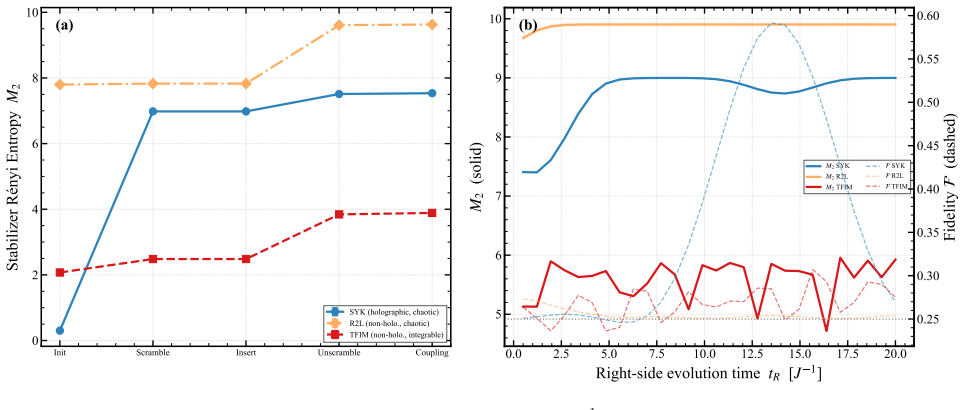
Observing high teleportation fidelity in a chaotic random two-local model that generates near-maximal magic would falsify the claim that structured redistribution is required beyond the total amount of magic.
Figures




read the original abstract
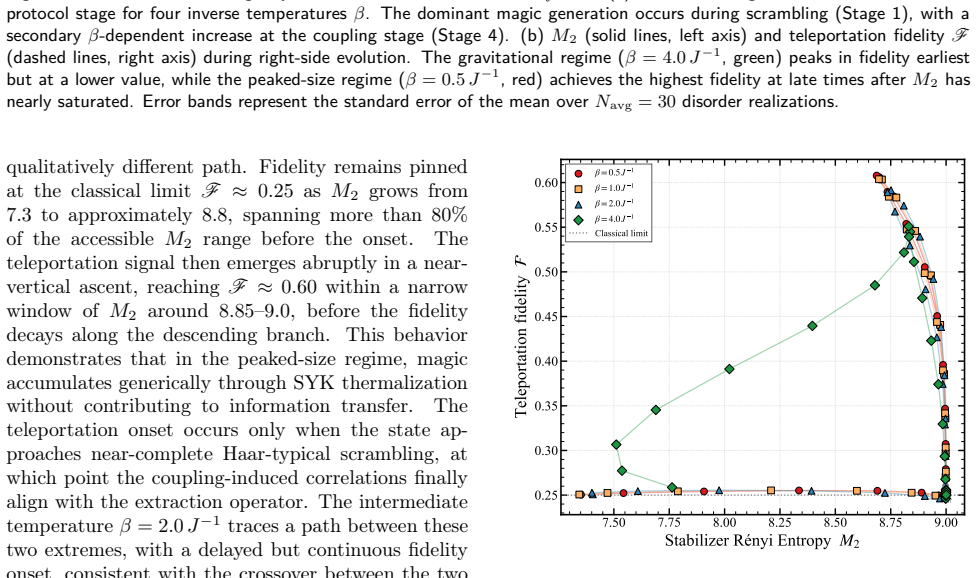
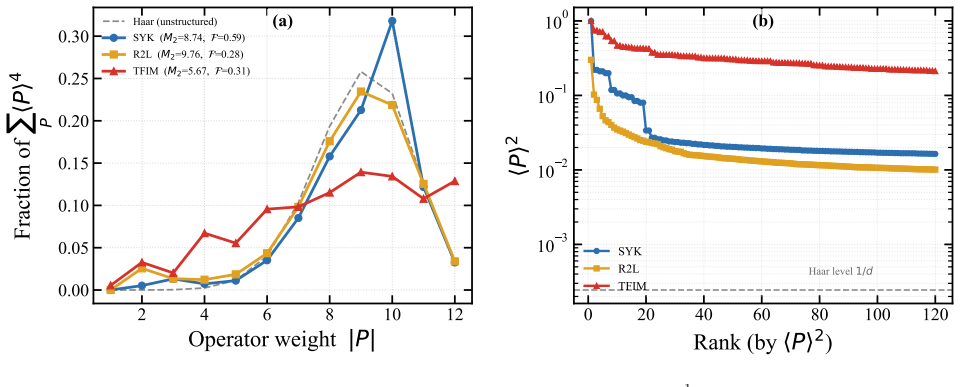
We investigate the dynamics of Quantum magic, formally known as non-stabilizerness, quantified by the stabilizer R\'enyi entropy (SRE), across the stages of the wormhole-inspired teleportation protocol (WITP) in the Sachdev-Ye-Kitaev (SYK) model. By tracking the SRE of the full pure state across scrambling, message insertion, left-right coupling, and right-side extraction, we uncover a regime-dependent relationship between magic accumulation and teleportation fidelity. In the gravitational (low temperature) regime, fidelity rises concurrently with magic from early times, whereas in the peaked-size (high temperature) regime, the magic saturates near the Haar-typical value before teleportation onset. A baseline-subtracted diagnostic comparing coupled and uncoupled protocols reveals that the double-trace coupling first suppresses and then channels non-stabilizer resources toward the teleportation signal, with the channel amplitude decreasing monotonically with inverse temperature. Comparison with a chaotic random two-local model that generates near-maximal magic yet fails to teleport, and with a magic-free Clifford scrambler that fails equally despite mixing operators efficiently, demonstrates that structured magic redistribution, rather than the amount of non-stabilizerness, underlies successful wormhole traversal. Moreover, the magic transiently dips at the fidelity peak, marking the teleportation event in the time domain. Our results are robust across the three system sizes studied ($N_{\mathrm{maj}}=8,10,12$), and the fidelity-magic trajectories exhibit an approximate collapse when the SRE is normalized by the Haar-typical prediction.
Editorial analysis
A structured set of objections, weighed in public.
Referee Report
Summary. The paper claims that in the SYK model, tracking stabilizer Rényi entropy (SRE) through the stages of the wormhole-inspired teleportation protocol (WITP) reveals a regime-dependent link between magic and fidelity; a baseline-subtracted diagnostic shows the double-trace coupling channels magic resources, and comparisons with a near-maximally magic random two-local model and a magic-free Clifford scrambler demonstrate that structured magic redistribution (rather than SRE magnitude) is required for successful teleportation. The results are stated to be robust for N_maj=8,10,12 with an approximate collapse after Haar normalization, and a transient SRE dip marks the fidelity peak.
Significance. If the central comparison holds, the work would usefully separate the role of magic structure from its total amount in a holographic teleportation setting, with the reported robustness across three system sizes and the normalized collapse constituting concrete strengths. The numerical nature of the study makes reproducibility of the SRE and fidelity trajectories particularly relevant to the claim.
major comments (2)
- [Abstract] Abstract: the central claim that 'structured magic redistribution, rather than the amount of non-stabilizerness, underlies successful wormhole traversal' rests on the two control models failing to teleport under the same left-right double-trace coupling. Because both controls replace the SYK all-to-all Hamiltonian with different dynamics, it is not shown that the coupling term produces an equivalent effective channel or operator mixing; without this equivalence the attribution of failure specifically to the absence of structured magic redistribution is not load-bearing.
- [Abstract] Abstract (numerical results paragraph): the reported SRE trajectories, fidelity rise, transient dip, and approximate collapse after normalization for N_maj=8,10,12 are presented without error bars, sampling details, or justification of the temperature regimes; these omissions directly affect the statistical support for the regime-dependent relationship and the robustness statement.
minor comments (1)
- The baseline-subtracted diagnostic is invoked in the abstract but its precise definition and normalization procedure are not stated in the provided text, which would aid reproducibility.
Simulated Author's Rebuttal
We thank the referee for the detailed and constructive report. We address the two major comments point by point below. Both points identify areas where the manuscript can be strengthened with additional discussion and data presentation; we commit to revisions accordingly.
read point-by-point responses
-
Referee: [Abstract] Abstract: the central claim that 'structured magic redistribution, rather than the amount of non-stabilizerness, underlies successful wormhole traversal' rests on the two control models failing to teleport under the same left-right double-trace coupling. Because both controls replace the SYK all-to-all Hamiltonian with different dynamics, it is not shown that the coupling term produces an equivalent effective channel or operator mixing; without this equivalence the attribution of failure specifically to the absence of structured magic redistribution is not load-bearing.
Authors: The referee correctly identifies that the control models employ different scrambling dynamics, which could in principle alter how the fixed left-right double-trace coupling mixes operators. Our intent was to hold the coupling fixed while varying only the scrambling Hamiltonian to isolate the necessity of SYK-specific structured magic redistribution. We agree that explicit verification of channel equivalence would make the attribution more robust. In the revised manuscript we will add a dedicated paragraph analyzing the effective operator content and mixing induced by the coupling in each model, drawing on the existing numerical data for the controls. revision: partial
-
Referee: [Abstract] Abstract (numerical results paragraph): the reported SRE trajectories, fidelity rise, transient dip, and approximate collapse after normalization for N_maj=8,10,12 are presented without error bars, sampling details, or justification of the temperature regimes; these omissions directly affect the statistical support for the regime-dependent relationship and the robustness statement.
Authors: We acknowledge that the abstract and main-text presentation of the numerical results omits error bars, explicit sampling counts, and temperature-regime justification, even though these details appear in the methods and supplementary sections. This presentation choice weakens the immediate readability of the robustness claims. In the revision we will (i) add error bars to all SRE and fidelity plots, (ii) state the number of disorder realizations used for each system size, and (iii) expand the methods paragraph to justify the chosen inverse-temperature windows that define the gravitational and peaked-size regimes. revision: yes
Circularity Check
No significant circularity in derivation chain
full rationale
The paper conducts numerical simulations tracking stabilizer Rényi entropy across WITP stages in the SYK model, with direct comparisons to two external control models (chaotic random two-local and Clifford scrambler). The central claim that structured magic redistribution (not SRE magnitude) underlies teleportation is supported by these empirical observations and the baseline-subtracted diagnostic, none of which reduce by the paper's own equations to a fitted parameter or self-referential definition. Haar-typical normalization is an external benchmark. No load-bearing step matches any of the enumerated circularity patterns; the work is self-contained against external controls.
Axiom & Free-Parameter Ledger
Reference graph
Works this paper leans on
-
[1]
Gapless spin- fluid ground state in a random quantum heisen- berg magnet
Subir Sachdev and Jinwu Ye. “Gapless spin- fluid ground state in a random quantum heisen- berg magnet”. Physical Review Letters70, 3339– 3342 (1993)
1993
-
[2]
Re- marks on the sachdev-ye-kitaev model
Juan Maldacena and Douglas Stanford. “Re- marks on the sachdev-ye-kitaev model”. Physical Review D94, 106002 (2016)
2016
-
[3]
A simple model of quantum holography (part 2)
Alexei Kitaev. “A simple model of quantum holography (part 2)”. Entanglement in strongly- correlated quantum matterPage 38 (2015). url:http://online.kitp.ucsb.edu/online/ entangled15/kitaev2/
2015
-
[4]
A bound on chaos
Juan Maldacena, Stephen H Shenker, and Dou- glas Stanford. “A bound on chaos”. Journal of High Energy Physics2016, 1–17 (2016)
2016
-
[5]
Conformal symmetry and its break- ing in two-dimensional nearly anti-de sitter space
Juan Maldacena, Douglas Stanford, and Zhen- bin Yang. “Conformal symmetry and its break- ing in two-dimensional nearly anti-de sitter space”. Progress of Theoretical and Experimental Physics2016, 12C104 (2016)
2016
-
[6]
The soft mode in the sachdev-ye-kitaev model and its gravity dual
Alexei Kitaev and S Josephine Suh. “The soft mode in the sachdev-ye-kitaev model and its gravity dual”. Journal of High Energy Physics 2018, 1–68 (2018)
2018
-
[7]
Traversable wormholes via a double trace deformation
Ping Gao, Daniel Louis Jafferis, and Aron C Wall. “Traversable wormholes via a double trace deformation”. Journal of High Energy Physics 2017, 1–25 (2017)
2017
-
[8]
Juan Maldacena and Xiao-Liang Qi. “Eternal traversable wormhole” (2018). arXiv:1804.00491
work page internal anchor Pith review Pith/arXiv arXiv 2018
-
[9]
How to build the thermofield double state
William Cottrell, Ben Freivogel, Diego M Hof- man, and Sagar F Lokhande. “How to build the thermofield double state”. Journal of High En- ergy Physics2019, 1–43 (2019)
2019
-
[10]
Holographic mea- surement and quantum teleportation in the syk thermofield double
Stefano Antonini, Brianna Grado-White, Shao- Kai Jian, and Brian Swingle. “Holographic mea- surement and quantum teleportation in the syk thermofield double”. Journal of High Energy Physics2023, 1–58 (2023)
2023
-
[11]
A traversable wormhole teleportation protocol in the syk model
Ping Gao and Daniel Louis Jafferis. “A traversable wormhole teleportation protocol in the syk model”. Journal of High Energy Physics 2021, 1–44 (2021)
2021
-
[12]
Quantum gravity in the lab. i. teleportation by size and traversable wormholes
Adam R Brown, Hrant Gharibyan, Stefan Le- ichenauer, Henry W Lin, Sepehr Nezami, Grant Salton, Leonard Susskind, Brian Swingle, and Michael Walter. “Quantum gravity in the lab. i. teleportation by size and traversable wormholes”. PRX quantum4, 010320 (2023)
2023
-
[13]
Quantum gravity in the lab. ii. teleportation by size and traversable wormholes
Sepehr Nezami, Henry W Lin, Adam R Brown, Hrant Gharibyan, Stefan Leichenauer, Grant 16 Salton, Leonard Susskind, Brian Swingle, and Michael Walter. “Quantum gravity in the lab. ii. teleportation by size and traversable wormholes”. PRX quantum4, 010321 (2023)
2023
-
[14]
Many-body quan- tum teleportation via operator spreading in the traversable wormhole protocol
Thomas Schuster, Bryce Kobrin, Ping Gao, Iris Cong, Emil T Khabiboulline, Norbert M Linke, Mikhail D Lukin, Christopher Monroe, Beni Yoshida, and Norman Y Yao. “Many-body quan- tum teleportation via operator spreading in the traversable wormhole protocol”. Physical Review X12, 031013 (2022)
2022
-
[15]
Traversable wormhole dynamics on a quan- tum processor
Daniel Jafferis, Alexander Zlokapa, Joseph D Lykken, David K Kolchmeyer, Samantha I Davis, NikolaiLauk, HartmutNeven, andMariaSpirop- ulu. “Traversable wormhole dynamics on a quan- tum processor”. Nature612, 51–55 (2022)
2022
-
[16]
Towards Quantum Gravity in the Lab on Quantum Pro- cessors
Illya Shapoval, Vincent Paul Su, Wibe de Jong, Miro Urbanek, and Brian Swingle. “Towards Quantum Gravity in the Lab on Quantum Pro- cessors”. Quantum7, 1138 (2023)
2023
-
[17]
Fidelity of worm- hole teleportation in finite-qubit systems
Zeyu Liu and Pengfei Zhang. “Fidelity of worm- hole teleportation in finite-qubit systems”. Jour- nal of High Energy Physics2024, 1–22 (2024)
2024
-
[18]
The heisenberg representa- tionofquantumcomputers
Daniel Gottesman. “The heisenberg representa- tionofquantumcomputers” (1998). arXiv:quant- ph/9807006
-
[19]
Im- proved simulation of stabilizer circuits
Scott Aaronson and Daniel Gottesman. “Im- proved simulation of stabilizer circuits”. Physi- cal Review A—Atomic, Molecular, and Optical Physics70, 052328 (2004)
2004
-
[20]
Univer- sal quantum computation with ideal clifford gates and noisy ancillas
Sergey Bravyi and Alexei Kitaev. “Univer- sal quantum computation with ideal clifford gates and noisy ancillas”. Physical Review A—Atomic, Molecular, and Optical Physics71, 022316 (2005)
2005
-
[21]
The resource theory of stabilizer quantum computation
Victor Veitch, SA Hamed Mousavian, Daniel Gottesman, and Joseph Emerson. “The resource theory of stabilizer quantum computation”. New Journal of Physics16, 013009 (2014)
2014
-
[22]
Application of a resource theory for magic states to fault- tolerant quantum computing
Mark Howard and Earl Campbell. “Application of a resource theory for magic states to fault- tolerant quantum computing”. Physical review letters118, 090501 (2017)
2017
-
[23]
Stabilizer rényi entropy
Lorenzo Leone, Salvatore FE Oliviero, and Alios- cia Hamma. “Stabilizer rényi entropy”. Physical Review Letters128, 050402 (2022)
2022
-
[24]
Quanti- fying non-stabilizerness via information scram- bling
Arash Ahmadi and Eliska Greplova. “Quanti- fying non-stabilizerness via information scram- bling”. SciPost Physics16, 043 (2024)
2024
-
[25]
Non- stabilizerness of sachdev-ye-kitaev model
Surajit Bera and Marco Schirò. “Non- stabilizerness of sachdev-ye-kitaev model”. Sci- Post Physics19, 159 (2025)
2025
-
[26]
Multipartite non-local magic and syk model
VinayMalvimat, MatthieuSarkis, YenaSuk, and Junggi Yoon. “Multipartite non-local magic and syk model” (2026). arXiv:2601.03076
-
[27]
Stabilizer rényi entropy and its transition in the coupled sachdev-ye-kitaev model
Pengfei Zhang, Shuyan Zhou, and Ning Sun. “Stabilizer rényi entropy and its transition in the coupled sachdev-ye-kitaev model”. Phys- ical Review Letters136, 080201 (2026). arXiv:2509.17417
-
[28]
Connecting magic dynamics in thermofield double states to spectral form factors
Ning Sun and Pengfei Zhang. “Connecting magic dynamics in thermofield double states to spectral form factors” (2026). arXiv:2601.12787
-
[29]
Magic and Wormholes in the Sachdev-Ye-Kitaev Model
Valérie Bettaque and Brian Swingle. “Magic and wormholes in the sachdev-ye-kitaev model” (2026). arXiv:2602.12339
work page internal anchor Pith review Pith/arXiv arXiv 2026
-
[30]
The fermionic canoni- cal commutation relations and the jordan-wigner transform
Michael A Nielsen et al. “The fermionic canoni- cal commutation relations and the jordan-wigner transform”. School of Physical Sciences The Uni- versity of Queensland59, 75 (2005)
2005
-
[31]
Quantum phase transitions
Subir Sachdev. “Quantum phase transitions”. Physics world12, 33–38 (1999)
1999
-
[32]
Variational preparation of the thermofield double state of the sachdev-ye-kitaev model
Vincent Paul Su. “Variational preparation of the thermofield double state of the sachdev-ye-kitaev model”. Physical Review A104, 012427 (2021)
2021
-
[33]
The one-dimensional ising model with a transverse field
Pierre Pfeuty. “The one-dimensional ising model with a transverse field”. ANNALS of Physics57, 79–90 (1970)
1970
-
[34]
Efficient and robust es- timation of many-qubit hamiltonians
Daniel Stilck França, Liubov A Markovich, Vi- atcheslav V Dobrovitski, Albert H Werner, and Johannes Borregaard. “Efficient and robust es- timation of many-qubit hamiltonians”. Nature Communications15, 311 (2024)
2024
-
[35]
Two-local modifica- tions of sachdev-ye-kitaev model with quantum chaos
Masanori Hanada, Sam van Leuven, Onur Ok- tay, and Masaki Tezuka. “Two-local modifica- tions of sachdev-ye-kitaev model with quantum chaos”. Physical Review E113, 014217 (2026)
2026
-
[36]
Quantify- ing nonstabilizerness of matrix product states
Tobias Haug and Lorenzo Piroli. “Quantify- ing nonstabilizerness of matrix product states”. Physical Review B107, 035148 (2023)
2023
-
[37]
A fast and ex- act approach for stabilizer rényi entropy via the xor-fwht algorithm
X Huang, HZ Li, and JX Zhong. “A fast and ex- act approach for stabilizer rényi entropy via the xor-fwht algorithm” (2026). arXiv:2512.24685
-
[38]
Pauli decomposition via the fast walsh- hadamard transform
Timothy N Georges, Bjorn K Berntson, Christoph Sünderhauf, and Aleksei V Ivanov. “Pauli decomposition via the fast walsh- hadamard transform”. New Journal of Physics 27, 033004 (2025)
2025
-
[39]
Magic-state resource theory for the ground state of the transverse-field ising model
Salvatore FE Oliviero, Lorenzo Leone, and Alios- cia Hamma. “Magic-state resource theory for the ground state of the transverse-field ising model”. Physical Review A106, 042426 (2022)
2022
-
[40]
Fast scramblers
Yasuhiro Sekino and Leonard Susskind. “Fast scramblers”. Journal of High Energy Physics 2008, 065 (2008)
2008
-
[41]
Sachdev-ye-kitaev model and ther- malization on the boundary of many-body lo- calized fermionic symmetry-protected topologi- cal states
Yi-Zhuang You, Andreas WW Ludwig, and Cenke Xu. “Sachdev-ye-kitaev model and ther- malization on the boundary of many-body lo- calized fermionic symmetry-protected topologi- cal states”. Physical Review B95, 115150 (2017)
2017
-
[42]
Computational complexity and black hole horizons
Leonard Susskind. “Computational complexity and black hole horizons”. Fortschritte der Physik 64, 24–43 (2016)
2016
-
[43]
Com- plexity and shock wave geometries
Douglas Stanford and Leonard Susskind. “Com- plexity and shock wave geometries”. Physical Re- view D90, 126007 (2014). 17
2014
-
[44]
Lowerbounds on the non-clifford resources for quantum com- putations
Michael Beverland, Earl Campbell, Mark Howard, andVadymKliuchnikov. “Lowerbounds on the non-clifford resources for quantum com- putations”. Quantum Science & Technology5, 035009 (2020)
2020
-
[45]
Many- body magic via pauli-markov chains—from crit- icality to gauge theories
Poetri Sonya Tarabunga, Emanuele Tirrito, Titas Chanda, and Marcello Dalmonte. “Many- body magic via pauli-markov chains—from crit- icality to gauge theories”. PRX Quantum4, 040317 (2023)
2023
-
[46]
Nonequilib- rium quantum monte carlo algorithm for stabi- lizer rényi entropy in spin systems
Zejun Liu and Bryan K Clark. “Nonequilib- rium quantum monte carlo algorithm for stabi- lizer rényi entropy in spin systems”. Physical Re- view B111, 085144 (2025). arXiv:2405.19577
-
[47]
Nora: a tensor network ansatz for volume-law entangled equilibrium states of highly connected hamilto- nians
Valérie Bettaque and Brian Swingle. “Nora: a tensor network ansatz for volume-law entangled equilibrium states of highly connected hamilto- nians”. Quantum8, 1362 (2024)
2024
-
[48]
Measuring magic on a quantum processor
Salvatore FE Oliviero, Lorenzo Leone, Alioscia Hamma, and Seth Lloyd. “Measuring magic on a quantum processor”. npj Quantum Information 8, 148 (2022)
2022
-
[49]
Magic-witp out- put data files
Sudhanva Joshi. “Magic-witp out- put data files”.https://github. com/sudhanvajoshirsphy24-cloud/ Magic-WITP(2026). A Perturbative magic injection near the Clifford point Letζ(ψ) = 1 d ∑ P∈Pn⟨ψ|P|ψ⟩4, so thatM 2 = −log2ζ; expectation values of Hermitian Paulis are real. We expand the magic of the coupled state ψϵ=e iϵVψabout the Clifford pointg= 2π, i.e. ϵ...
2026
discussion (0)
Sign in with ORCID, Apple, or X to comment. Anyone can read and Pith papers without signing in.