Thermal Characterization of a 6-Positioner, 6.2-mm-Pitch Module for Stage-5 Telescopes
Pith reviewed 2026-06-26 19:03 UTC · model grok-4.3
The pith
Robotic fiber positioners maintain stable performance with no degradation from -20°C to 30°C.
A machine-rendered reading of the paper's core claim, the machinery that carries it, and where it could break.
Core claim
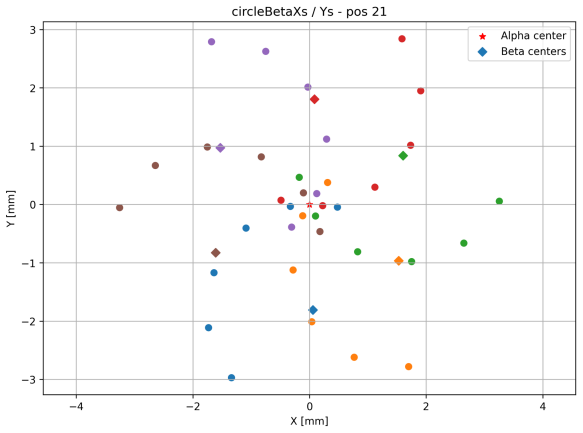
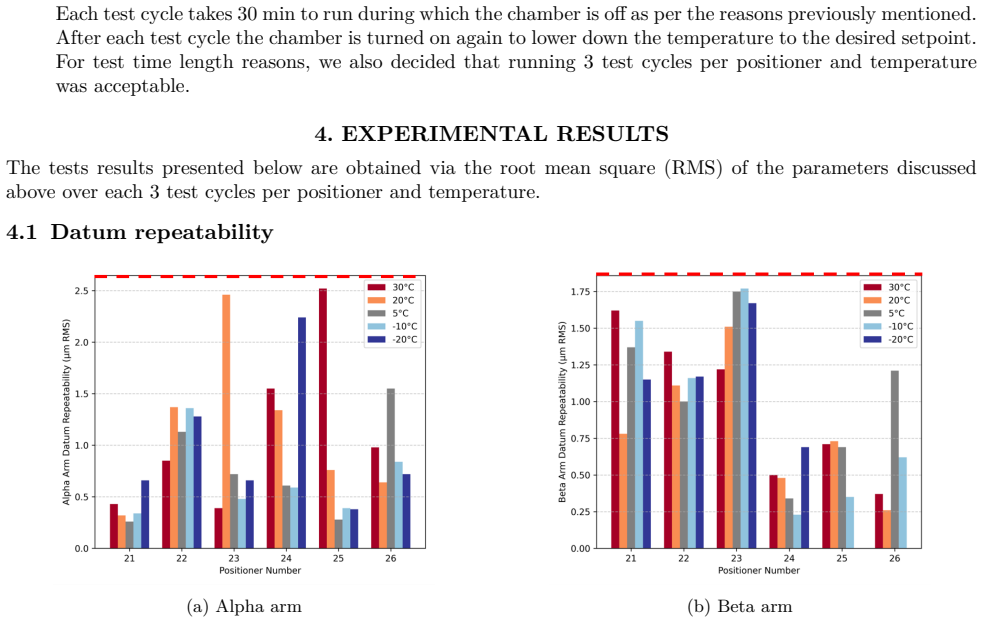
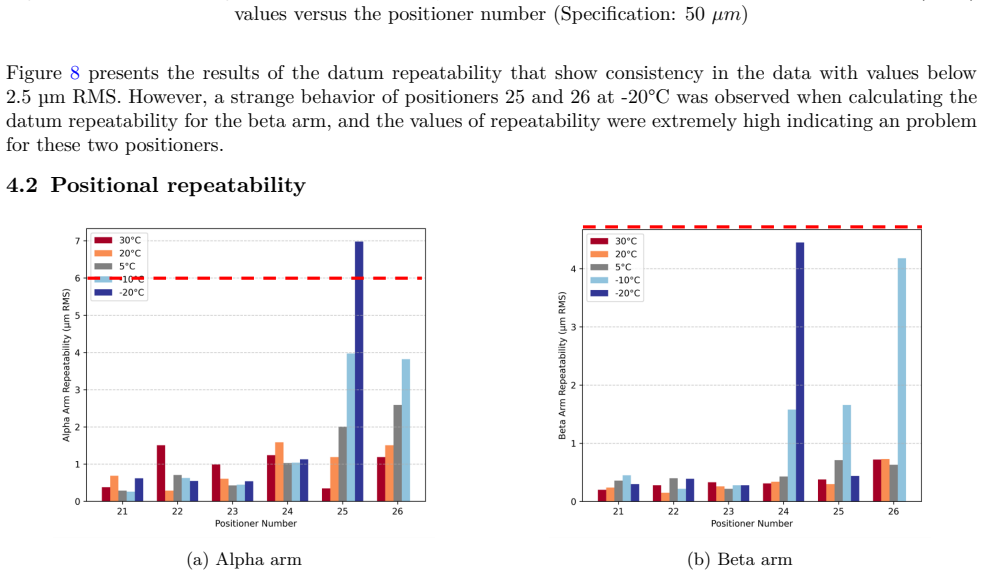
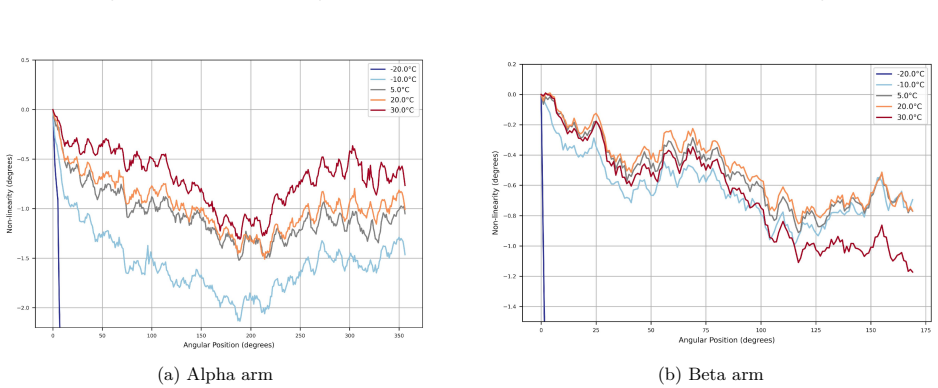
Across the full temperature range from -20°C to 30°C, the positioners maintained stable behavior with no measurable degradation in positioning repeatability, hard-stop repeatability, backlash, or non-linearity, and with no evidence of mechanical or electrical damage.
What carries the argument
Thermal qualification tests that record the four performance metrics at discrete temperatures and compare them directly to nominal performance.
If this is right
- The 6.2-mm-pitch modules meet thermal requirements for reliable use in Stage-5 telescope fiber systems.
- No additional active thermal stabilization is needed to preserve positioning accuracy under expected conditions.
- The test protocol can be applied to qualify larger batches or similar modules for other instruments.
- Deployment decisions can proceed based on thermal resilience already demonstrated.
Where Pith is reading between the lines
- Long-duration thermal cycling beyond the tested discrete points could still expose fatigue not captured here.
- Results at the module level support scaling to full focal-plane arrays if assembly variations remain small.
- Similar tests on competing positioner designs would allow direct comparison of thermal margins.
Load-bearing premise
The chosen discrete temperatures and four metrics are sufficient to represent all continuous operating conditions and relevant failure modes.
What would settle it
A measurable increase in backlash or drop in repeatability when the same module is tested at an intermediate temperature or after repeated thermal cycling between the extremes.
Figures




read the original abstract
Ensuring thermal stability of robotic fiber positioners is essential for reliable operation in the real environments of Stage-5 telescopes, where temperature variations can influence mechanical behavior and impact fiber-target accuracy. We present the results of thermal qualification tests conducted on 6.2-mm-pitch robotic positioner modules developed for high-density fiber positioning in next-generation astronomical systems. The positioners were characterized at discrete temperatures spanning negative 20 deg C to positive 30 deg C, representative of expected operational conditions. At each temperature point, key performance metrics, positioning repeatability, hard-stop repeatability, backlash, and non-linearity, were measured and compared to nominal performance. Across the full temperature range, the positioners maintained stable behavior with no measurable degradation in any metric and no evidence of mechanical or electrical damage. These results confirm that the 6.2-mm-pitch architecture provides the necessary thermal resilience for deployment in Stage-5 telescope instrumentation.
Editorial analysis
A structured set of objections, weighed in public.
Referee Report
Summary. The manuscript reports thermal qualification tests on a 6-positioner, 6.2-mm-pitch robotic fiber positioner module intended for Stage-5 telescopes. Positioners were tested at discrete temperatures from -20 °C to +30 °C; at each point the authors measured positioning repeatability, hard-stop repeatability, backlash, and non-linearity and state that all metrics remained unchanged relative to nominal performance, with no mechanical or electrical damage observed. The central conclusion is that the 6.2-mm-pitch architecture is thermally resilient for expected operational conditions.
Significance. If the underlying measurements are reproducible and statistically sound, the result would provide practical engineering confirmation that a compact positioner design can operate without performance loss over a representative temperature range, directly supporting instrument design choices for next-generation fiber-fed spectrographs. The work is incremental rather than foundational; its value lies in the specific hardware validation rather than new physical insight or modeling.
major comments (2)
- Abstract (and any Results section): the claim that the positioners 'maintained stable behavior with no measurable degradation in any metric' is presented without accompanying data tables, figures, error bars, sample sizes, or statistical tests. Without these, the central experimental claim cannot be evaluated or reproduced.
- Abstract: the temperature sampling consists of discrete points only. No data or discussion addresses possible non-monotonic dependence, hysteresis during thermal transitions, or behavior at intermediate temperatures; this directly limits the strength of the 'across the full temperature range' assertion.
minor comments (2)
- The manuscript should specify the number of positioners tested, the number of cycles per metric, and the definition of 'nominal performance' used for comparison.
- Clarify whether the reported metrics include any temperature-dependent systematic offsets (e.g., thermal expansion contributions to positioning) or only random repeatability.
Simulated Author's Rebuttal
We thank the referee for their constructive comments. We address the major comments point by point below.
read point-by-point responses
-
Referee: [—] Abstract (and any Results section): the claim that the positioners 'maintained stable behavior with no measurable degradation in any metric' is presented without accompanying data tables, figures, error bars, sample sizes, or statistical tests. Without these, the central experimental claim cannot be evaluated or reproduced.
Authors: We agree the abstract summarizes results at a high level without embedded data. The full manuscript includes a Results section with tables reporting measured values for repeatability, backlash, and non-linearity at each temperature, figures with data points and error bars from repeated trials, and a sample size of six positioners. We will revise the abstract to reference these (e.g., 'detailed in Figure 4 and Table 3'). No formal statistical hypothesis tests were applied beyond confirming values remained within nominal tolerances; we will add a sentence noting the observed standard deviations. revision: yes
-
Referee: [—] Abstract: the temperature sampling consists of discrete points only. No data or discussion addresses possible non-monotonic dependence, hysteresis during thermal transitions, or behavior at intermediate temperatures; this directly limits the strength of the 'across the full temperature range' assertion.
Authors: The tests used discrete setpoints (-20 °C to +30 °C in 10 °C steps) chosen to bracket expected operational conditions. No continuous sweeps, hysteresis cycles, or intermediate-temperature data were acquired. We will add a paragraph in the Discussion clarifying that conclusions apply specifically to the sampled temperatures, noting the lack of observed non-monotonic trends at those points, and acknowledging that behavior between setpoints or during transitions was not characterized. This will qualify the 'full temperature range' phrasing. revision: partial
Circularity Check
No circularity; experimental measurements only
full rationale
The paper reports direct experimental characterization of positioner metrics (repeatability, backlash, etc.) at discrete temperatures from -20°C to +30°C. No equations, models, fitted parameters, predictions, or derivations are present. Claims rest on observed data without any self-definition, self-citation load-bearing steps, or renaming of results. This is a standard empirical report with no derivation chain to inspect for circularity.
Axiom & Free-Parameter Ledger
Reference graph
Works this paper leans on
-
[2]
Prototyping of 6.2-mm-Pitch Fiber Positioner Modules for Stage-V Telescope Instrumentation
Galal, Malak and Rombach, Maxime and Wei, Jonathan and et al. , month = apr, year =. Prototyping of 6.2-mm-. doi:10.48550/arXiv.2508.19711 , abstract =
work page internal anchor Pith review Pith/arXiv arXiv doi:10.48550/arxiv.2508.19711
-
[3]
2022, in Society of Photo-Optical Instrumentation Engineers (SPIE) Conference Series, Vol
Farr, Emily and Tuttle, Sarah and Wilson, John and Pahuja, Rishi and Mandeville, Travis and Jurgenson, Colby and Kadlec, Kal and Wachter, Stefanie and Ramirez, Solange , month = aug, year =. Fiber optic throughput performance evaluation in multi-fiber termination connectors , volume =. Ground-based and. doi:10.1117/12.2629751 , abstract =
-
[4]
Fusion splicing: a novel approach to fiber connections for the
Fagrelius, Parker and Poppett, Claire and Edelstein, Jerry , month = aug, year =. Fusion splicing: a novel approach to fiber connections for the. Ground-based and. doi:10.1117/12.2231331 , abstract =
-
[5]
Overview of the. The Astronomical Journal , author =. 2019 , pages =. doi:10.3847/1538-3881/ab089d , abstract =
-
[6]
Poppett, Claire and Tyas, Luke and Aguilar, J. and Bebek, Christopher and Bramall, D. and Claybaugh, T. and Edelstein, J. and Fagrelius, P. and Heetderks, H. and Jelinsky, P. and Jelinsky, S. and Lafever, Robin and Lambert, A. and Lampton, M. and Levi, Michael E. and Martini, P. and Rockosi, C. and Schmoll, J. and Sharples, Ray M. and Sirk, Martin and Wis...
-
[7]
and Wang, Adeline and Bryant, Julia , month = aug, year =
Sathi, Zinat M. and Wang, Adeline and Bryant, Julia , month = aug, year =. Optimizing fibre connectors for high throughput and low. Advances in. doi:10.1117/12.3017730 , abstract =
-
[8]
FS.com , author =
1m (3ft). FS.com , author =
-
[9]
Schmoll, Jurgen , year =
-
[10]
Morris, Simon L. and Cuby, Jean-Gabriel and Dubbeldam, Marc and Evans, Christopher and Fusco, Thierry and Jagourel, Pascal and Myers, Richard M. and Parr-Burman, Phil and Rousset, Gerard and Schnetler, Hermine , editor =. The. 2012 , pages =. doi:10.1117/12.925889 , abstract =
-
[11]
2010 , note =
The Messenger , author =. 2010 , note =
2010
-
[12]
Gonzalez, Oscar and Cirasuolo, Michele and Taylor, William and Black, Martin and Rees, Philip and Bryson, Ian and Chittick, Stephen and Afonso, Jose and Lilly, Simon and Flores, Hector and Maiolino, Roberto and Oliva, Ernesto and Paltani, Stephane and Vanzi, Leonardo and Abreu, Manuel and Amans, Jean-Philippe and Atkinson, David and Beard, Steven and Belf...
-
[13]
Fibre assignment in next-generation wide-field spectrographs , volume =. Monthly Notices of the Royal Astronomical Society , author =. 2012 , note =. doi:10.1111/j.1365-2966.2011.19774.x , abstract =
-
[14]
Gajewski, Paul and Żurek, Dominik and Pietroń, Marcin and Faber, Kamil , month = oct, year =. Solving. doi:10.48550/arXiv.2410.06347 , abstract =
work page internal anchor Pith review Pith/arXiv arXiv doi:10.48550/arxiv.2410.06347
-
[15]
Research in Astronomy and Astrophysics , author =
Fault. Research in Astronomy and Astrophysics , author =. 2023 , pages =. doi:10.1088/1674-4527/acfd02 , abstract =
-
[16]
Advanced Intelligent Systems , author =
Long. Advanced Intelligent Systems , author =. 2024 , pages =. doi:10.1002/aisy.202300703 , abstract =
-
[17]
Frontiers in Robotics and AI , author =
Swarm-. Frontiers in Robotics and AI , author =. doi:10.3389/frobt.2017.00012 , abstract =
-
[18]
Fan, Tingxiang and Long, Pinxin and Liu, Wenxi and Pan, Jia , month = aug, year =. Fully. doi:10.48550/arXiv.1808.03841 , abstract =
work page internal anchor Pith review Pith/arXiv arXiv doi:10.48550/arxiv.1808.03841
-
[19]
doi:10.48550/arXiv.2408.06656 , abstract =
Guo, Yicheng and Liu, Jiaqi and Yu, Rongjie and Hang, Peng and Sun, Jian , month = aug, year =. doi:10.48550/arXiv.2408.06656 , abstract =
-
[20]
Zhang, Kaiqing and Yang, Zhuoran and Liu, Han and Zhang, Tong and Başar, Tamer , month = feb, year =. Fully. doi:10.48550/arXiv.1802.08757 , abstract =
work page internal anchor Pith review Pith/arXiv arXiv doi:10.48550/arxiv.1802.08757
-
[21]
and Koenig, Sven and Fioretto, Ferdinando , month = jun, year =
Liang, Jinhao and Christopher, Jacob K. and Koenig, Sven and Fioretto, Ferdinando , month = jun, year =. Simultaneous. doi:10.48550/arXiv.2502.03607 , abstract =
-
[22]
and Baierl, Mark and Koert, Dorothea and Peters, Jan , month = mar, year =
Carvalho, Joao and Le, An T. and Baierl, Mark and Koert, Dorothea and Peters, Jan , month = mar, year =. Motion. doi:10.48550/arXiv.2308.01557 , abstract =
-
[23]
Complex System Modeling and Simulation , author =
Distributed. Complex System Modeling and Simulation , author =. 2022 , pages =. doi:10.23919/CSMS.2022.0017 , abstract =
-
[24]
Hierarchical hybrid control for. IFAC-PapersOnLine , author =. 2019 , pages =. doi:10.1016/j.ifacol.2019.08.093 , abstract =
-
[25]
Introduction to Graph Neural Networks for Machine Learning Engineers
Tanis, James H. and Giannella, Chris and Mariano, Adrian V. , month = dec, year =. Introduction to. doi:10.48550/arXiv.2412.19419 , abstract =
work page internal anchor Pith review Pith/arXiv arXiv doi:10.48550/arxiv.2412.19419
-
[26]
The. The Astronomical Journal , author =. 2023 , note =. doi:10.3847/1538-3881/ac9ab1 , abstract =
-
[27]
doi:10.48550/arXiv.2409.00134 , abstract =
Andreychuk, Anton and Yakovlev, Konstantin and Panov, Aleksandr and Skrynnik, Alexey , month = apr, year =. doi:10.48550/arXiv.2409.00134 , abstract =
-
[28]
The Astronomical Journal , author =. 2021 , note =. doi:10.3847/1538-3881/abd0f2 , abstract =
-
[29]
Goeckner, Anthony and Sui, Yueyuan and Martinet, Nicolas and Li, Xinliang and Zhu, Qi , month = mar, year =. Graph. doi:10.48550/arXiv.2403.13093 , abstract =
-
[30]
Biasi, Roberto and Gallieni, Daniele and Briguglio, Runa and Vernet, Elise and Andrighettoni, Mario and Angerer, Gerald and Pescoller, Dietrich and Manetti, Mauro and Tintori, Matteo and Mantegazza, Marco and Lazzarini, Paolo and Fumi, Pierluigi and Anaclerio, Vincenzo and Xompero, Marco and Pariani, Giorgio and Riccardi, Armando and Cayrel, Marc and Dier...
-
[31]
Tamura, Naoyuki and Yabe, Kiyoto and Koshida, Shintaro and Moritani, Yuki and Tanaka, Masayuki and Ishigaki, Miho N. and Ishizuka, Yuki and Kamata, Yukiko and Allaoui, Ali and Arai, Akira and Arnouts, Stéphane and Barette, Rudy and Barkhouser, Robert H. and Bergeron, Eddie and Blanchard, Patrick and Caplar, Neven and Carle, Michael and Chabaud, Pierre-Yve...
-
[32]
The Adaptive Mirror for the E-ELT , author =
The. The Adaptive Mirror for the E-ELT , author =. doi:10.12839/AO4ELT3.13431 , language =
-
[33]
Dark Energy Spectroscopic Instrument (DESI) Fiber Positioner Thermal and Wind Disturbance Test
Zhang, Kai and Silber, Joseph H. and Heetderks, Henry D. and Leitner, Daniela and Schubnell, Michael and Levi, Michael and Wang, Gradey and Fanning, Kevin and Fagrelius, Parker and Dobson, Carl and Aguilar, Jessica , year =. Dark. doi:10.48550/ARXIV.1807.09383 , abstract =
work page internal anchor Pith review Pith/arXiv arXiv doi:10.48550/arxiv.1807.09383
-
[34]
Schlegel, David J. and Kollmeier, Juna A. and Aldering, Greg and Bailey, Stephen and Baltay, Charles and Bebek, Christopher and BenZvi, Segev and Besuner, Robert and Blanc, Guillermo and Bolton, Adam S. and Bonaca, Ana and Bouri, Mohamed and Brooks, David and Buckley-Geer, Elizabeth and Cai, Zheng and Crane, Jeffrey and Demina, Regina and DeRose, Joseph a...
-
[35]
Silber, Joseph H. and Schlegel, David J. and Araujo, Ricardo and Baltay, Charles and Besuner, Robert W. and Farr, Emily and Guy, Julien and Kneib, Jean-Paul and Poppett, Claire and Mandeville, Travis A. and Schubnell, Michael and Thurneysen, Markus and Tuttle, Sarah , month = dec, year =. 25,000 optical fiber positioning robots for next-generation cosmolo...
-
[36]
and Galal, Malak and Schlegel, David and Kneib, Jean-Paul , editor =
Rombach, Maxime and Xu, Xiangyu and Araujo, Ricardo and Thurneysen, Markus and Caseiro, Stefane and Magnenat, Corentin and Silber, Joseph H. and Galal, Malak and Schlegel, David and Kneib, Jean-Paul , editor =. Investigations on assembly and coverage for modular focal planes of multiplexed telescopes , url =. Ground-based and. 2024 , pages =. doi:10.1117/...
-
[37]
, month = jan, year =
Ramsey, Lawrence W. , month = jan, year =. Focal ratio degradation in optical fibers of astronomical interest. , volume =
-
[38]
Gutierrez, Pablo and Atkinson, David and Beard, Steven and Di Lieto, Nicola , editor =. Ethernet to multi-. Software and. 2020 , pages =. doi:10.1117/12.2557215 , urldate =
-
[39]
Sphinx: a massively multiplexed fiber positioner for
Smedley, Scott and Baker, Gabriella and Brown, Rebecca and Gilbert, James and Gillingham, Peter and Saunders, Will and Sheinis, Andrew and Venkatesan, Sudharshan and Waller, Lewis , editor =. Sphinx: a massively multiplexed fiber positioner for. Ground-based and. 2018 , pages =. doi:10.1117/12.2310021 , urldate =
discussion (0)
Sign in with ORCID, Apple, or X to comment. Anyone can read and Pith papers without signing in.