The Collins-Soper kernel from a vacuum soft function
Pith reviewed 2026-06-26 18:15 UTC · model grok-4.3
The pith
Collins-Soper kernel extracted from vacuum soft function on Euclidean lattice using complex-directional Wilson lines
A machine-rendered reading of the paper's core claim, the machinery that carries it, and where it could break.
Core claim
The Collins-Soper kernel is calculated from a vacuum soft function using space-like Wilson lines with complex-directional vectors on the Euclidean lattice. Pure gauge calculations achieve high statistical precision in computing the soft function, whose rapidity dependence is well described by Collins-Soper evolution across a wide range of rapidity differences. The extracted kernel contains errors comparable to those achieved in state-of-the-art lattice calculations based on hadronic observables, but exhibits saturated behavior at large transverse Wilson-line separations.
What carries the argument
Vacuum soft function computed from space-like Wilson lines with complex-directional vectors on the Euclidean lattice
If this is right
- High statistical precision is reached in pure gauge theory calculations of the soft function.
- The soft function's rapidity dependence matches Collins-Soper evolution across wide ranges of differences.
- The kernel errors are comparable to those from lattice calculations that use hadronic observables.
- Saturated behavior appears at large transverse Wilson-line separations.
Where Pith is reading between the lines
- The method could be extended to full QCD simulations that include dynamical quarks.
- It offers a route to TMD calculations that avoids constructing hadronic matrix elements.
- The observed saturation at large separations could be examined in other formulations of the soft function to test its origin.
Load-bearing premise
The rapidity dependence of the computed vacuum soft function follows the Collins-Soper evolution equation sufficiently well to permit reliable extraction of the kernel.
What would settle it
A measurement in which the soft function's rapidity dependence deviates from the Collins-Soper evolution prediction by more than the achieved statistical errors would show that the kernel extraction is not reliable.
Figures



read the original abstract
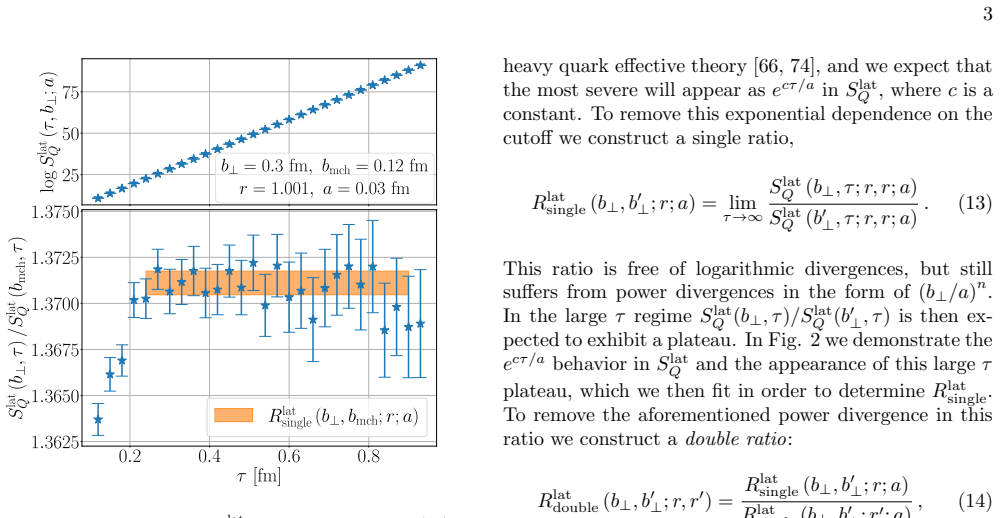
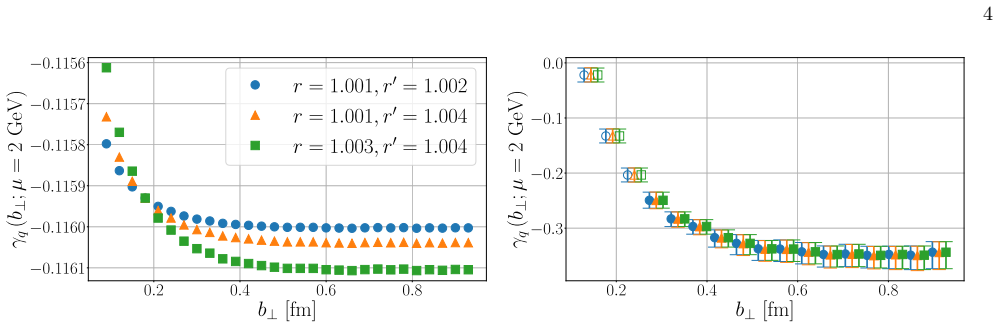
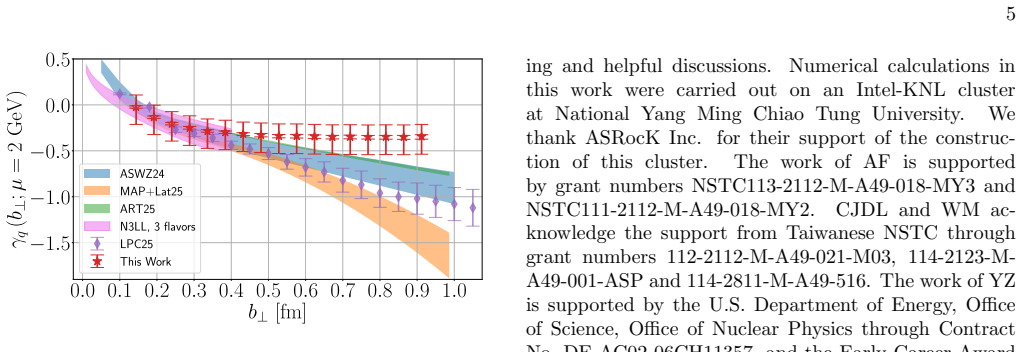
The Collins-Soper kernel is calculated from a vacuum soft function using space-like Wilson lines with complex-directional vectors on the Euclidean lattice. Our pure gauge calculations with this method achieve high statistical precision in computing the soft function, whose rapidity dependence is well described by Collins-Soper evolution across a wide range of rapidity differences. The extracted kernel contains errors comparable to those achieved in state-of-the-art lattice calculations based on hadronic observables, but exhibits saturated behavior at large transverse Wilson-line separations.
Editorial analysis
A structured set of objections, weighed in public.
Referee Report
Summary. The manuscript claims to compute the Collins-Soper kernel K(b) from the rapidity dependence of a vacuum soft function S(b,y) evaluated on the Euclidean lattice with space-like Wilson lines using complex directional vectors in pure gauge theory. It reports high statistical precision in the soft function, that its rapidity dependence is well described by Collins-Soper evolution over a wide range, and that the resulting kernel has errors comparable to state-of-the-art hadronic lattice calculations, while noting saturated behavior at large transverse Wilson-line separations.
Significance. If the central assumption holds, the approach supplies a new lattice route to the Collins-Soper kernel that dispenses with hadronic matrix elements and achieves high statistical precision in the underlying soft function; this could simplify future calculations while maintaining competitive errors.
major comments (1)
- The extraction of K(b) rests on the assumption that the computed vacuum soft function obeys the Collins-Soper evolution equation d log S / dy = K(b) (plus known perturbative pieces) with sufficient fidelity across the simulated rapidity range. The reported saturation at large transverse separations is not the expected large-b form of the kernel; without explicit tests (e.g., consistency of extracted K(b) across sub-ranges of rapidity or comparison to perturbative expectations at small b) it remains possible that lattice artifacts or the complex Wilson-line prescription introduce systematic deviations that bias the result.
Simulated Author's Rebuttal
We thank the referee for their careful reading and constructive feedback. We address the single major comment below.
read point-by-point responses
-
Referee: The extraction of K(b) rests on the assumption that the computed vacuum soft function obeys the Collins-Soper evolution equation d log S / dy = K(b) (plus known perturbative pieces) with sufficient fidelity across the simulated rapidity range. The reported saturation at large transverse separations is not the expected large-b form of the kernel; without explicit tests (e.g., consistency of extracted K(b) across sub-ranges of rapidity or comparison to perturbative expectations at small b) it remains possible that lattice artifacts or the complex Wilson-line prescription introduce systematic deviations that bias the result.
Authors: The manuscript already reports that the rapidity dependence of the soft function is well described by Collins-Soper evolution over a wide range. To strengthen the validation against possible systematics from lattice artifacts or the Wilson-line prescription, we will add two explicit tests in the revised manuscript: (i) extraction of K(b) from independent sub-ranges of the simulated rapidity values, demonstrating consistency within statistical errors, and (ii) direct comparison of the extracted kernel at small b against perturbative expectations. These additions will quantify the fidelity of the evolution assumption. We will also expand the discussion of the observed saturation at large transverse separations to note explicitly that it deviates from the expected large-b asymptotic form of the kernel and to comment on possible origins without claiming agreement with that form. revision: yes
Circularity Check
No significant circularity: kernel extraction applies standard definition to independently computed lattice soft function
full rationale
The paper computes the vacuum soft function S(b,y) directly on the Euclidean lattice using space-like Wilson lines, then extracts K(b) from the observed rapidity dependence. The abstract states that this dependence 'is well described by Collins-Soper evolution', indicating an empirical check rather than a definitional assumption that forces the result. No quoted equations or self-citations reduce the extracted kernel to a fit or prior result by construction; the lattice computation of S is independent of the evolution equation used for extraction. This is the normal, non-circular case for a first-principles lattice calculation that invokes a known evolution relation.
Axiom & Free-Parameter Ledger
axioms (1)
- domain assumption The rapidity dependence of the soft function follows Collins-Soper evolution
Reference graph
Works this paper leans on
-
[1]
MAP+Lat25 [26] is a combined analysis using lattice and experimental data
Recent lattice extractions are: ASWZ24 [59], LPC25 [63] A recent phenomenological extraction is: ART25 [23]. MAP+Lat25 [26] is a combined analysis using lattice and experimental data. with the prediction from [85], that the CS kernel should be constant at largeb ⊥. While our result is consistent with other lattice computations at intermediateb ⊥, it disag...
-
[2]
Collins, Foundations of Perturbative QCD, Vol
J. Collins, Foundations of Perturbative QCD, Vol. 32 (Cambridge University Press, 2011)
2011
-
[3]
J. C. Collins and D. E. Soper, Nucl. Phys. B193, 381 (1981), [Erratum: Nucl.Phys.B 213, 545 (1983)]
1981
-
[4]
J. C. Collins and D. E. Soper, Nucl. Phys. B197, 446 (1982)
1982
-
[5]
J. C. Collins, D. E. Soper, and G. F. Sterman, Nucl. Phys. B250, 199 (1985)
1985
-
[6]
J. C. Collins, D. E. Soper, and G. F. Sterman, Nucl. Phys. B261, 104 (1985)
1985
-
[7]
J. C. Collins, D. E. Soper, and G. F. Sterman, Nucl. Phys. B308, 833 (1988)
1988
-
[8]
S. Catani, D. de Florian, and M. Grazzini, Nucl. Phys. B596, 299 (2001), arXiv:hep-ph/0008184
Pith/arXiv arXiv 2001
-
[9]
S. Catani and M. Grazzini, Nucl. Phys. B845, 297 (2011), arXiv:1011.3918 [hep-ph]
Pith/arXiv arXiv 2011
-
[10]
J. C. Collins, D. E. Soper, and G. F. Sterman, Adv. Ser. Direct. High Energy Phys.5, 1 (1989), arXiv:hep- ph/0409313
arXiv 1989
-
[11]
D. de Florian and M. Grazzini, Nucl. Phys. B616, 247 (2001), arXiv:hep-ph/0108273
Pith/arXiv arXiv 2001
-
[12]
Angeles-Martinez et al., Acta Phys
R. Angeles-Martinez et al., Acta Phys. Polon. B46, 2501 (2015), arXiv:1507.05267 [hep-ph]
Pith/arXiv arXiv 2015
-
[13]
S. Amoroso et al., Acta Phys. Polon. B53, 12 (2022), arXiv:2203.13923 [hep-ph]
arXiv 2022
-
[14]
F. Hautmann, I. Scimemi, and A. Vladimirov, Phys. Lett. B806, 135478 (2020), arXiv:2002.12810 [hep-ph]
arXiv 2020
-
[15]
M. Bury, F. Hautmann, S. Leal-Gomez, I. Scimemi, A. Vladimirov, and P. Zurita, JHEP10, 118 (2022), arXiv:2201.07114 [hep-ph]
arXiv 2022
-
[16]
A. Bacchetta, V. Bertone, C. Bissolotti, G. Bozzi, M. Cerutti, F. Piacenza, M. Radici, and A. Signori (MAP (Multi-dimensional Analyses of Partonic distribu- tions)), JHEP10, 127 (2022), arXiv:2206.07598 [hep-ph]
arXiv 2022
-
[17]
J. Isaacson, Y. Fu, and C. P. Yuan, Phys. Rev. D110, 073002 (2024), arXiv:2311.09916 [hep-ph]
arXiv 2024
-
[18]
V. Moos, I. Scimemi, A. Vladimirov, and P. Zurita, JHEP05, 036 (2024), arXiv:2305.07473 [hep-ph]
arXiv 2024
- [19]
-
[20]
A. Bacchetta, A. Bongallino, M. Cerutti, M. Radici, and L. Rossi (MAP (Multi-dimensional Analyses of Partonic 6 distributions)), Phys. Rev. Lett.134, 121901 (2025), arXiv:2409.18078 [hep-ph]
arXiv 2025
-
[21]
A. Bacchetta, V. Bertone, C. Bissolotti, M. Cerutti, M. Radici, S. Rodini, and L. Rossi, (2025), arXiv:2502.04166 [hep-ph]
arXiv 2025
-
[22]
Z.-B. Kang, J. Penttala, and C. Zhang, (2024), arXiv:2410.21435 [hep-ph]
arXiv 2024
-
[23]
A. B. Martinez, F. Hautmann, L. Keersmaekers, A. Lelek, M. Mendizabal Morentin, S. Taheri Monfared, and A. M. van Kampen, Phys. Lett. B868, 139762 (2025), arXiv:2412.21116 [hep-ph]
arXiv 2025
-
[24]
V. Moos, I. Scimemi, A. Vladimirov, and P. Zurita, JHEP11, 134 (2025), arXiv:2503.11201 [hep-ph]
arXiv 2025
-
[25]
S. Camarda, G. Ferrera, and L. Rossi, JHEP01, 150 (2026), arXiv:2508.06201 [hep-ph]
arXiv 2026
-
[26]
P. C. Barry et al., (2025), arXiv:2510.13771 [hep-ph]
arXiv 2025
-
[27]
A. Avkhadiev, V. Bertone, C. Bissolotti, M. Cerutti, Y. Fu, S. Rodini, P. Shanahan, M. Wagman, and Y. Zhao, Phys. Rev. Lett.136, 171902 (2026), arXiv:2510.26489 [hep-ph]
arXiv 2026
-
[28]
U. G. Aglietti, G. Ferrera, and L. Rossi, (2026), arXiv:2603.19162 [hep-ph]
arXiv 2026
-
[29]
Z.-B. Kang, L. Sellers, C. Zhang, and C. Zhou, (2026), arXiv:2604.14133 [hep-ph]
Pith/arXiv arXiv 2026
- [30]
-
[31]
X. Ji, Sci. China Phys. Mech. Astron.57, 1407 (2014), arXiv:1404.6680 [hep-ph]
Pith/arXiv arXiv 2014
- [32]
-
[33]
X. Ji, P. Sun, X. Xiong, and F. Yuan, Phys. Rev. D91, 074009 (2015), arXiv:1405.7640 [hep-ph]
Pith/arXiv arXiv 2015
-
[34]
X. Ji, L.-C. Jin, F. Yuan, J.-H. Zhang, and Y. Zhao, Phys. Rev. D99, 114006 (2019), arXiv:1801.05930 [hep- ph]
Pith/arXiv arXiv 2019
-
[35]
M. A. Ebert, I. W. Stewart, and Y. Zhao, Phys. Rev. D 99, 034505 (2019), arXiv:1811.00026 [hep-ph]
Pith/arXiv arXiv 2019
-
[36]
M. A. Ebert, I. W. Stewart, and Y. Zhao, JHEP09, 037 (2019), arXiv:1901.03685 [hep-ph]
arXiv 2019
-
[37]
X. Ji, Y. Liu, and Y.-S. Liu, Nucl. Phys. B955, 115054 (2020), arXiv:1910.11415 [hep-ph]
arXiv 2020
-
[38]
X. Ji, Y. Liu, and Y.-S. Liu, Phys. Lett. B811, 135946 (2020), arXiv:1911.03840 [hep-ph]
arXiv 2020
-
[39]
M. A. Ebert, S. T. Schindler, I. W. Stewart, and Y. Zhao, JHEP09, 099 (2020), arXiv:2004.14831 [hep-ph]
arXiv 2020
-
[40]
X. Ji, Y. Liu, A. Sch¨ afer, and F. Yuan, Phys. Rev. D 103, 074005 (2021), arXiv:2011.13397 [hep-ph]
arXiv 2021
- [41]
-
[42]
M. A. Ebert, S. T. Schindler, I. W. Stewart, and Y. Zhao, JHEP04, 178 (2022), arXiv:2201.08401 [hep-ph]
arXiv 2022
-
[43]
S. T. Schindler, I. W. Stewart, and Y. Zhao, JHEP08, 084 (2022), arXiv:2205.12369 [hep-ph]
arXiv 2022
-
[44]
Z.-F. Deng, W. Wang, and J. Zeng, JHEP09, 046 (2022), arXiv:2207.07280 [hep-th]
arXiv 2022
-
[45]
R. Zhu, Y. Ji, J.-H. Zhang, and S. Zhao, JHEP02, 114 (2023), arXiv:2209.05443 [hep-ph]
arXiv 2023
-
[46]
´O. del R´ ıo and A. Vladimirov, Phys. Rev. D108, 114009 (2023), arXiv:2304.14440 [hep-ph]
arXiv 2023
-
[47]
X. Ji, Y. Liu, and Y. Su, JHEP08, 037 (2023), arXiv:2305.04416 [hep-ph]
arXiv 2023
- [48]
- [49]
-
[50]
P. Shanahan, M. Wagman, and Y. Zhao, Phys. Rev. D 102, 014511 (2020), arXiv:2003.06063 [hep-lat]
arXiv 2020
-
[51]
Q.-A. Zhang et al. (Lattice Parton), Phys. Rev. Lett. 125, 192001 (2020), arXiv:2005.14572 [hep-lat]
arXiv 2020
-
[52]
M. Schlemmer, A. Vladimirov, C. Zimmermann, M. En- gelhardt, and A. Sch¨ afer, JHEP08, 004 (2021), arXiv:2103.16991 [hep-lat]
arXiv 2021
-
[53]
P. Shanahan, M. Wagman, and Y. Zhao, Phys. Rev. D 104, 114502 (2021), arXiv:2107.11930 [hep-lat]
arXiv 2021
-
[54]
Y. Li et al., Phys. Rev. Lett.128, 062002 (2022), arXiv:2106.13027 [hep-lat]
arXiv 2022
- [55]
- [56]
-
[57]
H.-T. Shu, M. Schlemmer, T. Sizmann, A. Vladimirov, L. Walter, M. Engelhardt, A. Sch¨ afer, and Y.-B. Yang, Phys. Rev. D108, 074519 (2023), arXiv:2302.06502 [hep- lat]
arXiv 2023
-
[58]
A. Avkhadiev, P. E. Shanahan, M. L. Wagman, and Y. Zhao, Phys. Rev. D108, 114505 (2023), arXiv:2307.12359 [hep-lat]
arXiv 2023
-
[59]
W.-Y. Liu, I. Zahed, and Y. Zhao, Phys. Rev. D111, 074022 (2025), arXiv:2501.00678 [hep-ph]
arXiv 2025
-
[60]
A. Avkhadiev, P. E. Shanahan, M. L. Wagman, and Y. Zhao, Phys. Rev. Lett.132, 231901 (2024), arXiv:2402.06725 [hep-lat]
arXiv 2024
-
[61]
D. Bollweg, X. Gao, S. Mukherjee, and Y. Zhao, Phys. Lett. B852, 138617 (2024), arXiv:2403.00664 [hep-lat]
arXiv 2024
-
[62]
D. Bollweg, X. Gao, J. He, S. Mukherjee, and Y. Zhao, Phys. Rev. D112, 034501 (2025), arXiv:2504.04625 [hep- lat]
arXiv 2025
-
[63]
C. Alexandrou, S. Bacchio, K. Cichy, M. Constantinou, A. Sen, G. Spanoudes, F. Steffens, and J. Tarello, Phys. Rev. D113, 074506 (2026), arXiv:2509.26316 [hep-lat]
arXiv 2026
-
[64]
J.-X. Tan et al., Phys. Rev. D113, 054505 (2026), arXiv:2511.22547 [hep-lat]
arXiv 2026
- [65]
-
[66]
R. R. Horgan et al., Phys. Rev. D80, 074505 (2009), arXiv:0906.0945 [hep-lat]
Pith/arXiv arXiv 2009
- [67]
-
[68]
S. Hashimoto and H. Matsufuru, Phys. Rev. D54, 4578 (1996), arXiv:hep-lat/9511027
Pith/arXiv arXiv 1996
-
[69]
I. Y. Arefeva, Phys. Lett. B93, 347 (1980)
1980
-
[70]
Gervais and A
J.-L. Gervais and A. Neveu, Nucl. Phys. B163, 189 (1980)
1980
-
[71]
Y. Z. Liu, Acta Phys. Pol. B53, 4 (2022)
2022
-
[72]
B. A. Thacker and G. P. Lepage, Phys. Rev. D43, 196 (1991)
1991
-
[73]
J. E. Mandula and M. C. Ogilvie, Phys. Rev. D45, 2183 (1992)
1992
-
[74]
R. R. Horgan, L. Khomskii, S. Meinel, M. Wingate, K. M. Foley, G. P. Lepage, G. M. von Hippel, A. Hart, E. H. M¨ uller, C. T. H. Davies, A. Dougall, and K. Y. Wong, Phys. Rev. D80, 074505 (2009)
2009
-
[75]
Aglietti, M
U. Aglietti, M. Crisafulli, and M. Masetti, Phys. Lett. B 294, 281 (1992). 7
1992
-
[76]
Y. Li and H. X. Zhu, Phys. Rev. Lett.118, 022004 (2017), arXiv:1604.01404 [hep-ph]
Pith/arXiv arXiv 2017
-
[77]
A. A. Vladimirov, Phys. Rev. Lett.118, 062001 (2017), arXiv:1610.05791 [hep-ph]
Pith/arXiv arXiv 2017
-
[78]
G. P. Korchemsky and A. V. Radyushkin, Nucl. Phys. B 283, 342 (1987)
1987
-
[79]
S. Moch, J. A. M. Vermaseren, and A. Vogt, Nucl. Phys. B688, 101 (2004), arXiv:hep-ph/0403192
Pith/arXiv arXiv 2004
-
[80]
J. M. Henn, G. P. Korchemsky, and B. Mistlberger, JHEP04, 018 (2020), arXiv:1911.10174 [hep-th]
arXiv 2020
discussion (0)
Sign in with ORCID, Apple, or X to comment. Anyone can read and Pith papers without signing in.