Acceleration of an algebraic multigrid pressure solver using graph neural networks
Pith reviewed 2026-06-26 18:36 UTC · model grok-4.3
The pith
A graph neural network predicts coefficients for a smoother that reduces V-cycles in algebraic multigrid pressure solvers on unstructured meshes.
A machine-rendered reading of the paper's core claim, the machinery that carries it, and where it could break.
Core claim
A modified graph convolutional isomorphism network takes the sparse coefficient matrix of the pressure system and outputs polynomial coefficients that define a sparse pseudo-inverse operator; when used as the smoother inside algebraic multigrid V-cycles, these coefficients reduce the residual more rapidly than standard smoothers while preserving linearity and the algebraic structure of the multigrid hierarchy.
What carries the argument
The modified graph convolutional isomorphism network (GCIN) that maps the sparse coefficient matrix to polynomial coefficients for constructing the sparse pseudo-inverse smoother.
If this is right
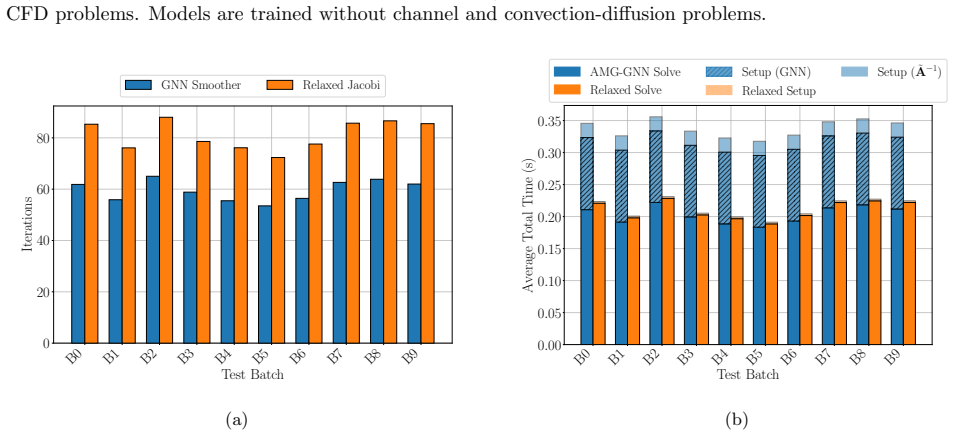
- The number of V-cycles required to reach a prescribed tolerance decreases on diverse unstructured grids.
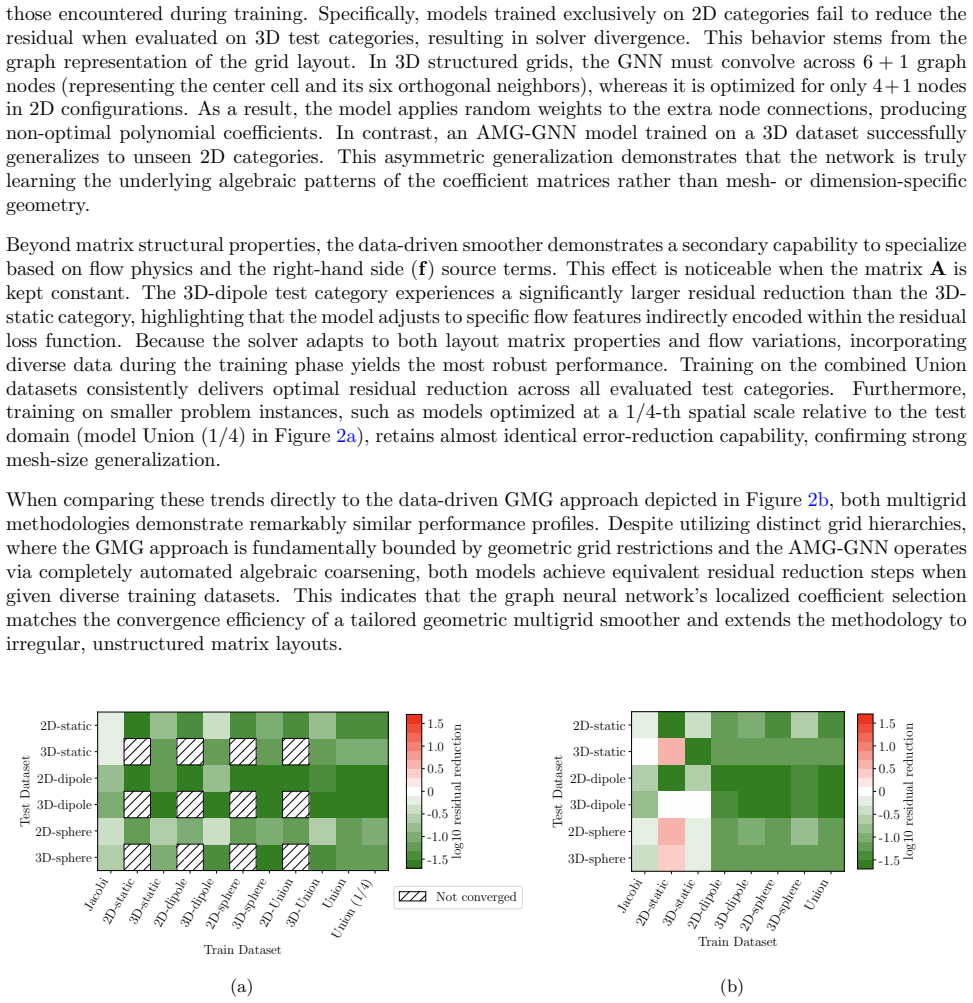
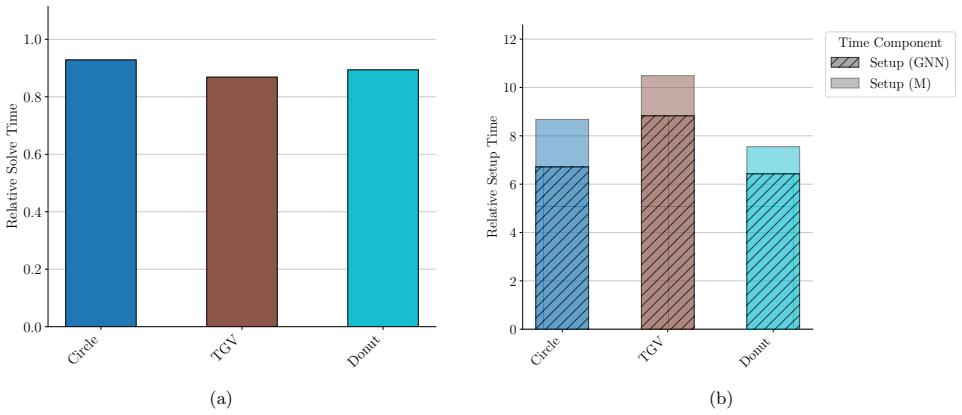
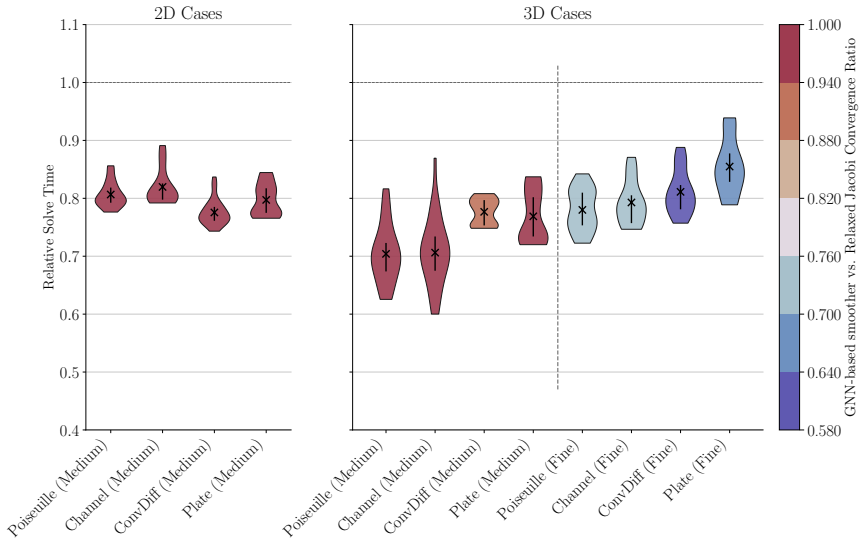
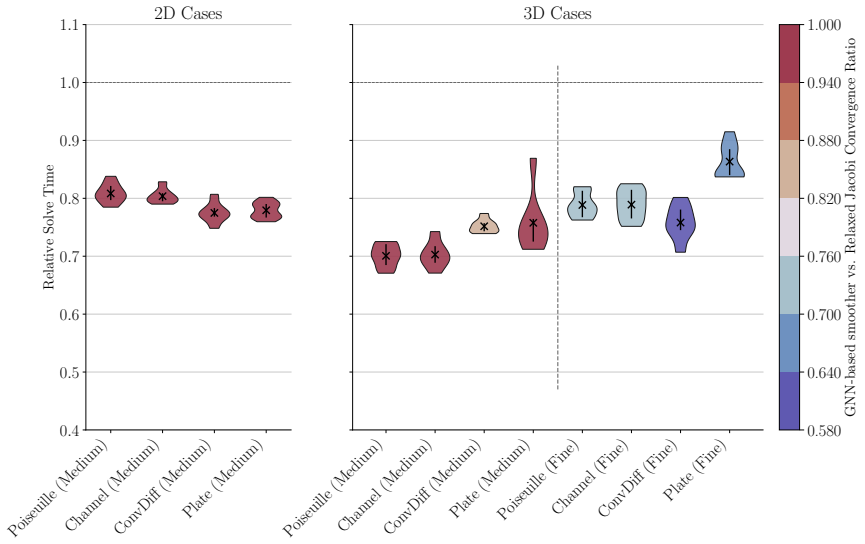
- Wall-clock execution time of the pressure solve drops by 4 to 37 percent across tested cases.
- The acceleration persists when the mesh is scaled up to 128 times the size used during training.
- Convergence improves on previously unseen industry meshes such as those in the AirfRANS dataset.
Where Pith is reading between the lines
- The same coefficient-prediction idea could be tested on other linear systems that suffer from mesh-induced ill-conditioning, such as elasticity or heat conduction on irregular domains.
- Because the network operates directly on the matrix graph, it might be combined with adaptive mesh refinement loops without retraining from scratch.
- If the predicted smoother remains effective across mesh sizes, it suggests that training data could be generated on small prototype grids and then deployed on production-scale simulations.
Load-bearing premise
A graph neural network trained on a limited collection of meshes can predict coefficients that reliably improve convergence on arbitrary unstructured grids, including ones 128 times larger and drawn from unrelated application domains, without violating the mathematical properties required by the algebraic multigrid solver.
What would settle it
Running the trained model on a fresh collection of meshes from a new domain and observing that the predicted coefficients produce no reduction in V-cycles or cause the solver to diverge would show the claimed generalization and acceleration do not hold.
Figures



read the original abstract
Solving the pressure-Poisson equation remains the primary computational bottleneck in incompressible unstructured flow solvers primarily due to the inherent sensitivity of traditional linear solvers to mesh irregularities. This work introduces a data-driven algebraic multigrid (AMG) smoother that uses a modified graph convolutional isomorphism network (GCIN). The graph neural network predicts optimal polynomial coefficients to construct a sparse pseudo-inverse operator across diverse grid topologies. The coefficients are optimized to reduce the residual after each V-cycle iteration. By directly capturing the algebraic structure of the system from the sparse coefficient matrix, the proposed method maintains the solver's linearity while adapting to local anisotropies in unstructured grids. Our framework demonstrates significant performance gains by reducing the number of V-cycles required for a given tolerance and delivering wall-clock speedups from 4% to 37% across diverse benchmarks. Notably, the model exhibits robust generalization by maintaining efficiency on meshes up to 128 times larger than those seen in training, and by accelerating the solver's convergence on unseen industry-relevant problems such as the AirfRANS dataset.
Editorial analysis
A structured set of objections, weighed in public.
Referee Report
Summary. The paper introduces a modified graph convolutional isomorphism network (GCIN) that predicts polynomial coefficients to construct a sparse pseudo-inverse smoother for algebraic multigrid (AMG) solution of the pressure-Poisson equation on unstructured grids. It claims this data-driven smoother reduces the number of V-cycles needed for a given tolerance and yields wall-clock speedups between 4% and 37% on diverse benchmarks, while generalizing to meshes up to 128 times larger than the training set and to out-of-domain problems such as the AirfRANS dataset, all without sacrificing the linearity of the underlying AMG solver.
Significance. If the reported generalization holds and the learned smoother provably preserves AMG convergence properties, the approach could meaningfully accelerate pressure solves in large-scale incompressible CFD on complex geometries. The work also highlights a potential route for embedding learned algebraic structure directly into established multigrid theory rather than replacing the solver entirely.
major comments (3)
- [Abstract] Abstract: the central generalization claim (robust performance on meshes 128× larger than training and on unseen AirfRANS cases) is stated without any description of training-set size, mesh-size distribution, loss formulation, or quantitative scale-up results; this information is load-bearing for the claim that the GCIN outputs remain valid smoothers independent of graph diameter.
- [Abstract] Abstract: no evidence or argument is supplied that the predicted polynomial coefficients produce an operator whose iteration matrix satisfies the spectral-radius or smoothing-property conditions required by classical AMG convergence theory; without such a guarantee the reported V-cycle reductions cannot be attributed to the method rather than to overfitting on the training residuals.
- [Abstract] The manuscript presents the GCIN as learning a mapping from matrix structure to coefficients yet supplies neither the explicit loss function (e.g., residual reduction versus a regularization term enforcing smoother validity) nor the validation protocol used to confirm that the learned operator remains a contraction on out-of-distribution graphs.
Simulated Author's Rebuttal
We thank the referee for the constructive and detailed comments. We address each major comment point by point below. Revisions will focus on clarifying the abstract and methods to better support the claims while remaining faithful to the empirical nature of the study.
read point-by-point responses
-
Referee: [Abstract] Abstract: the central generalization claim (robust performance on meshes 128× larger than training and on unseen AirfRANS cases) is stated without any description of training-set size, mesh-size distribution, loss formulation, or quantitative scale-up results; this information is load-bearing for the claim that the GCIN outputs remain valid smoothers independent of graph diameter.
Authors: We agree that additional context in the abstract would strengthen the generalization claim. In the revised manuscript we will update the abstract to include a concise statement on training-set size and mesh-size distribution, note that the loss targets residual reduction after V-cycle iterations, and point to the quantitative scale-up results already reported in the results section. This will be done without exceeding typical abstract length limits. revision: yes
-
Referee: [Abstract] Abstract: no evidence or argument is supplied that the predicted polynomial coefficients produce an operator whose iteration matrix satisfies the spectral-radius or smoothing-property conditions required by classical AMG convergence theory; without such a guarantee the reported V-cycle reductions cannot be attributed to the method rather than to overfitting on the training residuals.
Authors: The work is empirical and demonstrates performance gains through extensive numerical testing, including on meshes up to 128 times larger and on the unseen AirfRANS dataset. We will revise the abstract to explicitly characterize the improvements as empirically observed while preserving linearity of the AMG solver. A formal proof that the learned operator satisfies classical spectral-radius or smoothing conditions is not supplied and lies outside the present scope; the cross-mesh and out-of-distribution results provide supporting evidence that the gains are not due to overfitting. revision: partial
-
Referee: [Abstract] The manuscript presents the GCIN as learning a mapping from matrix structure to coefficients yet supplies neither the explicit loss function (e.g., residual reduction versus a regularization term enforcing smoother validity) nor the validation protocol used to confirm that the learned operator remains a contraction on out-of-distribution graphs.
Authors: We will make the loss function and validation protocol explicit in the revised manuscript. The loss is defined on residual reduction after each V-cycle iteration; we will add its precise mathematical form and describe the validation protocol (including out-of-distribution assessment) in the methods section, with a brief reference added to the abstract. revision: yes
Circularity Check
No significant circularity; derivation is self-contained empirical training plus held-out evaluation
full rationale
The paper trains a GCIN on a limited set of meshes to predict polynomial coefficients for a sparse pseudo-inverse AMG smoother, with the objective of reducing residual after V-cycles. Performance (V-cycle count and wall-clock speedup) is then measured on separate test meshes up to 128× larger and on the unseen AirfRANS dataset. This is a standard train/test split with no evidence that the reported speedups are re-statements of fitted quantities by construction, no self-definitional loops in the equations, and no load-bearing self-citations or uniqueness theorems imported from the authors' prior work. The generalization claim is an empirical assertion about the model's behavior on out-of-sample data, not a tautology.
Axiom & Free-Parameter Ledger
axioms (2)
- domain assumption The pressure-Poisson equation is the dominant computational cost in incompressible unstructured flow solvers.
- domain assumption Traditional AMG smoothers are sensitive to mesh irregularities.
invented entities (1)
-
modified graph convolutional isomorphism network (GCIN)
no independent evidence
Reference graph
Works this paper leans on
-
[1]
arXiv preprint arXiv:1511.07289 , year =
Djork-Arné Clevert and Thomas Unterthiner and Sepp Hochreiter , title =. arXiv preprint arXiv:1511.07289 , year =
-
[2]
Proceedings of the IEEE International Conference on Computer Vision (ICCV) , year =
Kaiming He and Xiangyu Zhang and Shaoqing Ren and Jian Sun , title =. Proceedings of the IEEE International Conference on Computer Vision (ICCV) , year =
-
[3]
Mark F. Adams , city =. A distributed memory unstructured gauss-seidel algorithm for multigrid smoothers , year =. Proceedings of the 2001 ACM/IEEE conference on Supercomputing , month =. doi:10.1145/582034.582038 , isbn =
-
[4]
Parallel multigrid smoothing: polynomial versus Gauss–Seidel , volume =
Mark Adams and Marian Brezina and Jonathan Hu and Ray Tuminaro , doi =. Parallel multigrid smoothing: polynomial versus Gauss–Seidel , volume =. Journal of Computational Physics , month =
-
[5]
Adams and S
N.A. Adams and S. Hickel , title =. 2009 , publisher =
2009
-
[6]
Ajuria Illarramendi, Ekhi and Bauerheim, Michaël and Cuenot, Bénédicte , year =. Performance and accuracy assessments of an incompressible fluid solver coupled with a deep convolutional neural network , volume =. doi:10.1017/dce.2022.2 , journal =
-
[7]
COARSENING INVARIANCE AND BUCKET-SORTED INDEPENDENT SETS FOR ALGEBRAIC MULTIGRID * , volume =
David M Alber and Luke N Olson , issn =. COARSENING INVARIANCE AND BUCKET-SORTED INDEPENDENT SETS FOR ALGEBRAIC MULTIGRID * , volume =. Electronic Transactions on Numerical Analysis , keywords =
-
[8]
Antonietti and Matteo Caldana and Luca Dede’ , doi =
Paola F. Antonietti and Matteo Caldana and Luca Dede’ , doi =. Accelerating Algebraic Multigrid Methods via Artificial Neural Networks , volume =. Vietnam Journal of Mathematics , month =
-
[9]
Asch, Mark and Bocquet, Marc and Nodet, Ma. Data. 2016 , publisher =
2016
-
[10]
Communication-efficient algorithms for solving pressure Poisson equation for multiphase flows using parallel computers , volume =
Soumyadip Ghosh and Jiacai Lu and Vijay Gupta and Gretar Tryggvason , doi =. Communication-efficient algorithms for solving pressure Poisson equation for multiphase flows using parallel computers , volume =. PLOS ONE , month =
-
[11]
A H Baker and R D Falgout and T V Kolev and U M Yang and Allison H Baker and Robert D Falgout and Tzanio V Kolev and Ulrike Meier Yang , title =
-
[12]
Y. Bao and R. Palacios and M. Graham and S. Sherwin , title =. doi:10.1016/j.jcp.2016.05.062 , year =
-
[13]
Battaglia and Jessica B
Peter W. Battaglia and Jessica B. Hamrick and Victor Bapst and Alvaro Sanchez-Gonzalez and Vinicius Zambaldi and Mateusz Malinowski and Andrea Tacchetti and David Raposo and Adam Santoro and Ryan Faulkner and Caglar Gulcehre and Francis Song and Andrew Ballard and Justin Gilmer and George Dahl and Ashish Vaswani and Kelsey Allen and Charles Nash and Victo...
-
[14]
2018 , eprint =
Relational inductive biases, deep learning, and graph networks , author =. 2018 , eprint =
2018
-
[15]
Deep neural networks for data-driven
Andrea Beck and David Flad and Claus-Dieter Munz , doi =. Deep neural networks for data-driven. Journal of Computational Physics , month =
-
[16]
Analysis of Augmented Lagrangian-Based Preconditioners for the Steady Incompressible Navier–Stokes Equations , volume =
Michele Benzi and Zhen Wang , doi =. Analysis of Augmented Lagrangian-Based Preconditioners for the Steady Incompressible Navier–Stokes Equations , volume =. SIAM Journal on Scientific Computing , month =
-
[17]
Stanley Williams and Katherine Yelick , journal =
Keren Bergman and Shekhar Borkar and Dan Campbell and William Carlson and William Dally and Monty Denneau and Paul Franzon and William Harrod and Kerry Hill and Jon Hiller and Sherman Karp and Stephen Keckler and Dean Klein and Peter Kogge and Robert Lucas and Mark Richards and Al Scarpelli and Steven Scott and Thomas Sterling and Allan Snavely and R. Sta...
-
[18]
Carrozzo and Alessandro Celestini and Giacomo Piperno and Pasqua D'Ambra , month =
Massimo Bernaschi and Mauro G. Carrozzo and Alessandro Celestini and Giacomo Piperno and Pasqua D'Ambra , month =. Communication-reduced Conjugate Gradient Variants for GPU-accelerated Clusters , year =
-
[19]
Florent Bonnet and Ahmed Jocelyn Mazari and Paola Cinnella and Patrick Gallinari , year =. Airf. 2212.07564 , archiveprefix =
-
[20]
BoomerAMG: A parallel algebraic multigrid solver and preconditioner , volume =
Henson, Van and Yang, Ulrike , year =. BoomerAMG: A parallel algebraic multigrid solver and preconditioner , volume =. Applied Numerical Mathematics , doi =
-
[21]
Bose and George Ilhwan Park , doi =
Sanjeeb T. Bose and George Ilhwan Park , doi =. Wall-Modeled Large-Eddy Simulation for Complex Turbulent Flows , volume =. Annual Review of Fluid Mechanics , month =
-
[22]
Bramble, James H. and Kwak, Do Y. and Pasciak, Joseph E. , title =. SIAM Journal on Numerical Analysis , volume =. 1994 , doi =. https://doi.org/10.1137/0731089 , abstract =
-
[23]
UNIFORM CONVERGENCE OF THE MULTIGRID V-CYCLE FOR AN ANISOTROPIC PROBLEM , volume =
James H Bramble and Xuejun Zhang , issue =. UNIFORM CONVERGENCE OF THE MULTIGRID V-CYCLE FOR AN ANISOTROPIC PROBLEM , volume =. MATHEMATICS OF COMPUTATION , pages =
-
[24]
J. H.. Bramble , isbn =. Multigrid methods , year =
-
[25]
Multi-Level Adaptive Technique (MLAT) for Fast Numerical Solution to Boundary Value Problems , volume =
Brandt, Achi , year =. Multi-Level Adaptive Technique (MLAT) for Fast Numerical Solution to Boundary Value Problems , volume =. Lecture Notes in Physics , doi =
-
[26]
Livne , doi =
Achi Brandt and Oren E. Livne , doi =. Multigrid Techniques , year =
-
[27]
Brezina and R
M. Brezina and R. Falgout and Scott MacLachlan and T. Manteuffel and Steve McCormick and J. Ruge , doi =. Adaptive smoothed aggregation (αSA) multigrid , volume =. SIAM Review , keywords =
-
[28]
Sparse approximate inverse smoothers for geometric and algebraic multigrid , volume =
O Bröker , doi =. Sparse approximate inverse smoothers for geometric and algebraic multigrid , volume =. Applied Numerical Mathematics , month =
-
[29]
Improving Efficiency of Algebraic Multigrid Methods through Artificial Neural Networks , year =
Matteo Caldana , city =. Improving Efficiency of Algebraic Multigrid Methods through Artificial Neural Networks , year =
-
[30]
Antonietti and Luca Dede' , doi =
Matteo Caldana and Paola F. Antonietti and Luca Dede' , doi =. A deep learning algorithm to accelerate algebraic multigrid methods in finite element solvers of 3. Computers & Mathematics with Applications , month =
-
[31]
A machine learning based solver for pressure Poisson equations , volume =
Ruilin Chen and Xiaowei Jin and Hui Li , doi =. A machine learning based solver for pressure Poisson equations , volume =. Theoretical and Applied Mechanics Letters , month =
-
[32]
IMA Journal of Numerical Analysis , volume =
Bruce Christianson , title =. IMA Journal of Numerical Analysis , volume =
-
[33]
Carrozzo and Alessandro Celestini and Giacomo Piperno and Pasqua D’Ambra , doi =
Massimo Bernaschi and Mauro G. Carrozzo and Alessandro Celestini and Giacomo Piperno and Pasqua D’Ambra , doi =. Communication-reduced. 2025 33rd Euromicro International Conference on Parallel, Distributed, and Network-Based Processing (PDP) , month =
2025
-
[34]
AMG Preconditioners for Linear Solvers towards Extreme Scale , volume =
Pasqua D'Ambra and Fabio Durastante and Salvatore Filippone , doi =. AMG Preconditioners for Linear Solvers towards Extreme Scale , volume =. SIAM Journal on Scientific Computing , month =
-
[35]
2024 , publisher =
Jan van Gemert , title =. 2024 , publisher =
2024
-
[36]
Mitigation of transonic shock buffet on a supercritical airfoil through wavy leading edges , volume =
Degregori, Enrico and Kim, Jae , year =. Mitigation of transonic shock buffet on a supercritical airfoil through wavy leading edges , volume =. Physics of Fluids , doi =
-
[37]
2018 , eprint =
Topology Adaptive Graph Convolutional Networks , author =. 2018 , eprint =
2018
-
[38]
Mohamed F. El-Amin , keywords =. Chapter Three - Spatial-fractional derivatives for fluid flow and transport phenomena , editor =. Fractional-Order Modeling of Dynamic Systems with Applications in Optimization, Signal Processing and Control , publisher =. 2022 , volume =. doi:https://doi.org/10.1016/B978-0-32-390089-8.00008-8 , url =
-
[39]
MULTIGRID AND KRYLOV SUBSPACE METHODS FOR THE DISCRETE STOKES EQUATIONS , volume =
Howard C Elman , journal =. MULTIGRID AND KRYLOV SUBSPACE METHODS FOR THE DISCRETE STOKES EQUATIONS , volume =
-
[40]
, journal =
Falgout, R.D. , journal =. An introduction to algebraic multigrid , year =
-
[41]
2023 , publisher =
Aidan Wimshurst , title =. 2023 , publisher =
2023
-
[42]
B. Font and G.D. Weymouth and V.-T. Nguyen and O.R. Tutty , title =. 2019 , month = sep, publisher =. doi:10.1017/jfm.2019.637 , url =
-
[43]
and Weymouth, G.D
Font, B. and Weymouth, G.D. and Nguyen, V.-T. and Tutty, O.R. , year =. Deep learning of the spanwise-averaged. Journal of Computational Physics , volume =
-
[44]
Deep Learning , author =
-
[45]
Learning to
Greenfeld, Daniel and Galun, Meirav and Basri, Ronen and Yavneh, Irad and Kimmel, Ron , year =. Learning to
-
[46]
Haifeng Zou Haifeng Zou and Xiaowen Xu Xiaowen Xu and Chen-Song Zhang Chen-Song Zhang and Zeyao Mo Zeyao Mo , doi =. Auto. Communications in Computational Physics , month =
-
[47]
Accelerating multigrid solver with generative super-resolution , year =
Francisco Holguin and GS Sidharth and Gavin Portwood , month =. Accelerating multigrid solver with generative super-resolution , year =
-
[48]
Learning
Ru Huang and Ruipeng Li and Yuanzhe Xi , doi =. Learning. SIAM Journal on Scientific Computing , month =
-
[49]
Reducing
Ru Huang and Kai Chang and Huan He and Ruipeng Li and Yuanzhe Xi , doi =. Reducing. SIAM Journal on Scientific Computing , month =
-
[50]
arXiv preprint arXiv:1502.03167 , year =
Sergey Ioffe and Christian Szegedy , title =. arXiv preprint arXiv:1502.03167 , year =
-
[51]
Shantenu Jha and Abhinav Patke and Jim Brandt and Ann Gentile and Benjamin Lim and Mike Showerman and Greg Bauer and Larry Kaplan and Harvey Wasserman and Nicholas Wright and Kevin Tu and Sameer Shende , title =. 17th. 2020 , pages =
2020
-
[52]
Adaptive
Navnit Jha and Ekansh Mallik , doi =. Adaptive. SN Computer Science , month =
-
[53]
Jimenez Navarro, Cesar and Abou Khalil, Jacques and El Akoury, Rajaa and Marouf, Abderahmane and T. Numerical Study and Physical Analysis of the Transonic Interaction and Its Modification Through Morphing Around Supercritical Wings at High Reynolds Number , booktitle =. 2025 , publisher =. doi:10.1007/978-3-031-86605-0_11 , url =
-
[54]
Borgwardt , title =
Nino Shervashidze and Pascal Schweitzer and Erik Jan van Leeuwen and Kurt Mehlhorn and Karsten M. Borgwardt , title =. Journal of Machine Learning Research , year =
-
[55]
Jones and Paul E
Mark T. Jones and Paul E. Plassmann , doi =. A Parallel Graph Coloring Heuristic , volume =. SIAM Journal on Scientific Computing , month =
-
[56]
2017 , eprint =
Semi-Supervised Classification with Graph Convolutional Networks , author =. 2017 , eprint =
2017
-
[57]
Hinton , title =
Alex Krizhevsky and Ilya Sutskever and Geoffrey E. Hinton , title =. Advances in Neural Information Processing Systems , year =
- [58]
-
[59]
and Weymouth, G
Lauber, M. and Weymouth, G. D. and Limbert, G. , title =. Journal of Computational Physics , year =
-
[60]
Surrogate modeling of fluid dynamics with a multigrid inspired neural network architecture , volume =
Quang Tuyen Le and Chinchun Ooi , doi =. Surrogate modeling of fluid dynamics with a multigrid inspired neural network architecture , volume =. Machine Learning with Applications , month =
-
[61]
Advances in Neural Information Processing Systems , year =
Hao Li and Zheng Xu and Gavin Taylor and Christoph Studer and Tom Goldstein , title =. Advances in Neural Information Processing Systems , year =
-
[62]
Learning
Li, Yichen and Chen, Peter Yichen and Du, Tao and Matusik, Wojciech , booktitle =. Learning. 2023 , volume =
2023
-
[63]
M2NO: Multiresolution Operator Learning with Multiwavelet-based Algebraic Multigrid Method , year =
Zhihao Li and Zhilu Lai and Xiaobo Zhang and Wei Wang , month =. M2NO: Multiresolution Operator Learning with Multiwavelet-based Algebraic Multigrid Method , year =
-
[64]
2019 , eprint =
Decoupled Weight Decay Regularization , author =. 2019 , eprint =
2019
-
[65]
Proceedings of the 37th International Conference on Machine Learning , articleno =
Luz, Ilay and Galun, Meirav and Maron, Haggai and Basri, Ronen and Yavneh, Irad , title =. Proceedings of the 37th International Conference on Machine Learning , articleno =. 2020 , publisher =
2020
-
[66]
and Weymouth, Gabriel D
Maertens, Andrew P. and Weymouth, Gabriel D. , title =. Computer Methods in Applied Mechanics and Engineering , year =
-
[67]
Maulik and O
R. Maulik and O. San and A. Rasheed and P. Vedula , doi =. Subgrid modelling for two-dimensional turbulence using neural networks , volume =. Journal of Fluid Mechanics , month =
-
[68]
Understanding Aerodynamics , year =
Doug McLean , doi =. Understanding Aerodynamics , year =
-
[69]
A multilevel AINV preconditioner , volume =
Gérard Meurant , journal =. A multilevel AINV preconditioner , volume =
-
[70]
Numerical Study and Physical Analysis of the Transonic Interaction and Its Modification Through Morphing Around Supercritical Wings at High Reynolds Number , isbn =
Navarro, César and Khalil, Jacques and Akoury, Rajaa and Marouf, Abderahmane and Tô, Jean-Baptiste and Hoarau, Yannick and Rouchon, Jean-François and Braza, Marianna , year =. Numerical Study and Physical Analysis of the Transonic Interaction and Its Modification Through Morphing Around Supercritical Wings at High Reynolds Number , isbn =
-
[71]
A neural network multigrid solver for the
Nils Margenberg and Dirk Hartmann and Christian Lessig and Thomas Richter , doi =. A neural network multigrid solver for the. Journal of Computational Physics , month =
-
[72]
Mathematics of Computation , volume =
Jorge Nocedal , title =. Mathematics of Computation , volume =
-
[73]
Learning aggregates and interpolation for algebraic multigrid , year =
Nicolas Nytko , city =. Learning aggregates and interpolation for algebraic multigrid , year =
-
[74]
Ali Girayhan Ozbay and Arash Hamzehloo and Sylvain Laizet and Panagiotis Tzirakis and Georgios Rizos and Bjorn Schuller , doi =. Poisson. Data-Centric Engineering , keywords =
-
[75]
doi:10.48550/ARXIV.2501.10750 , author =
2025 , copyright =. doi:10.48550/ARXIV.2501.10750 , author =
-
[76]
torch\_geometric.nn.conv.GCNConv — PyTorch Geometric Documentation , author =
-
[77]
torch.optim.lr\_scheduler.CosineAnnealingLR — PyTorch 2.9 documentation , author =
-
[78]
torch.optim.lr\_scheduler.ReduceLROnPlateau — PyTorch 2.9 documentation , author =
-
[79]
U-Net: Convolutional Networks for Biomedical Image Segmentation , year =
Olaf Ronneberger and Philipp Fischer and Thomas Brox , doi =. U-Net: Convolutional Networks for Biomedical Image Segmentation , year =
-
[80]
Iterative Methods for Sparse Linear Systems , year =
Yousef Saad , doi =. Iterative Methods for Sparse Linear Systems , year =
discussion (0)
Sign in with ORCID, Apple, or X to comment. Anyone can read and Pith papers without signing in.