Risk Stratification for ICU Delirium using Pervasive Ambient Sensing Information
Pith reviewed 2026-06-26 20:56 UTC · model grok-4.3
The pith
Ambient sound and light data from ICU rooms can predict patient delirium risk using sequential neural networks.
A machine-rendered reading of the paper's core claim, the machinery that carries it, and where it could break.
Core claim
A convolutional neural network applied to sequential ambient sound and light recordings from ICU rooms achieves an area under the curve of 0.80 for delirium prediction. Sound pressure level features dominate the predictions across all horizons, while the combination of sound and light yields the highest risk scores immediately after the sensing period for short-term forecasts.
What carries the argument
Convolutional neural network processing time-series ambient sound and light data, interpreted with Shapley Additive Explanations to rank feature importance.
If this is right
- Sound-based models can stratify delirium risk across multiple prediction windows from hours to weeks.
- Integrating light data with sound improves accuracy for predictions under one week.
- Passive sensing provides an interpretable environmental signal that can enrich multimodal ICU prediction systems.
- The dominant role of sound suggests focusing on acoustic environment modifications for prevention.
Where Pith is reading between the lines
- Similar ambient sensing could be tested in non-ICU hospital wards where delirium also occurs.
- Real-time alerts based on rising sound levels might allow immediate interventions like noise reduction.
- Future models could combine these signals with vital signs or medication data for higher accuracy.
Load-bearing premise
The ambient sound and light measurements are collected consistently across the nine ICUs without major confounding from patient-specific care practices or room variables.
What would settle it
Replicating the study in a new set of ICUs and finding that the convolutional model's AUC falls below 0.70 on sound data alone would falsify the claim that ambient sensing provides a reliable signal.
Figures



read the original abstract
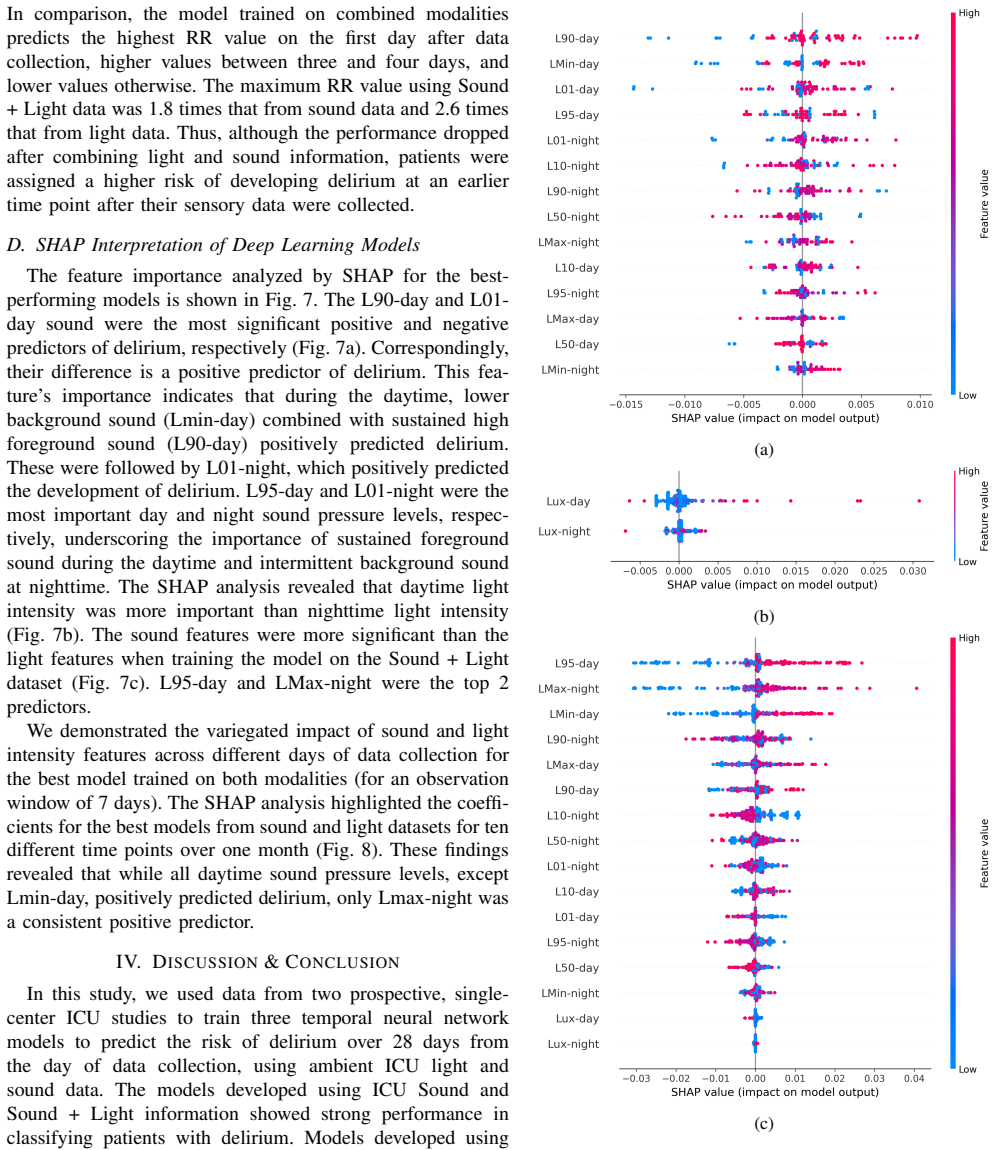
Delirium is a common and serious complication in the Intensive Care Unit (ICU), associated with increased morbidity, prolonged hospital stays, and higher healthcare costs. Despite its prevalence, early prediction and prevention remain challenging. Environmental factors such as ambient sound and light may influence the onset of delirium, yet they are often overlooked in risk assessments. In this study, we examined whether light intensity and sound pressure levels can independently predict delirium across multiple prediction horizons. We evaluated four efficient sequential neural network models on data collected from 9 ICUs across 309 patients to predict delirium for 10 prediction-window sizes. We reported feature importance and direction of influence using Shapley Additive Explanations analysis. The convolutional model achieved the strongest discrimination, with AUC = 0.80 on sound data and on combined data. Sound features were the dominant predictors overall. Integrating sound with light improved short-term ($<1$ week) prediction, with the combined model assigning the highest risk immediately after the sensing period. These findings suggest that passive ambient sensing, especially sound, can add a clinically meaningful, interpretable signal for delirium risk estimation and offer a practical pathway to enrich multimodal ICU prediction and prevention strategies.
Editorial analysis
A structured set of objections, weighed in public.
Referee Report
Summary. The paper claims that ambient sound pressure levels and light intensity data collected from 9 ICUs across 309 patients can be used with four efficient sequential neural network models to predict ICU delirium onset across 10 prediction horizons. The convolutional model achieves the highest discrimination with AUC = 0.80 on sound-only and combined sound+light inputs; sound features dominate overall, while adding light improves short-term (<1 week) predictions, with the combined model assigning highest risk immediately after the sensing period. SHAP analysis is used to report feature importance and direction of influence.
Significance. If the empirical results hold after proper validation, the work would demonstrate that passive ambient sensing—particularly sound—can supply a clinically meaningful, interpretable signal for delirium risk stratification that is independent of invasive patient monitoring and could enrich multimodal ICU prediction pipelines.
major comments (3)
- [Abstract] Abstract: the central performance claim (convolutional model AUC = 0.80 on sound and combined data) is presented without any information on model architectures, training/validation splits, handling of missing data, statistical testing, or pre-specification of the 10 prediction horizons, rendering the discrimination results unevaluable.
- [Abstract] Abstract / implied Methods: data are drawn from 9 ICUs yet the text supplies no site-stratified validation, fixed effects, or external covariates; consequently the reported AUC and SHAP attributions could be driven by site-level batch effects (care practices, occupancy, acuity) rather than the intended ambient-sensing pathway.
- [Abstract] Abstract: the claim that sound features are "dominant predictors overall" and that light integration improves short-term prediction rests on the same unevaluated experimental pipeline; without the missing methodological details these attributions cannot be assessed for robustness.
minor comments (1)
- The abstract contains inline LaTeX markup ("$<1$ week") that should be rendered consistently in the published version.
Simulated Author's Rebuttal
We thank the referee for the detailed review and constructive feedback on our manuscript. We address each of the major comments point by point below. Where appropriate, we have revised the abstract to incorporate additional methodological information while respecting length constraints, and we have added clarifications and sensitivity analyses to the main text and supplementary materials.
read point-by-point responses
-
Referee: [Abstract] Abstract: the central performance claim (convolutional model AUC = 0.80 on sound and combined data) is presented without any information on model architectures, training/validation splits, handling of missing data, statistical testing, or pre-specification of the 10 prediction horizons, rendering the discrimination results unevaluable.
Authors: We agree that the abstract is highly condensed and omits key methodological details present in the full manuscript. Model architectures (four efficient sequential networks, with the convolutional model detailed in Section 3.2), patient-level 5-fold cross-validation splits (Section 4.1), missing data handling via forward-fill and median imputation (Section 3.3), and pre-specification of the 10 clinically motivated prediction horizons (Section 2.3) are all described in the main text. We have revised the abstract to briefly reference the convolutional architecture, cross-validation procedure, and pre-specified horizons. Statistical testing (DeLong tests for AUC comparisons) is reported in Section 4.4. revision: yes
-
Referee: [Abstract] Abstract / implied Methods: data are drawn from 9 ICUs yet the text supplies no site-stratified validation, fixed effects, or external covariates; consequently the reported AUC and SHAP attributions could be driven by site-level batch effects (care practices, occupancy, acuity) rather than the intended ambient-sensing pathway.
Authors: This concern about potential site-level confounding is valid and was not fully addressed in the original submission. The models were trained on pooled multi-site data without explicit site stratification or fixed effects. We have added a sensitivity analysis incorporating site as a random effect (via mixed-effects logistic regression baseline) in the supplementary materials, which shows the AUC remains within 0.02 of the reported value. A full leave-one-site-out validation is noted as a limitation in the revised discussion due to uneven site sizes and computational cost; this will be prioritized in follow-up work. revision: partial
-
Referee: [Abstract] Abstract: the claim that sound features are "dominant predictors overall" and that light integration improves short-term prediction rests on the same unevaluated experimental pipeline; without the missing methodological details these attributions cannot be assessed for robustness.
Authors: The SHAP-based feature importance and dominance claims (sound features dominant across horizons; light adding value for <1 week horizons) derive directly from the pipeline now referenced in the revised abstract and detailed in Sections 4.5 and 5. With the added methodological context, the attributions can be evaluated against the reported cross-validation and model specifications. The direction of influence for sound (higher levels increasing risk) is consistent in the SHAP plots (Figure 5). revision: yes
Circularity Check
No circularity: standard empirical ML evaluation on held-out patient data
full rationale
The paper trains and evaluates four sequential neural network models (including a convolutional model) on ambient sound and light time-series data collected from 309 patients across 9 ICUs to predict delirium over 10 horizons, reporting AUC=0.80 and SHAP attributions. No equations, derivations, or first-principles results are presented; performance metrics derive from standard supervised learning on empirical data rather than any self-definitional mapping, fitted-input renaming, or self-citation chain. The central claims rest on data-driven discrimination and are self-contained against external benchmarks.
Axiom & Free-Parameter Ledger
Reference graph
Works this paper leans on
-
[1]
Acute brain failure: pathophysiology, diagnosis, management, and sequelae of delirium,
J. R. Maldonado, “Acute brain failure: pathophysiology, diagnosis, management, and sequelae of delirium,”Critical care clinics, vol. 33, no. 3, pp. 461–519, 2017
2017
-
[2]
Artificial intelligence appli- cations in delirium prediction, diagnosis, and management: a systematic review,
S. Lv, J. Li, H. He, Q. Zhao, and Y . Jiang, “Artificial intelligence appli- cations in delirium prediction, diagnosis, and management: a systematic review,”Artificial Intelligence Review, vol. 58, no. 9, p. 269, 2025
2025
-
[3]
Association of delirium with long-term cognitive decline: a meta-analysis,
T. E. Goldberg, C. Chen, Y . Wang, E. Jung, A. Swanson, C. Ing, P. S. Garcia, R. A. Whittington, and V . Moitra, “Association of delirium with long-term cognitive decline: a meta-analysis,”JAMA neurology, vol. 77, no. 11, pp. 1373–1381, 2020
2020
-
[4]
Delirium epidemiology in critical care (decca): an international study,
J. I. Salluh, M. Soares, J. M. Teles, D. Ceraso, N. Raimondi, V . S. Nava, P. Blasquez, S. Ugarte, C. Ibanez-Guzman, J. V . Centenoet al., “Delirium epidemiology in critical care (decca): an international study,” Critical Care, vol. 14, pp. 1–7, 2010
2010
-
[5]
Melon: M ultimodal mixture-of-e xperts with spectral-temporal fusion for l ong- term mo bility estimatio n in critical care,
J. Zhang, M. Contreras, J. Sena, A. Davidson, Y . Ren, Z. Guan, T. Ozrazgat-Baslanti, T. J. Loftus, S. Nerella, A. Bihoracet al., “Melon: M ultimodal mixture-of-e xperts with spectral-temporal fusion for l ong- term mo bility estimatio n in critical care,” inInternational Conference on Medical Image Computing and Computer-Assisted Intervention. Springer, ...
2025
-
[6]
Costs associated with delirium in mechanically ventilated patients,
E. B. Milbrandt, S. Deppen, P. L. Harrison, A. K. Shintani, T. Speroff, R. A. Stiles, B. Truman, G. R. Bernard, R. S. Dittus, and E. W. Ely, “Costs associated with delirium in mechanically ventilated patients,” Critical care medicine, vol. 32, no. 4, pp. 955–962, 2004
2004
-
[7]
A critical care societies collaborative statement: burnout syndrome in critical care health-care professionals. a call for action,
M. Moss, V . S. Good, D. Gozal, R. Kleinpell, and C. N. Sessler, “A critical care societies collaborative statement: burnout syndrome in critical care health-care professionals. a call for action,”American journal of respiratory and critical care medicine, vol. 194, no. 1, pp. 106–113, 2016
2016
-
[8]
Evaluation of delirium in critically ill patients: validation of the confusion assessment method for the intensive care unit (cam-icu),
E. W. Ely, R. Margolin, J. Francis, L. May, B. Truman, R. Dittus, T. Speroff, S. Gautam, G. R. Bernard, and S. K. Inouye, “Evaluation of delirium in critically ill patients: validation of the confusion assessment method for the intensive care unit (cam-icu),”Critical care medicine, vol. 29, no. 7, pp. 1370–1379, 2001
2001
-
[9]
Delirium in mechanically ventilated patients: validity and reliability of the confusion assessment method for the intensive care unit (cam-icu),
E. W. Ely, S. K. Inouye, G. R. Bernard, S. Gordon, J. Francis, L. May, B. Truman, T. Speroff, S. Gautam, R. Margolinet al., “Delirium in mechanically ventilated patients: validity and reliability of the confusion assessment method for the intensive care unit (cam-icu),”Jama, vol. 286, no. 21, pp. 2703–2710, 2001
2001
-
[10]
Routine use of the confusion assessment method for the intensive care unit: a multicenter study,
M. M. van Eijk, M. van den Boogaard, R. J. van Marum, P. Benner, P. Eikelenboom, M. L. Honing, B. van der Hoven, J. Horn, G. J. Izaks, A. Kalfet al., “Routine use of the confusion assessment method for the intensive care unit: a multicenter study,”American journal of respiratory and critical care medicine, vol. 184, no. 3, pp. 340–344, 2011
2011
-
[11]
Limitations and practicalities of cam-icu implementation, a delirium scoring system, in a dutch intensive care unit,
B. Riekerk, E. J. Pen, J. G. Hofhuis, J. H. Rommes, M. J. Schultz, and P. E. Spronk, “Limitations and practicalities of cam-icu implementation, a delirium scoring system, in a dutch intensive care unit,”Intensive and Critical Care Nursing, vol. 25, no. 5, pp. 242–249, 2009
2009
-
[12]
Icu delirium-prediction models: a systematic review,
M. M. Ruppert, J. Lipori, S. Patel, E. Ingersent, J. Cupka, T. Ozrazgat- Baslanti, T. Loftus, P. Rashidi, and A. Bihorac, “Icu delirium-prediction models: a systematic review,”Critical care explorations, vol. 2, no. 12, p. e0296, 2020
2020
-
[13]
Predicting intensive care delirium with machine learning: model development and external validation,
K. D. Gong, R. Lu, T. S. Bergamaschi, A. Sanyal, J. Guo, H. B. Kim, H. T. Nguyen, J. L. Greenstein, R. L. Winslow, and R. D. Stevens, “Predicting intensive care delirium with machine learning: model development and external validation,”Anesthesiology, vol. 138, no. 3, pp. 299–311, 2023
2023
-
[14]
A machine learning approach to identifying delirium from electronic health records,
J. H. Kim, M. Hua, R. A. Whittington, J. Lee, C. Liu, C. N. Ta, E. R. Marcantonio, T. E. Goldberg, and C. Weng, “A machine learning approach to identifying delirium from electronic health records,”JAMIA open, vol. 5, no. 2, p. ooac042, 2022
2022
-
[15]
Automated tracking of level of consciousness and delirium in critical illness using deep learning,
H. Sun, E. Kimchi, O. Akeju, S. B. Nagaraj, L. M. McClain, D. W. Zhou, E. Boyle, W.-L. Zheng, W. Ge, and M. B. Westover, “Automated tracking of level of consciousness and delirium in critical illness using deep learning,”NPJ digital medicine, vol. 2, no. 1, p. 89, 2019
2019
-
[16]
Auditing Multimodal LLM Raters: Central Tendency Bias in Clinical Ordinal Scoring
J. Zhang, S. Elluri, B. Cherukuvada, Y . Joffe, J. Sena, M. Contreras, S. Siegel, S. Nerella, C. Price, and P. Rashidi, “Auditing multimodal llm raters: Central tendency bias in clinical ordinal scoring,”arXiv preprint arXiv:2605.16386, 2026
work page internal anchor Pith review Pith/arXiv arXiv 2026
-
[17]
Dellirium: A large language model for delirium prediction in the icu using structured ehr,
M. Contreras, S. Kapoor, J. Zhang, A. Davidson, Y . Ren, Z. Guan, T. Ozrazgat-Baslanti, J. Sena, S. Nerella, A. Bihoracet al., “Dellirium: A large language model for delirium prediction in the icu using structured ehr,”Research Square, pp. rs–3, 2025
2025
-
[18]
Association of natural light exposure and delirium according to the presence or absence of windows in the intensive care unit,
H. J. Lee, E. Bae, H. Y . Lee, S.-M. Lee, and J. Lee, “Association of natural light exposure and delirium according to the presence or absence of windows in the intensive care unit,”Acute and Critical Care, vol. 36, no. 4, p. 332, 2021
2021
-
[19]
Noise in the intensive care unit and its influence on sleep quality: a multicenter observational study in dutch intensive care units,
K. S. Simons, E. Verweij, P. M. Lemmens, S. Jelfs, M. Park, P. E. Spronk, J. P. Sonneveld, H.-M. Feijen, M. S. van der Steen, A. G. Kohlrauschet al., “Noise in the intensive care unit and its influence on sleep quality: a multicenter observational study in dutch intensive care units,”Critical Care, vol. 22, pp. 1–8, 2018
2018
-
[20]
Quantifying circadian desynchrony in icu patients and its association with delirium,
Y . Ren, A. E. Davidson, J. Zhang, M. Contreras, A. K. Patel, M. Gumz, T. Ozrazgat-Baslanti, P. Rashidi, and A. Bihorac, “Quantifying circadian desynchrony in icu patients and its association with delirium,”arXiv preprint arXiv:2503.08732, 2025
-
[21]
Noise in hospital intensive care units—a critical review of a critical topic,
A. Konkani and B. Oakley, “Noise in hospital intensive care units—a critical review of a critical topic,”Journal of critical care, vol. 27, no. 5, pp. 522–e1, 2012
2012
-
[22]
Light levels in icu patient rooms: dimming of daytime light in occupied rooms,
E. R. Lusczek and M. P. Knauert, “Light levels in icu patient rooms: dimming of daytime light in occupied rooms,”Journal of Patient Experience, vol. 8, p. 23743735211033104, 2021
2021
-
[23]
An investigation of sound levels on intensive care units with reference to the who guidelines,
J. L. Darbyshire and J. D. Young, “An investigation of sound levels on intensive care units with reference to the who guidelines,”Critical Care, vol. 17, pp. 1–8, 2013
2013
-
[24]
Impact of the environment on health status of intensive care unit patients: Functional data analysis using wearable monitoring systems,
F. J. Rodr ´ıguez-Cort´es, J. A. Arias-L´opez, M. Oviedo-de la Fuente, J. M. Jim´enez-Pastor, L. L ´opez-Coleto, P. Ar ´evalo-Buitrago, J. de la Cruz L´opez-Carrasco, R. Valverde-Le ´on, P. J. L ´opez-Soto, and I. Morales- Can´e, “Impact of the environment on health status of intensive care unit patients: Functional data analysis using wearable monitoring...
2025
-
[25]
Delirium variability is influenced by the sound environment (devise study): how changes in the intensive care unit soundscape affect delirium incidence,
A. Sangari, E. A. Emhardt, B. Salas, A. Avery, R. E. Freundlich, D. Fabbri, M. S. Shotwell, and J. J. Schlesinger, “Delirium variability is influenced by the sound environment (devise study): how changes in the intensive care unit soundscape affect delirium incidence,”Journal of medical systems, vol. 45, no. 8, p. 76, 2021
2021
-
[26]
A unified approach to interpreting model predictions,
S. M. Lundberg and S.-I. Lee, “A unified approach to interpreting model predictions,” inAdvances in Neural Information Processing Systems 30, I. Guyon, U. V . Luxburg, S. Bengio, H. Wallach, R. Fergus, S. Vishwanathan, and R. Garnett, Eds. Curran Associates, Inc., 2017, pp. 4765–4774. [Online]. Available: http://papers.nips.cc/paper/7062-a- unified-approa...
2017
-
[27]
Computable phenotypes to characterize changing patient brain dysfunction in the intensive care unit,
Y . Ren, T. J. Loftus, Z. Guan, R. Uddin, B. Shickel, C. B. Maciel, K. Busl, P. Rashidi, A. Bihorac, and T. Ozrazgat-Baslanti, “Computable phenotypes to characterize changing patient brain dysfunction in the intensive care unit,”arXiv preprint arXiv:2303.05504, 2023
-
[28]
Long short-term memory,
S. Hochreiter and J. Schmidhuber, “Long short-term memory,”Neural computation, vol. 9, no. 8, pp. 1735–1780, 1997
1997
-
[29]
Empirical Evaluation of Gated Recurrent Neural Networks on Sequence Modeling
J. Chung, C. Gulcehre, K. Cho, and Y . Bengio, “Empirical evaluation of gated recurrent neural networks on sequence modeling,”arXiv preprint arXiv:1412.3555, 2014
work page internal anchor Pith review Pith/arXiv arXiv 2014
-
[30]
Mango: Multimodal acuity transformer for intelligent icu outcomes,
J. Zhang, M. Contreras, S. Bandyopadhyay, A. Davidson, J. Sena, Y . Ren, Z. Guan, T. Ozrazgat-Baslanti, T. J. Loftus, S. Nerellaet al., “Mango: Multimodal acuity transformer for intelligent icu outcomes,” arXiv preprint arXiv:2412.17832, 2024
discussion (0)
Sign in with ORCID, Apple, or X to comment. Anyone can read and Pith papers without signing in.