The Z'-boson of the B-L Supersymmetric Standard Model and its Large Hadron Collider Searches
Pith reviewed 2026-06-26 20:07 UTC · model grok-4.3
The pith
The Z' boson in the B-L Supersymmetric Standard Model can have a mass as low as 2.24 TeV while evading the standard LHC lower bound of around 5 TeV.
A machine-rendered reading of the paper's core claim, the machinery that carries it, and where it could break.
Core claim
The Z'-boson of the BLSSM could evade the current lower bound of around 5 TeV on the mass of such a resonance from the LHC by a significant margin when it becomes fat or develops leptophobia or possesses an optimally large decay branching ratio to BLSSM-specific states or when some or all of these are at play simultaneously, while still respecting the non-negotiable precision constraints from the LEP and the SLC experiments as well as those from the LHC.
What carries the argument
The Z' boson acquiring a large total width, leptophobia, or large branching ratios to BLSSM states (including SUSY particles) while satisfying precision electroweak constraints.
If this is right
- Standard sequential Z' mass limits do not directly apply to the BLSSM because of its distinct decay and width properties.
- LHC searches must incorporate model-specific branching ratios and widths to set reliable bounds on BLSSM Z' states.
- Precision data from LEP/SLC remain compatible with these lighter Z' masses when the new features are present.
- The allowed mass window extends down to 2.24 TeV only in specific corners of parameter space identified by the scan.
Where Pith is reading between the lines
- Similar evasion mechanisms could appear in other supersymmetric or extended gauge models with additional decay channels.
- Reinterpretation of existing LHC resonance searches in terms of variable width and exotic branching ratios would be needed to test these regions.
- Future high-luminosity LHC data might close the window by improving sensitivity to non-standard final states.
Load-bearing premise
The BLSSM parameter space contains regions where the Z' can develop enough width, leptophobia, or large branching ratios to new states to impair LHC sensitivity without violating LEP/SLC or LHC limits.
What would settle it
An LHC analysis targeting broad resonances or decays to supersymmetric final states that excludes a Z' signal in the 2.2-3 TeV range under the BLSSM decay patterns described would rule out the low-mass windows.
Figures



read the original abstract
We discuss how the $Z'$-boson of the $B-L$ Supersymmetric (SUSY) Standard Model (BLSSM) could evade the current lower bound of around 5 TeV on the mass of such a resonance (of sequential nature) from the Large Hadron Collider (LHC) by a significant margin. This happens when the experimental sensitivities are critically impaired as the $Z'$-boson becomes `fat' or develops some leptophobia or possesses an optimally large decay Branching Ratio (BR) to BLSSM-specific states (including the SUSY ones) or when some or all of these are at play simultaneously. We describe how such a $Z'$-boson could acquire there features while still respecting the non-negotiable precision constraints from the LEP and the SLC experiments running at the $Z$-pole as well as those from the multi-purpose experiments at the LHC that search for such a resonance. We explore the interplay of the aforementioned phenomena and identify the regions of the BLSSM parameter space that give rise to the described situation by carrying out a thorough scan of it. We find that $M_{Z'}$ masses as low as 2.24 TeV may still be allowed in the BLSSM under favorable circumstances.
Editorial analysis
A structured set of objections, weighed in public.
Referee Report
Summary. The manuscript claims that the Z' boson in the B-L Supersymmetric Standard Model (BLSSM) can evade the LHC lower mass bound of ~5 TeV for sequential Z' resonances, with viable masses as low as 2.24 TeV. This occurs when the Z' develops a large width, leptophobia, or large branching ratios to BLSSM-specific states (including SUSY particles), or combinations thereof, while still satisfying LEP/SLC precision constraints at the Z-pole and existing LHC search limits. The authors identify such regions via a thorough parameter scan of the BLSSM, exploiting the model's B-L charges and possible kinetic mixing to adjust couplings.
Significance. If the scan results are robust, the finding would be significant for LHC Z' searches, as it shows that model-specific decay properties in the BLSSM can relax standard mass bounds by a substantial margin. The use of an exhaustive parameter scan to map viable regions is a strength, providing concrete, falsifiable examples of evasion mechanisms grounded in the BLSSM structure.
major comments (1)
- [parameter scan / results section] The section describing the parameter scan: the abstract and results claim a thorough scan identifies M_Z' down to 2.24 TeV under favorable conditions, but provide no details on the scanned parameter ranges, the precise implementation of LEP/SLC precision constraints, the quantification of width/leptophobia/BR effects, or the criteria used to enforce LHC limits. This information is load-bearing for the central claim that such low masses remain allowed.
Simulated Author's Rebuttal
We thank the referee for their detailed review and for highlighting the need for greater transparency in our parameter scan. We agree that the requested methodological details are essential to substantiate the central claim and will incorporate them in the revised manuscript.
read point-by-point responses
-
Referee: [parameter scan / results section] The section describing the parameter scan: the abstract and results claim a thorough scan identifies M_Z' down to 2.24 TeV under favorable conditions, but provide no details on the scanned parameter ranges, the precise implementation of LEP/SLC precision constraints, the quantification of width/leptophobia/BR effects, or the criteria used to enforce LHC limits. This information is load-bearing for the central claim that such low masses remain allowed.
Authors: We agree that the current manuscript lacks sufficient detail on the scan methodology. In the revision we will add an expanded subsection (or appendix) specifying: (i) the full ranges and sampling method for all scanned parameters, including the B-L gauge coupling, kinetic mixing angle, soft-breaking terms, and Higgs vevs; (ii) the precise LEP/SLC implementation via the full set of Z-pole observables (e.g., partial widths, asymmetries, and effective couplings) with the corresponding χ^{2} or allowed-region criteria; (iii) explicit formulas and numerical procedures used to compute the Z' total width, the degree of leptophobia (via adjusted couplings), and branching ratios to BLSSM-specific final states (including SUSY particles); and (iv) the exact LHC search channels, efficiency maps, and limit-application criteria employed to enforce the bounds. These additions will render the scan fully reproducible and directly address the load-bearing nature of the results. revision: yes
Circularity Check
No significant circularity in parameter scan
full rationale
The paper's central result—that M_Z' as low as 2.24 TeV can remain allowed—arises from a parameter scan over BLSSM inputs (B-L charges, kinetic mixing, SUSY parameters) subject to external LEP/SLC precision data and LHC search limits. No derivation reduces a claimed prediction to a fitted quantity by construction, nor does any load-bearing step rely on self-citation chains or imported uniqueness theorems. The model structure permits the required width/leptophobia/BR adjustments, and the scan simply maps the resulting allowed regions; this is self-contained against external benchmarks with no internal reduction to the inputs.
Axiom & Free-Parameter Ledger
Reference graph
Works this paper leans on
-
[1]
5 1 1 . 5 2 2 . 5 3 3 . 5 4 4 . 5 5 σ(pp → ℓ+ℓ− ) (pb) MZ′ (TeV) gY B = −0. 3, g BY = 0. 005 Z ′ ∆ BLSSM = (Z ′+ Z + γ∗) − (Z + γ∗) ΓZ′/M Z′ = 3% ΓZ′ /M Z′ = 10% SSM: θ′ = 0 0 5 10 15 20 25 30 35 40 45 50 ΓZ′ /M Z′(%) 10− 5 10− 4 10− 3 10− 2 10− 1 100 101
-
[2]
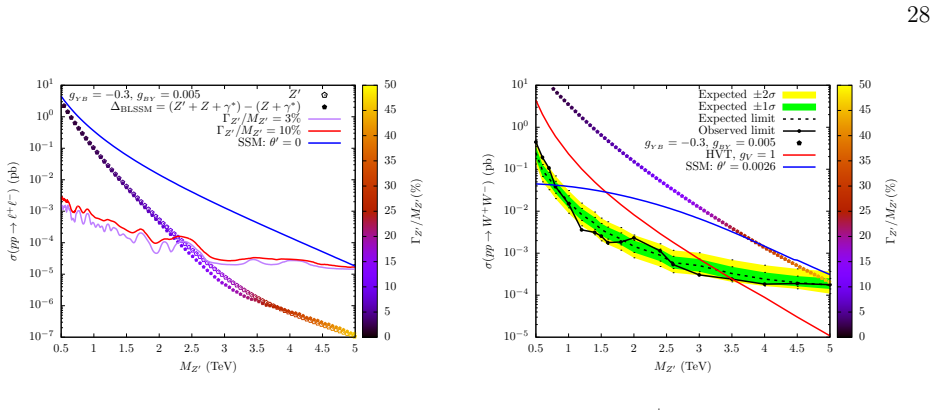
5 1 1 . 5 2 2 . 5 3 3 . 5 4 4 . 5 5 σ(pp → W +W − ) (pb) MZ′ (TeV) Expected ±2σ Expected ±1σ Expected limit Observed limit gY B = −0. 3, g BY = 0. 005 HVT, gV = 1 SSM: θ′ = 0. 0026 0 5 10 15 20 25 30 35 40 45 50 Γ Z′ /M Z′(%) FIG. 6. Variations of the fiducial dilepton cross sections forpp→ℓ +ℓ−,ℓ≡e, µ, withM ℓ+ℓ− > MZ′ −2Γ Z′ (left) and the total cross s...
-
[3]
5 1 1 . 5 2 2 . 5 3 3 . 5 4 4 . 5 5 σ(pp → ℓ+ℓ− ) (pb) MZ′ (TeV) ΓZ′ /M Z′ = 3% ΓZ′ /M Z′ = 10% SSM: θ′ = 0 10− 4 10− 3 10− 2 10− 1 100 101
-
[4]
5 1 1 . 5 2 2 . 5 3 3 . 5 4 4 . 5 5 σ(pp → W +W − ) (pb) MZ′ (TeV) Expected ±2σ Expected ±1σ Expected limit Observed limit gBL = 0. 5, g BY = 0, g Y B = −0. 5 gBY = 0. 001, g Y B = −0. 5 gBY = 0. 001, g Y B = −0. 8 gBY = 0. 001, g Y B = −1. 0 gBY = 0. 002, g Y B = 0 gBY = 0. 005, g Y B = 0 SSM: θ′ = 0. 0026 HVT, gV = 1 10− 7 10− 6 10− 5 10− 4 10− 3 10− 2 ...
-
[5]
5 1 1 . 5 2 2 . 5 3 3 . 5 4 4 . 5 5 σ(pp → ℓ+ℓ− ) (pb) MZ′ (TeV) ΓZ′/M Z′ = 3% ΓZ′ /M Z′ = 10% SSM: θ′ = 0 0 5 10 15 20 25 30 35 40 45 50 ΓZ′ /M Z′(%) 10− 4 10− 3 10− 2 10− 1 100 101
-
[6]
5 1 1 . 5 2 2 . 5 3 3 . 5 4 4 . 5 5 σ(pp → W +W − ) (pb) MZ′ (TeV) Expected ±2σ Expected ±1σ Expected limit Observed limit HVT, gV = 1 SSM: θ′ = 0. 0026 0 5 10 15 20 25 30 35 40 45 50 Γ Z′ /M Z′(%) 10− 7 10− 6 10− 5 10− 4 10− 3 10− 2 10− 1 100 101
-
[7]
5 1 1 . 5 2 2 . 5 3 3 . 5 4 4 . 5 5 σ(pp → ℓ+ℓ− ) (pb) MZ′ (TeV) Γ Z′/M Z′ = 3% Γ Z′ /M Z′ = 10% SSM: θ′ = 0 0
-
[8]
01 θ′ (radian) 10− 4 10− 3 10− 2 10− 1 100 101
-
[9]
5 1 1 . 5 2 2 . 5 3 3 . 5 4 4 . 5 5 σ(pp → W +W − ) (pb) MZ′ (TeV) Expected ±2σ Expected ±1σ Expected limit Observed limit HVT, gV = 1 SSM: θ′ = 0. 0026 0
-
[10]
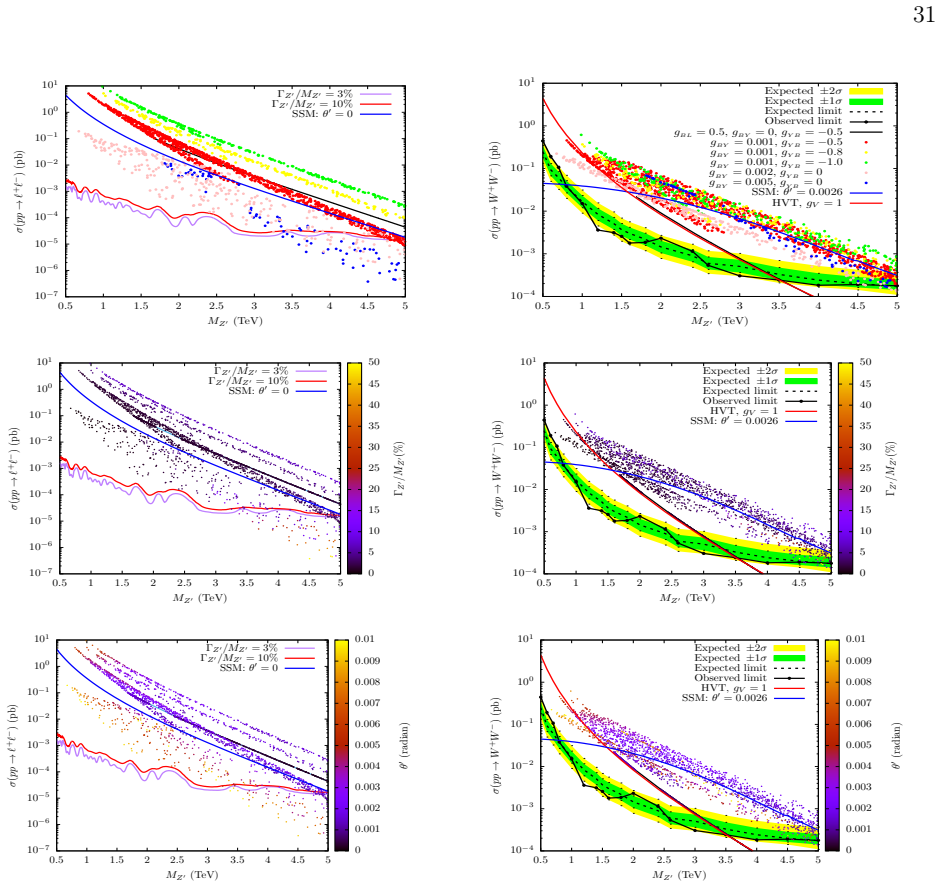
01 θ′ (radian) FIG. 7. Scatter plots in the left (right) column showing variations of the fiducial (total) cross sections for the dilepton (W+W −) final states at the 13 TeV LHC, as functions ofMZ′, and are generated by scanning overg BL ∈[0.2,0.8], andv ′ ∈[2TeV,25TeV], for various representative combinations of values forgBY andg Y B (presented in diffe...
-
[11]
1 1 10 θ′ (radian) Γ Z′ /M Z′(%)
-
[12]
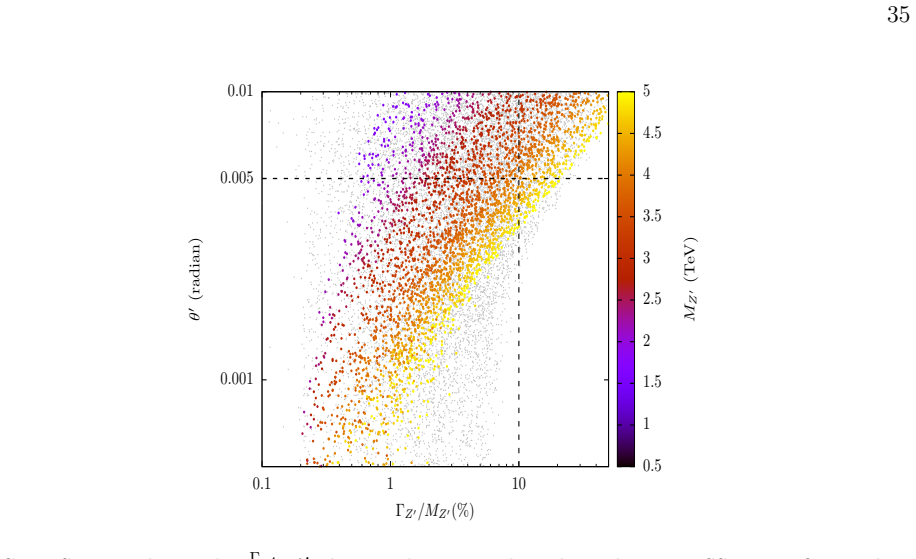
5 5 MZ′ (TeV) FIG. 8. Scatter plot in theΓZ′ MZ′–θ′ plane withM Z′ in the color palette. BLSSM-specific coupling parameters over the following ranges:gBL ∈[0.2.0.8],g BY ∈[−0.005,0.005]andg Y B ∈[−0.5,0.5]. Also,v ′ is varied over the rangev ′ ∈[2TeV,25TeV]. The points satisfy the somewhat weaker bound of Eq. (22) obtained from the global fit of the obliq...
-
[13]
5 1 1 . 5 2 2 . 5 3 3 . 5 4 4 . 5 5 σ(pp → ℓ+ℓ−) (pb) MZ′ (TeV) ΓZ′/M Z′ = 3% ΓZ′ /M Z′ = 10% 0 5 10 15 20 ΓZ′ /M Z′(%) 10−8 10−7 10−6 10−5 10−4 10−3 10−2 10−1 100
-
[14]
5 1 1 . 5 2 2 . 5 3 3 . 5 4 4 . 5 5 σ(pp → W +W −) (pb) MZ′ (TeV) Expected ±2σ Expected ±1σ Expected limit Observed limit 0 5 10 15 20 Γ Z′ /M Z′(%) 10− 9 10− 8 10− 7 10− 6 10− 5 10− 4 10− 3 10− 2 10− 1 100
-
[16]
5 BR[Z ′ → SUSY states] 10− 8 10− 7 10− 6 10− 5 10− 4 10− 3 10− 2 10− 1 100
-
[18]
5 BR[Z ′ → SUSY states] 10− 9 10− 8 10− 7 10− 6 10− 5 10− 4 10− 3 10− 2 10− 1 100
-
[19]
5 1 1 . 5 2 2 . 5 3 3 . 5 4 4 . 5 5 σ(pp → ℓ+ℓ− ) (pb) MZ′ (TeV) Γ Z′/M Z′ = 3% Γ Z′ /M Z′ = 10% 0
-
[20]
005 θ′ (radian) 10− 8 10− 7 10− 6 10− 5 10− 4 10− 3 10− 2 10− 1 100
-
[21]
5 1 1 . 5 2 2 . 5 3 3 . 5 4 4 . 5 5 σ(pp → W +W − ) (pb) MZ′ (TeV) Expected ±2σ Expected ±1σ Expected limit Observed limit 0
-
[22]
005 θ′ (radian) FIG. 11. Scatter plots showing dilepton (the left column) andW+W − (the right column) cross sections againstM Z′, with the color palettes presentingΓZ′ MZ′ (top panel), BR[Z′ →SUSY states] (middle panel) andθ′ (bottom panel), forµ, µ′ < M1, M2, and contrasting them with the respective experimental upper bounds. Points in grey in the left (...
-
[23]
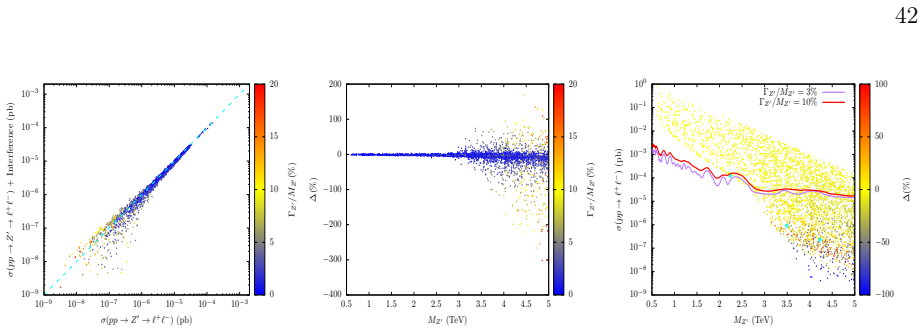
5 1 1 . 5 2 2 . 5 3 3 . 5 4 4 . 5 5 σ(pp → ℓ+ℓ−) (pb) MZ′ (TeV) ΓZ′/M Z′ = 3% ΓZ′ /M Z′ = 10% −100 −50 0 50 100 ∆(%) FIG. 12. Left: Scatter plot in the plane of pure BLSSM (i.e., onlyZ′-mediated) contribution to the cross sections for the dilepton production at the 13 TeV LHC (horizontal axis) and the same contribution plus the one arising from the interf...
-
[24]
Couplings of theZ′-boson to various neutral (CP-even (H) andCP-odd (A)) physical Higgs states of the BLSSM. •Couplings of theZ ′-boson toZ-boson andH i Z ′-Z-H i : Z ′ZH i :− 1 4 n g1sθW +g 2cθW 2 −g 2 Y B o s2θ′ + 2gY B g1sθW +g 2cθW c2θ′ v1Z H i1 +v 2Z H i2 + h g2 BL −g 2 BY s2 θW s2θ′ −2g BL gBY sθW c2θ′ i v′ 1Z H i3 +v ′ 2Z H i4 ,(A.1) where,Z H ij (i...
-
[25]
N ∗ j3 n g1sθW +g 2cθW sθ′ +g Y B cθ′ o Ni3 −N ∗ j4 g1sθW sθ′ +g 2cθW sθ′ +g Y B cθ′ Ni4 + 2 gBY sθW sθ′ +g BL cθ′ N ∗ j6Ni6 −N ∗ j7Ni7 # ,(A.4) cR˜χ0 ij =− 1 2
Couplings of theZ ′-boson to the EWinos (χ) follow from the Lagrangian term LZ′χiχj ≡¯χiγµ cLfij PL +c Rfij PR χjZ ′ µ ,(A.3) where the projection operatorsPL,R are given byPL,R ≡(1∓γ 5)/2. In the following, we present the coefficientscL,R forZ ′-boson’s couplings to different genres of fermions. •Couplings of theZ ′-boson to the neutralinos Z ′-˜χ0 i-˜χ0...
-
[26]
Couplings of theZ ′-boson to the sfermions follow from the Lagrangian term LZ′ ˜f ˜f ∗ ≡c ˜f ,ij ˜fi ˜f ∗ j pµ ˜fi −p µ ˜f ∗ j Z ′ µ ,(A.8) where,p ˜fi andp ˜f ∗ j are the four-momenta of the sfermions. In the following, we define the coefficientsc ˜f ,ij for various such couplings, wherein 50 Z ˜f denotes the (6×6) matrix needed to diagonalize the mass-s...
-
[27]
Altarelli, B
G. Altarelli, B. Mele and M. Ruiz-Altaba, Z. Phys. C45, 109 (1989) [erratum: Z. Phys. C47, 676 (1990)]
1989
-
[28]
London and J
D. London and J. L. Rosner, Phys. Rev. D34, 1530 (1986) 51
1986
-
[29]
J. L. Hewett and T. G. Rizzo, Phys. Rept.183, 193 (1989)
1989
-
[30]
S. F. King, S. Moretti and R. Nevzorov, Symmetry12, no.4, 557 (2020) [arXiv:2002.02788 [hep-ph]]
arXiv 2020
-
[31]
S. De Curtis, M. Redi and A. Tesi, JHEP04, 042 (2012) [arXiv:1110.1613 [hep-ph]]
Pith/arXiv arXiv 2012
-
[32]
D. Barducci, A. Belyaev, S. De Curtis, S. Moretti and G. M. Pruna, JHEP04, 152 (2013) [arXiv:1210.2927 [hep-ph]]. [7]
Pith/arXiv arXiv 2013
-
[33]
F. del Aguila, J. de Blas and M. Perez-Victoria, JHEP09, 033 (2010) [arXiv:1005.3998 [hep- ph]]
arXiv 2010
-
[34]
J. de Blas, J. M. Lizana and M. Perez-Victoria, JHEP01, 166 (2013) [arXiv:1211.2229 [hep- ph]]
Pith/arXiv arXiv 2013
-
[35]
D. Pappadopulo, A. Thamm, R. Torre and A. Wulzer, JHEP09, 060 (2014) [arXiv:1402.4431 [hep-ph]]
Pith/arXiv arXiv 2014
-
[36]
E. Salvioni, G. Villadoro and F. Zwirner, JHEP11, 068 (2009) [arXiv:0909.1320 [hep-ph]]
Pith/arXiv arXiv 2009
-
[37]
E. Accomando, A. Belyaev, L. Fedeli, S. F. King and C. Shepherd-Themistocleous, Phys. Rev. D83, 075012 (2011) [arXiv:1010.6058 [hep-ph]]
Pith/arXiv arXiv 2011
-
[38]
L. Randall and R. Sundrum, Phys. Rev. Lett.83, 3370-3373 (1999) [arXiv:hep-ph/9905221 [hep-ph]]
Pith/arXiv arXiv 1999
-
[39]
L. Randall and R. Sundrum, Phys. Rev. Lett.83, 4690-4693 (1999) [arXiv:hep-th/9906064 [hep-th]]
Pith/arXiv arXiv 1999
-
[40]
R. Kelley, L. Randall and B. Shuve, JHEP02, 014 (2011) [arXiv:1011.0728 [hep-ph]]
Pith/arXiv arXiv 2011
-
[41]
T. Flacke, A. Menon and D. J. Phalen, Phys. Rev. D79, 056009 (2009) [arXiv:0811.1598 [hep-ph]]
Pith/arXiv arXiv 2009
-
[42]
Thesis by S
Ph.D. Thesis by S. Niyogi, HBNI Enrollment No. PHYS08200605006, September 2014
2014
- [43]
-
[44]
A. Leike, Phys. Rept.317, 143-250 (1999) [arXiv:hep-ph/9805494 [hep-ph]]
Pith/arXiv arXiv 1999
-
[45]
P. Langacker, Rev. Mod. Phys.81, 1199-1228 (2009) [arXiv:0801.1345 [hep-ph]]
Pith/arXiv arXiv 2009
-
[46]
G. Aadet al.[ATLAS], Phys. Lett. B796, 68-87 (2019) [arXiv:1903.06248 [hep-ex]]
arXiv 2019
-
[47]
Aadet al.[ATLAS], JHEP09, 091 (2019) [erratum: JHEP06, 042 (2020)] [arXiv:1906.08589 [hep-ex]]
G. Aadet al.[ATLAS], JHEP09, 091 (2019) [erratum: JHEP06, 042 (2020)] [arXiv:1906.08589 [hep-ex]]
arXiv 2019
-
[48]
Aadet al.[ATLAS], JHEP03, 145 (2020) [arXiv:1910.08447 [hep-ex]]
G. Aadet al.[ATLAS], JHEP03, 145 (2020) [arXiv:1910.08447 [hep-ex]]
arXiv 2020
-
[49]
G. Aadet al.[ATLAS], Eur. Phys. J. C80, no.12, 1165 (2020) [arXiv:2004.14636 [hep-ex]]. 52
arXiv 2020
-
[50]
A. M. Sirunyanet al.[CMS], JHEP06, 120 (2018) [arXiv:1803.06292 [hep-ex]]
Pith/arXiv arXiv 2018
-
[51]
A. M. Sirunyanet al.[CMS], JHEP08, 130 (2018) [arXiv:1806.00843 [hep-ex]]
Pith/arXiv arXiv 2018
-
[52]
A. M. Sirunyanet al.[CMS], JHEP05, 033 (2020) [arXiv:1911.03947 [hep-ex]]
arXiv 2020
-
[53]
A. M. Sirunyanet al.[CMS], JHEP07, 208 (2021) [arXiv:2103.02708 [hep-ex]]
arXiv 2021
-
[54]
A. Tumasyanet al.[CMS], Phys. Rev. D105, no.3, 032008 (2022) [arXiv:2109.06055 [hep-ex]]
arXiv 2022
-
[55]
D. Berdine, N. Kauer and D. Rainwater, Phys. Rev. Lett.99, 111601 (2007) [arXiv:hep- ph/0703058 [hep-ph]]
arXiv 2007
-
[56]
N. Kauer, Phys. Lett. B649, 413-416 (2007) [arXiv:hep-ph/0703077 [hep-ph]]
Pith/arXiv arXiv 2007
-
[57]
C. F. Uhlemann and N. Kauer, Nucl. Phys. B814, 195-211 (2009) [arXiv:0807.4112 [hep-ph]]
Pith/arXiv arXiv 2009
-
[58]
E. Accomando, D. Becciolini, A. Belyaev, S. Moretti and C. Shepherd-Themistocleous, JHEP 10, 153 (2013) [arXiv:1304.6700 [hep-ph]]
Pith/arXiv arXiv 2013
-
[59]
E. Accomando, A. Belyaev, J. Fiaschi, K. Mimasu, S. Moretti and C. Shepherd- Themistocleous, JHEP01, 127 (2016) [arXiv:1503.02672 [hep-ph]]
Pith/arXiv arXiv 2016
-
[60]
T. Bandyopadhyay, G. Bhattacharyya, D. Das and A. Raychaudhuri, Phys. Rev. D98, no.3, 035027 (2018) [arXiv:1803.07989 [hep-ph]]
Pith/arXiv arXiv 2018
-
[61]
A. Belyaev, R. Foadi, M. T. Frandsen, M. Jarvinen, F. Sannino and A. Pukhov, Phys. Rev. D 79, 035006 (2009) [arXiv:0809.0793 [hep-ph]]
Pith/arXiv arXiv 2009
-
[62]
D. Choudhury, R. M. Godbole and P. Saha, JHEP01, 155 (2012) [arXiv:1111.1054 [hep-ph]]
Pith/arXiv arXiv 2012
-
[63]
A. Hayreter, X. G. He and G. Valencia, Eur. Phys. J. C80, no.10, 912 (2020) [arXiv:1912.06344 [hep-ph]]
arXiv 2020
-
[64]
S. Khalil and A. Masiero, Phys. Lett. B665, 374-377 (2008) [arXiv:0710.3525 [hep-ph]]
Pith/arXiv arXiv 2008
-
[65]
T. Kikuchi and T. Kubo, Phys. Lett. B666, 262-268 (2008) [arXiv:0804.3933 [hep-ph]]
Pith/arXiv arXiv 2008
-
[66]
P. Fileviez Perez and S. Spinner, Phys. Rev. D83, 035004 (2011) [arXiv:1005.4930 [hep-ph]]
Pith/arXiv arXiv 2011
-
[67]
R. M. Fonseca, M. Malinsky, W. Porod and F. Staub, Nucl. Phys. B854, 28-53 (2012) [arXiv:1107.2670 [hep-ph]]
Pith/arXiv arXiv 2012
-
[68]
S. Khalil, J. Phys. G35, 055001 (2008) [arXiv:hep-ph/0611205 [hep-ph]]
Pith/arXiv arXiv 2008
-
[69]
W. Emam and S. Khalil, Eur. Phys. J. C52, 625-633 (2007) [arXiv:0704.1395 [hep-ph]]
Pith/arXiv arXiv 2007
-
[70]
M. Abbas and S. Khalil, JHEP04, 056 (2008) [arXiv:0707.0841 [hep-ph]]
Pith/arXiv arXiv 2008
-
[71]
K. Huitu, S. Khalil, H. Okada and S. K. Rai, Phys. Rev. Lett.101, 181802 (2008) [arXiv:0803.2799 [hep-ph]]
Pith/arXiv arXiv 2008
-
[72]
S. Schaelet al.[ALEPH, DELPHI, L3, OPAL, SLD, LEP Electroweak Working Group, 53 SLD Electroweak Group and SLD Heavy Flavour Group], Phys. Rept.427, 257-454 (2006) [arXiv:hep-ex/0509008 [hep-ex]]
Pith/arXiv arXiv 2006
-
[73]
J. Erler, P. Langacker, S. Munir and E. Rojas, JHEP08, 017 (2009) [arXiv:0906.2435 [hep-ph]]
Pith/arXiv arXiv 2009
-
[74]
Schaelet al.[ALEPH, DELPHI, L3, OPAL and LEP Electroweak], Phys
S. Schaelet al.[ALEPH, DELPHI, L3, OPAL and LEP Electroweak], Phys. Rept.532, 119-244 (2013) [arXiv:1302.3415 [hep-ex]]
Pith/arXiv arXiv 2013
-
[75]
Navaset al.[Particle Data Group], Phys
S. Navaset al.[Particle Data Group], Phys. Rev. D110, no.3, 030001 (2024)
2024
-
[76]
J. Alcarazet al.[ALEPH, DELPHI, L3, OPAL and LEP Electroweak Working Group], [arXiv:hep-ex/0612034 [hep-ex]]
-
[77]
A. A. Pankov, P. Osland, I. A. Serenkova and V. A. Bednyakov, Eur. Phys. J. C80, no.6, 503 (2020) [arXiv:1912.02106 [hep-ph]]
arXiv 2020
- [78]
- [79]
-
[80]
W. Abdallah and S. Khalil, JCAP04, 016 (2017) [arXiv:1701.04436 [hep-ph]]
Pith/arXiv arXiv 2017
-
[81]
B. O’Leary, W. Porod and F. Staub, JHEP05, 042 (2012) [arXiv:1112.4600 [hep-ph]]
Pith/arXiv arXiv 2012
-
[82]
M. E. Krauss, B. O’Leary, W. Porod and F. Staub, Phys. Rev. D86, 055017 (2012) [arXiv:1206.3513 [hep-ph]]
Pith/arXiv arXiv 2012
discussion (0)
Sign in with ORCID, Apple, or X to comment. Anyone can read and Pith papers without signing in.