P-K-GCN: Physics-augmented Koopman-enhanced Graph Convolutional Network for Deep Spatiotemporal Super-resolution
Pith reviewed 2026-06-26 20:50 UTC · model grok-4.3
The pith
Physics augmentation and Koopman regularization in a graph network reduce super-resolution error by diminishing Rademacher complexity and tightening generalization bounds.
A machine-rendered reading of the paper's core claim, the machinery that carries it, and where it could break.
Core claim
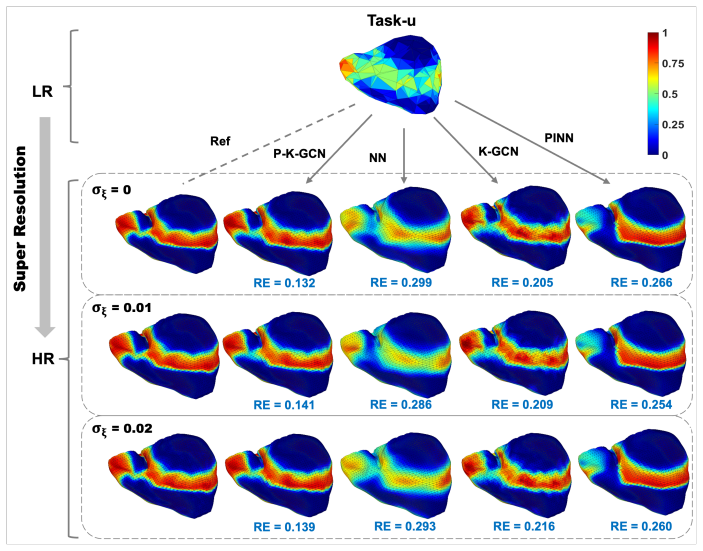
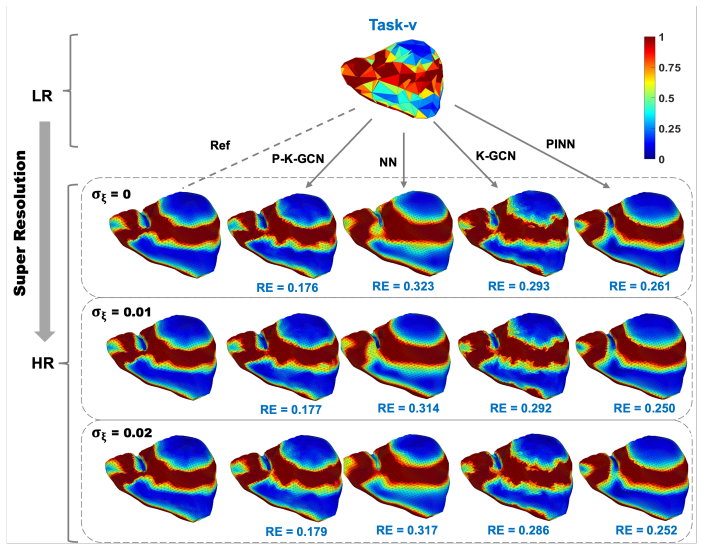
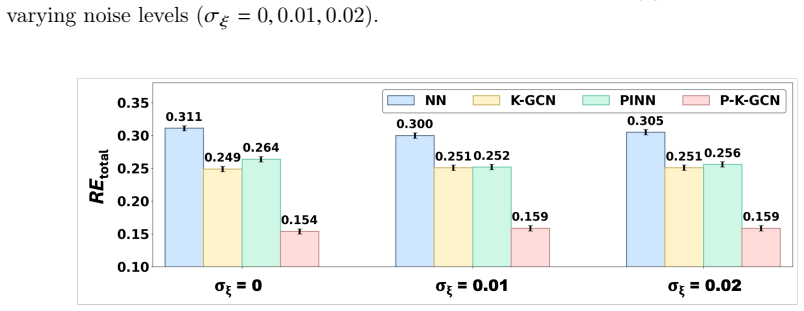
The central claim is that the physics augmentation and Koopman regularization mathematically guarantees a reduction in super-resolution error by diminishing Rademacher complexity and tightening generalization bounds. Numerical experiments demonstrate that the method achieves superior accuracy compared to baseline models on reconstructing spatially high-resolution cardiac electrodynamics across a 3D heart geometry from sparse low-resolution measurements.
What carries the argument
The Koopman operator that projects nonlinear dynamics into a compact latent space where temporal progression is linearized, paired with a physics-based loss that enforces physical laws directly on the graph geometry.
If this is right
- Super-resolution error decreases because Rademacher complexity is reduced and generalization bounds tighten.
- Reconstructions of 3D cardiac electrodynamics from sparse measurements achieve higher accuracy than baseline graph networks.
- The spline-based graph convolutions combined with the latent linearization handle irregular spatial domains without loss of fidelity.
- Adherence to physical laws improves predictive robustness on the target system.
Where Pith is reading between the lines
- If the same Koopman-plus-physics pattern reduces complexity on other mesh-based dynamical systems, the same error-reduction argument could apply to fluid flow or structural mechanics.
- The continuous spline construction might allow the network to be trained on one geometry and transferred to a different irregular mesh without retraining the spatial operator.
- The theoretical bound on Rademacher complexity provides a concrete way to compare the sample efficiency of this model against purely data-driven graph networks on the same task.
Load-bearing premise
The nonlinear dynamics of the target system can be projected into a compact latent space in which temporal progression is linearized by the Koopman operator, and a physics-based loss can be formulated that correctly enforces physical laws on irregular graph geometries without introducing new inconsistencies.
What would settle it
An experiment that adds the physics and Koopman terms yet shows no reduction in measured super-resolution error or no tightening of the generalization bound on the cardiac electrodynamics dataset would falsify the claimed guarantee.
Figures

read the original abstract
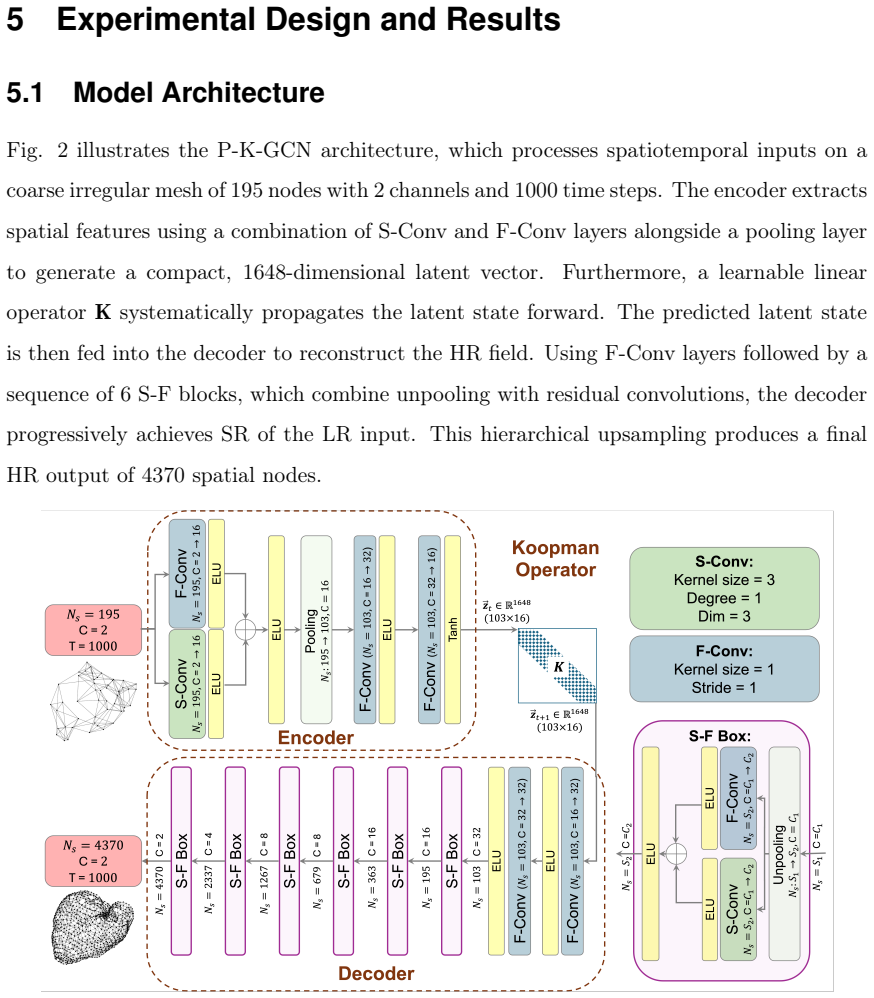
High-fidelity simulation of spatiotemporal dynamics is computationally prohibitive, necessitating efficient super-resolution techniques to reconstruct high-resolution data from coarse-grained inputs. Traditional data-driven methods often lack physical constraints, and simple physics-informed learning struggles with irregular spatial geometries and intricately evolving temporal dynamics. To tackle these challenges, we propose a Physics-augmented Koopman-enhanced Graph Convolutional Network (P-K-GCN) for spatiotemporal super-resolution on irregular geometries. Specifically, a continuous spline-based GCN is first designed to extract spatial dependencies directly from coarse graph, and Koopman operator theory is incorporated to project the nonlinear dynamics into a compact latent space where temporal progression is linearized. Second, we augment the optimization objective with a physics-based loss to force the data-driven reconstructions to adhere to physical laws for improving predictive fidelity and robustness. Finally, we provide a rigorous theoretical analysis, establishing that the physics augmentation and Koopman regularization mathematically guarantees a reduction in super-resolution error by diminishing Rademacher complexity and tightening generalization bounds. We evaluate our framework on reconstructing spatially high-resolution cardiac electrodynamics across a 3D heart geometry from sparse low-resolution measurements. Numerical experiments demonstrate that our method achieves superior accuracy compared to baseline models.
Editorial analysis
A structured set of objections, weighed in public.
Referee Report
Summary. The manuscript proposes P-K-GCN, a spline-based graph convolutional network augmented with Koopman operator theory to project nonlinear spatiotemporal dynamics into a linearized latent space and a physics-based loss to enforce physical constraints on irregular graph geometries. It claims that the physics augmentation and Koopman regularization mathematically guarantee a reduction in super-resolution error via diminished Rademacher complexity and tightened generalization bounds, and reports superior empirical accuracy over baselines when reconstructing high-resolution 3D cardiac electrodynamics from sparse low-resolution measurements.
Significance. If the theoretical guarantee is rigorously established and the empirical results are reproducible, the framework could advance physics-informed learning for super-resolution on irregular domains by providing a principled way to combine Koopman linearization with graph-based physical constraints, potentially improving robustness in data-limited settings such as biomedical simulations.
major comments (2)
- [Theoretical Analysis] Theoretical Analysis section: The central claim that physics augmentation and Koopman regularization 'mathematically guarantees a reduction in super-resolution error by diminishing Rademacher complexity and tightening generalization bounds' lacks a bridging argument. Standard Rademacher analysis bounds only the generalization gap; it does not entail a smaller true risk when the physics loss and latent-space projection alter the hypothesis class or increase empirical risk, and no explicit bound, derivation steps, or control on the net risk change is supplied.
- [Numerical Experiments] § on experimental evaluation: No protocol is given for how the Rademacher complexity term is estimated or bounded in the presence of the spline GCN and irregular-graph physics loss, nor are the specific baselines, metrics, or cross-validation details provided to support the superiority claim on cardiac electrodynamics data.
minor comments (2)
- [Method] The description of the continuous spline-based GCN would benefit from an explicit equation defining the convolution operator on the coarse graph.
- [Method] Notation for the Koopman operator in the latent space should be introduced with a reference to the relevant equation to avoid ambiguity with standard GCN layers.
Simulated Author's Rebuttal
We thank the referee for the constructive feedback. We address each major comment below and indicate the revisions that will be made to strengthen the manuscript.
read point-by-point responses
-
Referee: [Theoretical Analysis] The central claim that physics augmentation and Koopman regularization 'mathematically guarantees a reduction in super-resolution error by diminishing Rademacher complexity and tightening generalization bounds' lacks a bridging argument. Standard Rademacher analysis bounds only the generalization gap; it does not entail a smaller true risk when the physics loss and latent-space projection alter the hypothesis class or increase empirical risk, and no explicit bound, derivation steps, or control on the net risk change is supplied.
Authors: We acknowledge that the current presentation of the theoretical analysis would benefit from an explicit bridging argument. In the revised manuscript we will expand the Theoretical Analysis section to supply the missing derivation steps: we will show how the physics-augmented loss and Koopman projection modify the hypothesis class, derive the resulting change in Rademacher complexity, and demonstrate that the net effect on the true risk bound is a reduction (accounting for any change in empirical risk). revision: yes
-
Referee: [Numerical Experiments] No protocol is given for how the Rademacher complexity term is estimated or bounded in the presence of the spline GCN and irregular-graph physics loss, nor are the specific baselines, metrics, or cross-validation details provided to support the superiority claim on cardiac electrodynamics data.
Authors: We agree that these experimental details are necessary for reproducibility. The revised manuscript will include (i) the precise protocol used to estimate and bound the Rademacher complexity term under the spline GCN and physics loss, and (ii) explicit statements of the baselines, metrics, and cross-validation procedure applied to the cardiac electrodynamics dataset. revision: yes
Circularity Check
No circularity detected; theoretical claim presented as independent analysis
full rationale
The abstract asserts a rigorous theoretical analysis showing that physics augmentation and Koopman regularization guarantee error reduction via Rademacher complexity diminution and tighter generalization bounds. No equations, self-citations, fitted parameters, or prior-author uniqueness theorems are referenced in the provided text that would reduce this claim to a definitional equivalence or statistical forcing. The derivation is therefore treated as self-contained external mathematical content rather than a renaming or self-referential fit.
Axiom & Free-Parameter Ledger
axioms (1)
- domain assumption The target dynamics admit a useful Koopman operator representation that linearizes temporal evolution in a latent space
Reference graph
Works this paper leans on
-
[1]
International Conference on Learning Representations , year=
Learning mesh-based simulation with graph networks , author=. International Conference on Learning Representations , year=
-
[2]
International Conference on Machine Learning , pages=
Learning to simulate complex physics with graph networks , author=. International Conference on Machine Learning , pages=
-
[3]
Zeng, Bocheng and Wang, Qi and Yan, Mengtao and Liu, Yang and Chengze, Ruizhi and Zhang, Yi and Liu, Hongsheng and Wang, Zidong and Sun, Hao , booktitle=
-
[4]
Combining physics-informed graph neural network and finite difference for solving forward and inverse spatiotemporal
Zhang, Hao and Jiang, Longxiang and Chu, Xinkun and Wen, Yong and Li, Luxiong and Xiao, Yonghao and Wang, Liyuan , journal=. Combining physics-informed graph neural network and finite difference for solving forward and inverse spatiotemporal
-
[5]
IEEE transactions on image processing , volume=
Image super-resolution via sparse representation , author=. IEEE transactions on image processing , volume=. 2010 , publisher=
2010
-
[6]
IEEE transactions on pattern analysis and machine intelligence , volume=
Image super-resolution using deep convolutional networks , author=. IEEE transactions on pattern analysis and machine intelligence , volume=. 2015 , publisher=
2015
-
[7]
Proceedings of the IEEE conference on computer vision and pattern recognition , pages=
Photo-realistic single image super-resolution using a generative adversarial network , author=. Proceedings of the IEEE conference on computer vision and pattern recognition , pages=
-
[8]
Proceedings of the IEEE conference on computer vision and pattern recognition workshops , pages=
Enhanced deep residual networks for single image super-resolution , author=. Proceedings of the IEEE conference on computer vision and pattern recognition workshops , pages=
-
[9]
Proceedings of the IEEE conference on computer vision and pattern recognition , pages=
Real-time single image and video super-resolution using an efficient sub-pixel convolutional neural network , author=. Proceedings of the IEEE conference on computer vision and pattern recognition , pages=
-
[10]
arXiv preprint arXiv:1807.02758 , year=
Image super-resolution using very deep residual channel attention networks , author=. arXiv preprint arXiv:1807.02758 , year=
-
[11]
Proceedings of the IEEE conference on computer vision and pattern recognition , pages=
Video frame interpolation via adaptive convolution , author=. Proceedings of the IEEE conference on computer vision and pattern recognition , pages=
-
[12]
Proceedings of the IEEE conference on computer vision and pattern recognition , pages=
Super slomo: High quality estimation of multiple intermediate frames for video interpolation , author=. Proceedings of the IEEE conference on computer vision and pattern recognition , pages=
-
[13]
Proceedings of the IEEE conference on computer vision and pattern recognition , pages=
Frame-recurrent video super-resolution , author=. Proceedings of the IEEE conference on computer vision and pattern recognition , pages=
-
[14]
Proceedings of the IEEE conference on computer vision and pattern recognition , pages=
Zooming slow-mo: Fast and accurate one-stage space-time video super-resolution , author=. Proceedings of the IEEE conference on computer vision and pattern recognition , pages=
-
[15]
ACM Transactions on Graphics (TOG) , volume=
TempoGAN: A temporally coherent, volumetric GAN for super-resolution fluid flow , author=. ACM Transactions on Graphics (TOG) , volume=. 2018 , publisher=
2018
-
[16]
Proceedings of the National Academy of Sciences , volume=
Learning data-driven discretizations for partial differential equations , author=. Proceedings of the National Academy of Sciences , volume=. 2019 , publisher=
2019
-
[17]
Physics of Fluids , year=
Deep learning approaches for recovering turbulence fields from low-resolution data , author=. Physics of Fluids , year=
-
[18]
Journal of Fluid Mechanics , volume=
Machine-learning-based spatio-temporal super resolution reconstruction of turbulent flows , author=. Journal of Fluid Mechanics , volume=. 2021 , publisher=
2021
-
[19]
Proceedings of the National Academy of Sciences , volume=
Adversarial super-resolution of climatological wind and solar data , author=. Proceedings of the National Academy of Sciences , volume=. 2020 , publisher=
2020
-
[20]
Physics of Fluids , year=
Deep learning-based surrogate model for fast and accurate prediction of fluid flows , author=. Physics of Fluids , year=
-
[21]
Journal of Computational Physics , year=
Physics-informed deep learning for super-resolution and denoising of fluid flow data , author=. Journal of Computational Physics , year=
-
[22]
arXiv preprint arXiv:2011.04728 , year=
Turbulence enrichment using physics-informed generative adversarial networks , author=. arXiv preprint arXiv:2011.04728 , year=
arXiv 2011
-
[23]
Proceedings of the IEEE/CVF Conference on Computer Vision and Pattern Recognition , pages=
Meshfreeflownet: A physics-constrained deep continuous space-time super-resolution framework , author=. Proceedings of the IEEE/CVF Conference on Computer Vision and Pattern Recognition , pages=
-
[24]
Physics of Fluids , year=
Super-resolution reconstruction of turbulent flows with physics-informed neural networks , author=. Physics of Fluids , year=
-
[25]
Computer Methods in Applied Mechanics and Engineering , volume=
PhyCRNet: Physics-informed convolutional-recurrent network for solving spatiotemporal PDEs , author=. Computer Methods in Applied Mechanics and Engineering , volume=. 2022 , publisher=
2022
-
[26]
IISE Transactions , pages=
Geometry-aware active learning of spatiotemporal dynamic systems , author=. IISE Transactions , pages=. 2026 , publisher=
2026
-
[27]
Journal of Computational Physics , volume=
PhySR: Physics-informed deep super-resolution for spatiotemporal data , author=. Journal of Computational Physics , volume=. 2023 , publisher=
2023
-
[28]
Journal of Machine Learning Research , volume=
Rademacher and Gaussian complexities: Risk bounds and structural results , author=. Journal of Machine Learning Research , volume=
-
[29]
2018 , edition=
Foundations of Machine Learning , author=. 2018 , edition=
2018
-
[30]
SIAM Journal on Applied Dynamical Systems , volume=
Linearly recurrent autoencoder networks for learning dynamics , author=. SIAM Journal on Applied Dynamical Systems , volume=. 2019 , publisher=
2019
-
[31]
Journal of Nonlinear Science , volume=
On convergence of extended dynamic mode decomposition to the Koopman operator , author=. Journal of Nonlinear Science , volume=. 2018 , publisher=
2018
-
[32]
Reliability Engineering & System Safety , volume=
Fusing physics-based and deep learning models for prognostics , author=. Reliability Engineering & System Safety , volume=. 2022 , publisher=
2022
-
[33]
Reliability Engineering & System Safety , volume=
A physics-regularized data-driven approach for health prognostics of complex engineered systems with dependent health states , author=. Reliability Engineering & System Safety , volume=. 2022 , publisher=
2022
-
[34]
Reliability Engineering & System Safety , volume=
Remaining useful life prediction combined dynamic model with transfer learning under insufficient degradation data , author=. Reliability Engineering & System Safety , volume=. 2023 , publisher=
2023
-
[35]
Reliability Engineering & System Safety , volume=
Physics-informed Gaussian process probabilistic modeling with multi-source data for prognostics of degradation processes , author=. Reliability Engineering & System Safety , volume=. 2025 , publisher=
2025
-
[36]
Reliability Engineering & System Safety , volume=
Model correction and updating of a stochastic degradation model for failure prognostics of miter gates , author=. Reliability Engineering & System Safety , volume=. 2022 , publisher=
2022
-
[37]
Computer Methods in Applied Mechanics and Engineering , volume=
A sequential calibration and validation framework for model uncertainty quantification and reduction , author=. Computer Methods in Applied Mechanics and Engineering , volume=. 2020 , publisher=
2020
-
[38]
IEEE Transactions on Reliability , volume=
Review of hybrid prognostics approaches for remaining useful life prediction of engineered systems, and an application to battery life prediction , author=. IEEE Transactions on Reliability , volume=. 2014 , publisher=
2014
-
[39]
IEEE transactions on pattern analysis and machine intelligence , volume=
Weighted graph cuts without eigenvectors a multilevel approach , author=. IEEE transactions on pattern analysis and machine intelligence , volume=. 2007 , publisher=
2007
-
[40]
Proceedings of the IEEE conference on computer vision and pattern recognition , pages=
Deep residual learning for image recognition , author=. Proceedings of the IEEE conference on computer vision and pattern recognition , pages=
-
[41]
Proceedings of the IEEE conference on computer vision and pattern recognition , pages=
Splinecnn: Fast geometric deep learning with continuous b-spline kernels , author=. Proceedings of the IEEE conference on computer vision and pattern recognition , pages=
-
[42]
Physical Review Letters , volume=
Geometry from a time series , author=. Physical Review Letters , volume=. 1980 , publisher=
1980
-
[43]
Dynamical Systems and Turbulence, Warwick 1980 , pages=
Detecting strange attractors in turbulence , author=. Dynamical Systems and Turbulence, Warwick 1980 , pages=. 1981 , publisher=
1980
-
[44]
part 1: Theory , author=
Lyapunov characteristic exponents for smooth dynamical systems and for hamiltonian systems; a method for computing all of them. part 1: Theory , author=. Meccanica , volume=. 1980 , publisher=
1980
-
[45]
Physica D: Nonlinear Phenomena , volume=
Determining Lyapunov exponents from a time series , author=. Physica D: Nonlinear Phenomena , volume=. 1985 , publisher=
1985
-
[46]
Physical Review Letters , volume=
Characterization of strange attractors , author=. Physical Review Letters , volume=. 1983 , publisher=
1983
-
[47]
Journal of Fluid Mechanics , volume=
Dynamic mode decomposition of numerical and experimental data , author=. Journal of Fluid Mechanics , volume=. 2010 , publisher=
2010
-
[48]
2016 , publisher=
Dynamic mode decomposition: data-driven modeling of complex systems , author=. 2016 , publisher=
2016
-
[49]
Proceedings of the National Academy of Sciences , volume=
Hamiltonian systems and transformation in Hilbert space , author=. Proceedings of the National Academy of Sciences , volume=. 1931 , publisher=
1931
-
[50]
SIAM Review , volume=
Modern Koopman theory for dynamical systems , author=. SIAM Review , volume=. 2022 , publisher=
2022
-
[51]
Journal of Nonlinear Science , volume=
A data-driven approximation of the Koopman operator: Extending dynamic mode decomposition , author=. Journal of Nonlinear Science , volume=. 2015 , publisher=
2015
-
[52]
Nature Communications , volume=
Deep learning for universal linear embeddings of nonlinear dynamics , author=. Nature Communications , volume=. 2018 , publisher=
2018
-
[53]
Advances in Neural Information Processing Systems , volume=
Learning Koopman invariant subspaces for dynamic mode decomposition , author=. Advances in Neural Information Processing Systems , volume=
-
[54]
Journal of Computational Dynamics , volume=
Learning Koopman eigenfunctions of conservative dynamical systems with masks , author=. Journal of Computational Dynamics , volume=
-
[55]
Physica D: Nonlinear Phenomena , volume=
Multiscale learning of Koopman eigenfunctions for nonlinear dynamics , author=. Physica D: Nonlinear Phenomena , volume=. 2023 , publisher=
2023
-
[56]
arXiv preprint arXiv:2510.13601 , year=
Physics-augmented Multi-task Gaussian Process for Modeling Spatiotemporal Dynamics , author=. arXiv preprint arXiv:2510.13601 , year=
-
[57]
arXiv preprint arXiv:2507.03855 , year=
Transformer with Koopman-Enhanced Graph Convolutional Network for Spatiotemporal Dynamics Forecasting , author=. arXiv preprint arXiv:2507.03855 , year=
-
[58]
IEEE Signal Processing Magazine , volume=
Geometric deep learning: going beyond euclidean data , author=. IEEE Signal Processing Magazine , volume=. 2017 , publisher=
2017
-
[59]
IEEE transactions on neural networks and learning systems , volume=
Spatio-temporal point process for multiple object tracking , author=. IEEE transactions on neural networks and learning systems , volume=. 2020 , publisher=
2020
-
[60]
Expert Systems with Applications , volume=
A hybrid clustering--regression approach for predicting passenger congestion in a carriage at a subway platform , author=. Expert Systems with Applications , volume=. 2025 , publisher=
2025
-
[61]
Earth Science Informatics , volume=
Semantic segmentation of oblique UAV video based on ConvLSTM in complex urban area , author=. Earth Science Informatics , volume=. 2024 , publisher=
2024
-
[62]
Advances in neural information processing systems , volume=
Convolutional LSTM network: A machine learning approach for precipitation nowcasting , author=. Advances in neural information processing systems , volume=
-
[63]
Earth-Science Reviews , volume=
Spatiotemporal forecasting in earth system science: Methods, uncertainties, predictability and future directions , author=. Earth-Science Reviews , volume=. 2021 , publisher=
2021
-
[64]
Journal of Quality Technology , volume=
A statistical modeling approach for spatio-temporal degradation data , author=. Journal of Quality Technology , volume=. 2018 , publisher=
2018
-
[65]
Technometrics , volume=
Function-on-function kriging, with applications to three-dimensional printing of aortic tissues , author=. Technometrics , volume=. 2021 , publisher=
2021
-
[66]
Journal of the American Statistical Association , volume=
An efficient surrogate model for emulation and physics extraction of large eddy simulations , author=. Journal of the American Statistical Association , volume=. 2018 , publisher=
2018
-
[67]
IEEE Transactions on Automation Science and Engineering , year=
Simulation Optimization of Spatiotemporal Dynamics in 3D Geometries , author=. IEEE Transactions on Automation Science and Engineering , year=
-
[68]
IFAC Proceedings Volumes , volume=
Power load forecasting based on multi-task Gaussian process , author=. IFAC Proceedings Volumes , volume=. 2014 , publisher=
2014
-
[69]
IEEE Transactions on Industrial Electronics , volume=
Multitask Bayesian spatiotemporal Gaussian processes for short-term load forecasting , author=. IEEE Transactions on Industrial Electronics , volume=. 2019 , publisher=
2019
-
[70]
Handbook of Regional Science , pages=
Multivariate spatial process models , author=. Handbook of Regional Science , pages=. 2021 , publisher=
2021
-
[71]
Nature machine intelligence , volume=
Learning nonlinear operators via DeepONet based on the universal approximation theorem of operators , author=. Nature machine intelligence , volume=. 2021 , publisher=
2021
-
[72]
Journal of Computational Physics , volume=
Parallel physics-informed neural networks via domain decomposition , author=. Journal of Computational Physics , volume=. 2021 , publisher=
2021
-
[73]
Communications in Computational Physics , volume=
Extended physics-informed neural networks (XPINNs): A generalized space-time domain decomposition based deep learning framework for nonlinear partial differential equations , author=. Communications in Computational Physics , volume=. 2020 , publisher=
2020
-
[74]
Nature Reviews Physics , volume=
Physics-informed machine learning , author=. Nature Reviews Physics , volume=. 2021 , publisher=
2021
-
[75]
Journal of Computational physics , volume=
Physics-informed neural networks: A deep learning framework for solving forward and inverse problems involving nonlinear partial differential equations , author=. Journal of Computational physics , volume=. 2019 , publisher=
2019
-
[76]
arXiv preprint arXiv:2204.02583 , year=
PAGP: A physics-assisted Gaussian process framework with active learning for forward and inverse problems of partial differential equations , author=. arXiv preprint arXiv:2204.02583 , year=
-
[77]
Journal of Machine Learning Research , volume=
Boundary constrained Gaussian processes for robust physics-informed machine learning of linear partial differential equations , author=. Journal of Machine Learning Research , volume=
-
[78]
arXiv preprint arXiv:2212.12474 , year=
Physics-informed Gaussian process regression generalizes linear PDE solvers , author=. arXiv preprint arXiv:2212.12474 , year=
-
[79]
Journal of Computational Physics , volume=
Hidden physics models: Machine learning of nonlinear partial differential equations , author=. Journal of Computational Physics , volume=. 2018 , publisher=
2018
-
[80]
Advances in Neural Information Processing Systems , volume=
Multi-resolution multi-task Gaussian processes , author=. Advances in Neural Information Processing Systems , volume=
discussion (0)
Sign in with ORCID, Apple, or X to comment. Anyone can read and Pith papers without signing in.