Calabi-Yau Orientifold Hypersurfaces and their F-theory Uplifts
Pith reviewed 2026-06-26 19:37 UTC · model grok-4.3
The pith
An algorithm constructs Calabi-Yau threefold orientifolds and their F-theory uplifts as elliptically fibered fourfolds from 6d reflexive polytopes.
A machine-rendered reading of the paper's core claim, the machinery that carries it, and where it could break.
Core claim
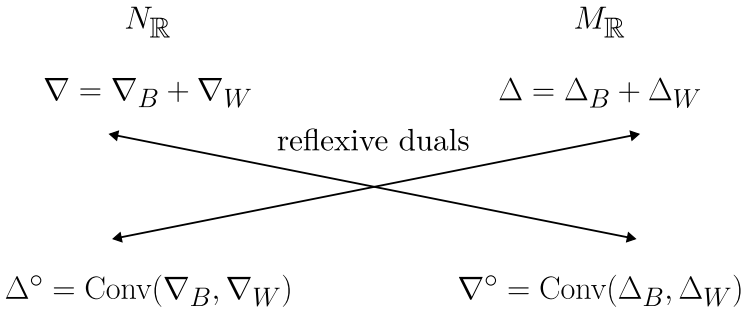
We present an algorithm that constructs Calabi-Yau threefold orientifolds and their F-theory uplifts to elliptically-fibered Calabi-Yau fourfolds, embedded in toric varieties at codimension one and two respectively. The resulting Calabi-Yau fourfolds arise from triangulations of 6d reflexive polytopes which our method constructs from orientifold data and are smooth away from isolated terminal singularities. For many of our fourfolds, the construction of the mirror manifold is immediate, enabling the computation of fourfold periods, and thus the seven-brane superpotential.
What carries the argument
The algorithm that builds 6d reflexive polytopes from orientifold data so that their triangulations produce elliptically fibered Calabi-Yau fourfolds.
If this is right
- Immediate mirror manifold construction becomes available for many of the generated fourfolds.
- Fourfold periods can be computed directly from the mirror data.
- The seven-brane superpotential follows from those periods.
- The fourfolds remain smooth except at isolated terminal singularities.
Where Pith is reading between the lines
- The method supplies explicit geometric data that could support systematic enumeration of F-theory vacua.
- It may link to broader mirror-symmetry calculations in string compactifications beyond the examples shown.
- Extensions could test whether the same orientifold-to-polytope map works for non-toric or higher-codimension embeddings.
Load-bearing premise
The polytopes generated by the algorithm from orientifold data always produce fourfolds that remain smooth away from isolated terminal singularities after triangulation.
What would settle it
An orientifold input for which the algorithm outputs a 6d reflexive polytope whose triangulation produces a fourfold with singularities that are neither isolated nor terminal.
Figures



read the original abstract
We present an algorithm that constructs Calabi-Yau threefold orientifolds and their $F$-theory uplifts to elliptically-fibered Calabi-Yau fourfolds, embedded in toric varieties at codimension one and two respectively. The resulting Calabi-Yau fourfolds arise from triangulations of $6d$ reflexive polytopes -- which our method constructs from orientifold data -- and are smooth away from isolated terminal singularities. For many of our fourfolds, the construction of the mirror manifold is immediate, enabling the computation of fourfold periods, and thus the seven-brane superpotential. We present multiple examples that demonstrate these capabilities. Our algorithms work with $\mathtt{CYTools}$ and are available through a GitHub repository.
Editorial analysis
A structured set of objections, weighed in public.
Referee Report
Summary. The paper presents an algorithm that constructs Calabi-Yau threefold orientifolds and their F-theory uplifts to elliptically-fibered Calabi-Yau fourfolds, embedded in toric varieties at codimension one and two respectively. The resulting Calabi-Yau fourfolds arise from triangulations of 6d reflexive polytopes—which the method constructs from orientifold data—and are smooth away from isolated terminal singularities. For many of the fourfolds the mirror manifold construction is immediate, enabling computation of fourfold periods and thus the seven-brane superpotential. Multiple explicit examples are provided, and the algorithms are implemented in CYTools with public code release.
Significance. If the algorithm reliably generates the claimed fourfolds with the stated smoothness properties and supports period computations via mirrors, the work would provide a concrete, reproducible tool for systematic construction of F-theory models with orientifold data. The public code release and integration with CYTools constitute a clear strength for reproducibility and further use in the field.
minor comments (2)
- [Abstract] Abstract: the smoothness statement ('smooth away from isolated terminal singularities') is presented as a property of the outputs; a short statement in §3 or the examples section confirming how terminal singularities are identified and counted in the explicit constructions would strengthen the claim without altering the central result.
- The manuscript states that mirror construction is 'immediate' for many fourfolds; a brief clarification on the criterion used to identify those cases (e.g., a reference to a specific triangulation property or polytope feature) would improve clarity.
Simulated Author's Rebuttal
We thank the referee for their positive summary of our work, the assessment of its significance, and the recommendation for minor revision. No specific major comments were provided in the report.
Circularity Check
Algorithmic construction with explicit code release; no circular reductions
full rationale
The paper describes a constructive algorithm that ingests orientifold data, builds 6d reflexive polytopes, performs triangulations, and outputs elliptically fibered CY4 hypersurfaces. Smoothness away from terminal singularities is stated as an observed property of the algorithm's outputs across presented examples, not a derived claim that reduces to fitted parameters or prior self-referential definitions. The work is implemented in CYTools with public GitHub code, making the central claims empirically verifiable from the construction steps rather than tautological. No load-bearing self-citations, ansatze smuggled via citation, or renamings of known results appear in the provided abstract or description. The derivation chain is therefore self-contained as an explicit procedure.
Axiom & Free-Parameter Ledger
Reference graph
Works this paper leans on
-
[1]
R. Bousso and J. Polchinski,Quantization of four form fluxes and dynamical neutralization of the cosmological constant,JHEP06(2000) 006, [hep-th/0004134]
Pith/arXiv arXiv 2000
-
[2]
S. B. Giddings, S. Kachru, and J. Polchinski,Hierarchies from fluxes in string compactifications,Phys. Rev. D66(2002) 106006, [hep-th/0105097]
Pith/arXiv arXiv 2002
-
[3]
M. R. Douglas,The Statistics of string / M theory vacua,JHEP05(2003) 046, [hep-th/0303194]
Pith/arXiv arXiv 2003
-
[4]
S. Ashok and M. R. Douglas,Counting flux vacua,JHEP01(2004) 060, [hep-th/0307049]
Pith/arXiv arXiv 2004
-
[5]
F. Denef and M. R. Douglas,Distributions of flux vacua,JHEP05(2004) 072, [hep-th/0404116]
Pith/arXiv arXiv 2004
-
[6]
Candelas, G
P. Candelas, G. T. Horowitz, A. Strominger, and E. Witten,Vacuum configurations for superstrings,Nucl. Phys. B258(1985) 46–74
1985
-
[7]
S. Gukov, C. Vafa, and E. Witten,CFT’s from Calabi-Yau four folds,Nucl. Phys. B 584(2000) 69–108, [hep-th/9906070]. [Erratum: Nucl.Phys.B 608, 477–478 (2001)]
Pith/arXiv arXiv 2000
-
[8]
K. Dasgupta, G. Rajesh, and S. Sethi,M theory, orientifolds and G - flux,JHEP08 (1999) 023, [hep-th/9908088]
Pith/arXiv arXiv 1999
-
[9]
S. Kachru, R. Kallosh, A. D. Linde, and S. P. Trivedi,De Sitter vacua in string theory,Phys. Rev. D68(2003) 046005, [hep-th/0301240]. 59
Pith/arXiv arXiv 2003
-
[10]
T. W. Grimm and J. Louis,The Effective action of N = 1 Calabi-Yau orientifolds, Nucl. Phys. B699(2004) 387–426, [hep-th/0403067]
Pith/arXiv arXiv 2004
-
[11]
V. Balasubramanian, P. Berglund, J. P. Conlon, and F. Quevedo,Systematics of moduli stabilisation in Calabi-Yau flux compactifications,JHEP03(2005) 007, [hep-th/0502058]
Pith/arXiv arXiv 2005
-
[12]
J. P. Conlon, F. Quevedo, and K. Suruliz,Large-volume flux compactifications: Moduli spectrum and D3/D7 soft supersymmetry breaking,JHEP08(2005) 007, [hep-th/0505076]
Pith/arXiv arXiv 2005
-
[13]
S. Kachru, J. Pearson, and H. L. Verlinde,Brane / flux annihilation and the string dual of a nonsupersymmetric field theory,JHEP06(2002) 021, [hep-th/0112197]
Pith/arXiv arXiv 2002
-
[14]
V. V. Batyrev,Dual polyhedra and mirror symmetry for Calabi-Yau hypersurfaces in toric varieties,J. Alg. Geom.3(1994) 493–545, [alg-geom/9310003]
Pith/arXiv arXiv 1994
-
[15]
M. Kreuzer and H. Skarke,Complete classification of reflexive polyhedra in four-dimensions,Adv. Theor. Math. Phys.4(2000) 1209–1230, [hep-th/0002240]
Pith/arXiv arXiv 2000
-
[16]
D. Cox, J. Little, and H. Schenck,Toric Varieties. Graduate studies in mathematics. American Mathematical Society, 2011
2011
-
[17]
A. P. Braun, C. Long, L. McAllister, M. Stillman, and B. Sung,The Hodge Numbers of Divisors of Calabi-Yau Threefold Hypersurfaces,arXiv:1712.04946
-
[18]
M. Demirtas, C. Long, L. McAllister, and M. Stillman,The Kreuzer-Skarke Axiverse,JHEP04(2020) 138, [arXiv:1808.01282]
Pith/arXiv arXiv 2020
-
[19]
M. Demirtas, L. McAllister, and A. Rios-Tascon,Bounding the Kreuzer-Skarke Landscape,Fortsch. Phys.68(2020) 2000086, [arXiv:2008.01730]
arXiv 2020
-
[20]
M. Demirtas, M. Kim, L. McAllister, J. Moritz, and A. Rios-Tascon,Computational Mirror Symmetry,JHEP01(2024) 184, [arXiv:2303.00757]
arXiv 2024
-
[21]
Moritz,Orientifolding Kreuzer-Skarke,arXiv:2305.06363
J. Moritz,Orientifolding Kreuzer-Skarke,arXiv:2305.06363
- [22]
-
[23]
MacFadden,Efficient Algorithm for Generating Homotopy Inequivalent Calabi-Yaus,arXiv:2309.10855
N. MacFadden,Efficient Algorithm for Generating Homotopy Inequivalent Calabi-Yaus,arXiv:2309.10855
-
[24]
N. MacFadden, A. Schachner, and E. Sheridan,The DNA of Calabi-Yau Hypersurfaces,arXiv:2405.08871
-
[25]
N. MacFadden and E. Sheridan,Calabi-Yau Threefolds from Vex Triangulations, arXiv:2512.14817
-
[26]
N. MacFadden,Sampling Triangulations and Calabi-Yau Threefolds with Autoregressive GNNs,arXiv:2605.27770
-
[27]
M. Demirtas, M. Kim, L. Mcallister, and J. Moritz,Vacua with Small Flux Superpotential,Phys. Rev. Lett.124(2020), no. 21 211603, [arXiv:1912.10047]
arXiv 2020
-
[28]
M. Demirtas, M. Kim, L. McAllister, and J. Moritz,Conifold Vacua with Small Flux Superpotential,Fortsch. Phys.68(2020) 2000085, [arXiv:2009.03312]
arXiv 2020
-
[29]
R. ´Alvarez-Garc´ ıa, R. Blumenhagen, M. Brinkmann, and L. Schlechter,Small Flux Superpotentials for Type IIB Flux Vacua Close to a Conifold,Fortsch. Phys.68 (2020) 2000088, [arXiv:2009.03325]
arXiv 2020
-
[30]
M. Demirtas, M. Kim, L. McAllister, J. Moritz, and A. Rios-Tascon,Exponentially Small Cosmological Constant in String Theory,Phys. Rev. Lett.128(2022), no. 1 011602, [arXiv:2107.09065]
arXiv 2022
-
[31]
L. McAllister, J. Moritz, R. Nally, and A. Schachner,Candidate de Sitter vacua, Phys. Rev. D111(2025), no. 8 086015, [arXiv:2406.13751]
arXiv 2025
-
[32]
S. Hosono, A. Klemm, S. Theisen, and S.-T. Yau,Mirror symmetry, mirror map and applications to Calabi-Yau hypersurfaces,Commun. Math. Phys.167(1995) 301–350, [hep-th/9308122]
Pith/arXiv arXiv 1995
-
[33]
S. Hosono, A. Klemm, S. Theisen, and S.-T. Yau,Mirror symmetry, mirror map and applications to complete intersection Calabi-Yau spaces,Nucl. Phys. B433(1995) 501–554, [hep-th/9406055]
Pith/arXiv arXiv 1995
-
[34]
A. P. Braun, A. Hebecker, C. Ludeling, and R. Valandro,Fixing D7 Brane Positions by F-Theory Fluxes,Nucl. Phys. B815(2009) 256–287, [arXiv:0811.2416]. 61
Pith/arXiv arXiv 2009
-
[35]
A. P. Braun, S. Gerigk, A. Hebecker, and H. Triendl,D7-Brane Moduli vs. F-Theory Cycles in Elliptically Fibred Threefolds,Nucl. Phys. B836(2010) 1–36, [arXiv:0912.1596]
Pith/arXiv arXiv 2010
-
[36]
M. Arends, A. Hebecker, K. Heimpel, S. C. Kraus, D. Lust, C. Mayrhofer, C. Schick, and T. Weigand,D7-Brane Moduli Space in Axion Monodromy and Fluxbrane Inflation,Fortsch. Phys.62(2014) 647–702, [arXiv:1405.0283]
Pith/arXiv arXiv 2014
-
[37]
M. Demirtas, M. Kim, L. McAllister, J. Moritz, and A. Rios-Tascon,Small cosmological constants in string theory,JHEP12(2021) 136, [arXiv:2107.09064]
arXiv 2021
-
[38]
Vafa,Evidence for F theory,Nucl
C. Vafa,Evidence for F theory,Nucl. Phys. B469(1996) 403–418, [hep-th/9602022]
Pith/arXiv arXiv 1996
-
[39]
D. R. Morrison and C. Vafa,Compactifications of F theory on Calabi-Yau threefolds. 1,Nucl. Phys. B473(1996) 74–92, [hep-th/9602114]
Pith/arXiv arXiv 1996
-
[40]
D. R. Morrison and C. Vafa,Compactifications of F theory on Calabi-Yau threefolds. 2.,Nucl. Phys. B476(1996) 437–469, [hep-th/9603161]
Pith/arXiv arXiv 1996
-
[41]
Denef,Lectures on constructing string vacua,Les Houches87(2008) 483–610, [arXiv:0803.1194]
F. Denef,Lectures on constructing string vacua,Les Houches87(2008) 483–610, [arXiv:0803.1194]
Pith/arXiv arXiv 2008
-
[42]
Weigand,F-theory,PoSTASI2017(2018) 016, [arXiv:1806.01854]
T. Weigand,F-theory,PoSTASI2017(2018) 016, [arXiv:1806.01854]
Pith/arXiv arXiv 2018
-
[43]
Sen,F theory and orientifolds,Nucl
A. Sen,F theory and orientifolds,Nucl. Phys. B475(1996) 562–578, [hep-th/9605150]
Pith/arXiv arXiv 1996
-
[44]
Sen,Orientifold limit of F theory vacua,Phys
A. Sen,Orientifold limit of F theory vacua,Phys. Rev. D55(1997) R7345–R7349, [hep-th/9702165]
Pith/arXiv arXiv 1997
- [45]
-
[46]
N. Raghuram, W. Taylor, and A. P. Turner,General F-theory models with tuned (SU(3)×SU(2)×U(1))/Z 6 symmetry,JHEP04(2020) 008, [arXiv:1912.10991]
arXiv 2020
-
[47]
F. Marchesano, B. Schellekens, and T. Weigand,D-brane and F-theory Model Building. 2024.arXiv:2212.07443. 62
arXiv 2024
- [48]
-
[49]
F. Marchesano, G. Shiu, and T. Weigand,The Standard Model from String Theory: What Have We Learned?,Ann. Rev. Nucl. Part. Sci.74(2024), no. 1 113–140, [arXiv:2401.01939]
arXiv 2024
-
[50]
Collinucci,New F-theory lifts,JHEP08(2009) 076, [arXiv:0812.0175]
A. Collinucci,New F-theory lifts,JHEP08(2009) 076, [arXiv:0812.0175]
Pith/arXiv arXiv 2009
-
[51]
A. Collinucci,New F-theory lifts. II. Permutation orientifolds and enhanced singularities,JHEP04(2010) 076, [arXiv:0906.0003]
Pith/arXiv arXiv 2010
-
[52]
V. V. Batyrev,Dual polyhedra and mirror symmetry for calabi-yau hypersurfaces in toric varieties, 1993
1993
-
[53]
D. R. Morrison and W. Taylor,Toric bases for 6D F-theory models,Fortsch. Phys. 60(2012) 1187–1216, [arXiv:1204.0283]
Pith/arXiv arXiv 2012
-
[54]
D. R. Morrison and W. Taylor,Classifying bases for 6D F-theory models,Central Eur. J. Phys.10(2012) 1072–1088, [arXiv:1201.1943]
Pith/arXiv arXiv 2012
-
[55]
G. Martini and W. Taylor,6D F-theory models and elliptically fibered Calabi-Yau threefolds over semi-toric base surfaces,JHEP06(2015) 061, [arXiv:1404.6300]
Pith/arXiv arXiv 2015
-
[56]
W. Taylor and Y.-N. Wang,Non-toric bases for elliptic Calabi–Yau threefolds and 6D F-theory vacua,Adv. Theor. Math. Phys.21(2017) 1063–1114, [arXiv:1504.07689]
Pith/arXiv arXiv 2017
-
[57]
J. Halverson and W. Taylor,P 1-bundle bases and the prevalence of non-Higgsable structure in 4D F-theory models,JHEP09(2015) 086, [arXiv:1506.03204]
Pith/arXiv arXiv 2015
-
[58]
W. Taylor and Y.-N. Wang,A Monte Carlo exploration of threefold base geometries for 4d F-theory vacua,JHEP01(2016) 137, [arXiv:1510.04978]
Pith/arXiv arXiv 2016
-
[59]
J. Halverson, C. Long, and B. Sung,Algorithmic universality in F-theory compactifications,Phys. Rev. D96(2017), no. 12 126006, [arXiv:1706.02299]
Pith/arXiv arXiv 2017
-
[60]
W. Taylor and Y.-N. Wang,Scanning the skeleton of the 4D F-theory landscape, JHEP01(2018) 111, [arXiv:1710.11235]
Pith/arXiv arXiv 2018
- [61]
-
[62]
D. R. Morrison and W. Taylor,Non-Higgsable clusters for 4D F-theory models, JHEP05(2015) 080, [arXiv:1412.6112]
Pith/arXiv arXiv 2015
-
[63]
Halverson,Strong Coupling in F-theory and Geometrically Non-Higgsable Seven-branes,Nucl
J. Halverson,Strong Coupling in F-theory and Geometrically Non-Higgsable Seven-branes,Nucl. Phys. B919(2017) 267–296, [arXiv:1603.01639]
Pith/arXiv arXiv 2017
-
[64]
J. Halverson, C. Long, and B. Sung,On the Scarcity of Weak Coupling in the String Landscape,JHEP02(2018) 113, [arXiv:1710.09374]
Pith/arXiv arXiv 2018
-
[65]
L. Borisov,Towards the mirror symmetry for calabi-yau complete intersections in gorenstein toric fano varieties,alg-geom/9310001
-
[66]
V. V. Batyrev and L. A. Borisov,On Calabi-Yau complete intersections in toric varieties,alg-geom/9412017
-
[67]
V. V. Batyrev and D. I. Dais,Strong McKay correspondence, string theoretic Hodge numbers and mirror symmetry,alg-geom/9410001
-
[68]
V. V. Batyrev and L. A. Borisov,Mirror duality and string theoretic Hodge numbers, Invent. Math.126(1996) 183, [alg-geom/9509009]
Pith/arXiv arXiv 1996
-
[69]
V. Batyrev and B. Nill,Combinatorial aspects of mirror symmetry,math/0703456
-
[70]
V. V. Batyrev and L. A. Borisov,Dual cones and mirror symmetry for generalized calabi-yau manifolds,alg-geom/9402002
-
[71]
Hartshorne,Algebraic Geometry, vol
R. Hartshorne,Algebraic Geometry, vol. 52 ofGraduate Texts in Mathematics. Springer-Verlag, New York, 1977
1977
-
[72]
D. A. Cox,The homogeneous coordinate ring of a toric variety,alg-geom/9210008
-
[73]
Compagnin, J
F. Compagnin, J. Halverson, J. Moritz, and E. Sheridan,Upcoming,
-
[74]
P. Jefferson and M. Kim,On the intermediate Jacobian of M5-branes,JHEP05 (2024) 180, [arXiv:2211.00210]
arXiv 2024
-
[75]
Kodaira,On compact analytic surfaces ii,Annals of Mathematics77(1963) 563–626
K. Kodaira,On compact analytic surfaces ii,Annals of Mathematics77(1963) 563–626. 64
1963
-
[76]
N´ eron,Mod` eles minimaux des vari´ et´ es ab´ eliennes sur les corps locaux et globaux, Publications Math´ ematiques de l’IH´ES21(1964) 5–128
A. N´ eron,Mod` eles minimaux des vari´ et´ es ab´ eliennes sur les corps locaux et globaux, Publications Math´ ematiques de l’IH´ES21(1964) 5–128
1964
-
[77]
Tate,Algorithm for determining the type of a singular fiber in an elliptic pencil, in Modular Functions of One Variable IV(B
J. Tate,Algorithm for determining the type of a singular fiber in an elliptic pencil, in Modular Functions of One Variable IV(B. J. Birch and W. Kuyk, eds.), vol. 476 of Lecture Notes in Mathematics, (Berlin, Heidelberg), pp. 33–52, Springer-Verlag, 1975
1975
-
[78]
S. Katz, D. R. Morrison, S. Schafer-Nameki, and J. Sully,Tate’s algorithm and F-theory,JHEP08(2011) 094, [arXiv:1106.3854]
Pith/arXiv arXiv 2011
-
[79]
A. Grassi and D. R. Morrison,Anomalies and the Euler characteristic of elliptic Calabi-Yau threefolds,Commun. Num. Theor. Phys.6(2012) 51–127, [arXiv:1109.0042]
Pith/arXiv arXiv 2012
-
[80]
M. Del Zotto, J. J. Heckman, A. Tomasiello, and C. Vafa,6d Conformal Matter, JHEP02(2015) 054, [arXiv:1407.6359]
Pith/arXiv arXiv 2015
discussion (0)
Sign in with ORCID, Apple, or X to comment. Anyone can read and Pith papers without signing in.