BayeSN times Dovekie: Joint Photometric Cross-calibration and SED Modelling of Type Ia Supernovae
Pith reviewed 2026-06-26 19:48 UTC · model grok-4.3
The pith
A framework that folds photometric cross-calibration into BayeSN SED training produces the G26 model and lowers scatter by 12 percent on DES supernovae.
A machine-rendered reading of the paper's core claim, the machinery that carries it, and where it could break.
Core claim
The central claim is that parametrizing filter wavelength and zero-point offsets inside the SN SED model training supplies valid additional constraints on cross-calibration, independent of the stellar-based Dovekie pipeline; when this framework is used to train the G26 BayeSN model on an order-of-magnitude larger sample that incorporates high-redshift SNe Ia, the model yields a 12 percent reduction in σ_NMAD scatter (0.164 mag versus 0.185 mag) on the DES-SN5YR sample of likely SNe Ia at z < 0.7, without bias corrections.
What carries the argument
The parametrization of filter wavelength and zero-point offsets inside the SN SED model training, which supplies additional constraints from SNe Ia during hierarchical Bayesian fitting.
If this is right
- The G26 model supplies tighter distance estimates for cosmological analyses that use BayeSN.
- Cross-calibration wavelength and zero-point shifts can be constrained jointly from SNe Ia and the Dovekie stellar pipeline.
- High-redshift SNe Ia can be leveraged directly in future BayeSN training runs.
- The public BayeSN code now includes the G26 model for end-to-end cosmological work.
Where Pith is reading between the lines
- Surveys that observe the same supernovae with multiple instruments could obtain consistent photometry without running separate stellar-calibration pipelines first.
- The approach may reduce the size of systematic error budgets that currently limit constraints on dark energy from Type Ia supernovae.
- If the SN-derived offsets remain stable across different training samples, the method could be applied to next-generation surveys that will discover far more high-redshift events.
Load-bearing premise
The parametrization of filter wavelength and zero-point offsets inside the SN SED model training supplies valid additional constraints on cross-calibration that are independent of the stellar-based Dovekie pipeline and do not introduce new biases into the distance measurements.
What would settle it
Repeating the distance measurement comparison on the same DES-SN5YR sample after deliberately omitting the SN-derived offset parameters from the training would test whether the 12 percent scatter reduction disappears.
Figures

read the original abstract
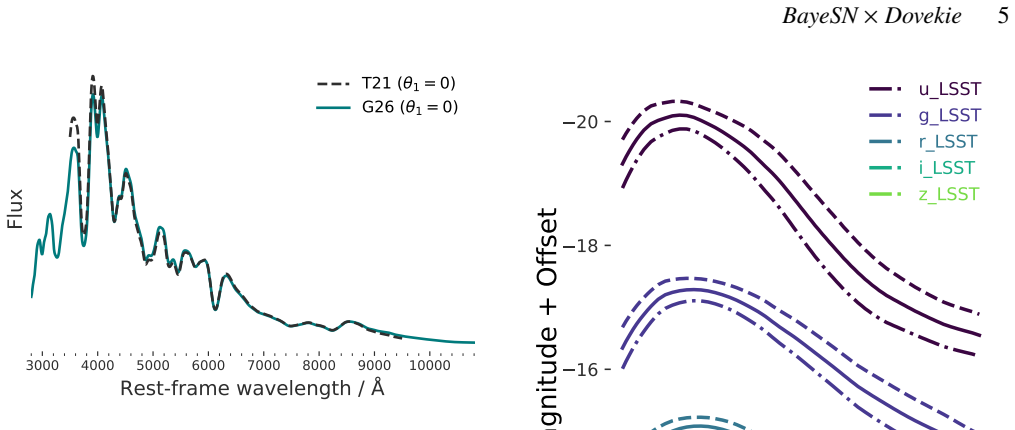
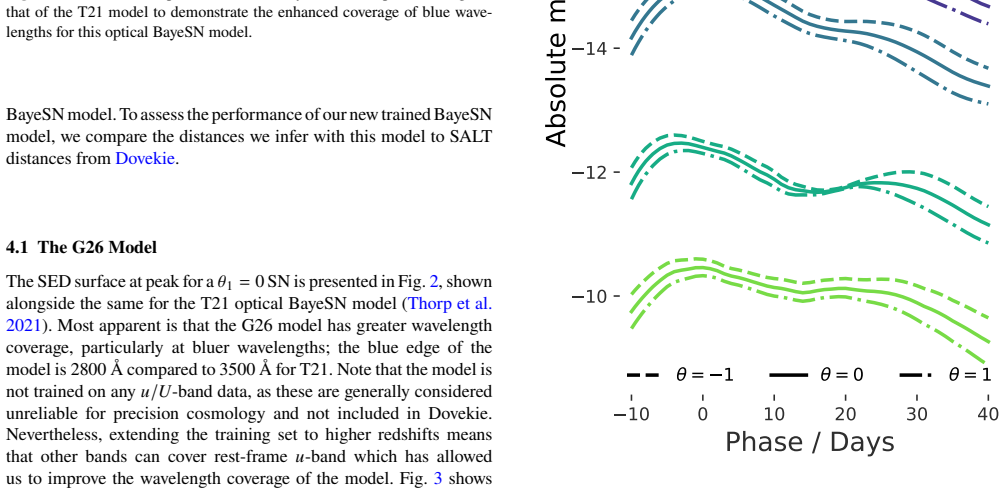
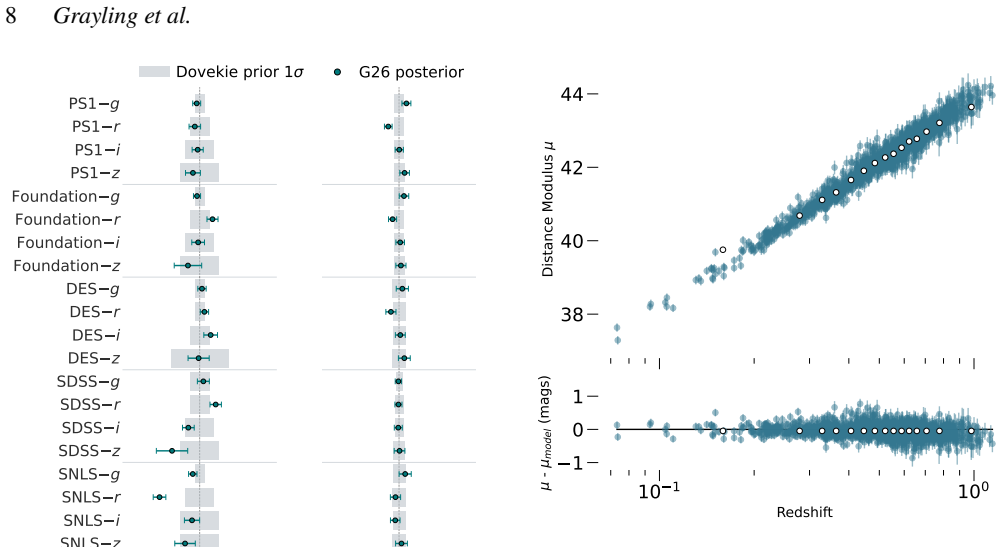
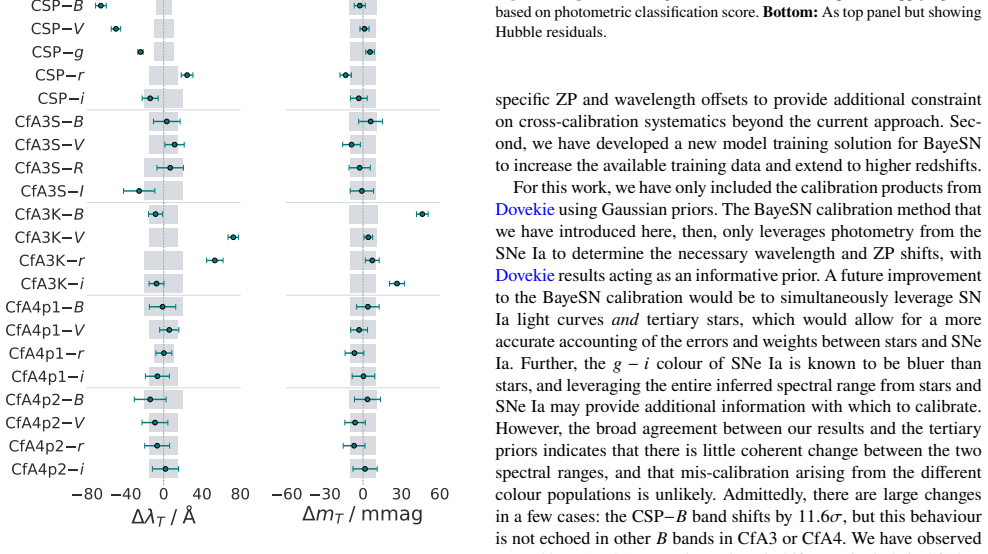
We present a new framework for BayeSN, the hierarchical Bayesian SED model for type Ia supernovae (SNe Ia), incorporating cross-calibration of samples observed across heterogeneous telescopes. This framework is the first to parametrise the filter wavelength and zero-point offsets commonly used in SN~Ia cosmology within SN SED model training, enabling additional constraint on cross-calibration from SNe beyond the standard stellar-based cross-calibration pipeline. We apply this framework to train a new G26 BayeSN model on the same SED model training sample used in recent cosmological analyses, an order-of-magnitude increase over previous BayeSN training samples, and include a novel training methodology to leverage high-redshift SNe Ia in BayeSN training. We present the G26 model and apply it to the DES-SN5YR sample to assess performance, finding a 12 per cent reduction in $\sigma_{\rm NMAD}$ scatter when compared with SALT3$.$Dovekie; 0.164 mag compared with 0.185 mag for a sample of likely SNe Ia at $z < 0.7$, without bias corrections. We additionally present constraints on cross-calibration wavelength and zero-point shifts from our framework when using the latest `Dovekie' calibration constraints as a prior. This work is a key step towards a full end-to-end cosmological analysis with BayeSN; the new G26 model is incorporated within the public BayeSN code.
Editorial analysis
A structured set of objections, weighed in public.
Referee Report
Summary. The paper presents a new framework for BayeSN that jointly performs photometric cross-calibration and SED modeling by parametrizing filter wavelength and zero-point offsets inside the hierarchical Bayesian training, using Dovekie stellar-based constraints as a prior. It trains the G26 model on an order-of-magnitude larger sample that includes high-redshift SNe Ia via a novel methodology, reports constraints on the calibration shifts, and demonstrates a 12% reduction in σ_NMAD scatter (0.164 mag vs. 0.185 mag for SALT3.Dovekie) on the DES-SN5YR sample of likely SNe Ia at z < 0.7 without bias corrections. The G26 model is released publicly as a step toward end-to-end cosmological analyses.
Significance. If the reported scatter reduction is shown to arise from genuinely independent calibration constraints rather than absorption of unmodeled effects, the framework would represent a meaningful advance for SN Ia cosmology by tightening distance measurements through integrated use of SN data for cross-calibration. The expanded training sample and high-z inclusion are positive features; public code release aids reproducibility.
major comments (2)
- [Abstract] The central claim of a 12% σ_NMAD reduction (Abstract) rests on the parametrization of filter wavelength/zero-point offsets supplying additional constraints independent of the Dovekie pipeline. The manuscript must demonstrate this independence via explicit tests (e.g., posterior predictive checks on calibration parameters or consistency between SN-derived and stellar offsets) to rule out the possibility that offsets absorb selection effects or intrinsic variations from the larger training set.
- The novel high-redshift training methodology (Abstract) is load-bearing for the scatter claim on the low-z DES-SN5YR sample; the paper needs to show that this methodology does not introduce covariance or bias that artificially lowers the reported scatter when the model is applied at z < 0.7.
minor comments (1)
- [Abstract] The phrase 'without bias corrections' in the Abstract should be defined more precisely with respect to the DES-SN5YR application and any implicit corrections already present in the training.
Simulated Author's Rebuttal
We thank the referee for their careful reading of our manuscript and their constructive comments. We respond to each major comment below and have revised the manuscript accordingly to strengthen the claims regarding the independence of the calibration constraints and the validity of the high-redshift training methodology.
read point-by-point responses
-
Referee: [Abstract] The central claim of a 12% σ_NMAD reduction (Abstract) rests on the parametrization of filter wavelength/zero-point offsets supplying additional constraints independent of the Dovekie pipeline. The manuscript must demonstrate this independence via explicit tests (e.g., posterior predictive checks on calibration parameters or consistency between SN-derived and stellar offsets) to rule out the possibility that offsets absorb selection effects or intrinsic variations from the larger training set.
Authors: We concur that it is essential to demonstrate that the SN-derived calibration offsets provide constraints independent of the Dovekie stellar priors. To address this, we have performed and now report in the revised manuscript explicit tests, including posterior predictive checks on the calibration parameters and comparisons of the SN-inferred offsets with the stellar-based ones. These tests confirm that the offsets are consistent with the priors but receive additional tightening from the SN data, and there is no indication that they are absorbing selection effects or intrinsic variations from the expanded training sample. This supports that the scatter reduction arises from the integrated use of SN data for cross-calibration. revision: yes
-
Referee: [—] The novel high-redshift training methodology (Abstract) is load-bearing for the scatter claim on the low-z DES-SN5YR sample; the paper needs to show that this methodology does not introduce covariance or bias that artificially lowers the reported scatter when the model is applied at z < 0.7.
Authors: We recognize the need to verify that the novel high-redshift training methodology does not artificially reduce the scatter on the low-redshift DES-SN5YR sample through introduced covariance or bias. In the revised manuscript, we have added specific validation tests: we compare the performance of models trained with and without the high-z SNe on the low-z sample, and examine the covariance structure in the model parameters. These analyses demonstrate that the scatter reduction is robust and not due to bias or covariance introduced by the high-z inclusion, as the improvement holds in the controlled tests. revision: yes
Circularity Check
Minor self-citation of training sample; central scatter reduction measured on external DES sample with no reduction to fitted inputs by construction
full rationale
The paper parametrizes filter wavelength and zero-point offsets inside BayeSN training and adopts Dovekie constraints as a prior, then reports an empirical 12% reduction in σ_NMAD (0.164 vs 0.185 mag) on the DES-SN5YR sample at z<0.7 when using the resulting G26 model versus SALT3.Dovekie. No quoted equation or procedure shows the performance metric itself being a fitted parameter that is then relabeled a prediction, nor does any load-bearing step reduce to a self-citation of an unverified uniqueness result. The training sample is the same as in prior cosmological analyses, but this is a data choice rather than a definitional loop; the improvement claim remains an independent comparison against an external benchmark sample and model.
Axiom & Free-Parameter Ledger
free parameters (2)
- filter wavelength offsets
- zero-point offsets
axioms (2)
- domain assumption Previous BayeSN hierarchical Bayesian SED model structure remains valid when calibration offsets are added as free parameters
- domain assumption Dovekie calibration constraints provide an independent prior that does not absorb the new SN-derived constraints
Reference graph
Works this paper leans on
-
[1]
ZTF SNe Ia DR2: Towards cosmology-grade ZTF supernova light curves using scene modeling photometry. arXiv e-prints , keywords =. doi:10.48550/arXiv.2509.04073 , archivePrefix =. 2509.04073 , primaryClass =
-
[2]
ZTF SN Ia DR2: Overview. , keywords =. doi:10.1051/0004-6361/202450388 , archivePrefix =. 2409.04346 , primaryClass =
-
[3]
DAmodel: hierarchical Bayesian modelling of DA white dwarfs for spectrophotometric calibration. , keywords =. doi:10.1093/mnras/staf629 , archivePrefix =. 2412.08809 , primaryClass =
-
[4]
A Reassessment of the Pantheon+ and DES 5YR Calibration Uncertainties: Dovekie. arXiv e-prints , keywords =. doi:10.48550/arXiv.2506.05471 , archivePrefix =. 2506.05471 , primaryClass =
-
[5]
ZTF SN Ia DR2: The secondary maximum in Type Ia supernovae. arXiv e-prints , keywords =. doi:10.48550/arXiv.2406.19460 , archivePrefix =. 2406.19460 , primaryClass =
-
[6]
Constraining the SN Ia host galaxy dust law distribution and mass step: hierarchical BAYESN analysis of optical and near-infrared light curves. , keywords =. doi:10.1093/mnras/stac2714 , archivePrefix =. 2209.10552 , primaryClass =
-
[7]
Using rest-frame optical and NIR data from the RAISIN survey to explore the redshift evolution of dust laws in SN Ia host galaxies. , keywords =. doi:10.1093/mnras/stae1111 , archivePrefix =. 2402.18624 , primaryClass =
-
[8]
Secondary Maximum in the Near-Infrared Lightcurves of Type Ia Supernovae
Secondary Maximum in the Near-Infrared Light Curves of Type Ia Supernovae. , keywords =. doi:10.1086/506588 , archivePrefix =. astro-ph/0606449 , primaryClass =
work page internal anchor Pith review Pith/arXiv arXiv doi:10.1086/506588
-
[9]
Concerning colour: The effect of environment on type Ia supernova colour in the dark energy survey. , keywords =. doi:10.1093/mnras/stac3711 , archivePrefix =. 2208.01357 , primaryClass =
-
[10]
The axis of systematic bias in SN Ia cosmology and implications for DESI 2024 results. arXiv e-prints , keywords =. doi:10.48550/arXiv.2409.18668 , archivePrefix =. 2409.18668 , primaryClass =
-
[11]
The Zwicky Transient Facility: Surveys and Scheduler
The Zwicky Transient Facility: Surveys and Scheduler. , keywords =. doi:10.1088/1538-3873/ab0c2a , archivePrefix =. 1905.02209 , primaryClass =
work page internal anchor Pith review Pith/arXiv arXiv doi:10.1088/1538-3873/ab0c2a 1905
-
[12]
The Zwicky Transient Facility: System Overview, Performance, and First Results
The Zwicky Transient Facility: System Overview, Performance, and First Results. , keywords =. doi:10.1088/1538-3873/aaecbe , archivePrefix =. 1902.01932 , primaryClass =
work page internal anchor Pith review Pith/arXiv arXiv doi:10.1088/1538-3873/aaecbe 1902
-
[13]
LSST: from Science Drivers to Reference Design and Anticipated Data Products
LSST: From Science Drivers to Reference Design and Anticipated Data Products. , keywords =. doi:10.3847/1538-4357/ab042c , archivePrefix =. 0805.2366 , primaryClass =
work page internal anchor Pith review Pith/arXiv arXiv doi:10.3847/1538-4357/ab042c
-
[14]
On the dependence of the type Ia SNe luminosities on the metallicity of their host galaxies
On the Dependence of Type Ia SNe Luminosities on the Metallicity of Their Host Galaxies. , keywords =. doi:10.3847/2041-8205/818/1/L19 , archivePrefix =. 1511.05348 , primaryClass =
work page internal anchor Pith review Pith/arXiv arXiv doi:10.3847/2041-8205/818/1/l19 2041
-
[15]
Using the local gas-phase oxygen abundances to explore a metallicity dependence in SNe Ia luminosities. , keywords =. doi:10.1093/mnras/stw1706 , archivePrefix =. 1607.05526 , primaryClass =
work page internal anchor Pith review Pith/arXiv arXiv doi:10.1093/mnras/stw1706
-
[16]
Strong dependence of Type Ia supernova standardization on the local specific star formation rate. , keywords =. doi:10.1051/0004-6361/201730404 , archivePrefix =. 1806.03849 , primaryClass =
-
[17]
PISCO: The Pmas/ppak Integral-field Supernova hosts COmpilation
PISCO: The PMAS/PPak Integral-field Supernova Hosts Compilation. , keywords =. doi:10.3847/1538-4357/aaaf20 , archivePrefix =. 1802.01589 , primaryClass =
work page internal anchor Pith review Pith/arXiv arXiv doi:10.3847/1538-4357/aaaf20
-
[18]
Environmental Dependence of Type Ia Supernova Luminosities from a Sample without a Local-Global Difference in Host Star Formation. , keywords =. doi:10.3847/1538-4357/aaa127 , archivePrefix =. 1801.01192 , primaryClass =
work page internal anchor Pith review Pith/arXiv arXiv doi:10.3847/1538-4357/aaa127
-
[19]
Dependence of Type Ia supernova luminosities on their local environment
Dependence of Type Ia supernova luminosities on their local environment. , keywords =. doi:10.1051/0004-6361/201731425 , archivePrefix =. 1706.07697 , primaryClass =
work page internal anchor Pith review Pith/arXiv arXiv doi:10.1051/0004-6361/201731425
-
[20]
Environmental Dependence of Type Ia Supernova Luminosities from the YONSEI Supernova Catalog. J.\ Korean Astron.\ Soc. , keywords =. doi:10.5303/JKAS.2019.52.5.181 , archivePrefix =. 1908.10375 , primaryClass =
-
[21]
The effect of environment on Type Ia supernovae in the Dark Energy Survey three-year cosmological sample. , keywords =. doi:10.1093/mnras/staa3924 , archivePrefix =. 2008.12101 , primaryClass =
-
[22]
BEAMS: separating the wheat from the chaff in supernova analysis
BEAMS: Separating the Wheat from the Chaff in Supernova Analysis. Astrostatistical Challenges for the New Astronomy , year = 2013, editor =. doi:10.1007/978-1-4614-3508-2_4 , archivePrefix =. 1210.7762 , primaryClass =
work page internal anchor Pith review Pith/arXiv arXiv doi:10.1007/978-1-4614-3508-2_4 2013
-
[23]
Shedding light on the Type Ia supernova extinction puzzle: dust location found
Shedding light on the Type Ia supernova extinction puzzle: dust location found. , keywords =. doi:10.1093/mnras/sty1619 , archivePrefix =. 1803.09749 , primaryClass =
work page internal anchor Pith review Pith/arXiv arXiv doi:10.1093/mnras/sty1619
-
[24]
Estimating dust distances to Type Ia supernovae from colour excess time-evolution
Estimating dust distances to Type Ia supernovae from colour excess time evolution. , keywords =. doi:10.1093/mnras/stx2291 , archivePrefix =. 1707.00696 , primaryClass =
work page internal anchor Pith review Pith/arXiv arXiv doi:10.1093/mnras/stx2291
-
[25]
The effects of varying colour-luminosity relations on Type Ia supernova science. , keywords =. doi:10.1093/mnras/stab2802 , archivePrefix =. 2009.13230 , primaryClass =
-
[26]
A sample of dust attenuation laws for Dark Energy Survey supernova host galaxies. , keywords =. doi:10.1051/0004-6361/202346534 , archivePrefix =. 2211.14291 , primaryClass =
-
[27]
DESI 2024 VI: Cosmological Constraints from the Measurements of Baryon Acoustic Oscillations
DESI 2024 VI: cosmological constraints from the measurements of baryon acoustic oscillations. , keywords =. doi:10.1088/1475-7516/2025/02/021 , archivePrefix =. 2404.03002 , primaryClass =
work page internal anchor Pith review Pith/arXiv arXiv doi:10.1088/1475-7516/2025/02/021 2024
-
[28]
DESI DR2 results. II. Measurements of baryon acoustic oscillations and cosmological constraints. , keywords =. doi:10.1103/tr6y-kpc6 , archivePrefix =. 2503.14738 , primaryClass =
work page internal anchor Pith review Pith/arXiv arXiv doi:10.1103/tr6y-kpc6
-
[29]
Overview of the Instrumentation for the Dark Energy Spectroscopic Instrument
Overview of the Instrumentation for the Dark Energy Spectroscopic Instrument. , keywords =. doi:10.3847/1538-3881/ac882b , archivePrefix =. 2205.10939 , primaryClass =
work page internal anchor Pith review Pith/arXiv arXiv doi:10.3847/1538-3881/ac882b
-
[30]
The Hourglass Simulation: A Catalog for the Roman High-Latitude Time-Domain Core Community Survey. arXiv e-prints , keywords =. doi:10.48550/arXiv.2506.05161 , archivePrefix =. 2506.05161 , primaryClass =
-
[31]
The Dark Energy Survey Supernova Program results: type Ia supernova brightness correlates with host galaxy dust. , keywords =. doi:10.1093/mnras/stac3056 , archivePrefix =. 2206.06928 , primaryClass =
-
[32]
Diverse reddening distributions in sight lines to type Ia supernovae. , keywords =. doi:10.1051/0004-6361/202555686 , archivePrefix =. 2505.22216 , primaryClass =
-
[33]
A Bayesian Perspective on Evidence for Evolving Dark Energy
A Bayesian Perspective on Evidence for Evolving Dark Energy. arXiv e-prints , keywords =. doi:10.48550/arXiv.2511.10631 , archivePrefix =. 2511.10631 , primaryClass =
work page internal anchor Pith review Pith/arXiv arXiv doi:10.48550/arxiv.2511.10631
-
[34]
A BayeSN distance ladder: H _ 0 from a consistent modelling of Type Ia supernovae from the optical to the near-infrared. , keywords =. doi:10.1093/mnras/stad1590 , archivePrefix =. 2211.07657 , primaryClass =
-
[35]
BayeSN and SALT: a comparison of dust inference across SN Ia light-curve models with DES5YR. , keywords =. doi:10.1093/mnras/staf1345 , archivePrefix =. 2410.13747 , primaryClass =
-
[36]
Characterizing the standardization properties of type ia supernovae in the z band with hierarchical Bayesian modelling. , keywords =. doi:10.1093/mnras/staf1056 , archivePrefix =. 2506.04309 , primaryClass =
-
[37]
Relative Intrinsic Scatter in Hierarchical Type Ia Supernova Sibling Analyses: Application to SNe 2021hpr, 1997bq, and 2008fv in NGC 3147. , keywords =. doi:10.3847/1538-4357/acf7bb , archivePrefix =. 2209.10558 , primaryClass =
-
[38]
Variational inference for acceleration of SN Ia photometric distance estimation with BayeSN. , keywords =. doi:10.1093/mnras/stae2465 , archivePrefix =. 2405.06013 , primaryClass =
-
[39]
Type Ia Supernova Light Curve Inference: Hierarchical Bayesian Analysis in the Near Infrared
Type Ia Supernova Light-Curve Inference: Hierarchical Bayesian Analysis in the Near-Infrared. , keywords =. doi:10.1088/0004-637X/704/1/629 , archivePrefix =. 0908.0536 , primaryClass =
work page internal anchor Pith review Pith/arXiv arXiv doi:10.1088/0004-637x/704/1/629
-
[40]
Type Ia Supernova Light Curve Inference: Hierarchical Models in the Optical and Near Infrared
Type Ia Supernova Light Curve Inference: Hierarchical Models in the Optical and Near-infrared. , keywords =. doi:10.1088/0004-637X/731/2/120 , archivePrefix =. 1011.5910 , primaryClass =
work page internal anchor Pith review Pith/arXiv arXiv doi:10.1088/0004-637x/731/2/120
-
[41]
arXiv e-prints , keywords =
On the origin of the environmental step: A BayeSN view of the ZTF SN Ia DR2. arXiv e-prints , keywords =
-
[42]
BayeSN-TD: Time Delay and $H_0$ Estimation for Lensed SN H0pe
BayeSN-TD: Time Delay and H _ 0 Estimation for Lensed SN H0pe. , keywords =. doi:10.1093/mnras/stag340 , archivePrefix =. 2510.11719 , primaryClass =
work page internal anchor Pith review Pith/arXiv arXiv doi:10.1093/mnras/stag340
-
[43]
Transient Name Server AstroNote , keywords =
SN H0pe: three images of a SN detected near the central region of the galaxy cluster field PLCK G165.7+67.0. Transient Name Server AstroNote , keywords =
-
[44]
JWST Photometric Time-delay and Magnification Measurements for the Triply Imaged Type Ia ``SN H0pe'' at z = 1.78. , keywords =. doi:10.3847/1538-4357/ad3c43 , archivePrefix =. 2403.18954 , primaryClass =
-
[45]
The Dark Energy Survey supernova program: a reanalysis of cosmology results and evidence for evolving dark energy with an updated Type Ia supernova calibration. , keywords =. doi:10.1093/mnras/stag632 , archivePrefix =. 2511.07517 , primaryClass =
work page internal anchor Pith review Pith/arXiv arXiv doi:10.1093/mnras/stag632
-
[46]
SIDE-real: Supernova Ia Dust Extinction with truncated marginal neural ratio estimation applied to real data. , keywords =. doi:10.1093/mnras/stae995 , archivePrefix =. 2403.07871 , primaryClass =
-
[47]
FlowSN: Neural Simulation-Based Inference under Realistic Selection Effects applied to Supernova Cosmology. , keywords =. doi:10.1093/mnras/stag1046 , archivePrefix =. 2603.11165 , primaryClass =
work page internal anchor Pith review Pith/arXiv arXiv doi:10.1093/mnras/stag1046
-
[48]
CIGaRS I: Combined simulation-based inference from type Ia supernovae and host photometry
CIGaRS I: combined simulation-based inference from type Ia supernovae and host photometry. Nature Astronomy , keywords =. doi:10.1038/s41550-026-02842-5 , archivePrefix =. 2508.15899 , primaryClass =
work page internal anchor Pith review Pith/arXiv arXiv doi:10.1038/s41550-026-02842-5
-
[49]
Examining extinction distributions for type Ia supernovae in simulated 3D galaxies
Examining extinction distributions for type Ia supernovae in simulated 3D galaxies. arXiv e-prints , keywords =. doi:10.48550/arXiv.2605.23512 , archivePrefix =. 2605.23512 , primaryClass =
work page internal anchor Pith review Pith/arXiv arXiv doi:10.48550/arxiv.2605.23512
-
[50]
arXiv e-prints , keywords =
Old Universe, Young SNe Ia: A Statistical Analysis of Type Ia Supernova Progenitor Age from 6,983 TITAN Host Galaxies, and Implications for Cosmology. arXiv e-prints , keywords =
-
[51]
ZTF SN Ia DR2: Environmental dependencies of stretch and luminosity for a volume-limited sample of 1000 type Ia supernovae. , keywords =. doi:10.1051/0004-6361/202450378 , archivePrefix =. 2405.20965 , primaryClass =
-
[52]
The Pantheon+ Analysis: SuperCal-fragilistic Cross Calibration, Retrained SALT2 Light-curve Model, and Calibration Systematic Uncertainty. , keywords =. doi:10.3847/1538-4357/ac8bcc , archivePrefix =. 2112.03864 , primaryClass =
-
[53]
First Cosmology Results using Type Ia Supernovae from the Dark Energy Survey: Constraints on Cosmological Parameters. , keywords =. doi:10.3847/2041-8213/ab04fa , archivePrefix =. 1811.02374 , primaryClass =
work page internal anchor Pith review Pith/arXiv arXiv doi:10.3847/2041-8213/ab04fa 2041
-
[54]
The Supernova Legacy Survey: measurement of _ M , _ and w from the first year data set. , keywords =. doi:10.1051/0004-6361:20054185 , adsurl =
-
[55]
Improved cosmological constraints from a joint analysis of the SDSS-II and SNLS supernova samples
Improved cosmological constraints from a joint analysis of the SDSS-II and SNLS supernova samples. , keywords =. doi:10.1051/0004-6361/201423413 , archivePrefix =. 1401.4064 , primaryClass =
work page internal anchor Pith review Pith/arXiv arXiv doi:10.1051/0004-6361/201423413
-
[56]
First Cosmology Results Using Type Ia Supernovae from the Dark Energy Survey: Analysis, Systematic Uncertainties, and Validation. , keywords =. doi:10.3847/1538-4357/ab08a0 , archivePrefix =. 1811.02377 , primaryClass =
work page internal anchor Pith review Pith/arXiv arXiv doi:10.3847/1538-4357/ab08a0
-
[57]
The Pantheon+ Analysis: Cosmological Constraints
The Pantheon+ Analysis: Cosmological Constraints. , keywords =. doi:10.3847/1538-4357/ac8e04 , archivePrefix =. 2202.04077 , primaryClass =
work page internal anchor Pith review Pith/arXiv arXiv doi:10.3847/1538-4357/ac8e04
-
[58]
It's Dust: Solving the Mysteries of the Intrinsic Scatter and Host-galaxy Dependence of Standardized Type Ia Supernova Brightnesses. , keywords =. doi:10.3847/1538-4357/abd69b , archivePrefix =. 2004.10206 , primaryClass =
-
[59]
Cosmological parameters from the comparison of peculiar velocities with predictions from the 2M++ density field. , keywords =. doi:10.1093/mnras/stv547 , archivePrefix =. 1504.04627 , primaryClass =
work page internal anchor Pith review Pith/arXiv arXiv doi:10.1093/mnras/stv547
-
[60]
The Dark Energy Survey Supernova Program: Cosmological Analysis and Systematic Uncertainties. , keywords =. doi:10.3847/1538-4357/ad5e6c , archivePrefix =. 2401.02945 , primaryClass =
-
[61]
Correcting for the Effects of Interstellar Extinction
Correcting for the Effects of Interstellar Extinction. , keywords =. doi:10.1086/316293 , archivePrefix =. astro-ph/9809387 , primaryClass =
work page internal anchor Pith review Pith/arXiv arXiv doi:10.1086/316293
-
[62]
The Dark Energy Camera. , keywords =. doi:10.1088/0004-6256/150/5/150 , archivePrefix =. 1504.02900 , primaryClass =
work page internal anchor Pith review Pith/arXiv arXiv doi:10.1088/0004-6256/150/5/150
-
[63]
The Foundation Supernova Survey: Motivation, Design, Implementation, and First Data Release
The Foundation Supernova Survey: motivation, design, implementation, and first data release. , keywords =. doi:10.1093/mnras/stx3136 , archivePrefix =. 1711.02474 , primaryClass =
work page internal anchor Pith review Pith/arXiv arXiv doi:10.1093/mnras/stx3136
-
[64]
Scalable hierarchical BayeSN inference: investigating dependence of SN Ia host galaxy dust properties on stellar mass and redshift. , keywords =. doi:10.1093/mnras/stae1202 , archivePrefix =. 2401.08755 , primaryClass =
-
[65]
SALT2: using distant supernovae to improve the use of Type Ia supernovae as distance indicators
SALT2: using distant supernovae to improve the use of type Ia supernovae as distance indicators. , keywords =. doi:10.1051/0004-6361:20066930 , archivePrefix =. astro-ph/0701828 , primaryClass =
work page internal anchor Pith review Pith/arXiv arXiv doi:10.1051/0004-6361:20066930
-
[66]
The Supernova Legacy Survey 3-year sample: Type Ia supernovae photometric distances and cosmological constraints. , keywords =. doi:10.1051/0004-6361/201014468 , archivePrefix =. 1010.4743 , primaryClass =
work page internal anchor Pith review Pith/arXiv arXiv doi:10.1051/0004-6361/201014468
-
[67]
CfA3: 185 Type Ia Supernova Light Curves from the CfA
CfA3: 185 Type Ia Supernova Light Curves from the CfA. , keywords =. doi:10.1088/0004-637X/700/1/331 , archivePrefix =. 0901.4787 , primaryClass =
work page internal anchor Pith review Pith/arXiv arXiv doi:10.1088/0004-637x/700/1/331
-
[68]
Improved Dark Energy Constraints from ~100 New CfA Supernova Type Ia Light Curves
Improved Dark Energy Constraints from 100 New CfA Supernova Type Ia Light Curves. , keywords =. doi:10.1088/0004-637X/700/2/1097 , archivePrefix =. 0901.4804 , primaryClass =
work page internal anchor Pith review Pith/arXiv arXiv doi:10.1088/0004-637x/700/2/1097
-
[69]
CfA4: Light Curves for 94 Type Ia Supernovae
CfA4: Light Curves for 94 Type Ia Supernovae. , keywords =. doi:10.1088/0067-0049/200/2/12 , archivePrefix =. 1205.4493 , primaryClass =
work page internal anchor Pith review Pith/arXiv arXiv doi:10.1088/0067-0049/200/2/12
-
[70]
The Sloan Digital Sky Survey-II: Photometry and Supernova Ia Light Curves from the 2005 data
The Sloan Digital Sky Survey-II: Photometry and Supernova IA Light Curves from the 2005 Data. , keywords =. doi:10.1088/0004-6256/136/6/2306 , archivePrefix =. 0908.4277 , primaryClass =
work page internal anchor Pith review Pith/arXiv arXiv doi:10.1088/0004-6256/136/6/2306 2005
-
[71]
K-corrections and spectral templates of Type Ia supernovae
K-Corrections and Spectral Templates of Type Ia Supernovae. , keywords =. doi:10.1086/518232 , archivePrefix =. astro-ph/0703529 , primaryClass =
work page internal anchor Pith review Pith/arXiv arXiv doi:10.1086/518232
-
[72]
Measuring Dark Energy Properties with Photometrically Classified Pan-STARRS Supernovae. II. Cosmological Parameters. , keywords =. doi:10.3847/1538-4357/aab6b1 , archivePrefix =. 1710.00846 , primaryClass =
work page internal anchor Pith review Pith/arXiv arXiv doi:10.3847/1538-4357/aab6b1
-
[73]
Hubble Residuals of Nearby Type Ia Supernovae Are Correlated with Host Galaxy Masses
Hubble Residuals of Nearby Type Ia Supernovae are Correlated with Host Galaxy Masses. , keywords =. doi:10.1088/0004-637X/715/2/743 , archivePrefix =. 0912.0929 , primaryClass =
work page internal anchor Pith review Pith/arXiv arXiv doi:10.1088/0004-637x/715/2/743
-
[74]
SALT3: An Improved Type Ia Supernova Model for Measuring Cosmic Distances. , keywords =. doi:10.3847/1538-4357/ac30d8 , archivePrefix =. 2104.07795 , primaryClass =
-
[75]
The Difference Imaging Pipeline for the Transient Search in the Dark Energy Survey
The Difference Imaging Pipeline for the Transient Search in the Dark Energy Survey. , keywords =. doi:10.1088/0004-6256/150/6/172 , archivePrefix =. 1507.05137 , primaryClass =
work page internal anchor Pith review Pith/arXiv arXiv doi:10.1088/0004-6256/150/6/172
-
[76]
Correcting Type Ia Supernova Distances for Selection Biases and Contamination in Photometrically Identified Samples. , keywords =. doi:10.3847/1538-4357/836/1/56 , archivePrefix =. 1610.04677 , primaryClass =
work page internal anchor Pith review Pith/arXiv arXiv doi:10.3847/1538-4357/836/1/56
-
[77]
The Carnegie Supernova Project. I. Third Photometry Data Release of Low-redshift Type Ia Supernovae and Other White Dwarf Explosions. , keywords =. doi:10.3847/1538-3881/aa8df0 , archivePrefix =. 1709.05146 , primaryClass =
work page internal anchor Pith review Pith/arXiv arXiv doi:10.3847/1538-3881/aa8df0
-
[78]
The Type Ia Supernova Color-Magnitude Relation and Host Galaxy Dust: A Simple Hierarchical Bayesian Model. , keywords =. doi:10.3847/1538-4357/aa6038 , archivePrefix =. 1609.04470 , primaryClass =
work page internal anchor Pith review Pith/arXiv arXiv doi:10.3847/1538-4357/aa6038
-
[79]
A hierarchical Bayesian SED model for Type Ia supernovae in the optical to near-infrared. , keywords =. doi:10.1093/mnras/stab3496 , archivePrefix =. 2008.07538 , primaryClass =
-
[80]
SuperNNova: an open-source framework for Bayesian, neural network-based supernova classification. , keywords =. doi:10.1093/mnras/stz3312 , archivePrefix =. 1901.06384 , primaryClass =
discussion (0)
Sign in with ORCID, Apple, or X to comment. Anyone can read and Pith papers without signing in.