QMCtwin: Master-Equation Simulation of Syndrome Statistics Beyond Pauli Noise
Pith reviewed 2026-06-26 17:33 UTC · model grok-4.3
The pith
Master-equation simulation of a distance-7 surface code produces syndrome biases and syndrome-logical-parity correlations absent from Pauli-twirled models.
A machine-rendered reading of the paper's core claim, the machinery that carries it, and where it could break.
Core claim
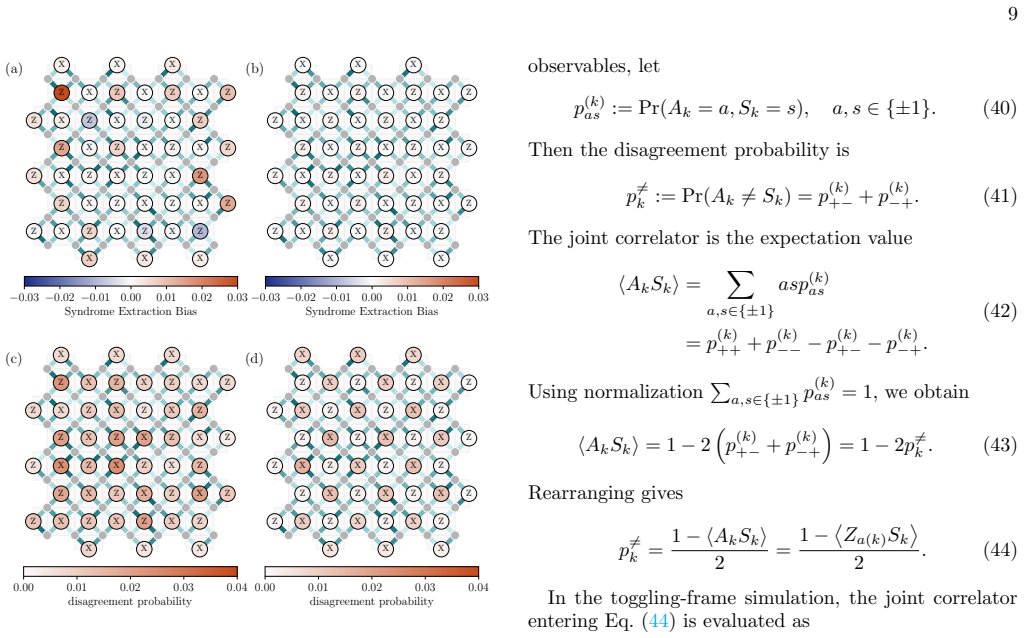
QMCtwin predicts syndrome-extraction biases and correlations between syndromes and proxies of logical-string-parity that are absent or strongly suppressed in the stochastic Pauli description. Information-theoretic diagnostics further quantify how the information content of syndromes versus string-parity proxies differs between the realistic master-equation simulation and the Pauli-twirled model.
What carries the argument
QMCtwin, a sign-problem-suppressed quantum Monte Carlo framework that evolves an open-system master equation for full QEC circuits and estimates syndrome observables from stochastic density-matrix samples.
If this is right
- Syndrome statistics extracted from the master-equation trajectory contain biases that Pauli models omit.
- Correlations appear between measured syndromes and proxies for logical string parity that are strongly suppressed under Pauli twirling.
- Information-theoretic measures of mutual information between syndromes and string-parity proxies take different values in the two descriptions.
- Decoder-facing noise models derived from master-equation simulation can retain features discarded by Clifford approximation.
Where Pith is reading between the lines
- Decoders trained on Pauli-generated data may underperform when deployed on hardware whose noise includes the coherent and continuous-time channels retained by QMCtwin.
- The same framework could be used to test whether adding a small number of extra syndrome observables to the decoder input recovers the missing correlations.
- If the master-equation biases persist at larger code distances, they would set a lower bound on the logical error rate improvement achievable by any decoder that assumes independent Pauli noise.
Load-bearing premise
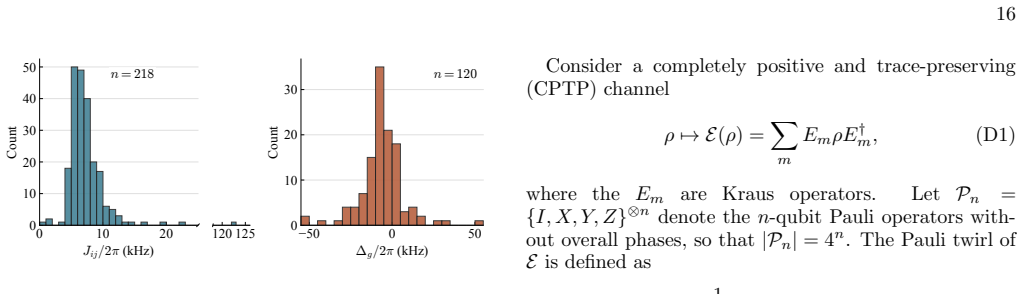
The chosen master equation, containing relaxation, pure dephasing, coherent miscalibration, residual ZZ crosstalk, and drive detuning, accurately captures the device dynamics during syndrome extraction.
What would settle it
An experiment on the same distance-7 hardware that measures no extraction biases or syndrome-logical-parity correlations beyond those already present in a Pauli-twirled model would falsify the claim that the master-equation dynamics differ in these observables.
Figures



read the original abstract
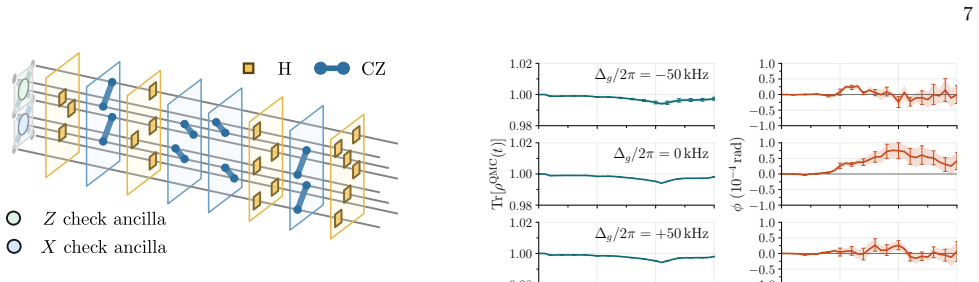
As quantum error correction moves toward large-scale experimental implementations, decoder performance increasingly depends on how faithfully hardware noise is translated into syndrome statistics. Standard stabilizer workflows achieve scalability by replacing device dynamics with stochastic Pauli or detector-error models, but this compression can discard coherent phase information, nonunital drift, continuous-time effects of always-on couplings, and correlations generated by simultaneous Hamiltonian and dissipative evolution. Here we present QMCtwin, a sign-problem-suppressed quantum Monte Carlo framework for master-equation simulation of QEC circuits, and apply it to a full syndrome-extraction round of a distance-$7$ rotated surface code with $97$ physical qubits. The open-system model includes realistic superconducting-device noise mechanisms such as relaxation, pure dephasing, coherent gate miscalibration, residual $ZZ$ crosstalk, and drive-qubit detuning. By directly estimating syndrome observables from the QMC-generated stochastic density matrix estimator, we compare the master-equation dynamics with their Pauli-twirled Clifford simulation counterparts. QMCtwin predicts syndrome-extraction biases and correlations between syndromes and proxies of logical-string-parity that are absent or strongly suppressed in the stochastic Pauli description. We introduce information-theoretic diagnostics that further quantify how information concerning syndromes versus string-parity proxies differs between the realistic master-equation simulation and the corresponding Pauli-twirled model. These results show that QMC-based master-equation digital twins can expose noise features hidden by conventional Pauli/Clifford noise models and provide a practical path toward more accurate decoder-facing syndrome models.
Editorial analysis
A structured set of objections, weighed in public.
Referee Report
Summary. The manuscript introduces QMCtwin, a sign-problem-suppressed quantum Monte Carlo framework for direct master-equation simulation of QEC circuits. It applies the method to a complete syndrome-extraction round on a distance-7 rotated surface code (97 qubits) whose open-system dynamics include relaxation, pure dephasing, coherent gate miscalibration, residual ZZ crosstalk, and drive-qubit detuning. The central claim is that the resulting syndrome statistics exhibit extraction biases and correlations with logical-string-parity proxies that are absent or strongly suppressed when the identical master equation is replaced by its Pauli-twirled Clifford counterpart; information-theoretic diagnostics are introduced to quantify the difference in accessible information between the two models.
Significance. If the numerical comparison holds, the work supplies a concrete computational route to syndrome models that retain coherent-phase and continuous-time information discarded by conventional Pauli or detector-error models. The internal, parameter-free contrast between the master-equation evolution and its own Pauli-twirled version is a methodological strength, as is the use of QMC to reach a 97-qubit code without sign-problem collapse. The information-theoretic diagnostics offer a new, falsifiable way to assess when non-Pauli features become decoder-relevant.
major comments (2)
- [§4] §4 (numerical results): the reported syndrome biases and syndrome–string-parity correlations are presented without Monte Carlo error bars or convergence diagnostics versus sample number; without these, it is impossible to determine whether the claimed differences from the Pauli-twirled model exceed statistical fluctuations of the QMC estimator.
- [§3.2] §3.2 (QMCtwin algorithm): the claim of sign-problem suppression for the combined coherent-plus-dissipative evolution is stated but the explicit importance-sampling weight or decomposition that achieves it is not given; without this, the scalability assertion for 97 qubits cannot be verified and the comparison to the Pauli-twirled case rests on an unexamined numerical foundation.
minor comments (2)
- Notation for the logical-string-parity proxy is introduced without an explicit equation; a short definition would remove ambiguity when the information-theoretic diagnostics are later applied.
- Figure captions for the information-theoretic plots do not state the number of QMC trajectories or the binning used for the syndrome observables.
Simulated Author's Rebuttal
We thank the referee for the constructive and detailed report. The two major comments identify genuine gaps in the presentation of statistical validation and algorithmic details. We address each point below and will revise the manuscript to incorporate the requested information.
read point-by-point responses
-
Referee: [§4] §4 (numerical results): the reported syndrome biases and syndrome–string-parity correlations are presented without Monte Carlo error bars or convergence diagnostics versus sample number; without these, it is impossible to determine whether the claimed differences from the Pauli-twirled model exceed statistical fluctuations of the QMC estimator.
Authors: We agree that Monte Carlo error bars and convergence diagnostics are required to establish that the reported differences are statistically significant rather than sampling artifacts. In the revised manuscript we will add bootstrap or jackknife error bars to all syndrome-bias and correlation plots in §4. We will also include a new supplementary section (or expanded methods subsection) that shows the running averages and standard errors of the key observables as functions of sample number, confirming convergence well before the final sample counts used in the figures. revision: yes
-
Referee: [§3.2] §3.2 (QMCtwin algorithm): the claim of sign-problem suppression for the combined coherent-plus-dissipative evolution is stated but the explicit importance-sampling weight or decomposition that achieves it is not given; without this, the scalability assertion for 97 qubits cannot be verified and the comparison to the Pauli-twirled case rests on an unexamined numerical foundation.
Authors: We accept that the explicit importance-sampling weights and the precise decomposition of the Liouvillian that suppresses the sign problem must be stated for reproducibility. The revised §3.2 will contain the full analytic form of the importance-sampling weight (including the coherent-phase and dissipative contributions) together with the Trotterized decomposition used to keep the estimator sign-problem free. This addition will make the 97-qubit scaling claim verifiable and will clarify why the same master equation can be compared directly with its Pauli-twirled counterpart. revision: yes
Circularity Check
No significant circularity detected
full rationale
The paper's core contribution is a direct numerical comparison, via sign-problem-suppressed QMC simulation of an open-system master equation, between syndrome statistics generated by the full dynamics (including relaxation, dephasing, coherent miscalibration, ZZ crosstalk, and detuning) and those generated by the Pauli-twirled Clifford version of the identical noise model. This contrast is internal to the chosen dynamical model and does not reduce any reported bias or correlation to a fitted parameter, self-citation, or definitional equivalence. No load-bearing uniqueness theorems, ansatzes smuggled via prior work, or renaming of known results are invoked in the abstract or described workflow. The simulation is constructed independently of the Pauli-twirled baseline, making the reported differences a genuine model distinction rather than a tautology.
Axiom & Free-Parameter Ledger
axioms (2)
- domain assumption The quantum master equation with the listed noise channels governs the open-system evolution of the superconducting device.
- domain assumption The QMC algorithm remains sign-problem-suppressed for the 97-qubit distance-7 code under the chosen noise model.
invented entities (1)
-
QMCtwin framework
no independent evidence
Reference graph
Works this paper leans on
-
[1]
Syndrome-extraction biasδ k The first diagnostic measures the first-moment mis- match between each ancilla readout and the correspond- ing data stabilizer. In an ideal syndrome-extraction cir- cuit, the ancilla outcome reports the eigenvalue of the corresponding data-qubit stabilizer, so the ancilla read- out value and the data stabilizer have exactly the...
-
[2]
To define this probability, letA k :=Z a(k)
Disagreement probabilityp ̸= k The second diagnostic is the total probability that the ancilla readout disagrees with the corresponding data stabilizer. To define this probability, letA k :=Z a(k). Us- ing the syndrome-label convention of Eq. (15), the noise- less ideal circuit makes the outcome ofA k agree with the eigenvalue ofS k. Since bothA k andS k ...
-
[3]
As our third diagnostic, we introduce a more decoder-facing information-theoretic measure
Mutual information The diagnostics in the previous subsections quantify local check-extraction behavior. As our third diagnostic, we introduce a more decoder-facing information-theoretic measure. Rather than asking whether a single ancilla faithfully reports a single stabilizer, we ask how much information a local measured syndrome pattern carries about a...
2026
-
[4]
P. W. Shor, Phys. Rev. A52, R2493 (1995)
1995
-
[5]
A. M. Steane, Phys. Rev. Lett.77, 793 (1996)
1996
-
[6]
D. A. Lidar and T. A. Brun,Quantum error correction (Cambridge university press, 2013)
2013
-
[7]
E. T. Campbell, B. M. Terhal, and C. Vuillot, Nature 549, 172 EP (2017)
2017
-
[8]
Aharonov and M
D. Aharonov and M. Ben-Or, SIAM Journal on Comput- ing38, 1207 (2008)
2008
- [9]
-
[10]
Nature638, 920 (2025)
2025
-
[11]
Bluvstein, A
D. Bluvstein, A. A. Geim, S. H. Li, S. J. Evered, J. P. Bonilla Ataides, G. Baranes, A. Gu, T. Manovitz, M. Xu, M. Kalinowski,et al., Nature649, 39 (2026)
2026
-
[12]
B. W. Reichardt, D. Aasen, R. Chao, A. Chernogu- zov, W. van Dam, J. P. Gaebler, D. Gresh, D. Luc- chetti, M. Mills, S. A. Moses,et al., arXiv preprint arXiv:2409.04628 (2024)
arXiv 2024
-
[13]
A. Vezvaee, C. Benito, M. Morford-Oberst, A. Bermudez, and D. A. Lidar, Surface code scaling on heavy-hex super- conducting quantum processors (2025), arXiv:2510.18847 [quant-ph]
arXiv 2025
-
[14]
A. Paetznick, M. P. da Silva, C. Ryan-Anderson, J. M. Bello-Rivas, J. P. C. III, A. Chernoguzov, J. M. Dreil- ing, C. Foltz, F. Frachon, J. P. Gaebler, T. M. Gatter- man, L. Grans-Samuelsson, D. Gresh, D. Hayes, N. He- witt, C. Holliman, C. V. Horst, J. Johansen, D. Luc- chetti, Y. Matsuoka, M. Mills, S. A. Moses, B. Neyen- huis, A. Paz, J. Pino, P. Siegf...
Pith/arXiv arXiv 2024
-
[15]
R. S. Gupta, N. Sundaresan, T. Alexander, C. J. Wood, S. T. Merkel, M. B. Healy, M. Hillenbrand, T. Jochym- O’Connor, J. R. Wootton, T. J. Yoder,et al., Nature 625, 259 (2024)
2024
-
[16]
W. C. Chung, D. C. Cole, P. Gokhale, E. B. Jones, K. W. Kuper, D. Mason, V. Omole, A. G. Radnaev, R. Rines, M. H. Teo,et al., npj Quantum Information (2025)
2025
-
[17]
Vezvaee, V
A. Vezvaee, V. Tripathi, M. Morford-Oberst, F. Butt, V. Kasatkin, and D. A. Lidar, Nature Communications (2026)
2026
-
[18]
E. Rosenfeld, C. Gidney, G. Roberts, A. Morvan, N. Lacroix, D. Kafri, J. Marshall, M. Li, V. Sivak, D. Abanin,et al., Magic state cultivation on a super- conducting quantum processor (2025), arXiv:2512.13908 [quant-ph]
arXiv 2025
-
[19]
Sales Rodriguez, J
P. Sales Rodriguez, J. M. Robinson, P. N. Jepsen, Z. He, C. Duckering, C. Zhao, K.-H. Wu, J. Campo, K. Bagnall, M. Kwon,et al., Nature645, 620 (2025)
2025
-
[20]
T. He, W. Lin, R. Wang, Y. Li, J. Bei, J. Cai, S. Cao, D. Chen, K. Chen, X. Chen,et al., Physical Review Let- ters135, 260601 (2025)
2025
-
[21]
Dennis, A
E. Dennis, A. Kitaev, A. Landahl, and J. Preskill, Jour- nal of Mathematical Physics43, 4452 (2002)
2002
-
[22]
A. G. Fowler, M. Mariantoni, J. M. Martinis, and A. N. Cleland, Physical Review A—Atomic, Molecular, and Optical Physics86, 032324 (2012)
2012
-
[23]
N. P. Breuckmann and J. N. Eberhardt, PRX quantum 2, 040101 (2021)
2021
-
[24]
D. K. Tuckett, S. D. Bartlett, S. T. Flammia, and B. J. Brown, Physical review letters124, 130501 (2020)
2020
-
[25]
Higgott, T
O. Higgott, T. C. Bohdanowicz, A. Kubica, S. T. Flam- mia, and E. T. Campbell, Physical Review X13, 031007 (2023)
2023
-
[26]
Gidney, Quantum5, 497 (2021)
C. Gidney, Quantum5, 497 (2021)
2021
-
[27]
Higgott and C
O. Higgott and C. Gidney, Quantum7, 1141 (2023)
2023
-
[28]
P.-J. H. Derks, A. Townsend-Teague, A. G. Burchards, and J. Eisert, Quantum9, 1905 (2025)
1905
-
[29]
D¨ ur, M
W. D¨ ur, M. Hein, J. I. Cirac, and H.-J. Briegel, Physical Review A—Atomic, Molecular, and Optical Physics72, 052326 (2005)
2005
-
[30]
M. R. Geller and Z. Zhou, Efficient error models for fault- tolerant architectures and the pauli twirling approxima- tion (2013), arXiv:1305.2021 [quant-ph]
Pith/arXiv arXiv 2013
-
[31]
Gottesman,Stabilizer codes and quantum error cor- rection(California Institute of Technology, 1997)
D. Gottesman,Stabilizer codes and quantum error cor- rection(California Institute of Technology, 1997)
1997
-
[32]
Aaronson and D
S. Aaronson and D. Gottesman, Physical Review A—Atomic, Molecular, and Optical Physics70, 052328 (2004)
2004
-
[33]
Z. Schwartzman-Nowik, L. Shirizly, and H. Landa, Phys- ical Review A111, 022613 (2025), arXiv:2402.16727 [quant-ph]
arXiv 2025
-
[34]
M. Katsuda, K. Mitarai, and K. Fujii, Physical Review Research6, 013024 (2024), arXiv:2204.11404 [quant-ph]
arXiv 2024
-
[35]
X. Ni, Z. Wang, R. Chao, and J. Chen, Superconducting processor design optimization for quantum error correc- tion performance (2024), arXiv:2312.04186 [quant-ph]
arXiv 2024
- [36]
-
[37]
M. Myers, II, M. H. Teo, R. Mishra, J. H. Chai, and H. K. Ng, Simulating general noise nearly as cheaply as Pauli noise (2025), arXiv:2512.07304 [quant-ph]
arXiv 2025
-
[38]
T. Tuloup and T. Ayral, Computing logical error thresh- olds with the Pauli Frame Sparse Representation (2026), arXiv:2603.14670 [quant-ph]
Pith/arXiv arXiv 2026
-
[39]
T. LeBlond, P. Groszkowski, J. G. Lietz, C. M. Seck, and R. S. Bennink, Physical Review Research7, 043184 (2025), arXiv:2508.14227 [quant-ph]
arXiv 2025
-
[40]
B. Harper, A. C. Nakhl, M. Sevior, and M. Us- man, Non-Clifford crosstalk noise in surface codes us- ing hybrid stabilizer-tensor network methods (2026), arXiv:2605.29514 [quant-ph]
Pith/arXiv arXiv 2026
-
[41]
F. P. Barone, D. Jaschke, I. Siloi, and S. Montangero, Color code thresholds under circuit-level noise beyond the Pauli framework (2025), arXiv:2511.05719 [quant- ph]
arXiv 2025
- [42]
-
[43]
E. Takou and K. R. Brown, Estimating and decoding coherent errors of QEC experiments with detector error models (2025), arXiv:2510.23797 [quant-ph]
arXiv 2025
-
[44]
Dalibard, Y
J. Dalibard, Y. Castin, and K. Mølmer, Physical review letters68, 580 (1992)
1992
-
[45]
J. R. Johansson, P. D. Nation, and F. Nori, Computer Physics Communications183, 1760 (2012)
2012
-
[46]
Chen and D
H. Chen and D. A. Lidar, Communications Physics5, 112 (2022)
2022
-
[47]
Rivas, S
´A. Rivas, S. F. Huelga, and M. B. Plenio, Reports on Progress in Physics77, 094001 (2014)
2014
-
[48]
Becker, C
T. Becker, C. Netzer, and A. Eckardt, Physical Review Letters131, 160401 (2023)
2023
-
[49]
Vidal, Physical review letters91, 147902 (2003)
G. Vidal, Physical review letters91, 147902 (2003)
2003
-
[50]
Verstraete, J
F. Verstraete, J. J. Garcia-Ripoll, and J. I. Cirac, Phys- ical review letters93, 207204 (2004)
2004
-
[51]
Zwolak and G
M. Zwolak and G. Vidal, Physical review letters93, 207205 (2004)
2004
-
[52]
Weimer, A
H. Weimer, A. Kshetrimayum, and R. Or´ us, Reviews of Modern Physics93, 015008 (2021)
2021
-
[53]
Shen and D
T. Shen and D. A. Lidar, Phys. Rev. Lett.136, 230601 (2026)
2026
-
[54]
R. Blume-Kohout and K. Young, Estimating detector er- ror models from syndrome data (2025), arXiv:2504.14643 [quant-ph]
arXiv 2025
-
[55]
A. Remm, N. Lacroix, L. B¨ odeker, E. Genois, C. Hellings, F. Swiadek, G. J. Norris, C. Eichler, A. Blais, M. M¨ uller, S. Krinner, and A. Wallraff, Experimentally informed de- coding of stabilizer codes based on syndrome correlations (2025), arXiv:2502.17722 [quant-ph]
arXiv 2025
-
[56]
E. Takou and K. R. Brown, Estimating decoding graphs and hypergraphs of memory QEC experiments (2025), arXiv:2504.20212 [quant-ph]
arXiv 2025
-
[57]
Gorini, A
V. Gorini, A. Kossakowski, and E. C. G. Sudarshan, J. Math. Phys.17, 821 (1976)
1976
-
[58]
Lindblad, Comm
G. Lindblad, Comm. Math. Phys.48, 119 (1976)
1976
-
[59]
Breuer and F
H.-P. Breuer and F. Petruccione,The Theory of Open Quantum Systems(Oxford University Press, Oxford, 2002)
2002
-
[60]
Breuer, E.-M
H.-P. Breuer, E.-M. Laine, J. Piilo, and B. Vacchini, Re- views of Modern Physics88, 021002 (2016)
2016
-
[61]
P. D. Nation, H. Kang, N. Sundaresan, and J. M. Gam- betta, PRX Quantum2, 040326 (2021)
2021
-
[62]
J. Koch, T. M. Yu, J. Gambetta, A. A. Houck, D. I. Schuster, J. Majer, A. Blais, M. H. Devoret, S. M. Girvin, and R. J. Schoelkopf, Physical Review A76, 042319 (2007)
2007
-
[63]
J. A. Schreier, A. A. Houck, J. Koch, D. I. Schuster, B. R. Johnson, J. M. Chow, J. M. Gambetta, J. Ma- jer, L. Frunzio, M. H. Devoret, S. M. Girvin, and R. J. Schoelkopf, Physical Review B77, 180502 (2008)
2008
-
[64]
H. Paik, D. I. Schuster, L. S. Bishop, G. Kirchmair, G. Catelani, A. P. Sears, B. R. Johnson, M. J. Reagor, L. Frunzio, L. I. Glazman, S. M. Girvin, M. H. De- voret, and R. J. Schoelkopf, Physical Review Letters108, 240501 (2011)
2011
-
[65]
Blais, A
A. Blais, A. L. Grimsmo, S. M. Girvin, and A. Wallraff, Reviews of Modern Physics93, 025005 (2021)
2021
-
[66]
Tripathi, H
V. Tripathi, H. Chen, E. Levenson-Falk, and D. A. Lidar, PRX Quantum5, 010320 (2024)
2024
-
[67]
D. C. McKay, C. J. Wood, S. Sheldon, J. M. Chow, and J. M. Gambetta, Physical Review A96, 022330 (2017)
2017
-
[68]
Vezvaee, V
A. Vezvaee, V. Tripathi, D. Kowsari, E. Levenson-Falk, and D. A. Lidar, PRX Quantum6, 020348 (2025)
2025
-
[69]
E. Y. Loh, J. E. Gubernatis, R. T. Scalettar, S. R. White, D. J. Scalapino, and R. L. Sugar, Physical Review B41, 9301 (1990)
1990
-
[70]
Troyer and U.-J
M. Troyer and U.-J. Wiese, Physical Review Letters94, 170201 (2005)
2005
-
[71]
C. H. Mak and R. Egger, Journal of Chemical Physics 110, 12 (1999)
1999
-
[72]
Cohen, E
G. Cohen, E. Gull, D. R. Reichman, and A. J. Millis, Physical Review Letters115, 266802 (2015)
2015
-
[73]
Marvian, D
M. Marvian, D. A. Lidar, and I. Hen, Nature Communi- cations10, 1571 (2019)
2019
-
[74]
Hashim, L
A. Hashim, L. B. Nguyen, N. Goss, B. Marinelli, R. K. Naik, T. Chistolini, J. Hines, J. P. Marceaux, Y. Kim, P. Gokhale,et al., PRX Quantum6, 030202 (2025)
2025
-
[75]
Bausch, A
J. Bausch, A. W. Senior, F. J. Heras, T. Edlich, A. Davies, M. Newman, C. Jones, K. Satzinger, M. Y. Niu, S. Blackwell,et al., Nature635, 834 (2024)
2024
-
[76]
A. B. Magann, C. Arenz, M. D. Grace, T.-S. Ho, R. L. Kosut, J. R. McClean, H. A. Rabitz, and M. Sarovar, PRX Quantum2, 010101 (2021)
2021
-
[77]
W. Dong, F. Zhuang, S. E. Economou, and E. Barnes, PRX Quantum2, 030333 (2021)
2021
-
[78]
R. L. Kosut, D. A. Lidar, and H. Rabitz, arXiv preprint arXiv:2507.01215 (2025)
arXiv 2025
-
[79]
Tripathi, N
V. Tripathi, N. Goss, A. Vezvaee, L. B. Nguyen, I. Sid- diqi, and D. A. Lidar, Physical Review Letters134, 050601 (2025)
2025
-
[80]
Mathews, L
M. Mathews, L. Pahl, D. Pahl, V. L. Addala, C. Tang, W. D. Oliver, and J. A. Grover, npj Quantum Informa- tion (2026)
2026
discussion (0)
Sign in with ORCID, Apple, or X to comment. Anyone can read and Pith papers without signing in.