Covariant Tolman-Oppenheimer-Volkoff equations in Energy-Momentum Squared Gravity
Pith reviewed 2026-06-26 16:56 UTC · model grok-4.3
The pith
In Energy-Momentum Squared Gravity the stellar equilibrium equations retain the standard Tolman-Oppenheimer-Volkoff form when the nonlinear corrections are absorbed into effective fluid variables.
A machine-rendered reading of the paper's core claim, the machinery that carries it, and where it could break.
Core claim
For perfect physical fluids the nonlinear matter corrections arising from the Energy-Momentum Squared Gravity action can be reinterpreted as the stress-energy of an effective perfect fluid. This allows the covariant structure equations to retain the standard Tolman-Oppenheimer-Volkoff form when expressed in effective variables. The exterior spacetime remains Schwarzschild, yet the surface matching condition becomes the vanishing of the effective pressure rather than the physical pressure.
What carries the argument
Reinterpretation of the nonlinear matter corrections as the stress-energy tensor of an effective perfect fluid inside the covariant 1+1+2 semi-tetrad formalism for static spherical symmetry.
If this is right
- The stellar equilibrium equations reduce to the standard Tolman-Oppenheimer-Volkoff form in effective variables.
- For linear equations of state some sectors are exactly, asymptotically or piecewise equivalent to general relativity.
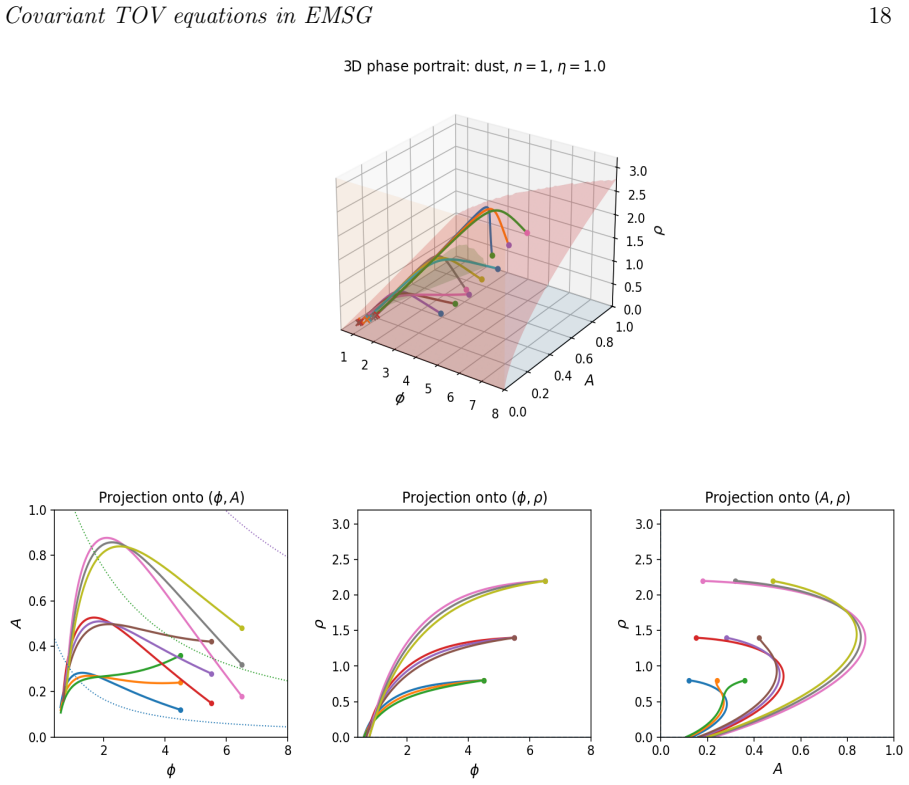
- Dust configurations require the full three-dimensional covariant flow rather than a planar dynamical system.
- The natural surface matching condition is the vanishing of effective pressure, which need not coincide with vanishing physical pressure for self-bound matter.
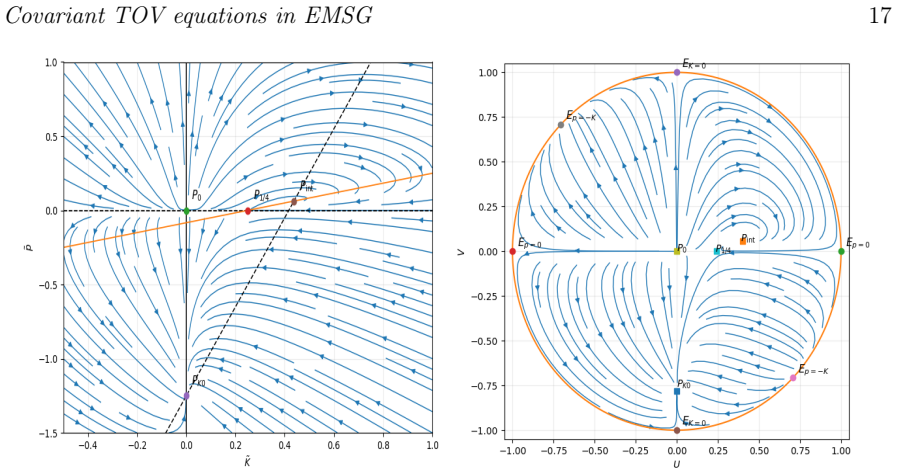
- The phase space of stellar configurations is described globally by finite and asymptotic critical points of the reduced dynamical system.
Where Pith is reading between the lines
- Numerical integration routines already written for the general-relativity Tolman-Oppenheimer-Volkoff equation could be reused after a simple redefinition of the input density and pressure.
- Self-bound stars might possess a nonzero physical pressure at the surface while still matching smoothly to the exterior Schwarzschild geometry.
- The breakdown of the planar reduction for dust indicates that pressureless matter may produce qualitatively different interior solutions than in general relativity.
- The same effective-fluid rewriting may apply to other modified-gravity models whose field equations contain quadratic or higher powers of the matter tensor.
Load-bearing premise
The nonlinear matter corrections from the modified action can be exactly rewritten as the energy-momentum tensor of a perfect fluid when the spacetime is static and spherically symmetric.
What would settle it
A direct substitution of the effective density and pressure into the hydrostatic equilibrium equation that fails to hold identically would disprove the effective-fluid reinterpretation.
Figures

read the original abstract
We study static, spherically symmetric stellar configurations in an extended class of Energy--Momentum Squared Gravity using the covariant \(1+1+2\) semi-tetrad formalism. For perfect physical fluids, we show that the nonlinear matter corrections can be reinterpreted as an effective perfect fluid, so that the stellar equilibrium equations retain the standard Tolman--Oppenheimer--Volkoff form when written in terms of effective variables. The resulting covariant structure equations are formulated in both metric and dimensionless variables and, whenever an effective closure relation exists, reduce to an autonomous planar dynamical system. This provides a global qualitative description of the stellar phase space in terms of finite and asymptotic critical points. Specializing to linear physical equations of state, we recover the general relativistic benchmark and identify sectors that are exactly, asymptotically, or piecewise equivalent to general relativity, as well as sectors -- particularly dust configurations -- for which the planar reduction breaks down and the full three-dimensional covariant flow must be considered. We further recover the standard metric Tolman--Oppenheimer--Volkoff equation in terms of effective variables and show that, although the exterior spacetime remains Schwarzschild, the natural matching condition at the stellar surface is \(p_{\rm eff}(R)=0\), which need not coincide with \(p(R)=0\) for self-bound matter.
Editorial analysis
A structured set of objections, weighed in public.
Referee Report
Summary. The manuscript investigates static spherically symmetric stellar models in Energy-Momentum Squared Gravity using the covariant 1+1+2 semi-tetrad formalism. For perfect fluids it shows that nonlinear matter corrections can be reinterpreted as an effective perfect fluid, so the stellar equilibrium equations retain the standard Tolman-Oppenheimer-Volkoff form when expressed in effective variables. The covariant structure equations are given in both metric and dimensionless variables and reduce to an autonomous planar dynamical system whenever an effective closure exists. Specializing to linear physical equations of state recovers the GR benchmark, identifies sectors of exact/asymptotic/piecewise equivalence to GR, and notes that dust configurations require the full three-dimensional flow. The exterior remains Schwarzschild, but the surface matching condition is p_eff(R)=0.
Significance. If the effective-fluid reinterpretation is established by direct substitution into the field equations under the static spherical symmetry and perfect-fluid ansatz, the paper supplies a covariant route to stellar structure that reuses familiar TOV machinery while exposing the modified-gravity corrections explicitly. The dynamical-systems reduction supplies a global qualitative description of the phase space via critical points, which is a genuine methodological advance for this class of theories. Recovery of GR limits and the explicit caveat for dust are appropriately cautious and strengthen the comparative value of the results.
minor comments (2)
- The abstract states that the planar reduction holds 'whenever an effective closure relation exists'; an explicit example of such a closure (or the condition under which it is guaranteed for linear EOS) should be stated early in the introduction or in the section deriving the reduced system.
- Notation for physical versus effective quantities (p vs p_eff, ho vs ho_eff) must be introduced once and used consistently; any place where the effective variables are first defined should include a short table or list of the redefinitions.
Simulated Author's Rebuttal
We thank the referee for the careful reading and positive assessment of our manuscript, including the accurate summary of our results on the effective-fluid reinterpretation, the dynamical-systems reduction, and the caveats for dust configurations. The recommendation for minor revision is noted. No specific major comments were provided in the report.
Circularity Check
No significant circularity
full rationale
The paper begins from the field equations of Energy-Momentum Squared Gravity and applies the covariant 1+1+2 formalism to perfect fluids under static spherical symmetry. It demonstrates that nonlinear corrections can be exactly recast as the stress-energy of an effective perfect fluid (same 4-velocity, isotropic pressure), allowing the structure equations to retain TOV form in effective variables. This is a direct algebraic re-expression from the given action and symmetries, with no fitted parameters renamed as predictions, no load-bearing self-citations, and no ansatz or uniqueness theorem imported from prior author work. The central claim is therefore independent of its inputs and self-contained.
Axiom & Free-Parameter Ledger
axioms (2)
- domain assumption The spacetime is static and spherically symmetric
- domain assumption Matter is described by a perfect fluid
Reference graph
Works this paper leans on
-
[1]
Roshan M and Shojai F 2016Phys. Rev. D94044002 (Preprint1607.06049)
-
[2]
Katırcı N and Kavuk M 2014Eur. Phys. J. Plus129163 (Preprint1302.4300)
-
[3]
Board C V R and Barrow J D 2017Phys. Rev. D96123517 (Preprint1709.09501)
-
[4]
Akarsu Ö, Katırcı N and Kumar S 2018Phys. Rev. D97024011 (Preprint1709.02367)
-
[5]
Akarsu Ö, Barrow J D, Çikıntoğlu S, Ekşi K Y and Katırcı N 2018Phys. Rev. D97124017 (Preprint1802.02093)
-
[6]
Nazari E, Roshan M and De Martino I 2022Phys. Rev. D105044014 (Preprint2201.08578)
-
[7]
Cipriano R A C, Ganiyeva N, Harko T, Lobo F S N, Pinto M A S and Rosa J L 2024Universe10 339 (Preprint2408.14106)
-
[8]
Dunsby P K S, Caldis M A and Bittencourt E 2025 Cosmological perturbations in energy- momentum squared gravity (Preprint2511.05166) URLhttps://arxiv.org/abs/2511.05166
Pith/arXiv arXiv 2025
-
[9]
Rev.55364–373
Tolman R C 1939Phys. Rev.55364–373
-
[10]
Rev.55374–381
Oppenheimer J R and Volkoff G M 1939Phys. Rev.55374–381
-
[11]
Nari N and Roshan M 2018Phys. Rev. D98024031 (Preprint1802.02399)
-
[12]
Alam N, Pal S, Rahmansyah A and Sulaksono A 2024Phys. Rev. D109083007 (Preprint 2309.06022)
-
[13]
Banerjee A, İzzet Sakallı, Rayimbaev J, Ibragimov I and Muminov S 2025Physics of the Dark Universe48101866 ISSN 2212-6864
-
[14]
Dark Univ.31 100774 (Preprint2007.00455)
Singh K N, Banerjee A, Maurya S K, Rahaman F and Pradhan A 2021Phys. Dark Univ.31 100774 (Preprint2007.00455)
-
[15]
Phys.458169440 (Preprint2308.05197)
Pretel J M Z, Tangphati T and Banerjee A 2023Ann. Phys.458169440 (Preprint2308.05197)
-
[16]
Nasir M M M, Bhatti M Z and Yousaf Z 2023Int. J. Mod. Phys. D322350009
-
[17]
Naz S and Sharif M 2022Universe8142
-
[18]
Quantum Grav.203855–3884 (Preprintgr-qc/ 0209051)
Clarkson C A and Barrett R K 2003Class. Quantum Grav.203855–3884 (Preprintgr-qc/ 0209051)
-
[19]
Carloni S and Vernieri D 2018Phys. Rev. D97124056 (Preprint1709.02818)
-
[20]
Naidu N F, Carloni S and Dunsby P K S 2021Phys. Rev. D104044014 (Preprint2104.09595)
-
[21]
Nzioki A M, Carloni S, Goswami R and Dunsby P K S 2010Phys. Rev. D81084028 (Preprint 0908.3333)
-
[22]
Quantum Grav.42085014 (Preprint2403.00070)
Campbell M, Carloni S, Dunsby P K S and Naidu N F 2025Class. Quantum Grav.42085014 (Preprint2403.00070)
-
[23]
Harko T, Lobo F S N, Nojiri S and Odintsov S D 2011Phys. Rev. D84024020 (Preprint 1104.2669)
-
[24]
Akarsu Ö, Bouhmadi-López M, Katırcı N, Nazari E, Roshan M and Uzun N M 2024Phys. Rev. D109104055 (Preprint2305.07506)
-
[25]
Clarkson C 2007Phys. Rev. D76(10) 104034 URLhttps://link.aps.org/doi/10.1103/ PhysRevD.76.104034
-
[26]
Bittencourt E, Campbell M, Dunsby P K S and Jorás S E 2026 Covariant dynamical systems formulation of the tolman-oppenheimer-volkoff equations (Preprint2605.26187) URLhttps: //arxiv.org/abs/2605.26187
Pith/arXiv arXiv 2026
-
[27]
Collins C B 1977Journal of Mathematical Physics181374–1377 ISSN 0022-2488 URLhttps: //doi.org/10.1063/1.523431
-
[28]
Collins C B 1985Journal of Mathematical Physics262268–2274 ISSN 0022-2488
-
[29]
Nilsson U S and Uggla C 2000Annals of Physics286278–291
-
[30]
Nilsson U S and Uggla C 2000Annals of Physics286292–319
-
[31]
Heinzle J M, Röhr N and Uggla C 2003Classical and Quantum Gravity204567–4586 (Preprint gr-qc/0304012) Covariant TOV equations in EMSG26
-
[32]
Wainwright J and Ellis G F R (eds) 1997Dynamical Systems in Cosmology(Cambridge: Cambridge University Press) ISBN 0521554578
-
[33]
Bahamonde S, Marciu M and Rudra P 2019Phys. Rev. D100083511 (Preprint1906.00027)
-
[34]
Dumortier F, Llibre J and Artés J C 2006Qualitative Theory of Planar Differential Systems Universitext (Berlin Heidelberg: Springer) ISBN 978-3-540-32893-3
discussion (0)
Sign in with ORCID, Apple, or X to comment. Anyone can read and Pith papers without signing in.