Symmetry enforced quantum spin Hall effect in Altermagnets
Pith reviewed 2026-06-26 16:16 UTC · model grok-4.3
The pith
Altermagnets can host the quantum spin Hall effect when symmetry enforces spin-valley locking.
A machine-rendered reading of the paper's core claim, the machinery that carries it, and where it could break.
Core claim
Symmetry analysis shows that specific magnetic point groups allow altermagnetic quantum spin Hall states. In these groups pronounced spin-valley locking occurs, and the interaction of this locking with band inversion produces helical edge states. First-principles calculations confirm the effect in monolayer Nb2SeTeO, which shows spin-valley locking, and in bilayer Hf3Se3Te2, which shows spin-valley-layer locking.
What carries the argument
Magnetic point groups that enforce spin-valley locking, acting together with band inversion to generate helical edge states.
If this is right
- Helical edge states appear in altermagnets that satisfy the identified point-group symmetries.
- Spin-valley locking protects the topological phase against magnetic disorder.
- The same mechanism operates in both monolayer and bilayer geometries with appropriate layer locking.
- A new class of magnetic topological materials becomes available for spintronic exploration.
Where Pith is reading between the lines
- Transport experiments that detect spin-polarized edge currents in these materials would provide direct evidence.
- The symmetry rules could be used to screen other altermagnetic compounds for similar topological behavior.
- Device designs that combine magnetic control with dissipationless edge transport become conceivable.
Load-bearing premise
The first-principles calculations correctly identify band inversion and the resulting topological invariants without being overturned by the choice of exchange-correlation functional or the modeling of magnetic order.
What would settle it
A calculation or measurement on monolayer Nb2SeTeO that finds no band inversion near the Fermi level or a trivial topological invariant would falsify the central claim.
Figures


read the original abstract
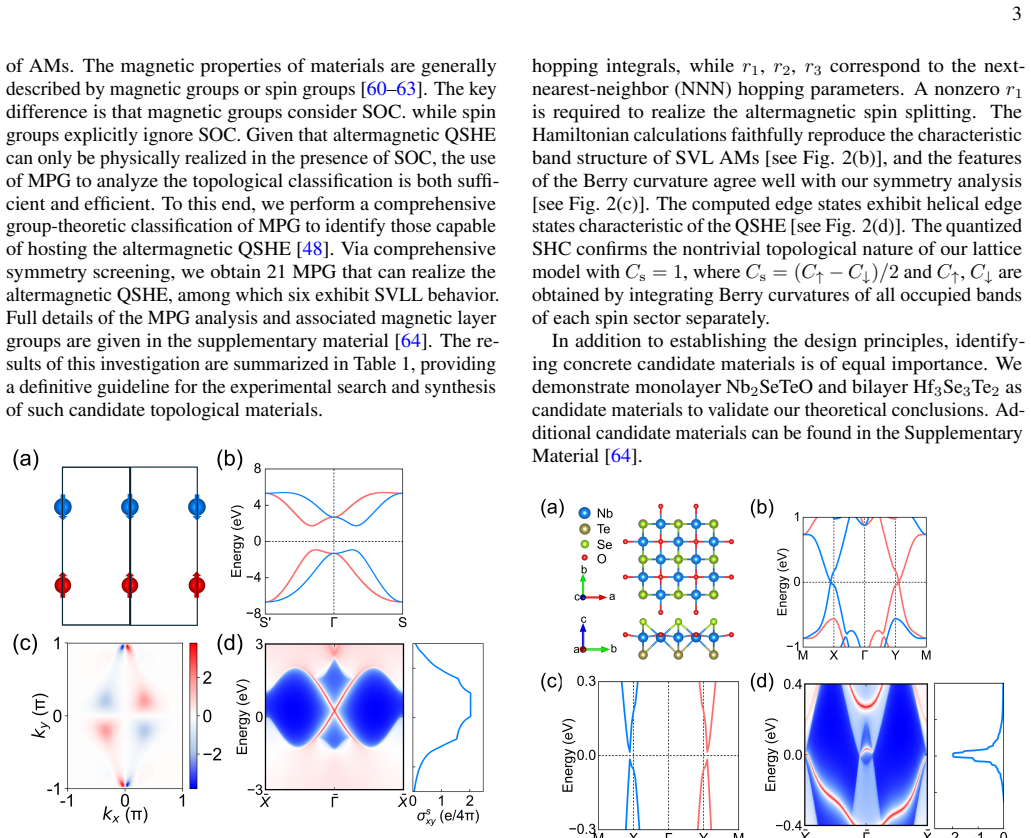
The quantum spin Hall effect (QSHE) has attracted widespread attention due to its dissipationless transport, which is protected by non-trivial topological invariants and helical edge states. Because even weak magnetic disorder can destroy the stability of topological quantum states, current research on the QSHE has primarily focused on non-magnetic materials. In this work, we extend the research scope of the QSHE to altermagnets. We establish the relevant symmetry constraints and identify all magnetic point groups that can realize the altermagnetic QSHE. Symmetry analysis reveals that pronounced spin-valley locking or spin-valley-layer locking universally exists in these systems. The concerted interaction between band inversion and spin-valley locking collectively gives rise to the helical edge states. Using first-principles calculations and theoretical models, we demonstrate that monolayer Nb2SeTeO exhibits an altermagnetic QSHE characterized by spin-valley locking, while bilayer Hf3Se3Te2 manifests an altermagnetic QSHE featuring spin-valley-layer locking. This work clarifies the intrinsic symmetry correlation between altermagnetism and quantum spin Hall topological phases, providing a brand-new theoretical perspective and research platform for exploring magnetic topological systems and developing next-generation spintronic devices
Editorial analysis
A structured set of objections, weighed in public.
Referee Report
Summary. The paper claims that altermagnets can host a quantum spin Hall effect enforced by symmetry. It identifies the magnetic point groups permitting this phase, shows that spin-valley or spin-valley-layer locking is universal in these groups, and demonstrates the effect via first-principles calculations in two materials: monolayer Nb2SeTeO (spin-valley locking) and bilayer Hf3Se3Te2 (spin-valley-layer locking), where band inversion produces helical edge states.
Significance. If the central symmetry classification holds and the material examples are robust, the work supplies a systematic framework linking altermagnetism to QSHE, identifies concrete candidates, and opens a route to magnetic topological spintronics. The exhaustive enumeration of allowed point groups is a clear strength.
major comments (2)
- [First-principles calculations] First-principles section on Nb2SeTeO and Hf3Se3Te2: band inversion, spin-valley locking, and helical edge states are obtained with a single XC functional (standard PBE is implied by context). Because altermagnetic order and SOC are known to be sensitive to the choice of functional and to the treatment of magnetic configuration, the manuscript must demonstrate that the inversion and locking survive at least one additional functional (e.g., HSE06) or +U correction; otherwise the concrete material claims rest on an unverified assumption.
- [Theoretical models and edge states] Edge-state and topological-invariant subsection: the helical edge states are attributed to the concerted action of band inversion and spin-valley locking. The paper should report the explicit computation of a topological invariant (Z2 or Wilson-loop) or the edge spectrum obtained from a Wannier-based tight-binding model that retains the altermagnetic order; inference from symmetry alone is insufficient to establish protection.
minor comments (2)
- [Symmetry analysis] The abstract states that 'all magnetic point groups' are identified; the main text should include an explicit table or enumerated list of these groups with their symmetry-allowed spin textures.
- Notation for spin-valley-layer locking in the bilayer case is introduced without a clear diagram showing the layer degree of freedom; a supplementary figure would improve clarity.
Simulated Author's Rebuttal
We thank the referee for the careful review and constructive suggestions. We address each major comment below and will revise the manuscript accordingly.
read point-by-point responses
-
Referee: [First-principles calculations] First-principles section on Nb2SeTeO and Hf3Se3Te2: band inversion, spin-valley locking, and helical edge states are obtained with a single XC functional (standard PBE is implied by context). Because altermagnetic order and SOC are known to be sensitive to the choice of functional and to the treatment of magnetic configuration, the manuscript must demonstrate that the inversion and locking survive at least one additional functional (e.g., HSE06) or +U correction; otherwise the concrete material claims rest on an unverified assumption.
Authors: We agree that verifying robustness against functional choice is important for the material claims. We have carried out additional calculations with the HSE06 hybrid functional on both Nb2SeTeO and Hf3Se3Te2. The band inversion, spin-valley (or spin-valley-layer) locking, and helical edge states persist. A new subsection and supplementary figures documenting these results will be added to the revised manuscript. revision: yes
-
Referee: [Theoretical models and edge states] Edge-state and topological-invariant subsection: the helical edge states are attributed to the concerted action of band inversion and spin-valley locking. The paper should report the explicit computation of a topological invariant (Z2 or Wilson-loop) or the edge spectrum obtained from a Wannier-based tight-binding model that retains the altermagnetic order; inference from symmetry alone is insufficient to establish protection.
Authors: We appreciate the request for explicit topological diagnostics. We have constructed a Wannier-based tight-binding model from the first-principles results that preserves the altermagnetic order and computed the Z2 invariant via the Wilson-loop method. The calculation yields a non-trivial Z2 = 1, confirming the topological protection of the helical edge states. These results and the associated methodology will be included in the revised manuscript. revision: yes
Circularity Check
No significant circularity; symmetry classification and DFT verification are independent
full rationale
The derivation proceeds from general magnetic point-group symmetry constraints (derived via group theory) to identification of allowed altermagnetic QSHE cases, followed by explicit first-principles verification on Nb2SeTeO and Hf3Se3Te2. No equation or claim reduces by construction to a fitted parameter, self-citation, or renamed input. The symmetry analysis is presented as an independent classification step whose output (allowed groups and locking) is then checked numerically; the numerical results do not feed back into the symmetry rules. This matches the default non-circular case for symmetry-plus-computation papers.
Axiom & Free-Parameter Ledger
axioms (1)
- domain assumption Magnetic point groups can be exhaustively classified to determine which permit altermagnetic QSHE
Reference graph
Works this paper leans on
-
[1]
and (0,0, 3 4), where the two sites carry distinct spin orientations, as illustrated in Fig. 2(a). The lattice Hamiltonian respecting this symmetry can be formulated as: H= εA +ε B 2 τ0 ⊗σ 0 + εA −ε B 2 τz ⊗σ z −8r 1τx ⊗σ z −8t 3τy ⊗σ z + 8t1τx ⊗σ 0 (5) With εA = 4e2 + 8r2 cosk y + 8t2 cosk x and εB = 4e1 + 8r3 cosk y + 8t4 cosk x. Here, τ and σ denote Pa...
2024
-
[2]
Bansil, H
A. Bansil, H. Lin, and T. Das, Colloquium: Topological band theory, Rev. Mod. Phys.88, 021004 (2016)
2016
-
[3]
M. Z. Hasan and C. L. Kane, Colloquium: Topological insula- tors, Rev. Mod. Phys.82, 3045 (2010)
2010
-
[4]
Qi and S.-C
X.-L. Qi and S.-C. Zhang, Topological insulators and supercon- ductors, Rev. Mod. Phys.83, 1057 (2011)
2011
-
[5]
Breunig and Y
O. Breunig and Y . Ando, Opportunities in topological insulator devices, Nat. Rev. Phys.4, 184 (2022)
2022
-
[6]
Xiao and B
J. Xiao and B. Yan, First-principles calculations for topological quantum materials, Nat. Rev. Phys.3, 283 (2021)
2021
-
[7]
C. L. Kane and E. J. Mele,Z2 topological order and the quantum spin hall effect, Phys. Rev. Lett.95, 146802 (2005)
2005
-
[8]
C. L. Kane and E. J. Mele, Quantum spin hall effect in graphene, Phys. Rev. Lett.95, 226801 (2005)
2005
-
[9]
Maciejko, C
J. Maciejko, C. Liu, Y . Oreg, X.-L. Qi, C. Wu, and S.-C. Zhang, Kondo effect in the helical edge liquid of the quantum spin hall state, Phys. Rev. Lett.102, 256803 (2009)
2009
-
[10]
Kimme, B
L. Kimme, B. Rosenow, and A. Brataas, Backscattering in helical edge states from a magnetic impurity and Rashba disorder, Phys. Rev. B93, 081301 (2016)
2016
-
[11]
B. Jäck, Y . Xie, B. A. Bernevig, and A. Yazdani, Observation of backscattering induced by magnetism in a topological edge state, Proc. Natl. Acad. Sci. U.S.A.117, 16214 (2020)
2020
-
[12]
B. A. Bernevig, T. L. Hughes, and S.-C. Zhang, Quantum spin Hall effect and topological phase transition in HgTe quantum wells, Science314, 1757 (2006)
2006
-
[13]
König, S
M. König, S. Wiedmann, C. Brüne, A. Roth, H. Buhmann, L. W. Molenkamp, X.-L. Qi, and S.-C. Zhang, Quantum spin hall insulator state in HgTe quantum wells, Science318, 766 (2007)
2007
-
[14]
S. Tang, C. Zhang, D. Wong, Z. Pedramrazi, H.-Z. Tsai, C. Jia, B. Moritz, M. Claassen, H. Ryu, S. Kahn, J. Jiang, H. Yan, M. Hashimoto, D. Lu, R. G. Moore, C.-C. Hwang, C. Hwang, Z. Hussain, Y . Chen, M. M. Ugeda, Z. Liu, X. Xie, T. P. Dev- ereaux, M. F. Crommie, S.-K. Mo, and Z.-X. Shen, Quantum spin Hall state in monolayer 1T ′-WTe2, Nat. Phys.13, 683 (2017)
2017
-
[15]
Xu and J
C. Xu and J. E. Moore, Stability of the quantum spin Hall effect: Effects of interactions, disorder, and Z2 topology, Phys. Rev. B 73, 045322 (2006)
2006
-
[16]
Hattori, Quantized spin transport in magnetically-disordered quantum spin hall systems, J
K. Hattori, Quantized spin transport in magnetically-disordered quantum spin hall systems, J. Phys. Soc. Jpn.80, 124712 (2011)
2011
-
[17]
C. Niu, H. Wang, N. Mao, B. Huang, Y . Mokrousov, and Y . Dai, Antiferromagnetic topological insulator with nonsymmorphic protection in two dimensions, Phys. Rev. Lett.124, 066401 (2020)
2020
-
[18]
Jiang, H
Y . Jiang, H. Wang, K. Bao, and J. Wang, Intrinsic antiferromag- netic topological insulator and axion state inV2WS4, Phys. Rev. B111, 165109 (2025)
2025
-
[19]
X. Zou, R. Li, Z. Chen, Y . Dai, B. Huang, and C. Niu, Engineer- ing gapless edge states from antiferromagnetic chern homobi- layer, Nano Lett.24, 450 (2024)
2024
-
[21]
Šmejkal, J
L. Šmejkal, J. Sinova, and T. Jungwirth, Emerging research landscape of altermagnetism, Phys. Rev. X12, 040501 (2022)
2022
-
[22]
Mazin and The PRX Editors, Altermagnetism—a new punch line of fundamental magnetism, Phys
I. Mazin and The PRX Editors, Altermagnetism—a new punch line of fundamental magnetism, Phys. Rev. X12, 040002 (2022)
2022
-
[23]
Mazin, Altermagnetism in MnTe: Origin, predicted manifes- tations, and routes to detwinning, Phys
I. Mazin, Altermagnetism in MnTe: Origin, predicted manifes- tations, and routes to detwinning, Phys. Rev. B107, L100418 (2023)
2023
-
[24]
González-Hernández, L
R. González-Hernández, L. Šmejkal, K. Výborný, Y . Yahagi, J. Sinova, T. Jungwirth, and J. Železný, Efficient electrical spin splitter based on nonrelativistic collinear antiferromagnetism, Phys. Rev. Lett.126, 127701 (2021)
2021
-
[25]
Šmejkal, J
L. Šmejkal, J. Sinova, and T. Jungwirth, Beyond conventional ferromagnetism and antiferromagnetism: A phase with nonrel- ativistic spin and crystal rotation symmetry, Phys. Rev. X12, 031042 (2022)
2022
-
[26]
Šmejkal, R
L. Šmejkal, R. González-Hernández, T. Jungwirth, and J. Sinova, Crystal time-reversal symmetry breaking and spontaneous Hall effect in collinear antiferromagnets, Sci. Adv.6, eaaz8809 (2020)
2020
-
[27]
Sheoran and P
S. Sheoran and P. Dev, Spontaneous anomalous Hall effect in two-dimensional altermagnets, Phys. Rev. B111, 184407 (2025)
2025
-
[28]
H.-Y . Ma, M. Hu, N. Li, J. Liu, W. Yao, and B. Yan, Multifunc- tional antiferromagnetic materials with giant piezomagnetism and noncollinear spin current, Nat. Commun.12, 2846 (2021)
2021
-
[29]
Šmejkal, A
L. Šmejkal, A. B. Hellenes, R. González-Hernández, J. Sinova, and T. Jungwirth, Giant and tunneling magnetoresistance in unconventional collinear antiferromagnets with nonrelativistic spin-momentum coupling, Phys. Rev. X12, 011028 (2022)
2022
-
[30]
D. S. Antonenko, R. M. Fernandes, and J. W. F. Venderbos, Mirror chern bands and weyl nodal loops in altermagnets, Phys. Rev. Lett.134, 096703 (2025)
2025
-
[31]
Zhang, Y
Z. Zhang, Y . Bai, X. Zou, B. Huang, Y . Dai, and C. Niu, Al- termagnetic quantum spin Hall effect in a Chern homobilayer, Phys. Rev. B112, 085128 (2025)
2025
-
[32]
Y . Q. Jiang, X. G. Zhang, H. Y . Bai, Y . P. Tian, B. Y . Zhang, W. J. Gong, and X. R. Kong, Strain-engineering spin-valley locking effect in altermagnetic monolayer with multipiezo properties, Appl. Phys. Lett.126, 053102 (2025)
2025
-
[33]
Zhang, C
R.-W. Zhang, C. Cui, Y . Wang, J. Duan, Z.-M. Yu, and Y . Yao, Quantized spin Hall conductivity in altermagnetic Fe2Te2O with mirror-spin coupling, Phys. Rev. B113, L161115 (2026). 6
2026
- [34]
-
[35]
González-Hernández, H
R. González-Hernández, H. Serrano, and B. Uribe, Spin chern number in altermagnets, Phys. Rev. B111, 085127 (2025)
2025
-
[37]
C.-Y . Tan, P. Feng, Z.-F. Gao, F. Ma, P.-J. Guo, and Z.-Y . Lu, Stacking-induced type-II quantum spin hall insulators with high spin chern number in unconventional magnetism, Science Bul- letin71, 2196 (2026)
2026
-
[38]
Z. Chen, F. Zhan, Z. Qin, D.-S. Ma, D.-H. Xu, and R. Wang, Quantum spin Hall effect with extended topologically pro- tected features in altermagnetic multilayers, Nano Lett.26, 4197 (2026)
2026
-
[39]
J. Yu, J. Bai, Y . Yang, S. Qian, X. Wang, and Z. Liu, Diverse landscape of tunable magnetic, topological, and ferroelectric states in 2DTi 3Se3Te2, Adv. Sci.13, 2524385 (2026)
2026
-
[40]
X. R. Zou, X. R. Feng, Y . Dai, B. B. Huang, and C. W. Niu, Floquet quantum anomalous Hall effect with in-plane magneti- zation in two-dimensional altermagnets, ACS Nano19, 35575 (2025)
2025
-
[41]
R. W. Zhang, C. X. Cui, R. Z. Li, J. Y . Duan, L. Li, Z. M. Yu, and Y . G. Yao, Predictable gate-field control of spin in altermagnets with spin-layer coupling, Phys. Rev. Lett.133, 056401 (2024)
2024
-
[42]
N. J. Yang, Z. G. Huang, and J. M. Zhang, Spin-selective second-order topological insulators enabling cornertronics in two-dimensional altermagnets, Nano Lett.25, 15495 (2025)
2025
-
[43]
K. H. Liu and M. W. Zhao, Altermagnetism and higher-order topological states in bilayer Chern insulators, Phys. Rev. B112, L241405 (2025)
2025
-
[44]
Q. Wang, R. Wu, and J. Hu, Spin-biased quantum spin Hall effect in altermagnetic Lieb lattice, Phys. Rev. B113, L161101 (2026)
2026
-
[45]
Jing, T.-D
T. Jing, T.-D. Onyx, D. Liang, Y . Xiong, Y . Hu, and M. Deng, Quantum spin Hall insulator with altermagnetism in NiNbSe2 bilayer, Chin. J. Phys.102, 141 (2026)
2026
-
[46]
Ma and J.-F
H.-Y . Ma and J.-F. Jia, Altermagnetic topological insulator and the selection rules, Phys. Rev. B110, 064426 (2024)
2024
-
[48]
H.-Y . Ma, D. Guan, S. Wang, Y . Li, C. Liu, H. Zheng, and J.-F. Jia, Quantum spin Hall and quantum anomalous Hall states in magnetic Ti2Te2O single layer, J. Phys.: Condens. Matter33, 21LT01 (2021)
2021
-
[49]
B. J. Campbell, H. T. Stokes, J. M. Perez-Mato, and J. Rodríguez- Carvajal, Introducing a unified magnetic space-group symbol, Acta Crystallographica Section AA78, 99 (2022)
2022
-
[50]
J. Hui, Y . Ma, Y . Dai, B. Huang, and X. Li, Switchable anoma- lous valley hall effect in 2d antiferromagnetic system, Phys. Rev. Mater.10, 024402 (2026)
2026
-
[51]
C. Lei, Z. Qian, Y . Ma, and R. Ahuja, Intrinsic ferroelastic valleytronics in 2D Pd4X3Te3 (X = S, Se) materials: A new platform for ultrafast intervalley carrier dynamics, Mater. Horiz. 12, 6271 (2025)
2025
-
[52]
G. Wu, Y . Feng, Y . Dai, B. Huang, and Y . Ma, Pseudo lattice- breathing driven valley switching in 2D ferromagnetic lattices, Mater. Horiz.13, 2911 (2026)
2026
-
[53]
S. Chai, J. Zhao, X. Li, Y . Dai, B. Huang, and Y . Ma, van hove singularity-induced non-equilibrium anomalous valley hall effect in a two-dimensional lattice, Nano Lett.25, 4108 (2025)
2025
- [54]
-
[55]
Guo, Z.-X
P.-J. Guo, Z.-X. Liu, and Z.-Y . Lu, Quantum anomalous hall effect in collinear antiferromagnetism, npj Comput. Mater.9, 70 (2023)
2023
-
[56]
Tan, Z.-F
C.-Y . Tan, Z.-F. Gao, H.-C. Yang, Z.-X. Liu, K. Liu, P.-J. Guo, and Z.-Y . Lu, Crystal valley hall effect, Phys. Rev. B111, 094411 (2025)
2025
-
[57]
H. Shi, Y . Jiang, Y . Tian, W. Wang, S. Li, W.-J. Gong, and X. Kong, Tunable quantum layer spin hall effect in bilayer alter- magneticNb 2SeTeO, Appl. Phys. Lett.128, 063101 (2026)
2026
-
[58]
R. Xu, Y . Gao, and J. Liu, Chemical design of monolayer alter- magnets, Nat. Sci. Rev.13, nwaf528 (2026)
2026
-
[59]
H. L. Zhang, C.-X. Liu, X.-L. Qi, X. Dai, Z. Fang, and S.-C. Zhang, Topological insulators in Bi2Se3, Bi2Te3 and Sb2Te3 with a single Dirac cone on the surface, Nat. Phys.5, 438 (2009)
2009
-
[60]
H. Zhou, X. Wang, and F. Liu, Electric field control of spin- valley polarization and the spin hall effect in altermagnets, Phys. Rev. B113, 094427 (2026)
2026
-
[61]
Elcoro, B
L. Elcoro, B. J. Wieder, Z. Song, N. Regnault, B. Bradlyn, and B. A. Bernevig, Magnetic topological quantum chemistry, Nat. Commun.12, 5965 (2021)
2021
-
[62]
X. B. Chen, J. Ren, Y . Z. Zhu, Y . T. Yu, A. Zhang, P. F. Liu, J. Y . Li, Y . T. Liu, C. H. Li, and Q. H. Liu, Enumeration and representation theory of spin space groups, Phys. Rev. X14, 031038 (2024)
2024
-
[63]
Z. Y . Xiao, J. Z. Zhao, Y . Q. Li, R. Shindou, and Z. D. Song, Spin space groups: Full classification and applications, Phys. Rev. X14, 031037 (2024)
2024
-
[64]
Jiang, Z
Y . Jiang, Z. Y . Song, T. N. Zhu, Z. Fang, H. M. Weng, Z. X. Liu, J. Yang, and C. Fang, Enumeration of spin-space groups: Toward a complete description of symmetries of magnetic orders, Phys. Rev. X14, 031039 (2024)
2024
-
[65]
See Supplemental Material for the MPGs and MLGs of the alter- magnetic QSHE, effective tight-binding Hamiltonian, Brillouin Zones for models and materials in the Main Text, computational methods, other candidate materials, supplemental figures
-
[66]
Zhang, Z.-M
Z. Zhang, Z.-M. Yu, G.-B. Liu, and Y . Yao, MagneticTB: A package for tight-binding model of magnetic and nonmagnetic materials, Comput. Phys. Commun.270, 108153 (2022)
2022
-
[67]
Zhang, X
F. Zhang, X. Cheng, Z. Yin, S. Han, X. B. Chen, P. Zhou, Z. Jiang, C. Liu, and Q. H. Liu, Crystal-symmetry-paired spin– valley locking in a layered room-temperature metallic altermag- net candidate, Nat. Phys.21, 760 (2025)
2025
-
[68]
parity anomaly
F. D. M. Haldane, Model for a quantum Hall effect without Landau levels: Condensed-matter realization of the “parity anomaly”, Phys. Rev. Lett.61, 2015 (1988)
2015
-
[69]
Chang, C.-X
C.-Z. Chang, C.-X. Liu, and A. H. MacDonald, Colloquium: Quantum anomalous Hall effect, Rev. Mod. Phys.95, 011002 (2023)
2023
-
[70]
Chang, J
C.-Z. Chang, J. X. Zhang, X. Feng, J. Shen, Z. Zhang, M. Guo, K. Li, Y . Ou, P. Wei, L.-L. Wang, Z.-Q. Ji, Y . Feng, S. Ji, X. Chen, J. Jia, X. Dai, Z. Fang, S.-C. Zhang, K. He, Y . Wang, L. Lu, X.-C. Ma, and Q.-K. Xue, Experimental observation of the quan- tum anomalous Hall effect in a magnetic topological insulator, Science340, 167 (2013)
2013
-
[71]
Y . Deng, Y . Yu, M. Z. Shi, Z. Guo, Z. Xu, J. Wang, X. H. Chen, and Y . Zhang, Quantum anomalous Hall effect in intrinsic magnetic topological insulator MnBi2Te4, Science367, 895 (2020)
2020
-
[72]
X. Wang, S. Liu, L. Bai, R.-W. Zhang, Y . Yao, and W. Feng, Layer hall and layer spin hall effects in two-dimensional al- termagnets induced by spin-layer coupling, Phys. Rev. B112, 7 134421 (2025)
2025
-
[73]
Zhang, Z
Y . Zhang, Z. Chen, X. Zou, B. Huang, Y . Dai, and C. Niu, Topological control of corner and edge states in an altermagnetic Fe2Se2Omonolayer, Phys. Rev. B113, 155428 (2026)
2026
-
[74]
Y . Han, C. Cui, X.-P. Li, T.-T. Zhang, Z. Zhang, Z.-M. Yu, and Y . Yao, Cornertronics in two-dimensional second-order topolog- ical insulators, Phys. Rev. Lett.133, 176602 (2024)
2024
-
[75]
J. Gong, Y . Wang, Y . Han, Z. Cheng, X. Wang, Z.-M. Yu, and Y . Yao, Hidden real topology and unusual magnetoelectric re- sponses in two-dimensional antiferromagnets, Adv. Mater.36, 2402232 (2024). Supplemental Material: Symmetry enforced quantum spin Hall effect in Altermagnets Fanzheng Chen,1 Lixin Zhang,2 Shuaishuai Niu,1 Junfeng Ren,2 Weijiang Gong,1...
2024
-
[76]
B. J. Campbell, H. T. Stokes, J. M. Perez-Mato, and J. Rodríguez-Carvajal, Introducing a unified magnetic space-group symbol, Acta Crystallographica Section AA78, 99 (2022). 9 FIG. S6. Distinct magnetic configurations for (a) FM, (b) AFM1, (c) AFM2 of monlayerHf3Se3Te2. FIG. S7. The calculated phonon spectrum of (a) monolayerNb2SeTeO, (b) monolayerHf3Se3T...
2022
-
[77]
L. Bai, S. Liu, X. Wang, L. Šmejkal, J. Sinova, Y. Mokrousov, Y. Yao, and W. Feng, Pt- symmetric antiferromagnets as building blocks for anomalous transport, Nano Lett.26, 3934 (2026)
2026
-
[78]
Z. Fu, M. Hu, A. Li, H. Duan, J. Liu, and F. Ouyang, Multiple topological phases controlled via strain in two-dimensional altermagnets (2025), arXiv:2507.22474. FIG. S8. side view for (a) AA stackedHf3Se3Te2, (b) AB stackedHf3Se3Te2. 10 FIG. S9. (a) Band structure with SOC for monolayerHf3Se3Te2, (b) Band structure with SOC for AB stackedHf 3Se3Te2. FIG. ...
-
[79]
Zhang, Y
Z. Zhang, Y. Bai, X. Zou, B. Huang, Y. Dai, and C. Niu, Altermagnetic quantum spin Hall effect in a Chern homobilayer, Phys. Rev. B112, 085128 (2025)
2025
-
[80]
Kresse and D
G. Kresse and D. Joubert, From ultrasoft pseudopotentials to the projector augmented-wave method, Phys. Rev. B59, 1758 (1999)
1999
-
[81]
Kresse and J
G. Kresse and J. Hafner, Ab initio molecular dynamics for liquid metals, Phys. Rev. B47, 558 (1993)
1993
-
[82]
Kresse and J
G. Kresse and J. Furthmüller, Efficient iterative schemes for ab initio total-energy calculations using a plane-wave basis set, Phys. Rev. B54, 11169 (1996)
1996
-
[83]
Hohenberg and W
P. Hohenberg and W. Kohn, Inhomogeneous electron gas, Phys. Rev.136, B864 (1964). 11 FIG. S11. (a) Band structure without SOC for AB stacked Hf3Se3Te2. (b) Zoom-in band structure without SOC for AB stacked Hf3Se3Te2. (c) Band structure with SOC for AB stacked Hf3Se3Te2. (d) The edge states and SHC for AB stacked Hf3Se3Te2 along the [100] direction
1964
discussion (0)
Sign in with ORCID, Apple, or X to comment. Anyone can read and Pith papers without signing in.