QMaxCal: Path-Space Regularization for Open Quantum Control via Girsanov's Theorem
Pith reviewed 2026-06-26 17:33 UTC · model grok-4.3
The pith
Girsanov's theorem supplies closed-form regularizers that steer open quantum control away from strong decoherence states.
A machine-rendered reading of the paper's core claim, the machinery that carries it, and where it could break.
Core claim
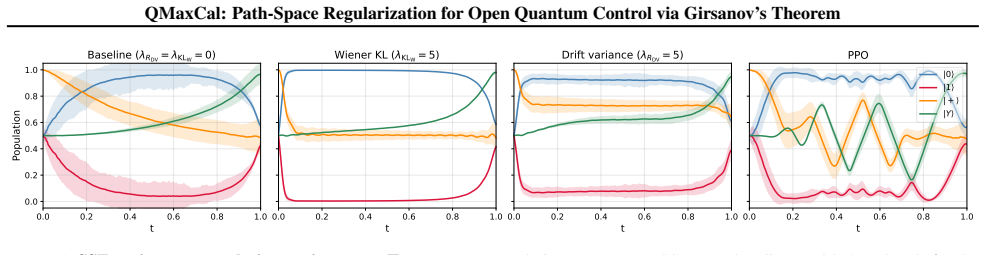
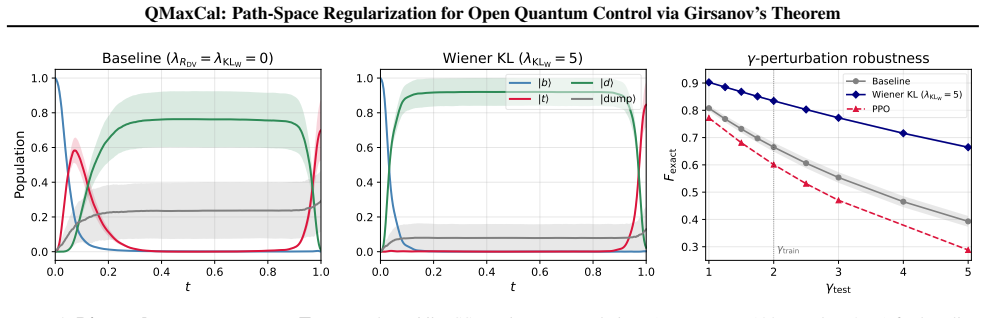
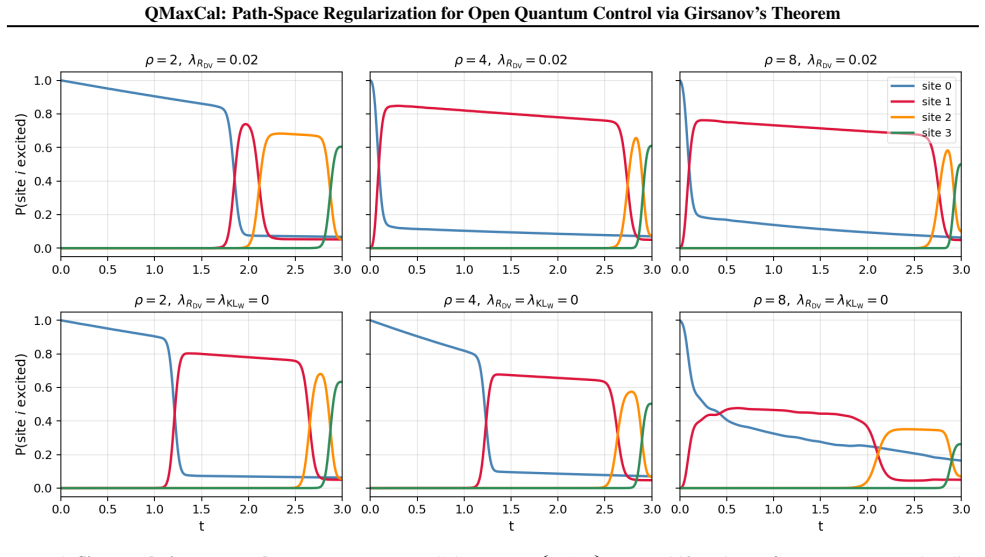
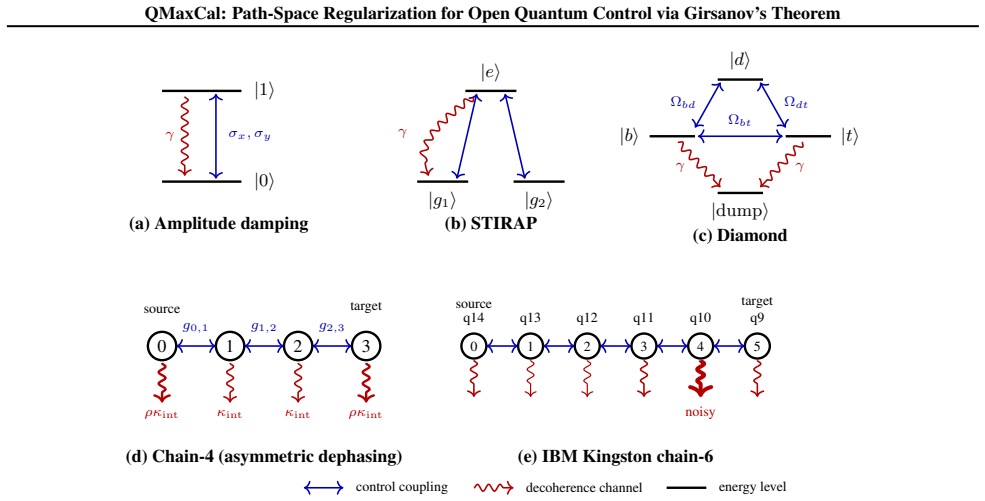
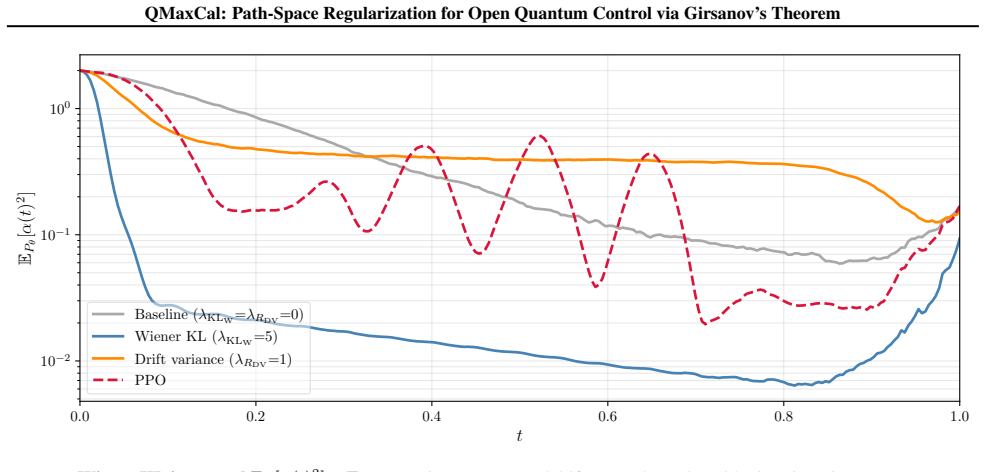
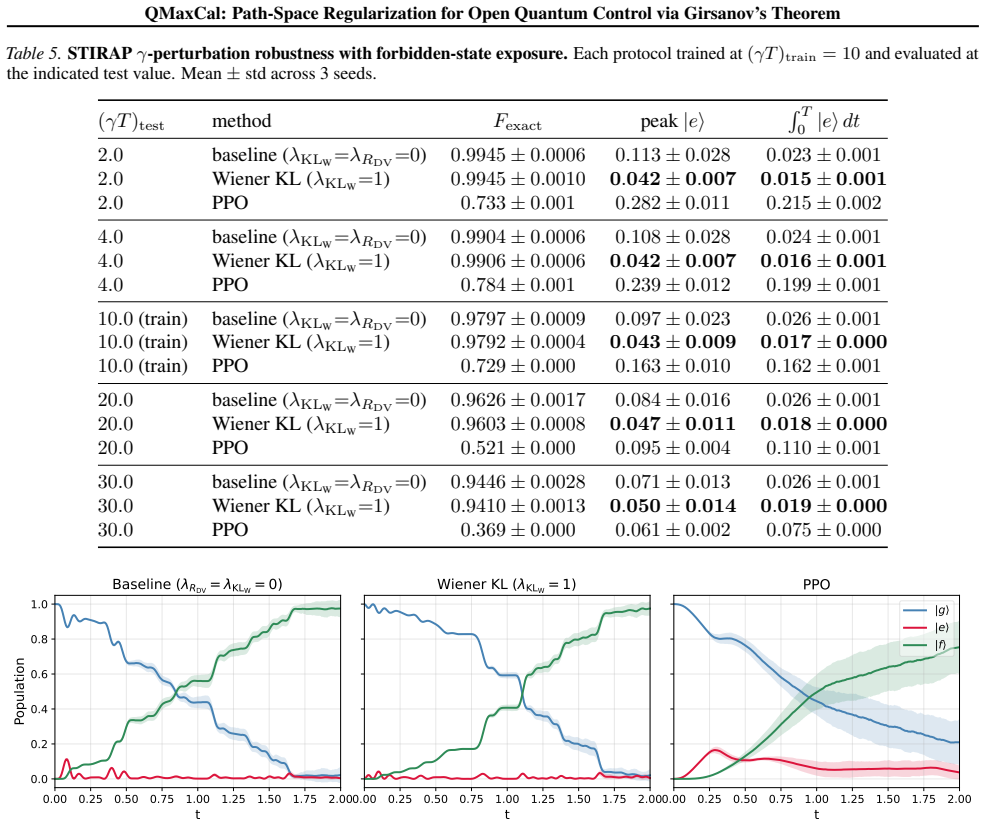
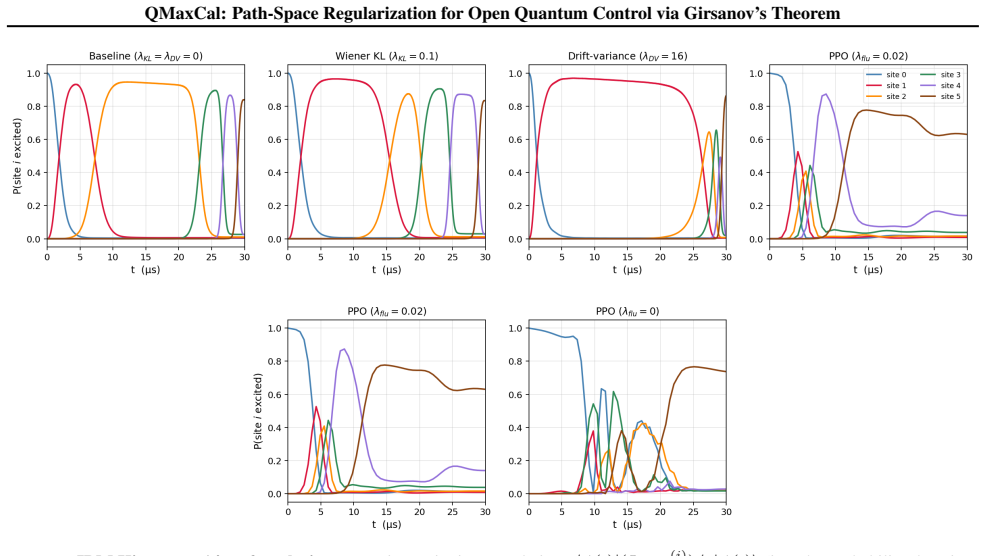
Instantiating the Girsanov-derived KL estimator with a Wiener reference measure and with a drift-variance reference measure produces two regularizers, KL_W and R_DV, that both drive controlled trajectories toward states where decoherence effects are minimal; when added to gradient-based and reinforcement-learning policies these regularizers outperform the unregularized baselines on final-state fidelity, robustness under noise mismatch, and forbidden-state occupation across single- and multi-qubit test cases and on a multi-qubit chain calibrated to a published IBM Kingston snapshot.
What carries the argument
Girsanov's theorem applied to pairs of measurement records that share decoherence channels but differ only in drift, supplying a closed-form differentiable KL estimator between their trajectory distributions.
If this is right
- The regularizers reduce infidelity by up to 50 percent relative to unregularized policies.
- Gains in fidelity increase from 17 percentage points at matched noise to 27 percentage points under 2.5-fold noise mismatch.
- Both regularizers lower occupation of forbidden states compared with baselines.
- The same performance ordering holds on a multi-qubit chain whose parameters are taken from a published IBM Kingston snapshot.
Where Pith is reading between the lines
- The same Girsanov construction could be applied to other continuously monitored quantum systems whose trajectory measures admit a drift-only difference under shared noise channels.
- Because the penalties act on observable trajectory statistics rather than on the control waveform, they may remain effective when the control hardware itself introduces additional distortions.
- The method opens a route to regularizing policies that must satisfy hard constraints on state occupation by folding those constraints directly into the reference measure.
Load-bearing premise
Measurement records of two evolutions that share the same decoherence channels differ only in their drift term.
What would settle it
A direct numerical check on the IBM Kingston-calibrated chain showing that the reported fidelity gains disappear when the assumed noise model is replaced by the true hardware noise would falsify the robustness claim.
Figures
read the original abstract
Reliable quantum control in the presence of decoherence requires policies that combat the effect of environmental noise on the controlled dynamics. Open quantum systems under continuous monitoring generate classical measurement records whose drift depends on the noise experienced by the system; the records of two evolutions sharing the same decoherence channels differ only in this drift, so Girsanov's theorem yields a closed-form, differentiable estimator of the KL divergence between their trajectory distributions. We instantiate this estimator with two physically motivated reference measures, yielding two regularizers that both drive the system toward states where the effects of decoherence are minimal: the Wiener KL (KL_W), which is empirically more effective under certain conditions on the noise model, and the drift-variance regularizer (R_DV), which works for all noise models. Both are qualitatively distinct from existing penalties on control fluence or smoothness: they penalize the observable consequences of control on the decoherence channels rather than the control amplitude itself. The regularizers outperform unregularized gradient-based and reinforcement-learning baselines across a range of open quantum systems -- including single- and multi-qubit benchmarks and a multi-qubit chain calibrated to a published snapshot of the IBM Kingston processor -- along several axes of evaluation: final-state fidelity, robustness to mismatch in the assumed noise model (gains grow from +17 pp at training noise to +27 pp under 2.5x noise mismatch), and occupation of forbidden states. The regularizers reduce infidelity by up to 50%, with ~16% gains on the calibrated IBM Kingston chain.
Editorial analysis
A structured set of objections, weighed in public.
Referee Report
Summary. The paper claims that Girsanov's theorem supplies a closed-form, differentiable KL estimator between trajectory distributions of two open quantum evolutions that share decoherence channels (differing only in drift), which is instantiated as two regularizers (Wiener KL and drift-variance) for quantum control policies; these are shown empirically to outperform unregularized gradient and RL baselines on fidelity, noise-mismatch robustness, and forbidden-state occupation across single-/multi-qubit benchmarks and a calibrated IBM Kingston multi-qubit chain, with infidelity reductions up to 50%.
Significance. If the central derivation and assumption hold without hidden model-specific corrections, the approach supplies a distinct path-space regularization (penalizing observable decoherence consequences rather than control fluence) with reported robustness gains that grow under noise mismatch; the inclusion of a hardware-calibrated benchmark is a concrete strength for practical relevance in open-system control.
major comments (2)
- [Abstract / derivation] Abstract and derivation section: the load-bearing premise that 'the records of two evolutions sharing the same decoherence channels differ only in this drift' is asserted without an explicit Radon-Nikodym derivation or verification for the stochastic master equation trajectories used; if control enters the diffusion coefficients, induces cross-qubit correlations, or produces back-action not reducible to drift shift, the claimed closed-form differentiable KL estimator acquires extra factors and the reported performance numbers (including the IBM Kingston ~16% gain) may not follow directly.
- [Empirical results] Empirical evaluation (IBM Kingston chain and multi-qubit benchmarks): the abstract reports gains without error bars, data-exclusion rules, or explicit confirmation that the KL estimator remains free of post-hoc parameter choices or model-specific adjustments; this undermines assessment of whether the +17 pp to +27 pp robustness improvement is reproducible or an artifact of the unverified drift-only assumption.
minor comments (2)
- [Method] Notation for the two reference measures (KL_W and R_DV) should be introduced with explicit equations showing how each is obtained from the Girsanov Radon-Nikodym derivative.
- [Introduction] The distinction from fluence/smoothness penalties is stated qualitatively; a short table comparing the functional form of each regularizer on a common example would clarify the claimed qualitative difference.
Simulated Author's Rebuttal
We thank the referee for the careful reading and constructive comments. The feedback highlights important points on the derivation's rigor and the presentation of empirical results. We address each major comment below and indicate planned revisions.
read point-by-point responses
-
Referee: [Abstract / derivation] Abstract and derivation section: the load-bearing premise that 'the records of two evolutions sharing the same decoherence channels differ only in this drift' is asserted without an explicit Radon-Nikodym derivation or verification for the stochastic master equation trajectories used; if control enters the diffusion coefficients, induces cross-qubit correlations, or produces back-action not reducible to drift shift, the claimed closed-form differentiable KL estimator acquires extra factors and the reported performance numbers (including the IBM Kingston ~16% gain) may not follow directly.
Authors: We agree that an explicit step-by-step Radon-Nikodym derivation for the SME trajectories would improve clarity. The manuscript applies Girsanov's theorem under the stated premise that control modulates only the drift (consistent with standard Lindblad-form open-system models where the decoherence channels are fixed), but we will expand the derivation section to include the full Radon-Nikodym derivative computation and explicitly state the modeling assumptions (control does not alter diffusion coefficients or introduce unaccounted cross-correlations). This will also include a brief discussion of the conditions under which the closed-form KL holds. We believe the reported gains follow directly from these assumptions for the benchmarks considered. revision: yes
-
Referee: [Empirical results] Empirical evaluation (IBM Kingston chain and multi-qubit benchmarks): the abstract reports gains without error bars, data-exclusion rules, or explicit confirmation that the KL estimator remains free of post-hoc parameter choices or model-specific adjustments; this undermines assessment of whether the +17 pp to +27 pp robustness improvement is reproducible or an artifact of the unverified drift-only assumption.
Authors: The full manuscript presents results with error bars computed over multiple independent runs (visible in the figures for all benchmarks, including IBM Kingston). We will revise the abstract to reference the statistical evaluation and error bars shown in the results section. We will also add a short methods paragraph confirming that the KL estimator is obtained directly from the Girsanov formula with no post-hoc tuning or model-specific corrections beyond the fixed noise channels. Data exclusion follows standard outlier removal based on convergence criteria, which will be stated explicitly. revision: yes
Circularity Check
No significant circularity; derivation applies external Girsanov theorem
full rationale
The paper asserts that measurement records of two evolutions sharing decoherence channels differ only in drift, allowing Girsanov's theorem to supply a closed-form differentiable KL estimator. This premise is presented as a physical property of the stochastic master equation rather than a self-definition, fitted parameter renamed as prediction, or result derived from self-citation. The two regularizers (KL_W and R_DV) are instantiated from physically motivated reference measures, and performance claims are empirical evaluations on benchmarks. No load-bearing step reduces by construction to the paper's own inputs or prior author work; the derivation remains self-contained against external mathematical results.
Axiom & Free-Parameter Ledger
axioms (1)
- domain assumption Measurement records of two controlled evolutions that share the same decoherence channels differ only in their drift term.
Reference graph
Works this paper leans on
-
[1]
2013 , publisher=
Quantum error correction , author=. 2013 , publisher=
2013
-
[2]
and Boscain, Ugo and Calarco, Tommaso and Koch, Christiane P
Glaser, Steffen J. and Boscain, Ugo and Calarco, Tommaso and Koch, Christiane P. and Köckenberger, Walter and Kosloff, Ronnie and Kuprov, Ilya and Luy, Burkhard and Schirmer, Sophie and Schulte-Herbrüggen, Thomas and Sugny, Dominique and Wilhelm, Frank K. , year =. Training. doi:10.1140/epjd/e2015-60464-1 , url =
-
[3]
and Boscain, Ugo and Calarco, Tommaso and Dirr, Gunther and Filipp, Stefan and Glaser, Steffen J
Koch, Christiane P. and Boscain, Ugo and Calarco, Tommaso and Dirr, Gunther and Filipp, Stefan and Glaser, Steffen J. and Kosloff, Ronnie and Montangero, Simone and Schulte-Herbrüggen, Thomas and Sugny, Dominique and Wilhelm, Frank K. , year =. Quantum Optimal Control in Quantum Technologies. doi:10.1140/epjqt/s40507-022-00138-x , url =
-
[4]
Quantum sensing , author =. Rev. Mod. Phys. , volume =. 2017 , month =. doi:10.1103/RevModPhys.89.035002 , url =
work page internal anchor Pith review doi:10.1103/revmodphys.89.035002 2017
-
[5]
Khaneja, Navin and Reiss, Timo and Kehlet, Cindie and Schulte-Herbrüggen, Thomas and Glaser, Steffen J. , year =. Optimal Control of Coupled Spin Dynamics: Design of. doi:10.1016/j.jmr.2004.11.004 , url =
-
[6]
and Ndong, Mamadou and Koch, Christiane P
Reich, Daniel M. and Ndong, Mamadou and Koch, Christiane P. , year =. Monotonically Convergent Optimization in Quantum Control Using. doi:10.1063/1.3691827 , url =. https://pubs.aip.org/aip/jcp/article-pdf/doi/10.1063/1.3691827/13032598/104103_1_online.pdf , pages =
-
[7]
Proceedings of the 42nd International Conference on Machine Learning , year=
Reinforcement Learning for Quantum Control under Physical Constraints , author=. Proceedings of the 42nd International Conference on Machine Learning , year=
-
[8]
arXiv preprint arXiv:2410.18635 , year=
Stochastic optimal control of open quantum systems , author=. arXiv preprint arXiv:2410.18635 , year=
-
[9]
Girsanov, I. V. , title =. Theory of Probability & Its Applications , volume =. 1960 , doi =
1960
-
[10]
2003 , publisher=
Stochastic Differential Equations: An Introduction with Applications , author=. 2003 , publisher=
2003
-
[11]
Principle of Minimum Entropy Production , author =. Phys. Rev. , volume =. 1954 , month =. doi:10.1103/PhysRev.96.250 , url =
-
[12]
Principles of maximum entropy and maximum caliber in statistical physics , author =. Rev. Mod. Phys. , volume =. 2013 , month =. doi:10.1103/RevModPhys.85.1115 , url =
-
[13]
2009 , publisher=
Quantum Measurement and Control , author=. 2009 , publisher=
2009
-
[14]
1998 , publisher=
Quantum State Diffusion , author=. 1998 , publisher=
1998
-
[15]
Quantum Thermodynamics under Continuous Monitoring:
Manzano, Gonzalo and Zambrini, Roberta , year =. Quantum Thermodynamics under Continuous Monitoring:. doi:10.1116/5.0079886 , url =. https://pubs.aip.org/avs/aqs/article-pdf/doi/10.1116/5.0079886/19803548/025302_1_online.pdf , pages =
-
[16]
Advances in Neural Information Processing Systems , author =
Linearly-Solvable. Advances in Neural Information Processing Systems , author =
-
[17]
Linear Theory for Control of Nonlinear Stochastic Systems , author =. Phys. Rev. Lett. , volume =. 2005 , month =. doi:10.1103/PhysRevLett.95.200201 , url =
-
[18]
Thermodynamic Metrics and Optimal Paths , author =. Phys. Rev. Lett. , volume =. 2012 , month =. doi:10.1103/PhysRevLett.108.190602 , url =
-
[19]
Reports on Progress in Physics75(12), 126001 (2012) https://doi.org/ 10.1088/0034-4885/75/12/126001
Stochastic Thermodynamics, Fluctuation Theorems and Molecular Machines , author =. doi:10.1088/0034-4885/75/12/126001 , url =
-
[20]
Quantum-trajectory approach to the stochastic thermodynamics of a forced harmonic oscillator , author =. Phys. Rev. E , volume =. 2012 , month =. doi:10.1103/PhysRevE.85.031110 , url =
-
[21]
Resonator reset in circuit QED by optimal control for large open quantum systems , author =. Phys. Rev. A , volume =. 2017 , month =. doi:10.1103/PhysRevA.96.042315 , url =
-
[22]
and Agozzino, Luca and Dill, Ken A
Ghosh, Kingshuk and Dixit, Purushottam D. and Agozzino, Luca and Dill, Ken A. , year =. The. doi:10.1146/annurev-physchem-071119-040206 , url =
-
[23]
Maximum Caliber: a general variational principle for dynamical systems
Perspective: Maximum caliber is a general variational principle for dynamical systems. The Journal of Chemical Physics , keywords =. doi:10.1063/1.5012990 , archivePrefix =. 1711.03450 , primaryClass =
work page internal anchor Pith review Pith/arXiv arXiv doi:10.1063/1.5012990
-
[24]
Optimal Control in Large Open Quantum Systems: The Case of Transmon Readout and Reset , author =. Phys. Rev. Lett. , volume =. 2025 , month =. doi:10.1103/PhysRevLett.134.070802 , url =
-
[25]
Karmakar, Tathagata and Jordan, Andrew N. , journal =. doi:10.22331/q-2026-03-24-2043 , url =
-
[26]
Faidon Brotzakis and Michele Vendruscolo and Peter G
Z. Faidon Brotzakis and Michele Vendruscolo and Peter G. Bolhuis , title =. Proceedings of the National Academy of Sciences , volume =. 2021 , doi =. https://www.pnas.org/doi/pdf/10.1073/pnas.2012423118 , abstract =
-
[27]
A Maximum Caliber Approach for Continuum Path Ensembles , author =. 2021 , journaltitle =. doi:10.1140/epjb/s10051-021-00154-3 , url =
-
[28]
Gradient-based optimal control of open quantum systems using quantum trajectories and automatic differentiation , author =. Phys. Rev. A , volume =. 2019 , month =. doi:10.1103/PhysRevA.99.052327 , url =
-
[29]
Optimizing Molecular Potential Models by Imposing Kinetic Constraints with Path Reweighting , author =. 2023 , journaltitle =. doi:10.1063/5.0151166 , url =. https://pubs.aip.org/aip/jcp/article-pdf/doi/10.1063/5.0151166/18299649/074102_1_5.0151166.pdf , pages =
-
[30]
arXiv preprint arXiv:2509.24104 , year=
Path integral quantum control for quantum chemistry applications , author=. arXiv preprint arXiv:2509.24104 , year=
-
[31]
Preskill, John , journal =. Quantum. doi:10.22331/q-2018-08-06-79 , url =
work page internal anchor Pith review doi:10.22331/q-2018-08-06-79 2018
-
[32]
Decoherence, einselection, and the quantum origins of the classical , author =. Rev. Mod. Phys. , volume =. 2003 , month =. doi:10.1103/RevModPhys.75.715 , url =
-
[33]
Decoherence-Free Subspaces for Quantum Computation , author =. Phys. Rev. Lett. , volume =. 1998 , month =. doi:10.1103/PhysRevLett.81.2594 , url =
-
[34]
Dynamical Decoupling of Open Quantum Systems , author =. Phys. Rev. Lett. , volume =. 1999 , month =. doi:10.1103/PhysRevLett.82.2417 , url =
work page internal anchor Pith review doi:10.1103/physrevlett.82.2417 1999
-
[35]
On the Generators of Quantum Dynamical Semigroups , author =. 1976 , date =. doi:10.1007/BF01608499 , url =
-
[36]
Universal Fidelity Reduction of Quantum Operations from Weak Dissipation , author =. Phys. Rev. Lett. , volume =. 2022 , month =. doi:10.1103/PhysRevLett.129.150504 , url =
-
[37]
Gorini, Vittorio and Kossakowski, Andrzej and Sudarshan, E. C. G. , year =. Completely Positive Dynamical Semigroups of. doi:10.1063/1.522979 , url =. https://pubs.aip.org/aip/jmp/article-pdf/17/5/821/19090720/821_1_online.pdf , pages =
-
[38]
Leakage Reduction in Fast Superconducting Qubit Gates via Optimal Control , author =. 2021 , journaltitle =. doi:10.1038/s41534-020-00346-2 , url =
-
[39]
Simple Pulses for Elimination of Leakage in Weakly Nonlinear Qubits , author =. Phys. Rev. Lett. , volume =. 2009 , month =. doi:10.1103/PhysRevLett.103.110501 , url =
-
[40]
Quantum metrology with nonclassical states of atomic ensembles , author =. Rev. Mod. Phys. , volume =. 2018 , month =. doi:10.1103/RevModPhys.90.035005 , url =
work page internal anchor Pith review doi:10.1103/revmodphys.90.035005 2018
-
[41]
From Pulses to Circuits and Back Again: A Quantum Optimal Control Perspective on Variational Quantum Algorithms , author =. PRX Quantum , volume =. 2021 , month =. doi:10.1103/PRXQuantum.2.010101 , url =
-
[42]
Kappen, H. J. and Ruiz, H. C. , year =. Adaptive. doi:10.1007/s10955-016-1446-7 , url =
-
[43]
Advances in Neural Information Processing Systems , volume=
Stochastic optimal control for collective variable free sampling of molecular transition paths , author=. Advances in Neural Information Processing Systems , volume=
-
[44]
Orlando, Simon Gustavsson, and William D
A Quantum Engineer's Guide to Superconducting Qubits , author =. 2019 , journaltitle =. doi:10.1063/1.5089550 , url =. https://pubs.aip.org/aip/apr/article-pdf/doi/10.1063/1.5089550/20722375/021318_1_1.5089550.pdf , pages =
-
[45]
arXiv preprint arXiv:2506.15420 , year=
Error-detected coherence metrology of a dual-rail encoded fixed-frequency multimode superconducting qubit , author=. arXiv preprint arXiv:2506.15420 , year=
-
[46]
Erasure Qubits: Overcoming the
Kubica, Aleksander and Haim, Arbel and Vaknin, Yotam and Levine, Harry and Brand\ ao, Fernando and Retzker, Alex , journal =. Erasure Qubits: Overcoming the. 2023 , month =. doi:10.1103/PhysRevX.13.041022 , url =
-
[47]
Stimulated Raman adiabatic passage in physics, chemistry, and beyond , author =. Rev. Mod. Phys. , volume =. 2017 , month =. doi:10.1103/RevModPhys.89.015006 , url =
-
[48]
Bergmann, Klaas and Nägerl, Hanns-Christoph and Panda, Cristian and Gabrielse, Gerald and Miloglyadov, Eduard and Quack, Martin and Seyfang, Georg and Wichmann, Gunther and Ospelkaus, Silke and Kuhn, Axel and Longhi, Stefano and Szameit, Alexander and Pirro, Philipp and Hillebrands, Burkard and Zhu, Xue-Feng and Zhu, Jie and Drewsen, Michael and Hensinger...
-
[49]
doi:10.1038/nature10401 , url =
High-Fidelity Projective Read-out of a Solid-State Spin Quantum Register , author =. doi:10.1038/nature10401 , url =
-
[50]
Earnest, N. and Chakram, S. and Lu, Y. and Irons, N. and Naik, R. K. and Leung, N. and Ocola, L. and Czaplewski, D. A. and Baker, B. and Lawrence, Jay and Koch, Jens and Schuster, D. I. , journal =. Realization of a. 2018 , month =. doi:10.1103/PhysRevLett.120.150504 , url =
-
[51]
doi:10.1038/s41467-021-26686-x , url =
Electron Shelving of a Superconducting Artificial Atom , author =. doi:10.1038/s41467-021-26686-x , url =
-
[52]
Quantum dynamics of single trapped ions , author =. Rev. Mod. Phys. , volume =. 2003 , month =. doi:10.1103/RevModPhys.75.281 , url =
-
[53]
Quantum Communication through an Unmodulated Spin Chain , author =. Phys. Rev. Lett. , volume =. 2003 , month =. doi:10.1103/PhysRevLett.91.207901 , url =
-
[54]
Transfer of arbitrary two-qubit states via a spin chain , author =. Phys. Rev. A , volume =. 2015 , month =. doi:10.1103/PhysRevA.91.042321 , url =
-
[55]
Quantum State Transfer in Arrays of Flux Qubits , author =. 2005 , journaltitle =. doi:10.1088/1367-2630/7/1/181 , url =
-
[56]
doi:10.1038/s41534-019-0168-5 , url =
Decoherence Benchmarking of Superconducting Qubits , author =. doi:10.1038/s41534-019-0168-5 , url =
-
[57]
doi:10.1038/s41534-021-00448-5 , url =
Time-Varying Quantum Channel Models for Superconducting Qubits , author =. doi:10.1038/s41534-021-00448-5 , url =
-
[58]
International conference on machine learning , pages=
Mutual information neural estimation , author=. International conference on machine learning , pages=. 2018 , organization=
2018
-
[59]
Omg Blueprint for Trapped Ion Quantum Computing with Metastable States , author =. 2021 , journaltitle =. doi:10.1063/5.0069544 , url =. https://pubs.aip.org/aip/apl/article-pdf/doi/10.1063/5.0069544/19773783/214002_1_online.pdf , pages =
-
[60]
Realizing Coherently Convertible Dual-Type Qubits with the Same Ion Species , author =. 2022 , journaltitle =. doi:10.1038/s41567-022-01661-5 , url =
-
[61]
Wu, Yue and Kolkowitz, Shimon and Puri, Shruti and Thompson, Jeff D. , year =. Erasure Conversion for Fault-Tolerant Quantum Computing in Alkaline Earth. doi:10.1038/s41467-022-32094-6 , url =
-
[62]
Demonstrating a Long-Coherence Dual-Rail Erasure Qubit Using Tunable Transmons , author =. Phys. Rev. X , volume =. 2024 , month =. doi:10.1103/PhysRevX.14.011051 , url =
-
[63]
Ivanov, P. A. and Poschinger, U. G. and Singer, K. and Schmidt-Kaler, F. , title =. Europhysics Letters , abstract =. 2010 , month =. doi:10.1209/0295-5075/92/30006 , url =
-
[64]
Fast and Unconditional All-Microwave Reset of a Superconducting Qubit , author =. Phys. Rev. Lett. , volume =. 2018 , month =. doi:10.1103/PhysRevLett.121.060502 , url =
-
[65]
Pulsed Reset Protocol for Fixed-Frequency Superconducting Qubits , author =. Phys. Rev. Appl. , volume =. 2018 , month =. doi:10.1103/PhysRevApplied.10.044030 , url =
-
[66]
Spontaneous emission in stimulated Raman adiabatic passage , author =. Phys. Rev. A , volume =. 2005 , month =. doi:10.1103/PhysRevA.72.053412 , url =
-
[67]
High-fidelity entanglement of metastable trapped-ion qubits with integrated erasure conversion , author =. Phys. Rev. A , volume =. 2026 , month =. doi:10.1103/p3cy-8yjk , url =
-
[68]
Annual Review of Physical Chemistry , volume=
The minimum entropy production principle , author=. Annual Review of Physical Chemistry , volume=. 1980 , publisher=
1980
-
[69]
Complex Systems—Operational Approaches in Neurobiology, Physics, and Computers: Proceedings of the International Symposium on Synergetics at Schlo
Macroscopic prediction , author=. Complex Systems—Operational Approaches in Neurobiology, Physics, and Computers: Proceedings of the International Symposium on Synergetics at Schlo. 1985 , organization=
1985
-
[70]
2025 , url =
Dynamiqs: an open-source Python library for GPU-accelerated and differentiable simulation of quantum systems , author =. 2025 , url =
2025
discussion (0)
Sign in with ORCID, Apple, or X to comment. Anyone can read and Pith papers without signing in.