Non-standard decays of vector-like top partners in a 2-Higgs doublet model at the HL-LHC
Pith reviewed 2026-06-26 17:02 UTC · model grok-4.3
The pith
The 2τ + 2b + missing transverse energy channel can discover vector-like top partners up to 1.9 TeV at the HL-LHC.
A machine-rendered reading of the paper's core claim, the machinery that carries it, and where it could break.
Core claim
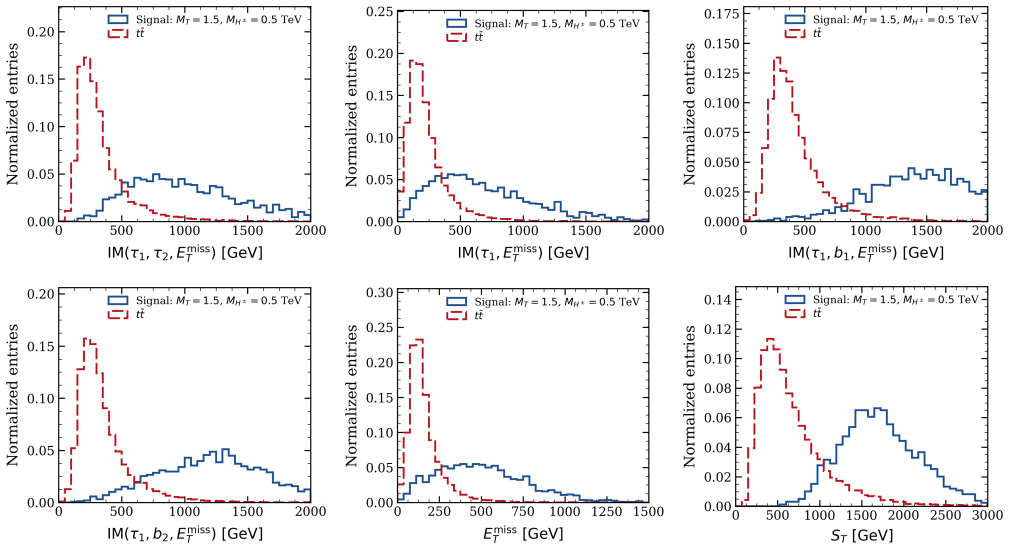
In extensions with both an enlarged scalar sector and vector-like fermions, the vector-like top partner T can decay via T to H± b followed by H± to τν, yielding a 2τ + 2b + MET signature. A model-independent analysis constructs global kinematic observables from visible objects and the missing transverse momentum to suppress backgrounds, while polarization-sensitive variables built from hadronic tau decay products probe the spin-0 origin of the taus. The expected discovery sensitivity evaluated with the Asimov significance at 3 ab inverse and 14 TeV shows that this channel reaches vector-like quark masses up to approximately 1.9 TeV.
What carries the argument
The 2τ + 2b + MET final state arising from T → H± b, H± → τν, discriminated by global kinematic observables from visible objects plus MET and by polarization variables from hadronic tau decays.
If this is right
- Observation of the 2τ + 2b + MET excess would point to non-standard vector-like quark decays involving additional Higgs states rather than standard-model-like modes.
- The channel supplies an orthogonal search strategy that existing experimental limits on vector-like quarks do not cover.
- Discovery sensitivity extending to 1.9 TeV implies that the high-luminosity LHC can test a sizable fraction of the viable parameter space in two-Higgs-doublet models with vector-like fermions.
- Polarization observables provide an independent handle that can confirm the charged-Higgs origin of the taus if a signal appears.
Where Pith is reading between the lines
- Similar final-state selections could be applied to other extended Higgs models that allow vector-like quarks to decay into charged scalars.
- Absence of a signal would set upper limits on the branching fraction of vector-like tops into charged Higgs bosons.
- Combining this channel with standard vector-like quark searches could tighten overall mass bounds or reveal inconsistencies between decay modes.
Load-bearing premise
Kinematic observables and polarization-sensitive variables built from visible objects and missing transverse momentum are assumed sufficient to reduce dominant backgrounds enough for discovery sensitivity as computed with the Asimov significance.
What would settle it
A detailed background estimation or full detector simulation that shows the background rejection falls short of the level needed for Asimov significance above 5 at 1.9 TeV would falsify the claimed discovery reach.
Figures



read the original abstract
Extensions of the Standard Model featuring both an enlarged scalar sector and vector-like fermions arise naturally in a wide class of well-motivated theoretical frameworks. In such scenarios, vector-like Quarks (VLQs) can exhibit non-standard decay modes involving additional Higgs states, giving rise to distinctive collider signatures that remain largely unexplored by existing experimental searches. We investigate the prospects of probing this possibility at the high-luminosity Large Hadron Collider (HL-LHC) through the decay of vector-like top partner ($T$) to charged Higgs ($H^{\pm}$) followed by the decay, $H^\pm\to\tau\nu$, producing a final state containing two tau leptons, two $b$-jets, and missing transverse energy. A model-independent collider analysis is performed using global kinematic observables constructed from visible objects and the missing transverse momentum vector to suppress the dominant backgrounds. Polarization-sensitive observables built from the hadronic $\tau$ decay products are also examined as complementary probes of the spin-$0$ origin of the $\tau$ leptons. The expected discovery sensitivity is evaluated using the Asimov significance for an integrated luminosity of $3$ ab$^{-1}$ at $\sqrt{s}=14$ TeV. Our results demonstrate that the $2\tau\:+\:2b\:+$ missing $E_T$ channel provides a promising and largely orthogonal avenue to search for non-standard VLQ decays in extended Higgs sectors, with discovery-level sensitivity achievable for VLQ masses up to approximately $1.9$ TeV.
Editorial analysis
A structured set of objections, weighed in public.
Referee Report
Summary. The manuscript presents a model-independent collider study of non-standard decays of vector-like top partners T → H± b (with H± → τν) in a 2HDM, targeting the 2τ + 2b + MET final state at the HL-LHC. It employs global kinematic observables from visible objects and MET together with hadronic-τ polarization variables to suppress backgrounds, and projects discovery sensitivity (Asimov significance) up to m_T ≈ 1.9 TeV at 3 ab⁻¹.
Significance. If the projected sensitivity is robust, the work identifies an orthogonal search channel for VLQ non-standard decays in extended Higgs sectors that is not covered by existing experimental strategies, potentially extending the HL-LHC reach for TeV-scale new physics in well-motivated BSM frameworks.
major comments (2)
- [sensitivity evaluation and results] The central sensitivity claim (discovery reach to 1.9 TeV) is evaluated using Asimov significance on Monte Carlo samples; the analysis does not incorporate systematic uncertainties on background normalizations, τ-identification efficiencies, or MET resolution smearing. This assumption is load-bearing for the quoted mass reach, as even moderate degradation would reduce the significance below 5σ.
- [collider analysis and event selection] The background suppression strategy relies on particle-level kinematic and polarization observables; no full detector simulation (including jet energy resolution, τ-tagging, or pile-up effects) is presented to validate that the reported S/B ratios survive realistic experimental conditions.
minor comments (1)
- [abstract] The abstract states the final state as '2τ + 2b + missing ET' but does not explicitly note whether the τ leptons are required to be hadronic; this should be clarified for reproducibility.
Simulated Author's Rebuttal
We thank the referee for the careful review and constructive comments. We address each major point below and outline revisions to strengthen the manuscript.
read point-by-point responses
-
Referee: The central sensitivity claim (discovery reach to 1.9 TeV) is evaluated using Asimov significance on Monte Carlo samples; the analysis does not incorporate systematic uncertainties on background normalizations, τ-identification efficiencies, or MET resolution smearing. This assumption is load-bearing for the quoted mass reach, as even moderate degradation would reduce the significance below 5σ.
Authors: We agree that the absence of systematic uncertainties is a limitation for the quoted discovery reach. In the revised manuscript we will add a new subsection that estimates the impact of moderate systematics (e.g., 10–20 % on background normalizations, 5 % on τ identification, and MET smearing) on the Asimov significance. We will then quote a more conservative mass reach under these assumptions while retaining the conclusion that the channel remains promising. This directly addresses the concern. revision: yes
-
Referee: The background suppression strategy relies on particle-level kinematic and polarization observables; no full detector simulation (including jet energy resolution, τ-tagging, or pile-up effects) is presented to validate that the reported S/B ratios survive realistic experimental conditions.
Authors: The study is performed at particle level, which is standard for phenomenological projections that aim to identify new search channels. A full GEANT-level detector simulation lies outside the scope of this theoretical work. In revision we will add a dedicated paragraph that qualitatively assesses the expected degradation from jet energy resolution, τ-tagging efficiencies, and pile-up, referencing typical values reported by ATLAS and CMS. This will clarify the robustness of the S/B ratios under realistic conditions. revision: partial
Circularity Check
No significant circularity; sensitivity projection is simulation-driven and independent of result.
full rationale
The paper performs a model-independent collider analysis using Monte Carlo simulations of signal and background processes with standard tools, applies kinematic and polarization observables to estimate yields, and computes projected Asimov significance at 3 ab^{-1}. No parameters are fitted to the target data or observables, no self-citations underpin the central sensitivity claim, and the derivation from model assumptions to projected mass reach does not reduce to its own inputs by construction. This is a standard forward projection with no load-bearing circular steps.
Axiom & Free-Parameter Ledger
free parameters (2)
- VLQ mass
- Charged Higgs mass
axioms (2)
- domain assumption The 2HDM extended with VLQs is a valid theoretical framework
- domain assumption Standard Model backgrounds can be accurately modeled with Monte Carlo
Reference graph
Works this paper leans on
-
[1]
J. F. Gunion, H. E. Haber, G. L. Kane and S. Dawson,The Higgs Hunter’s Guide, vol. 80. 2000, 10.1201/9780429496448
-
[2]
G. C. Branco, P. M. Ferreira, L. Lavoura, M. N. Rebelo, M. Sher and J. P. Silva,Theory and phenomenology of two-Higgs-doublet models,Phys. Rept.516(2012) 1–102, [1106.0034]
Pith/arXiv arXiv 2012
-
[3]
M. Carena, I. Low, N. R. Shah and C. E. M. Wagner, Impersonating the Standard Model Higgs Boson: Alignment without Decoupling,JHEP04(2014) 015, [1310.2248]
Pith/arXiv arXiv 2014
-
[4]
Y. Okada and L. Panizzi,LHC signatures of vector-like quarks,Adv. High Energy Phys.2013(2013) 364936, [1207.5607]
Pith/arXiv arXiv 2013
-
[5]
S. Gopalakrishna, T. Mandal, S. Mitra and R. Tibrewala, LHC Signatures of a Vector-like b’,Phys. Rev. D84(2011) 055001, [1107.4306]
Pith/arXiv arXiv 2011
-
[6]
S. Gopalakrishna, T. Mandal, S. Mitra and G. Moreau,LHC Signatures of Warped-space Vectorlike Quarks,JHEP08 (2014) 079, [1306.2656]
Pith/arXiv arXiv 2014
-
[7]
J. A. Aguilar-Saavedra, R. Benbrik, S. Heinemeyer and M. Pérez-Victoria,Handbook of vectorlike quarks: Mixing and single production,Phys. Rev. D88(2013) 094010, [1306.0572]
Pith/arXiv arXiv 2013
-
[8]
S. A. R. Ellis, R. M. Godbole, S. Gopalakrishna and J. D. Wells,Survey of vector-like fermion extensions of the Standard Model and their phenomenological implications, JHEP09(2014) 130, [1404.4398]
Pith/arXiv arXiv 2014
-
[9]
J. M. Alves, G. C. Branco, A. L. Cherchiglia, C. C. Nishi, J. T. Penedo, P. M. F. Pereira et al.,Vector-like singlet quarks: A roadmap,Phys. Rept.1057(2024) 1–69, [2304.10561]
arXiv 2024
-
[10]
A. Banerjee, E. Bergeaas Kuutmann, V. Ellajosyula, R. Enberg, G. Ferretti and L. Panizzi,Vector-like quarks: Status and new directions at the LHC,SciPost Phys. Core7 (2024) 079, [2406.09193]
arXiv 2024
-
[11]
S. Gopalakrishna, T. S. Mukherjee and S. Sadhukhan,Extra neutral scalars with vectorlike fermions at the LHC,Phys. Rev. D93(2016) 055004, [1504.01074]
Pith/arXiv arXiv 2016
-
[12]
Serra,Beyond the Minimal Top Partner Decay,JHEP09 (2015) 176, [1506.05110]
J. Serra,Beyond the Minimal Top Partner Decay,JHEP09 (2015) 176, [1506.05110]
Pith/arXiv arXiv 2015
-
[13]
B. A. Dobrescu and F. Yu,Exotic Signals of Vectorlike Quarks,J. Phys. G45(2018) 08LT01, [1612.01909]
Pith/arXiv arXiv 2018
-
[14]
A. Arhrib, R. Benbrik, R. Enberg, W. Klemm, S. Moretti and S. Munir,Identifying a light charged Higgs boson at the LHC Run II,Phys. Lett. B774(2017) 591–598, [1706.01964]
Pith/arXiv arXiv 2017
-
[15]
J. A. Aguilar-Saavedra, D. E. López-Fogliani and C. Muñoz, Novel signatures for vector-like quarks,JHEP06(2017) 095, [1705.02526]
Pith/arXiv arXiv 2017
-
[16]
Chala,Direct bounds on heavy toplike quarks with standard and exotic decays,Phys
M. Chala,Direct bounds on heavy toplike quarks with standard and exotic decays,Phys. Rev. D96(2017) 015028, [1705.03013]
Pith/arXiv arXiv 2017
-
[17]
S. Moretti, D. O’Brien, L. Panizzi and H. Prager,Production of extra quarks decaying to Dark Matter beyond the Narrow Width Approximation at the LHC,Phys. Rev. D96(2017) 035033, [1705.07675]
Pith/arXiv arXiv 2017
-
[18]
N. Bizot, G. Cacciapaglia and T. Flacke,Common exotic decays of top partners,JHEP06(2018) 065, [1803.00021]
Pith/arXiv arXiv 2018
-
[19]
S. Colucci, B. Fuks, F. Giacchino, L. Lopez Honorez, M. H. G. Tytgat and J. Vandecasteele,Top-philic Vector-Like Portal to Scalar Dark Matter,Phys. Rev. D98(2018) 035002, [1804.05068]
Pith/arXiv arXiv 2018
-
[20]
H. Han, L. Huang, T. Ma, J. Shu, T. M. P. Tait and Y. Wu, Six Top Messages of New Physics at the LHC,JHEP10 (2019) 008, [1812.11286]
arXiv 2019
-
[21]
R. Benbrik et al.,Signatures of vector-like top partners decaying into new neutral scalar or pseudoscalar bosons, JHEP05(2020) 028, [1907.05929]
arXiv 2020
-
[22]
G. Cacciapaglia, T. Flacke, M. Park and M. Zhang,Exotic decays of top partners: mind the search gap,Phys. Lett. B 798(2019) 135015, [1908.07524]
arXiv 2019
-
[23]
K.-P. Xie, G. Cacciapaglia and T. Flacke,Exotic decays of top partners with charge 5/3: bounds and opportunities,JHEP 10(2019) 134, [1907.05894]
arXiv 2019
-
[24]
R. Dermíšek, E. Lunghi and S. Shin,Hunting for Vectorlike Quarks,JHEP04(2019) 019, [1901.03709]. [Erratum: JHEP 10, 058 (2020)]
arXiv 2019
-
[25]
D. Wang, L. Wu and M. Zhang,Hunting for top partner with a new signature at the LHC,Phys. Rev. D103(2021) 115017, [2007.09722]
arXiv 2021
-
[26]
R. Dermisek, E. Lunghi, N. McGinnis and S. Shin,Signals with six bottom quarks for charged and neutral Higgs bosons,JHEP07(2020) 241, [2005.07222]. 8
arXiv 2020
-
[27]
D. Das, B. De and S. Mitra,Cancellation in Dark Matter-Nucleon Interactions: the Role of Non-Standard-Model-like Yukawa Couplings,Phys. Lett. B 815(2021) 136159, [2011.13225]
arXiv 2021
-
[28]
R. Dermisek, E. Lunghi, N. Mcginnis and S. Shin,Tau-jet signatures of vectorlike quark decays to heavy charged and neutral Higgs bosons,JHEP08(2021) 159, [2105.10790]
arXiv 2021
-
[29]
G. Corcella, A. Costantini, M. Ghezzi, L. Panizzi, G. M. Pruna and J. Šalko,Vector-like quarks decaying into singly and doubly charged bosons at LHC,JHEP10(2021) 108, [2107.07426]
arXiv 2021
-
[30]
S. Dasgupta, R. Pramanick and T. S. Ray,Broad toplike vector quarks at LHC and HL-LHC,Phys. Rev. D105(2022) 035032, [2112.03742]
arXiv 2022
-
[31]
A. Banerjee, D. B. Franzosi and G. Ferretti,Modelling vector-like quarks in partial compositeness framework,JHEP 03(2022) 200, [2202.00037]
arXiv 2022
-
[32]
A. Bhardwaj, T. Mandal, S. Mitra and C. Neeraj,Roadmap to explore vectorlike quarks decaying to a new scalar or pseudoscalar,Phys. Rev. D106(2022) 095014, [2203.13753]
arXiv 2022
-
[33]
A. Bhardwaj, K. Bhide, T. Mandal, S. Mitra and C. Neeraj, Discovery prospects of a vectorlike top partner decaying to a singlet boson,Phys. Rev. D106(2022) 075024, [2204.09005]
arXiv 2022
-
[34]
J. Bardhan, T. Mandal, S. Mitra and C. Neeraj,Machine learning-enhanced search for a vectorlike singlet B quark decaying to a singlet scalar or pseudoscalar,Phys. Rev. D107 (2023) 115001, [2212.02442]
arXiv 2023
- [35]
- [36]
-
[37]
J. Bardhan, T. Mandal, S. Mitra, C. Neeraj and M. Rawat, Tagging fully hadronic exotic decays of the vectorlike B quark using a graph neural network,Phys. Rev. D112(2025) 015015, [2505.07769]
arXiv 2025
-
[38]
A. Angelescu, A. Djouadi and G. Moreau,Scenarii for interpretations of the LHC diphoton excess: two Higgs doublets and vector-like quarks and leptons,Phys. Lett. B 756(2016) 126–132, [1512.04921]
Pith/arXiv arXiv 2016
-
[39]
R. Benbrik, C.-H. Chen and T. Nomura,Higgs singlet boson as a diphoton resonance in a vectorlike quark model,Phys. Rev. D93(2016) 055034, [1512.06028]
Pith/arXiv arXiv 2016
-
[40]
M. J. Dolan, J. L. Hewett, M. Krämer and T. G. Rizzo, Simplified Models for Higgs Physics: Singlet Scalar and Vector-like Quark Phenomenology,JHEP07(2016) 039, [1601.07208]
Pith/arXiv arXiv 2016
-
[41]
A. Arhrib, R. Benbrik, S. J. D. King, B. Manaut, S. Moretti and C. S. Un,Phenomenology of 2HDM with vectorlike quarks,Phys. Rev. D97(2018) 095015, [1607.08517]
Pith/arXiv arXiv 2018
-
[42]
K. Y. Cingiloglu and M. Frank,Vacuum stability and electroweak precision in the two-Higgs-doublet model with vectorlike quarks,Phys. Rev. D109(2024) 036016, [2309.03700]. [45]ATLAScollaboration, G. Aad et al.,Search for single production of a vectorlikeTquark decaying into a Higgs boson and top quark with fully hadronic final states using the ATLAS detect...
arXiv 2024
- [43]
-
[44]
M. Aliev, H. Lacker, U. Langenfeld, S. Moch, P. Uwer and M. Wiedermann,HATHOR: HAdronic Top and Heavy quarks crOss section calculatoR,Comput. Phys. Commun.182 (2011) 1034–1046, [1007.1327]
Pith/arXiv arXiv 2011
-
[45]
J. M. Campbell, R. K. Ellis and C. Williams,Vector boson pair production at the lhc,Journal of High Energy Physics 2011(July, 2011)
2011
-
[46]
N. Kidonakis,Theoretical results for electroweak-boson and single-top production,PoSDIS2015(2015) 170, [1506.04072]
arXiv 2015
-
[47]
C. Muselli, M. Bonvini, S. Forte, S. Marzani and G. Ridolfi, Top Quark Pair Production beyond NNLO,JHEP08(2015) 076, [1505.02006]
Pith/arXiv arXiv 2015
-
[48]
A. Kulesza, L. Motyka, D. Schwartländer, T. Stebel and V. Theeuwes,Associated production of a top quark pair with a heavy electroweak gauge boson at NLO+NNLL accuracy, Eur. Phys. J. C79(2019) 249, [1812.08622]
Pith/arXiv arXiv 2019
-
[49]
R. Balsach et al.,State-of-the-art cross sections fort¯tH: NNLO predictions matched with NNLL resummation and EW corrections,2503.15043
-
[50]
J. Alwall, R. Frederix, S. Frixione, V. Hirschi, F. Maltoni, O. Mattelaer et al.,The automated computation of tree-level and next-to-leading order differential cross sections, and their matching to parton shower simulations,JHEP07 (2014) 079, [1405.0301]
Pith/arXiv arXiv 2014
-
[51]
T. Sjöstrand, S. Ask, J. R. Christiansen, R. Corke, N. Desai, P. Ilten et al.,An introduction to PYTHIA 8.2,Comput. Phys. Commun.191(2015) 159–177, [1410.3012]
Pith/arXiv arXiv 2015
-
[52]
M. Cacciari, G. P. Salam and G. Soyez,The anti-kt jet clustering algorithm,JHEP04(2008) 063, [0802.1189]
Pith/arXiv arXiv 2008
-
[53]
M. Cacciari, G. P. Salam and G. Soyez,FastJet User Manual, Eur. Phys. J. C72(2012) 1896, [1111.6097]. [60]DELPHES 3collaboration, J. de Favereau, C. Delaere, P. Demin, A. Giammanco, V. Lemaître, A. Mertens et al., DELPHES 3, A modular framework for fast simulation of a generic collider experiment,JHEP02(2014) 057, [1307.6346]
Pith/arXiv arXiv 2012
-
[54]
G. Cowan, K. Cranmer, E. Gross and O. Vitells,Asymptotic formulae for likelihood-based tests of new physics,Eur. Phys. J. C71(2011) 1554, [1007.1727]. [Erratum: Eur.Phys.J.C 73, 2501 (2013)]
Pith/arXiv arXiv 2011
-
[55]
B. K. Bullock, K. Hagiwara and A. D. Martin,Tau polarization and its correlations as a probe of new physics, Nucl. Phys. B395(1993) 499–533
1993
-
[56]
S. Moretti and D. P. Roy,The tau polarization test for the H/A→τ +τ − signal at the LHC,Phys. Lett. B545(2002) 329–336, [hep-ph/0206206]
Pith/arXiv arXiv 2002
-
[57]
R. Benbrik, M. Boukidi and S. Moretti,Probing charged Higgs bosons in the two-Higgs-doublet model type II with vectorlike quarks,Phys. Rev. D109(2024) 055016, [2211.07259]. 9
arXiv 2024
discussion (0)
Sign in with ORCID, Apple, or X to comment. Anyone can read and Pith papers without signing in.