Quantization of Brane-Skyrmions via Physics-Informed Neural Networks
Pith reviewed 2026-06-26 16:05 UTC · model grok-4.3
The pith
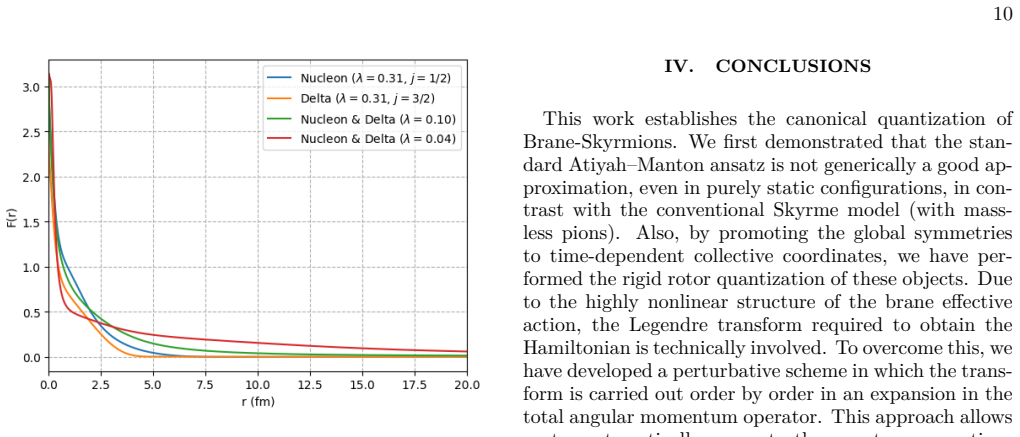
A physics-informed neural network determines the energy-minimizing profile of a brane-skyrmion while incorporating backreaction from its quantized spin.
A machine-rendered reading of the paper's core claim, the machinery that carries it, and where it could break.
Core claim
By quantizing the (iso)spin collective coordinates of the Brane-Skyrmion, we obtain a Hamiltonian that we solve perturbatively via an expansion in powers of J². We implement a Physics-Informed Neural Network to determine the soliton profile that minimizes the energy, consistently incorporating the backreaction from the quantized spin degrees of freedom.
What carries the argument
Physics-informed neural network that minimizes the energy functional of the brane-skyrmion profile after the Hamiltonian has been expanded perturbatively in J² to include spin backreaction.
If this is right
- The quantized brane-skyrmion states supply a candidate description of hadronic spectra within braneworld models.
- Brane-defect constructions acquire a practical quantization procedure that includes spin effects self-consistently.
- Neural-network methods become a viable tool for solving soliton profile equations that contain collective-coordinate corrections.
Where Pith is reading between the lines
- The same network architecture could be retrained on non-perturbative spin terms if a suitable loss function is constructed.
- The method might transfer to other higher-dimensional topological defects whose collective coordinates produce similar perturbative Hamiltonians.
- Accuracy could be cross-checked against lattice simulations of the underlying five-dimensional theory once such simulations become feasible.
Load-bearing premise
The perturbative expansion in J squared together with the neural-network optimization accurately captures the backreaction from quantized spins without uncontrolled errors or the need for non-perturbative checks.
What would settle it
An independent numerical minimization of the full energy functional that retains higher-order terms in the spin correction, compared directly with the PINN output, would show whether the perturbative result deviates systematically.
Figures

read the original abstract
In this work, we investigate the canonical quantization of topological solitons appearing in braneworld scenarios. In particular, we focus on Brane-Skyrmions, topological field configurations analogous to standard Skyrmions, which emerge as solutions of the Dirac-Nambu-Goto action supplemented by an induced curvature term. By quantizing the (iso)spin collective coordinates of the Brane-Skyrmion, we obtain a Hamiltonian that we solve perturbatively via an expansion in powers of $J^2$, in contrast to the standard Skyrme model. Furthermore, we implement a Physics-Informed Neural Network (PINN) to determine the soliton profile that minimizes the energy, consistently incorporating the backreaction from the quantized spin degrees of freedom. We conclude with a discussion of the potential applications of this framework to the description of hadronic spectra. Our results highlight both the theoretical potential of brane-defect models and the growing role of neural network methods in theoretical physics.
Editorial analysis
A structured set of objections, weighed in public.
Referee Report
Summary. The manuscript investigates the canonical quantization of topological solitons (Brane-Skyrmions) in braneworld scenarios. It quantizes the (iso)spin collective coordinates of solutions to the Dirac-Nambu-Goto action with an induced curvature term, obtains a Hamiltonian solved perturbatively via an expansion in powers of J², and implements a Physics-Informed Neural Network (PINN) to determine the soliton profile that minimizes the energy while incorporating backreaction from the quantized spins. The work concludes by discussing potential applications to hadronic spectra.
Significance. If the claimed PINN procedure yields a self-consistent minimum that reliably incorporates the O(J²) spin correction without uncontrolled errors, the combination of brane-defect models with neural-network optimization would represent a technically novel computational approach to soliton quantization, with possible relevance to hadronic spectra. No machine-checked proofs, reproducible code, or falsifiable predictions are described.
major comments (2)
- [Abstract] Abstract: the claim that the PINN 'consistently incorporat[es] the backreaction from the quantized spin degrees of freedom' cannot be evaluated because the abstract supplies no equations, numerical results, error estimates, or validation steps.
- [Abstract] Abstract: the perturbative J² expansion is asserted to capture backreaction via the modified energy functional minimized by the PINN, but no verification is indicated (e.g., comparison of J=0 versus small-J profiles or residual of the Euler-Lagrange equation after optimization), leaving open whether the term shifts the profile outside the perturbative regime or whether the optimizer reaches the true variational minimum.
Simulated Author's Rebuttal
We thank the referee for their report and the opportunity to clarify points regarding our manuscript on the quantization of Brane-Skyrmions. We respond to each major comment below, focusing on the abstract's claims while noting that detailed methods and results appear in the body of the paper.
read point-by-point responses
-
Referee: [Abstract] Abstract: the claim that the PINN 'consistently incorporat[es] the backreaction from the quantized spin degrees of freedom' cannot be evaluated because the abstract supplies no equations, numerical results, error estimates, or validation steps.
Authors: We acknowledge that the abstract is a concise summary and therefore omits the specific equations, numerical results, error estimates, and validation steps, which is standard practice. The full description of the PINN architecture, the modified energy functional that incorporates the O(J²) spin backreaction term, the training procedure, and associated error metrics are provided in Sections 3 and 4 of the manuscript. To improve clarity for readers who encounter only the abstract, we will revise it to include a brief reference to the numerical validation performed in the main text. revision: yes
-
Referee: [Abstract] Abstract: the perturbative J² expansion is asserted to capture backreaction via the modified energy functional minimized by the PINN, but no verification is indicated (e.g., comparison of J=0 versus small-J profiles or residual of the Euler-Lagrange equation after optimization), leaving open whether the term shifts the profile outside the perturbative regime or whether the optimizer reaches the true variational minimum.
Authors: The manuscript presents explicit comparisons between the J=0 profile and profiles obtained with small nonzero J, confirming that the induced shift remains small and within the perturbative regime. The PINN optimization explicitly tracks the residual of the Euler-Lagrange equation associated with the modified functional to verify convergence to a variational minimum. These checks are reported in the results section. We agree that the abstract could better signal the existence of this verification and will adjust its wording accordingly in a revision. revision: partial
Circularity Check
No circularity identified; derivation chain self-contained from available text
full rationale
The abstract and provided text describe a perturbative J² expansion of the Hamiltonian obtained from collective-coordinate quantization, followed by PINN optimization of the soliton profile on the resulting energy functional that includes the O(J²) backreaction term. No equations, ansatze, or explicit reductions are shown that would allow any result to be exhibited as equivalent to its inputs by construction (e.g., no fitted parameter renamed as a prediction, no self-citation load-bearing a uniqueness claim, no ansatz smuggled via prior work). The method is presented as a numerical variational procedure on a modified functional; absent any quoted mathematical step that collapses to a tautology or fit, the derivation remains independent of the target outputs and receives the default non-circularity finding.
Axiom & Free-Parameter Ledger
Reference graph
Works this paper leans on
-
[1]
Kaluza, On the unification problem in physics, In- ternational Journal of Modern Physics D27, 1870001 (2018)
T. Kaluza, On the unification problem in physics, In- ternational Journal of Modern Physics D27, 1870001 (2018)
2018
-
[2]
Klein, Quantum Theory and Five-Dimensional The- ory of Relativity
O. Klein, Quantum Theory and Five-Dimensional The- ory of Relativity. (In German and English), Z. Phys.37, 895 (1926)
1926
-
[3]
N. Arkani-Hamed, S. Dimopoulos, and G. R. Dvali, The Hierarchy problem and new dimensions at a millimeter, Phys. Lett. B429, 263 (1998), arXiv:hep-ph/9803315
Pith/arXiv arXiv 1998
-
[4]
V. A. Rubakov and M. E. Shaposhnikov, Do We Live Inside a Domain Wall?, Phys. Lett. B125, 136 (1983)
1983
-
[5]
A. Dobado and A. L. Maroto, The Dynamics of the Gold- stonebosonsonthebrane,Nucl.Phys.B592,203(2001), arXiv:hep-ph/0007100
Pith/arXiv arXiv 2001
-
[6]
J. Alcaraz, J. A. R. Cembranos, A. Dobado, and A. L. Maroto, Limits on the brane fluctuations mass and on the brane tension scale from electron positron colliders, Phys. Rev. D67, 075010 (2003), arXiv:hep-ph/0212269
Pith/arXiv arXiv 2003
-
[7]
J.A.R.Cembranos, A.Dobado,andA.L.Maroto,Brane world dark matter, Phys. Rev. Lett.90, 241301 (2003), arXiv:hep-ph/0302041
Pith/arXiv arXiv 2003
-
[8]
J. A. R. Cembranos, A. Dobado, and A. L. Maroto, Cos- mological and astrophysical limits on brane fluctuations, Phys. Rev. D68, 103505 (2003), arXiv:hep-ph/0307062
Pith/arXiv arXiv 2003
-
[9]
J. A. R. Cembranos, A. Dobado, and A. L. Maroto, Bra- non search in hadronic colliders, Phys. Rev. D70, 096001 (2004), arXiv:hep-ph/0405286
Pith/arXiv arXiv 2004
-
[10]
J. A. R. Cembranos, A. Dobado, and A. L. Maroto, Bra- non radiative corrections to collider physics and precision observables, Phys. Rev. D73, 035008 (2006), arXiv:hep- ph/0510399
arXiv 2006
-
[11]
J. A. R. Cembranos, A. Dobado, and A. L. Maroto, Dark matter clues in the muon anomalous magnetic moment, Phys. Rev. D73, 057303 (2006), arXiv:hep-ph/0507066
Pith/arXiv arXiv 2006
-
[12]
T. H. R. Skyrme, A Nonlinear field theory, Proc. Roy. Soc. Lond. A260, 127 (1961)
1961
-
[13]
J. K. Perring and T. H. R. Skyrme, A Model unified field equation, Nucl. Phys.31, 550 (1962)
1962
-
[14]
G. S. Adkins, C. R. Nappi, and E. Witten, Static Prop- erties of Nucleons in the Skyrme Model, Nucl. Phys. B 228, 552 (1983)
1983
-
[15]
Witten, Current Algebra, Baryons, and Quark Con- finement, Nucl
E. Witten, Current Algebra, Baryons, and Quark Con- finement, Nucl. Phys. B223, 433 (1983)
1983
-
[16]
J.A.R.Cembranos, A.Dobado,andA.L.Maroto,Brane skyrmions and wrapped states, Phys. Rev. D65, 026005 (2002), arXiv:hep-ph/0106322
Pith/arXiv arXiv 2002
-
[17]
J. A. R. Cembranos, A. de la Cruz-Dombriz, A. Dobado, and A. L. Maroto, Is the CMB Cold Spot a gate to extra dimensions?, JCAP10, 039, arXiv:0803.0694 [astro-ph]
-
[18]
Witten, Baryons and branes in anti-de Sitter space, JHEP07, 006, arXiv:hep-th/9805112
E. Witten, Baryons and branes in anti-de Sitter space, JHEP07, 006, arXiv:hep-th/9805112
-
[19]
T. Sakai and S. Sugimoto, Low energy hadron physics in holographic QCD, Prog. Theor. Phys.113, 843 (2005), arXiv:hep-th/0412141
Pith/arXiv arXiv 2005
-
[20]
S.BolognesiandP.Sutcliffe,TheSakai-Sugimotosoliton, JHEP01, 078, arXiv:1309.1396 [hep-th]
-
[21]
J. J. Blanco-Pillado, H. S. Ramadhan, and N. Shi- iki, Skyrme Branes, Phys. Rev. D79, 085004 (2009), arXiv:0809.0930 [hep-th]
Pith/arXiv arXiv 2009
-
[22]
S. B. Gudnason and M. Nitta, D-brane solitons in various dimensions, Phys. Rev. D91, 045018 (2015), arXiv:1412.6995 [hep-th]
Pith/arXiv arXiv 2015
-
[23]
Matsuda, Incidental brane defects, JHEP09, 064, arXiv:hep-th/0309266
T. Matsuda, Incidental brane defects, JHEP09, 064, arXiv:hep-th/0309266
-
[24]
M. Carrillo González, A. Masoumi, A. R. Solomon, and M. Trodden, Solitons in generalized galileon theories, Phys. Rev. D94, 125013 (2016), arXiv:1607.05260 [hep- th]
Pith/arXiv arXiv 2016
-
[25]
G. H. Derrick, Comments on nonlinear wave equations as models for elementary particles, J. Math. Phys.5, 1252 12 (1964)
1964
-
[26]
C. de Rham and A. J. Tolley, DBI and the Galileon re- united, JCAP05, 015, arXiv:1003.5917 [hep-th]
-
[27]
A. Garoffolo, K. Hinterbichler, and M. Trodden, Multi-Galileons in curved space, JHEP09, 115, arXiv:2505.08865 [hep-th]
-
[28]
K. Hinterbichler, M. Trodden, and D. Wesley, Multi-field galileons and higher co-dimension branes, Phys. Rev. D 82, 124018 (2010), arXiv:1008.1305 [hep-th]
Pith/arXiv arXiv 2010
-
[29]
M.TroddenandK.Hinterbichler,GeneralizingGalileons, Class. Quant. Grav.28, 204003 (2011), arXiv:1104.2088 [hep-th]
Pith/arXiv arXiv 2011
-
[30]
J. J. Blanco-Pillado, A. García Martín-Caro, D. Jiménez- Aguilar, and J. M. Queiruga, Effective actions for do- main wall dynamics, Phys. Rev. D111, 056007 (2025), arXiv:2411.13521 [hep-th]
arXiv 2025
-
[31]
J. C. Aurrekoetxea, J. J. Blanco-Pillado, A. Gar- cía Martín-Caro, and J. M. Queiruga, On curva- ture corrections for field theory cosmic strings (2026), arXiv:2603.05243 [hep-th]
arXiv 2026
-
[32]
M. F. Atiyah and N. S. Manton, Skyrmions From Instan- tons, Phys. Lett. B222, 438 (1989)
1989
-
[33]
H.Wang, L.Lu, S.Song,andG.Huang,Learningspecial- ized activation functions for physics-informed neural net- works, Communications in Computational Physics34, 869–906 (2023)
2023
-
[34]
Sánchez, Pinn for solving the brane skyrmion, ac- cessed: 2026-07-01
S. Sánchez, Pinn for solving the brane skyrmion, ac- cessed: 2026-07-01
2026
-
[35]
Luna, Machine learning for strong gravity, accessed: 2026-07-01
R. Luna, Machine learning for strong gravity, accessed: 2026-07-01
2026
-
[36]
N. S. Manton and P. Sutcliffe,Topological solitons, Cambridge Monographs on Mathematical Physics (Cam- bridge University Press, 2004)
2004
-
[37]
Navaset al.(Particle Data Group), Review of particle physics, Phys
S. Navaset al.(Particle Data Group), Review of particle physics, Phys. Rev. D110, 030001 (2024)
2024
-
[38]
E. B. Bogomolny, Stability of Classical Solutions, Sov. J. Nucl. Phys.24, 449 (1976)
1976
-
[39]
G. Goon, K. Hinterbichler, A. Joyce, and M. Trodden, Gauged Galileons From Branes, Phys. Lett. B714, 115 (2012), arXiv:1201.0015 [hep-th]
Pith/arXiv arXiv 2012
-
[40]
N. S. Manton,Skyrmions – A Theory of Nuclei(World Scientific, 2022)
2022
-
[41]
Castillejo, P
L. Castillejo, P. S. J. Jones, A. D. Jackson, J. J. M. Verbaarschot, and A. Jackson, Dense Skyrmion Systems, Nucl. Phys. A501, 801 (1989)
1989
-
[42]
C. Adam, A. García Martín-Caro, M. Huidobro, R. Vázquez, and A. Wereszczynski, Quantum skyrmion crystals and the symmetry energy of dense matter, Phys. Rev. D106, 114031 (2022), arXiv:2202.00953 [nucl-th]
arXiv 2022
-
[43]
D. Harland, P. Leask, and M. Speight, Skyrme crystals with massive pions, J. Math. Phys.64, 103503 (2023), arXiv:2305.14005 [hep-th]
arXiv 2023
-
[44]
C. Adam, A. García Martín-Caro, M. Huidobro, R. Vázquez, and A. Wereszczynski, A new consis- tent neutron star equation of state from a general- ized Skyrme model, Phys. Lett. B811, 135928 (2020), arXiv:2006.07983 [hep-th]
arXiv 2020
-
[45]
C. Adam, A. G. Martin-Caro, M. Huidobro, R. Vazquez, and A. Wereszczynski, Dense matter equation of state and phase transitions from a generalized Skyrme model, Phys. Rev. D105, 074019 (2022), arXiv:2109.13946 [hep- th]
arXiv 2022
-
[46]
C. Adam, A. García Martín-Caro, M. Huidobro, R.Vázquez,andA.Wereszczynski,Kaoncondensationin skyrmion matter and compact stars, Phys. Rev. D107, 074007 (2023), arXiv:2212.00385 [nucl-th]
arXiv 2023
-
[47]
C. Adam, A. García Martín-Caro, M. Huidobro, and A. Wereszczynski, Skyrme Crystals, Nuclear Mat- ter and Compact Stars, Symmetry15, 899 (2023), arXiv:2305.06639 [nucl-th]
arXiv 2023
-
[48]
P. Leask, M. Huidobro, and A. Wereszczynski, General- ized skyrmion crystals with applications to neutron stars, Phys. Rev. D109, 056013 (2024), arXiv:2306.04533 [hep- th]. Appendix A: Shooting Method The shooting method is a numerical technique de- signed to solve second-order boundary value problems where two conditions are specified for a functionF(r),...
arXiv 2024
discussion (0)
Sign in with ORCID, Apple, or X to comment. Anyone can read and Pith papers without signing in.