The Simplest Dirac Scoto-Seesaw Realization
Pith reviewed 2026-06-26 16:55 UTC · model grok-4.3
The pith
Chiral U(1) B-L charges for right-handed neutrinos generate atmospheric mass at tree level and solar mass radiatively while stabilizing dark matter with residual Z6.
A machine-rendered reading of the paper's core claim, the machinery that carries it, and where it could break.
Core claim
The central claim is that the anomaly-free chiral U(1) B-L charge assignment (-4,-4,5) for right-handed neutrinos enforces a Dirac scoto-seesaw structure in which the atmospheric mass-squared difference arises at tree level while the solar difference is generated radiatively, with the residual Z6 symmetry after U(1) B-L breaking automatically stabilizing a dark matter candidate.
What carries the argument
The anomaly-free U(1) B-L gauge symmetry with chiral charges (-4,-4,5) assigned to the three right-handed neutrinos, which restricts the allowed Yukawa interactions to produce the scoto-seesaw neutrino mass pattern and leaves a Z6 residual discrete symmetry after spontaneous breaking.
If this is right
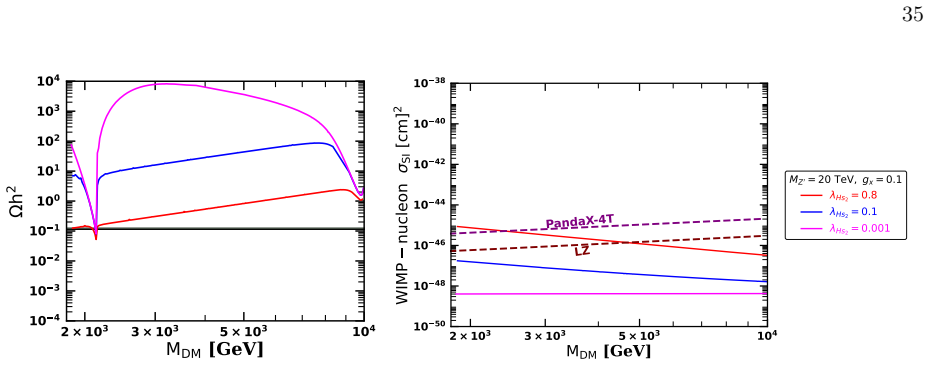
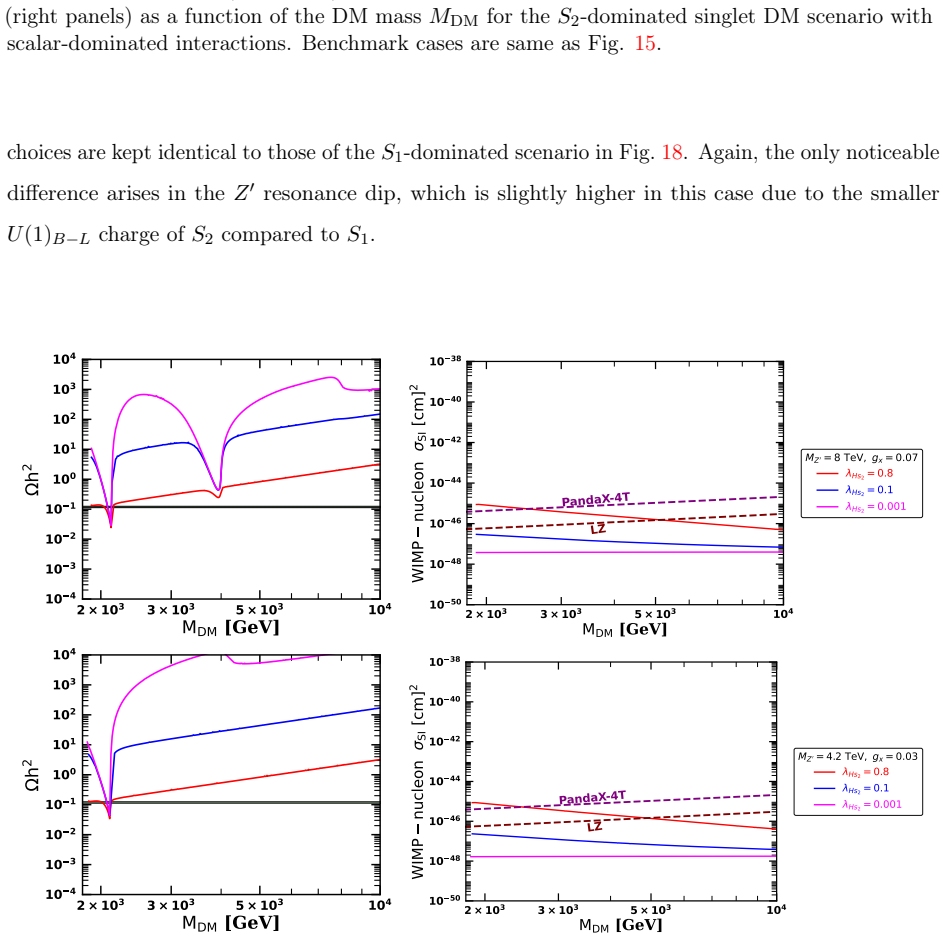
- One minimal realization allows both normal and inverted neutrino mass orderings while the other restricts to normal ordering only, each with distinct predictions for oscillation parameters.
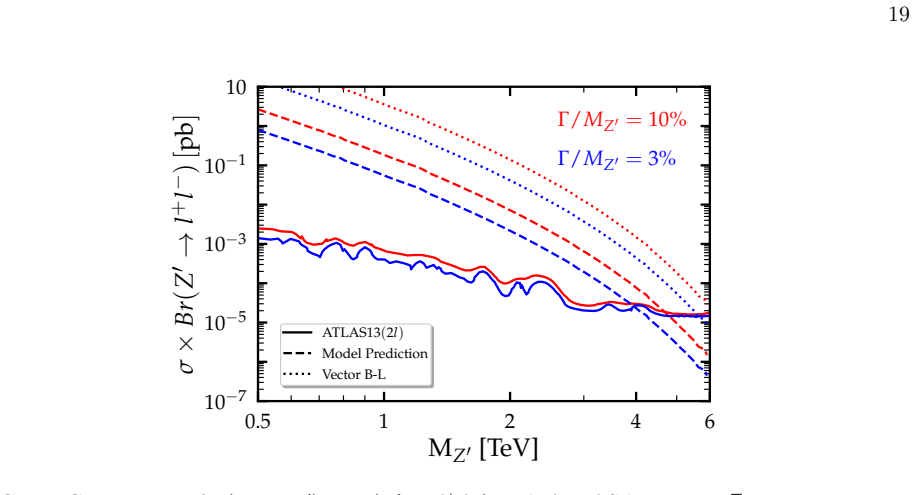
- Suppression of the Z' dilepton branching ratio weakens the ATLAS lower bound on the Z' mass relative to vector-like B-L models.
- The Z' portal together with annihilation and co-annihilation channels opens substantial regions of parameter space for both singlet scalar and fermionic dark matter to match the observed relic density.
- The two realizations yield testable differences in neutrino observables and dark matter direct-detection rates.
Where Pith is reading between the lines
- The same charge pattern could be embedded in larger gauge groups to generate additional mass hierarchies or flavor structures without extra discrete symmetries.
- Dijet or missing-energy searches at colliders may provide stronger constraints on the Z' than dilepton searches in this chiral setup.
- The radiative solar-mass loop could be connected to other scotogenic models to predict relations between neutrino mixing angles and dark matter annihilation cross sections.
Load-bearing premise
The U(1) B-L symmetry breaks in such a way that a residual Z6 symmetry remains unbroken and is sufficient to stabilize the chosen dark matter candidate.
What would settle it
Observation of inverted neutrino mass ordering in the realization that permits only normal ordering, or discovery of a Z' boson with unsuppressed dilepton branching fraction at the LHC.
Figures





read the original abstract
We present a simple Dirac scoto-seesaw framework based on the anomaly-free $U(1)_{B-L}$ charge assignment $(-4,-4,5)$ for $\nu_R$. This chiral charge assignment naturally accounts for the observed neutrino mass-squared differences, with $\Delta m^2_{\rm atm}$ generated at tree level and $\Delta m^2_{\rm sol}$ arising radiatively. After the spontaneous breaking of gauged $U(1)_{B-L}$, a residual $Z_6$ symmetry stabilizes the dark matter candidate. We investigate two minimal realizations of the framework, finding that both normal and inverted orderings are viable in one case, whereas only normal ordering survives in the other, with distinctive features for neutrino observables. Moreover, the chiral nature of the $U(1)_{B-L}$ charges suppresses the dilepton branching fraction of $Z'$, resulting in weaker ATLAS mass bounds than in the conventional vector $B-L$ scenario, thereby easing constraints on the dark sector. We explore the dark matter phenomenology of the singlet scalar and fermionic dark matter candidates. While singlet scalar DM is often severely constrained, the presence of the $Z'$ portal together with annihilation and co-annihilation channels substantially broadens the allowed parameter space. Thus, the framework offers a predictive scenario for neutrino and dark matter phenomenology that can be probed in future experiments.
Editorial analysis
A structured set of objections, weighed in public.
Referee Report
Summary. The manuscript constructs a Dirac scoto-seesaw model based on an anomaly-free gauged U(1)_{B-L} with chiral charges (-4,-4,5) assigned to the three right-handed neutrinos. This assignment is used to generate the atmospheric neutrino mass-squared splitting at tree level while the solar splitting arises only radiatively. Spontaneous breaking of U(1)_{B-L} leaves a residual Z_6 that stabilizes dark-matter candidates. Two minimal realizations are presented; one allows both normal and inverted orderings while the other permits only normal ordering, with associated predictions for neutrino observables. The chiral charges suppress the Z' dilepton branching ratio relative to vector-like B-L models, and the dark-matter phenomenology of singlet scalar and fermionic candidates is explored via the Z' portal together with annihilation and co-annihilation channels.
Significance. If the explicit constructions and mass-generation mechanisms hold, the work supplies a minimal, gauge-consistent framework that simultaneously explains the two neutrino mass-squared differences through distinct perturbative orders and stabilizes dark matter via a discrete remnant symmetry. The reduced ATLAS bounds on the Z' and the broadened viable parameter space for both scalar and fermionic dark matter constitute concrete, testable features that distinguish the scenario from conventional B-L extensions.
minor comments (3)
- The abstract states that the charge assignment is anomaly-free, but the explicit cancellation of all gauge anomalies (including mixed anomalies with gravity) should be shown in a dedicated subsection or appendix for completeness.
- A side-by-side comparison table of the two minimal realizations (field content, charge assignments, and resulting mass matrices) would clarify why one permits inverted ordering while the other does not.
- The statement that the Z_6 remnant 'stabilizes the dark matter candidate' is central; an explicit listing of the Z_6 charges of all fields and a brief proof that the lightest odd state cannot decay would strengthen the claim.
Simulated Author's Rebuttal
We thank the referee for the positive summary, significance assessment, and recommendation of minor revision. No major comments were listed in the report, so there are no specific points requiring detailed rebuttal or clarification at this stage.
Circularity Check
No significant circularity identified
full rationale
The paper selects the anomaly-free chiral U(1)_{B-L} charges (-4,-4,5) on the right-handed neutrinos as an explicit input to enforce the scoto-seesaw operator structure, with tree-level atmospheric and radiative solar mass splittings following directly from the allowed Lagrangian terms after symmetry breaking. This is a standard charge-assignment mechanism in flavored gauge models rather than a derivation that reduces to its own fitted outputs or self-citations; the residual Z_6 for DM stabilization is the usual discrete remnant, and the viability checks for normal/inverted orderings plus DM phenomenology are independent of any renaming or self-referential fitting. No load-bearing self-citation, ansatz smuggling, or prediction that collapses to an internal parameter fit appears in the abstract or described structure, so the central claims remain self-contained.
Axiom & Free-Parameter Ledger
free parameters (2)
- U(1)B-L breaking vev
- DM mass and portal couplings
axioms (2)
- standard math Charge assignment (-4,-4,5) is anomaly free under U(1)B-L
- domain assumption Spontaneous breaking leaves an exact residual Z6 that stabilizes DM
invented entities (3)
-
Z' gauge boson
no independent evidence
-
Singlet scalar DM candidate
no independent evidence
-
Fermionic DM candidate
no independent evidence
Reference graph
Works this paper leans on
-
[1]
In particular, the model is constructed within the simplest realization of the Dirac scoto-seesaw mechanism for neutrino mass generation
THE MINIMAL DIRAC SCOTO-SEESA W MODEL We first outline the particle content and the underlying symmetry structure governing the model framework. In particular, the model is constructed within the simplest realization of the Dirac scoto-seesaw mechanism for neutrino mass generation. An appealing feature of the model is its 1 ζp (p= 1,2,3) denotes the mass ...
-
[2]
NUMERICAL ANAL YSIS OF NEUTRINO SECTOR We now delve into the details of the numerical analysis of the neutrino sector. In our analysis, we employ the NuFIT 6.1 neutrino oscillation parameters at the3σlevel, given as follows [50–52] NO: ∆m 2 31 = [2.450,2.576]×10 −3 eV2,∆m 2 21 = [7.236,7.823]×10 −5 eV2, sin2 θ12 = [0.2893,0.3295],sin 2 θ23 = [0.435,0.584]...
-
[3]
To discuss the phenomenological implications of the model, we numerically diagonalize the combined neutrino mass matrix (seesaw+scoto) obtained in Eq
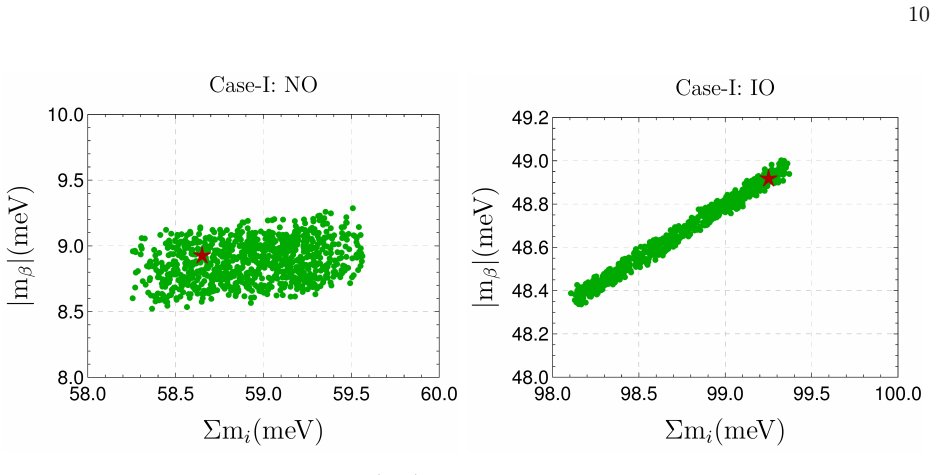
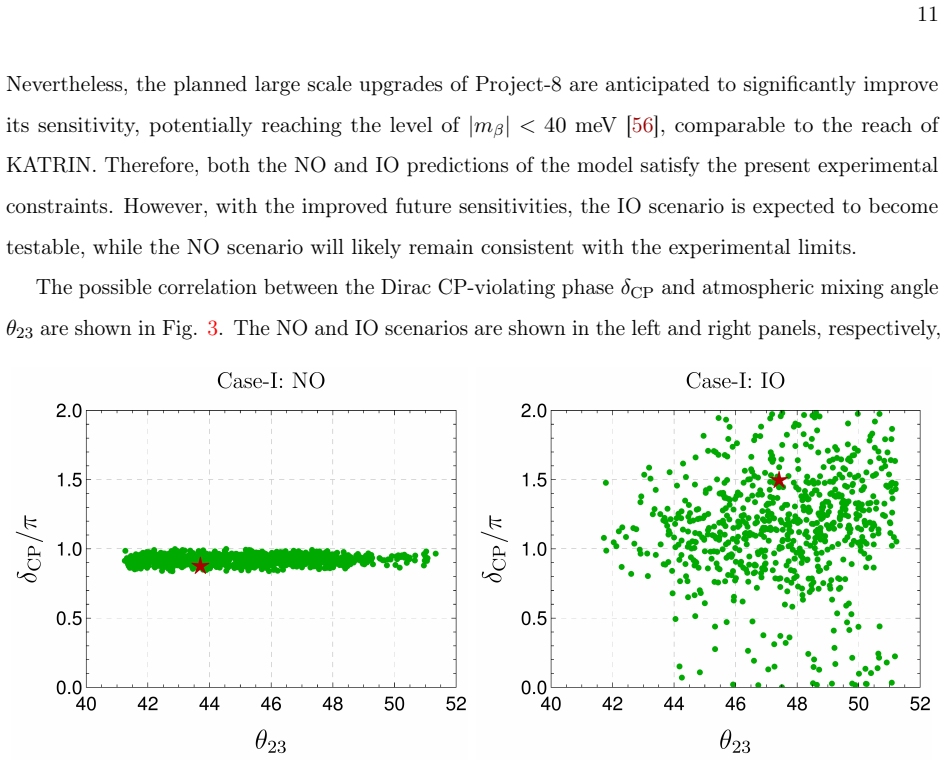
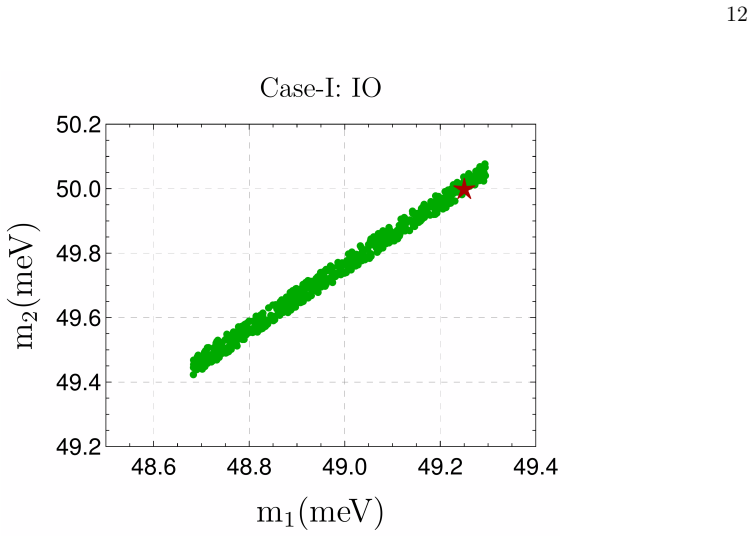
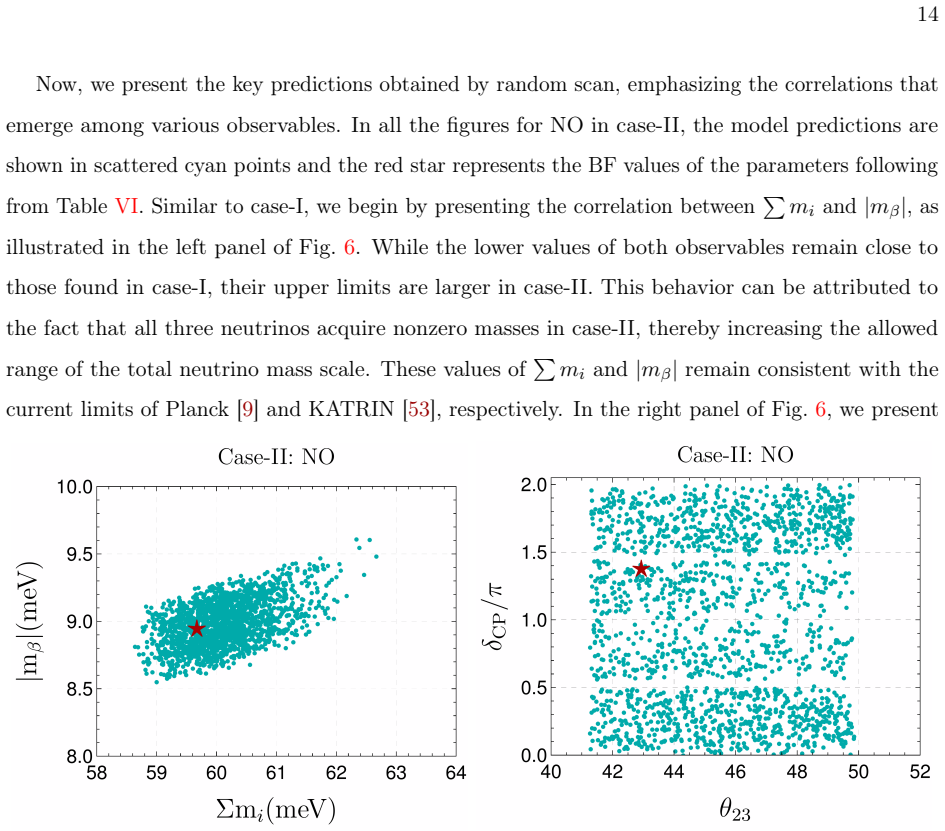
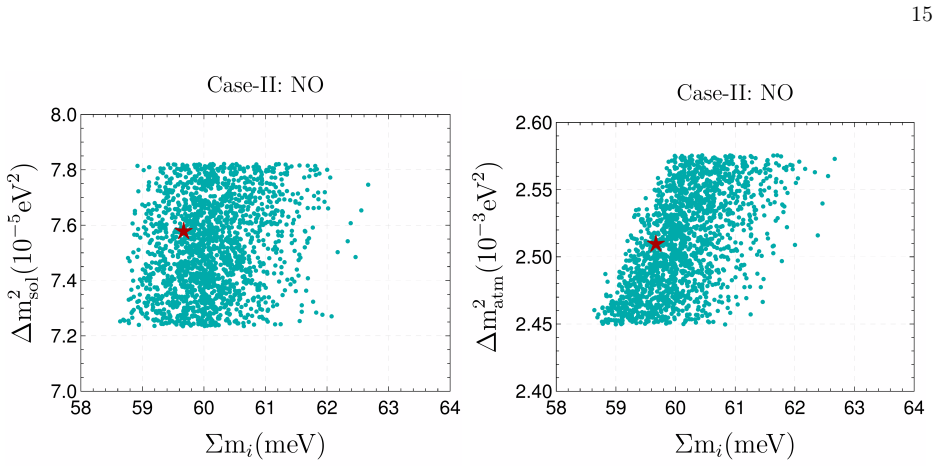
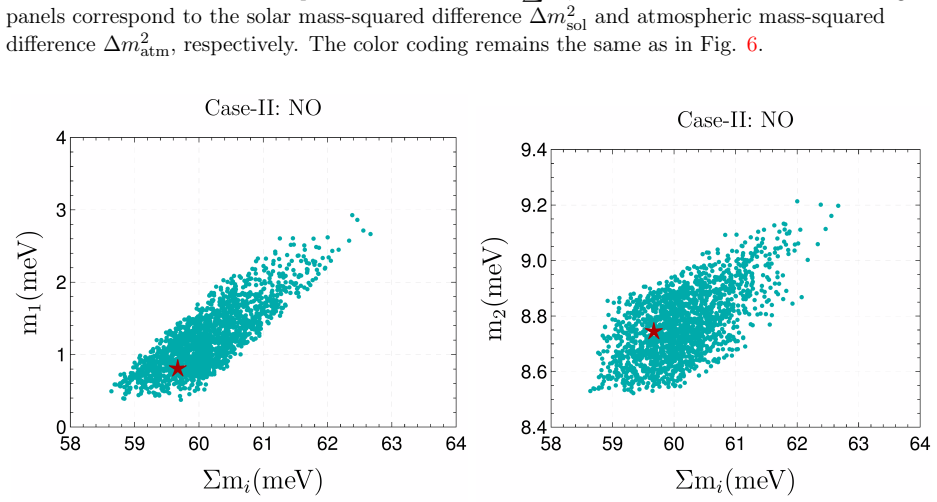
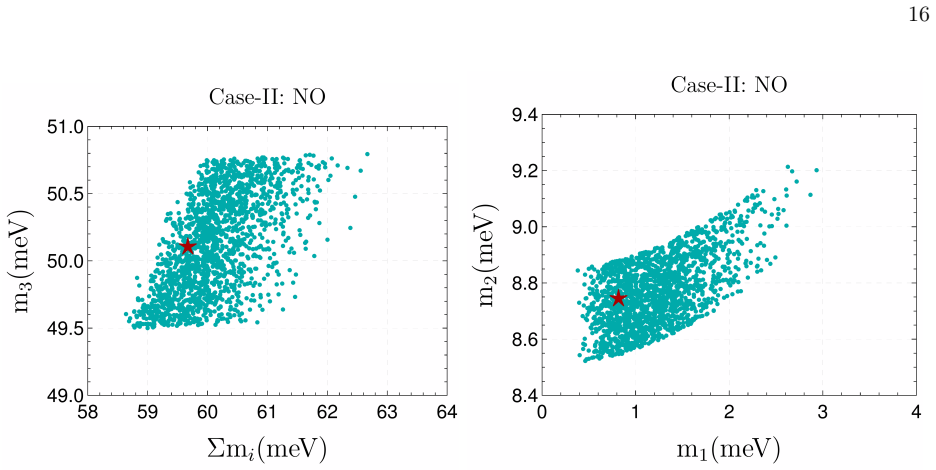
is associated with the atmospheric mass-squared difference∆ m2 atm, for NO (IO). To discuss the phenomenological implications of the model, we numerically diagonalize the combined neutrino mass matrix (seesaw+scoto) obtained in Eq. (6). This enables us to extract the neutrino masses and mixing parameters, which are subsequently used to analyze the numeric...
2024
-
[4]
The production of theZ′ boson is possible if the SM quarks carry charges under the newU(1)symmetry, or if they interact with theZ′ through mixing with the SMZ boson
CONSTRAINTS FROMZ ′ DECA Y In this section, we investigate collider constraints on theZ′ boson, focusing on its production and detection prospects at the LHC [39, 40]. The production of theZ′ boson is possible if the SM quarks carry charges under the newU(1)symmetry, or if they interact with theZ′ through mixing with the SMZ boson. For simplicity, we assu...
-
[5]
The numerical analysis is carried out using SPheno [58, 59], while collider simulations are performed with MadGraph [60]
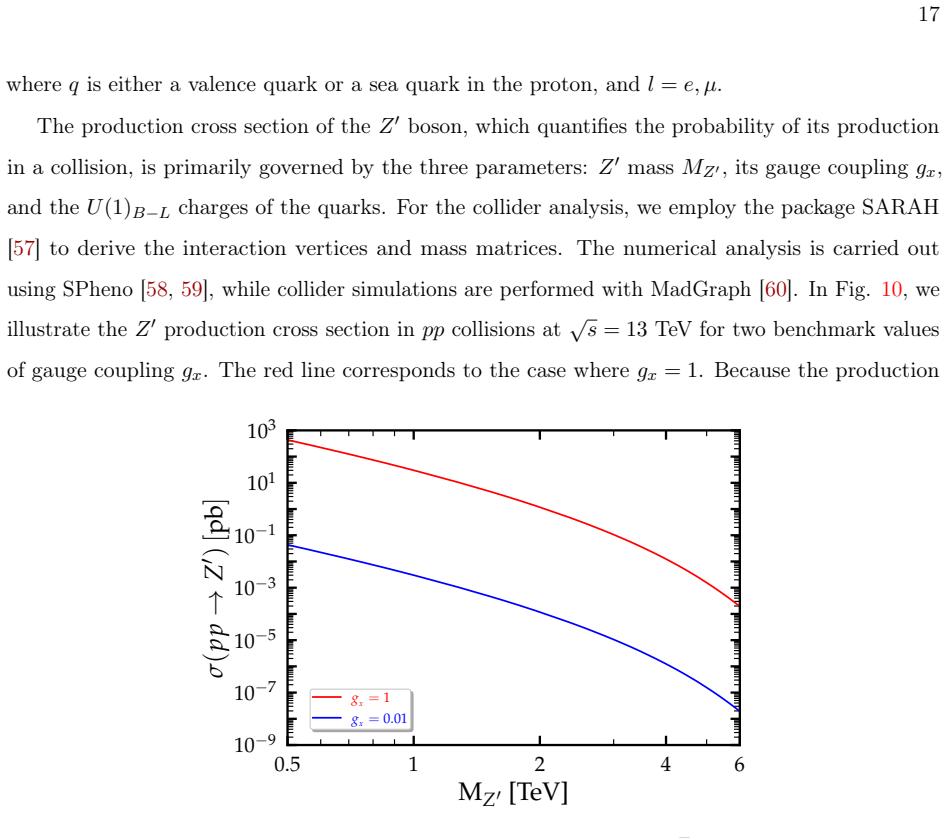
to derive the interaction vertices and mass matrices. The numerical analysis is carried out using SPheno [58, 59], while collider simulations are performed with MadGraph [60]. In Fig. 10, we illustrate the Z′ production cross section inpp collisions at √s = 13TeV for two benchmark values of gauge couplinggx. The red line corresponds to the case wheregx = ...
-
[6]
As discussed in Sec
PHENOMENOLOGY OF DARK SECTOR This section is devoted to the analysis of dark sector phenomenology of the model. As discussed in Sec. 2, the VEVs of the Higgs doubletH and the singlet scalar χ spontaneously break the electroweak and U(1)B−L symmetries, respectively. The breaking ofU(1)B−L leads to a residual Z6 symmetry. Under this residualZ6 symmetry, all...
-
[7]
These gauge interactions allow the DM particle to annihilate into fermions viaZ′ exchange, DM DM∗ →Z ′ →ψ ¯ψ
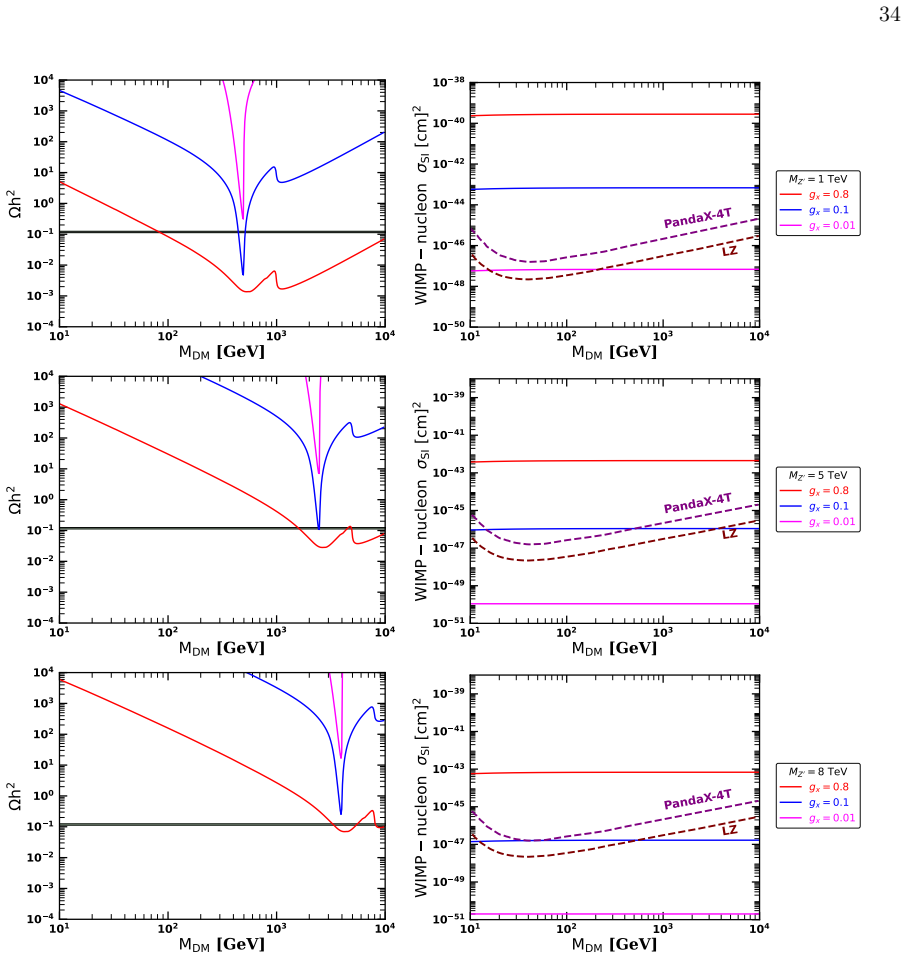
Singlet DM with pureZ ′ interactions We first examine the role of pureZ′ mediated interactions in shaping the phenomenology of singlet DM S1. These gauge interactions allow the DM particle to annihilate into fermions viaZ′ exchange, DM DM∗ →Z ′ →ψ ¯ψ. The contributions of these channels depend primarily on the gauge coupling gx and the Z′ mass MZ′. Conseq...
-
[8]
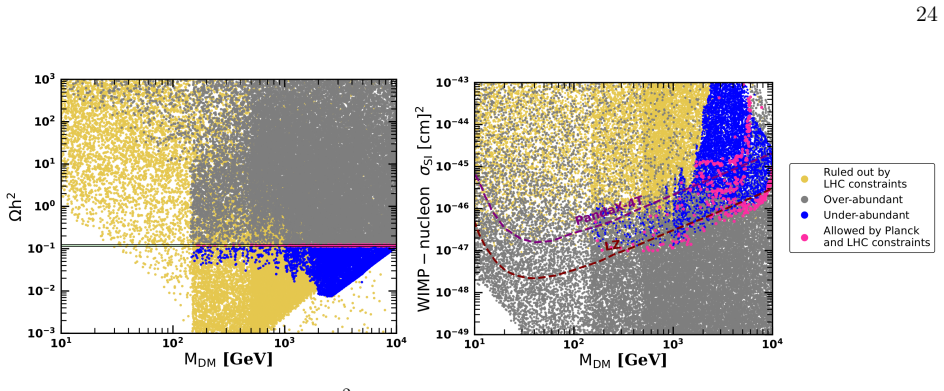
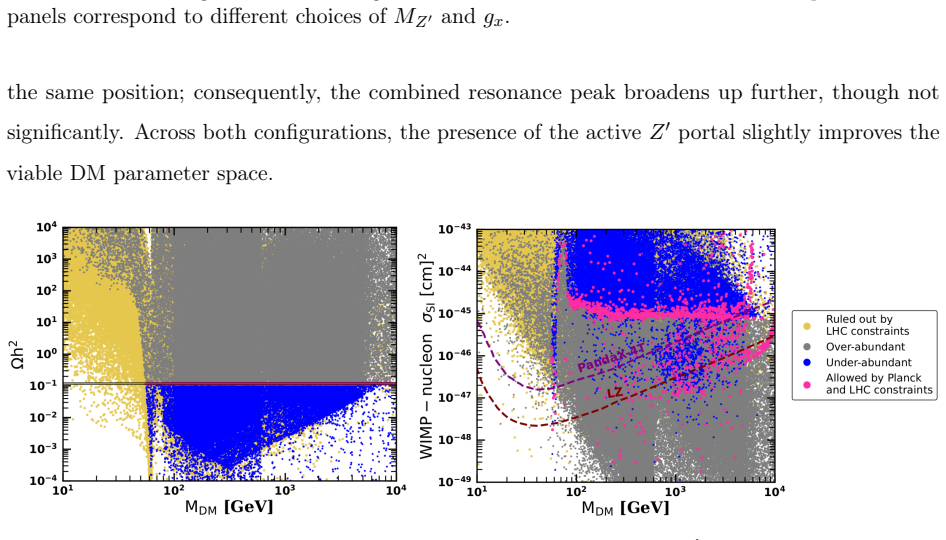
The left panel shows the DM relic density as a function of the DM massMDM for the mixed S1-S2 singlet DM scenario.4 The gauge parameters are scanned over the ranges,gx ∈ [10−4, 1]and 4 The lightest state amongS1 andS 2 serves as the DM candidate. 24 FIG. 14: Left: DM relic densityΩh2; Right: spin-independent WIMP–nucleon cross sectionσSI as functions ofM ...
-
[9]
These interactions resemble those of the Higgs portal scenario
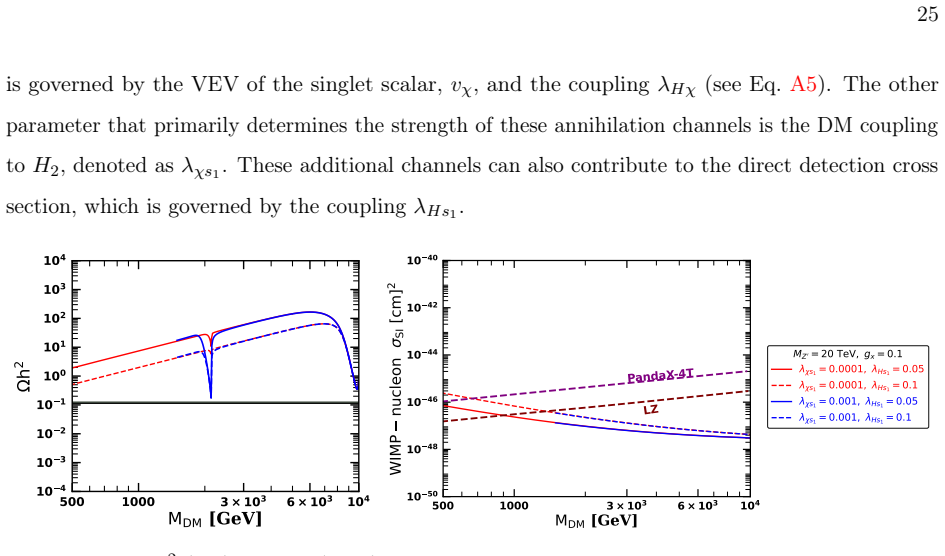
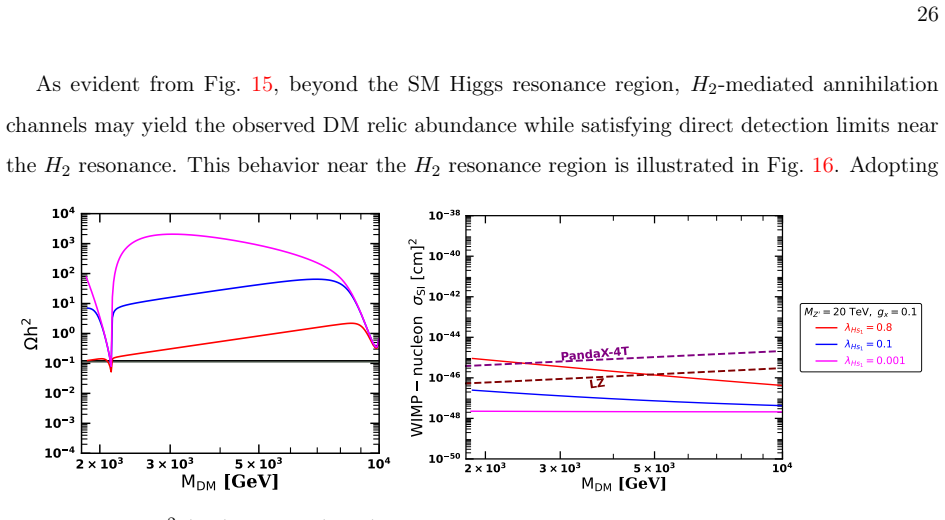
Singlet DM with scalar-dominated interactions Having discussed pure Z′ interactions, we now discuss scalar-dominated interactions. These interactions resemble those of the Higgs portal scenario. However, due to the rich scalar sector, the behavior is different from the simple Higgs portal scenario due to additional annihilation and co-annihilation channel...
-
[10]
We begin by considering the effect of theZ′ portal on theS1-dominated singlet DM scenario discussed in the previous section for the case of pure scalar interactions (see Fig
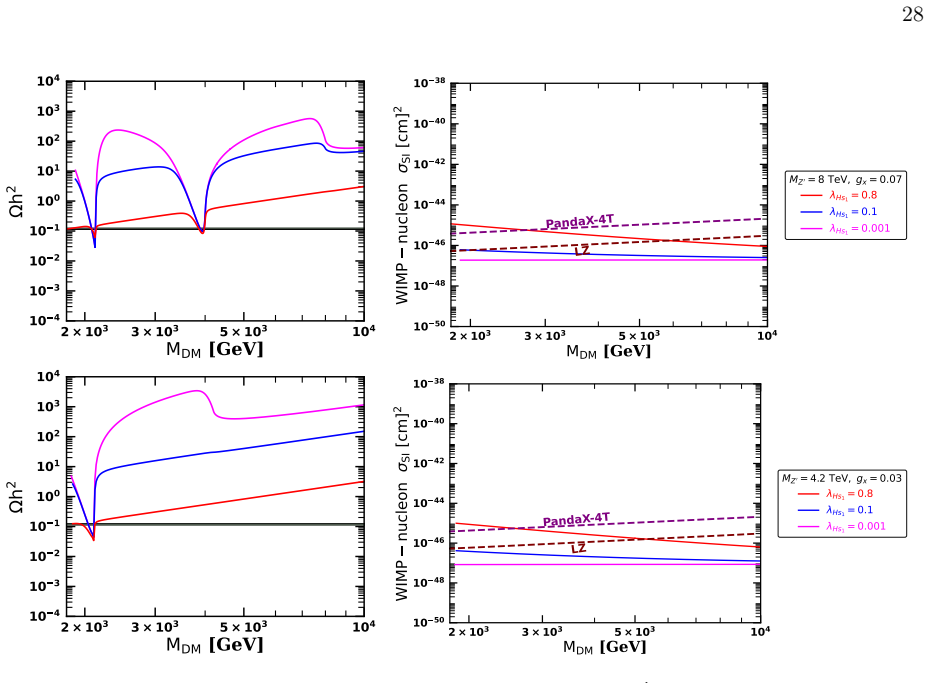
Singlet DM with mixed scalar and gauge interactions Having analyzed theZ′ and scalar portals independently, we now examine their combined impact to obtain a complete picture of the parameter space. We begin by considering the effect of theZ′ portal on theS1-dominated singlet DM scenario discussed in the previous section for the case of pure scalar interac...
-
[11]
Results from one thousand days of real time directional solar neutrino data,
CONCLUSION In this work, we proposed a simple Dirac scoto-seesaw framework that simultaneously explains the neutrino mass generation and DM stability. Owing to the anomaly-free chiralU(1)B−L charge assignment( −4,− 4, 5)of νRi, the model naturally realizes the observed two mass-squared differences. The two−4charged νR generate a tree level seesaw contribu...
1990
-
[12]
Observation of a small atmospheric muon-neutrino / electron-neutrino ratio in Kamiokande,
Kamiokande-IICollaboration, K. S. Hirataet al., “Observation of a small atmospheric muon-neutrino / electron-neutrino ratio in Kamiokande,”Phys. Lett. B280(1992) 146–152. [3]Super-KamiokandeCollaboration, Y. Fukudaet al., “Evidence for oscillation of atmospheric neutrinos,”Phys. Rev. Lett.81(1998) 1562–1567,arXiv:hep-ex/9807003
Pith/arXiv arXiv 1992
-
[13]
Measurement of the solar electron neutrino flux with the Homestake chlorine detector,
B. T. Cleveland, T. Daily, R. Davis, Jr., J. R. Distel, K. Lande, C. K. Lee, P. S. Wildenhain, and J. Ullman, “Measurement of the solar electron neutrino flux with the Homestake chlorine detector,” Astrophys. J.496(1998) 505–526. [5]SNOCollaboration, Q. R. Ahmadet al., “Direct evidence for neutrino flavor transformation from neutral current interactions i...
Pith/arXiv arXiv 1998
-
[14]
Die Rotverschiebung von extragalaktischen Nebeln,
F. Zwicky, “Die Rotverschiebung von extragalaktischen Nebeln,”Helv. Phys. Acta6(1933) 110–127
1933
-
[15]
Rotation of the Andromeda Nebula from a Spectroscopic Survey of Emission Regions,
V. C. Rubin and W. K. Ford, Jr., “Rotation of the Andromeda Nebula from a Spectroscopic Survey of Emission Regions,”Astrophys. J.159(1970) 379–403
1970
-
[16]
Rotational properties of 21 SC galaxies with a large range of luminosities and radii, from NGC 4605 /R = 4kpc/ to UGC 2885 /R = 122 kpc/,
V. C. Rubin, N. Thonnard, and W. K. Ford, Jr., “Rotational properties of 21 SC galaxies with a large range of luminosities and radii, from NGC 4605 /R = 4kpc/ to UGC 2885 /R = 122 kpc/,”Astrophys. J.238(1980) 471
1980
-
[17]
Planck 2018 results. VI. Cosmological parameters,
PlanckCollaboration, N. Aghanimet al., “Planck 2018 results. VI. Cosmological parameters,”Astron. Astrophys.641(2020) A6,arXiv:1807.06209 [astro-ph.CO]. [Erratum: Astron.Astrophys. 652, C4 (2021)]
Pith/arXiv arXiv 2018
-
[18]
Verifiable radiative seesaw mechanism of neutrino mass and dark matter,
E. Ma, “Verifiable radiative seesaw mechanism of neutrino mass and dark matter,”Phys. Rev. D73 (2006) 077301,arXiv:hep-ph/0601225
Pith/arXiv arXiv 2006
-
[19]
Observable Signatures of Scotogenic Dirac Model,
S.-Y. Guo and Z.-L. Han, “Observable Signatures of Scotogenic Dirac Model,”JHEP12(2020) 062, arXiv:2005.08287 [hep-ph]
arXiv 2020
-
[20]
Dirac Radiative Neutrino Mass with Modular Symmetry and Leptogenesis,
A. Dasgupta, T. Nomura, H. Okada, O. Popov, and M. Tanimoto, “Dirac Radiative Neutrino Mass with Modular Symmetry and Leptogenesis,”arXiv:2111.06898 [hep-ph]
-
[21]
Observable∆Neffin Dirac scotogenic model,
D. Borah, P. Das, and D. Nanda, “Observable∆Neffin Dirac scotogenic model,”Eur. Phys. J. C84 no. 2, (2024) 140,arXiv:2211.13168 [hep-ph]
arXiv 2024
-
[22]
Dark SU(2) gauge symmetry and scotogenic Dirac neutrinos,
D. Borah, E. Ma, and D. Nanda, “Dark SU(2) gauge symmetry and scotogenic Dirac neutrinos,”Phys. Lett. B835(2022) 137539,arXiv:2204.13205 [hep-ph]
arXiv 2022
-
[23]
Absolute neutrino mass scale and dark matter stability from flavour symmetry,
S. Chuliá Centelles, R. Cepedello, and O. Medina, “Absolute neutrino mass scale and dark matter stability from flavour symmetry,”JHEP10(2022) 080,arXiv:2204.12517 [hep-ph]
arXiv 2022
-
[24]
Dark Matter Escaping Direct Detection Runs into Higgs Mass Hierarchy Problem,
P. Bharadwaj, R. Kumar, H. K. Prajapati, R. Srivastava, and S. Yadav, “Dark Matter Escaping Direct Detection Runs into Higgs Mass Hierarchy Problem,”arXiv:2412.13301 [hep-ph]. 37
-
[25]
Comprehensive phenomenology of the Dirac Scotogenic Model: Novel low-mass dark matter,
S. Centelles Chuliá, R. Srivastava, and S. Yadav, “Comprehensive phenomenology of the Dirac Scotogenic Model: Novel low-mass dark matter,”JHEP04(2025) 038,arXiv:2409.18513 [hep-ph]
arXiv 2025
-
[26]
Extended scotogenic model of neutrino mass and proton decay,
T. Nomura and O. Popov, “Extended scotogenic model of neutrino mass and proton decay,”Phys. Rev. D110no. 7, (2024) 075035,arXiv:2406.00651 [hep-ph]
arXiv 2024
-
[27]
Type-III Scotogenic Model: Inflation, Dark Matter and Collider Phenomenology,
L. Singh, R. Srivastava, S. Verma, and S. Yadav, “Type-III Scotogenic Model: Inflation, Dark Matter and Collider Phenomenology,”arXiv:2501.13171 [hep-ph]
-
[28]
Dark Matter Induced Proton Decays,
R. Kumar and R. Srivastava, “Dark Matter Induced Proton Decays,”arXiv:2506.04370 [hep-ph]
-
[29]
Dark matter as the source of neutrino mass: theory overview and experimental prospects,
I. M. Ávila, A. Karan, S. Mandal, S. Sadhukhan, and J. W. F. Valle, “Dark matter as the source of neutrino mass: theory overview and experimental prospects,”arXiv:2506.24027 [hep-ph]
-
[30]
Radiative Dirac Neutrino Masses from ModularS3 Symmetry in an Axion Model,
S. K. Kang, R. Kumar, and H. Okada, “Radiative Dirac Neutrino Masses from ModularS3 Symmetry in an Axion Model,”arXiv:2601.22740 [hep-ph]
-
[31]
Simplest Scoto-Seesaw Mechanism,
N. Rojas, R. Srivastava, and J. W. Valle, “Simplest Scoto-Seesaw Mechanism,”Phys.Lett.B789(2019) 132–136,arXiv:1807.11447 [hep-ph]
Pith/arXiv arXiv 2019
-
[32]
Fermion Triplet Dark Matter and Radiative Neutrino Mass,
E. Ma and D. Suematsu, “Fermion Triplet Dark Matter and Radiative Neutrino Mass,”Mod. Phys. Lett. A24(2009) 583–589,arXiv:0809.0942 [hep-ph]
Pith/arXiv arXiv 2009
-
[33]
Minimal scoto-seesaw mechanism with spontaneous CP violation,
D. M. Barreiros, F. R. Joaquim, R. Srivastava, and J. W. F. Valle, “Minimal scoto-seesaw mechanism with spontaneous CP violation,”JHEP04(2021) 249,arXiv:2012.05189 [hep-ph]
arXiv 2021
-
[34]
The simplest scoto-seesaw model: WIMP dark matter phenomenology and Higgs vacuum stability,
S. Mandal, R. Srivastava, and J. W. F. Valle, “The simplest scoto-seesaw model: WIMP dark matter phenomenology and Higgs vacuum stability,”Phys. Lett. B819(2021) 136458,arXiv:2104.13401 [hep-ph]
arXiv 2021
-
[35]
Flavour and dark matter in a scoto/type-II seesaw model,
D. M. Barreiros, H. B. Camara, and F. R. Joaquim, “Flavour and dark matter in a scoto/type-II seesaw model,”JHEP08(2022) 030,arXiv:2204.13605 [hep-ph]
arXiv 2022
-
[36]
Common origin ofθ13 and dark matter within the flavor symmetric scoto-seesaw framework,
J. Ganguly, J. Gluza, and B. Karmakar, “Common origin ofθ13 and dark matter within the flavor symmetric scoto-seesaw framework,”JHEP11(2022) 074,arXiv:2209.08610 [hep-ph]
arXiv 2022
-
[37]
Phenomenology of the flavor symmetric scoto-seesaw model with dark matter and TM1 mixing,
J. Ganguly, J. Gluza, B. Karmakar, and S. Mahapatra, “Phenomenology of the flavor symmetric scoto-seesaw model with dark matter and TM1 mixing,”arXiv:2311.15997 [hep-ph]
-
[38]
Scotoseesaw model implied by dark right-handed neutrinos,
P. Van Dong and D. Van Loi, “Scotoseesaw model implied by dark right-handed neutrinos,” arXiv:2311.09795 [hep-ph]
-
[39]
Dynamical scoto-seesaw mechanism with gaugedB−L,
J. Leite, S. Sadhukhan, and J. W. F. Valle, “Dynamical scoto-seesaw mechanism with gaugedB−L,” arXiv:2307.04840 [hep-ph]
-
[40]
Predictions from scoto-seesaw with A4 modular symmetry,
R. Kumar, P. Mishra, M. K. Behera, R. Mohanta, and R. Srivastava, “Predictions from scoto-seesaw with A4 modular symmetry,”Phys. Lett. B853(2024) 138635,arXiv:2310.02363 [hep-ph]
arXiv 2024
-
[41]
Scotoseesaw mechanism from aZ3 symmetry of matter,
D. M. Luong and P. Van Dong, “Scotoseesaw mechanism from aZ3 symmetry of matter,”Eur. Phys. J. C85no. 4, (2025) 473,arXiv:2501.08711 [hep-ph]
arXiv 2025
-
[42]
Dark-portal leptogenesis in a nonholomorphic modular scoto-seesaw model,
S. Nasri, L. Singh, Tapender, and S. Verma, “Dark-portal leptogenesis in a nonholomorphic modular scoto-seesaw model,”Phys. Rev. D113no. 11, (2026) 115008,arXiv:2601.06435 [hep-ph]
arXiv 2026
-
[43]
Cutting the scotogenic loop: adding flavor to dark matter,
R. Kumar, N. Nath, and R. Srivastava, “Cutting the scotogenic loop: adding flavor to dark matter,” 38 JHEP12(2024) 036,arXiv:2406.00188 [hep-ph]
arXiv 2024
-
[44]
Discrete dark matter with light Dirac neutrinos,
D. Borah, P. Das, B. Karmakar, and S. Mahapatra, “Discrete dark matter with light Dirac neutrinos,” Phys. Rev. D111no. 3, (2025) 035032,arXiv:2406.17861 [hep-ph]
arXiv 2025
-
[45]
Dirac Scoto inverse-seesaw from A4 flavor symmetry,
R. Kumar, N. Nath, R. Srivastava, and S. Yadav, “Dirac Scoto inverse-seesaw from A4 flavor symmetry,” JHEP10(2025) 088,arXiv:2505.01407 [hep-ph]
arXiv 2025
-
[46]
Flavor imprints on novel low mass dark matter,
R. Kumar, H. K. Prajapati, R. Srivastava, and S. Yadav, “Flavor imprints on novel low mass dark matter,”JHEP11(2025) 094,arXiv:2510.02972 [hep-ph]. [39]CMSCollaboration, A. M. Sirunyanet al., “Search for narrow and broad dijet resonances in proton-proton collisions at√s= 13TeV and constraints on dark matter mediators and other new particles,”JHEP08(2018) ...
arXiv 2025
-
[47]
Pattern of Symmetry Breaking with Two Higgs Doublets,
N. G. Deshpande and E. Ma, “Pattern of Symmetry Breaking with Two Higgs Doublets,”Phys. Rev. D 18(1978) 2574
1978
-
[48]
Improved naturalness with a heavy Higgs: An Alternative road to LHC physics,
R. Barbieri, L. J. Hall, and V. S. Rychkov, “Improved naturalness with a heavy Higgs: An Alternative road to LHC physics,”Phys. Rev. D74(2006) 015007,arXiv:hep-ph/0603188
Pith/arXiv arXiv 2006
-
[49]
CDF-II W-boson mass anomaly in the canonical Scotogenic neutrino–dark matter model,
A. Batra, S. K. A, S. Mandal, H. Prajapati, and R. Srivastava, “CDF-II W-boson mass anomaly in the canonical Scotogenic neutrino–dark matter model,”Mod. Phys. Lett. A38no. 18n19, (2023) 2350090, arXiv:2204.11945 [hep-ph]
arXiv 2023
-
[50]
CDF-II W boson mass in the Dirac Scotogenic model,
S. Centelles Chuliá, R. Srivastava, and S. Yadav, “CDF-II W boson mass in the Dirac Scotogenic model,”Mod. Phys. Lett. A38no. 7, (2023) ,arXiv:2206.11903 [hep-ph]
arXiv 2023
-
[51]
Gamma rays from the annihilation of singlet scalar dark matter,
C. E. Yaguna, “Gamma rays from the annihilation of singlet scalar dark matter,”JCAP03(2009) 003, arXiv:0810.4267 [hep-ph]
Pith/arXiv arXiv 2009
-
[52]
Singlet Scalar Dark Matter: monochromatic gamma rays and metastable vacua,
S. Profumo, L. Ubaldi, and C. Wainwright, “Singlet Scalar Dark Matter: monochromatic gamma rays and metastable vacua,”Phys. Rev. D82(2010) 123514,arXiv:1009.5377 [hep-ph]
Pith/arXiv arXiv 2010
-
[53]
Closing in on singlet scalar dark matter: LUX, invisible Higgs decays and gamma-ray lines,
L. Feng, S. Profumo, and L. Ubaldi, “Closing in on singlet scalar dark matter: LUX, invisible Higgs decays and gamma-ray lines,”JHEP03(2015) 045,arXiv:1412.1105 [hep-ph]
Pith/arXiv arXiv 2015
-
[54]
Dark matter in the Higgs resonance region,
M. Di Mauro, C. Arina, N. Fornengo, J. Heisig, and D. Massaro, “Dark matter in the Higgs resonance region,”Phys. Rev. D108no. 9, (2023) 095008,arXiv:2305.11937 [hep-ph]
arXiv 2023
-
[55]
Y. Yu, T.-P. Tang, and L. Feng, “New constraints on singlet scalar dark matter model with LZ, invisible Higgs decay and gamma-ray line observations,”Nucl. Phys. B1015(2025) 116910,arXiv:2410.21089 [hep-ph]
arXiv 2025
-
[56]
NuFit-6.0: updated global analysis of three-flavor neutrino oscillations,
I. Esteban, M. C. Gonzalez-Garcia, M. Maltoni, I. Martinez-Soler, J. P. Pinheiro, and T. Schwetz, “NuFit-6.0: updated global analysis of three-flavor neutrino oscillations,”JHEP12(2024) 216, arXiv:2410.05380 [hep-ph]
Pith/arXiv arXiv 2024
-
[57]
Lessons from the first JUNO results,
I. Esteban, M. C. Gonzalez-Garcia, M. Maltoni, I. Martinez-Soler, J. P. Pinheiro, and T. Schwetz, 39 “Lessons from the first JUNO results,”JHEP04(2026) 089,arXiv:2601.09791 [hep-ph]
Pith/arXiv arXiv 2026
-
[58]
I. Esteban, M. C. Gonzalez-Garcia, M. Maltoni, I. Martinez-Soler, J. P. Pinheiro, and T. Schwetz, “NuFIT 6.1 (2026),”http://www.nu-fit.org/. [53]KA TRINCollaboration, M. Akeret al., “Direct neutrino-mass measurement based on 259 days of KATRIN data,”Science388no. 6743, (2025) adq9592,arXiv:2406.13516 [nucl-ex]. [54]Project 8Collaboration, A. Ashtari Esfah...
arXiv 2026
-
[59]
Antenna arrays for neutrino mass measurements with cyclotron radiation emission spectroscopy,
Project 8Collaboration, A. Ashtari Esfahaniet al., “Antenna arrays for neutrino mass measurements with cyclotron radiation emission spectroscopy,”Phys. Rev. C112no. 4, (2025) 045506. [56]Project 8Collaboration, A. A. Esfahaniet al., “The Project 8 Neutrino Mass Experiment,” in Snowmass 2021. 3, 2022.arXiv:2203.07349 [nucl-ex]
arXiv 2025
-
[60]
Exploring new models in all detail with SARAH,
F. Staub, “Exploring new models in all detail with SARAH,”Adv. High Energy Phys.2015(2015) 840780,arXiv:1503.04200 [hep-ph]
Pith/arXiv arXiv 2015
-
[61]
W. Porod, “SPheno, a program for calculating supersymmetric spectra, SUSY particle decays and SUSY particle production at e+ e- colliders,”Comput. Phys. Commun.153(2003) 275–315, arXiv:hep-ph/0301101
Pith/arXiv arXiv 2003
-
[62]
Generic calculation of two-body partial decay widths at the full one-loop level,
M. D. Goodsell, S. Liebler, and F. Staub, “Generic calculation of two-body partial decay widths at the full one-loop level,”Eur. Phys. J. C77no. 11, (2017) 758,arXiv:1703.09237 [hep-ph]
Pith/arXiv arXiv 2017
-
[63]
J. Alwall, R. Frederix, S. Frixione, V. Hirschi, F. Maltoni, O. Mattelaer, H. S. Shao, T. Stelzer, P. Torrielli, and M. Zaro, “The automated computation of tree-level and next-to-leading order differential cross sections, and their matching to parton shower simulations,”JHEP07(2014) 079, arXiv:1405.0301 [hep-ph]
Pith/arXiv arXiv 2014
-
[64]
B−Lmodel in light of the CDF II result,
S. Mandal, H. Prajapati, and R. Srivastava, “B−Lmodel in light of the CDF II result,” arXiv:2301.01522 [hep-ph]
-
[65]
The Dark HyperCharge Symmetry,
H. Prajapati and R. Srivastava, “The Dark HyperCharge Symmetry,”arXiv:2411.02512 [hep-ph]
-
[66]
micrOMEGAs4.1: two dark matter candidates,
G. Bélanger, F. Boudjema, A. Pukhov, and A. Semenov, “micrOMEGAs4.1: two dark matter candidates,”Comput. Phys. Commun.192(2015) 322–329,arXiv:1407.6129 [hep-ph]
Pith/arXiv arXiv 2015
-
[67]
G. Belanger, A. Mjallal, and A. Pukhov, “Recasting direct detection limits within micrOMEGAs and implication for non-standard Dark Matter scenarios,”Eur. Phys. J. C81no. 3, (2021) 239, arXiv:2003.08621 [hep-ph]. [65]PandaXCollaboration, Z. Boet al., “Dark Matter Search Results from 1.54 Tonne·Year Exposure of PandaX-4T,”Phys. Rev. Lett.134no. 1, (2025) 01...
arXiv 2021
-
[68]
Dark Matter Search Results from 4.2 Tonne-Years of Exposure of the LUX-ZEPLIN (LZ) Experiment,
LZCollaboration, J. Aalberset al., “Dark Matter Search Results from 4.2 Tonne-Years of Exposure of the LUX-ZEPLIN (LZ) Experiment,”arXiv:2410.17036 [hep-ex]
-
[69]
The Theory of Direct Dark Matter Detection: A Guide to Computations,
E. Del Nobile, “The Theory of Direct Dark Matter Detection: A Guide to Computations,” arXiv:2104.12785 [hep-ph]. 40
-
[70]
New light mediators and the neutrino fog: Implications from XENONnT nuclear recoil data,
V. De Romeri, A. Majumdar, D. K. Papoulias, and R. Srivastava, “New light mediators and the neutrino fog: Implications from XENONnT nuclear recoil data,”JCAP05(2026) 093, arXiv:2512.08853 [hep-ph]. [69]DAR WINCollaboration, J. Aalberset al., “DARWIN: towards the ultimate dark matter detector,” JCAP11(2016) 017,arXiv:1606.07001 [astro-ph.IM]. [70]P ANDA-X,...
Pith/arXiv arXiv 2026
-
[71]
Constraints on Scalar Dark Matter from Direct Experimental Searches,
X.-G. He, T. Li, X.-Q. Li, J. Tandean, and H.-C. Tsai, “Constraints on Scalar Dark Matter from Direct Experimental Searches,”Phys. Rev. D79(2009) 023521,arXiv:0811.0658 [hep-ph]
Pith/arXiv arXiv 2009
-
[72]
A TLASCollaboration, G. Aadet al., “Combination of searches for invisible decays of the Higgs boson using 139 fb−1 of proton-proton collision data at s=13 TeV collected with the ATLAS experiment,” Phys. Lett. B842(2023) 137963,arXiv:2301.10731 [hep-ex]
arXiv 2023
discussion (0)
Sign in with ORCID, Apple, or X to comment. Anyone can read and Pith papers without signing in.