Trace anomaly and interior curvature of neutron stars in energy-momentum squared gravity
Pith reviewed 2026-06-26 15:15 UTC · model grok-4.3
The pith
The trace anomaly organizes neutron star curvature invariants into bands even under energy-momentum squared gravity.
A machine-rendered reading of the paper's core claim, the machinery that carries it, and where it could break.
Core claim
In energy-momentum squared gravity the trace anomaly computed from the fluid sector organizes curvature invariants constructed from the effective variables that source the modified Tolman-Oppenheimer-Volkoff equations into organized bands, thereby extending the thermodynamic-geometric correspondence of general relativity even though profile shapes are deformed by the coupling strength.
What carries the argument
The matter-geometry separation in which the trace anomaly is evaluated from the physical fluid while curvature scalars are built from the effective pressure and density that source the spacetime.
If this is right
- Trace-anomaly profiles increase monotonically from core to surface in all accepted models and split systematically with EMSG coupling strength.
- The splitting grows with stellar compactness.
- Curvature invariants fall onto organized bands versus trace anomaly, with the Ricci contraction showing the tightest organization.
- The Ricci scalar remains the most equation-of-state sensitive invariant.
- EMSG effects stay modest for observationally accessible stars but become largest in stiff, ultracompact configurations.
Where Pith is reading between the lines
- If the bands survive in other nonlinear gravity-matter couplings, the trace anomaly could serve as a cross-theory diagnostic for neutron-star interiors.
- The separation of fluid and effective sectors suggests analogous tests are feasible in any theory where the matter stress-energy is rescaled before entering the metric equations.
- Stiffer equations of state combined with higher compactness would amplify any residual EMSG signature, offering a target for future radius or moment-of-inertia measurements.
Load-bearing premise
The trace anomaly can be isolated to the fluid sector while curvature scalars are computed from the separate effective variables that enter the field equations.
What would settle it
Curvature invariants plotted against trace anomaly in a stiff, high-compactness neutron-star model fail to form bands for any value of the EMSG coupling.
Figures



read the original abstract
In energy-momentum squared gravity (EMSG), the spacetime inside a neutron star is sourced by effective thermodynamic variables that need not coincide with the physical fluid pressure and energy density. It is therefore an open question whether the trace anomaly of dense matter -- the QCD measure of how strongly conformal symmetry is broken -- still organizes interior profiles and curvature in the same way it does in general relativity (GR). We adopt a clear matter-geometry separation: the trace anomaly is computed from the fluid sector alone, while spacetime curvature scalars are built from the variables that actually source the modified Tolman-Oppenheimer-Volkoff equations. For five relativistic mean-field equations of state, the radial trace-anomaly profiles increase monotonically from core to surface in all accepted EMSG models, as in GR, but split systematically with the EMSG coupling strength; the splitting grows with stellar compactness. Despite this deformation, curvature invariants still fall onto organized bands when plotted against the trace anomaly, extending the GR thermodynamic-geometric correspondence. The Ricci contraction shows the tightest organization, whereas the Ricci scalar remains the most equation-of-state sensitive. EMSG effects are modest for observationally accessible stars but largest in stiff, ultracompact configurations, indicating that the trace anomaly remains a useful thermodynamic label for interior geometry even when gravity couples nonlinearly to matter.
Editorial analysis
A structured set of objections, weighed in public.
Referee Report
Summary. The paper studies neutron-star interiors in energy-momentum squared gravity (EMSG). It adopts an explicit matter-geometry split in which the trace anomaly is evaluated solely on the fluid variables (ε−3p) while curvature scalars are constructed from the effective thermodynamic quantities that source the modified Tolman-Oppenheimer-Volkoff equations. For five relativistic mean-field equations of state the radial trace-anomaly profiles remain monotonically increasing from core to surface but split systematically with the EMSG coupling; despite this splitting, the curvature invariants (especially the Ricci contraction) continue to organize into tight bands when plotted against the fluid trace anomaly, thereby extending the GR thermodynamic-geometric correspondence. Effects are modest for observationally accessible stars and largest for stiff, ultracompact configurations.
Significance. If the reported band organization survives the adopted split, the result supplies a concrete, falsifiable extension of the GR correspondence to a nonlinear matter-gravity theory and demonstrates that the trace anomaly remains a useful thermodynamic label for interior geometry. The use of multiple independent EOS tables and direct numerical integration of the modified structure equations constitutes a reproducible numerical test of the claim.
major comments (2)
- [Abstract and §2] Abstract and §2 (modeling choice): the separation in which the trace anomaly is computed exclusively from the fluid sector while curvature scalars are built from the effective variables that source the modified TOV equations is stated as the choice that enables the GR comparison, but no derivation of this split from the EMSG field equations is supplied. Because the central claim is that the bands extend the thermodynamic-geometric correspondence, the result is sensitive to whether the trace anomaly evaluated on the effective tensor would preserve, disperse, or reorganize the bands.
- [Numerical results] Numerical results (profiles and bands): the abstract asserts organized bands without reporting convergence tests, resolution studies, or error estimates on the invariants; it is therefore unclear whether the reported organization is robust under changes in radial grid spacing or EOS parameter variations.
minor comments (1)
- [Abstract] The range of EMSG coupling strengths explored and the precise definition of the effective variables should be stated explicitly in the abstract for immediate reproducibility.
Simulated Author's Rebuttal
We thank the referee for the careful reading and constructive comments on our manuscript. We address each major comment below and indicate the planned revisions.
read point-by-point responses
-
Referee: [Abstract and §2] Abstract and §2 (modeling choice): the separation in which the trace anomaly is computed exclusively from the fluid sector while curvature scalars are built from the effective variables that source the modified TOV equations is stated as the choice that enables the GR comparison, but no derivation of this split from the EMSG field equations is supplied. Because the central claim is that the bands extend the thermodynamic-geometric correspondence, the result is sensitive to whether the trace anomaly evaluated on the effective tensor would preserve, disperse, or reorganize the bands.
Authors: The separation is a deliberate modeling choice to preserve a direct comparison with the GR thermodynamic-geometric correspondence, in which the trace anomaly is defined on the physical fluid variables. In EMSG the field equations are sourced by an effective tensor, yet the trace anomaly remains a property of the microscopic matter sector. We will revise §2 to supply an explicit justification of the split, showing its consistency with the EMSG action and explaining why the alternative (evaluating the trace anomaly on the effective tensor) would mix gravitational corrections into the thermodynamic label and thereby defeat the purpose of the test. While we defend the chosen split as the appropriate one for the central claim, we will add a short remark acknowledging the sensitivity issue raised by the referee. revision: partial
-
Referee: [Numerical results] Numerical results (profiles and bands): the abstract asserts organized bands without reporting convergence tests, resolution studies, or error estimates on the invariants; it is therefore unclear whether the reported organization is robust under changes in radial grid spacing or EOS parameter variations.
Authors: We agree that explicit numerical validation strengthens the results. In the revised manuscript we will expand the numerical-methods section to document the radial grid resolution, present convergence tests performed with halved and doubled spacing, and provide quantitative error estimates on the curvature invariants. These additions will confirm that the reported band organization is robust against discretization and EOS-parameter variations. revision: yes
Circularity Check
No significant circularity; numerical results from independent EOS integration
full rationale
The paper explicitly adopts a modeling choice for the matter-geometry separation (trace anomaly from fluid sector, curvature scalars from effective variables sourcing modified TOV) and then reports outcomes of numerical integration over five independent relativistic mean-field EOS tables. The organized bands in curvature invariants versus trace anomaly emerge from this computation rather than being imposed by definition, by fitting a parameter to the target quantity, or by any self-citation chain. No load-bearing step reduces to its own inputs by construction, satisfying the criteria for a self-contained derivation against external benchmarks.
Axiom & Free-Parameter Ledger
Reference graph
Works this paper leans on
-
[1]
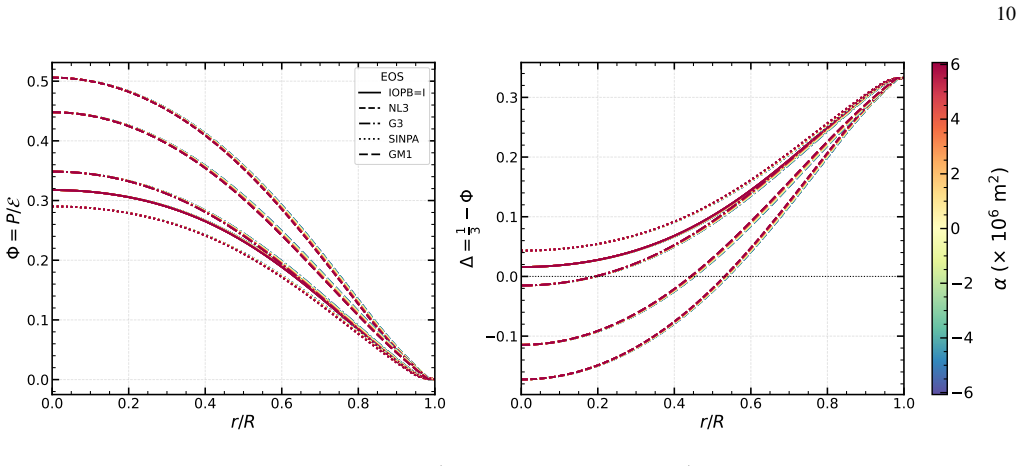
In all accepted EMSG integrations, the radial profile of∆increases monotonically outward and remains EOS structured, numerically mirroring the outward- increasing GR trend of Caiet al.[56] without invoking their GR-only proof, but acquires anα-dependent split- ting that grows with compactness and is strongest for smaller tidal deformability and smaller no...
-
[2]
Curvature invariants collapse onto organized one- parameter bands when plotted against∆, extending the GR curvature–∆correspondence of Garibayet al.[54] and complementing the I–Love–curvature relations of Danariantoet al.[55] in a modified-gravity setting
-
[3]
EMSG corrections are largest for ultracompact config- urations, yet remain smooth and regular over the cou- pling interval of Eq. (39)
-
[4]
These findings show that nonlinear gravity deforms, but does not erase, the thermodynamic–geometric organization already established in GR
At fixed compactness, tidal deformability, and moment of inertia, theα-induced splitting of∆(r)remains mod- est for observationally accessible parameters, while the Ricci contraction shows the tightest organization among the four invariants. These findings show that nonlinear gravity deforms, but does not erase, the thermodynamic–geometric organization al...
-
[5]
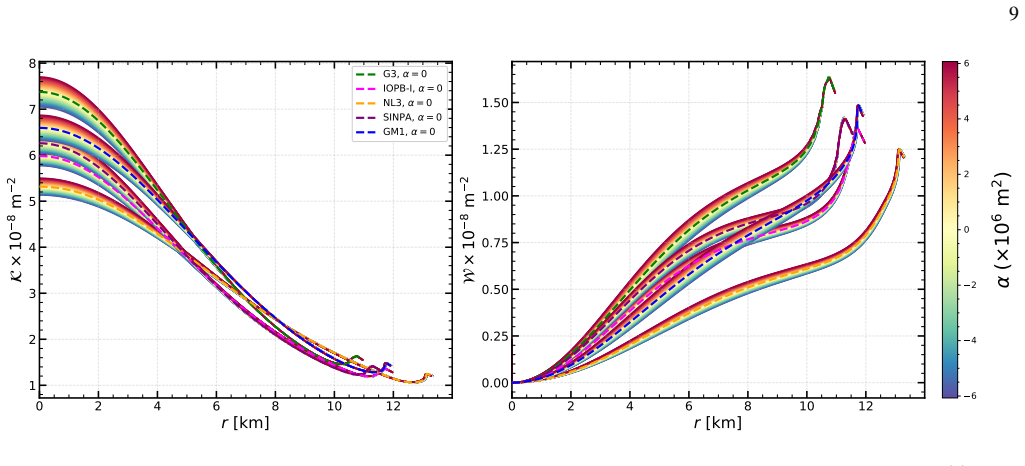
Kretschmann Scalar The Kretschmann scalarK(r)measures the total space- time curvature, including contributions from both the lo- cal effective matter source and the macroscopic gravitational field[54, 71, 99, 100]. In Eq. (21), the terms quadratic in (Eeff, Peff)encode local sourcing, whereas the pieces involv- ingm(r)describe the accumulated gravitationa...
-
[6]
Weyl Scalar The Weyl scalarW(r)measures the tidal component of the gravitational field and vanishes at the center for regular spheri- cal solutions[55, 101]. As a function of radius it grows toward the outer layers, where the enclosed mass distribution departs most strongly from the local energy density; as a function of baryon density it is subdominant i...
-
[7]
(23) and there- fore reflects the local balance betweenE eff andP eff[54, 102]
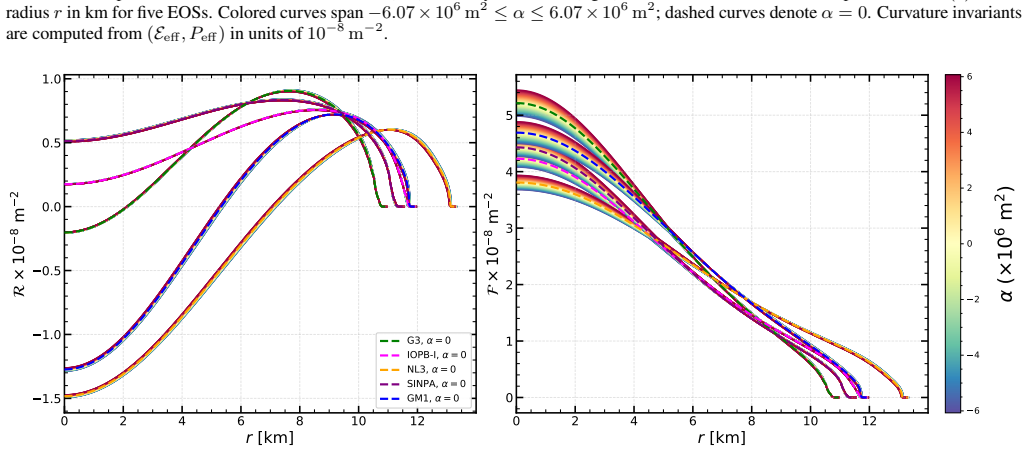
Ricci Scalar The Ricci scalarR(r)is tied directly to the trace of the ef- fective energy–momentum tensor through Eq. (23) and there- fore reflects the local balance betweenE eff andP eff[54, 102]. BecauseR ∝(E eff −3P eff), it is the most sensitive invariant to sign changes in the effective pressure–energy ratio and can become negative in stiff, compact c...
-
[8]
Ricci Contraction The Ricci contractionF(r)provides a positive-definite measure of matter-induced curvature that depends quadrat- ically on(E eff, Peff)without the cancellations present in R[54, 55]. In GR it corresponds to Garibayet al.’s[54] in- variantJ= p RµνRµν, and both Garibayet al.[54] and Danariantoet al.[55] report strong correlations between su...
-
[9]
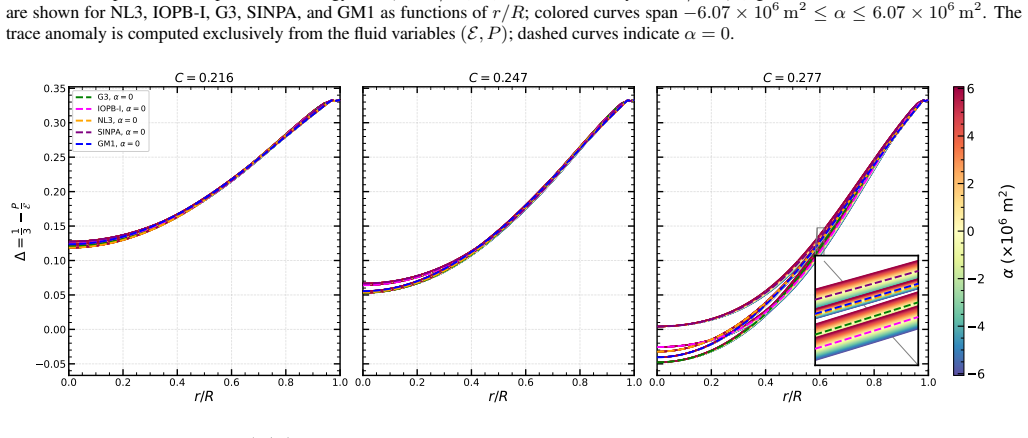
Fixed compactness We begin with sequences constructed at fixed compactness, following the procedure of Ren and Lin[53]. Figure 5 shows that, at the lowest compactness considered,C= 0.216, the ∆(r/R)profiles remain positive and exhibit only mild EOS scatter, closely resembling the GR quasi-universal surfaces (σ= 7.62×10 −3 for the(C, z, X)correlation in Re...
-
[10]
6 displays sequences withΛ = 160.8,265.2, and503.1, bracketing the GW170817 inference for a1.4M ⊙ star[28, 31, 32, 34]
Fixed tidal deformability Turning next to fixed tidal deformability, Fig. 6 displays sequences withΛ = 160.8,265.2, and503.1, bracketing the GW170817 inference for a1.4M ⊙ star[28, 31, 32, 34]. BecauseΛis dominated by the outer tidal layer[40, 44], Ren and Lin[53] found that fixingln Λnevertheless orga- nizes the full∆(r)profile to within about10%EOS scat...
-
[11]
7 shows sequences at fixed ¯I= 10,13, and 14.5
Fixed normalized moment of inertia Finally, Fig. 7 shows sequences at fixed ¯I= 10,13, and 14.5. Because ¯Iweights the entire interior mass profile and 10 0.0 0.2 0.4 0.6 0.8 1.0 r/R 0.0 0.1 0.2 0.3 0.4 0.5= P/ EOS IOPB=I NL3 G3 SINPA GM1 0.0 0.2 0.4 0.6 0.8 1.0 r/R 0.1 0.0 0.1 0.2 0.3 = 1 3 6 4 2 0 2 4 6 (× 106 m2) FIG. 4. Radial profiles of the pressure...
-
[12]
Equation-of-state set We employ five hadronic relativistic mean-field EOSs with- out explicit phase transitions, hyperonic degrees of freedom, or quark matter. TheR(∆)branch structure and the magni- tude of ultracompact profile splitting are therefore EOS de- pendent, and extending the study to hybrid or quark-hadron models[16, 123, 124] is a natural next step
-
[13]
Tidal deformability and normalized moment of inertia enter through the GR perturbation formalism of Sec
Perturbative approximations All models are static, spherically symmetric, and nonrotat- ing. Tidal deformability and normalized moment of inertia enter through the GR perturbation formalism of Sec. II F; the sequence targets(C,Λ, ¯I)are mapped to central conditions with GR reference integrations before the EMSG background profiles are evaluated. A fully s...
-
[14]
(39) is chosen to bracket prior EMSG neutron-star analyses[69, 71, 82]
Coupling parameter and observational bounds The coupling interval of Eq. (39) is chosen to bracket prior EMSG neutron-star analyses[69, 71, 82]. Cosmological and binary-pulsar constraints onαare typically far tighter than the profile splitting alone would require[68, 80, 89]. For sequences matched to GW170817 tidal deformabilities, the 14 0.0 0.2 0.4 0.6 ...
-
[15]
III E is assessed visually in Figs
Universality assessment TheI(∆)organization reported in Sec. III E is assessed visually in Figs. 8 and 9. A systematic scatter analysis across a larger EOS ensemble, along the lines of Garibayet al.[54] and Ren and Lin[53], remains for future work. Fu- ture studies could also combine NICER radii, gravitational- waveΛmeasurements, and pulsar timing constra...
-
[16]
N. K. Glendenning, Compact Stars (Springer, 1997)
1997
-
[17]
S. L. Shapiro and S. A. Teukolsky, Black holes, white dwarfs and neutron stars (Wiley, 1983)
1983
-
[18]
Chandrasekhar, apj140, 417 (1964)
S. Chandrasekhar, apj140, 417 (1964)
1964
-
[19]
Rezzolla, P
L. Rezzolla, P. Pizzochero, D. Jones, N. Rea, and I. Vida ˜na, The Physics and Astrophysics of Neutron Stars, Astrophysics and Space Science Library (Springer International Publishing, 2019)
2019
-
[20]
Baade and F
W. Baade and F. Zwicky, Phys. Rev.46, 76 (1934)
1934
-
[21]
Chanmugam, apj217, 799 (1977)
G. Chanmugam, apj217, 799 (1977)
1977
-
[22]
Rezzolla, in Recent Developments in General Relativity (Springer, Milano, 2002) pp
L. Rezzolla, in Recent Developments in General Relativity (Springer, Milano, 2002) pp. 235–248
2002
-
[23]
J. M. Lattimer and M. Prakash, From Nuclei to Stars , 275 (2011)
2011
-
[24]
Psaltis, Living Reviews in Relativity11, 9 (2008)
D. Psaltis, Living Reviews in Relativity11, 9 (2008)
2008
-
[25]
T. G. F. Li et al., J. Phys. Conf. Ser.363, 012028 (2012), arXiv:1111.5274 [gr-qc]
Pith/arXiv arXiv 2012
-
[26]
M. C. Miller et al., The Astrophysical Journal Letters887, L24 (2019)
2019
-
[27]
T. E. Riley et al., The Astrophysical Journal Letters918, L27 (2021)
2021
-
[28]
J. R. Oppenheimer and G. M. V olkoff, Phys. Rev.55, 374 (1939)
1939
-
[29]
R. M. Wald, General Relativity (Chicago Univ. Pr., Chicago, USA, 1984)
1984
-
[30]
The Con- densed matter physics of QCD,
K. Rajagopal and F. Wilczek, “The Con- densed matter physics of QCD,” in At the frontier of particle physics. Handbook of QCD. V ol. 1-3, edited by M. Shifman and B. Ioffe (2000) pp. 2061–2151, arXiv:hep-ph/0011333
Pith/arXiv arXiv 2000
-
[31]
M. G. Alford, A. Schmitt, K. Rajagopal, and T. Sch ¨afer, Rev. Mod. Phys.80, 1455 (2008)
2008
-
[32]
Akmal, V
A. Akmal, V . R. Pandharipande, and D. G. Ravenhall, Phys. Rev. C58, 1804 (1998)
1998
-
[33]
Kumar and P
B. Kumar and P. Landry, Phys. Rev. D99, 123026 (2019)
2019
-
[34]
Einstein, Sitzungsberichte der K ¨oniglich Preussischen Akademie der Wissenschaften , 831 (1915), provided by the SAO/NASA Astrophysics Data System
A. Einstein, Sitzungsberichte der K ¨oniglich Preussischen Akademie der Wissenschaften , 831 (1915), provided by the SAO/NASA Astrophysics Data System
1915
-
[35]
C. M. Will, Theory and Experiment in Gravitational Physics, 2nd ed. (Cambridge University Press, 2018)
2018
-
[36]
Clifton, P
T. Clifton, P. G. Ferreira, A. Padilla, and C. Skordis, Physics Reports513, 1–189 (2012)
2012
-
[37]
Kopeikin, Frontiers in Relativistic Celestial Mechanics, V ol
S. Kopeikin, Frontiers in Relativistic Celestial Mechanics, V ol. 2 (Walter de Gruyter, Berlin, Boston, 2014) provided by the SAO/NASA Astrophysics Data System
2014
-
[38]
M. C. Miller et al., The Astrophysical Journal Letters918, L28 (2021)
2021
-
[39]
M. K. Crombie et al., Nature Astronomy6, 505 (2022)
2022
-
[40]
Abbott, T
R. Abbott, T. D. Abbott, L. S. Collaboration, et al., The Astro- physical Journal Letters896, L44 (2020)
2020
-
[41]
T. E. Riley et al., The Astrophysical Journal Letters887, L21 (2019)
2019
-
[42]
B. P. Abbott, R. Abbott, and T. D. Abbott, The Astrophysical Journal Letters848, L12 (2017)
2017
-
[43]
B. P. Abbott, R. Abbott, and A. et al. (LIGO Scientific Collab- oration and Virgo Collaboration), Phys. Rev. Lett.119, 161101 (2017)
2017
-
[44]
D. A. Coulter et al., Science358, 1556 (2017), https://www.science.org/doi/pdf/10.1126/science.aap9811
-
[45]
B. P. Abbott, The Astrophysical Journal Letters892, L3 (2020)
2020
-
[46]
S. De, D. Finstad, J. M. Lattimer, D. A. Brown, E. Berger, and C. M. Biwer, Phys. Rev. Lett.121, 091102 (2018)
2018
-
[47]
B. P. Abbott (LIGO Scientific Collaboration and Virgo Col- laboration), Phys. Rev. X9, 011001 (2019)
2019
-
[48]
Fragione, The Astrophysical Journal Letters923, L2 (2021)
G. Fragione, The Astrophysical Journal Letters923, L2 (2021)
2021
-
[49]
Annala, T
E. Annala, T. Gorda, A. Kurkela, J. N ¨attil¨a, and A. Vuorinen, 16 Nature Physics16, 907–910 (2020)
2020
-
[50]
Jiang, S.-P
J.-L. Jiang, S.-P. Tang, Y .-Z. Wang, et al., The Astrophysical Journal892, 55 (2020)
2020
-
[51]
Ishii, M
T. Ishii, M. J ¨arvinen, and G. Nijs, Journal of High Energy Physics2019, 3 (2019)
2019
-
[52]
J ¨arvinen and E
M. J ¨arvinen and E. Kiritsis, Journal of High Energy Physics 2012, 2 (2012)
2012
-
[53]
X.-T. He, F. J. Fattoyev, B.-A. Li, and W. G. Newton, Phys. Rev. C91, 015810 (2015)
2015
-
[54]
Kramer et al., Phys
M. Kramer et al., Phys. Rev. X11, 041050 (2021)
2021
-
[55]
Yagi and N
K. Yagi and N. Yunes, Phys. Rev. D88, 023009 (2013)
2013
-
[56]
Yagi and N
K. Yagi and N. Yunes, Phys. Rev. D91, 123008 (2015)
2015
-
[57]
Haskell, International Journal of Modern Physics E24, 1541007 (2015)
B. Haskell, International Journal of Modern Physics E24, 1541007 (2015)
2015
-
[58]
Gupta, B
T. Gupta, B. Majumder, K. Yagi,et al., Classical and Quantum Gravity35, 025009 (2017)
2017
-
[59]
K. Yagi and N. Yunes, Science341, 365 (2013), arXiv:1302.4499 [gr-qc]
Pith/arXiv arXiv 2013
-
[60]
Capozziello and M
S. Capozziello and M. De Laurentis, Physics Reports509, 167 (2011)
2011
-
[61]
G. J. OLMO, International Journal of Modern Physics D20, 413 (2011), https://doi.org/10.1142/S0218271811018925
-
[62]
G. J. Olmo, D. Rubiera-Garcia, and A. Wojnar, Physics Re- ports876, 1 (2020), stellar structure models in modified theo- ries of gravity: Lessons and challenges
2020
-
[63]
The dark side of gravity: Modified theories of gravity,
F. S. N. Lobo, “The dark side of gravity: Modified theories of gravity,” (2008), arXiv:0807.1640 [gr-qc]
Pith/arXiv arXiv 2008
-
[64]
T. P. Sotiriou and V . Faraoni, Rev. Mod. Phys.82, 451 (2010)
2010
-
[65]
S. CAPOZZIELLO, International Jour- nal of Modern Physics D11, 483 (2002), https://doi.org/10.1142/S0218271802002025
-
[66]
Haskell, R
B. Haskell, R. Ciolfi, F. Pannarale, et al., Monthly Notices of the Royal Astronomical Society: Letters438, L71 (2013)
2013
-
[67]
Haskell, K
B. Haskell, K. Glampedakis, and N. Andersson, Mon. Not. R. Astron. Soc.441, 1662 (2014)
2014
-
[68]
Tracing the trace anomaly of dense matter inside neutron stars,
S. Ren and L.-M. Lin, “Tracing the trace anomaly of dense matter inside neutron stars,” (2026), arXiv:2511.18681 [astro- ph.HE]
Pith/arXiv arXiv 2026
-
[69]
Garibay, C
I. Garibay, C. Ecker, and L. Rezzolla, Phys. Rev. D113, 083028 (2026)
2026
-
[70]
i-love-curvature: Exploring compact stars’ quasi-universal relation with curvature scalars,
M. D. Danarianto, A. Sulaksono, A. Prasetyo, and R. Maulana, “i-love-curvature: Exploring compact stars’ quasi-universal relation with curvature scalars,” (2025), arXiv:2510.04260 [gr-qc]
arXiv 2025
-
[71]
B.-J. Cai, B.-A. Li, and Y .-G. Ma, Physical Review D113 (2026), 10.1103/nbmw-k5fs
-
[72]
Unraveling trace anomaly of supradense matter via neutron star compactness scaling,
B.-J. Cai, B.-A. Li, and Y .-G. Ma, “Unraveling trace anomaly of supradense matter via neutron star compactness scaling,” (2024), arXiv:2406.05025 [astro-ph.HE]
arXiv 2024
-
[73]
Fujimoto, K
Y . Fujimoto, K. Fukushima, L. D. McLerran, and M. Praszałowicz, Phys. Rev. Lett.129, 252702 (2022)
2022
-
[74]
Nojiri and S
S. Nojiri and S. D. Odintsov, Physics Reports505, 59 (2011)
2011
-
[75]
S. NOJIRI and S. D. ODINTSOV , International Journal of Geometric Methods in Modern Physics04, 115 (2007), https://doi.org/10.1142/S0219887807001928
-
[77]
Harko, F
T. Harko, F. S. N. Lobo, S. Nojiri, and S. D. Odintsov, Phys. Rev. D84, 024020 (2011)
2011
-
[78]
Chirenti, G
C. Chirenti, G. H. de Souza, and W. Kastaun, Phys. Rev. D 91, 044034 (2015)
2015
-
[79]
Roshan and F
M. Roshan and F. Shojai, Phys. Rev. D94, 044002 (2016)
2016
-
[81]
Nari and M
N. Nari and M. Roshan, Phys. Rev. D98, 024031 (2018)
2018
-
[82]
Akarsu, J
O. Akarsu, J. D. Barrow, and N. M. Uzun, Phys. Rev. D102, 124059 (2020)
2020
discussion (0)
Sign in with ORCID, Apple, or X to comment. Anyone can read and Pith papers without signing in.