Mitigating Trotter Errors via Post-Processed Symmetry Restoration
Pith reviewed 2026-06-26 16:52 UTC · model grok-4.3
The pith
Symmetry transformations applied before or between Trotter steps, followed by classical averaging of outcomes, project out symmetry-violating error components while leaving ideal dynamics unchanged.
A machine-rendered reading of the paper's core claim, the machinery that carries it, and where it could break.
Core claim
By applying symmetry transformations to the initial state or interleaving them between discrete Trotter layers, and then averaging an ensemble of the resulting measurement outcomes via classical post-processing, the method systematically projects out the symmetry-violating components of the Trotter error while leaving the ideal dynamics unchanged.
What carries the argument
Symmetry-based Trotter error mitigation protocol that uses classical post-processing of an ensemble of symmetry-transformed runs to project out error components.
If this is right
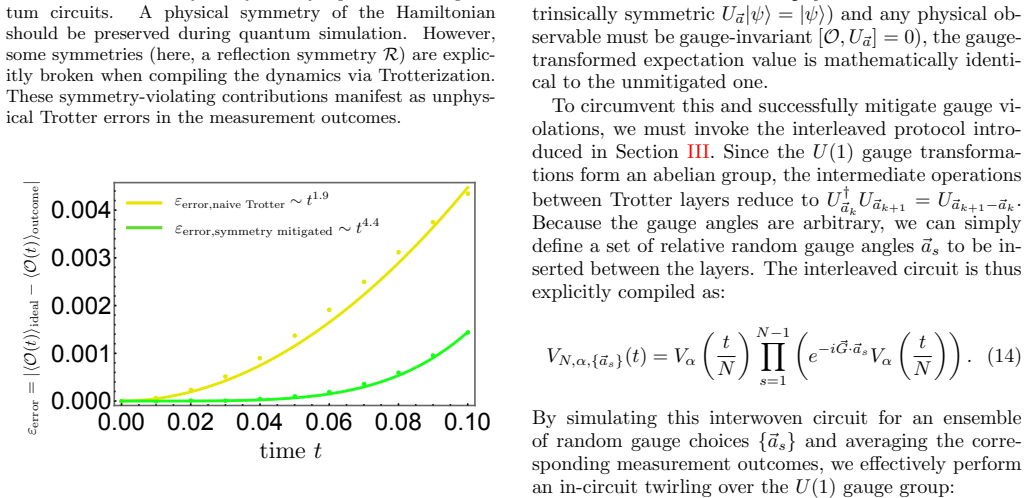
- Enforcing reflection symmetry suppresses the leading-order Trotter error in the one-dimensional XY model.
- Interleaving gauge transformations between Trotter layers enables gauge-twirling that reduces unphysical violations of local Gauss's law in the one-dimensional Schwinger model.
- The protocol works for non-local spatial symmetries and anti-unitary operations such as time reversal without requiring their direct implementation on hardware.
- The approach improves simulation fidelity while preserving circuit depth on near-term devices.
Where Pith is reading between the lines
- The same post-processing idea could be tested on two-dimensional lattice models where spatial symmetries are more intricate.
- Combining this averaging with existing variational or zero-noise extrapolation methods might yield multiplicative error reductions.
- The method's effectiveness for anti-unitary symmetries suggests it could help simulate systems with time-reversal invariance that are otherwise hard to protect on hardware.
- If the number of symmetry copies is increased, the residual error after averaging should scale as the inverse of the ensemble size for the symmetry-violating part.
Load-bearing premise
Classical averaging over symmetry-transformed runs isolates and removes only the symmetry-violating Trotter error components without distorting the ideal symmetric dynamics, including for non-local and anti-unitary symmetries.
What would settle it
Run the protocol on a symmetric Hamiltonian and observe whether the measured symmetry violation or deviation from exact dynamics fails to decrease relative to plain Trotterization.
Figures



read the original abstract
Quantum simulation is a powerful tool for exploring complex quantum many-body systems such as condensed matter physics and gauge theories. Trotterization, which approximates the ideal time evolution operator by decomposing it into a sequence of local gate operations, is one of the most widely used quantum simulation algorithms. However, such Trotterized implementations generally fail to preserve the symmetries of the target Hamiltonian during compilation. As a result, they can drive quantum states out of symmetrically allowed subspaces, leading to unphysical dynamics and symmetry-violating algorithmic errors. In this work, we propose a symmetry-based Trotter error mitigation protocol using classical post-processing. By applying symmetry transformations to the initial state or interleaving them between discrete Trotter layers, and then averaging an ensemble of the resulting measurement outcomes via classical post-processing, our method systematically projects out the symmetry-violating components of the Trotter error while leaving the ideal dynamics unchanged. Importantly, this framework naturally accommodates non-local spatial symmetries and anti-unitary operations such as time reversal, which are difficult or impossible to implement directly with hardware-native quantum gates. We benchmark our protocol on the one-dimensional XY model and the one-dimensional Schwinger model. In the XY model, enforcing reflection symmetry suppresses the leading-order Trotter error, whereas in the Schwinger model, interleaving gauge transformations between Trotter layers enables gauge-twirling effectively to reduce unphysical violations of local Gauss's law. These results demonstrate that symmetry-based post-processing provides a depth-preserving route to substantially improving the fidelity of Trotterized quantum simulations on near-term devices.
Editorial analysis
A structured set of objections, weighed in public.
Referee Report
Summary. The manuscript proposes a symmetry-based Trotter error mitigation protocol using classical post-processing. By applying symmetry transformations to the initial state or interleaving them between Trotter layers and averaging the resulting measurement outcomes, the method is claimed to project out symmetry-violating components of the Trotter error while leaving the ideal dynamics unchanged. The framework is asserted to naturally accommodate non-local spatial symmetries and anti-unitary operations such as time reversal. Benchmarks are presented on the one-dimensional XY model (enforcing reflection symmetry to suppress leading-order Trotter error) and the one-dimensional Schwinger model (interleaving gauge transformations to reduce violations of local Gauss's law).
Significance. If the protocol and its extension to anti-unitary symmetries hold, it would supply a depth-preserving classical post-processing route to improving the fidelity of Trotterized simulations on near-term devices, particularly for systems where non-local or anti-unitary symmetries are important but hardware implementation is difficult.
major comments (1)
- [Abstract] Abstract: the central claim that the post-processing 'naturally accommodates' anti-unitary operations such as time reversal rests on an unshown generalization of group twirling to antilinear corepresentations. No derivation is supplied showing that classical averaging isolates only the symmetry-violating Trotter-error components without introducing phase or conjugation artifacts into the ideal expectation value. The cited benchmarks (XY reflection symmetry, Schwinger gauge transformations) both involve unitary symmetries and therefore supply no empirical check for the anti-unitary case. This assumption is load-bearing for the abstract's assertion that the framework handles anti-unitary symmetries.
Simulated Author's Rebuttal
We thank the referee for their careful reading of the manuscript and for highlighting this important point regarding the anti-unitary case. We address the comment below.
read point-by-point responses
-
Referee: [Abstract] Abstract: the central claim that the post-processing 'naturally accommodates' anti-unitary operations such as time reversal rests on an unshown generalization of group twirling to antilinear corepresentations. No derivation is supplied showing that classical averaging isolates only the symmetry-violating Trotter-error components without introducing phase or conjugation artifacts into the ideal expectation value. The cited benchmarks (XY reflection symmetry, Schwinger gauge transformations) both involve unitary symmetries and therefore supply no empirical check for the anti-unitary case. This assumption is load-bearing for the abstract's assertion that the framework handles anti-unitary symmetries.
Authors: We agree that an explicit derivation of the extension to antilinear corepresentations is not provided in the current manuscript and that the numerical examples use only unitary symmetries. In the revised version we will add a dedicated appendix deriving the action of classical averaging over anti-unitary symmetries (including time reversal) on both the ideal evolution and the Trotter-error terms. The derivation will show that the averaging isolates symmetry-violating error components while leaving the ideal expectation values unchanged, without phase or conjugation artifacts. We will also update the abstract to indicate that the anti-unitary extension is supported by this derivation rather than asserted without proof. revision: yes
Circularity Check
No circularity: method is a proposed post-processing protocol justified by standard twirling for unitary cases and explicit benchmarks
full rationale
The paper proposes a classical post-processing protocol that applies symmetry transformations and averages outcomes to suppress symmetry-violating Trotter errors. For unitary symmetries this reduces to standard group twirling (projector onto invariants), which is externally known and not derived from the paper's own inputs. The extension to anti-unitary symmetries is stated but the central claim is supported by concrete benchmarks on the XY and Schwinger models rather than self-referential fitting, self-citation chains, or redefinition. No load-bearing step reduces by construction to a fitted parameter or prior self-citation; the derivation chain is therefore self-contained against external benchmarks.
Axiom & Free-Parameter Ledger
Reference graph
Works this paper leans on
-
[1]
Eugene Paul Wigner,Group Theory and Its Application to the Quantum Mechanics of Atomic Spectra(Academic Press, New York, 1959)
1959
-
[2]
A short re- view on noether’s theorems, gauge symme- tries and boundary terms,
Max Ba˜ nados and Ignacio Reyes, “A short re- view on noether’s theorems, gauge symme- tries and boundary terms,” International Jour- nal of Modern Physics D25, 1630021 (2016), https://doi.org/10.1142/S0218271816300214
-
[4]
PT-symmetric quantum mechanics,
Carl M. Bender and Daniel W. Hook, “PT-symmetric quantum mechanics,” Rev. Mod. Phys.96, 045002 (2024)
2024
-
[5]
Symmetry properties of the normal vibrations of a crystal,
A. A. MARADUDIN and S. H. VOSKO, “Symmetry properties of the normal vibrations of a crystal,” Rev. Mod. Phys.40, 1–37 (1968)
1968
-
[6]
Goals and opportuni- ties in quantum simulation,
J. Ignacio Cirac and Peter Zoller, “Goals and opportuni- ties in quantum simulation,” Nature Physics8, 264–266 (2012)
2012
-
[7]
Lloyd, Science273, 1073 (1996), https://www.science.org/doi/pdf/10.1126/science.273.5278.1073
Seth Lloyd, “Universal quantum simu- lators,” Science273, 1073–1078 (1996), https://www.science.org/doi/pdf/10.1126/science.273.5278.1073
-
[8]
Programmable quantum simulations of spin sys- tems with trapped ions,
C. Monroe, W. C. Campbell, L.-M. Duan, Z.-X. Gong, A. V. Gorshkov, P. W. Hess, R. Islam, K. Kim, N. M. Linke, G. Pagano, P. Richerme, C. Senko, and N. Y. Yao, “Programmable quantum simulations of spin sys- tems with trapped ions,” Rev. Mod. Phys.93, 025001 (2021)
2021
-
[9]
Large-scale 2 + 1d u(1) gauge theory with dynamical matter in a cold-atom quan- tum simulator,
Jesse J. Osborne, Ian P. McCulloch, Bing Yang, Philipp Hauke, and Jad C. Halimeh, “Large-scale 2 + 1d u(1) gauge theory with dynamical matter in a cold-atom quan- tum simulator,” Communications Physics8, 273 (2025)
2025
-
[10]
U(1) wilson lattice gauge theories in digital quantum simulators,
Christine Muschik, Markus Heyl, Esteban Martinez, Thomas Monz, Philipp Schindler, Berit Vogell, Mar- cello Dalmonte, Philipp Hauke, Rainer Blatt, and Pe- ter Zoller, “U(1) wilson lattice gauge theories in digital quantum simulators,” New Journal of Physics19, 103020 (2017)
2017
-
[11]
Quantum algorithms for quantum chem- istry and quantum materials science,
Bela Bauer, Sergey Bravyi, Mario Motta, and Garnet Kin-Lic Chan, “Quantum algorithms for quantum chem- istry and quantum materials science,” Chemical Reviews 120, 12685–12717 (2020)
2020
-
[12]
Simu- lating chemistry using quantum computers,
Ivan Kassal, James D. Whitfield, Alejandro Perdomo- Ortiz, Man-Hong Yung, and Al´ an Aspuru-Guzik, “Simu- lating chemistry using quantum computers,” Annual Re- view of Physical Chemistry62, 185–207 (2011)
2011
-
[13]
Progress in trapped-ion quan- tum simulation,
Michael Foss-Feig, Guido Pagano, Andrew C. Potter, and Norman Y. Yao, “Progress in trapped-ion quan- tum simulation,” Annual Review of Condensed Matter Physics16, 145–172 (2025)
2025
-
[14]
Onset of a quantum phase transition with a trapped ion quan- tum simulator,
R. Islam, E. E. Edwards, K. Kim, S. Korenblit, C. Noh, H. Carmichael, G. D. Lin, L. M. Duan, C. C. Joseph Wang, J. K. Freericks, and C. Monroe, “Onset of a quantum phase transition with a trapped ion quan- tum simulator,” Nature Communications2, 377 (2011)
2011
-
[15]
Simu- lating chern insulators on a superconducting quantum processor,
Zhong-Cheng Xiang, Kaixuan Huang, Yu-Ran Zhang, Tao Liu, Yun-Hao Shi, Cheng-Lin Deng, Tong Liu, Hao Li, Gui-Han Liang, Zheng-Yang Mei, Haifeng Yu, Guang- ming Xue, Ye Tian, Xiaohui Song, Zhi-Bo Liu, Kai Xu, Dongning Zheng, Franco Nori, and Heng Fan, “Simu- lating chern insulators on a superconducting quantum processor,” Nature Communications14, 5433 (2023)
2023
-
[16]
Observation of topo- 10 logical uhlmann phases with superconducting qubits,
O. Viyuela, A. Rivas, S. Gasparinetti, A. Wallraff, S. Fil- ipp, and M. A. Martin-Delgado, “Observation of topo- 10 logical uhlmann phases with superconducting qubits,” npj Quantum Information4, 10 (2018)
2018
-
[17]
General theory of fractal path inte- grals with applications to many-body theories and sta- tistical physics,
Masuo Suzuki, “General theory of fractal path inte- grals with applications to many-body theories and sta- tistical physics,” Journal of Mathematical Physics32, 400–407 (1991), https://pubs.aip.org/aip/jmp/article- pdf/32/2/400/19166143/400 1 online.pdf
1991
-
[18]
Finding expo- nential product formulas of higher orders,
Naomichi Hatano and Masuo Suzuki, “Finding expo- nential product formulas of higher orders,” inQuantum Annealing and Other Optimization Methods, edited by Arnab Das and Bikas K. Chakrabarti (Springer Berlin Heidelberg, Berlin, Heidelberg, 2005) pp. 37–68
2005
-
[19]
Universal digital quan- tum simulation with trapped ions,
B. P. Lanyon, C. Hempel, D. Nigg, M. M¨ uller, R. Ger- ritsma, F. Z¨ ahringer, P. Schindler, J. T. Barreiro, M. Rambach, G. Kirchmair, M. Hennrich, P. Zoller, R. Blatt, and C. F. Roos, “Universal digital quan- tum simulation with trapped ions,” Science334, 57–61 (2011)
2011
-
[20]
Evidence for the util- ity of quantum computing before fault tolerance,
Youngseok Kim, Andrew Eddins, Sajant Anand, Ken Xuan Wei, Ewout van den Berg, Sami Rosenblatt, Hasan Nayfeh, Yantao Wu, Michael Zaletel, Kristan Temme, and Abhinav Kandala, “Evidence for the util- ity of quantum computing before fault tolerance,” Nature 618, 500–505 (2023)
2023
-
[21]
First-order trotter error from a second- order perspective,
David Layden, “First-order trotter error from a second- order perspective,” Phys. Rev. Lett.128, 210501 (2022)
2022
-
[22]
Fourth-order sym- plectic integration,
Etienne Forest and Ronald D. Ruth, “Fourth-order sym- plectic integration,” Physica D: Nonlinear Phenomena 43, 105–117 (1990)
1990
-
[23]
A canonical integration technique,
Ronald D. Ruth, “A canonical integration technique,” IEEE Transactions on Nuclear Science30, 2669–2671 (1983)
1983
-
[24]
Randomizing multi- product formulas for Hamiltonian simulation,
Paul K. Faehrmann, Mark Steudtner, Richard Kueng, Maria Kieferova, and Jens Eisert, “Randomizing multi- product formulas for Hamiltonian simulation,” Quantum 6, 806 (2022)
2022
-
[25]
Concentration for random product for- mulas,
Chi-Fang Chen, Hsin-Yuan Huang, Richard Kueng, and Joel A. Tropp, “Concentration for random product for- mulas,” PRX Quantum2, 040305 (2021)
2021
-
[26]
Explicit symplectic integrators for solving non-separable hamiltonians,
Siu A. Chin, “Explicit symplectic integrators for solving non-separable hamiltonians,” (2009), arXiv:physics/0608043 [physics.comp-ph]
Pith/arXiv arXiv 2009
-
[27]
Suguru Endo, Zhenyu Cai, Simon C. Benjamin, and Xiao Yuan, “Hybrid quantum-classical algo- rithms and quantum error mitigation,” Journal of the Physical Society of Japan90, 032001 (2021), https://doi.org/10.7566/JPSJ.90.032001
-
[28]
Trotter error mitigation by error profiling with shallow quantum circuit,
Sangjin Lee, Youngseok Kim, and Seung-Woo Lee, “Trotter error mitigation by error profiling with shallow quantum circuit,” (2025), arXiv:2503.09710 [quant-ph]
arXiv 2025
-
[29]
Dual channel multi-product formulas,
Seung Park, Sangjin Lee, and Kyunghyun Baek, “Dual channel multi-product formulas,” (2026), arXiv:2602.01713 [quant-ph]
arXiv 2026
-
[30]
Trot- ter error bounds and dynamic multi-product formulas for hamiltonian simulation,
Sergiy Zhuk, Niall Robertson, and Sergey Bravyi, “Trot- ter error bounds and dynamic multi-product formulas for hamiltonian simulation,” (2024), arXiv:2306.12569 [quant-ph]
arXiv 2024
-
[31]
Well-conditioned multiproduct hamiltonian sim- ulation,
Guang Hao Low, Vadym Kliuchnikov, and Nathan Wiebe, “Well-conditioned multiproduct hamiltonian sim- ulation,” (2019), arXiv:1907.11679 [quant-ph]
arXiv 2019
-
[32]
Well-conditioned multi- product formulas for hardware-friendly Hamiltonian sim- ulation,
Almudena Carrera Vazquez, Daniel J. Egger, David Ochsner, and Stefan Woerner, “Well-conditioned multi- product formulas for hardware-friendly Hamiltonian sim- ulation,” Quantum7, 1067 (2023)
2023
-
[33]
Error mitigation for short-depth quantum cir- cuits,
Kristan Temme, Sergey Bravyi, and Jay M. Gam- betta, “Error mitigation for short-depth quantum cir- cuits,” Phys. Rev. Lett.119, 180509 (2017)
2017
-
[34]
Probabilistic error cancella- tion with sparse pauli–lindblad models on noisy quantum processors,
Ewout van den Berg, Zlatko K. Minev, Abhinav Kan- dala, and Kristan Temme, “Probabilistic error cancella- tion with sparse pauli–lindblad models on noisy quantum processors,” Nature Physics19, 1116–1121 (2023)
2023
-
[35]
Quantum error mitigation,
Zhenyu Cai, Ryan Babbush, Simon C. Benjamin, Suguru Endo, William J. Huggins, Ying Li, Jarrod R. McClean, and Thomas E. O’Brien, “Quantum error mitigation,” Rev. Mod. Phys.95, 045005 (2023)
2023
-
[36]
Efficient variational quantum simulator incorporating active error minimiza- tion,
Ying Li and Simon C. Benjamin, “Efficient variational quantum simulator incorporating active error minimiza- tion,” Phys. Rev. X7, 021050 (2017)
2017
-
[37]
Scalable error mitigation for noisy quantum circuits produces competitive expectation values,
Youngseok Kim, Christopher J. Wood, Theodore J. Yo- der, Seth T. Merkel, Jay M. Gambetta, Kristan Temme, and Abhinav Kandala, “Scalable error mitigation for noisy quantum circuits produces competitive expectation values,” Nature Physics19, 752–759 (2023)
2023
-
[38]
An introduction to lattice gauge theory and spin systems,
John B. Kogut, “An introduction to lattice gauge theory and spin systems,” Rev. Mod. Phys.51, 659–713 (1979)
1979
-
[39]
Classification of topological quantum matter with symmetries,
Ching-Kai Chiu, Jeffrey C. Y. Teo, Andreas P. Schnyder, and Shinsei Ryu, “Classification of topological quantum matter with symmetries,” Rev. Mod. Phys.88, 035005 (2016)
2016
-
[40]
Colloquium: Zoo of quantum- topological phases of matter,
Xiao-Gang Wen, “Colloquium: Zoo of quantum- topological phases of matter,” Rev. Mod. Phys.89, 041004 (2017)
2017
-
[41]
Faster digital quantum simulation by symmetry protection,
Minh C. Tran, Yuan Su, Daniel Carney, and Jacob M. Taylor, “Faster digital quantum simulation by symmetry protection,” PRX Quantum2, 010323 (2021)
2021
-
[42]
Quan- tum simulation with gauge fixing: From ising lattice gauge theory to dynamical flux model,
Junsen Wang, Xiangxiang Sun, and Wei Zheng, “Quan- tum simulation with gauge fixing: From ising lattice gauge theory to dynamical flux model,” Phys. Rev. Res. 7, 013311 (2025)
2025
-
[43]
Oracles for gauss’s law on digital quan- tum computers,
Jesse R. Stryker, “Oracles for gauss’s law on digital quan- tum computers,” Phys. Rev. A99, 042301 (2019)
2019
-
[44]
Reliability of lattice gauge theories,
Jad C. Halimeh and Philipp Hauke, “Reliability of lattice gauge theories,” Phys. Rev. Lett.125, 030503 (2020)
2020
-
[45]
Stabilizing quan- tum simulations of lattice gauge theories by dissipation,
Tobias Schmale and Hendrik Weimer, “Stabilizing quan- tum simulations of lattice gauge theories by dissipation,” Phys. Rev. Res.6, 033306 (2024)
2024
-
[46]
Gauge-symmetry protection using single-body terms,
Jad C. Halimeh, Haifeng Lang, Julius Mildenberger, Zhang Jiang, and Philipp Hauke, “Gauge-symmetry protection using single-body terms,” PRX Quantum2, 040311 (2021)
2021
-
[47]
Shearing approach to gauge-invariant trotterization,
Jesse R. Stryker, “Shearing approach to gauge-invariant trotterization,” Phys. Rev. D112, 014508 (2025)
2025
-
[48]
Symmetry verification for noisy quantum simulations of non-Abelian lattice gauge theories,
Edoardo Ballini, Julius Mildenberger, Matteo M. Wauters, and Philipp Hauke, “Symmetry verification for noisy quantum simulations of non-Abelian lattice gauge theories,” Quantum9, 1802 (2025)
2025
-
[49]
Low-cost error mitigation by symmetry verifi- cation,
X. Bonet-Monroig, R. Sagastizabal, M. Singh, and T. E. O’Brien, “Low-cost error mitigation by symmetry verifi- cation,” Phys. Rev. A98, 062339 (2018)
2018
-
[50]
Automated detection of symmetry-protected subspaces in quantum simulations,
Caleb Rotello, Eric B. Jones, Peter Graf, and Eliot Kapit, “Automated detection of symmetry-protected subspaces in quantum simulations,” Phys. Rev. Res.5, 033082 (2023)
2023
-
[51]
Hamiltonian simu- lation using linear combinations of unitary operations,
Nathan Wiebe Andrew M. Childs, “Hamiltonian simu- lation using linear combinations of unitary operations,” Quantum Information and Computation12, 0901–0924 (2012). 11
2012
-
[52]
Simulating hamiltonian dynamics with a truncated taylor series,
Dominic W. Berry, Andrew M. Childs, Richard Cleve, Robin Kothari, and Rolando D. Somma, “Simulating hamiltonian dynamics with a truncated taylor series,” Phys. Rev. Lett.114, 090502 (2015)
2015
-
[53]
Optimal hamil- tonian simulation by quantum signal processing,
Guang Hao Low and Isaac L. Chuang, “Optimal hamil- tonian simulation by quantum signal processing,” Phys. Rev. Lett.118, 010501 (2017)
2017
-
[54]
Quantum algorithm for linear dif- ferential equations with exponentially improved depen- dence on precision,
Dominic W. Berry, Andrew M. Childs, Aaron Ostrander, and Guoming Wang, “Quantum algorithm for linear dif- ferential equations with exponentially improved depen- dence on precision,” Communications in Mathematical Physics356, 1057–1081 (2017)
2017
-
[55]
Exponential algorithmic speedup by a quantum walk,
Andrew M. Childs, Richard Cleve, Enrico Deotto, Ed- ward Farhi, Sam Gutmann, and Daniel A. Spielman, “Exponential algorithmic speedup by a quantum walk,” inProceedings of the Thirty-Fifth Annual ACM Sympo- sium on Theory of Computing, STOC ’03 (Association for Computing Machinery, New York, NY, USA, 2003) pp. 59–68
2003
-
[56]
On the relationship between continuous- and discrete-time quantum walk,
Andrew M. Childs, “On the relationship between continuous- and discrete-time quantum walk,” Commu- nications in Mathematical Physics294, 581–603 (2010)
2010
-
[57]
Hamiltonian Sim- ulation by Qubitization,
Guang Hao Low and Isaac L. Chuang, “Hamiltonian Sim- ulation by Qubitization,” Quantum3, 163 (2019)
2019
-
[58]
Black-box hamiltonian simulation and unitary implementation,
Andrew M. Childs Dominic W. Berry, “Black-box hamiltonian simulation and unitary implementation,” Quantum Information and Computation12, 0029–0062 (2012)
2012
-
[59]
Random compiler for fast hamiltonian simulation,
Earl Campbell, “Random compiler for fast hamiltonian simulation,” Phys. Rev. Lett.123, 070503 (2019)
2019
-
[60]
High-order randomized compiler for hamiltonian simulation,
Kouhei Nakaji, Mohsen Bagherimehrab, and Al´ an Aspuru-Guzik, “High-order randomized compiler for hamiltonian simulation,” PRX Quantum5, 020330 (2024)
2024
-
[61]
qshift: An adaptive sampling protocol for higher-order quantum simulation,
Sangjin Lee and Sangkook Choi, “qshift: An adaptive sampling protocol for higher-order quantum simulation,” (2026), arXiv:2604.26263 [quant-ph]. Appendix A: Algebraic formulation of the 1D Schwinger model The 1D Schwinger model describes quantum electrodynamics (QED) in one spatial dimension. To simulate this continuum theory on a digital quantum computer...
Pith/arXiv arXiv 2026
-
[62]
Even sites represent positrons (where an empty site corresponds to a positron), and odd sites represent electrons
Kogut-Susskind Lattice Formulation In the staggered formulation, the continuous Dirac spinor is split across alternating lattice sites to avoid the fermion doubling problem. Even sites represent positrons (where an empty site corresponds to a positron), and odd sites represent electrons. We denote the fermionic annihilation and creation operators at sitei...
-
[63]
For quantum simulation, we truncate this infinite-dimensional space into a finite spin-Ssystem (Quantum Link Model)
Quantum Link Model and Qubit Encoding In standardU(1) lattice gauge theory,E i+ 1 2 possesses an infinite discrete spectrum,e∈Z. For quantum simulation, we truncate this infinite-dimensional space into a finite spin-Ssystem (Quantum Link Model). Taking the extreme limit ofS= 1/2, we encode the gauge degrees of freedom into qubits (denoted by Pauli matrice...
-
[64]
Jordan-Wigner Transformation To map the fermionic matter fields to qubit degrees of freedom (denoted by Pauli matricesS), we apply the Jordan-Wigner (JW) transformation. The fermionic operators are expressed as ψi = 1 2 Y j<i Sz j (Sx i −iS y i )≡ Y j<i Sz j σ− i .(A8) Using this transformation, the mass term trivially maps to theZ-basis ψ† ...
-
[65]
For instance, consider theXXZspin model, which is invariant under globalZ-axis rotations
Examples: Single-Qubit and Two-Qubit Errors Unlike standard randomized compiling, which requires inserting deep sequences of random gates, our approach achieves error simplification natively by exploiting the inherent symmetries of the target system. For instance, consider theXXZspin model, which is invariant under globalZ-axis rotations. Simulating the d...
discussion (0)
Sign in with ORCID, Apple, or X to comment. Anyone can read and Pith papers without signing in.