REVIEW 4 major objections 5 minor 61 references
Boundary Embedding Shaping with Adaptive Contrastive Learning for Graph Structural Disentanglement
T0 review · 4 major / 5 minor · reviewed 2026-08-02 · deepseek-v4-flash
Pith's one-line read The paper claims boundary-focused contrastive learning provably disentangles invariant class structure from spurious neighbor correlations, and the plug-in lifts node classification by ~3.3% on average (5.0% on WikiCS).
desk verdict Solid empirical recipe for boundary-focused graph contrastive learning; the attached identifiability theory doesn't cover the loss the method actually trains. read the letter →
The pith
A machine-rendered reading of the paper's core claim, the machinery that carries it, and where it could break.
The reading
What carries the argument
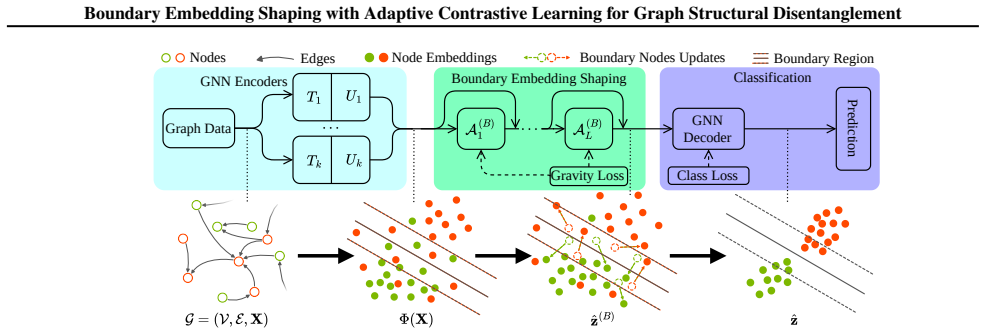
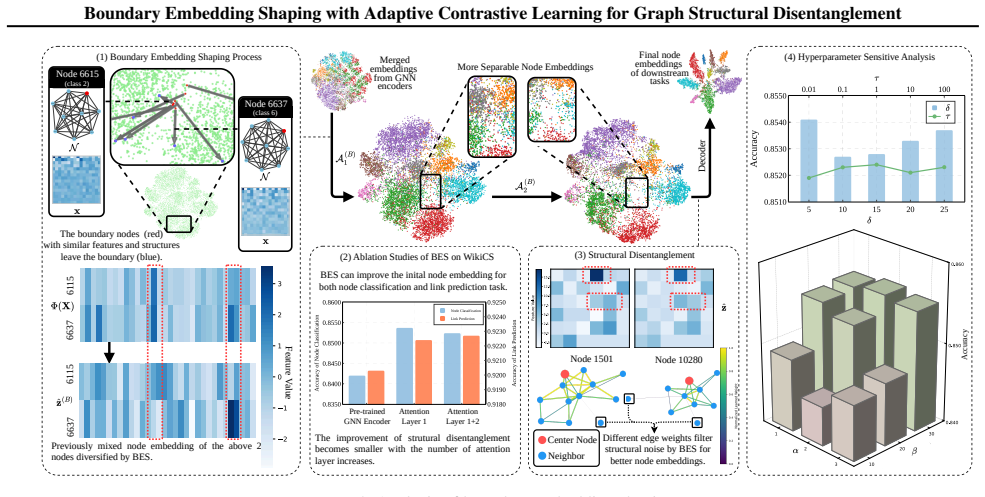
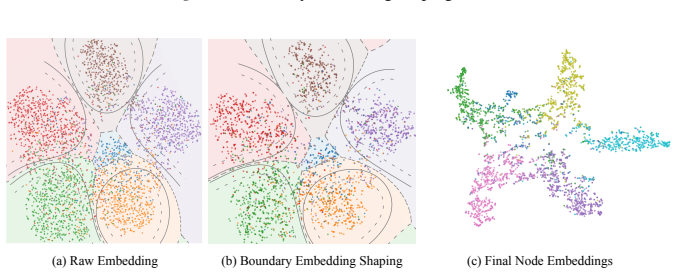
BES is built on the 'gravity loss,' a contrastive objective defined only for selected boundary nodes. A boundary region B is a covariance-scaled slab around the separating direction between class centroids; within it, nodes whose embedding-space neighbors disagree with their label more than half the time are boundary nodes. For those nodes, the positive similarity is squared distance to the class centroid and the negative similarity is squared distance to other class centroids. The load-bearing identity is Equation (8): the sum of squared distances to all same-class members decomposes into a centroid-distance term plus a constant, so optimizing against the centroid is gradient-equivalent to
What would settle it
Add controlled label noise to a fraction of training nodes on Cora or WikiCS while keeping the graph fixed; BES's claimed gain over GCN should shrink monotonically as the noise fraction grows if positive-pair disentanglement, rather than generic centroid fitting, is responsible for the improvement.
Extended reading notes
Core claim
At the paper's center is a latent-variable model in which observed node features x = g(z_inv, z_var), with the label y determined solely by z_inv. The main theoretical result, Theorem 3.1, says that minimizing a standard contrastive loss over positive pairs that share z_inv — operationalized as nodes with the same class label — block-identifies z_inv: the learned representation contains all and only invariant information, provided positives vary sufficiently in their variant variables (Assumptions 3.1 and 3.2). Corollary 3.1 restates this as mutual-information disentanglement, and Proposition 3.1 bounds representation error by the optimization loss plus an inverse-margin term. BES operationa
Load-bearing premise
The load-bearing premise is that all nodes sharing a class label have identical invariant latent variables and that the label depends only on those variables, with a practical side condition that class centroids are not highly overlapping in embedding space — exactly the regime BES targets.
Editorial extensions
If this is right
- BES can be attached to existing GNN encoders as a plug-in and is claimed to consistently improve node classification and link prediction across homogeneous, heterophilic, and OGB benchmark graphs.
- Under the stated assumptions, the gravity loss removes variant structural information from learned embeddings, so the reported gains are attributed to disentanglement rather than generic centroid fitting.
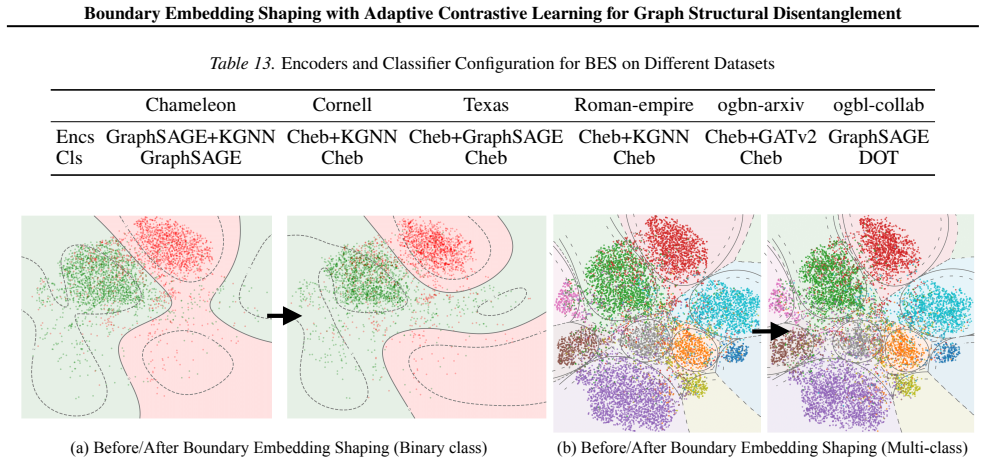
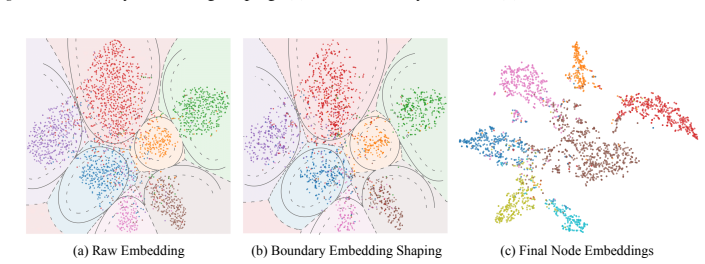
- Because only a small attention layer is trained and updates are scaled by the global perturbation they cause, non-boundary nodes are largely preserved while decision boundaries are sharpened.
- The center-based approximation is claimed to inherit the theoretical guarantees of the full pairwise contrastive loss while reducing complexity from O(N^2) to O(N), enabling large-graph use.
- Cleaner node embeddings propagate to edge-level tasks: link prediction improves because edge representations inherit less spurious structural noise.
Reading between the lines
- If the identifiability mechanism is doing the work, BES should be most valuable under heterophily, where same-class nodes have strongly varying local neighborhoods; varying the homophily ratio of a synthetic graph and tracking BES's gain over GCN would test this directly.
- The method's dependence on label-defined positives suggests a stress test: introducing controlled label noise should erode the gain monotonically, because positive pairs would no longer share the same invariant variables.
- The same boundary-selection and adaptive-update machinery could be ported to low-label or self-supervised settings by replacing class labels with cluster assignments, though the block-identifiability guarantee would then need re-examination.
- The inverse-margin bound implies that the boundary width parameter could be annealed during training, concentrating updates on the hardest nodes exactly as the margin shrinks.
Editorial analysis
A structured set of objections, weighed in public.
Referee Report
Summary. The paper proposes Boundary Embedding Shaping (BES), a GNN plug-in that identifies boundary nodes in embedding space, then applies an adaptive contrastive/centroid-attraction loss to sharpen those nodes' embeddings while leaving non-boundary nodes largely untouched. The authors claim three contributions: (1) a theoretical analysis showing that boundary-focused contrastive learning provably disentangles invariant latent factors from spurious structural correlations; (2) the BES framework combining hard example mining, a center-based gravity loss, and adaptive update scaling; (3) extensive experiments on homogeneous, heterophilic, heterogeneous, and OGB graphs showing consistent gains over strong baselines, e.g., a 3.3% average GCN improvement. The empirical core appears plausible: the paper's own ablations (Tables 14 and 16) show consistent gains from the boundary-aware shaping, and code is provided. However, the theoretical guarantee is not connected to the loss that is actually optimized, the proof of Proposition 3.1 is mathematically unsound as written, and key operational details about label usage in boundary selection are under-specified.
Significance. If the empirical improvements are robust, BES is a useful and simple plug-in: it is architecture-agnostic, adds few parameters, and the controlled ablations indicate that the boundary-selection and centroid-attraction mechanism, rather than the extra encoder, is responsible for the gains. The paper ships code, reports honest w/o-boundary controls, and covers a broad range of datasets. At the same time, the advertised 'provable disentanglement' guarantee is not established for the implemented method: Theorem 3.1 concerns a pairwise InfoNCE objective, while the method trains a centroid-based gravity loss, and Proposition 3.1's error bound does not follow from its proof. These are load-bearing for Contribution 1, not merely presentation issues. With a corrected or removed theory section and recalibrated claims, the empirical contribution is publishable; in its current form the central theoretical claim is unsupported.
major comments (4)
- [§4.2 and Theorem 3.1] Thm. 3.1 guarantees block-identifiability only for the pairwise InfoNCE loss with a general similarity. The loss actually optimized (Eqs. 9–10, Algorithm 1) replaces positive similarities with a single class-centroid distance and negatives with other class centroids. The identity in Eq. (8) justifies only the positive-sum reduction: the second term is constant w.r.t. Φ(x_b), so it does not affect the gradient. It does not justify replacing the denominator's sum of exponentials over negative similarities, because Σ exp(-||Φ(x_b)-Φ(x_n)||²) ≠ exp(-||Φ(x_b)-μ_j||²) in general. Hence the 'gradient-exact reduction' stated at the end of §4.2 does not hold for the full contrastive objective, and the reported results do not train the loss for which identifiability was proved. Appendix D.2 confirms that the exact pairwise loss was abandoned in favor of the center approximation. Please either prov
- [Assumption 3.1 / §3.1 and §4.1] Asm. 3.1 requires positive pairs to satisfy z_inv = z̃_inv almost surely. The operational positive-pair construction in §4.1 and Algorithm 1 groups nodes by observed class label: positives are nodes in C_{y_b}. Since Eq. (3) only assumes y = g_y(z_inv) with g_y deterministic but not injective, equal label does not imply equal z_inv. Thus the key premise of Thm. 3.1 is not guaranteed by the method's own sampling rule. The paper provides no experiment (e.g., synthetic data with known latent factors) that checks whether invariant latent variables are actually constant within classes. The 'provably disentangles' claim should be weakened to a conditional statement, or an injectivity/refinement assumption on g_y must be explicitly stated and argued for the benchmarks.
- [Appendix A.3, Prop. 3.1 / Eq. (33)] The proof of Prop. 3.1 is incorrect as written. Eq. (33) gives E∥Rhat{z}−z*∥² ≤ 2ε/(c·margin). Taking square roots and applying Jensen's inequality yields E∥Rhat{z}−z*∥ ≤ sqrt(2ε/(c·margin)), which is O(sqrt(ε/margin)), not the claimed O(sqrt ε) + O(1/margin). The final bound in Eq. (34) therefore does not follow. Additionally, the curvature-to-margin relation λ_min ≥ c·margin(∂Z_inv) in Eq. (32) is asserted without proof, and 'margin(∂Z_inv)' is never formally defined. Since Prop. 3.1 is the stated theoretical basis for the adaptive update in §4.3, that motivational chain is currently unsupported. The empirical adaptive mechanism may stand on its own, but the proposition should be fixed, proved, or removed from the theoretical claims.
- [Algorithm 1 / §4.1] The boundary-selection procedure is under-specified regarding training/test labels, creating a validity risk. Eq. (5) defines the boundary region B over all xi ∈ X, and Eq. (4) computes S(vi) for vi ∈ B using neighbor labels y_j. The text states that 'identification explicitly leverages label information solely from training nodes, while strictly excluding all test nodes and test labels,' but Algorithm 1 does not show how this restriction is operationalized. If B includes test nodes, Eq. (4) would require test labels; if it does not, the pseudocode should say that B is intersected with the training set before computing S. Please clarify the exact protocol, including how boundary nodes among test nodes are selected (if any) and whether validation/test features or labels are used to estimate μ_m, Σ_m. Without this clarification, the reproducibility and integrity of the empirical comparison
minor comments (5)
- [Table 1 and Abstract] Table 1 reports no standard deviations. Given that several margins are small (e.g., Cora NC: 89.46 vs 88.72; Cora LP: 94.45 vs IGCL's 95.13), error bars and significance tests should be reported. The abstract's 'consistently outperforms existing leading methods' is contradicted by the Cora LP row, where IGCL is higher; please qualify the claim.
- [§C.4 and Table 3] The hyperparameters specific to BES (δ, α, β, boundary threshold, number of layers L, number of iterations Q) are not listed in Table 3 or in §C.4. The sensitivity analysis in Fig. 3(4) mentions optimal τ=1 and δ=5, but exact per-dataset settings needed for reproduction are missing. Please add a table of BES hyperparameters.
- [Eq. (5)] The covariance Σ in the Mahalanobis slab is not defined. State whether it is a pooled covariance, a class-conditional covariance, or a global covariance, and specify how it is estimated (with or without labels). This detail matters because B (and hence the selected boundary nodes) depends on it.
- [Algorithm 1] Notation: B denotes both the boundary region from Eq. (5) and the selected boundary-node set in line 8 of Algorithm 1. Please rename one (e.g., B_region and B_nodes) to avoid ambiguity.
- [References and terminology] Reference inconsistencies: GCN is cited as (Yang et al., 2016) in Table 1 but the reference list has Kipf & Welling (2017) for GCN. Also, 'heterogeneous' and 'heterophilic' are used interchangeably in §5 and Appendix C; these should be made consistent.
Circularity Check
Identifiability guarantee is built into the label-based positive-pair assumption, and the theorem's objective is not the loss actually optimized.
-
self definitional
[Section 3.1, Eq. (3) and Assumption 3.1; Section 4.1, Eqs. (6)-(7)]
"z = (z_inv, z_var) ~ p_z, y = g_y(z_inv), x = g(z) ... gy is a deterministic function indicating that z_inv exclusively determines the class label y. Assumption 3.1: ... the two nodes ... share the same class label y. Then, the conditional density p_~z|z(~z|z) = delta(~z_inv - z_inv)p_~zvar|zvar(~zvar|zvar) ... For a designated boundary node, ... the embedding Phi(x_b) should be aligned with all positive samples v_p sharing the same label y_b."
The variable to be recovered (z_inv) is defined by the model as the class-determining factor, and Assumption 3.1 stipulates that positive pairs sharing a class label have identical z_inv. The method then constructs positive pairs precisely by class label (Section 4.1). Therefore the theorem's conclusion that contrastive learning isolates z_inv is an unpacking of the input assumption: label-grouping is assumed to equal invariant-factor grouping. No derivation or test establishes that same-label nodes share z_inv or that z_var is excluded; the claimed disentanglement from spurious structure is built into the definition of the positives.
-
self citation load bearing
[Appendix A.1, Step 4 (proof of Theorem 3.1)]
"By directly applying Lemma B.2 in (Cai et al., 2025), we conclude that the learned representations contain all and only the information about the invariant latent variables z_inv almost surely."
This is the step that upgrades the proof from 'the learned representation depends only on z_inv and is uniform' to the full block-identifiability conclusion 'all and only'. The cited Lemma B.2 comes from Cai et al. (2025), which shares authors with the present paper (Yichao Cai, Yuhang Liu, Zhen Zhang, Javen Qinfeng Shi). The lemma is not proved in this manuscript, is not machine-checked, and no independent external verification is supplied. The 'uniqueness' claim that makes Theorem 3.1's conclusion is thus imported from the authors' own prior work rather than derived from first principles here.
1 more flagged steps
-
other
[Section 4.2, Eq. (8); Appendix D.2]
"The approximated similarity thus inherits all theoretical properties of the pairwise form, which is a gradient-exact reduction ... We initially attempted to optimize the exact pairwise contrastive loss (Thm. 3.1) ... this yielded extensive computational overhead and chaotic convergence. ... By operating on cluster centers instead of node instances, theoretical properties (identifiability, information bounds) established for individual pairs efficiently remain preserved through geometric identity."
This is the load-bearing bridge from Theorem 3.1 to the implemented loss: the paper claims the centroid-based gravity loss inherits the theorem's identifiability guarantee by a gradient-exact reduction. But Eq. (8) is an identity only for the sum of squared distances to the class centroid, i.e. the positive numerator. The denominator of the Theorem 3.1 InfoNCE objective contains exp(sim_neg) summed over negative samples; a sum of exponentials is not the exponential of a centroid distance. Appendix D.2 confirms the exact pairwise loss was abandoned. Consequently the trained gravity loss is not the objective for which identifiability was proved, and the claim that the theoretical properties 'remain preserved' is asserted rather than derived for the full contrastive loss.
full rationale
The empirical benchmark tables are standard external comparisons, and those results are not circular in themselves. The circularity is concentrated in the paper's central theoretical contribution. First, the invariant latent variable is defined as the label-determining content (y = g_y(z_inv)), and Assumption 3.1 stipulates that label-sharing positive pairs have identical z_inv; the method then picks positives by label, so the theorem's 'disentanglement' is a restatement of the construction of the positives rather than an empirically grounded discovery about graph structure. Second, the final 'all and only' step of the theorem is delegated to Lemma B.2 of the authors' own prior work, a self-citation that carries the uniqueness conclusion. Third, the objective actually optimized in the algorithm is the centroid gravity loss, while Theorem 3.1 is proved for a pairwise InfoNCE-style loss; the claimed gradient-exact inheritance is only shown for the positive numerator (Eq. 8), not for the nonlinear negative denominator, and Appendix D.2 states the pairwise loss was abandoned. These issues make the central 'provably disentangles' claim partially circular by construction, even though the empirical gains over baselines may be real and are evaluated externally. Score 6 reflects partial circularity in the central claim, not in the experimental comparison.
Assumptions & free parameters
free parameters (9)
- delta (boundary slab width) =
5
- alpha (adaptive update scaling) =
not specified in text
- beta (boundary batch size) =
not specified in text
- eta (learning rate) =
0.01
- shift score threshold =
0.5
- number of attention layers L =
2
- number of encoders K =
2 (1 for ogbl-collab)
- temperature tau =
1 (reported 'optimal')
- kNN neighborhood size k =
unspecified
assumptions (8)
- domain assumption y = g_y(z_inv): class label fully determined by invariant latent variables
- domain assumption Assumption 3.1: label-informed positive pairs have identical z_inv
- domain assumption Assumption 3.2: sufficient local variation of z_var around every conditioning point
- standard math InfoNCE asymptotic alignment-maxent decomposition and Darmois construction (von Kuegelgen et al. 2021; Daunhawer et al. 2023)
- ad hoc to paper Lemma B.2 of (Cai et al., 2025): final 'all and only' block-identification step
- ad hoc to paper lambda_min >= c * margin(dZ_inv): curvature of loss Hessian proportional to class-boundary margin
- domain assumption Class centroids are not highly overlapping
- domain assumption Embedding-space kNN neighborhoods preserve heterophilic structure of the original graph
invented entities (3)
-
Boundary region B (Eq. 5)
-
Pre-update perturbation Delta(B) (Eq. 12)
-
Gravity similarity with per-class min offset (Eq. 9)
Cite this review
Pith. "Pith review of Boundary Embedding Shaping with Adaptive Contrastive Learning for Graph Structural Disentanglement." pith.science (2026). https://pith.science/paper/XW6TFOSY
@misc{pith2026260620283,
  author       = {Pith},
  title        = {Pith review of: Boundary Embedding Shaping with Adaptive Contrastive Learning for Graph Structural Disentanglement},
  year         = {2026},
  howpublished = {\url{https://pith.science/paper/XW6TFOSY}},
  note         = {Machine review of arXiv:2606.20283}
}
read the original abstract
Graph neural networks (GNNs) excel at aggregating neighbor information for classification, yet their performance is hindered by graph structural entanglement, where spurious correlations from semantically irrelevant neighbors contaminate node embeddings. This challenge is most acute for nodes near class boundaries in the embedding space, where amplified structural noise blurs decision boundaries and destabilizes predictions. Existing robust GNN methods largely treat all nodes uniformly, ignoring boundary vulnerabilities. In this paper, to improve classification performance, we tackle graph structural disentanglement by identifying boundary-region entanglement as the primary bottleneck and propose Boundary Embedding Shaping (BES), an adaptive contrastive learning GNN plug-in module that selectively suppresses spurious structural noise at decision boundaries with minimal model parameter perturbation. Extensive experiments demonstrate that BES consistently improves boundary discrimination and outperforms existing leading methods. Notably, BES boosts GCN performance by an average of 3.3% in node classification (up to 5.0% on WikiCS) and achieves superior accuracy in link prediction.
Figures

Figures from the paper (6 more)



Reference graph
Works this paper leans on
-
[1]
write newline
" write newline "" before.all 'output.state := FUNCTION n.dashify 't := "" t empty not t #1 #1 substring "-" = t #1 #2 substring "--" = not "--" * t #2 global.max substring 't := t #1 #1 substring "-" = "-" * t #2 global.max substring 't := while if t #1 #1 substring * t #2 global.max substring 't := if while FUNCTION format.date year duplicate empty "emp...
-
[2]
Z., van den Hengel, A., and Qi, Y
Bao, S., Xue, Z., Chen, Q., Ou, S., Beheshti, A., Sheng, Q. Z., van den Hengel, A., and Qi, Y. Causal MVC : Causal content-style representation learning for deep multi-view clustering. In Proceedings of the International Conference on Multimedia (MM), pp.\ 1598--1606, 2025
2025
-
[3]
Bishop, C. M. Latent variable models. In Learning in Graphical Models, volume 89, pp.\ 371--403. Springer, 1998
1998
-
[4]
How attentive are graph attention networks? In Proceedings of the International Conference on Learning Representations (ICLR), 2022
Brody, S., Alon, U., and Yahav, E. How attentive are graph attention networks? In Proceedings of the International Conference on Learning Representations (ICLR), 2022
2022
-
[5]
Cai, Y., Liu, Y., Gao, E., Jiang, T., Zhang, Z., van den Hengel, A., and Shi, J. Q. On the value of cross-modal misalignment in multimodal representation learning. In Proceedings of the Conference on Neural Information Processing Systems (NeurIPS), 2025
2025
-
[6]
Nodeimport: Imbalanced node classification with node importance assessment
Chen, N., Liu, Z., Hooi, B., He, B., Hu, J., and Chen, J. Nodeimport: Imbalanced node classification with node importance assessment. In Proceedings of the ACM SIGKDD Conference on Knowledge Discovery and Data Mining (KDD), pp.\ 94--105, 2025 a
2025
-
[7]
Chen, T., Kornblith, S., Norouzi, M., and Hinton, G. E. A simple framework for contrastive learning of visual representations. In Proceedings of the International Conference on Machine Learning (ICML), pp.\ 1597--1607, 2020
2020
-
[8]
Improving graph contrastive learning with community structure
Chen, X., Yue, K., Duan, L., and Yu, L. Improving graph contrastive learning with community structure. In Proceedings of the Conference on Uncertainty in Artificial Intelligence (UAI), pp.\ 568--585, 2025 b
2025
Show all 61 references
-
[9]
Daunhawer, I., Bizeul, A., Palumbo, E., Marx, A., and Vogt, J. E. Identifiability results for multimodal contrastive learning. In Proceedings of the International Conference on Learning Representations (ICLR), 2023
2023
-
[10]
Convolutional neural networks on graphs with fast localized spectral filtering
Defferrard, M., Bresson, X., and Vandergheynst, P. Convolutional neural networks on graphs with fast localized spectral filtering. In Proceedings of the Conference on Neural Information Processing Systems (NeurIPS), pp.\ 3837--3845, 2016
2016
-
[11]
Imagenet: A large-scale hierarchical image database
Deng, J., Dong, W., Socher, R., Li, L.-J., Li, K., and Fei-Fei, L. Imagenet: A large-scale hierarchical image database. In Proceedings of the IEEE Conference on Computer Vision and Pattern Recognition (CVPR), pp.\ 248--255, 2009
2009
-
[12]
The mnist database of handwritten digit images for machine learning research
Deng, L. The mnist database of handwritten digit images for machine learning research. IEEE Signal Processing Magazine, 29 0 (6): 0 141--142, 2012
2012
-
[13]
L., Bollacker, K
Giles, C. L., Bollacker, K. D., and Lawrence, S. Citeseer: An automatic citation indexing system. In Proceedings of the ACM International Conference on Digital Libraries (DL), pp.\ 89--98, 1998
1998
-
[14]
L., Ying, Z., and Leskovec, J
Hamilton, W. L., Ying, Z., and Leskovec, J. Inductive representation learning on large graphs. In Proceedings of the Conference on Neural Information Processing Systems (NeurIPS), pp.\ 1024--1034, 2017
2017
-
[15]
Hoang, V. T. and Lee, O. Transitivity-preserving graph representation learning for bridging local connectivity and role-based similarity. In Proceedings of the AAAI Conference on Artificial Intelligence (AAAI), pp.\ 12456--12465, 2024
2024
-
[16]
Open graph benchmark: Datasets for machine learning on graphs
Hu, W., Fey, M., Zitnik, M., Dong, Y., Ren, H., Liu, B., Catasta, M., and Leskovec, J. Open graph benchmark: Datasets for machine learning on graphs. In Proceedings of the Conference on Neural Information Processing Systems (NeurIPS), 2020
2020
-
[17]
Supervised contrastive learning
Khosla, P., Teterwak, P., Wang, C., Sarna, A., Tian, Y., Isola, P., Maschinot, A., Liu, C., and Krishnan, D. Supervised contrastive learning. In Proceedings of the Conference on Neural Information Processing Systems (NeurIPS), 2020
2020
-
[18]
Kipf, T. N. and Welling, M. Semi-supervised classification with graph convolutional networks. In Proceedings of the International Conference on Learning Representations (ICLR), 2017
2017
-
[19]
Koh, P. W. and Liang, P. Understanding black-box predictions via influence functions. In Proceedings of the International Conference on Machine Learning (ICML), pp.\ 1885--1894, 2017
2017
-
[20]
Li, J., Zhou, P., Xiong, C., and Hoi, S. C. Prototypical contrastive learning of unsupervised representations. In Proceedings of the International Conference on Learning Representations (ICLR), 2021
2021
-
[21]
Kolmogorov--arnold graph neural networks for molecular property prediction
Li, L., Zhang, Y., Wang, G., and Xia, K. Kolmogorov--arnold graph neural networks for molecular property prediction. Nature Machine Intelligence, 7 0 (8): 0 1346--1354, 2025
2025
-
[22]
Liu, Y., Zhang, Z., Gong, D., Gong, M., Huang, B., van den Hengel, A., Zhang, K., and Shi, J. Q. Identifiable latent polynomial causal models through the lens of change. In Proceedings of the International Conference on Learning Representations (ICLR), 2024
2024
-
[23]
Liu, Y., Zhang, Z., Gong, D., Gong, M., Huang, B., van den Hengel, A., Zhang, K., and Shi, J. Q. Latent covariate shift: Unlocking partial identifiability for multi-source domain adaptation. Transactions on Machine Learning Research, 2025. ISSN 2835-8856
2025
-
[24]
Liu, Y., Gong, D., Cai, Y., Gao, E., Zhang, Z., Huang, B., Gong, M., van den Hengel, A., and Shi, J. Q. I predict therefore i am: Is next token prediction enough to learn human-interpretable concepts from data? In Proceedings of the International Conference on Learning Represe...
2026
-
[25]
Liu, Y., Zhang, Z., Gong, D., Gao, E., Huang, B., Gong, M., van den Hengel, A., Zhang, K., and Shi, J. Q. Beyond DAG s: A latent partial causal model for multimodal learning. In Proceedings of the International Conference on Learning Representations (ICLR), 2026 b
2026
-
[26]
Liu, Y., Zhang, Z., Gong, D., Gong, M., Huang, B., van den Hengel, A., Zhang, K., and Shi, J. Q. Identifying weight-variant latent causal models. Journal of Machine Learning Research, 27 0 (4): 0 1--49, 2026 c
2026
-
[27]
Classic gnns are strong baselines: Reassessing gnns for node classification
Luo, Y., Shi, L., and Wu, X.-M. Classic gnns are strong baselines: Reassessing gnns for node classification. In Proceedings of the Conference on Neural Information Processing Systems (NeurIPS), pp.\ 97650--97669, 2024
2024
-
[28]
Enhancing robustness of graph neural networks on social media with explainable inverse reinforcement learning
Lyu, Y., Li, C., Xie, S., and Zhang, X. Enhancing robustness of graph neural networks on social media with explainable inverse reinforcement learning. In Proceedings of the Conference on Neural Information Processing Systems (NeurIPS), pp.\ 31736--31758, 2024
2024
-
[29]
Disentangled graph convolutional networks
Ma, J., Cui, P., Kuang, K., Wang, X., and Zhu, W. Disentangled graph convolutional networks. In Proceedings of the International Conference on Machine Learning (ICML), pp.\ 4212--4221, 2019
2019
-
[30]
K., Nigam, K., Rennie, J., and Seymore, K
McCallum, A. K., Nigam, K., Rennie, J., and Seymore, K. Automating the construction of internet portals with machine learning. Information Retrieval, 3: 0 127--163, 2000
2000
-
[31]
and Cangea, C
Mernyei, P. and Cangea, C. Wiki-cs: A wikipedia-based benchmark for graph neural networks. arXiv preprint arXiv:2007.02901, 2020
2007 arXiv
-
[32]
Interpretable and generalizable graph learning via stochastic attention mechanism
Miao, S., Liu, M., and Li, P. Interpretable and generalizable graph learning via stochastic attention mechanism. In Proceedings of the International Conference on Machine Learning (ICML), pp.\ 15524--15543, 2022
2022
-
[33]
L., Lenssen, J
Morris, C., Ritzert, M., Fey, M., Hamilton, W. L., Lenssen, J. E., Rattan, G., and Grohe, M. Weisfeiler and leman go neural: Higher-order graph neural networks. In Proceedings of the AAAI Conference on Artificial Intelligence (AAAI), pp.\ 4602--4609, 2019
2019
-
[34]
C.-C., Lei, Y., and Yang, B
Pei, H., Wei, B., Chang, K. C.-C., Lei, Y., and Yang, B. Geom-gcn: Geometric graph convolutional networks. In Proceedings of the International Conference on Learning Representations (ICLR), 2020
2020
-
[35]
Pennington, J., Socher, R., and Manning, C. D. Glove: Global vectors for word representation. In Proceedings of the Conference on Empirical Methods in Natural Language Processing (EMNLP), pp.\ 1532--1543, 2014
2014
-
[36]
A critical look at the evaluation of gnns under heterophily: Are we really making progress? In Proceedings of the International Conference on Learning Representations (ICLR), 2023
Platonov, O., Kuznedelev, D., Diskin, M., Babenko, A., and Prokhorenkova, L. A critical look at the evaluation of gnns under heterophily: Are we really making progress? In Proceedings of the International Conference on Learning Representations (ICLR), 2023
2023
-
[37]
K., Bronstein, M
Rusch, T. K., Bronstein, M. M., and Mishra, S. A survey on oversmoothing in graph neural networks. arXiv preprint arXiv:2303.10993, 2023
2023 arXiv
-
[38]
Collective classification in network data
Sen, P., Namata, G., Bilgic, M., Getoor, L., Galligher, B., and Eliassi-Rad, T. Collective classification in network data. AI Magazine, 29 0 (3): 0 93--106, 2008
2008
-
[39]
Training region-based object detectors with online hard example mining
Shrivastava, A., Gupta, A., and Girshick, R. Training region-based object detectors with online hard example mining. In Proceedings of the IEEE Conference on Computer Vision and Pattern Recognition (CVPR), pp.\ 761--769, 2016
2016
-
[40]
Networked inequality: Preferential attachment bias in graph neural network link prediction
Subramonian, A., Sagun, L., and Sun, Y. Networked inequality: Preferential attachment bias in graph neural network link prediction. In Proceedings of the International Conference on Machine Learning (ICML), pp.\ 46891--46925, 2024
2024
-
[41]
Sun, L., Huang, Z., Wang, Z., Wang, F., Peng, H., and Yu, P. S. Motif-aware riemannian graph neural network with generative-contrastive learning. In Proceedings of the AAAI Conference on Artificial Intelligence (AAAI), pp.\ 9044--9052, 2024
2024
-
[42]
Graph attention networks
Velickovic, P., Cucurull, G., Casanova, A., Romero, A., Li \` o , P., and Bengio, Y. Graph attention networks. In Proceedings of the International Conference on Learning Representations (ICLR), 2018
2018
-
[43]
u gelgen, J., Sharma, Y., Gresele, L., Brendel, W., Sch \
von K \" u gelgen, J., Sharma, Y., Gresele, L., Brendel, W., Sch \" o lkopf, B., Besserve, M., and Locatello, F. Self-supervised learning with data augmentations provably isolates content from style. In Proceedings of the Conference on Neural Information Processing Systems (Ne...
2021
-
[44]
Generalizing aggregation functions in gnns: Building high capacity and robust gnns via nonlinear aggregation
Wang, B., Jiang, B., Tang, J., and Luo, B. Generalizing aggregation functions in gnns: Building high capacity and robust gnns via nonlinear aggregation. IEEE Transactions on Pattern Analysis and Machine Intelligence, 45 0 (11): 0 13454--13466, 2023
2023
-
[45]
Disentangled graph collaborative filtering
Wang, X., Jin, H., Zhang, A., He, X., Xu, T., and Chua, T. Disentangled graph collaborative filtering. In Proceedings of the ACM SIGIR Conference on Research and Development in Information Retrieval (SIGIR), pp.\ 1001--1010, 2020
2020
-
[46]
Simplifying graph convolutional networks
Wu, F., Souza, A., Zhang, T., Fifty, C., Yu, T., and Weinberger, K. Simplifying graph convolutional networks. In Proceedings of the International Conference on Machine Learning (ICML), pp.\ 6861--6871, 2019
2019
-
[47]
Graph neural networks in recommender systems: A survey
Wu, S., Sun, F., Zhang, W., Xie, X., and Cui, B. Graph neural networks in recommender systems: A survey. ACM Computing Surveys, 55 0 (5): 0 1--37, 2022
2022
-
[48]
Xia, J., Wu, L., Wang, G., Chen, J., and Li, S. Z. Pro GCL : Rethinking hard negative mining in graph contrastive learning. In Proceedings of the International Conference on Machine Learning (ICML), pp.\ 24332--24346, 2022
2022
-
[49]
C., Wang, S., and Honavar, V
Xiao, T., Zhu, H., Zhang, Z., Guo, Z., Aggarwal, C. C., Wang, S., and Honavar, V. G. Efficient contrastive learning for fast and accurate inference on graphs. In Proceedings of the International Conference on Machine Learning (ICML), pp.\ 54363--54381, 2024
2024
-
[50]
Revisiting semi-supervised learning with graph embeddings
Yang, Z., Cohen, W., and Salakhudinov, R. Revisiting semi-supervised learning with graph embeddings. In Proceedings of the International Conference on Machine Learning (ICML), pp.\ 40--48, 2016
2016
-
[51]
v., and Locatello, F
Yao, D., Xu, D., Lachapelle, S., Magliacane, S., Taslakian, P., Martius, G., K \"u gelgen, J. v., and Locatello, F. Multi-view causal representation learning with partial observability. In Proceedings of the International Conference on Learning Representations (ICLR), 2024
2024
-
[52]
Do transformers really perform badly for graph representation? In Proceedings of the Conference on Neural Information Processing Systems (NeurIPS), pp.\ 28877--28888, 2021
Ying, C., Cai, T., Luo, S., Zheng, S., Ke, G., He, D., Shen, Y., and Liu, T. Do transformers really perform badly for graph representation? In Proceedings of the Conference on Neural Information Processing Systems (NeurIPS), pp.\ 28877--28888, 2021
2021
-
[53]
Graph contrastive learning with augmentations
You, Y., Chen, T., Sui, Y., Chen, T., Wang, Z., and Shen, Y. Graph contrastive learning with augmentations. In Proceedings of the Conference on Neural Information Processing Systems (NeurIPS), pp.\ 5812--5823, 2020
2020
-
[54]
Zeng, H., Zhou, H., Srivastava, A., Kannan, R., and Prasanna, V. K. Graph SAINT : Graph sampling based inductive learning method. In Proceedings of the International Conference on Learning Representations (ICLR), 2020
2020
-
[55]
Decouple graph neural networks: Train multiple simple gnns simultaneously instead of one
Zhang, H., Zhu, Y., and Li, X. Decouple graph neural networks: Train multiple simple gnns simultaneously instead of one. IEEE Transactions on Pattern Analysis and Machine Intelligence, 46 0 (11): 0 7451--7462, 2024 a
2024
-
[56]
Graph neural networks in modern ai-aided drug discovery
Zhang, O., Lin, H., Zhang, X., Wang, X., Wu, Z., Ye, Q., Zhao, W., Wang, J., Ying, K., Kang, Y., et al. Graph neural networks in modern ai-aided drug discovery. Chemical Reviews, 125 0 (20): 0 10001--10103, 2025
2025
-
[57]
Trans GNN : Harnessing the collaborative power of transformers and graph neural networks for recommender systems
Zhang, P., Yan, Y., Zhang, X., Li, C., Wang, S., Huang, F., and Kim, S. Trans GNN : Harnessing the collaborative power of transformers and graph neural networks for recommender systems. In Proceedings of the ACM SIGIR Conference on Research and Development in Information Retri...
2024
-
[58]
and Koniusz, P
Zhu, H. and Koniusz, P. Simple spectral graph convolution. In Proceedings of the International Conference on Learning Representations (ICLR), 2021
2021
-
[59]
Beyond homophily in graph neural networks: Current limitations and effective designs
Zhu, J., Yan, Y., Zhao, L., Heimann, M., Akoglu, L., and Koutra, D. Beyond homophily in graph neural networks: Current limitations and effective designs. In Proceedings of the Conference on Neural Information Processing Systems (NeurIPS), pp.\ 7793--7804, 2020
2020
-
[60]
Graph contrastive learning with adaptive augmentation
Zhu, Y., Xu, Y., Yu, F., Liu, Q., Wu, S., and Wang, L. Graph contrastive learning with adaptive augmentation. In Proceedings of the Web Conference (WWW), pp.\ 2069--2080, 2021
-
[61]
S., Sharma, Y., Schneider, S., Bethge, M., and Brendel, W
Zimmermann, R. S., Sharma, Y., Schneider, S., Bethge, M., and Brendel, W. Contrastive learning inverts the data generating process. In Proceedings of the International Conference on Machine Learning (ICML), pp.\ 12979--12990, 2021
2021
Reviewed August 2, 2026 · model on record in the stance chip above.
Discussion (0). Sign in to comment.