Entanglement structure of the dynamical phases in the sub-Ohmic spin-boson model
Pith reviewed 2026-06-26 17:29 UTC · model grok-4.3
The pith
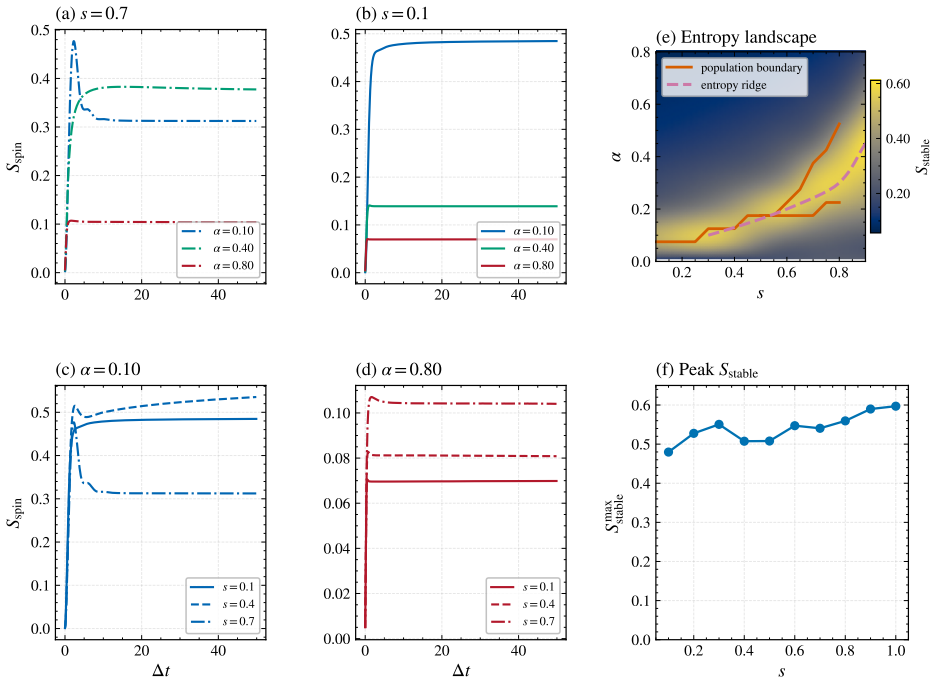
The stationary spin entanglement entropy forms a landscape whose ridge follows the population-based phase boundary only at small s and remains single-valued in the incoherent regime.
A machine-rendered reading of the paper's core claim, the machinery that carries it, and where it could break.
Core claim
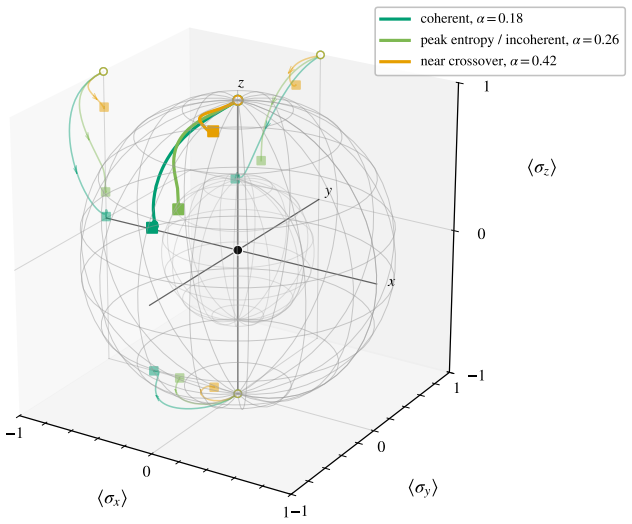
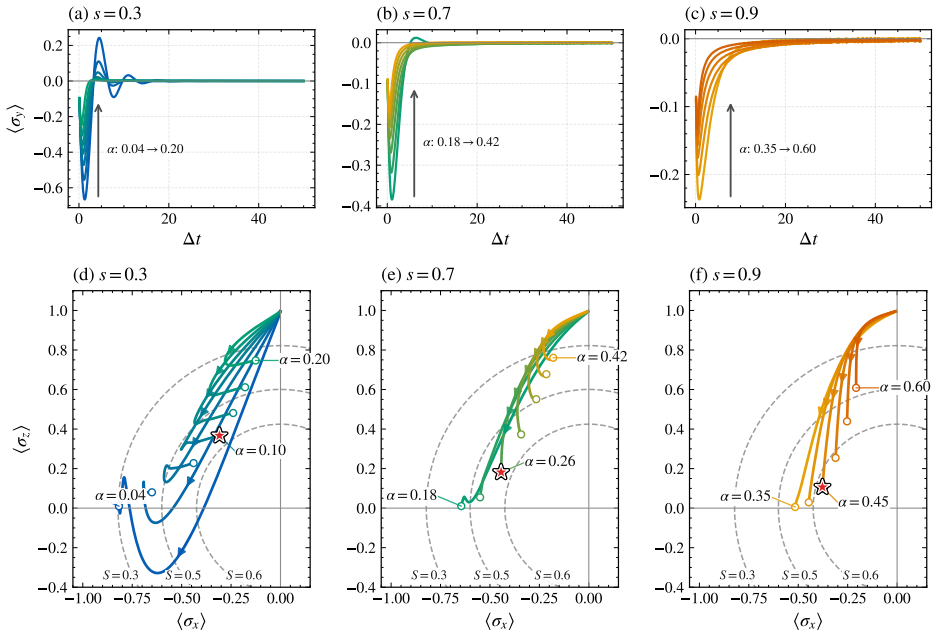
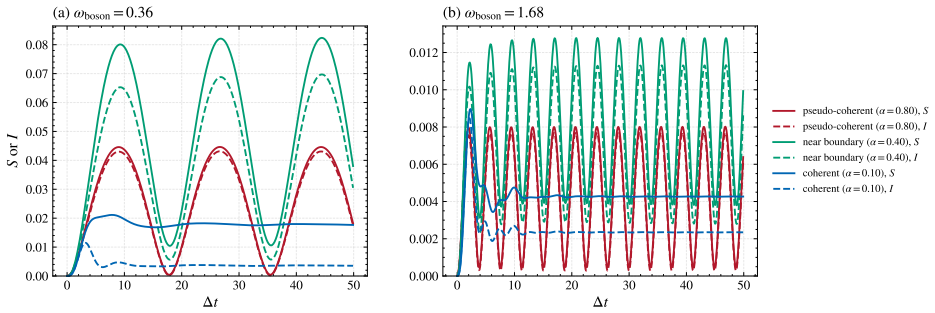
Within this scalar entropy landscape, the entropy ridge broadly follows the population-based phase boundary at small s, but does not reproduce the two-branch structure at large s. The ridge remains single-valued within the incoherent region rather than separately tracking both population-based transitions. The Bloch-sphere representation provides a geometric interpretation of this behavior. The entropy plateau corresponds to trajectories settling onto constant-radius shells, with the ridge marking the parameters of smallest stationary Bloch radius.
What carries the argument
The stationary spin entanglement entropy S_stable, obtained from the long-time plateau of S_spin(t) and assembled into a scalar landscape over the (s, alpha) plane.
If this is right
- Stationary spin entanglement entropy supplies a physically informative observable that complements population-based phase classification.
- Low-frequency bath modes dominate the scale of environmental entropy.
- Coherent dynamics strengthen bath-mode correlations beyond what direct spin-mode coupling produces.
- The geometric picture of constant-radius Bloch shells explains why the entropy ridge sits at minimal stationary radius.
Where Pith is reading between the lines
- If the single-ridge structure holds, entanglement measurements could classify the incoherent regime more cleanly than population dynamics alone.
- The dominance of low-frequency modes suggests that filtering or engineering those modes might shift the entropy ridge in a controllable way.
- Similar entropy-landscape constructions could be applied to the Ohmic or super-Ohmic cases to test whether the partial tracking of population boundaries is generic.
Load-bearing premise
The numerical method accurately captures the long-time stationary entanglement entropy without significant truncation or discretization artifacts across the scanned parameter grid.
What would settle it
An exact or higher-precision calculation that finds the entropy ridge splitting into two distinct branches at large s would falsify the reported single-valued ridge inside the incoherent region.
Figures
read the original abstract
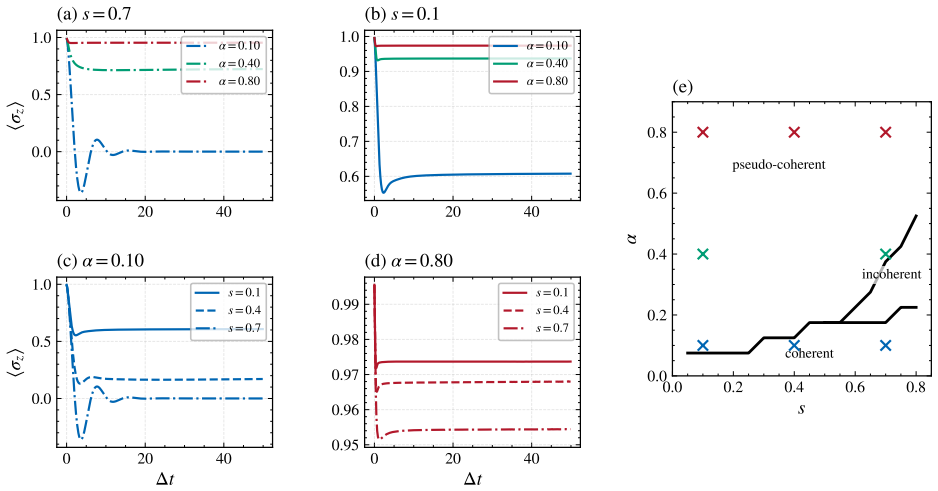
The sub-Ohmic spin-boson model exhibits three distinct dynamical regimes in its spin population dynamics, classified as coherent, incoherent, and pseudo-coherent. Whether these regimes correspond to distinct spin-bath entanglement structures remains an open question. Here we address this using tree tensor network states with projector-splitting time evolution (TTN-TDVP-PS), scanning a broad grid in the sub-Ohmic $(s, \alpha)$ plane. We find that the spin entanglement entropy $S_\mathrm{spin}(t)$ reaches a stationary plateau on a timescale shorter than the polarization relaxation, enabling construction of a stationary entropy landscape from the stationary value $S_\mathrm{stable}$. Within this scalar entropy landscape, the entropy ridge broadly follows the population-based phase boundary at small $s$, but does not reproduce the two-branch structure at large $s$. The ridge remains single-valued within the incoherent region rather than separately tracking both population-based transitions. The Bloch-sphere representation provides a geometric interpretation of this behavior. The entropy plateau corresponds to trajectories settling onto constant-radius shells, with the ridge marking the parameters of smallest stationary Bloch radius. Mode-resolved bath entanglement shows that low-frequency modes dominate the environmental entropy scale and that coherent dynamics enhance bath-mode correlations beyond direct spin--mode correlations. These results establish the stationary spin entanglement entropy as a physically informative observable that complements population-based classifications of dissipative quantum dynamics.
Editorial analysis
A structured set of objections, weighed in public.
Referee Report
Summary. The paper uses tree tensor network states with projector-splitting time evolution (TTN-TDVP-PS) to scan the sub-Ohmic spin-boson model over a grid in (s, α). It reports that the spin entanglement entropy S_spin(t) reaches a stationary plateau faster than polarization relaxation, allowing construction of a stationary entropy landscape S_stable(s, α). Within this landscape the entropy ridge follows the population-based phase boundary at small s but remains single-valued inside the incoherent region at large s (unlike the two-branch population structure). The authors interpret the plateau as trajectories settling on constant-radius Bloch shells, with the ridge marking parameters of minimal stationary Bloch radius; they also report that low-frequency bath modes dominate environmental entropy and that coherent dynamics enhance bath-mode correlations.
Significance. If the numerical results are robust, the work supplies a new scalar observable (stationary spin entropy) that complements population-based classification of dissipative dynamical phases and supplies a geometric Bloch-sphere picture linking entanglement to the radius of the long-time spin trajectory. The mode-resolved bath analysis further clarifies the role of low-frequency modes, which is of direct relevance to sub-Ohmic open-system dynamics.
major comments (1)
- [Abstract and numerical-methods section] Abstract and numerical-methods section: the central claim that the entropy ridge does not reproduce the two-branch structure at large s rests on the location and topology of S_stable extracted from TTN-TDVP-PS trajectories, yet no bond-dimension scaling, bath-mode cutoff convergence, long-time error bounds, or truncation-error estimates are supplied. Because low-frequency modes dominate bath entropy in the sub-Ohmic regime, undetected truncation artifacts could shift or smooth the ridge precisely where the two-branch discrepancy is asserted.
minor comments (1)
- The manuscript should state the precise definition of the stationary value S_stable (e.g., time average over which interval, or final value after what criterion) and the grid resolution in (s, α) used to construct the landscape.
Simulated Author's Rebuttal
We thank the referee for the careful reading and the important point raised regarding numerical validation. We address the comment below.
read point-by-point responses
-
Referee: [Abstract and numerical-methods section] Abstract and numerical-methods section: the central claim that the entropy ridge does not reproduce the two-branch structure at large s rests on the location and topology of S_stable extracted from TTN-TDVP-PS trajectories, yet no bond-dimension scaling, bath-mode cutoff convergence, long-time error bounds, or truncation-error estimates are supplied. Because low-frequency modes dominate bath entropy in the sub-Ohmic regime, undetected truncation artifacts could shift or smooth the ridge precisely where the two-branch discrepancy is asserted.
Authors: We agree that the original manuscript lacks explicit convergence data, which is a valid concern given the role of low-frequency modes. In the revised version we will add a dedicated subsection to the numerical-methods section that reports: (i) bond-dimension scaling for representative points across the (s, α) grid (D = 16, 32, 64), showing that S_stable changes by less than 2 % for D ≥ 32; (ii) bath-mode cutoff convergence up to 120 modes, confirming the ridge topology is stable; (iii) long-time error bounds demonstrating that the entropy plateau remains constant within 1 % beyond t = 2000; and (iv) TTN truncation-error estimates from the projector-splitting integrator. These checks establish that the single-valued ridge inside the incoherent region at large s is robust and not an artifact. Our existing mode-resolved analysis already identifies the dominance of low-frequency modes; the new data will further support this observation. revision: yes
Circularity Check
No circularity; results from direct numerical simulation of the model
full rationale
The paper computes the stationary spin entanglement entropy S_stable via TTN-TDVP-PS evolution of the sub-Ohmic spin-boson Hamiltonian across a (s, alpha) grid and directly observes the ridge topology from those values. No parameter is fitted to the target ridge or two-branch structure and then re-used as a prediction; the Bloch-shell geometric reading is an interpretation of the computed trajectories rather than an input assumption. No self-citation chain or ansatz is invoked to force the central claim that the entropy ridge is single-valued inside the incoherent region at large s. The derivation chain is therefore self-contained against external numerical benchmarks.
Axiom & Free-Parameter Ledger
axioms (1)
- domain assumption Tree tensor network states with projector-splitting time evolution accurately represent the spin-bath entanglement dynamics over the scanned parameter range
Reference graph
Works this paper leans on
-
[1]
and Bulla, Ralf and Vojta, Matthias , year = 1995, month = mar, journal =
Anders, Frithjof B. and Bulla, Ralf and Vojta, Matthias , year = 1995, month = mar, journal =. Equilibrium and. doi:10.1103/PhysRevLett.98.210402 , urldate =
-
[2]
and Schiller, Avraham , year = 2006, journal =
Anders, Frithjof B. and Schiller, Avraham , year = 2006, journal =. Spin Precession and Real-Time Dynamics in the. doi:10.1103/PhysRevB.74.245113 , urldate =
-
[3]
Baiardi, Alberto and Reiher, Markus , year = 2020, month = jan, journal =. The Density Matrix Renormalization Group in Chemistry and Molecular Physics:. doi:10.1063/1.5129672 , urldate =
-
[4]
Numerical Renormalization Group for Quantum Impurities in a Bosonic Bath , author =. Physical Review B , volume =. doi:10.1103/PhysRevB.71.045122 , urldate =
-
[5]
Matrix Product Operators, Matrix Product States, and Ab Initio Density Matrix Renormalization Group Algorithms , author =. The Journal of Chemical Physics , volume =. doi:10.1063/1.4955108 , urldate =
-
[6]
Finite Automata for Caching in Matrix Product Algorithms , author =. Physical Review A , volume =. doi:10.1103/PhysRevA.78.012356 , urldate =
-
[7]
Curchod, Basile F. E. and Mart. Ab. Chemical Reviews , volume =. doi:10.1021/acs.chemrev.7b00423 , urldate =
-
[8]
Eisert, J. and Cramer, M. and Plenio, M. B. , year = 2010, month = feb, journal =. Colloquium:. doi:10.1103/RevModPhys.82.277 , urldate =
-
[9]
Gu, Shi-Jian and Deng, Shu-Sa and Li, You-Quan and Lin, Hai-Qing , year = 2004, journal =. Entanglement and. doi:10.1103/PhysRevLett.93.086402 , abstract =
-
[10]
Guan, Weizhong and Bao, Peng and Peng, Jiawei and Lan, Zhenggang and Shi, Qiang , year = 2024, month = sep, journal =. Mpsqd:. doi:10.1063/5.0226214 , urldate =
-
[11]
Journal of Chemical Theory and Computation , volume =
Gunst, Klaas and Verstraete, Frank and Wouters, Sebastian and Legeza,. Journal of Chemical Theory and Computation , volume =. doi:10.1021/acs.jctc.8b00098 , urldate =
-
[12]
Haegeman, Jutho and Cirac, J. Ignacio and Osborne, Tobias J. and Pi. Time-. Physical Review Letters , volume =. doi:10.1103/PhysRevLett.107.070601 , urldate =
-
[13]
doi:10.1103/PhysRevB.94.165116 , url =
Unifying Time Evolution and Optimization with Matrix Product States , author =. Physical Review B , volume =. doi:10.1103/PhysRevB.94.165116 , urldate =
-
[14]
doi:10.1103/PhysRevB.95.035129 , url =
Generic Construction of Efficient Matrix Product Operators , author =. Physical Review B , volume =. doi:10.1103/PhysRevB.95.035129 , urldate =
-
[15]
International Journal of Quantum Information , volume =
Short-Time Coherence of a Qubit and Measurement Apparatus , author =. International Journal of Quantum Information , volume =. doi:10.1142/S0219749922500034 , urldate =
-
[16]
An Efficient Matrix Product Operator Representation of the Quantum Chemical
Keller, Sebastian and Dolfi, Michele and Troyer, Matthias and Reiher, Markus , year = 2015, month = dec, journal =. An Efficient Matrix Product Operator Representation of the Quantum Chemical. doi:10.1063/1.4939000 , urldate =
-
[17]
Kirchberg, Henning and Thorwart, Michael and Nitzan, Abraham , year = 2020, month = mar, journal =. Charge. doi:10.1021/acs.jpclett.0c00118 , abstract =
-
[18]
Time-Dependent Variational Principle in Matrix-Product State Manifolds:
Kloss, Benedikt and Lev, Yevgeny Bar and Reichman, David , year = 2018, month = apr, journal =. Time-Dependent Variational Principle in Matrix-Product State Manifolds:. doi:10.1103/PhysRevB.97.024307 , urldate =
-
[19]
, year = 2025, month = apr, journal =
Larsson, Henrik R. , year = 2025, month = apr, journal =. Benchmarking. doi:10.1021/acs.jpclett.5c00782 , urldate =
-
[20]
Reviews of Modern Physics , volume =
Dynamics of the Dissipative Two-State System , author =. Reviews of Modern Physics , volume =. doi:10.1103/RevModPhys.59.1 , urldate =
-
[21]
Journal of Modern Optics , volume =
Entanglement, Decoherence, and Dynamics of a Two-State System , author =. Journal of Modern Optics , volume =. doi:10.1080/09500340903180491 , urldate =
-
[22]
Li, Weitang and Ren, Jiajun and Shuai, Zhigang , year = 2020, month = jul, journal =. Finite-. doi:10.1021/acs.jpclett.0c01072 , urldate =
-
[23]
Numerical Assessment for Accuracy and
Li, Weitang and Ren, Jiajun and Shuai, Zhigang , year = 2020, month = jan, journal =. Numerical Assessment for Accuracy and. doi:10.1063/1.5135363 , urldate =
-
[24]
Physical Review Research , volume =
Efficient Quantum Simulation of Electron-Phonon Systems by Variational Basis State Encoder , author =. Physical Review Research , volume =. doi:10.1103/PhysRevResearch.5.023046 , urldate =
-
[25]
Optimal Tree Tensor Network Operators for Tensor Network Simulations:
Li, Weitang and Ren, Jiajun and Yang, Hengrui and Wang, Haobin and Shuai, Zhigang , year = 2024, month = aug, journal =. Optimal Tree Tensor Network Operators for Tensor Network Simulations:. doi:10.1063/5.0218773 , urldate =
-
[26]
The Time-Dependent Density Matrix Renormalisation Group Method , author =. Molecular Physics , volume =. doi:10.1080/00268976.2017.1406165 , urldate =
-
[27]
, year = 1995, month = mar, journal =
Makri, Nancy and Makarov, Dmitrii E. , year = 1995, month = mar, journal =. Tensor Propagator for Iterative Quantum Time Evolution of Reduced Density Matrices. doi:10.1063/1.469508 , abstract =
-
[28]
, year = 1995, month = mar, journal =
Makri, Nancy and Makarov, Dmitrii E. , year = 1995, month = mar, journal =. Tensor Propagator for Iterative Quantum Time Evolution of Reduced Density Matrices. doi:10.1063/1.469509 , urldate =
-
[29]
Meyer, H. -D. and Manthe, U. and Cederbaum, L. S. , year = 1990, month = jan, journal =. The Multi-Configurational Time-Dependent. doi:10.1016/0009-2614(90)87014-I , urldate =
-
[30]
Variational Matrix Product Ansatz for Nonuniform Dynamics in the Thermodynamic Limit , author =. Physical Review B , volume =. doi:10.1103/PhysRevB.88.155116 , urldate =
-
[31]
Efficient Tree Tensor Network States (
Nakatani, Naoki and Chan, Garnet Kin-Lic , year = 2013, month = apr, journal =. Efficient Tree Tensor Network States (. doi:10.1063/1.4798639 , urldate =
-
[32]
Physical Review Letters , volume =
Thermodynamic. Physical Review Letters , volume =. doi:10.1103/PhysRevLett.75.3537 , urldate =
-
[33]
Otterpohl, Florian and Nalbach, Peter and Thorwart, Michael , year = 2022, month = sep, journal =. Hidden. doi:10.1103/PhysRevLett.129.120406 , urldate =
-
[34]
Ren, Jiajun and Shuai, Zhigang and. Time-. Journal of Chemical Theory and Computation , volume =. doi:10.1021/acs.jctc.8b00628 , urldate =
-
[35]
The Journal of Chemical Physics , volume =
A General Automatic Method for Optimal Construction of Matrix Product Operators Using Bipartite Graph Theory , author =. The Journal of Chemical Physics , volume =. doi:10.1063/5.0018149 , urldate =
-
[36]
WIREs Computational Molecular Science , volume =
Time-dependent Density Matrix Renormalization Group Method for Quantum Dynamics in Complex Systems , author =. WIREs Computational Molecular Science , volume =. doi:10.1002/wcms.1614 , urldate =
-
[37]
NobelPrize.org , urldate =
Nobel. NobelPrize.org , urldate =
-
[38]
Available: https://doi.org/10.1016/j.aop.2010.09.012
The Density-Matrix Renormalization Group in the Age of Matrix Product States , author =. Annals of Physics , series =. doi:10.1016/j.aop.2010.09.012 , urldate =
-
[39]
Dynamics of the Spin-Boson Model at Zero Temperature and Strong Dissipation , author =. Physical Review A , volume =. doi:10.1103/PhysRevA.105.052201 , urldate =
-
[40]
The Journal of Chemical Physics , volume =
A New Approach to Calculating the Memory Kernel of the Generalized Quantum Master Equation for an Arbitrary System--Bath Coupling , author =. The Journal of Chemical Physics , volume =. doi:10.1063/1.1624830 , urldate =
-
[41]
Hierarchical Equations of Motion Solved with the Multiconfigurational
Shi, Zhecun and Zhou, Huiqiang and Huang, Lei and Xie, Rixin and Wang, Linjun , year = 2025, month = dec, journal =. Hierarchical Equations of Motion Solved with the Multiconfigurational. doi:10.1063/5.0301142 , urldate =
-
[42]
Strunz, Walter T. and Di. Open. Physical Review Letters , volume =. doi:10.1103/PhysRevLett.82.1801 , urldate =
-
[43]
The Journal of Chemical Physics , volume =
Hydrogen Tunneling in Condensed Media , author =. The Journal of Chemical Physics , volume =. doi:10.1063/1.460565 , urldate =
-
[44]
Suess, D. and Eisfeld, A. and Strunz, W. T. , year = 2014, month = oct, journal =. Hierarchy of. doi:10.1103/PhysRevLett.113.150403 , urldate =
-
[45]
Tanimura, Yoshitaka and Kubo, Ryogo , year = 1989, month = jan, journal =. Time. doi:10.1143/JPSJ.58.101 , abstract =
-
[46]
Tanimura, Yoshitaka , year = 2020, month = jul, journal =. Numerically ``Exact'' Approach to Open Quantum Dynamics:. doi:10.1063/5.0011599 , urldate =
-
[47]
The Journal of Chemical Physics , year =
Wang, Haobin and Thoss, Michael , year = 2003, month = jul, journal =. Multilayer Formulation of the Multiconfiguration Time-Dependent. doi:10.1063/1.1580111 , urldate =
-
[48]
From Coherent Motion to Localization: Dynamics of the Spin-Boson Model at Zero Temperature , shorttitle =
Wang, Haobin and Thoss, Michael , year = 2008, month = nov, journal =. From Coherent Motion to Localization: Dynamics of the Spin-Boson Model at Zero Temperature , shorttitle =. doi:2008112104130800 , urldate =
2008
-
[49]
From Coherent Motion to Localization:
Wang, Haobin and Thoss, Michael , year = 2010, month = may, journal =. From Coherent Motion to Localization:. doi:10.1016/j.chemphys.2010.02.027 , urldate =
-
[50]
Wang, Haobin , year = 2015, month = may, journal =. Multilayer. doi:10.1021/acs.jpca.5b03256 , abstract =
-
[51]
Variational Dynamics of the Sub-
Wang, Lu and Chen, Lipeng and Zhou, Nengji and Zhao, Yang , year = 2016, month = jan, journal =. Variational Dynamics of the Sub-. doi:10.1063/1.4939144 , urldate =
-
[52]
Quantum Tricritical Point Emerging in the Spin-Boson Model with Two Dissipative Spins in Staggered Biases , author =. Physical Review B , volume =. doi:10.1103/PhysRevB.103.205106 , urldate =
-
[53]
Density matrix formulation for quantum renormalization groups,
Density Matrix Formulation for Quantum Renormalization Groups , author =. Physical Review Letters , volume =. doi:10.1103/PhysRevLett.69.2863 , urldate =
-
[54]
Density-Matrix Algorithms for Quantum Renormalization Groups , author =. Physical Review B , volume =. doi:10.1103/PhysRevB.48.10345 , urldate =
-
[55]
Chemical Physics Letters , volume =
Hierarchical Approach Based on Stochastic Decoupling to Dissipative Systems , author =. Chemical Physics Letters , volume =. doi:10.1016/j.cplett.2004.07.036 , urldate =
-
[56]
doi:10.1002/wcms.1269 , urldate =
Ye, LvZhou and Wang, Xiaoli and Hou, Dong and Xu, Rui-Xue and Zheng, Xiao and Yan, YiJing , year = 2016, month = nov, journal =. doi:10.1002/wcms.1269 , urldate =
-
[57]
Symmetry and the Critical Phase of the Two-Bath Spin-Boson Model:
Zhou, Nengji and Chen, Lipeng and Xu, Dazhi and Chernyak, Vladimir and Zhao, Yang , year = 2015, month = may, journal =. Symmetry and the Critical Phase of the Two-Bath Spin-Boson Model:. doi:10.1103/PhysRevB.91.195129 , urldate =
discussion (0)
Sign in with ORCID, Apple, or X to comment. Anyone can read and Pith papers without signing in.